hybrid CHRYSLER PACIFICA 2021 User Guide
[x] Cancel search | Manufacturer: CHRYSLER, Model Year: 2021, Model line: PACIFICA, Model: CHRYSLER PACIFICA 2021Pages: 401, PDF Size: 26.88 MB
Page 282 of 401
280SAFETY
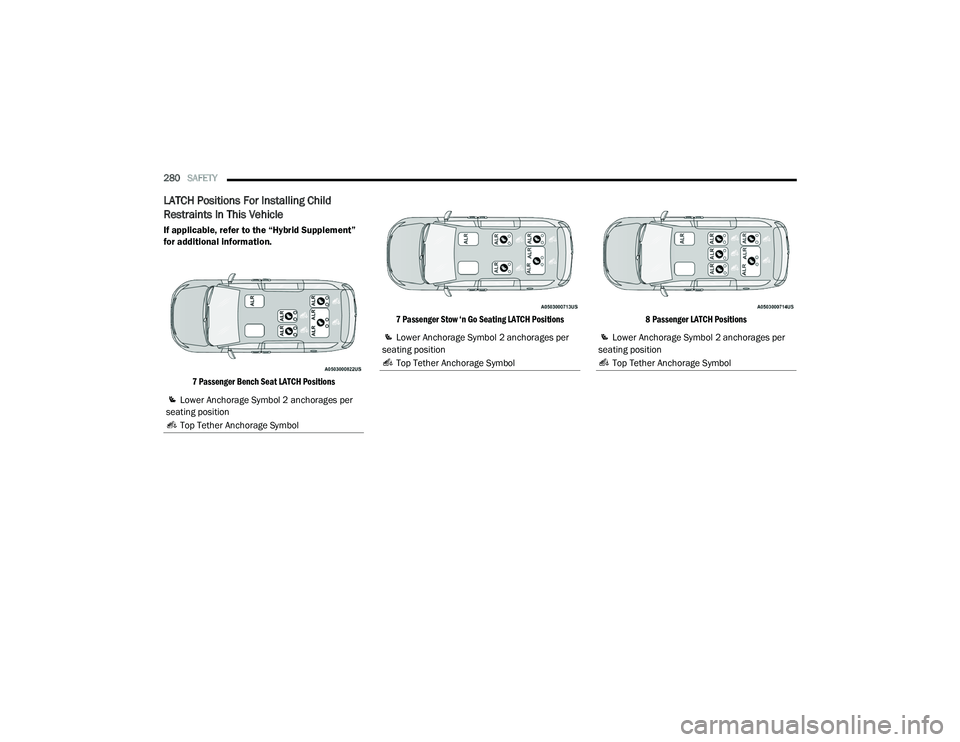
LATCH Positions For Installing Child
Restraints In This Vehicle
If applicable, refer to the “Hybrid Supplement”
for additional information.
7 Passenger Bench Seat LATCH Positions 7 Passenger Stow ‘n Go Seating LATCH Positions
8 Passenger LATCH Positions
Lower Anchorage Symbol 2 anchorages per
seating position
Top Tether Anchorage Symbol
Lower Anchorage Symbol 2 anchorages per
seating position
Top Tether Anchorage Symbol Lower Anchorage Symbol 2 anchorages per
seating position
Top Tether Anchorage Symbol
21_RUP_OM_EN_USC_t.book Page 280
Page 284 of 401
282SAFETY
NOTE:If the folding, non-adjustable head restraint inter -
feres with the installation of the child restraint, the
head restraint may be folded and the child seat
installed in front of it.
Car Seat With Head Restraint Folded
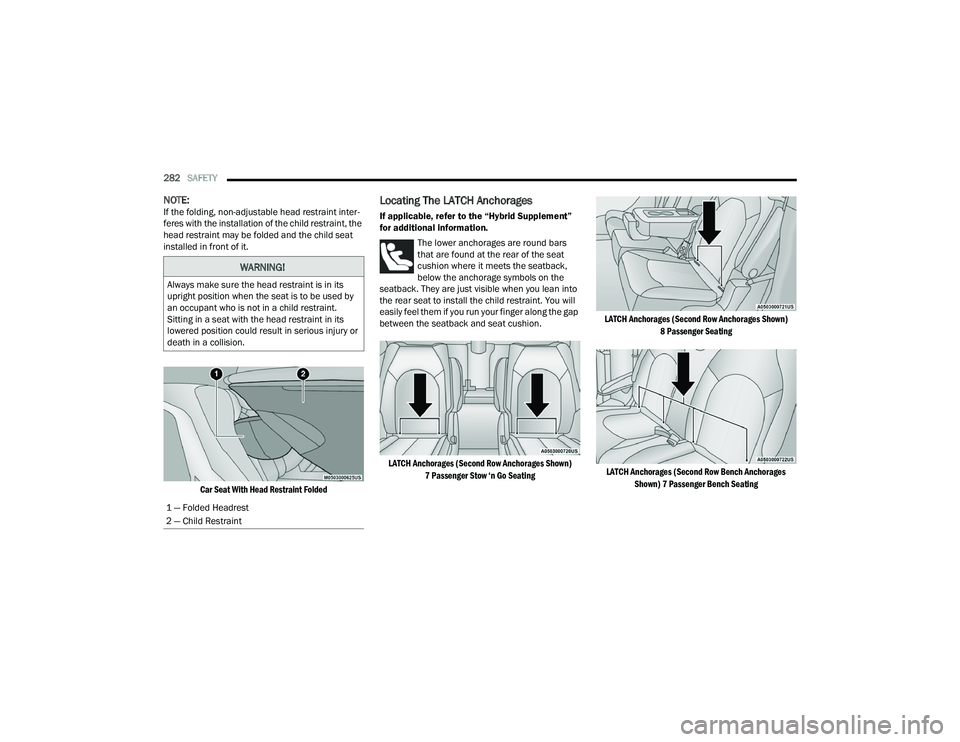
Locating The LATCH Anchorages
If applicable, refer to the “Hybrid Supplement”
for additional information. The lower anchorages are round bars
that are found at the rear of the seat
cushion where it meets the seatback,
below the anchorage symbols on the
seatback. They are just visible when you lean into
the rear seat to install the child restraint. You will
easily feel them if you run your finger along the gap
between the seatback and seat cushion.
LATCH Anchorages (Second Row Anchorages Shown) 7 Passenger Stow ‘n Go Seating LATCH Anchorages (Second Row Anchorages Shown)
8 Passenger Seating
LATCH Anchorages (Second Row Bench Anchorages Shown) 7 Passenger Bench Seating
WARNING!
Always make sure the head restraint is in its
upright position when the seat is to be used by
an occupant who is not in a child restraint.
Sitting in a seat with the head restraint in its
lowered position could result in serious injury or
death in a collision.
1 — Folded Headrest
2 — Child Restraint
21_RUP_OM_EN_USC_t.book Page 282
Page 285 of 401
SAFETY283
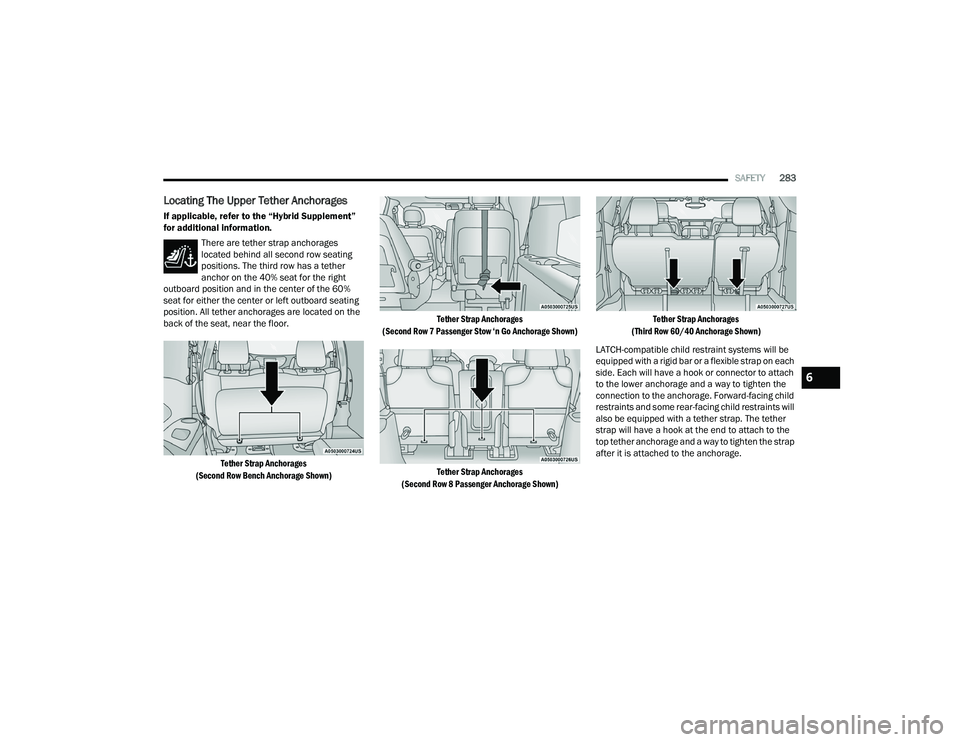
Locating The Upper Tether Anchorages
If applicable, refer to the “Hybrid Supplement”
for additional information.
There are tether strap anchorages
located behind all second row seating
positions. The third row has a tether
anchor on the 40% seat for the right
outboard position and in the center of the 60%
seat for either the center or left outboard seating
position. All tether anchorages are located on the
back of the seat, near the floor.
Tether Strap Anchorages
(Second Row Bench Anchorage Shown) Tether Strap Anchorages
(Second Row 7 Passenger Stow ‘n Go Anchorage Shown)
Tether Strap Anchorages
(Second Row 8 Passenger Anchorage Shown) Tether Strap Anchorages
(Third Row 60/40 Anchorage Shown)
LATCH-compatible child restraint systems will be
equipped with a rigid bar or a flexible strap on each
side. Each will have a hook or connector to attach
to the lower anchorage and a way to tighten the
connection to the anchorage. Forward-facing child
restraints and some rear-facing child restraints will
also be equipped with a tether strap. The tether
strap will have a hook at the end to attach to the
top tether anchorage and a way to tighten the strap
after it is attached to the anchorage.
6
21_RUP_OM_EN_USC_t.book Page 283
Page 288 of 401
286SAFETY
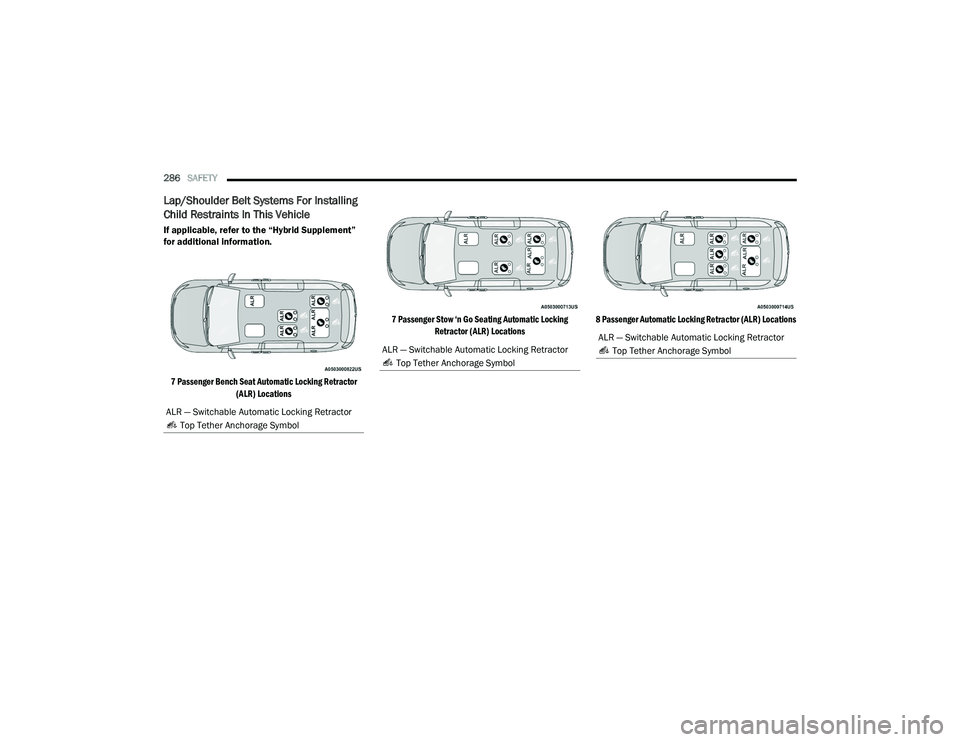
Lap/Shoulder Belt Systems For Installing
Child Restraints In This Vehicle
If applicable, refer to the “Hybrid Supplement”
for additional information.
7 Passenger Bench Seat Automatic Locking Retractor (ALR) Locations 7 Passenger Stow ‘n Go Seating Automatic Locking
Retractor (ALR) Locations 8 Passenger Automatic Locking Retractor (ALR) Locations
ALR — Switchable Automatic Locking Retractor Top Tether Anchorage Symbol
ALR — Switchable Automatic Locking Retractor Top Tether Anchorage SymbolALR — Switchable Automatic Locking Retractor Top Tether Anchorage Symbol
21_RUP_OM_EN_USC_t.book Page 286
Page 291 of 401
SAFETY289
8. If the child restraint has a top tether strap and the seating position has a top tether
anchorage, connect the tether strap to the
anchorage and tighten the tether strap. See
Úpage 289 for directions to attach a tether
anchor.
9. Test that the child restraint is installed tightly by pulling back and forth on the child seat at
the belt path. It should not move more than
1 inch (25.4 mm) in any direction.
Any seat belt system will loosen with time, so check
the belt occasionally, and pull it tight if necessary.
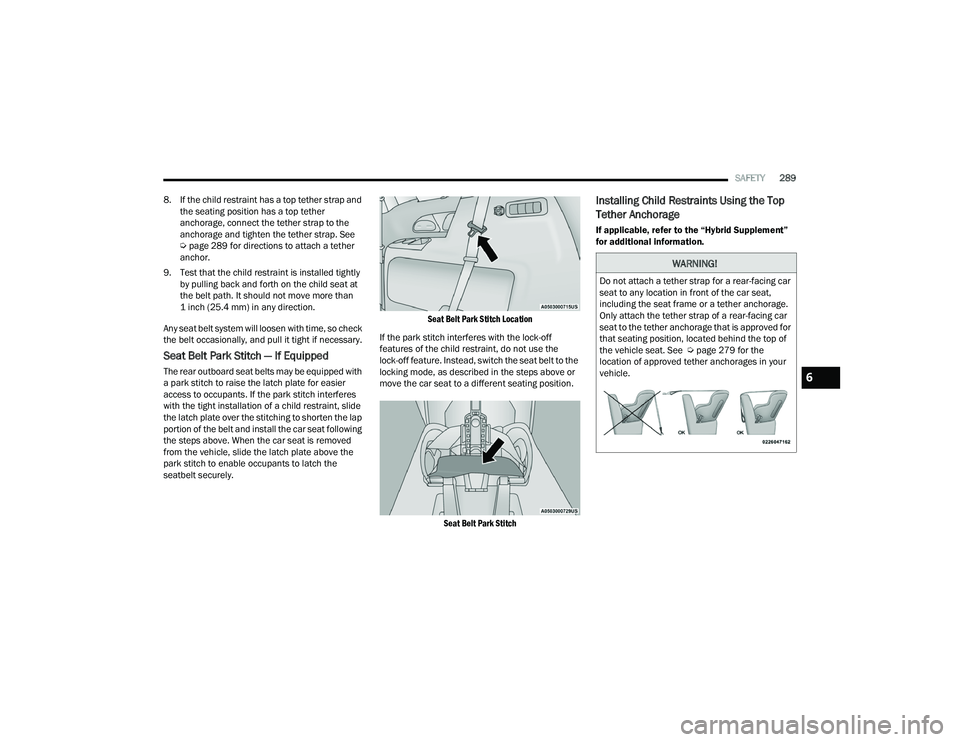
Seat Belt Park Stitch — If Equipped
The rear outboard seat belts may be equipped with
a park stitch to raise the latch plate for easier
access to occupants. If the park stitch interferes
with the tight installation of a child restraint, slide
the latch plate over the stitching to shorten the lap
portion of the belt and install the car seat following
the steps above. When the car seat is removed
from the vehicle, slide the latch plate above the
park stitch to enable occupants to latch the
seatbelt securely.
Seat Belt Park Stitch Location
If the park stitch interferes with the lock-off
features of the child restraint, do not use the
lock-off feature. Instead, switch the seat belt to the
locking mode, as described in the steps above or
move the car seat to a different seating position.
Seat Belt Park Stitch
Installing Child Restraints Using the Top
Tether Anchorage
If applicable, refer to the “Hybrid Supplement”
for additional information.
WARNING!
Do not attach a tether strap for a rear-facing car
seat to any location in front of the car seat,
including the seat frame or a tether anchorage.
Only attach the tether strap of a rear-facing car
seat to the tether anchorage that is approved for
that seating position, located behind the top of
the vehicle seat. See Ú page 279 for the
location of approved tether anchorages in your
vehicle.
6
21_RUP_OM_EN_USC_t.book Page 289
Page 344 of 401
342SERVICING AND MAINTENANCE
COOLING SYSTEMEngine Coolant Checks
Check the engine coolant (antifreeze) protection
every 12 months (before the onset of freezing
weather, where applicable). If the engine coolant is
dirty, the system should be drained, flushed, and
refilled with fresh Organic Additive Technology
(OAT) coolant (conforming to MS.90032) by an
authorized dealer. Check the front of the A/C
condenser for any accumulation of bugs, leaves,
etc. If dirty, clean by gently spraying water from a
garden hose vertically down the face of the
condenser.
Check the engine cooling system hoses for brittle
rubber, cracking, tears, cuts, and tightness of the
connection at the coolant recovery bottle and
radiator. Inspect the entire system for leaks. DO
NOT REMOVE THE COOLANT PRESSURE CAP
WHEN THE COOLING SYSTEM IS HOT.
Cooling System — Drain, Flush And Refill
NOTE:Some vehicles require special tools to add coolant
properly. Failure to fill these systems properly
could lead to severe internal engine damage. If any
coolant is needed to be added to the system
please contact an authorized dealer. If the engine coolant (antifreeze) is dirty or
contains visible sediment, have an authorized
dealer clean and flush with Organic Additive
Technology (OAT) coolant (conforming to
MS.90032).
For the proper maintenance intervals
Úpage 328.
Selection Of Coolant
For further information Ú page 382.
NOTE:
Mixing of engine coolant (antifreeze) other than
specified Organic Additive Technology (OAT)
engine coolant, may result in engine damage
and may decrease corrosion protection. OAT
engine coolant is different and should not be
mixed with Hybrid Organic Additive Technology
(HOAT) engine coolant or any “globally compat -
ible” coolant. If a non-OAT engine coolant is
introduced into the cooling system in an emer -
gency, the cooling system will need to be
drained, flushed, and refilled with fresh OAT
coolant (conforming to MS.90032), by an autho -
rized dealer as soon as possible.
Do not use water alone or alcohol-based engine
coolant products. Do not use additional rust
inhibitors or anti-rust products, as they may not
be compatible with the radiator engine coolant
and may plug the radiator.
WARNING!
You or others can be badly burned by hot
engine coolant (antifreeze) or steam from your
radiator. If you see or hear steam coming from
under the hood, do not open the hood until the
radiator has had time to cool. Never open a
cooling system pressure cap when the radi -
ator or coolant bottle is hot.
Keep hands, tools, clothing, and jewelry away
from the radiator cooling fan when the hood is
raised. The fan starts automatically and may
start at any time, whether the engine is
running or not.
When working near the radiator cooling fan,
disconnect the fan motor lead or turn the igni -
tion to the OFF mode. The fan is temperature
controlled and can start at any time the igni -
tion is in the ON mode.
21_RUP_OM_EN_USC_t.book Page 342
Page 384 of 401
382TECHNICAL SPECIFICATIONS
ENGINE FLUIDS AND LUBRICANTS
Component Fluid, Lubricant, or Genuine Part
Engine Coolant We recommend you use Mopar® Antifreeze/Coolant 10 Year/150,000 Mile
(240,000 km) Formula OAT (Organic Additive Technology) or equivalent
meeting the requirements of the manufacturer Material Standard MS.90032.
Engine Oil – 3.6L Engine We recommend you use API Certified SAE 0W-20 Engine Oil, meeting the
requirements of the manufacturer Material Standard MS-6395 such as
Mopar®, Pennzoil, and Shell Helix. Refer to your engine oil filler cap for
correct SAE grade.
Engine Oil Filter We recommend you use a Mopar® Engine Oil Filter. If a Mopar® Engine Oil
Filter is unavailable only use filters that meet or exceed SAE/USCAR-36 Filter
Performance Requirements.
Fuel Selection – 3.6L Engine 87 Octane (R+M)/2 Method, 0-15% ethanol (Do not use E-85).
CAUTION!
Mixing of engine coolant (antifreeze) other than specified Organic Additive Technology (OAT) engine coolant (antifreeze), may result in engine damage and
may decrease corrosion protection. Organic Additive Technology (OAT) engine coolant is different and should not be mixed with Hybrid Organic Additive Tech -
nology (HOAT) engine coolant (antifreeze) or any “globally compatible” coolant (antifreeze). If a non-OAT engine coolant (antifreeze) is introduced into the
cooling system in an emergency, the cooling system will need to be drained, flushed, and refilled with fresh OAT coolant (conforming to MS.90032), by an
authorized dealer as soon as possible.
Do not use water alone or alcohol-based engine coolant (antifreeze) products. Do not use additional rust inhibitors or antirust products, as they may not be
compatible with the radiator engine coolant and may plug the radiator.
This vehicle has not been designed for use with propylene glycol-based engine coolant (antifreeze). Use of propylene glycol-based engine coolant (antifreeze)
is not recommended.
21_RUP_OM_EN_USC_t.book Page 382