battery CHRYSLER VOYAGER 1996 Owners Manual
[x] Cancel search | Manufacturer: CHRYSLER, Model Year: 1996, Model line: VOYAGER, Model: CHRYSLER VOYAGER 1996Pages: 1938, PDF Size: 55.84 MB
Page 424 of 1938
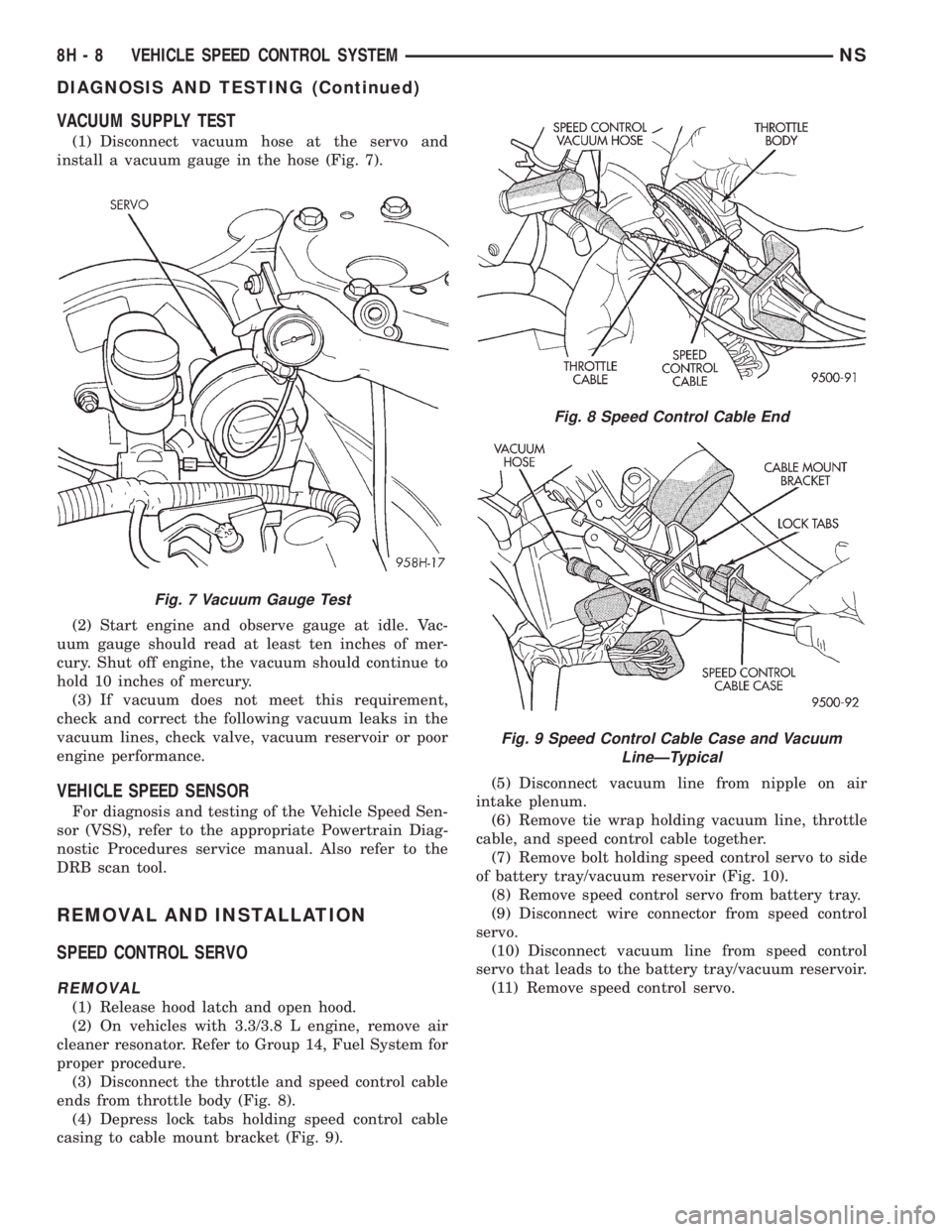
VACUUM SUPPLY TEST
(1) Disconnect vacuum hose at the servo and
install a vacuum gauge in the hose (Fig. 7).
(2) Start engine and observe gauge at idle. Vac-
uum gauge should read at least ten inches of mer-
cury. Shut off engine, the vacuum should continue to
hold 10 inches of mercury.
(3) If vacuum does not meet this requirement,
check and correct the following vacuum leaks in the
vacuum lines, check valve, vacuum reservoir or poor
engine performance.
VEHICLE SPEED SENSOR
For diagnosis and testing of the Vehicle Speed Sen-
sor (VSS), refer to the appropriate Powertrain Diag-
nostic Procedures service manual. Also refer to the
DRB scan tool.
REMOVAL AND INSTALLATION
SPEED CONTROL SERVO
REMOVAL
(1) Release hood latch and open hood.
(2) On vehicles with 3.3/3.8 L engine, remove air
cleaner resonator. Refer to Group 14, Fuel System for
proper procedure.
(3) Disconnect the throttle and speed control cable
ends from throttle body (Fig. 8).
(4) Depress lock tabs holding speed control cable
casing to cable mount bracket (Fig. 9).(5) Disconnect vacuum line from nipple on air
intake plenum.
(6) Remove tie wrap holding vacuum line, throttle
cable, and speed control cable together.
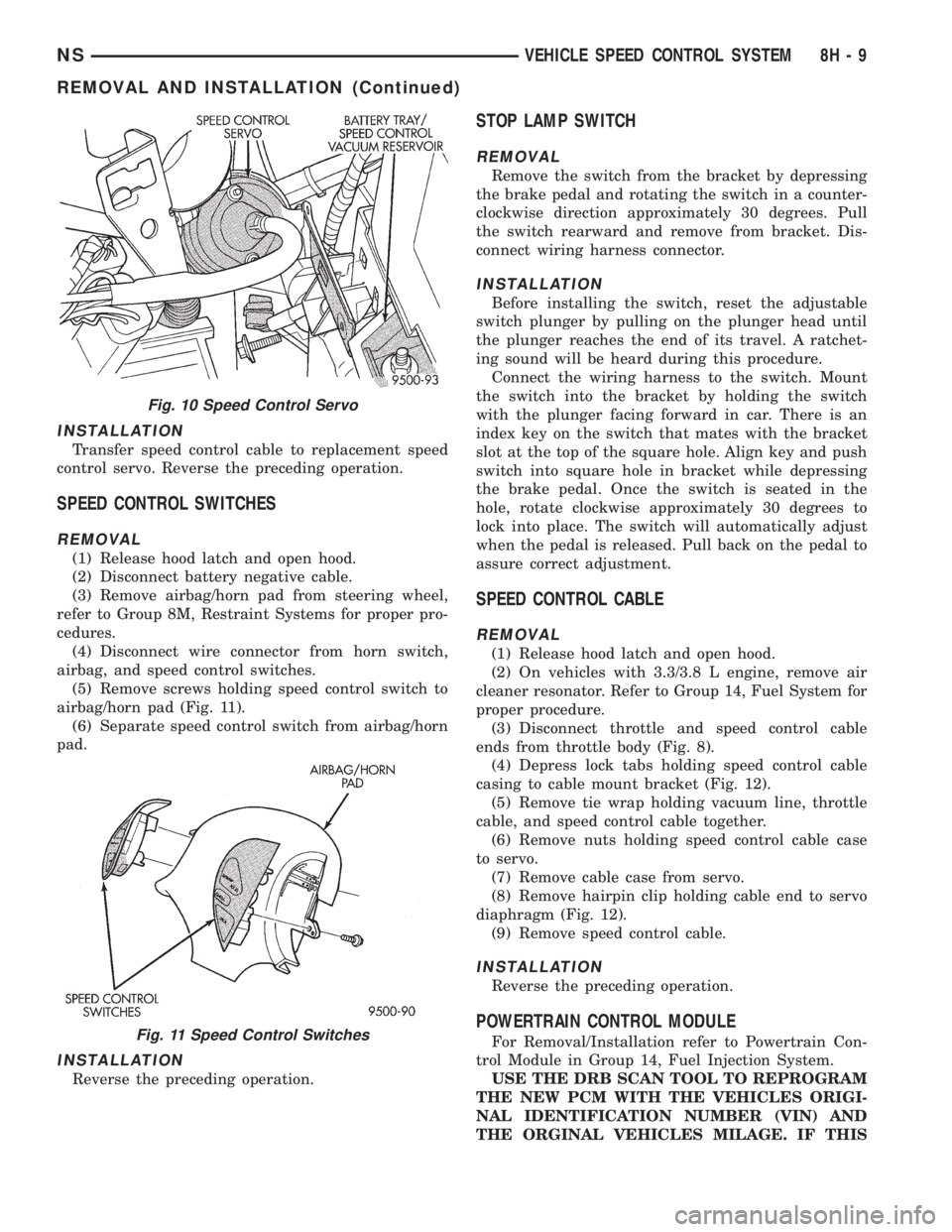
(7) Remove bolt holding speed control servo to side
of battery tray/vacuum reservoir (Fig. 10).
(8) Remove speed control servo from battery tray.
(9) Disconnect wire connector from speed control
servo.
(10) Disconnect vacuum line from speed control
servo that leads to the battery tray/vacuum reservoir.
(11) Remove speed control servo.
Fig. 7 Vacuum Gauge Test
Fig. 8 Speed Control Cable End
Fig. 9 Speed Control Cable Case and Vacuum
LineÐTypical
8H - 8 VEHICLE SPEED CONTROL SYSTEMNS
DIAGNOSIS AND TESTING (Continued)
Page 425 of 1938
INSTALLATION
Transfer speed control cable to replacement speed
control servo. Reverse the preceding operation.
SPEED CONTROL SWITCHES
REMOVAL
(1) Release hood latch and open hood.
(2) Disconnect battery negative cable.
(3) Remove airbag/horn pad from steering wheel,
refer to Group 8M, Restraint Systems for proper pro-
cedures.
(4) Disconnect wire connector from horn switch,
airbag, and speed control switches.
(5) Remove screws holding speed control switch to
airbag/horn pad (Fig. 11).
(6) Separate speed control switch from airbag/horn
pad.
INSTALLATION
Reverse the preceding operation.
STOP LAMP SWITCH
REMOVAL
Remove the switch from the bracket by depressing
the brake pedal and rotating the switch in a counter-
clockwise direction approximately 30 degrees. Pull
the switch rearward and remove from bracket. Dis-
connect wiring harness connector.
INSTALLATION
Before installing the switch, reset the adjustable
switch plunger by pulling on the plunger head until
the plunger reaches the end of its travel. A ratchet-
ing sound will be heard during this procedure.
Connect the wiring harness to the switch. Mount
the switch into the bracket by holding the switch
with the plunger facing forward in car. There is an
index key on the switch that mates with the bracket
slot at the top of the square hole. Align key and push
switch into square hole in bracket while depressing
the brake pedal. Once the switch is seated in the
hole, rotate clockwise approximately 30 degrees to
lock into place. The switch will automatically adjust
when the pedal is released. Pull back on the pedal to
assure correct adjustment.
SPEED CONTROL CABLE
REMOVAL
(1) Release hood latch and open hood.
(2) On vehicles with 3.3/3.8 L engine, remove air
cleaner resonator. Refer to Group 14, Fuel System for
proper procedure.
(3) Disconnect throttle and speed control cable
ends from throttle body (Fig. 8).
(4) Depress lock tabs holding speed control cable
casing to cable mount bracket (Fig. 12).
(5) Remove tie wrap holding vacuum line, throttle
cable, and speed control cable together.
(6) Remove nuts holding speed control cable case
to servo.
(7) Remove cable case from servo.
(8) Remove hairpin clip holding cable end to servo
diaphragm (Fig. 12).
(9) Remove speed control cable.
INSTALLATION
Reverse the preceding operation.
POWERTRAIN CONTROL MODULE
For Removal/Installation refer to Powertrain Con-
trol Module in Group 14, Fuel Injection System.
USE THE DRB SCAN TOOL TO REPROGRAM
THE NEW PCM WITH THE VEHICLES ORIGI-
NAL IDENTIFICATION NUMBER (VIN) AND
THE ORGINAL VEHICLES MILAGE. IF THIS
Fig. 10 Speed Control Servo
Fig. 11 Speed Control Switches
NSVEHICLE SPEED CONTROL SYSTEM 8H - 9
REMOVAL AND INSTALLATION (Continued)
Page 426 of 1938

STEP IS NOT DONE A DIAGONSTIC TROUBLE
CODE (DTC) MAY BE SET.
VACUUM RESEROIR
REMOVAL
(1) Disconnect negative cable from battery.
(2) Remove battery, Refer to Group 8B, for Battery
Removal/Installation
(3) Remove battery tray.
(4) Disconnect vacuum hoses from vacuum reser-
voir
INSTALLATION
(1) Connect vacuum hoses to vacuum reservoir.
(2) Install battery tray
(3) Install battery, Refer to Group 8B, for Battery
Removal/Installation.
(4) Connect negative cable to battery.
VEHICLE SPEED SENSOR
For Removal/Installation, refer to Vehicle Speed
Sensor in Group 14, Fuel Injections.
Fig. 12 Speed Control Cable
8H - 10 VEHICLE SPEED CONTROL SYSTEMNS
REMOVAL AND INSTALLATION (Continued)
Page 431 of 1938
COMBINATION FLASHER WITH / WITHOUT
DAYTIME RUNNING LAMPS MODULEÐCIRCUIT
DIAGNOSTICS
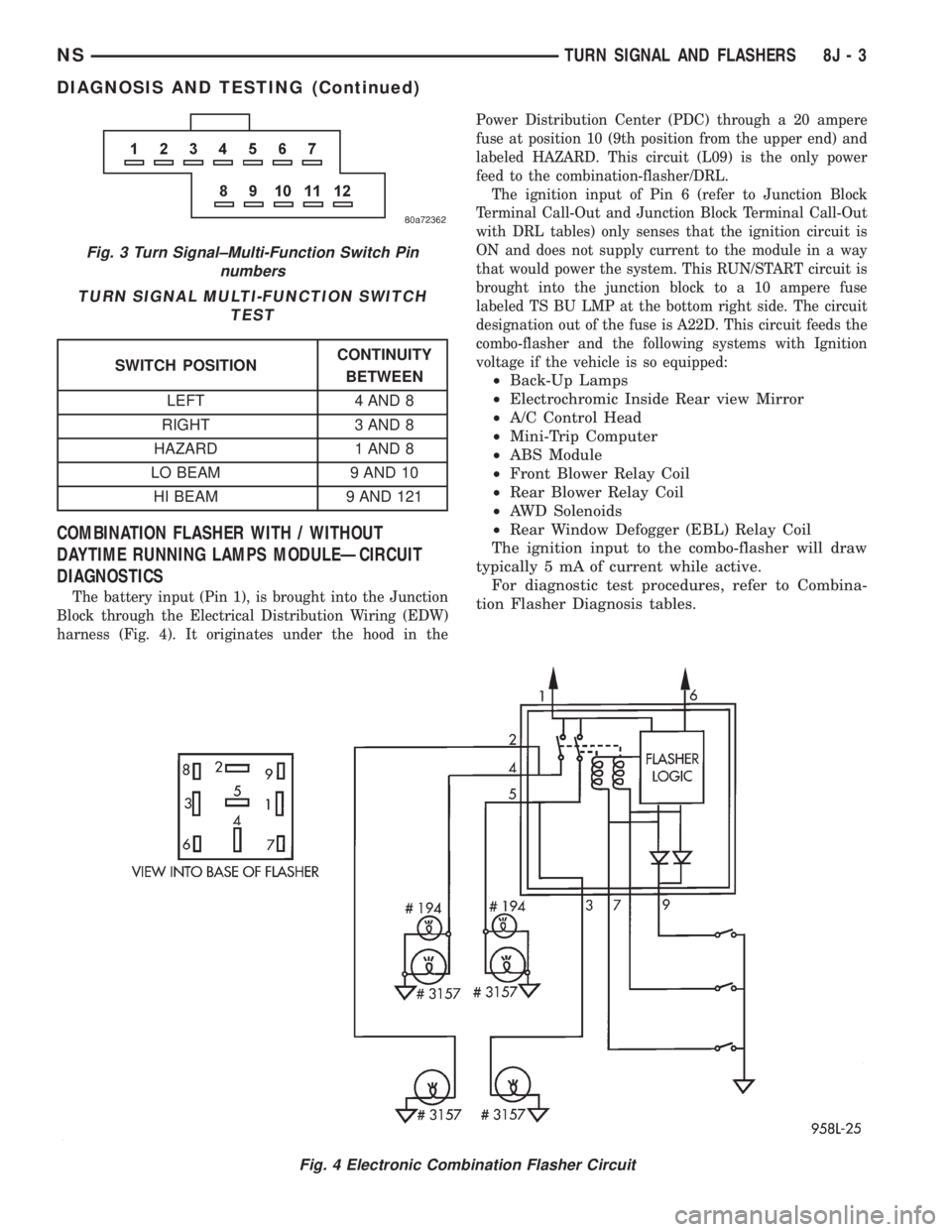
The battery input (Pin 1), is brought into the Junction
Block through the Electrical Distribution Wiring (EDW)
harness (Fig. 4). It originates under the hood in thePower Distribution Center (PDC) through a 20 ampere
fuse at position 10 (9th position from the upper end) and
labeled HAZARD. This circuit (L09) is the only power
feed to the combination-flasher/DRL.
The ignition input of Pin 6 (refer to Junction Block
Terminal Call-Out and Junction Block Terminal Call-Out
with DRL tables) only senses that the ignition circuit is
ON and does not supply current to the module in a way
that would power the system. This RUN/START circuit is
brought into the junction block to a 10 ampere fuse
labeled TS BU LMP at the bottom right side. The circuit
designation out of the fuse is A22D. This circuit feeds the
combo-flasher and the following systems with Ignition
voltage if the vehicle is so equipped:
²Back-Up Lamps
²Electrochromic Inside Rear view Mirror
²A/C Control Head
²Mini-Trip Computer
²ABS Module
²Front Blower Relay Coil
²Rear Blower Relay Coil
²AWD Solenoids
²Rear Window Defogger (EBL) Relay Coil
The ignition input to the combo-flasher will draw
typically 5 mA of current while active.
For diagnostic test procedures, refer to Combina-
tion Flasher Diagnosis tables.
Fig. 4 Electronic Combination Flasher Circuit
Fig. 3 Turn Signal±Multi-Function Switch Pin
numbers
TURN SIGNAL MULTI-FUNCTION SWITCH
TEST
SWITCH POSITIONCONTINUITY
BETWEEN
LEFT 4 AND 8
RIGHT 3 AND 8
HAZARD 1 AND 8
LO BEAM 9 AND 10
HI BEAM 9 AND 121
NSTURN SIGNAL AND FLASHERS 8J - 3
DIAGNOSIS AND TESTING (Continued)
Page 432 of 1938
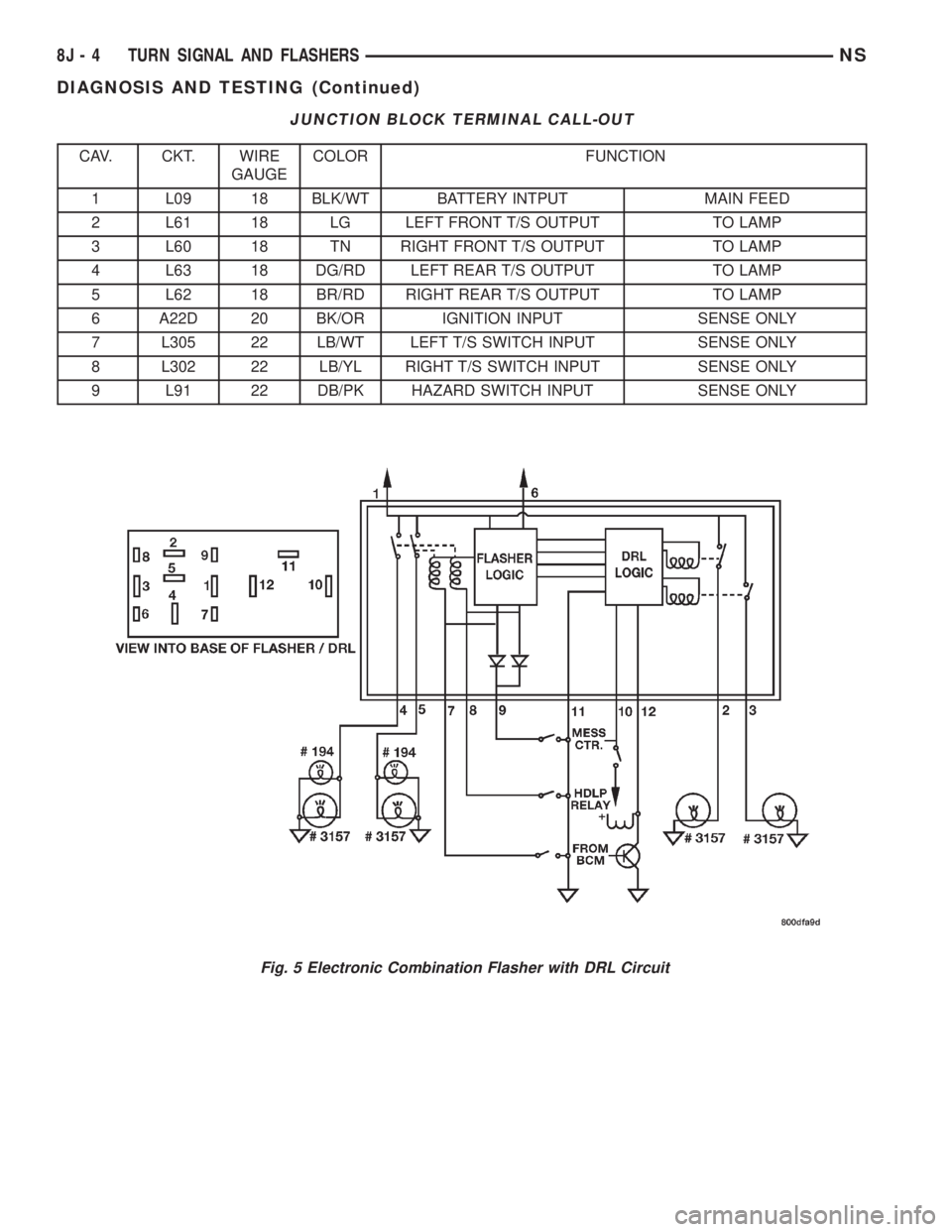
Fig. 5 Electronic Combination Flasher with DRL Circuit
JUNCTION BLOCK TERMINAL CALL-OUT
CAV. CKT. WIRE
GAUGECOLOR FUNCTION
1 L09 18 BLK/WT BATTERY INTPUT MAIN FEED
2 L61 18 LG LEFT FRONT T/S OUTPUT TO LAMP
3 L60 18 TN RIGHT FRONT T/S OUTPUT TO LAMP
4 L63 18 DG/RD LEFT REAR T/S OUTPUT TO LAMP
5 L62 18 BR/RD RIGHT REAR T/S OUTPUT TO LAMP
6 A22D 20 BK/OR IGNITION INPUT SENSE ONLY
7 L305 22 LB/WT LEFT T/S SWITCH INPUT SENSE ONLY
8 L302 22 LB/YL RIGHT T/S SWITCH INPUT SENSE ONLY
9 L91 22 DB/PK HAZARD SWITCH INPUT SENSE ONLY
8J - 4 TURN SIGNAL AND FLASHERSNS
DIAGNOSIS AND TESTING (Continued)
Page 433 of 1938

JUNCTION BLOCK TERMINAL CALL-OUT WITH DRL
CAV. CKT. WIRE
GAUGECOLOR FUNCTION
1 L09 18 BLK/WT BATTERY INTPUT MAIN FEED
2 L61 18 LG LEFT FRONT T/S OUTPUT TO LAMP
3 L60 18 TN RIGHT FRONT T/S OUTPUT TO LAMP
4 L63 18 DG/RD LEFT REAR T/S OUTPUT TO LAMP
5 L62 18 BR/RD RIGHT REAR T/S OUTPUT TO LAMP
6 A22D 20 BK/OR IGNITION INPUT SENSE ONLY
7 L305 22 LB/WT LEFT T/S SWITCH INPUT SENSE ONLY
8 L302 22 LB/YL RIGHT T/S SWITCH INPUT SENSE ONLY
9 L91 22 DB/PK HAZARD SWITCH INPUT SENSE ONLY
10 G09 22 GY/BK PARK BRAKE SWITCH INPUT SENSE ONLY
11 Z01 14 BK GROUND MAIN GRD.
12 L93 22 RD/YL HEADLAMP RELAY SWITCH
INPUTSENSE ONLY
NSTURN SIGNAL AND FLASHERS 8J - 5
DIAGNOSIS AND TESTING (Continued)
Page 439 of 1938
REMOVAL AND INSTALLATION
MULTI-FUNCTION SWITCH
WARNING: BEFORE SERVICING A STEERING COL-
UMN EQUIPPED WITH AN AIRBAG REFER TO
GROUP 8M, RESTRAINT SYSTEMS FOR PROPER
AND SAFE SERVICE PROCEDURES.
REMOVAL
(1) Release hood latch and open hood.
(2) Disconnect and isolate battery negative cable.
(3) Remove upper and lower steering column
shrouds, refer to Group 19, Steering for proper pro-
cedures.
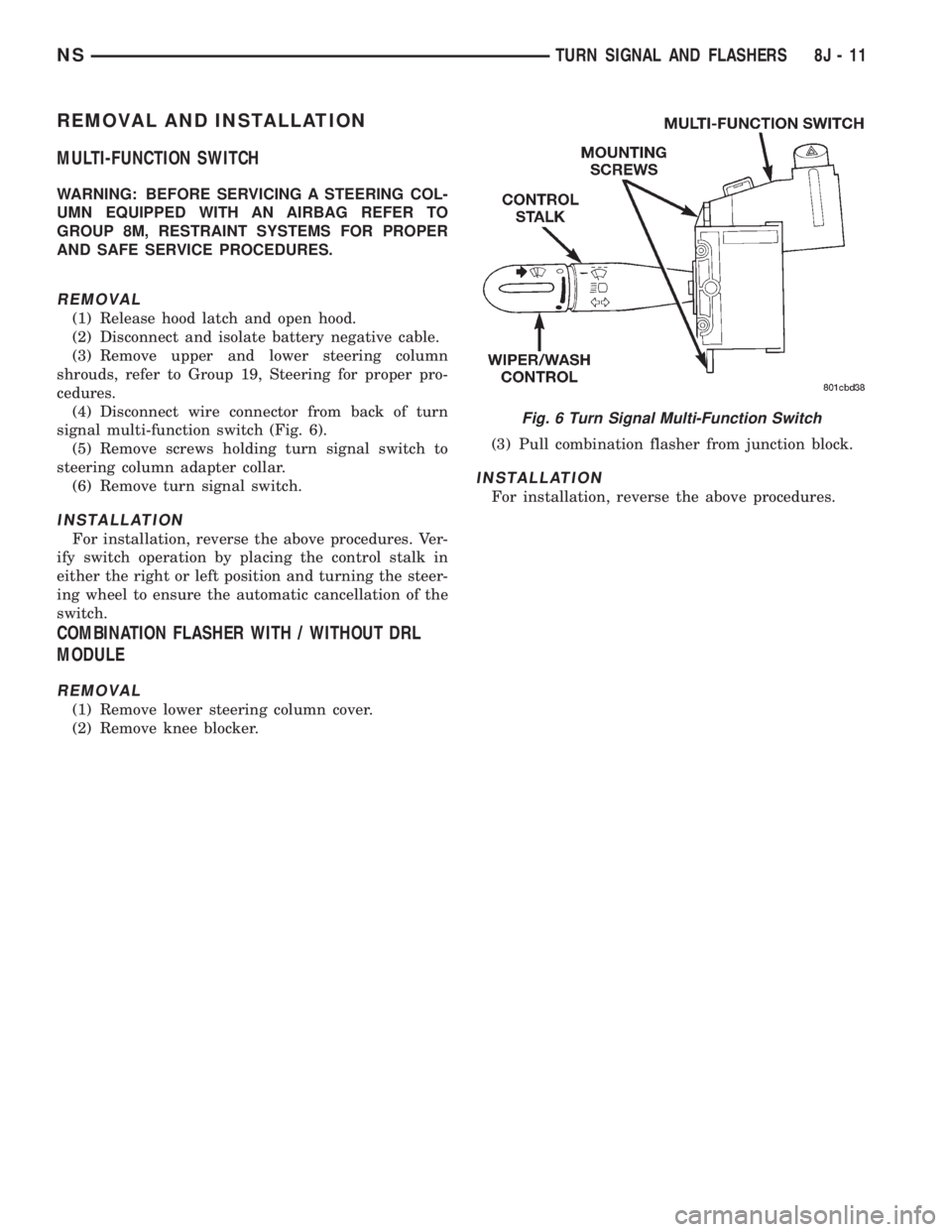
(4) Disconnect wire connector from back of turn
signal multi-function switch (Fig. 6).
(5) Remove screws holding turn signal switch to
steering column adapter collar.
(6) Remove turn signal switch.
INSTALLATION
For installation, reverse the above procedures. Ver-
ify switch operation by placing the control stalk in
either the right or left position and turning the steer-
ing wheel to ensure the automatic cancellation of the
switch.
COMBINATION FLASHER WITH / WITHOUT DRL
MODULE
REMOVAL
(1) Remove lower steering column cover.
(2) Remove knee blocker.(3) Pull combination flasher from junction block.
INSTALLATION
For installation, reverse the above procedures.
Fig. 6 Turn Signal Multi-Function Switch
NSTURN SIGNAL AND FLASHERS 8J - 11
Page 441 of 1938

WINDSHIELD WIPERS AND WASHERS
CONTENTS
page page
REAR WIPER AND WASHER................ 9WINDSHIELD WIPERS AND WASHER......... 1
WINDSHIELD WIPERS AND WASHER
INDEX
page page
GENERAL INFORMATION
INTRODUCTION......................... 1
DIAGNOSIS AND TESTING
DIAGNOSTIC PROCEDURES................ 1
FAILED PARK SWITCH.................... 2
MULTI-FUNCTION SWITCH................. 4
REMOVAL AND INSTALLATION
MULTI-FUNCTION SWITCH................. 4
WINDSHIELD WASHER BOTTLE............. 4
WINDSHIELD WIPER BLADE ELEMENT....... 6WINDSHIELD WIPER BLADE................ 5
WINDSHIELD WIPER MOTOR............... 6
WIPER ARM............................. 7
WIPER LINKAGE......................... 7
WIPER UNIT............................ 7
CLEANING AND INSPECTION
WIPER BLADES.......................... 8
ADJUSTMENTS
WIPER ARM ALIGNMENT.................. 8
GENERAL INFORMATION
INTRODUCTION
WARNING: ON VEHICLES EQUIPPED WITH AIR-
BAG, SEE GROUP 8M, RESTRAINT SYSTEMS FOR
SAFETY PRECAUTIONS. DISCONNECT THE NEGA-
TIVE CABLE FROM THE BATTERY BEFORE SER-
VICING COMPONENTS INVOLVING THE AIRBAG
SYSTEM. ACCIDENTAL DEPLOYMENT OF AIRBAG
AND PERSONAL INJURY CAN RESULT.
The windshield wipers can be operated with the
windshield wiper switch when the ignition switch is
in the RUN or ACCESSORY positions. The wind-
shield wiper system is protected by a 40 amp fuse (9)
located in the Power Distribution Center (PDC) in
the engine compartment. The windshield washer cir-
cuit is protected by a 6 amp fuse (9) located in the
Junction Block. The wiper motor has permanent
magnetic fields. The speeds are determined by cur-
rent flow to the appropriate set of brushes inside the
motor. The current flow is controlled by the multi-
function switch stalk mounted wiper switch, high
speed/low speed relays located in the PDC. The speed
sensitive intermittent wiper is controlled by the BodyControl Module (BCM). The intermittent mode, with
the vehicle traveling greater than 10.4 mph, has a
range of 0.5 to 18 seconds. With the vehicle traveling
less than 10.4 mph, and the time delay is not
adjusted, time delay doubles to a range of 1 to 36
seconds. The wiper arms will park at the base of the
windshield just above the cowl cover after the wiper
switch is turned OFF.
The windshield wiper motor and linkage is located
in an integral wiper unit at the rear of the engine
compartment. The wiper unit must be removed to
gain access to the wiper motor.
DIAGNOSIS AND TESTING
DIAGNOSTIC PROCEDURES
The windshield wiper system operates in several
modes:
²Low and high speed normal wipe
²Speed sensitive intermittent wipe
²Wipe after wash
²Pulse wipe
²Park (switch OFF)
The windshield wiper circuits are continuously
monitored and controlled by the Body Control Mod-
NSWINDSHIELD WIPERS AND WASHERS 8K - 1
Page 442 of 1938
ule (BCM). If a problem occurs in the electronic com-
ponents, wiring, switch (except integral motor park
switch) and wiper motor a Diagnostic Trouble Code
(DTC) will be stored in the BCM memory. DTC's can
be retrieved using a scan tool (DRB). Refer to proper
Body Diagnostic Procedures manual for DTC descrip-
tions and retrieval information.
The windshield wiper park switch and circuit is
monitored by the BCM. The park switch and circuit
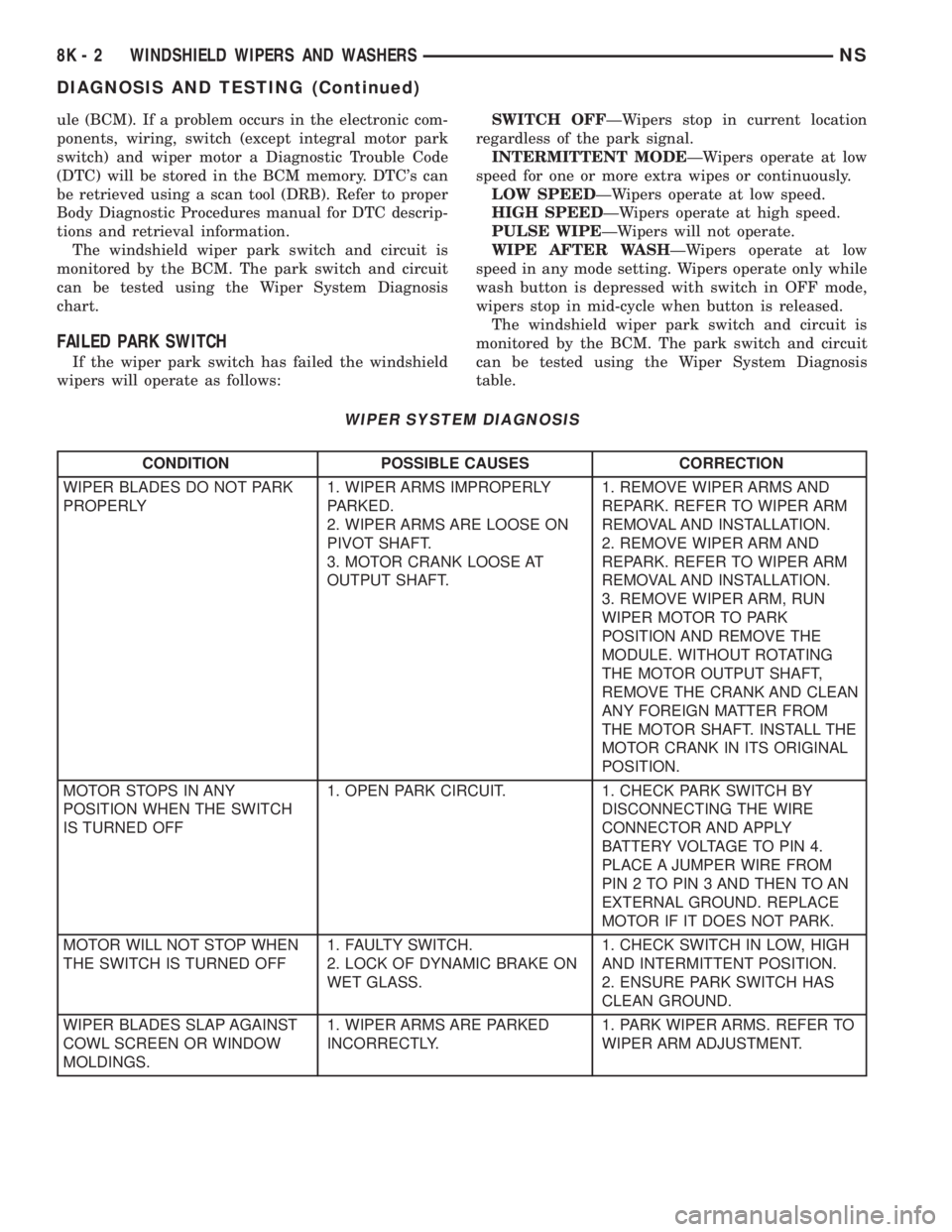
can be tested using the Wiper System Diagnosis
chart.
FAILED PARK SWITCH
If the wiper park switch has failed the windshield
wipers will operate as follows:SWITCH OFFÐWipers stop in current location
regardless of the park signal.
INTERMITTENT MODEÐWipers operate at low
speed for one or more extra wipes or continuously.
LOW SPEEDÐWipers operate at low speed.
HIGH SPEEDÐWipers operate at high speed.
PULSE WIPEÐWipers will not operate.
WIPE AFTER WASHÐWipers operate at low
speed in any mode setting. Wipers operate only while
wash button is depressed with switch in OFF mode,
wipers stop in mid-cycle when button is released.
The windshield wiper park switch and circuit is
monitored by the BCM. The park switch and circuit
can be tested using the Wiper System Diagnosis
table.
WIPER SYSTEM DIAGNOSIS
CONDITION POSSIBLE CAUSES CORRECTION
WIPER BLADES DO NOT PARK
PROPERLY1. WIPER ARMS IMPROPERLY
PARKED.
2. WIPER ARMS ARE LOOSE ON
PIVOT SHAFT.
3. MOTOR CRANK LOOSE AT
OUTPUT SHAFT.1. REMOVE WIPER ARMS AND
REPARK. REFER TO WIPER ARM
REMOVAL AND INSTALLATION.
2. REMOVE WIPER ARM AND
REPARK. REFER TO WIPER ARM
REMOVAL AND INSTALLATION.
3. REMOVE WIPER ARM, RUN
WIPER MOTOR TO PARK
POSITION AND REMOVE THE
MODULE. WITHOUT ROTATING
THE MOTOR OUTPUT SHAFT,
REMOVE THE CRANK AND CLEAN
ANY FOREIGN MATTER FROM
THE MOTOR SHAFT. INSTALL THE
MOTOR CRANK IN ITS ORIGINAL
POSITION.
MOTOR STOPS IN ANY
POSITION WHEN THE SWITCH
IS TURNED OFF1. OPEN PARK CIRCUIT. 1. CHECK PARK SWITCH BY
DISCONNECTING THE WIRE
CONNECTOR AND APPLY
BATTERY VOLTAGE TO PIN 4.
PLACE A JUMPER WIRE FROM
PIN 2 TO PIN 3 AND THEN TO AN
EXTERNAL GROUND. REPLACE
MOTOR IF IT DOES NOT PARK.
MOTOR WILL NOT STOP WHEN
THE SWITCH IS TURNED OFF1. FAULTY SWITCH.
2. LOCK OF DYNAMIC BRAKE ON
WET GLASS.1. CHECK SWITCH IN LOW, HIGH
AND INTERMITTENT POSITION.
2. ENSURE PARK SWITCH HAS
CLEAN GROUND.
WIPER BLADES SLAP AGAINST
COWL SCREEN OR WINDOW
MOLDINGS.1. WIPER ARMS ARE PARKED
INCORRECTLY.1. PARK WIPER ARMS. REFER TO
WIPER ARM ADJUSTMENT.
8K - 2 WINDSHIELD WIPERS AND WASHERSNS
DIAGNOSIS AND TESTING (Continued)
Page 444 of 1938
MULTI-FUNCTION SWITCH
To test the windshield wiper and washer portion of
the multi-function switch:
(1) Remove the multi-function switch, refer to
removal procedures.
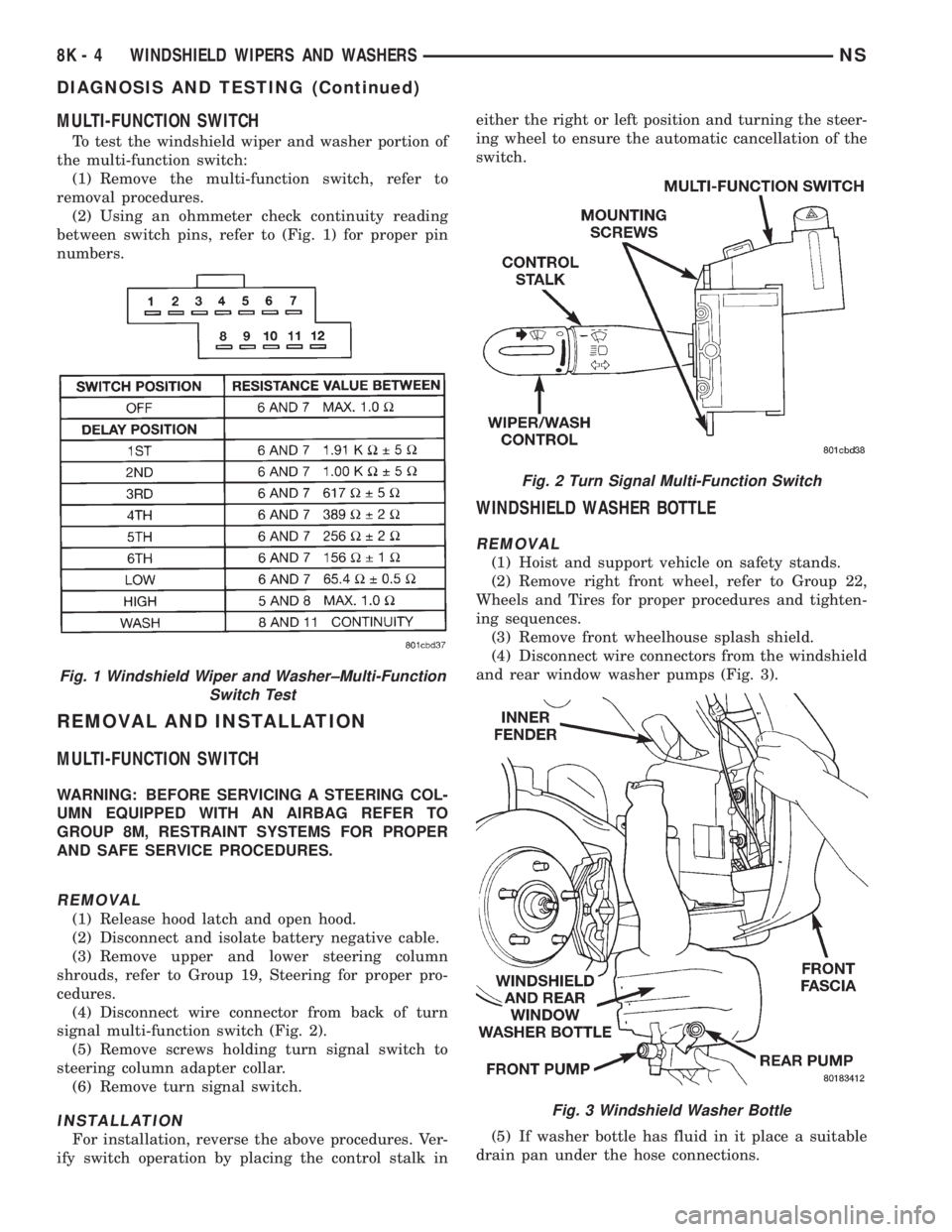
(2) Using an ohmmeter check continuity reading
between switch pins, refer to (Fig. 1) for proper pin
numbers.
REMOVAL AND INSTALLATION
MULTI-FUNCTION SWITCH
WARNING: BEFORE SERVICING A STEERING COL-
UMN EQUIPPED WITH AN AIRBAG REFER TO
GROUP 8M, RESTRAINT SYSTEMS FOR PROPER
AND SAFE SERVICE PROCEDURES.
REMOVAL
(1) Release hood latch and open hood.
(2) Disconnect and isolate battery negative cable.
(3) Remove upper and lower steering column
shrouds, refer to Group 19, Steering for proper pro-
cedures.
(4) Disconnect wire connector from back of turn
signal multi-function switch (Fig. 2).
(5) Remove screws holding turn signal switch to
steering column adapter collar.
(6) Remove turn signal switch.
INSTALLATION
For installation, reverse the above procedures. Ver-
ify switch operation by placing the control stalk ineither the right or left position and turning the steer-
ing wheel to ensure the automatic cancellation of the
switch.
WINDSHIELD WASHER BOTTLE
REMOVAL
(1) Hoist and support vehicle on safety stands.
(2) Remove right front wheel, refer to Group 22,
Wheels and Tires for proper procedures and tighten-
ing sequences.
(3) Remove front wheelhouse splash shield.
(4) Disconnect wire connectors from the windshield
and rear window washer pumps (Fig. 3).
(5) If washer bottle has fluid in it place a suitable
drain pan under the hose connections.
Fig. 1 Windshield Wiper and Washer±Multi-Function
Switch Test
Fig. 2 Turn Signal Multi-Function Switch
Fig. 3 Windshield Washer Bottle
8K - 4 WINDSHIELD WIPERS AND WASHERSNS
DIAGNOSIS AND TESTING (Continued)