battery CHRYSLER VOYAGER 1996 Repair Manual
[x] Cancel search | Manufacturer: CHRYSLER, Model Year: 1996, Model line: VOYAGER, Model: CHRYSLER VOYAGER 1996Pages: 1938, PDF Size: 55.84 MB
Page 290 of 1938
CHARGING SYSTEM RESISTANCE TESTS
These tests will show the amount of voltage drop
across the generator output wire from the generator
output (B+) terminal to the battery positive post.
They will also show the amount of voltage drop from
the ground (-) terminal on the generator or case
ground (Fig. 1) to the battery negative post.
A voltmeter with a 0±18 volt DC scale should be
used for these tests. By repositioning the voltmeter
test leads, the point of high resistance (voltage drop)
can easily be found.
PREPARATION
(1) Before starting test, make sure battery is in
good condition and is fully-charged. See Group 8A,
Battery for more information.
(2) Check condition of battery cables at battery.
Clean if necessary.
(3) Start the engine and allow it to reach normal
operating temperature.
(4) Shut engine off.
(5) Connect an engine tachometer.
(6) Fully engage the parking brake.
TEST
(1) Start engine.
(2) Place heater blower in high position.
(3) Turn on headlamps and place in high-beam
position.
(4) Turn rear window defogger on.
(5) Bring engine speed up to 2400 rpm and hold.
(6) Testing (+ positive) circuitry:
(a) Touch the negative lead of voltmeter directly
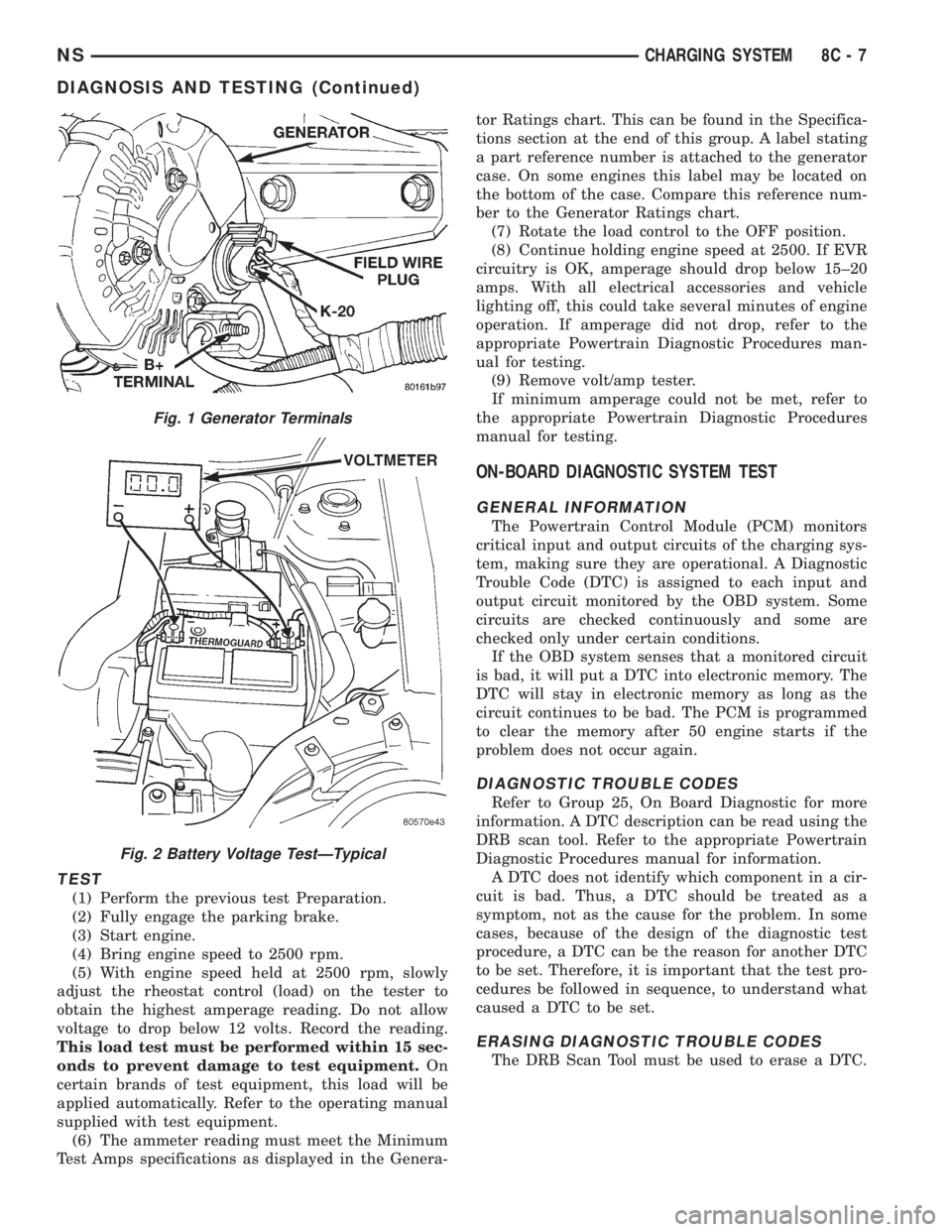
to battery positivePOST(Fig. 2).
(b) Touch the positive lead of voltmeter to the
B+ output terminal stud on the generator (not the
terminal mounting nut). Voltage should be no
higher than 0.6 volts. If voltage is higher than 0.6
volts, touch test lead to terminal mounting stud
nut and then to the wiring connector. If voltage is
now below 0.6 volts, look for dirty, loose or poor
connection at this point. Also check condition of the
generator output wire-to-battery bullet connector.
Refer to Group 8, Wiring for connector location. A
voltage drop test may be performed at each (-
ground) connection in this circuit to locate the
excessive resistance.
(7) Testing (- ground) circuitry:
(a) Touch the positive lead of voltmeter directly
to battery negativePOST.
(b) Touch the negative lead of voltmeter to the
generator case. Voltage should be no higher than
0.3 volts. If voltage is higher than 0.3 volts, touch
test lead to generator case and then to the engine
block. If voltage is now below 0.3 volts, look for
dirty, loose or poor connection at this point. A volt-
age drop test may be performed at each connectionin this circuit to locate the excessive resistance.
This test can also be performed between the gener-
ator case and the engine. If test voltage is higher
than 0.3 volts, check for corrosion at generator
mounting points or loose generator mounting.
CURRENT OUTPUT TEST
The current output test will determine if the
charging system can deliver its minimum test cur-
rent (amperage) output. Refer to the Specifications
section at the end of this group for minimum test
current (amperage) requirements.
The first part of this test will determine the com-
bined amperage output of both the generator and the
Electronic Voltage Regulator (EVR) circuitry.
PREPARATION
(1) Determine if any Diagnostic Trouble Codes
(DTC) exist. To determine a DTC, refer to On-Board
Diagnostics in this group. For repair, refer to the
appropriate Powertrain Diagnostic Procedures man-
ual.
(2) Before starting test, make sure battery is in
good condition and is fully-charged. See Group 8A,
Battery for more information.
(3) Check condition of battery cables at battery.
Clean if necessary.
(4) Perform the Voltage Drop Test. This will
ensure clean and tight generator/battery electrical
connections.
(5) Be sure the generator drive belt is properly
tensioned. Refer to Group 7, Cooling System for
information.
(6) A volt/amp tester equipped with both a battery
load control (carbon pile rheostat) and an inductive-
type pickup clamp (ammeter probe) will be used for
this test. Refer to operating instructions supplied
with tester. When using a tester equipped with an
inductive-type clamp, removal of wiring at the gener-
ator will not be necessary.
(7) Start the engine and allow it to reach operating
temperature.
(8) Shut engine off.
(9) Turn off all electrical accessories and all vehicle
lighting.
(10) Connect the volt/amp tester leads to the bat-
tery. Be sure the carbon pile rheostat control is in the
OPEN or OFF position before connecting leads. See
Load Test in Group 8A, Battery for more information.
Also refer to the operating instructions supplied with
test equipment.
(11) Connect the inductive clamp (ammeter probe).
Refer to the operating instructions supplied with test
equipment.
(12) If volt/amp tester is not equipped with an
engine tachometer, connect a separate tachometer to
the engine.
8C - 4 CHARGING SYSTEMNS
DIAGNOSIS AND TESTING (Continued)
Page 293 of 1938
TEST
(1) Perform the previous test Preparation.
(2) Fully engage the parking brake.
(3) Start engine.
(4) Bring engine speed to 2500 rpm.
(5) With engine speed held at 2500 rpm, slowly
adjust the rheostat control (load) on the tester to
obtain the highest amperage reading. Do not allow
voltage to drop below 12 volts. Record the reading.
This load test must be performed within 15 sec-
onds to prevent damage to test equipment.On
certain brands of test equipment, this load will be
applied automatically. Refer to the operating manual
supplied with test equipment.
(6) The ammeter reading must meet the Minimum
Test Amps specifications as displayed in the Genera-tor Ratings chart. This can be found in the Specifica-
tions section at the end of this group. A label stating
a part reference number is attached to the generator
case. On some engines this label may be located on
the bottom of the case. Compare this reference num-
ber to the Generator Ratings chart.
(7) Rotate the load control to the OFF position.
(8) Continue holding engine speed at 2500. If EVR
circuitry is OK, amperage should drop below 15±20
amps. With all electrical accessories and vehicle
lighting off, this could take several minutes of engine
operation. If amperage did not drop, refer to the
appropriate Powertrain Diagnostic Procedures man-
ual for testing.
(9) Remove volt/amp tester.
If minimum amperage could not be met, refer to
the appropriate Powertrain Diagnostic Procedures
manual for testing.
ON-BOARD DIAGNOSTIC SYSTEM TEST
GENERAL INFORMATION
The Powertrain Control Module (PCM) monitors
critical input and output circuits of the charging sys-
tem, making sure they are operational. A Diagnostic
Trouble Code (DTC) is assigned to each input and
output circuit monitored by the OBD system. Some
circuits are checked continuously and some are
checked only under certain conditions.
If the OBD system senses that a monitored circuit
is bad, it will put a DTC into electronic memory. The
DTC will stay in electronic memory as long as the
circuit continues to be bad. The PCM is programmed
to clear the memory after 50 engine starts if the
problem does not occur again.
DIAGNOSTIC TROUBLE CODES
Refer to Group 25, On Board Diagnostic for more
information. A DTC description can be read using the
DRB scan tool. Refer to the appropriate Powertrain
Diagnostic Procedures manual for information.
A DTC does not identify which component in a cir-
cuit is bad. Thus, a DTC should be treated as a
symptom, not as the cause for the problem. In some
cases, because of the design of the diagnostic test
procedure, a DTC can be the reason for another DTC
to be set. Therefore, it is important that the test pro-
cedures be followed in sequence, to understand what
caused a DTC to be set.
ERASING DIAGNOSTIC TROUBLE CODES
The DRB Scan Tool must be used to erase a DTC.
Fig. 1 Generator Terminals
Fig. 2 Battery Voltage TestÐTypical
NSCHARGING SYSTEM 8C - 7
DIAGNOSIS AND TESTING (Continued)
Page 295 of 1938

REMOVAL AND INSTALLATION
GENERATORÐ2.4L ENGINE
REMOVAL
(1) Release hood latch and open hood.
(2) Disconnect battery negative cable (Fig. 3).
(3) Remove accessory drive belt, refer to Group 7,
Cooling System for proper procedures.
(4) Disconnect the push-in field wire connector
from back of generator (Fig. 4).
(5) Remove nut holding B+ wire to terminal on
back of generator.
(6) Separate B+ wire from generator terminal.
(7) Remove nut holding top of generator to adjust-
able T-bolt (Fig. 5).
(8) Remove bolt holding bottom generator pivot to
lower mount.
(9) Remove generator.
INSTALLATION
(1) Place generator in position on vehicle.
(2) Install bolt to hold bottom generator pivot to
lower mount.(3) Install nut to hold top of generator to adjust-
able T-bolt.
(4) Place B+ wire in position on generator termi-
nal.
(5) Install nut to hold B+ wire to terminal on back
of generator.
(6) Connect the push-in field wire connector onto
back of generator.
(7) Install accessory drive belt, refer to Group 7,
Cooling System for proper procedures.
(8) Connect battery negative cable.
(9) Verify generator charge rate.
GENERATORÐ3.0L ENGINE
REMOVAL
(1) Release hood latch and open hood.
(2) Disconnect battery negative cable (Fig. 3).
(3) Remove windshield wiper housing, refer to
Group 8K, Windshield Wipers and Washers for
proper procedures.
(4) Remove accessory drive belt, refer to Group 7,
Cooling System for proper procedures.
(5) Remove bolt holding top of generator to mount
bracket (Fig. 6).
(6) Remove bolt holding bottom of generator to
lower pivot bracket (Fig. 4).
(7) Disengage push-in field wire connector from
back of generator.
(8) Remove nut holding B+ wire terminal to back
of generator.
(9) Remove B+ terminal from generator.
INSTALLATION
(1) Place B+ terminal in position on generator.
(2) Install nut to hold B+ wire terminal to back of
generator
(3) Connect the push-in field wire connector into
back of generator.
Fig. 3 Removal/Installation of Battery Cables
Fig. 4 Wire Connectors
Fig. 5 Generator±2.4L Engine
NSCHARGING SYSTEM 8C - 9
Page 296 of 1938

(4) Install bolt to hold bottom of generator to lower
pivot bracket.
(5) Install bolt to hold top of generator to mount
bracket.
(6) Install accessory drive belt, refer to Group 7,
Cooling System for proper procedures.
(7) Install windshield wiper housing, refer to
Group 8K, Windshield Wipers and Washers for
proper procedures.
(8) Connect battery negative cable.
(9) Verify generator charge rate.
GENERATORÐ3.3/3.8 L ENGINE
REMOVAL
(1) Release hood latch and open hood.
(2) Disconnect battery negative cable (Fig. 3).
(3) Remove windshield wiper housing, refer to
Group 8K, Windshield Wipers and Washers for
proper procedures.
(4) Remove accessory drive belt, refer to Group 7,
Cooling System for proper procedures.
(5) Remove bolt holding top of generator mount
bracket to engine air intake plenum (Fig. 7).
(6) Remove bolts holding outside of generator
mount bracket to generator mount plate.
(7) Remove bolt holding top of generator to mount
bracket.
(8) Remove generator mount bracket from vehicle.
(9) Rotate generator toward rear dash panel.
(10) Disconnect the push-in field wire connector
from back of generator (Fig. 6).
(11) Remove nut holding B+ wire terminal to back
of generator.
(12) Separate B+ terminal from generator.
(13) Remove bolt holding bottom of generator to
lower pivot bracket (Fig. 8).
(14) Remove generator from vehicle (Fig. 9).
INSTALLATION
(1) Place generator in position on vehicle.
Fig. 6 Generator±3.0L EngineFig. 7 Generator Mounting Bracket
Fig. 8 Generator pivot Bolt
Fig. 9 Generator±3.3/3.8 L Engine
8C - 10 CHARGING SYSTEMNS
REMOVAL AND INSTALLATION (Continued)
Page 297 of 1938

(2) Install bolt to hold bottom of generator to lower
pivot bracket.
(3) Place B+ terminal in position on generator.
(4) Install nut to hold B+ wire terminal to back of
generator.
(5) Connect the push-in field wire connector into
back of generator.
(6) Rotate generator forward away from dash
panel.
(7) Place generator mount bracket in position on
vehicle.
(8) Install bolt to hold top of generator to mount
bracket.
(9) Install bolts to hold outside of generator mount
bracket to generator mount plate.
(10) Install bolt to hold top of generator mount
bracket to engine air intake plenum.
(11) Install accessory drive belt, refer to Group 7,
Cooling System for proper procedures.
(12) Install windshield wiper housing, refer to
Group 8K, Windshield Wipers and Washers for
proper procedures.
(13) Connect battery negative cable.
(14) Verify generator charge rate.SPECIFICATIONS
GENERATOR
Part number is located on the side of the generator.
TORQUE
DESCRIPTION TORQUE
Battery Hold Down Bolt.......14N´m(125 in. lbs.)
Generator Mounting Bolts......54N´m(40ft.lbs.)
Generator B+ Terminal.........9N´m(75in.lbs.)
Starter Mounting Bolts.........54N´m(40ft.lbs.)
Starter Solenoid Battery Nut. . . .10 N´m (90 in. lbs.)
TypePart Num-
berAmperage out-
put
Nippondenso 90 A
HS4727220 86 Amp
Nippondenso 120 A
HS4727221 98 Amp
NSCHARGING SYSTEM 8C - 11
REMOVAL AND INSTALLATION (Continued)
Page 299 of 1938

IGNITION SYSTEM
CONTENTS
page page
GENERAL INFORMATION................... 1
2.4L ENGINE............................ 16
3.0L ENGINE............................ 233.3/3.8L ENGINE........................ 28
IGNITION SWITCH AND LOCK CYLINDER..... 35
GENERAL INFORMATION
INDEX
page page
GENERAL INFORMATION
AUTOMATIC SHUTDOWN (ASD) RELAY....... 4
CAMSHAFT POSITION SENSOR............. 5
CRANKSHAFT POSITION SENSOR........... 5
ENGINE COOLANT TEMPERATURE (ECT)
SENSOR.............................. 6
IGNITION COIL.......................... 4
IGNITION SYSTEM....................... 2
INTRODUCTION......................... 1
KNOCK SENSOR......................... 7
LOCK KEY CYLINDER..................... 7
MANIFOLD ABSOLUTE PRESSURE (MAP)
SENSOR.............................. 6
POWERTRAIN CONTROL MODULE........... 1
SPARK PLUG CABLE...................... 3
SPARK PLUGSÐ2.4/3.0L................... 2
SPARK PLUGSÐ3.3/3.8L................... 2
THROTTLE POSITION SENSOR (TPS)........ 7DIAGNOSIS AND TESTING
CAMSHAFT POSITION SENSOR AND
CRANKSHAFT POSITION SENSOR......... 11
CHECK COIL TESTÐ2.4L.................. 9
CHECK COIL TESTÐ3.3/3.8L................ 9
ENGINE COOLANT TEMPERATURE SENSOR . . 11
FAILURE TO START TEST................. 10
IGNITION TIMING PROCEDURE............ 11
INTAKE AIR TEMPERATURE SENSOR........ 11
MANIFOLD ABSOLUTE PRESSURE (MAP)
SENSOR TEST........................ 11
SPARK PLUG CONDITION................. 11
TESTING FOR SPARK AT COILÐ2.4/3.3/3.8L
ENGINES............................. 8
TESTING FOR SPARK AT COILÐ3.0L......... 8
THROTTLE POSITION SENSOR............ 13
SERVICE PROCEDURES
IGNITION TIMING PROCEDURE............ 15
POWERTRAIN CONTROL MODULE.......... 13
SPARK PLUG GAP ADJUSTMENT........... 13
GENERAL INFORMATION
INTRODUCTION
This group describes the ignition systems for the
2.4, 3.0, and 3.3/3.8L engines.
On Board Diagnostics is described in Group 25 -
Emission Control Systems.
Group 0 - Lubrication and Maintenance, contains
general maintenance information for ignition related
items. The Owner's Manual also contains mainte-
nance information.
POWERTRAIN CONTROL MODULE
The ignition system is regulated by the Powertrain
Control Module (PCM) (Fig. 1). The PCM supplies
battery voltage to the ignition coil through the Auto
Shutdown (ASD) Relay. The PCM also controls
ground circuit for the ignition coil. By switching the
ground path for the coil on and off, the PCM adjusts
ignition timing to meet changing engine operating
conditions.
During the crank-start period the PCM advances
ignition timing a set amount. During engine opera-
tion, the amount of spark advance provided by the
PCM is determined by the following input factors:
NSIGNITION SYSTEM 8D - 1
Page 302 of 1938
Clean Spark Plug cables with a cloth moistened
with a non-flammable solvent. Wipe the cables dry.
Check for brittle or cracked insulation.
SPARK PLUG CABLESÐ3.3/3.8L
The spark plug cables and spark plug boots are
made from high temperature silicone materials. The
spark plug boots utilize metal heat shields for ther-
mal protection from the exhaust manifold. The heat
shields slide over the spark plug boots. The notches
on the heat shields ensure the spark plug boot and
shield twist together during spark plug boot removal.
They also identify proper heat shield installation on
the boot for service.Refer to 3.3/3.8L Spark Plug
Cable removal and installation.All spark plug
cable leads are properly identified with cylinder num-
bers. The inside of the spark plug boot is coated with
a special high temperature silicone grease for greater
sealing and to minimize boot bonding to the spark
plug insulator. The convoluted tubing on the rear
plug cables are made of a high temperature plastic
material. Under normal driving conditions, the spark
plug cables have a recommended service life of a
100,000 miles. The spark plugs have a recommended
service life of 75,000 miles for severe driving condi-
tions per schedule B in this manual.
The spark plug heat shield can be reused if an
ignition cable is replaced due to failure. Never reuse
heat shield's that have heat shield anti-twist, side or
spark plug attachment tabs bent or missing. Ensure
that the heat shield is properly attached to the spark
plug to avoid RFI problems. The bottom of the spark
plug heat shield must make contact with the spark
plug hex.
The front ignition cables must not make contact
with the oil dip stick tube and #5 cable must not
touch the coil mounting bolt to avoid abrasion/dielec-
tric failures.
IGNITION COIL
WARNING: THE DIRECT IGNITION SYSTEM GEN-
ERATES APPROXIMATELY 40,000 VOLTS. PER-
SONAL INJURY COULD RESULT FROM CONTACT
WITH THIS SYSTEM.
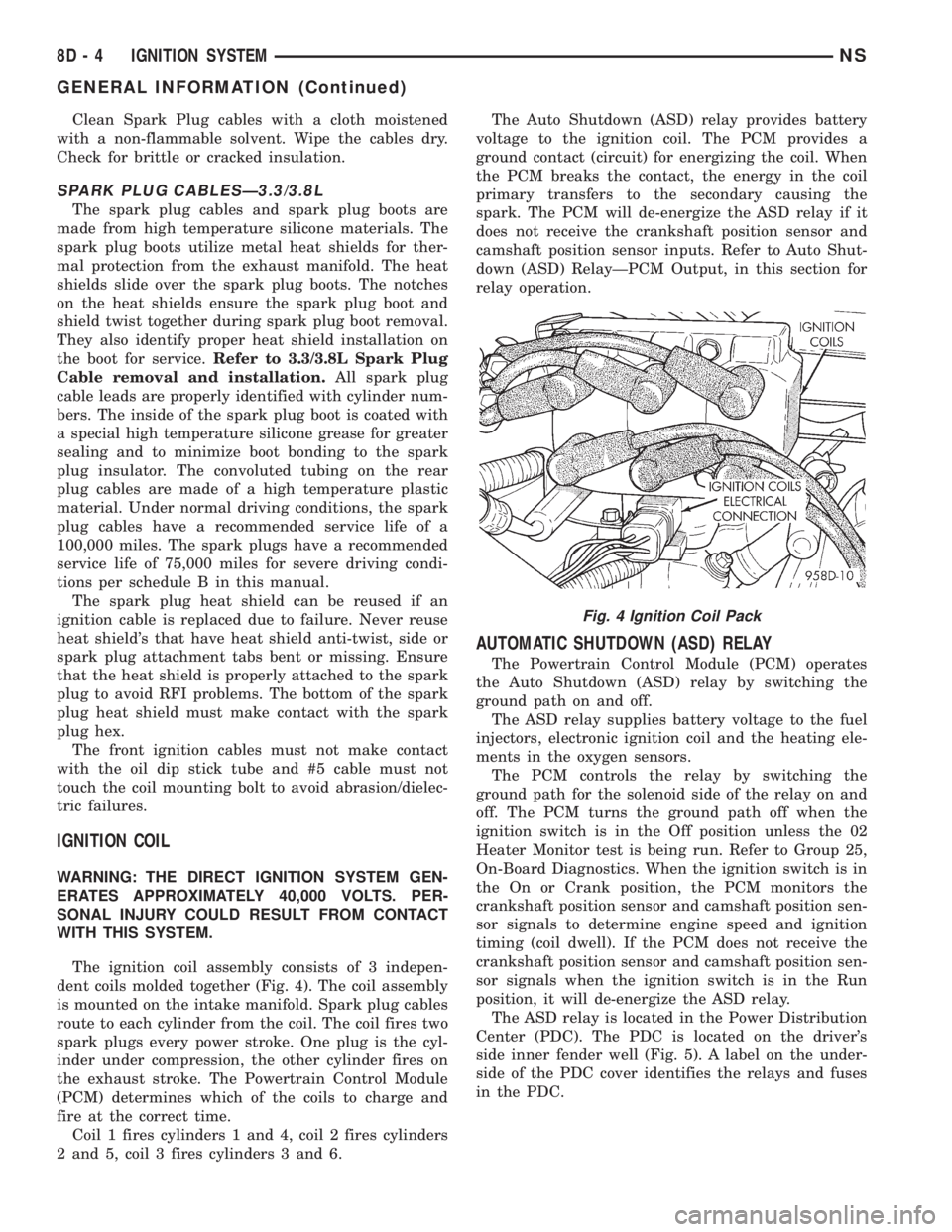
The ignition coil assembly consists of 3 indepen-
dent coils molded together (Fig. 4). The coil assembly
is mounted on the intake manifold. Spark plug cables
route to each cylinder from the coil. The coil fires two
spark plugs every power stroke. One plug is the cyl-
inder under compression, the other cylinder fires on
the exhaust stroke. The Powertrain Control Module
(PCM) determines which of the coils to charge and
fire at the correct time.
Coil 1 fires cylinders 1 and 4, coil 2 fires cylinders
2 and 5, coil 3 fires cylinders 3 and 6.The Auto Shutdown (ASD) relay provides battery
voltage to the ignition coil. The PCM provides a
ground contact (circuit) for energizing the coil. When
the PCM breaks the contact, the energy in the coil
primary transfers to the secondary causing the
spark. The PCM will de-energize the ASD relay if it
does not receive the crankshaft position sensor and
camshaft position sensor inputs. Refer to Auto Shut-
down (ASD) RelayÐPCM Output, in this section for
relay operation.
AUTOMATIC SHUTDOWN (ASD) RELAY
The Powertrain Control Module (PCM) operates
the Auto Shutdown (ASD) relay by switching the
ground path on and off.
The ASD relay supplies battery voltage to the fuel
injectors, electronic ignition coil and the heating ele-
ments in the oxygen sensors.
The PCM controls the relay by switching the
ground path for the solenoid side of the relay on and
off. The PCM turns the ground path off when the
ignition switch is in the Off position unless the 02
Heater Monitor test is being run. Refer to Group 25,
On-Board Diagnostics. When the ignition switch is in
the On or Crank position, the PCM monitors the
crankshaft position sensor and camshaft position sen-
sor signals to determine engine speed and ignition
timing (coil dwell). If the PCM does not receive the
crankshaft position sensor and camshaft position sen-
sor signals when the ignition switch is in the Run
position, it will de-energize the ASD relay.
The ASD relay is located in the Power Distribution
Center (PDC). The PDC is located on the driver's
side inner fender well (Fig. 5). A label on the under-
side of the PDC cover identifies the relays and fuses
in the PDC.
Fig. 4 Ignition Coil Pack
8D - 4 IGNITION SYSTEMNS
GENERAL INFORMATION (Continued)
Page 308 of 1938

(3) Remove ignition cables from the secondary tow-
ers of the coil. Measure the secondary resistance of
the coil between the towers of each individual coil
(Fig. 21). Secondary resistance should be 7,000 to
15,800 ohms. Replace the coil if resistance is not
within tolerance.
FAILURE TO START TEST
This no-start test checks the camshaft position sen-
sor and crankshaft position sensor.
The Powertrain Control Module (PCM) supplies 8
volts to the camshaft position sensor and crankshaft
position sensor through one circuit. If the 8 volt sup-
ply circuit shorts to ground, neither sensor will pro-
duce a signal (output voltage to the PCM).
When the ignition key is turned and left in the On
position, the PCM automatically energizes the Auto
Shutdown (ASD) relay. However, the controller de-en-
ergizes the relay within one second because it has
not received a camshaft position sensor signal indi-
cating engine rotation.
During cranking, the ASD relay will not energize
until the PCM receives a camshaft position sensor
signal. Secondly, the ASD relay remains energized
only if the controller senses a crankshaft position
sensor signal immediately after detecting the cam-
shaft position sensor signal.
(1) Check battery voltage. Voltage should be
approximately 12.66 volts or higher to perform fail-
ure to start test.
(2) Disconnect the harness connector from the coil
pack.
(3) Connect a test light to the B+ (battery voltage)
terminal of the coil electrical connector and ground
as shown in (Fig. 22). The B+ wire for the DIS coil is
dark green with an orange tracer.Do not spread
the terminal with the test light probe.(4) Turn the ignition key to theON position.The
test light should flash On and then Off.Do not turn
the Key to off position, leave it in the On posi-
tion.
(a) If the test light flashes momentarily, the
PCM grounded the Auto Shutdown (ASD) relay.
Proceed to step 5.
(b) If the test light did not flash, the ASD relay
did not energize. The cause is either the relay or
one of the relay circuits. Use the DRB scan tool to
test the ASD relay and circuits. Refer to the appro-
priate Powertrain Diagnostics Procedure Manual.
Refer to the wiring diagrams section for circuit
information.
(5) Crank the engine. (If the key was placed in the
off position after step 4, place the key in the On posi-
tion before cranking. Wait for the test light to flash
once, then crank the engine.)
(6) If the test light momentarily flashes during
cranking, the PCM is not receiving a crankshaft posi-
tion sensor signal. Use the DRB scan tool to test the
crankshaft position sensor and sensor circuits. Refer
to the appropriate Powertrain Diagnostics Procedure
Manual. Refer to the wiring diagrams section for cir-
cuit information.
(7) If the test light did not flash during cranking,
unplug the crankshaft position sensor connector.
Turn the ignition key to the off position. Turn the
key to the On position, wait for the test light to
momentarily flash once, then crank the engine. If the
test light momentarily flashes, the crankshaft posi-
tion sensor is shorted and must be replaced. If the
light did not flash, the cause of the no-start is in
Fig. 21 Checking Ignition Coil Secondary
ResistanceFig. 22 Ignition Coil Engine Harness Connector
8D - 10 IGNITION SYSTEMNS
DIAGNOSIS AND TESTING (Continued)
Page 311 of 1938

29). The increase in electrode gap will be consider-
ably in excess of 0.001 in per 1000 miles of operation.
This suggests that a plug with a cooler heat range
rating should be used. Over advanced ignition tim-
ing, detonation and cooling system malfunctions also
can cause spark plug overheating.
THROTTLE POSITION SENSOR
To perform a complete test of the this sensor and
its circuitry, refer to the DRB scan tool and appropri-
ate Powertrain Diagnostics Procedures manual. To
test the throttle position sensor only, refer to the fol-
lowing:
The Throttle Position Sensor (TPS) can be tested
with a digital voltmeter (DVM). The center terminal
of the sensor is the output terminal. One of the other
terminals is a 5 volt supply and the remaining ter-
minal is ground.
Connect the DVM between the center and sensor
ground terminal. Refer to Group 8W - Wiring Dia-
grams for correct pinout.With the ignition switch in the ON position, check
the output voltage at the center terminal wire of the
connector. Check the output voltage at idle and at
Wide-Open-Throttle (WOT). At idle, TPS output volt-
age should be approximately 0.38 volts to 1.2 volts.
At wide open throttle, TPS output voltage should be
approximately 3.1 volts to 4.4 volts. The output volt-
age should gradually increase as the throttle plate
moves slowly from idle to WOT.
Check for spread terminals at the sensor and PCM
connections before replacing the TPS.
SERVICE PROCEDURES
SPARK PLUG GAP ADJUSTMENT
Check the spark plug gap with a gap gauge. If the
gap is not correct, adjust it by bending the ground
electrode (Fig. 30).
CAUTION: The Platinum pads can be damaged dur-
ing the measurement of checking the gap if extreme
care is not used.
Refer to 3.3/3.8L Spark Plug Gap Measurment in
this section.
POWERTRAIN CONTROL MODULE
REMOVAL
(1) Disconnect both cables from battery, negative
cable first.
(2) Remove 2 screws holding Power Distribution
Center (PDC) to bracket (Fig. 31).
(3) Remove heat shield from battery (Fig. 32).
(4) Remove nut and clamp holding battery to bat-
tery tray (Fig. 33).
(5) Remove battery from vehicle.
(6) Rotate PDC toward center of vehicle to remove
from rear bracket (Fig. 34).
Fig. 27 Chipped Electrode Insulator
Fig. 28 Preignition Damage
Fig. 29 Spark Plug Overheating
NSIGNITION SYSTEM 8D - 13
DIAGNOSIS AND TESTING (Continued)
Page 312 of 1938

(7) Pull PDC rearward to remove from front
bracket. Lay PDC aside to allow access to Powertrain
Control Module (PCM).
(8) Squeeze tabs on 40-way connector. Pull connec-
tor rearward to remove from PCM (Fig. 35). Remove
both way connectors.
(9) Remove 3 screws holding PCM to fender (Fig.
36).
(10) Remove PCM from vehicle.INSTALLATION
(1) Connect 2 40-Way electrical connectors to PCM
(Fig. 35).
(2) Install PCM. Tighten mounting screws.
(3) Install PDC bracket.
(4) Install battery.
Fig. 30 Setting Spark Plug Electrode GapÐTypical
Fig. 31 Power Distribution Center Retaining Screws
Fig. 32 Battery Heat Shield
Fig. 33 Battery Clamp
8D - 14 IGNITION SYSTEMNS
SERVICE PROCEDURES (Continued)