instrument panel CHRYSLER VOYAGER 1996 Owners Manual
[x] Cancel search | Manufacturer: CHRYSLER, Model Year: 1996, Model line: VOYAGER, Model: CHRYSLER VOYAGER 1996Pages: 1938, PDF Size: 55.84 MB
Page 430 of 1938

take advantage of low current switching require-
ments in the vehicle. It is plugged into the Junction
Block at positions 4 (Fig. 1) where all wiring associ-
ated with its operation is terminated. The Junction
Block is adjacent to and left of the steering column of
the vehicle.
To gain access to the device, remove the lower
steering column cover and knee blocker, refer to
Group 8E, Instrument Panel and Systems.
The combination flasher may be operated in its
hazard warning mode either with or without the igni-
tion circuit being active. However, in order to operate
in the turn signal mode, the ignition circuit must be
completed to the module.
While the combination flasher is idle, there is no
current drawn through the module. The device does
not become active until a signal ground circuit is
supplied to either of the turn signal inputs or the
hazard warning input.
Typical flash rate for the flasher is 90 flashes per
minute.
When a lamp is burnt out for a given side of the
vehicle or a wire is open to a lamp, the flash rate will
increase to 180 flashes per minute when in the turn
signal mode. When in the hazard warning signal
mode the flash rate remains at 90 flashes per
minute.
Turn signal inputs that actuate the flasher are low
current grounds, each drawing a maximum of 300
mA., and are provided to the flasher through the
Junction Block from the multi-function switch that is
mounted to the steering column. The hazard warning
signal input is a low current ground drawing a max-
imum of 600 mA. through the multi-function switch.
COMBINATION FLASHER / DAYTIME RUNNING
LAMPS (DRL) MODULE
The Combination Flasher/DRL is a module provid-
ing turn signal, hazard warning, and daytime run-
ning light functions, and has been designed with
internal relays to take advantage of low current
switching requirements in the vehicle. It is plugged
into the junction block at positions 3 AND 4 (Fig. 2)
where all wiring associated with its operation is ter-
minated. The Junction Block is adjacent to and left of
the steering column of the vehicle.
To gain access to the device, remove the lower
steering column cover and knee blocker, refer to
Group 8E, Instrument Panel and Gauges.
The combination flasher/DRL may be operated in
its hazard warning mode either with or without the
ignition circuit being active. However, in order to
operate in the turn signal mode or the DRL mode,
the ignition circuit must be completed to the module.
While the combination flasher portion is idle, there
is no current drawn through the module. The devicedoes not become active in the turn signal or hazard
warning modes until a signal ground circuit is sup-
plied to either of the turn signal inputs or the hazard
warning input. With the ignition OFF, there is no
current drawn through the module.
While the ignition is ON, the front turn signal fil-
aments are illuminated steadily thus providing the
DRL function. The DRL function may be inhibited by
applying a signal ground input from either the park
brake circuit or the headlamp relay activation circuit.
Typical flash rate for the flasher is 90 flashes per
minute.
When a lamp is burnt out for a given side of the
vehicle or a wire is open to a lamp, the flash rate will
increase to 180 flashes per minute when in the turn
signal mode. When in the hazard warning signal
mode the flash rate remains at 90 flashes per
minute.
Turn signal inputs that actuate the flasher are low
current grounds, each could draw a maximum of 300
mA., and are provided to the flasher through the
Junction Block from the multi-function switch that is
mounted to the steering column. The hazard warning
signal input is a low current ground that could draw
a maximum of 600 mA. through the multi-function
switch.
DIAGNOSIS AND TESTING
TURN SIGNAL MULTI-FUNCTION SWITCH
To test turn signal, headlamp beam select and opti-
cal horn portion of the multi-function switch:
(1) Remove the multi-function switch, refer to
removal procedures.
(2) Using an ohmmeter check continuity reading
between multi-function switch pins. Refer to (Fig. 3)
for proper pin numbers and Turn Signal Multi-Func-
tion Switch Test chart.
Fig. 2 Junction Block Terminal Pins
8J - 2 TURN SIGNAL AND FLASHERSNS
DESCRIPTION AND OPERATION (Continued)
Page 449 of 1938
REAR WIPER AND WASHER
INDEX
page page
DESCRIPTION AND OPERATION
INTRODUCTION......................... 9
REAR WINDOW WIPER/WASHER SWITCHES . . . 9
DIAGNOSIS AND TESTING
DIAGNOSTIC PROCEDURES................ 9
REMOVAL AND INSTALLATION
REAR GLASS RUBBER GROMMET........... 9REAR WINDOW WIPER MOTOR............ 10
REAR WIPER ARM...................... 10
REAR WIPER BLADE ELEMENT............ 10
REAR WIPER BLADE..................... 10
DESCRIPTION AND OPERATION
INTRODUCTION
When continuous rear wiper operation is required,
the Body Control Module (BCM) will provide ignition
ON voltage to the rear wiper motor. When the wiper
switch is turned OFF, the BCM provides circuit
ground to operate the motor until the wipe cycle is
complete and the wiper arm returns to the base of
the rear window.
When intermittent rear wiper mode is selected, the
wiper motor will cycle every 7 seconds. The intermit-
tent delay time is also adjusted based upon vehicle
speed. With the vehicle traveling greater at 50 mph,
the cycle changes to every 5 seconds.
REAR WINDOW WIPER/WASHER SWITCHES
The rear window wiper/washer switches are incor-
porated into the HVAC switch panel. Refer to Group
8E, Instrument Panel for proper service procedures.
DIAGNOSIS AND TESTING
DIAGNOSTIC PROCEDURES
The rear window wiper system operates in several
modes:
²Continuous wipe
²Intermittent wipe
²Wash
²Wipe after wash
The windshield wiper circuits are continuously
monitored and controlled by the Body Control Mod-
ule (BCM). If a problem occurs in the electronic com-
ponents, wiring, switch (except integral motor park
switch) and wiper motor a Diagnostic Trouble Code
(DTC) will be stored in the BCM memory. The
DTC(s) can be retrieved using a scan tool (DRB).
Refer to proper Body Diagnostic Procedures manual
for DTC descriptions and retrieval information.
REMOVAL AND INSTALLATION
REAR GLASS RUBBER GROMMET
REMOVAL
(1) Remove rear window wiper motor.
(2) Peel wiper pivot seal grommet from rear glass.
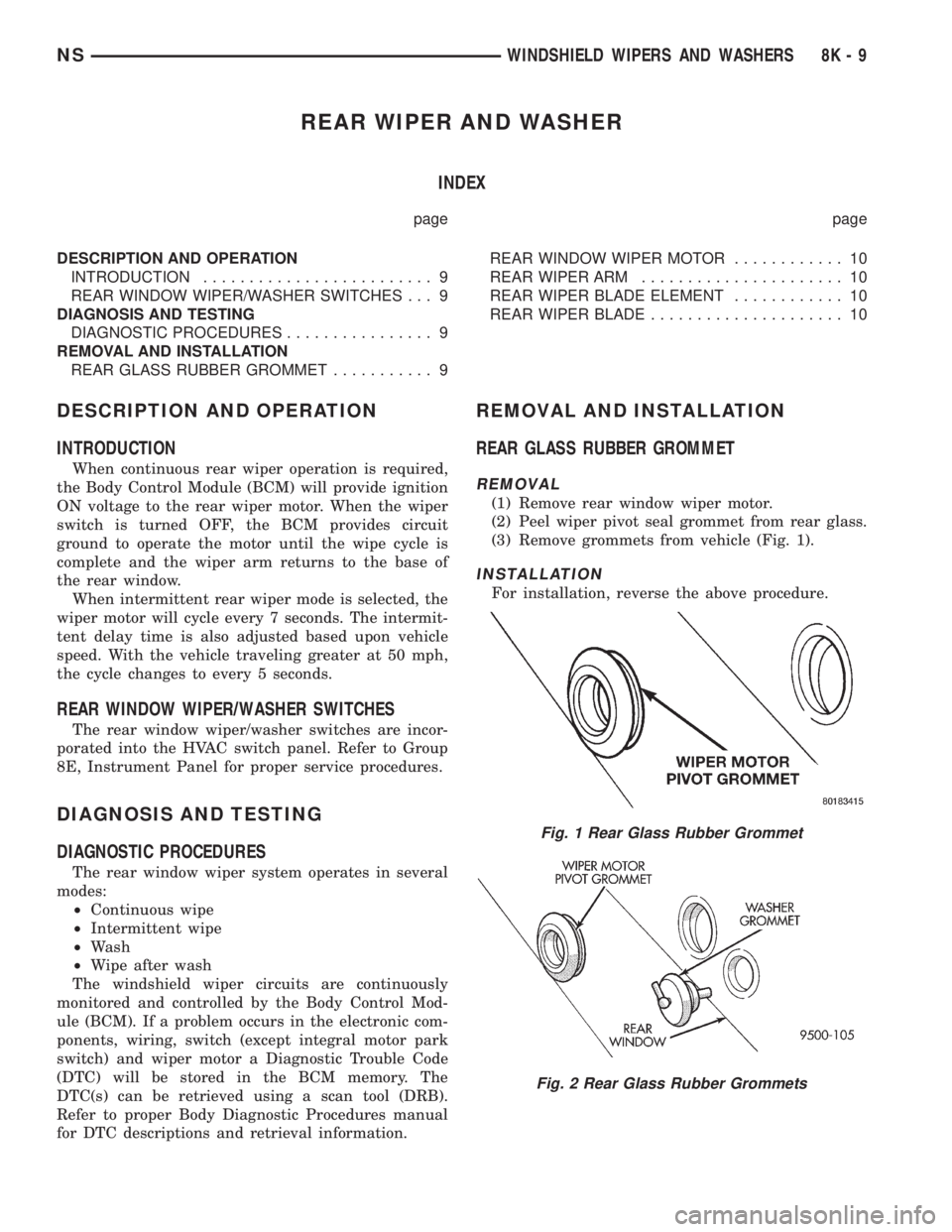
(3) Remove grommets from vehicle (Fig. 1).
INSTALLATION
For installation, reverse the above procedure.
Fig. 1 Rear Glass Rubber Grommet
Fig. 2 Rear Glass Rubber Grommets
NSWINDSHIELD WIPERS AND WASHERS 8K - 9
Page 454 of 1938

ning light functions (for Canadian vehicles), and has
been designed with internal relays to take advantage
of low current switching requirements in the vehicle.
It is plugged into the junction block at positions
three and four (Fig. 1), where all wiring associated
with its operation is terminated. The junction block
is adjacent to and left of the steering column of the
vehicle. For diagnostic information refer to Group 8J,
Turn Signal and Flashers.
On vehicles built for use in the United States, only
position four is used. Vehicles built for use in Canada
utilize both positions three and four.
To gain access to the device, remove the lower
steering column cover and knee blocker. Refer to
Group 8E, Instrument Panel and Gauges.SYSTEM FUNCTION
The combination-flasher/DRL may be operated in
its hazard warning mode either with or without the
ignition circuit being active. However, in order to
operate in the turn signal mode or the DRL mode,
the ignition circuit must be completed to the module.
While the combination-flasher portion is idle, there
is no current drawn through the module. The device
does not become active in the turn signal or hazard
warning modes until a signal ground circuit is sup-
plied to either of the turn signal inputs or the hazard
warning input. With the ignition OFF, there is no
current drawn through the module.
While the ignition is ON, the front turn signal fil-
aments are illuminated steadily thus providing the
DRL function. The DRL function may be inhibited by
applying a signal ground input from either the park
brake circuit or the headlamp relay activation circuit.
DIAGNOSIS AND TESTING
DIAGNOSTIC PROCEDURES
When a vehicle experiences problems with the
headlamp system, verify the condition of the battery
connections, charging system, headlamp bulbs, wire
connectors, relay, high beam dimmer switch and
headlamp switch. Refer to Group 8W, Wiring Dia-
grams, for component locations and circuit informa-
tion.
Fig. 1 Junction Block Terminal PINS
8L - 2 LAMPSNS
GENERAL INFORMATION (Continued)
Page 466 of 1938
EXTERIOR LAMP SERVICE
INDEX
page page
GENERAL INFORMATION
HEADLAMP DIMMER SWITCH.............. 14
HEADLAMP MODULE.................... 14
HEADLAMP SWITCH..................... 14
REMOVAL AND INSTALLATION
CENTER HIGH MOUNTED STOP LAMP
(CHMSL)............................. 17
FOG LAMP ± TOWN and COUNTRY......... 15
FOG LAMP............................. 14FRONT PARKING AND TURN SIGNAL LAMP ±
TOWN and COUNTRY.................. 15
FRONT SIDE MARKER LAMP TOWN and
COUNTRY............................ 15
HEADLAMP MODULE.................... 14
LICENSE PLATE LAMP................... 16
TAIL, STOP, TURN SIGNAL AND BACK-UP
LAMP............................... 16
GENERAL INFORMATION
HEADLAMP MODULE
Minor amounts of fogging may occur around the
edges of the headlamp lens when exposed to humid
conditions. This is considered normal. The fogging
will dissipate with increased ambient temperature or
headlamp usage.
HEADLAMP SWITCH
Service procedures for the headlamp switch can be
found in Group 8E, Instrument Panel and Gauges.
More information can be found in Group 8W, Wiring
Diagrams.
HEADLAMP DIMMER SWITCH
The headlamp dimmer switch is incorporated into
the multi-function (turn signal) switch. Proper proce-
dures can be found in Group 8J, Turn Signal and
Flashers. More information can be found in Group
8W, Wiring Diagrams.
REMOVAL AND INSTALLATION
HEADLAMP MODULE
REMOVAL
(1) Release hood latch and open hood.
(2) From inside engine compartment, remove nuts
holding headlamp module to radiator closure panel.
(3) Remove screw holding top of module to closure
panel.
(4) Remove headlamp module from radiator clo-
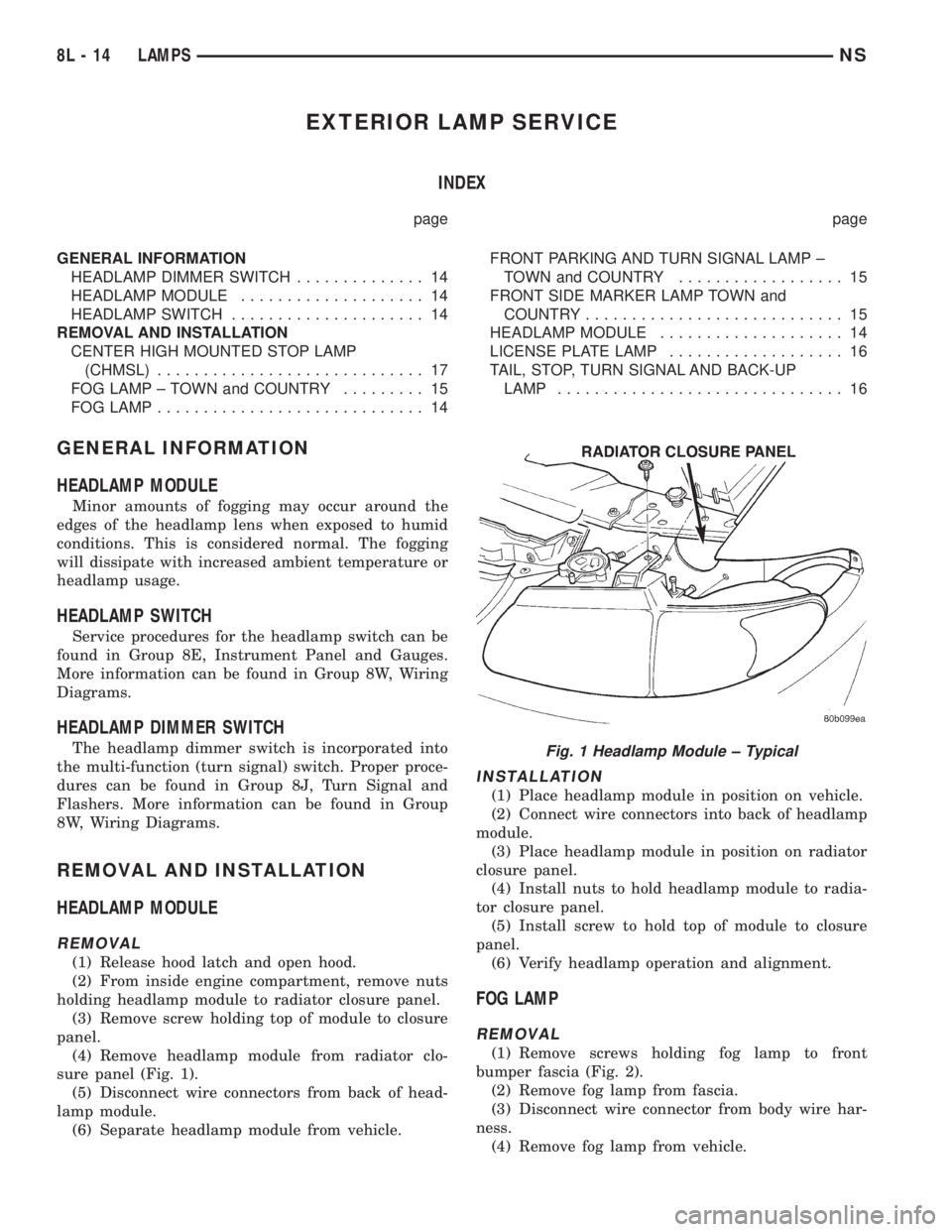
sure panel (Fig. 1).
(5) Disconnect wire connectors from back of head-
lamp module.
(6) Separate headlamp module from vehicle.
INSTALLATION
(1) Place headlamp module in position on vehicle.
(2) Connect wire connectors into back of headlamp
module.
(3) Place headlamp module in position on radiator
closure panel.
(4) Install nuts to hold headlamp module to radia-
tor closure panel.
(5) Install screw to hold top of module to closure
panel.
(6) Verify headlamp operation and alignment.
FOG LAMP
REMOVAL
(1) Remove screws holding fog lamp to front
bumper fascia (Fig. 2).
(2) Remove fog lamp from fascia.
(3) Disconnect wire connector from body wire har-
ness.
(4) Remove fog lamp from vehicle.
Fig. 1 Headlamp Module ± Typical
8L - 14 LAMPSNS
Page 470 of 1938
INTERIOR LAMPS
INDEX
page page
REMOVAL AND INSTALLATION
CONVENIENCE BIN LAMP................. 20
DOME LAMP BULB...................... 21
DOME LAMP........................... 21
FRONT DOOR COURTESY LAMP BULB...... 22
FRONT DOOR COURTESY LAMP........... 21
GLOVE BOX LAMP AND SWITCH........... 19
GLOVE BOX LAMP BULB.................. 19
HEADER READING/COURTESY LAMP BULB . . . 19HEADER READING/COURTESY LAMP....... 18
IGNITION HALO LAMP BULB............... 19
INSTRUMENT PANEL LAMPS AND SWITCHES . 20
LIFTGATE COURTESY LAMP BULB.......... 24
LIFTGATE COURTESY LAMP............... 23
OVERHEAD CONSOLE READING/COURTESY
LAMP BULB.......................... 18
RAIL LAMP MODULE BULB................ 23
REMOVAL AND INSTALLATION
OVERHEAD CONSOLE READING/COURTESY LAMP
BULB
REMOVAL
(1) Using a trim stick, lightly pry outward the for-
ward end of reading lamp lens.
(2) Rotate reading lamp bulb socket one quarter
turn counterclockwise.
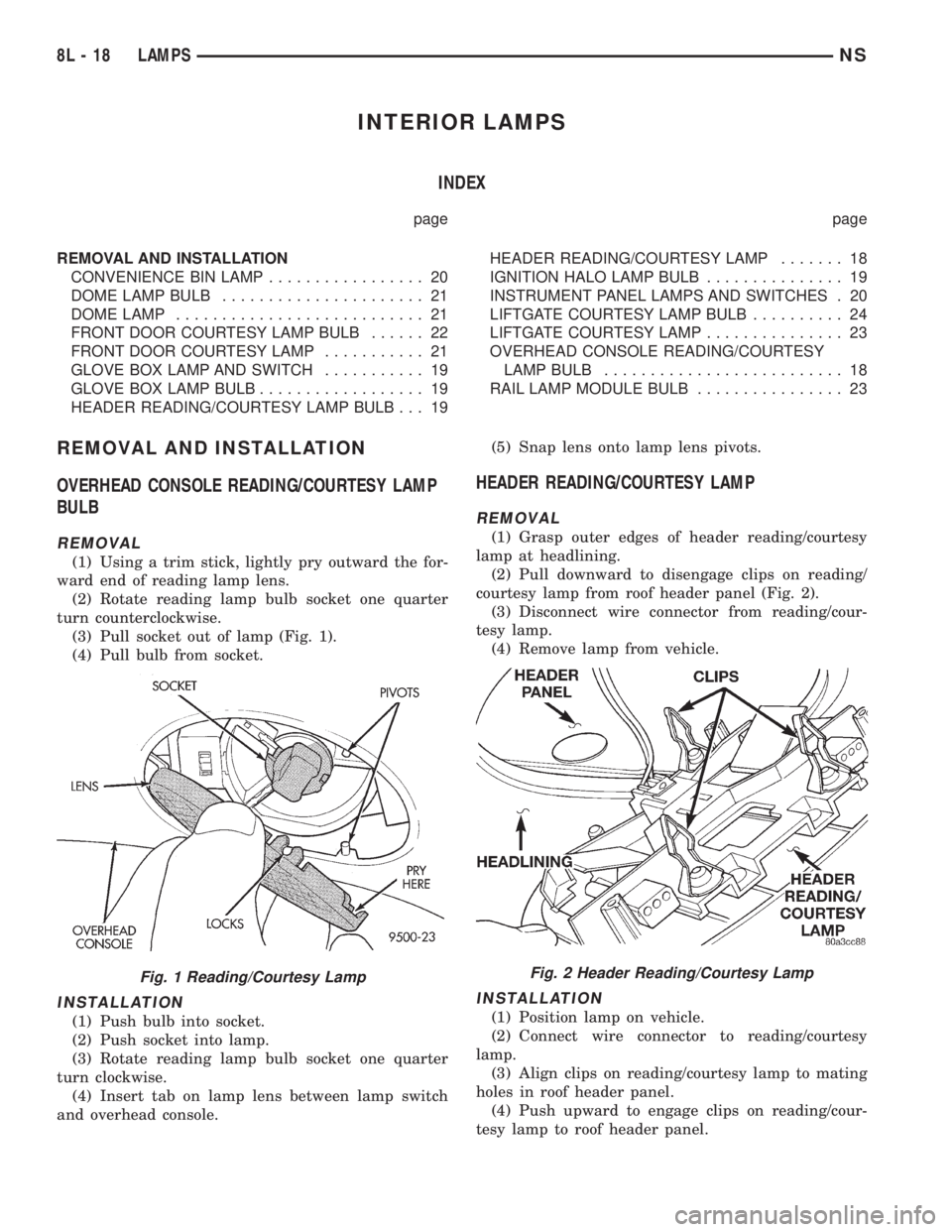
(3) Pull socket out of lamp (Fig. 1).
(4) Pull bulb from socket.
INSTALLATION
(1) Push bulb into socket.
(2) Push socket into lamp.
(3) Rotate reading lamp bulb socket one quarter
turn clockwise.
(4) Insert tab on lamp lens between lamp switch
and overhead console.(5) Snap lens onto lamp lens pivots.
HEADER READING/COURTESY LAMP
REMOVAL
(1) Grasp outer edges of header reading/courtesy
lamp at headlining.
(2) Pull downward to disengage clips on reading/
courtesy lamp from roof header panel (Fig. 2).
(3) Disconnect wire connector from reading/cour-
tesy lamp.
(4) Remove lamp from vehicle.
INSTALLATION
(1) Position lamp on vehicle.
(2) Connect wire connector to reading/courtesy
lamp.
(3) Align clips on reading/courtesy lamp to mating
holes in roof header panel.
(4) Push upward to engage clips on reading/cour-
tesy lamp to roof header panel.
Fig. 1 Reading/Courtesy LampFig. 2 Header Reading/Courtesy Lamp
8L - 18 LAMPSNS
Page 471 of 1938
HEADER READING/COURTESY LAMP BULB
REMOVAL
(1) Insert a small, flat bladed pry tool at forward
position between reading/courtesy lamp lens and
lamp housing.
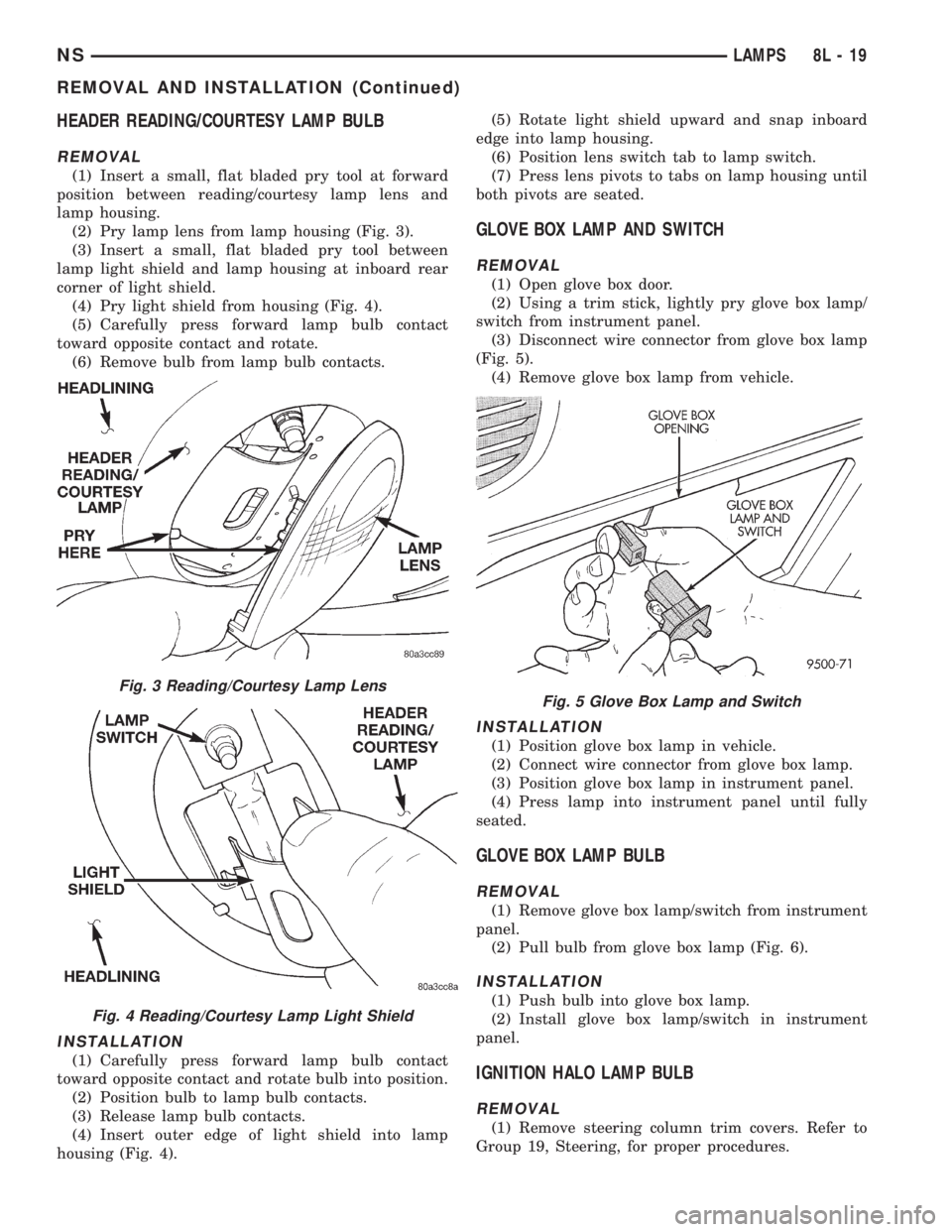
(2) Pry lamp lens from lamp housing (Fig. 3).
(3) Insert a small, flat bladed pry tool between
lamp light shield and lamp housing at inboard rear
corner of light shield.
(4) Pry light shield from housing (Fig. 4).
(5) Carefully press forward lamp bulb contact
toward opposite contact and rotate.
(6) Remove bulb from lamp bulb contacts.
INSTALLATION
(1) Carefully press forward lamp bulb contact
toward opposite contact and rotate bulb into position.
(2) Position bulb to lamp bulb contacts.
(3) Release lamp bulb contacts.
(4) Insert outer edge of light shield into lamp
housing (Fig. 4).(5) Rotate light shield upward and snap inboard
edge into lamp housing.
(6) Position lens switch tab to lamp switch.
(7) Press lens pivots to tabs on lamp housing until
both pivots are seated.
GLOVE BOX LAMP AND SWITCH
REMOVAL
(1) Open glove box door.
(2) Using a trim stick, lightly pry glove box lamp/
switch from instrument panel.
(3) Disconnect wire connector from glove box lamp
(Fig. 5).
(4) Remove glove box lamp from vehicle.
INSTALLATION
(1) Position glove box lamp in vehicle.
(2) Connect wire connector from glove box lamp.
(3) Position glove box lamp in instrument panel.
(4) Press lamp into instrument panel until fully
seated.
GLOVE BOX LAMP BULB
REMOVAL
(1) Remove glove box lamp/switch from instrument
panel.
(2) Pull bulb from glove box lamp (Fig. 6).
INSTALLATION
(1) Push bulb into glove box lamp.
(2) Install glove box lamp/switch in instrument
panel.
IGNITION HALO LAMP BULB
REMOVAL
(1) Remove steering column trim covers. Refer to
Group 19, Steering, for proper procedures.
Fig. 3 Reading/Courtesy Lamp Lens
Fig. 4 Reading/Courtesy Lamp Light Shield
Fig. 5 Glove Box Lamp and Switch
NSLAMPS 8L - 19
REMOVAL AND INSTALLATION (Continued)
Page 472 of 1938
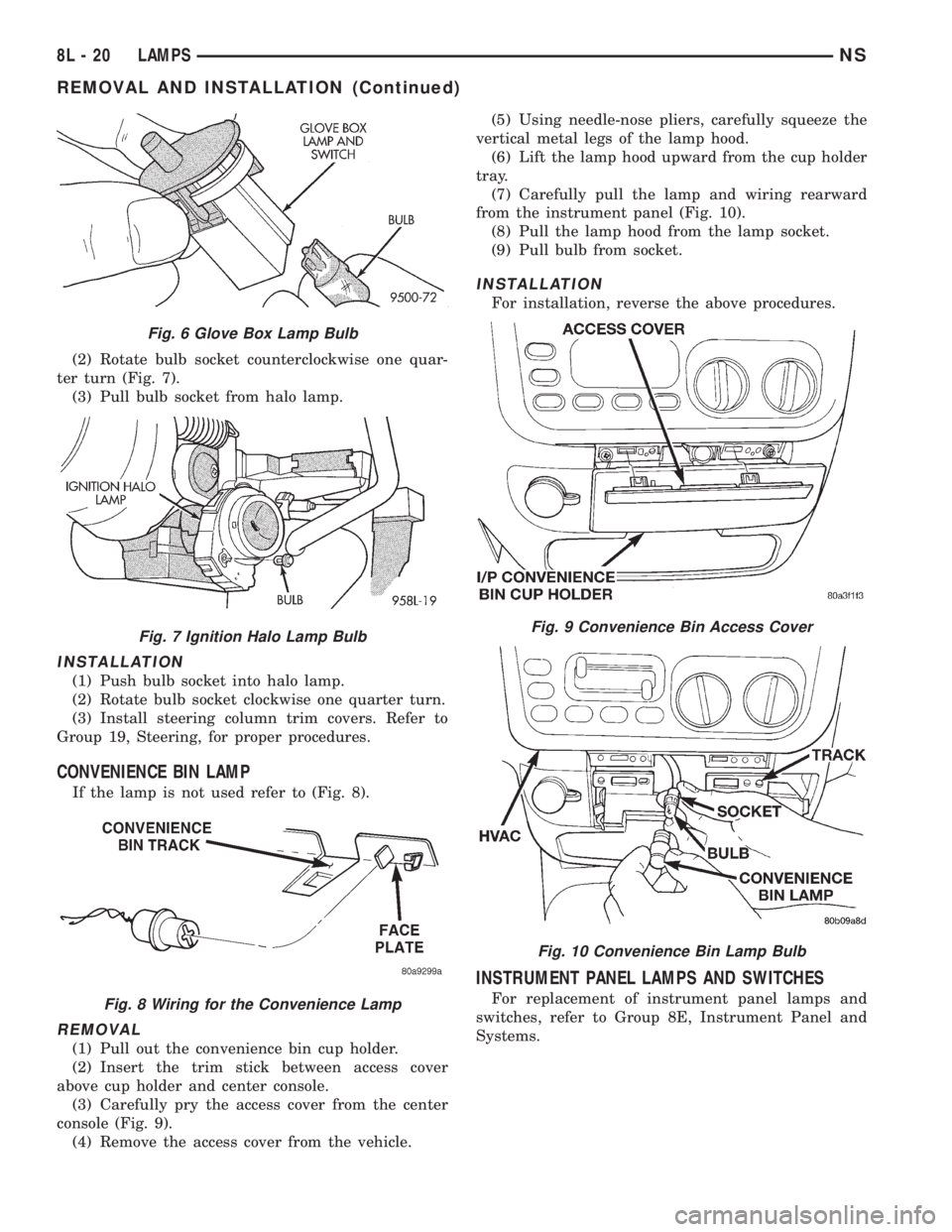
(2) Rotate bulb socket counterclockwise one quar-
ter turn (Fig. 7).
(3) Pull bulb socket from halo lamp.
INSTALLATION
(1) Push bulb socket into halo lamp.
(2) Rotate bulb socket clockwise one quarter turn.
(3) Install steering column trim covers. Refer to
Group 19, Steering, for proper procedures.
CONVENIENCE BIN LAMP
If the lamp is not used refer to (Fig. 8).
REMOVAL
(1) Pull out the convenience bin cup holder.
(2) Insert the trim stick between access cover
above cup holder and center console.
(3) Carefully pry the access cover from the center
console (Fig. 9).
(4) Remove the access cover from the vehicle.(5) Using needle-nose pliers, carefully squeeze the
vertical metal legs of the lamp hood.
(6) Lift the lamp hood upward from the cup holder
tray.
(7) Carefully pull the lamp and wiring rearward
from the instrument panel (Fig. 10).
(8) Pull the lamp hood from the lamp socket.
(9) Pull bulb from socket.
INSTALLATION
For installation, reverse the above procedures.
INSTRUMENT PANEL LAMPS AND SWITCHES
For replacement of instrument panel lamps and
switches, refer to Group 8E, Instrument Panel and
Systems.
Fig. 6 Glove Box Lamp Bulb
Fig. 7 Ignition Halo Lamp Bulb
Fig. 8 Wiring for the Convenience Lamp
Fig. 9 Convenience Bin Access Cover
Fig. 10 Convenience Bin Lamp Bulb
8L - 20 LAMPSNS
REMOVAL AND INSTALLATION (Continued)
Page 480 of 1938

HEADLAMP LEVELING MOTOR
This vehicle is equipped with a remote headlamp
leveling system. This system allows the driver to
adjust the vertical headlamp aim from the interior of
the vehicle to compensate for passenger or cargo
load. A headlamp leveling switch is located in the
instrument panel and controls the headlamp leveling
motor found on the back of the headlamp module.
DIAGNOSIS AND TESTING
DIAGNOSTIC PROCEDURES
When a vehicle experiences problems with the head-
lamp system, verify the condition of the battery connec-
tions, charging system, headlamp bulbs, wire
connectors, relay, high beam dimmer switch and head-
lamp switch. Refer to Group 8W, Wiring Diagrams, for
component locations and circuit information.
HEADLAMP DIAGNOSIS
CONDITION POSSIBLE CAUSES CORRECTION
HEADLAMPS ARE DIM
WITH ENGINE IDLING OR
IGNITION TURNED OFF1. Loose or corroded battery cables. 1. Clean and secure battery cable clamps
and posts.
2. Loose or worn alternator drive
belt.2. Adjust or replace alternator drive belt.
3. Charging system output too low. 3. Test and repair charging system. Refer
to Group 8A.
4. Battery has insufficient charge. 4. Test battery state-of -charge. Refer to
Group 8A.
5. Battery is sulfated or shorted. 5. Load test battery. Refer to Group 8A.
6. Poor lighting circuit Z1-ground. 6. Test for voltage drop across Z1-ground
locations. Refer to Group 8W.
HEADLAMP BULBS BURN
OUT FREQUENTLY1. Charging system output too high. 1. Test and repair charging system. Refer
to Group 8A.
2. Loose or corroded terminals or
splices in circuit.2. Inspect and repair all connectors and
splices. Refer to Group 8W.
HEADLAMPS ARE DIM
WITH ENGINE RUNNING
ABOVE IDLE1. Charging system output too low. 1. Test and repair charging system. Refer
to Group 8A.
2. Poor lighting circuit Z1-ground. 2. Test for voltage drop across Z1-ground
locations. Refer to Group 8W.
3. High resistance in headlamp
circuit.3. Test amperage draw of headlamp circuit.
HEADLAMPS FLASH
RANDOMLY1. Poor lighting circuit Z1-ground. 1. Test for voltage drop across Z1-ground
locations, refer to Group 8W.
2. High resistance in headlamp
circuit.2. Test amperage draw of headlamp circuit.
3. Loose or corroded terminals or
splices in circuit.3. Inspect and repair all connectors and
splices. Refer to Group 8W.
HEADLAMPS DO NOT
ILLUMINATE1. No voltage to headlamps. 1. Repair open headlamp circuit. Refer to
Group 8W.
2. No Z1-ground at headlamps. 2. Repair circuit ground. Refer to Group
8W.
3. Faulty headlamp switch. 3. Replace headlamp switch.
4. Faulty headlamp dimmer
(multi-function) switch.4. Replace multi-function switch.
5. Broken connector terminal or wire
splice in headlamp circuit.5. Repair connector terminal or wire splice.
6. Defective or burned out bulb. 6. Replace bulb.
7. Body controller malfunction. 7. Refer to appropriate body controller
diagnostics.
8L - 2 LAMPSNS/GS
GENERAL INFORMATION (Continued)
Page 491 of 1938
LAMP SERVICE
INDEX
page page
GENERAL INFORMATION
HEADLAMP DIMMER SWITCH............. 13
HEADLAMP SWITCH.................... 13
REMOVAL AND INSTALLATION
CENTER HIGH MOUNTED STOP LAMP
(CHMSL)............................ 16FOG LAMP............................ 14
HEADLAMP LEVELING MOTOR............ 14
HEADLAMP MODULE................... 13
LICENSE PLATE LAMP.................. 15
SIDE REPEATER LAMP.................. 14
TAIL LAMP............................ 15
GENERAL INFORMATION
HEADLAMP SWITCH
Service procedures for the headlamp switch can be
found in Group 8E, Instrument Panel and Gauges.
More information can be found in Group 8W, Wiring
Diagrams.
HEADLAMP DIMMER SWITCH
The headlamp dimmer switch is incorporated into
the multi-function (turn signal) switch. Proper proce-
dures can be found in Group 8J, Turn Signal and
Flashers. More information can be found in Group
8W, Wiring Diagrams.
REMOVAL AND INSTALLATION
HEADLAMP MODULE
REMOVAL
(1) Release hood latch and open hood.
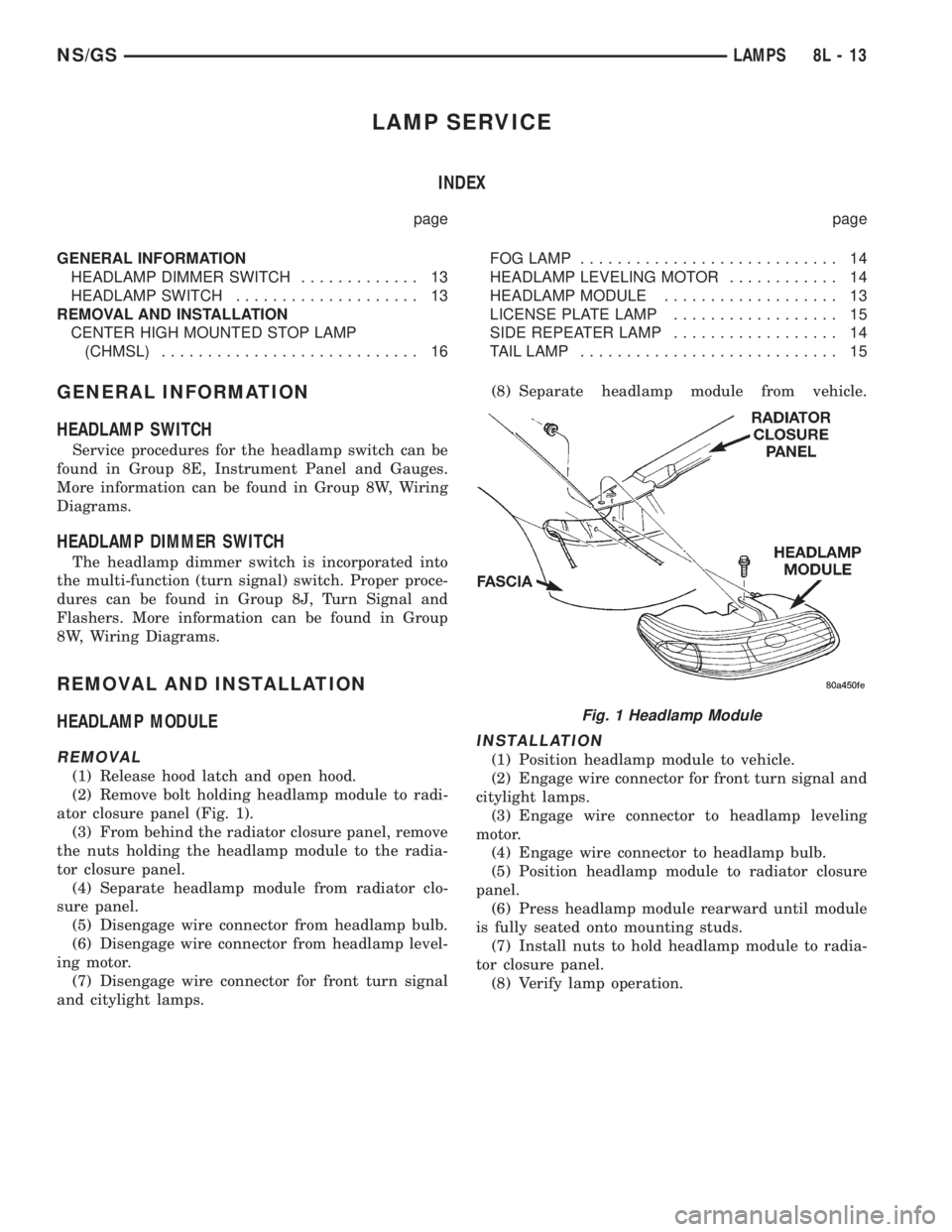
(2) Remove bolt holding headlamp module to radi-
ator closure panel (Fig. 1).
(3) From behind the radiator closure panel, remove
the nuts holding the headlamp module to the radia-
tor closure panel.
(4) Separate headlamp module from radiator clo-
sure panel.
(5) Disengage wire connector from headlamp bulb.
(6) Disengage wire connector from headlamp level-
ing motor.
(7) Disengage wire connector for front turn signal
and citylight lamps.(8) Separate headlamp module from vehicle.
INSTALLATION
(1) Position headlamp module to vehicle.
(2) Engage wire connector for front turn signal and
citylight lamps.
(3) Engage wire connector to headlamp leveling
motor.
(4) Engage wire connector to headlamp bulb.
(5) Position headlamp module to radiator closure
panel.
(6) Press headlamp module rearward until module
is fully seated onto mounting studs.
(7) Install nuts to hold headlamp module to radia-
tor closure panel.
(8) Verify lamp operation.
Fig. 1 Headlamp Module
NS/GSLAMPS 8L - 13
Page 498 of 1938

ACM monitors the system to determine the system
readiness. The ACM contains on-board diagnostics
and will light the AIRBAG warning lamp in the mes-
sage center when a problem occurs.
The driver and passenger airbag system is a safety
device designed to reduce the risk of fatality or seri-
ous injury, caused by a frontal impact of the vehicle.
The impact sensor provides verification of the
direction and severity of the impact. One impact sen-
sor is used. It is located inside the Airbag Control
Module (ACM) which is mounted on a bracket, just
forward of the center console. The impact sensor is
an accelerometer that senses deceleration. The decel-
eration pulses are sent to a microprocessor which
contains a decision algorithm. When an impact is
severe enough to require airbag protection, the ACM
micro processor sends a signal that completes the
electrical circuit to the driver and passenger airbags.
The sensor is calibrated for the specific vehicle and
reacts to the severity and direction of the impact.
CLOCKSPRING
The clockspring is snapped into a plastic mounting
platform on the steering column behind the steering
wheel. The clockspring is used to maintain a contin-
uous electrical circuit between the wiring harness
and the driver's airbag module. This assembly con-
sists of a flat ribbon like electrically conductive tape
which winds and unwinds with the steering wheel
rotation.
DRIVER AND PASSENGER AIRBAG MODULES
The Driver Airbag Module is located in the center
of the steering wheel. The Passenger Airbag Module
is located in the instrument panel above the glove
box (Fig. 1). The Driver Airbag Module cover contains
the horn switch, inflator device, and a fabric bag. The
airbag cover/horn switch is serviced separately from
the inflator and bag components. Refer to Group 8G,
Horns for proper service procedure for horn switch.
The Passenger Airbag Module is serviced as an
assembly.
WARNING: WHEN THE AIRBAG SYSTEM IS
DEPLOYED BECAUSE OF A COLLISION, THE FOL-
LOWING MUST BE REPLACED:
²COMPLETE STEERING COLUMN ASSEMBLY
²LOWER STEERING COUPLER
²STEERING WHEEL
²STEERING COLUMN CLOCKSPRING
²DRIVER AIRBAG COVER/HORN SWITCH
²DRIVER AIRBAG MODULE
²PASSENGER AIRBAG MODULE
²UPPER INSTRUMENT PANEL WITH PAD
DIAGNOSIS AND TESTING
AIRBAG SYSTEM TEST
(1) Disconnect and isolate the battery negative
cable.
WARNING: DISCONNECT AND ISOLATE THE BAT-
TERY NEGATIVE CABLE BEFORE BEGINNING AIR-
BAG SYSTEM COMPONENT SERVICE
PROCEDURES. THIS WILL DISABLE THE AIRBAG
SYSTEM. FAILURE TO DISCONNECT THE BATTERY
COULD RESULT IN ACCIDENTAL AIRBAG DEPLOY-
MENT AND POSSIBLE PERSONAL INJURY. ALLOW
SYSTEM CAPACITOR TO DISCHARGE FOR TWO
MINUTES BEFORE REMOVING AIRBAG COMPO-
NENTS.
(2) Connect scan tool (DRB) to Data Link connec-
tor, located at left side of the steering column and at
the lower edge of the lower instrument panel.
(3) Turn the ignition key to ON position. Exit vehi-
cle with scan tool. Use the latest version of the
proper cartridge.
(4) After checking that no one is inside the vehicle,
connect the battery negative terminal.
(5) Using the scan tool, read and record active
diagnostic code data.
(6) Read and record any stored diagnostic codes.
(7) Refer to the proper Body Diagnostic Procedures
Manual if any diagnostic codes are found in Step 5 or
Step 6.
(8) Erase stored diagnostic codes if there are no
active diagnostic codes. If problems remain, diagnos-
tic codes will not erase. Refer to the Passive
Restraint Diagnostic Test Manual to diagnose the
problem.If airbag warning lamp either fails to
light, or goes on and stays on, there is a system
malfunction. Refer to the proper Body Diagnos-
tic Procedures Manual to diagnose the problem.
Fig. 1 Airbag Module Locations
8M - 2 RESTRAINT SYSTEMNS
DESCRIPTION AND OPERATION (Continued)