tow CHRYSLER VOYAGER 1996 Service Manual
[x] Cancel search | Manufacturer: CHRYSLER, Model Year: 1996, Model line: VOYAGER, Model: CHRYSLER VOYAGER 1996Pages: 1938, PDF Size: 55.84 MB
Page 1525 of 1938
Inspect all valve springs for distortion and col-
lapsed coils. Inspect all valves and plugs for burrs,
nicks, and scores. Small nicks and scores may be
removed with crocus cloth, providing extreme care is
taken not to round off sharp edges. The sharpness of
these edges is vitally important. It prevents foreign
matter from lodging between valve and valve body.
This reduces the possibility of sticking. Inspect all
valves and plugs for freedom of operation in valve
body bores.
When bores, valves, and plugs are clean and dry,
the valves and plugs should fall freely in the bores.
The valve body bores do not change its dimensions
with use. Therefore, a valve body that was function-
ing properly when vehicle was new, will operate cor-
rectly if it is properly and thoroughly cleaned. There
is no need to replace valve body unless it is damaged
in handling.
ADJUSTMENTS
GEARSHIFT CABLE ADJUSTMENT
Lift and rotate the gearshift hand lever into the
park (P) gate position and remove the ignition key.
This confirms the shift lever is in the gated park (P)
position.
After confirming the park gate position, turn the
ignition switch. If the starter will operate, the park
gate position is correct. Move the shift lever into the
neutral (N) position. If the starter will operate in this
position, the linkage is properly adjusted. If the
starter fails to operate in either position, linkage
adjustment is required.
(1) Park the vehicle on level ground and set the
parking brake.
(2) Place the gearshift lever in park (P) gate posi-
tion and remove key.
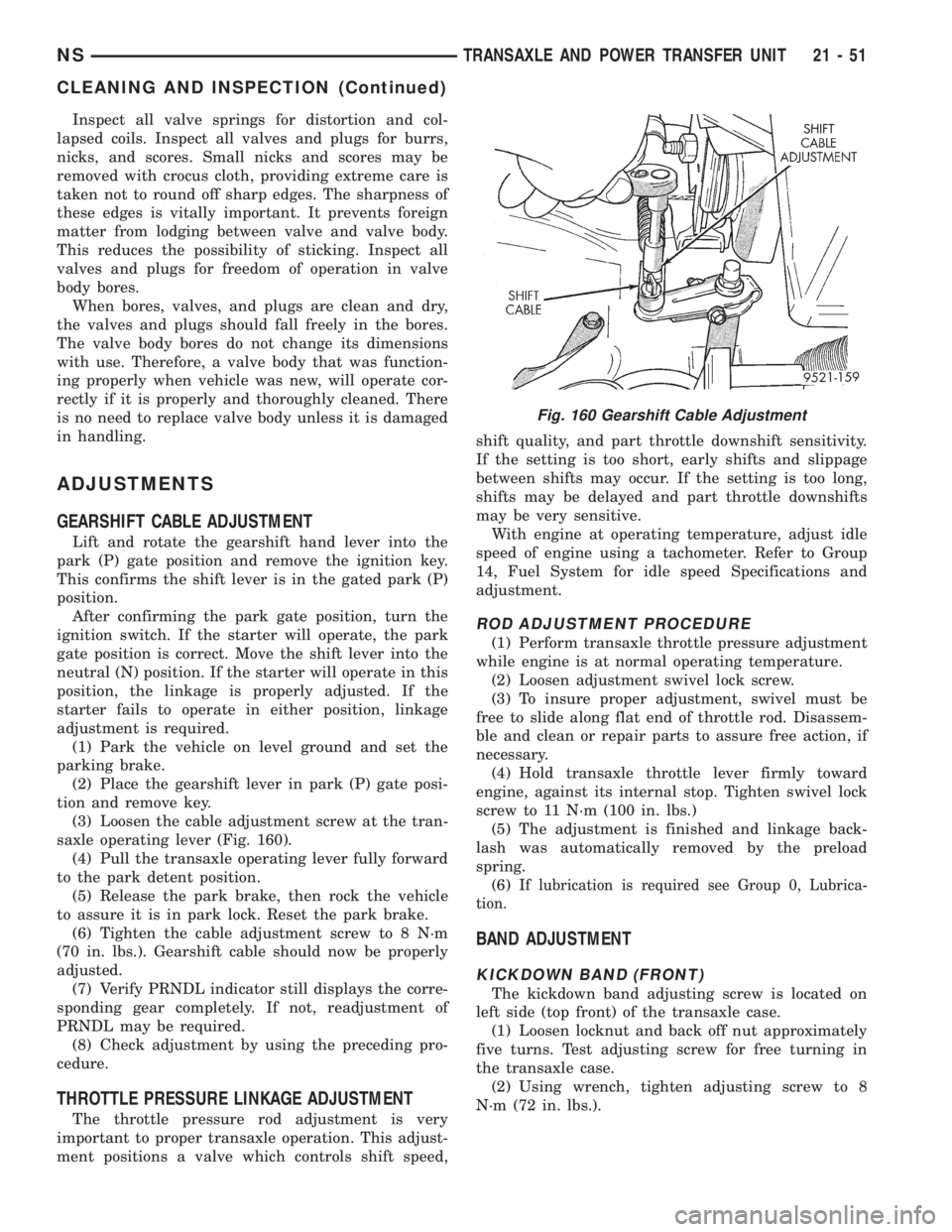
(3) Loosen the cable adjustment screw at the tran-
saxle operating lever (Fig. 160).
(4) Pull the transaxle operating lever fully forward
to the park detent position.
(5) Release the park brake, then rock the vehicle
to assure it is in park lock. Reset the park brake.
(6) Tighten the cable adjustment screw to 8 N´m
(70 in. lbs.). Gearshift cable should now be properly
adjusted.
(7) Verify PRNDL indicator still displays the corre-
sponding gear completely. If not, readjustment of
PRNDL may be required.
(8) Check adjustment by using the preceding pro-
cedure.
THROTTLE PRESSURE LINKAGE ADJUSTMENT
The throttle pressure rod adjustment is very
important to proper transaxle operation. This adjust-
ment positions a valve which controls shift speed,shift quality, and part throttle downshift sensitivity.
If the setting is too short, early shifts and slippage
between shifts may occur. If the setting is too long,
shifts may be delayed and part throttle downshifts
may be very sensitive.
With engine at operating temperature, adjust idle
speed of engine using a tachometer. Refer to Group
14, Fuel System for idle speed Specifications and
adjustment.
ROD ADJUSTMENT PROCEDURE
(1) Perform transaxle throttle pressure adjustment
while engine is at normal operating temperature.
(2) Loosen adjustment swivel lock screw.
(3) To insure proper adjustment, swivel must be
free to slide along flat end of throttle rod. Disassem-
ble and clean or repair parts to assure free action, if
necessary.
(4) Hold transaxle throttle lever firmly toward
engine, against its internal stop. Tighten swivel lock
screw to 11 N´m (100 in. lbs.)
(5) The adjustment is finished and linkage back-
lash was automatically removed by the preload
spring.
(6) I
f lubrication is required see Group 0, Lubrica-
tion.
BAND ADJUSTMENT
KICKDOWN BAND (FRONT)
The kickdown band adjusting screw is located on
left side (top front) of the transaxle case.
(1) Loosen locknut and back off nut approximately
five turns. Test adjusting screw for free turning in
the transaxle case.
(2) Using wrench, tighten adjusting screw to 8
N´m (72 in. lbs.).
Fig. 160 Gearshift Cable Adjustment
NSTRANSAXLE AND POWER TRANSFER UNIT 21 - 51
CLEANING AND INSPECTION (Continued)
Page 1574 of 1938
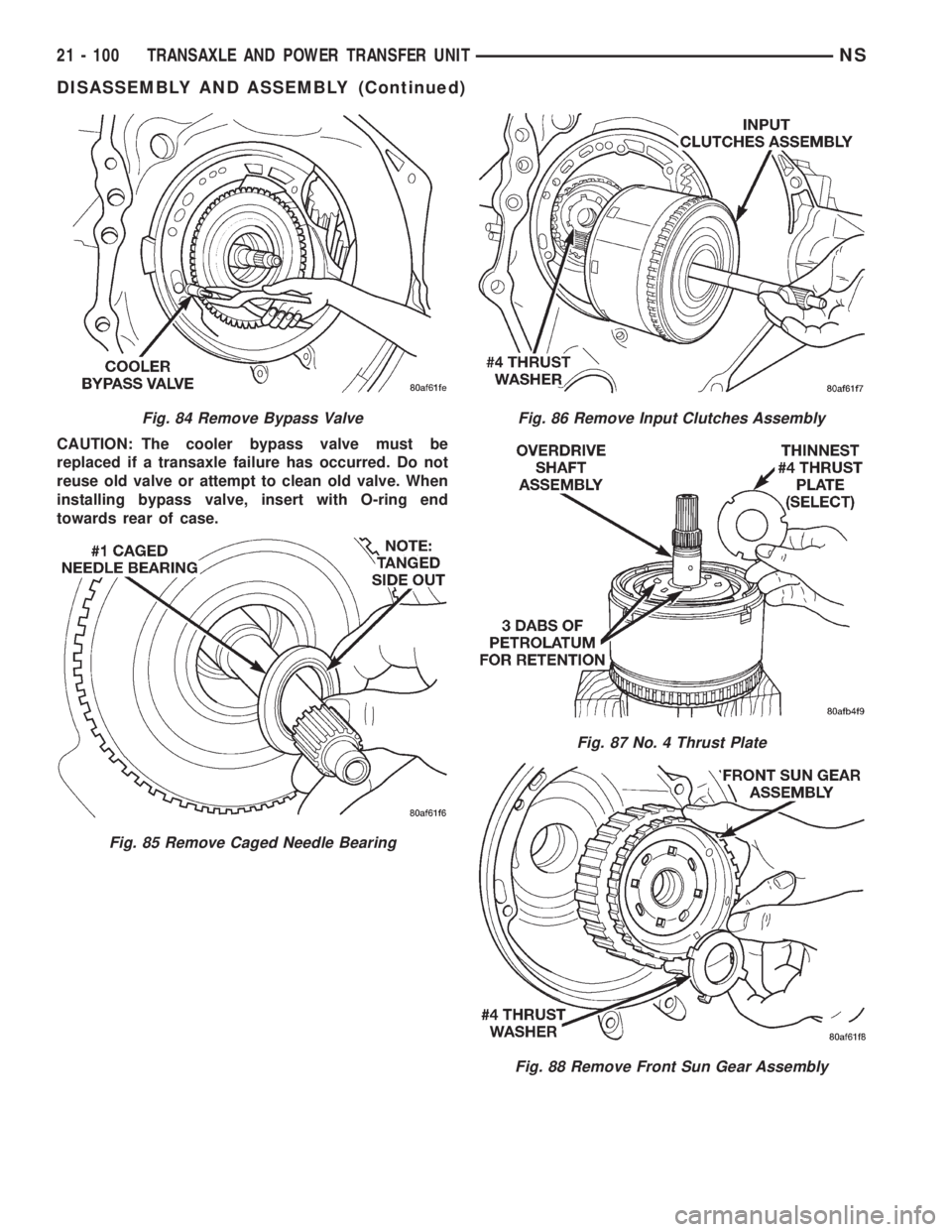
CAUTION: The cooler bypass valve must be
replaced if a transaxle failure has occurred. Do not
reuse old valve or attempt to clean old valve. When
installing bypass valve, insert with O-ring end
towards rear of case.
Fig. 84 Remove Bypass Valve
Fig. 85 Remove Caged Needle Bearing
Fig. 86 Remove Input Clutches Assembly
Fig. 87 No. 4 Thrust Plate
Fig. 88 Remove Front Sun Gear Assembly
21 - 100 TRANSAXLE AND POWER TRANSFER UNITNS
DISASSEMBLY AND ASSEMBLY (Continued)
Page 1610 of 1938
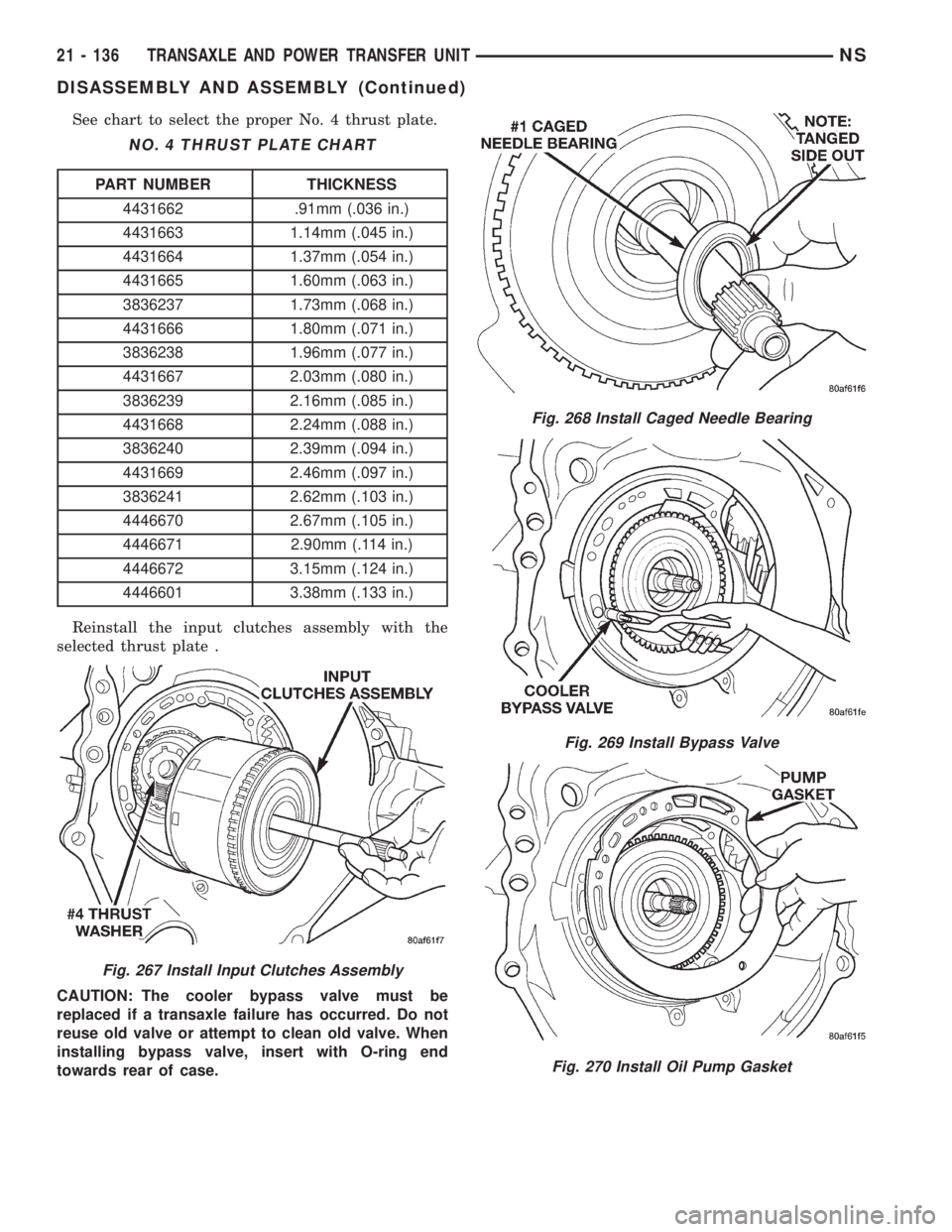
See chart to select the proper No. 4 thrust plate.
Reinstall the input clutches assembly with the
selected thrust plate .
CAUTION: The cooler bypass valve must be
replaced if a transaxle failure has occurred. Do not
reuse old valve or attempt to clean old valve. When
installing bypass valve, insert with O-ring end
towards rear of case.
NO. 4 THRUST PLATE CHART
PART NUMBER THICKNESS
4431662 .91mm (.036 in.)
4431663 1.14mm (.045 in.)
4431664 1.37mm (.054 in.)
4431665 1.60mm (.063 in.)
3836237 1.73mm (.068 in.)
4431666 1.80mm (.071 in.)
3836238 1.96mm (.077 in.)
4431667 2.03mm (.080 in.)
3836239 2.16mm (.085 in.)
4431668 2.24mm (.088 in.)
3836240 2.39mm (.094 in.)
4431669 2.46mm (.097 in.)
3836241 2.62mm (.103 in.)
4446670 2.67mm (.105 in.)
4446671 2.90mm (.114 in.)
4446672 3.15mm (.124 in.)
4446601 3.38mm (.133 in.)
Fig. 267 Install Input Clutches Assembly
Fig. 268 Install Caged Needle Bearing
Fig. 269 Install Bypass Valve
Fig. 270 Install Oil Pump Gasket
21 - 136 TRANSAXLE AND POWER TRANSFER UNITNS
DISASSEMBLY AND ASSEMBLY (Continued)
Page 1618 of 1938
(11) Install the oil baffle. Install the proper shim
combination under the bearing cup.
(12) Install the differential bearing retainer. Seal
the retainer to the housing with MopartSilicone
Rubber Adhesive Sealant. Torque bolts to 28 N´m
(250 in. lbs.).
(13) Using Miller Special Tool L-4436-A and an
inch-pound torque wrench, check the turning torque
of the differential (Fig. 299). The turning torque
should be between 5-18 inch-pounds.
NOTE: If turning torque is too high install a .05mm
(.002 inch) thicker shim. If the turning torque is too
low, install a .05mm (.002 inch) thinner shim. Repeat
until 5-18 inch-pounds of turning torque is
obtained.
CLEANING AND INSPECTION
CLEANING VALVE BODY
Prior to removing any transaxle parts, plug all
openings and clean unit, preferably by steam. Clean-
liness through entire disassembly and assembly can-
not be overemphasized. When disassembling, each
part should be washed in a suitable solvent, then
dried by compressed air.Do not wipe parts with
shop towels.All mating surfaces in the transaxles
are accurately machined; therefore, careful handling
of all parts must be exercised to avoid nicks or burrs.
NOTE: Tag all springs, as they are removed, for
reassembly identification.
ADJUSTMENTS
GEARSHIFT CABLE ADJUSTMENT
Lift and rotate the gearshift hand lever into the
park (P) gate position and remove the ignition key.This confirms the shift lever is in the gated park (P)
position.
After confirming the park gate position, turn the
ignition switch. If the starter will operate, the park
gate position is correct. Move the shift lever into the
neutral (N) position. If the starter will operate in this
position, the linkage is properly adjusted. If the
starter fails to operate in either position, linkage
adjustment is required.
(1) Park the vehicle on level ground and set the
parking brake.
(2) Place the gearshift lever in park (P) gate posi-
tion and remove key.
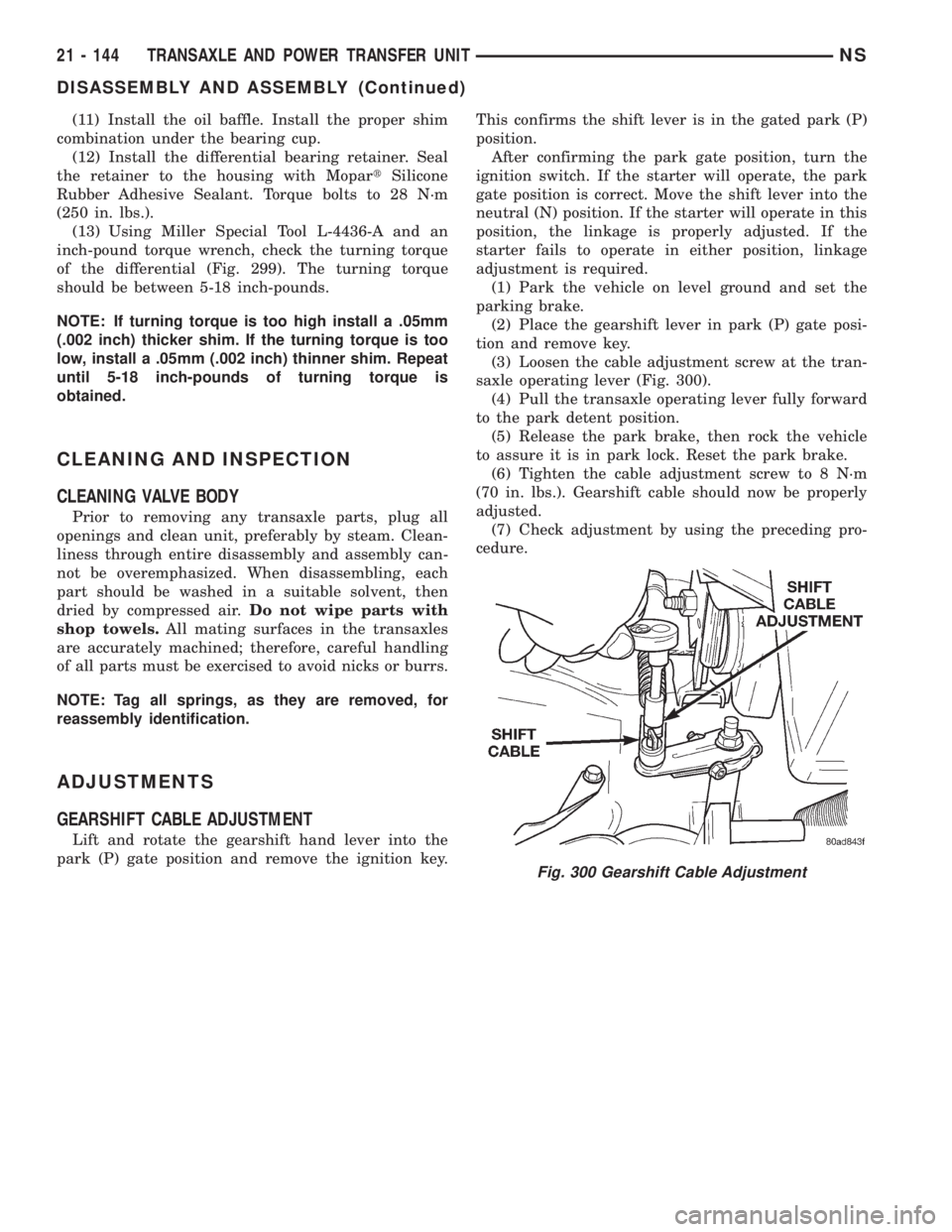
(3) Loosen the cable adjustment screw at the tran-
saxle operating lever (Fig. 300).
(4) Pull the transaxle operating lever fully forward
to the park detent position.
(5) Release the park brake, then rock the vehicle
to assure it is in park lock. Reset the park brake.
(6) Tighten the cable adjustment screw to 8 N´m
(70 in. lbs.). Gearshift cable should now be properly
adjusted.
(7) Check adjustment by using the preceding pro-
cedure.
Fig. 300 Gearshift Cable Adjustment
21 - 144 TRANSAXLE AND POWER TRANSFER UNITNS
DISASSEMBLY AND ASSEMBLY (Continued)
Page 1644 of 1938
INSTALLATION
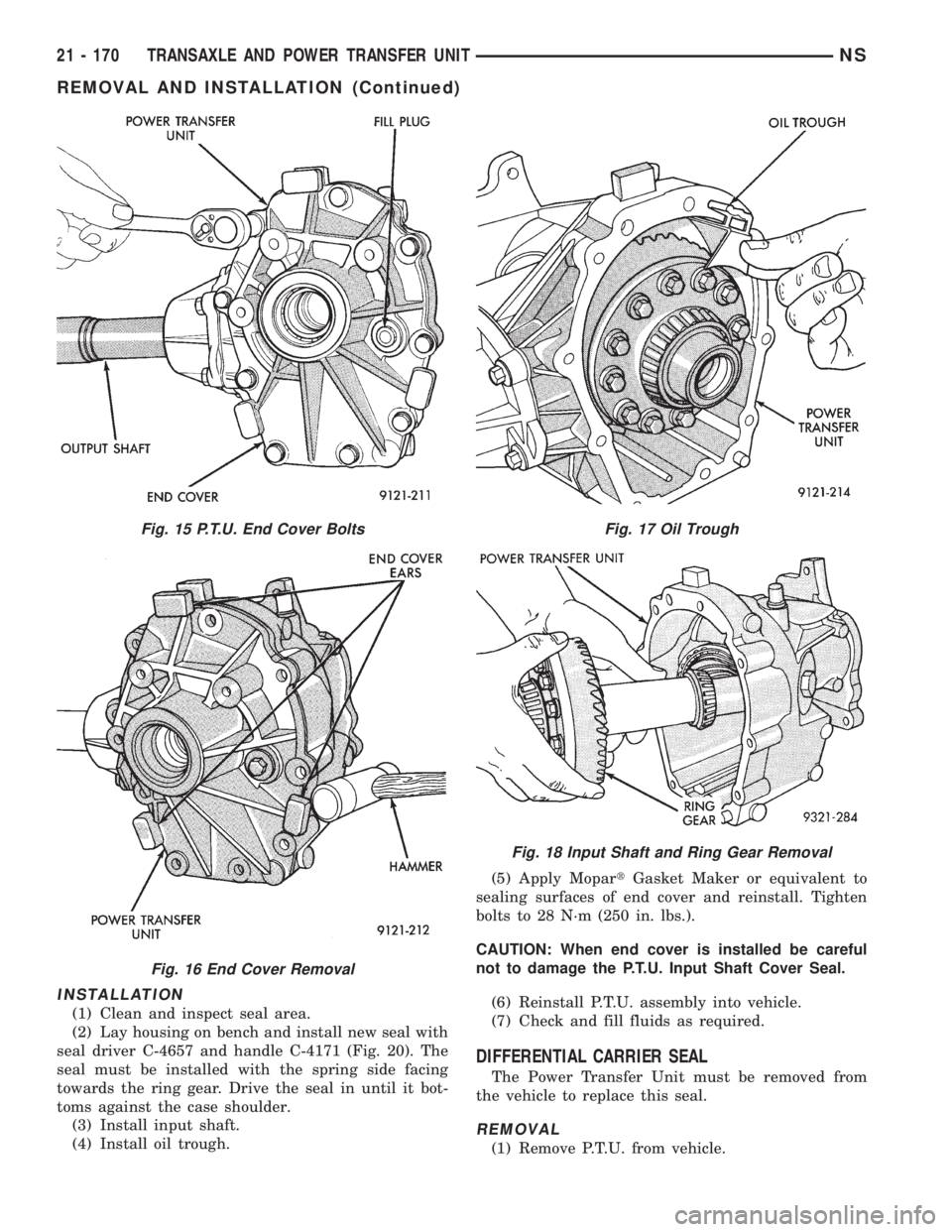
(1) Clean and inspect seal area.
(2) Lay housing on bench and install new seal with
seal driver C-4657 and handle C-4171 (Fig. 20). The
seal must be installed with the spring side facing
towards the ring gear. Drive the seal in until it bot-
toms against the case shoulder.
(3) Install input shaft.
(4) Install oil trough.(5) Apply MopartGasket Maker or equivalent to
sealing surfaces of end cover and reinstall. Tighten
bolts to 28 N´m (250 in. lbs.).
CAUTION: When end cover is installed be careful
not to damage the P.T.U. Input Shaft Cover Seal.
(6) Reinstall P.T.U. assembly into vehicle.
(7) Check and fill fluids as required.
DIFFERENTIAL CARRIER SEAL
The Power Transfer Unit must be removed from
the vehicle to replace this seal.
REMOVAL
(1) Remove P.T.U. from vehicle.
Fig. 15 P.T.U. End Cover Bolts
Fig. 16 End Cover Removal
Fig. 17 Oil Trough
Fig. 18 Input Shaft and Ring Gear Removal
21 - 170 TRANSAXLE AND POWER TRANSFER UNITNS
REMOVAL AND INSTALLATION (Continued)
Page 1648 of 1938
(4) Install rear cover. Use care not to cut rear
cover O-Ring when installing rear cover into P.T.U.
housing.
(5) Install rear cover retaining bolts and tighten to
28 N´m (250 in. lbs.).
(6) Install propeller shaft.
(7) Check and fill fluids as required.
INPUT SHAFT COVER SEAL
The power transfer unit input shaft cover seal is
the larger of the two seals located on the inside of
the end cover. The differential bearing cup must be
removed to service this seal.
The Power Transfer Unit must be removed from
vehicle to perform this operation.
REMOVAL
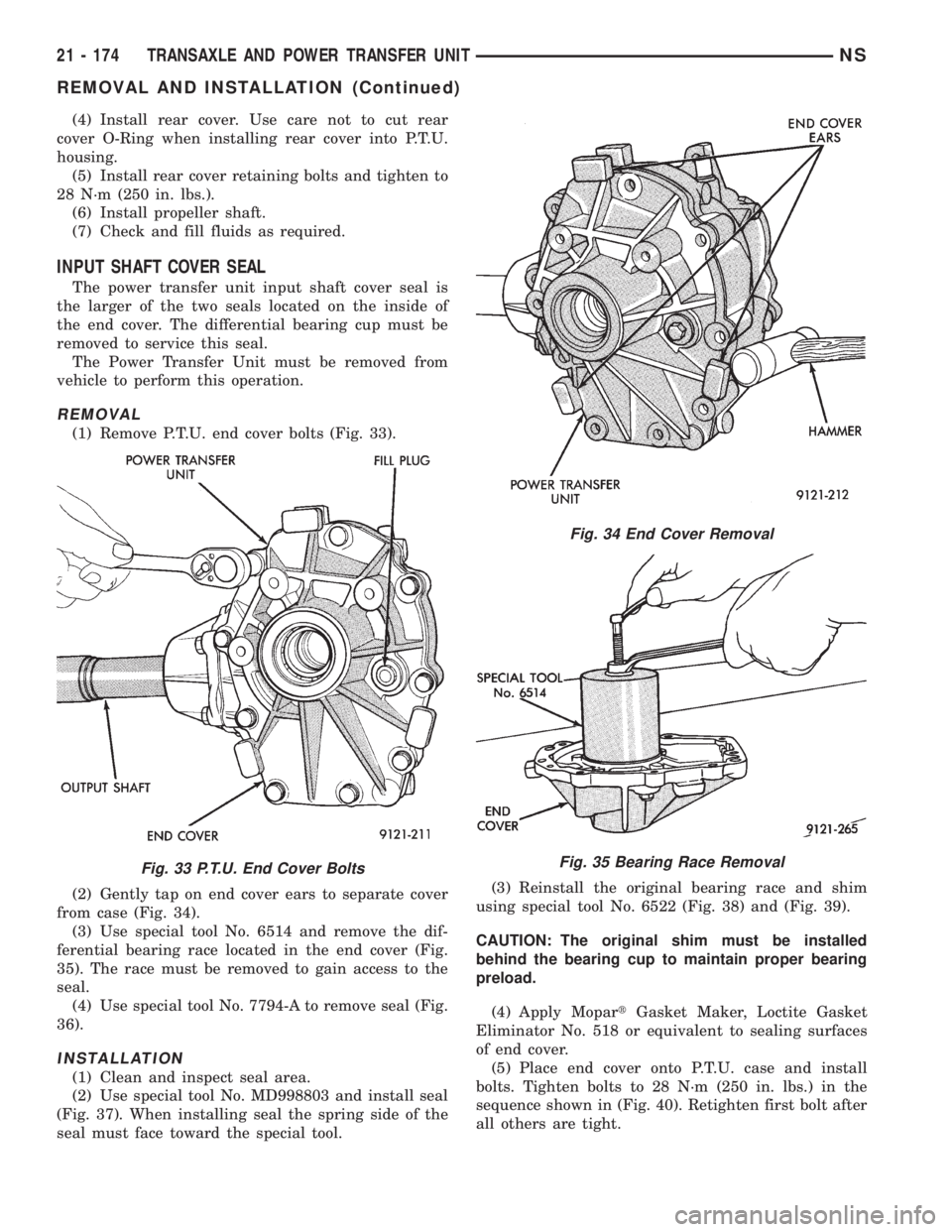
(1) Remove P.T.U. end cover bolts (Fig. 33).
(2) Gently tap on end cover ears to separate cover
from case (Fig. 34).
(3) Use special tool No. 6514 and remove the dif-
ferential bearing race located in the end cover (Fig.
35). The race must be removed to gain access to the
seal.
(4) Use special tool No. 7794-A to remove seal (Fig.
36).
INSTALLATION
(1) Clean and inspect seal area.
(2) Use special tool No. MD998803 and install seal
(Fig. 37). When installing seal the spring side of the
seal must face toward the special tool.(3) Reinstall the original bearing race and shim
using special tool No. 6522 (Fig. 38) and (Fig. 39).
CAUTION: The original shim must be installed
behind the bearing cup to maintain proper bearing
preload.
(4) Apply MopartGasket Maker, Loctite Gasket
Eliminator No. 518 or equivalent to sealing surfaces
of end cover.
(5) Place end cover onto P.T.U. case and install
bolts. Tighten bolts to 28 N´m (250 in. lbs.) in the
sequence shown in (Fig. 40). Retighten first bolt after
all others are tight.
Fig. 33 P.T.U. End Cover Bolts
Fig. 34 End Cover Removal
Fig. 35 Bearing Race Removal
21 - 174 TRANSAXLE AND POWER TRANSFER UNITNS
REMOVAL AND INSTALLATION (Continued)
Page 1708 of 1938
REVERSE SHIFT LEVER
REMOVAL
(1) Remove reverse shift lever E-clip.
(2) Remove the flat and wave washers.
(3) Remove the reverse shift lever from the mount-
ing stud.
INSTALLATION
(1) Position the reverse shift lever onto the mount-
ing stud.
(2) Install the washers onto the mounting stud.
(3) Install the E-clip.
CLEANING AND INSPECTION
TRANSAXLE
Clean the gears, bearings, shafts, synchronizers,
thrust washers, oil feeder, shift mechanism, gear
case, and bellhousing with solvent. Dry all parts
except the bearings with compressed air. Allow thebearings to either air dry or wipe them dry with
clean shop towels.
Inspect the gears, bearings, shafts and thrust
washers. Replace the bearings and cups if the rollers
are worn, chipped, cracked, flat spotted, or brin-
nelled, or if the bearing cage is damaged or distorted.
Replace the thrust washers if cracked, chipped, or
worn. Replace the gears if the teeth are chipped,
cracked, or worn thin. Inspect the synchronizers.
Replace the sleeve if worn or damaged in any way.
Replace the stop rings if the friction material is
burned, flaking off, or worn. Check the condition of
the synchro struts and springs. Replace these parts if
worn, cracked, or distorted.
SYNCHRONIZER
CLEAN
Do not attempt to clean the blocking rings in sol-
vent. The friction material will become contaminated.
Place synchronizer components in a suitable holder
and clean with solvent. Air dry.
INSPECT
Proper inspection of components involve:
²Teeth, for wear, scuffed, nicked, burred, or bro-
ken teeth
²Struts, for wear or distortion
²Springs, for distortion, cracks, or wear
If any of these conditions exist in these compo-
nents, replace as necessary.
ADJUSTMENTS
GEARSHIFT CROSSOVER CABLE
Before replacing the gearshift cables for a hard-
shifting complaint, disconnect both cables at the
transaxle. Then, from the driver's seat, manually
operate the gearshift lever through all gear ranges. If
the gearshift lever moves smoothly, the cable(s)
should NOT be replaced. If the gear lever binds
replace the cable that is causing the binding condi-
tion. If the problem still exists, check the crossover
cable adjustment (Fig. 210).
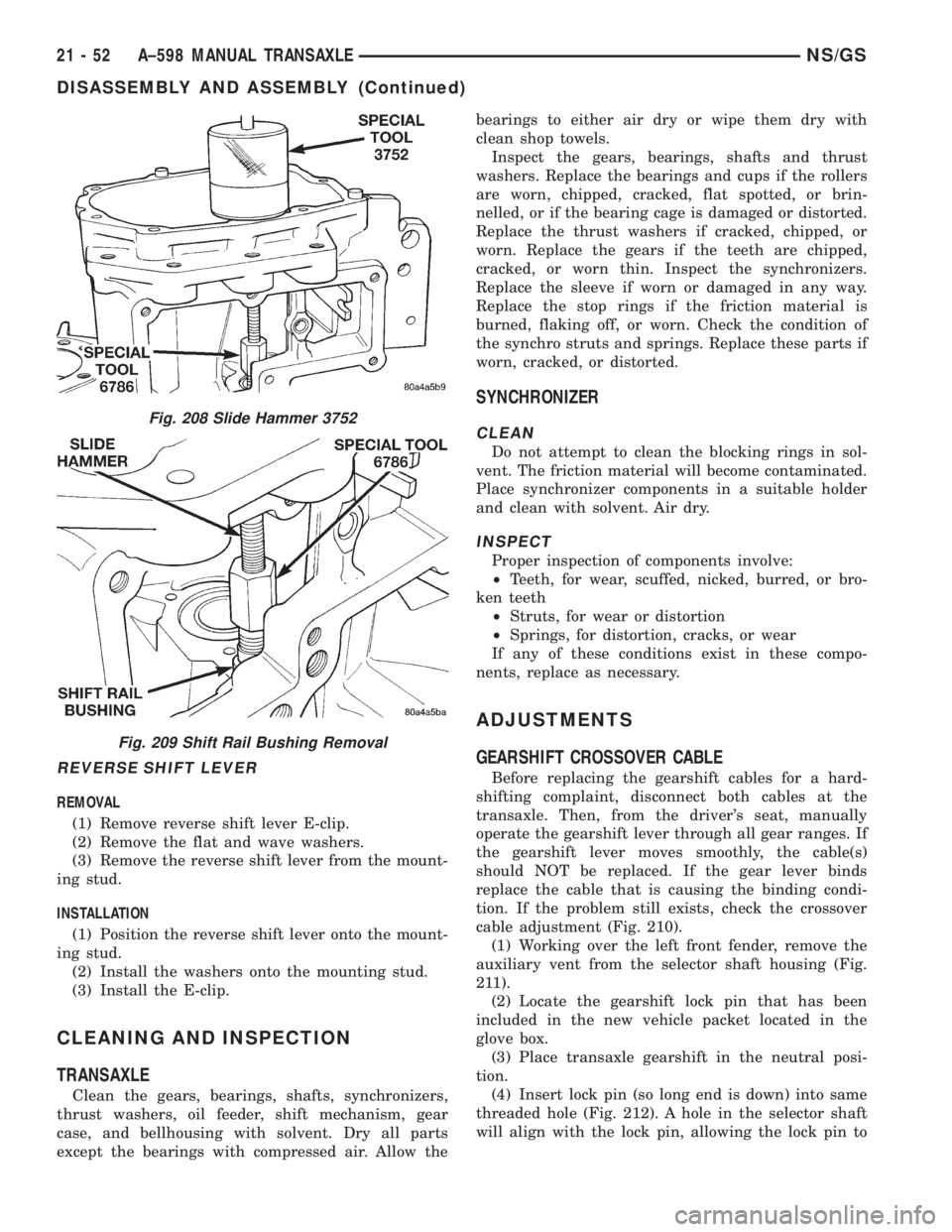
(1) Working over the left front fender, remove the
auxiliary vent from the selector shaft housing (Fig.
211).
(2) Locate the gearshift lock pin that has been
included in the new vehicle packet located in the
glove box.
(3) Place transaxle gearshift in the neutral posi-
tion.
(4) Insert lock pin (so long end is down) into same
threaded hole (Fig. 212). A hole in the selector shaft
will align with the lock pin, allowing the lock pin to
Fig. 208 Slide Hammer 3752
Fig. 209 Shift Rail Bushing Removal
21 - 52 A±598 MANUAL TRANSAXLENS/GS
DISASSEMBLY AND ASSEMBLY (Continued)
Page 1710 of 1938
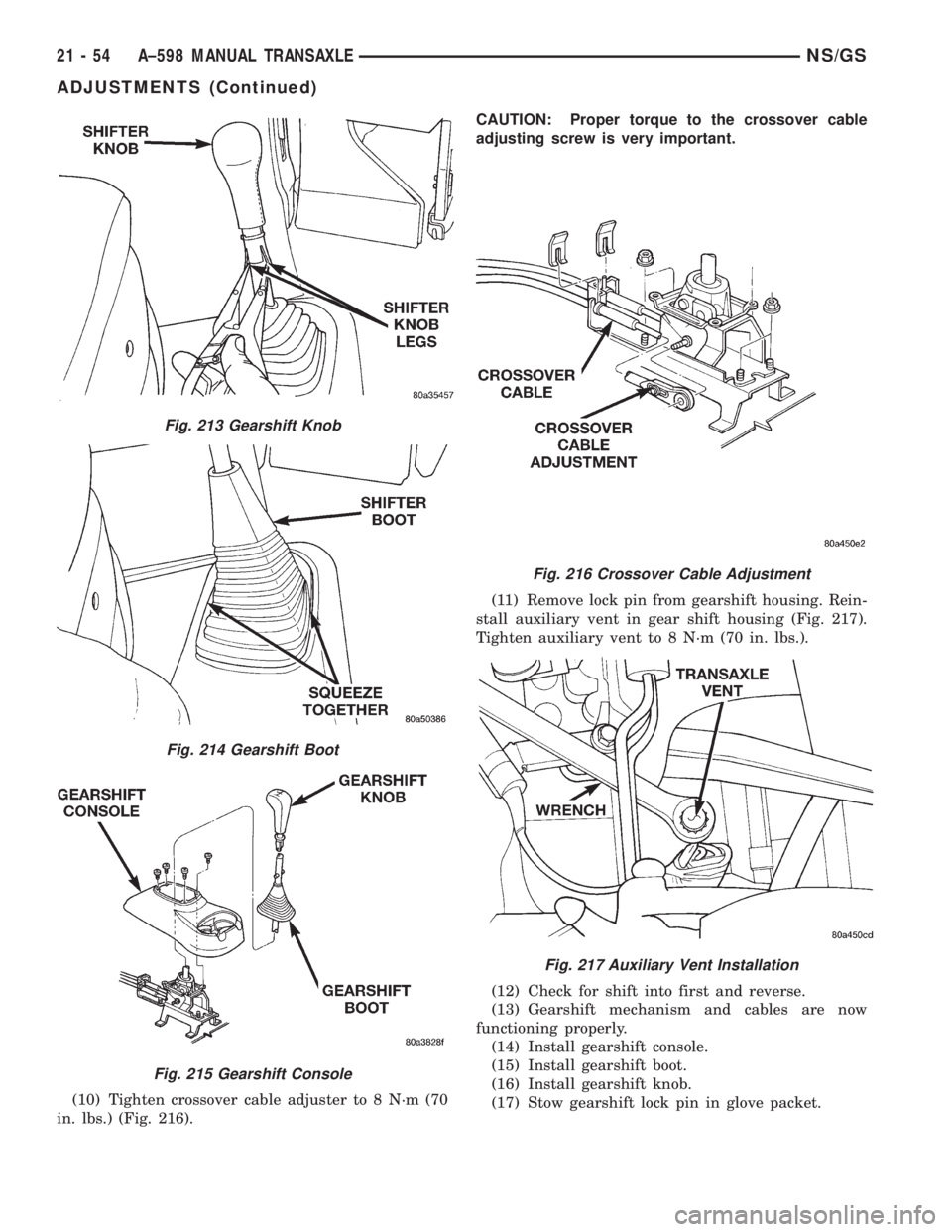
(10) Tighten crossover cable adjuster to 8 N´m (70
in. lbs.) (Fig. 216).CAUTION: Proper torque to the crossover cable
adjusting screw is very important.
(11) Remove lock pin from gearshift housing. Rein-
stall auxiliary vent in gear shift housing (Fig. 217).
Tighten auxiliary vent to 8 N´m (70 in. lbs.).
(12) Check for shift into first and reverse.
(13) Gearshift mechanism and cables are now
functioning properly.
(14) Install gearshift console.
(15) Install gearshift boot.
(16) Install gearshift knob.
(17) Stow gearshift lock pin in glove packet.
Fig. 213 Gearshift Knob
Fig. 214 Gearshift Boot
Fig. 215 Gearshift Console
Fig. 216 Crossover Cable Adjustment
Fig. 217 Auxiliary Vent Installation
21 - 54 A±598 MANUAL TRANSAXLENS/GS
ADJUSTMENTS (Continued)
Page 1712 of 1938
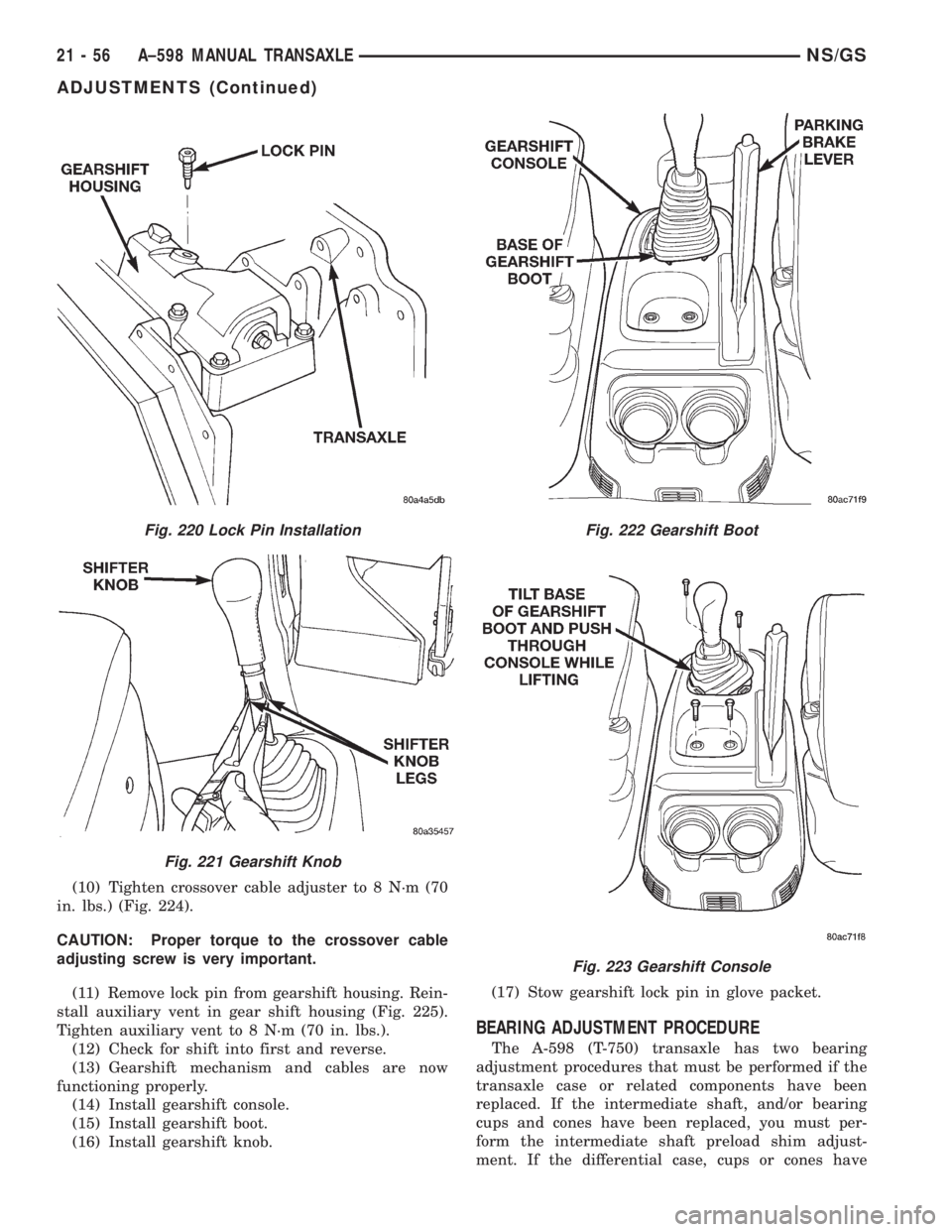
(10) Tighten crossover cable adjuster to 8 N´m (70
in. lbs.) (Fig. 224).
CAUTION: Proper torque to the crossover cable
adjusting screw is very important.
(11) Remove lock pin from gearshift housing. Rein-
stall auxiliary vent in gear shift housing (Fig. 225).
Tighten auxiliary vent to 8 N´m (70 in. lbs.).
(12) Check for shift into first and reverse.
(13) Gearshift mechanism and cables are now
functioning properly.
(14) Install gearshift console.
(15) Install gearshift boot.
(16) Install gearshift knob.(17) Stow gearshift lock pin in glove packet.
BEARING ADJUSTMENT PROCEDURE
The A-598 (T-750) transaxle has two bearing
adjustment procedures that must be performed if the
transaxle case or related components have been
replaced. If the intermediate shaft, and/or bearing
cups and cones have been replaced, you must per-
form the intermediate shaft preload shim adjust-
ment. If the differential case, cups or cones have
Fig. 220 Lock Pin Installation
Fig. 221 Gearshift Knob
Fig. 222 Gearshift Boot
Fig. 223 Gearshift Console
21 - 56 A±598 MANUAL TRANSAXLENS/GS
ADJUSTMENTS (Continued)
Page 1742 of 1938
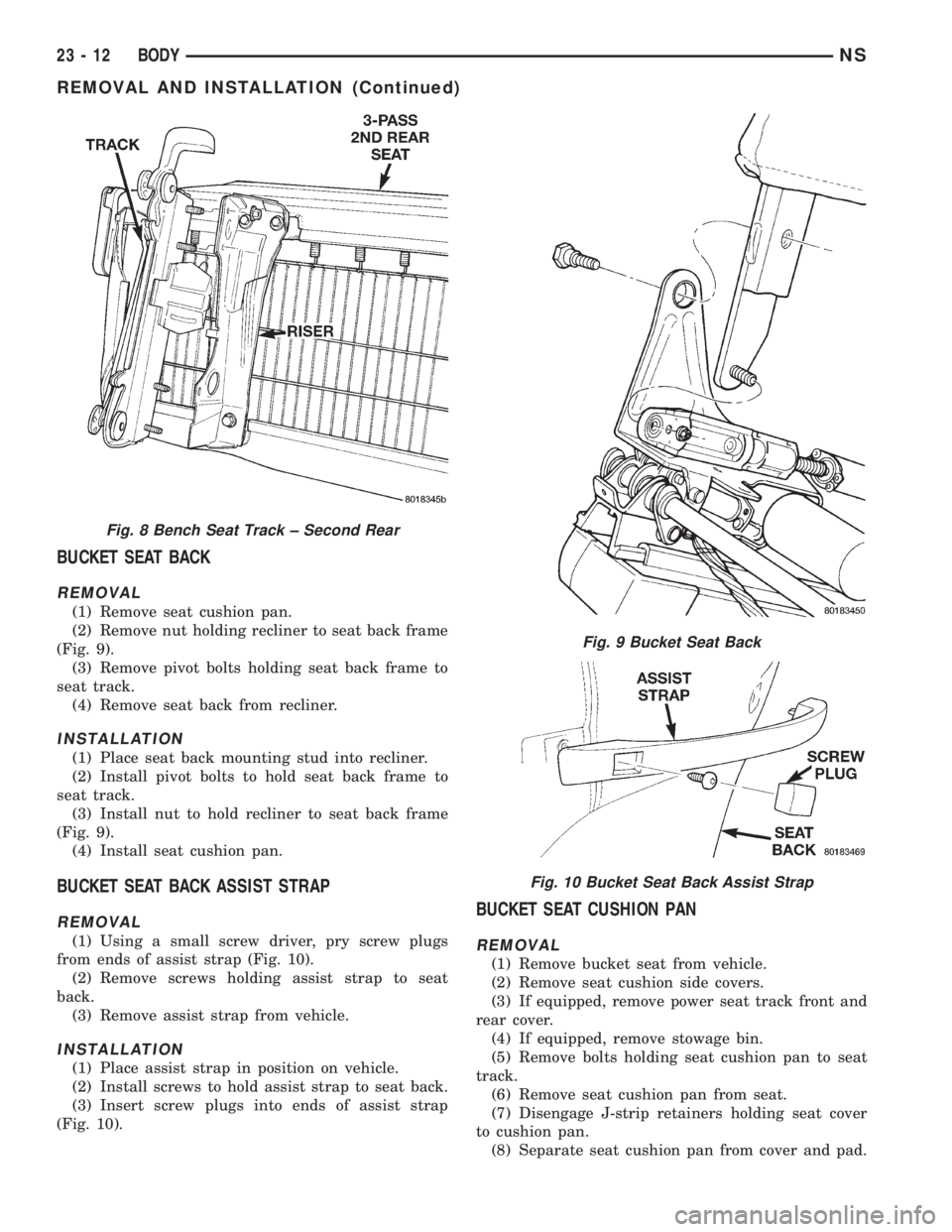
BUCKET SEAT BACK
REMOVAL
(1) Remove seat cushion pan.
(2) Remove nut holding recliner to seat back frame
(Fig. 9).
(3) Remove pivot bolts holding seat back frame to
seat track.
(4) Remove seat back from recliner.
INSTALLATION
(1) Place seat back mounting stud into recliner.
(2) Install pivot bolts to hold seat back frame to
seat track.
(3) Install nut to hold recliner to seat back frame
(Fig. 9).
(4) Install seat cushion pan.
BUCKET SEAT BACK ASSIST STRAP
REMOVAL
(1) Using a small screw driver, pry screw plugs
from ends of assist strap (Fig. 10).
(2) Remove screws holding assist strap to seat
back.
(3) Remove assist strap from vehicle.
INSTALLATION
(1) Place assist strap in position on vehicle.
(2) Install screws to hold assist strap to seat back.
(3) Insert screw plugs into ends of assist strap
(Fig. 10).
BUCKET SEAT CUSHION PAN
REMOVAL
(1) Remove bucket seat from vehicle.
(2) Remove seat cushion side covers.
(3) If equipped, remove power seat track front and
rear cover.
(4) If equipped, remove stowage bin.
(5) Remove bolts holding seat cushion pan to seat
track.
(6) Remove seat cushion pan from seat.
(7) Disengage J-strip retainers holding seat cover
to cushion pan.
(8) Separate seat cushion pan from cover and pad.
Fig. 8 Bench Seat Track ± Second Rear
Fig. 9 Bucket Seat Back
Fig. 10 Bucket Seat Back Assist Strap
23 - 12 BODYNS
REMOVAL AND INSTALLATION (Continued)