coolant CHRYSLER VOYAGER 1996 Service Manual
[x] Cancel search | Manufacturer: CHRYSLER, Model Year: 1996, Model line: VOYAGER, Model: CHRYSLER VOYAGER 1996Pages: 1938, PDF Size: 55.84 MB
Page 1930 of 1938

defective fuel injector sensoris monitoredby the
PCM.
Vacuum Assist:Leaks or restrictions in the vac-
uum circuits of vacuum assisted engine control sys-
tem devices are not monitored by the PCM.
PCM System Ground:The PCM cannot deter-
mine a poor system ground. However, a DTC may be
generated as a result of this condition.
PCM Connector Engagement:The PCM cannot
determine spread or damaged connector pins. How-
ever, a DTC may be generated as a result of this con-
dition.
HIGH AND LOW LIMITS
The PCM compares input signal voltages from each
input device. It will establish high and low limits
that are programmed into it for that device. If the
input voltage is not within specifications and other
DTC criteria are met, a DTC will be stored in mem-
ory. Other DTC criteria might include engine rpm
limits or input voltages from other sensors or
switches. The other inputs might have to be sensed
by the PCM when it senses a high or low input volt-
age from the control system device in question.
DESCRIPTION AND OPERATION
DIAGNOSTIC TROUBLE CODES
On the following pages, a list of DTC's is provided
for the 2.5L diesel engine. A DTC indicates that the
PCM has recognized an abnormal signal in a circuitor the system. A DTC may indicate the result of a
failure, but most likely will not identify the failed
component directly.
ACCESSING DIAGNOSTIC TROUBLE CODES
A stored DTC can be displayed through the use of
the DRB III scan tool. The DRB III connects to the
data link connector. The data link connector is
located under the instrument panel near bottom of
the steering column (Fig. 1).
ERASING TROUBLE CODES
After the problem has been repaired, use the DRB
III scan tool to erase a DTC.
Generic Scan
Tool CodeDRB III Scan Tool Display
P1112 Boost Pressure Sensor Signal High
Boost Pressure Sensor Signal Low
Boost Pressure Sensor Supply High
Boost Pressure Sensor Supply Low
Boost Pressure Sensor Plausibility
P0110 Intake Air Temperature Sensor Signal High
Intake Air Temperature Sensor Signal Low
P1685 Immobilizer Signal Lost
Invalid SKIM Message
P0115 Temperature of Engine Coolant SRC High Exceeded
Temperature of Engine Coolant SRC Low Exceeded
P0180 Fuel Temperature Sensor SRC High Exceeded
Fuel Temperature Sensor SRC Low Exceeded
P0400 EGR Open Circuit
EGR Short Circuit
P0500 Vehicle Speed Sensor PEC Frequency Too High
Vehicle Speed Sensor Signal SRC High Exceeded
Fig. 1 Data Link Connector LocationÐTypical
25 - 2 EMISSION CONTROL SYSTEMNS/GS
GENERAL INFORMATION (Continued)
Page 1934 of 1938
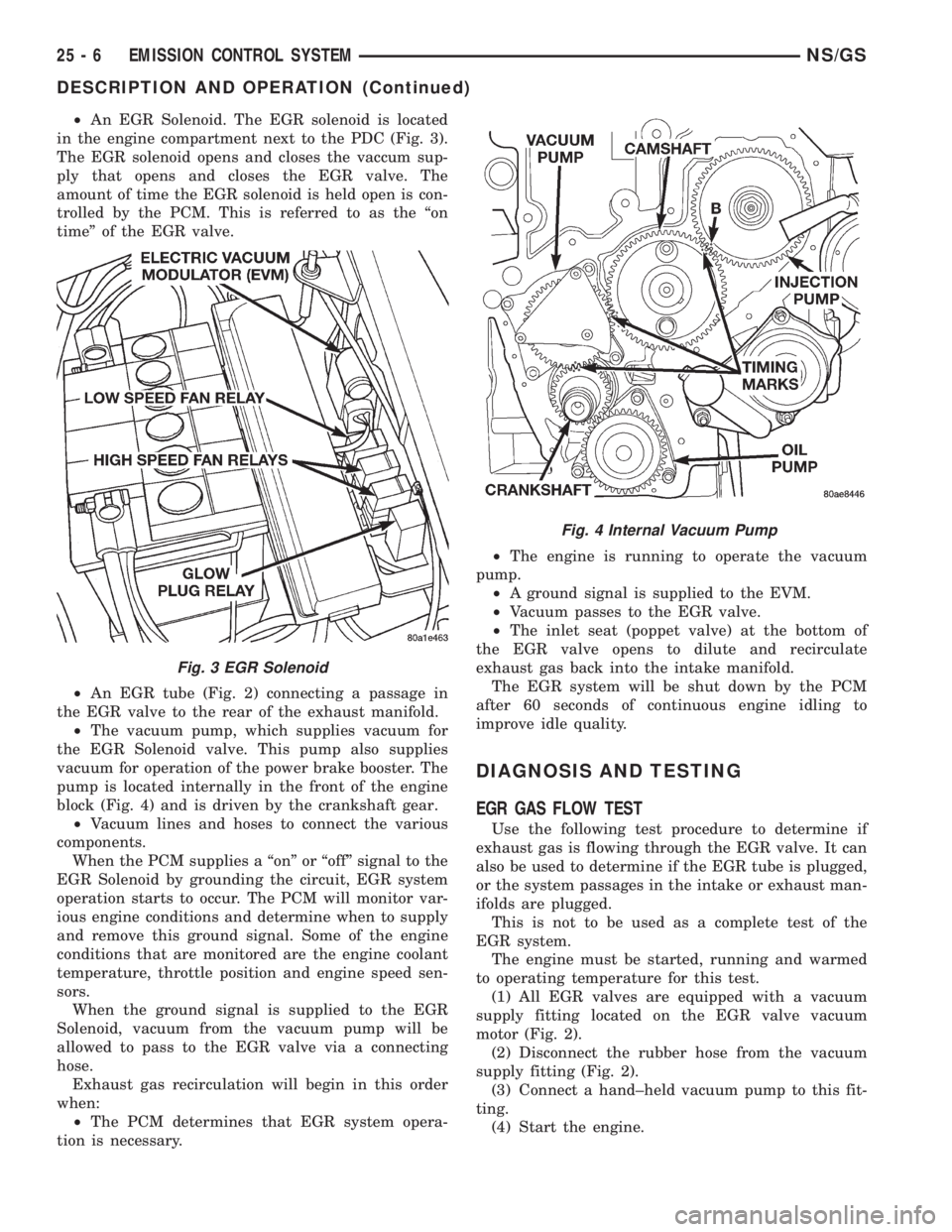
²An EGR Solenoid. The EGR solenoid is located
in the engine compartment next to the PDC (Fig. 3).
The EGR solenoid opens and closes the vaccum sup-
ply that opens and closes the EGR valve. The
amount of time the EGR solenoid is held open is con-
trolled by the PCM. This is referred to as the ªon
timeº of the EGR valve.
²An EGR tube (Fig. 2) connecting a passage in
the EGR valve to the rear of the exhaust manifold.
²The vacuum pump, which supplies vacuum for
the EGR Solenoid valve. This pump also supplies
vacuum for operation of the power brake booster. The
pump is located internally in the front of the engine
block (Fig. 4) and is driven by the crankshaft gear.
²Vacuum lines and hoses to connect the various
components.
When the PCM supplies a ªonº or ªoffº signal to the
EGR Solenoid by grounding the circuit, EGR system
operation starts to occur. The PCM will monitor var-
ious engine conditions and determine when to supply
and remove this ground signal. Some of the engine
conditions that are monitored are the engine coolant
temperature, throttle position and engine speed sen-
sors.
When the ground signal is supplied to the EGR
Solenoid, vacuum from the vacuum pump will be
allowed to pass to the EGR valve via a connecting
hose.
Exhaust gas recirculation will begin in this order
when:
²The PCM determines that EGR system opera-
tion is necessary.²The engine is running to operate the vacuum
pump.
²A ground signal is supplied to the EVM.
²Vacuum passes to the EGR valve.
²The inlet seat (poppet valve) at the bottom of
the EGR valve opens to dilute and recirculate
exhaust gas back into the intake manifold.
The EGR system will be shut down by the PCM
after 60 seconds of continuous engine idling to
improve idle quality.
DIAGNOSIS AND TESTING
EGR GAS FLOW TEST
Use the following test procedure to determine if
exhaust gas is flowing through the EGR valve. It can
also be used to determine if the EGR tube is plugged,
or the system passages in the intake or exhaust man-
ifolds are plugged.
This is not to be used as a complete test of the
EGR system.
The engine must be started, running and warmed
to operating temperature for this test.
(1) All EGR valves are equipped with a vacuum
supply fitting located on the EGR valve vacuum
motor (Fig. 2).
(2) Disconnect the rubber hose from the vacuum
supply fitting (Fig. 2).
(3) Connect a hand±held vacuum pump to this fit-
ting.
(4) Start the engine.
Fig. 3 EGR Solenoid
Fig. 4 Internal Vacuum Pump
25 - 6 EMISSION CONTROL SYSTEMNS/GS
DESCRIPTION AND OPERATION (Continued)