height CHRYSLER VOYAGER 1996 User Guide
[x] Cancel search | Manufacturer: CHRYSLER, Model Year: 1996, Model line: VOYAGER, Model: CHRYSLER VOYAGER 1996Pages: 1938, PDF Size: 55.84 MB
Page 82 of 1938
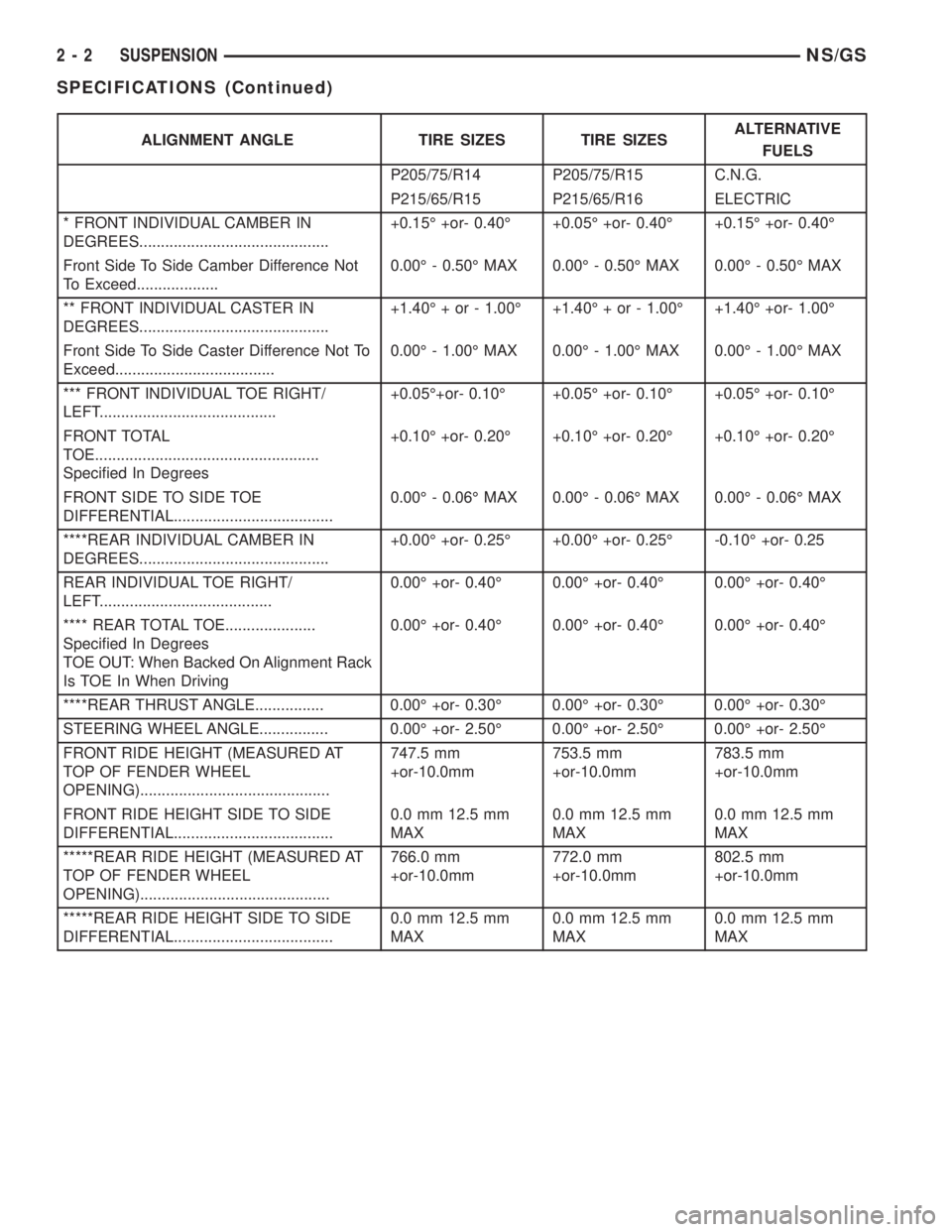
ALIGNMENT ANGLE TIRE SIZES TIRE SIZESALTERNATIVE
FUELS
P205/75/R14 P205/75/R15 C.N.G.
P215/65/R15 P215/65/R16 ELECTRIC
* FRONT INDIVIDUAL CAMBER IN
DEGREES............................................+0.15É +or- 0.40É +0.05É +or- 0.40É +0.15É +or- 0.40É
Front Side To Side Camber Difference Not
To Exceed...................0.00É - 0.50É MAX 0.00É - 0.50É MAX 0.00É - 0.50É MAX
** FRONT INDIVIDUAL CASTER IN
DEGREES............................................+1.40É + or - 1.00É +1.40É + or - 1.00É +1.40É +or- 1.00É
Front Side To Side Caster Difference Not To
Exceed.....................................0.00É - 1.00É MAX 0.00É - 1.00É MAX 0.00É - 1.00É MAX
*** FRONT INDIVIDUAL TOE RIGHT/
LEFT.........................................+0.05É+or- 0.10É +0.05É +or- 0.10É +0.05É +or- 0.10É
FRONT TOTAL
TOE....................................................
Specified In Degrees+0.10É +or- 0.20É +0.10É +or- 0.20É +0.10É +or- 0.20É
FRONT SIDE TO SIDE TOE
DIFFERENTIAL.....................................0.00É - 0.06É MAX 0.00É - 0.06É MAX 0.00É - 0.06É MAX
****REAR INDIVIDUAL CAMBER IN
DEGREES............................................+0.00É +or- 0.25É +0.00É +or- 0.25É -0.10É +or- 0.25
REAR INDIVIDUAL TOE RIGHT/
LEFT........................................0.00É +or- 0.40É 0.00É +or- 0.40É 0.00É +or- 0.40É
**** REAR TOTAL TOE.....................
Specified In Degrees
TOE OUT: When Backed On Alignment Rack
Is TOE In When Driving0.00É +or- 0.40É 0.00É +or- 0.40É 0.00É +or- 0.40É
****REAR THRUST ANGLE................ 0.00É +or- 0.30É 0.00É +or- 0.30É 0.00É +or- 0.30É
STEERING WHEEL ANGLE................ 0.00É +or- 2.50É 0.00É +or- 2.50É 0.00É +or- 2.50É
FRONT RIDE HEIGHT (MEASURED AT
TOP OF FENDER WHEEL
OPENING)............................................747.5 mm
+or-10.0mm753.5 mm
+or-10.0mm783.5 mm
+or-10.0mm
FRONT RIDE HEIGHT SIDE TO SIDE
DIFFERENTIAL.....................................0.0 mm 12.5 mm
MAX0.0 mm 12.5 mm
MAX0.0 mm 12.5 mm
MAX
*****REAR RIDE HEIGHT (MEASURED AT
TOP OF FENDER WHEEL
OPENING)............................................766.0 mm
+or-10.0mm772.0 mm
+or-10.0mm802.5 mm
+or-10.0mm
*****REAR RIDE HEIGHT SIDE TO SIDE
DIFFERENTIAL.....................................0.0 mm 12.5 mm
MAX0.0 mm 12.5 mm
MAX0.0 mm 12.5 mm
MAX
2 - 2 SUSPENSIONNS/GS
SPECIFICATIONS (Continued)
Page 83 of 1938
BRAKES
CONTENTS
page page
ANTILOCK BRAKE SYSTEM ±
TEVES MARK-20....................... 85BASE BRAKE SYSTEM..................... 3
GENERAL INFORMATION................... 1
GENERAL INFORMATION
INDEX
page page
GENERAL INFORMATION
BASE BRAKE SYSTEM COMPONENT
DESCRIPTION......................... 1GENERAL VEHICLE SERVICE CAUTIONS...... 1
GENERAL INFORMATION
GENERAL VEHICLE SERVICE CAUTIONS
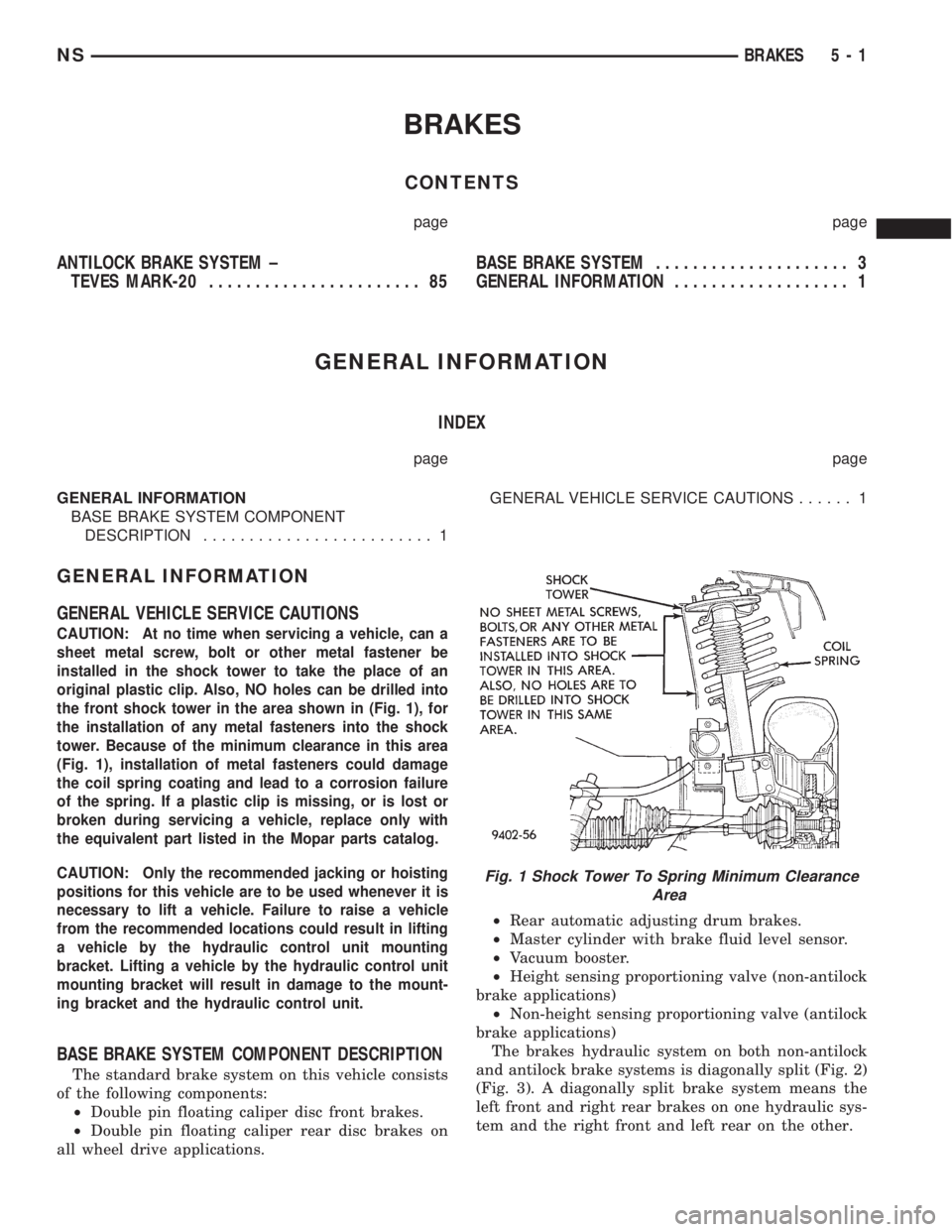
CAUTION: At no time when servicing a vehicle, can a
sheet metal screw, bolt or other metal fastener be
installed in the shock tower to take the place of an
original plastic clip. Also, NO holes can be drilled into
the front shock tower in the area shown in (Fig. 1), for
the installation of any metal fasteners into the shock
tower. Because of the minimum clearance in this area
(Fig. 1), installation of metal fasteners could damage
the coil spring coating and lead to a corrosion failure
of the spring. If a plastic clip is missing, or is lost or
broken during servicing a vehicle, replace only with
the equivalent part listed in the Mopar parts catalog.
CAUTION: Only the recommended jacking or hoisting
positions for this vehicle are to be used whenever it is
necessary to lift a vehicle. Failure to raise a vehicle
from the recommended locations could result in lifting
a vehicle by the hydraulic control unit mounting
bracket. Lifting a vehicle by the hydraulic control unit
mounting bracket will result in damage to the mount-
ing bracket and the hydraulic control unit.
BASE BRAKE SYSTEM COMPONENT DESCRIPTION
The standard brake system on this vehicle consists
of the following components:
²Double pin floating caliper disc front brakes.
²Double pin floating caliper rear disc brakes on
all wheel drive applications.²Rear automatic adjusting drum brakes.
²Master cylinder with brake fluid level sensor.
²Vacuum booster.
²Height sensing proportioning valve (non-antilock
brake applications)
²Non-height sensing proportioning valve (antilock
brake applications)
The brakes hydraulic system on both non-antilock
and antilock brake systems is diagonally split (Fig. 2)
(Fig. 3). A diagonally split brake system means the
left front and right rear brakes on one hydraulic sys-
tem and the right front and left rear on the other.
Fig. 1 Shock Tower To Spring Minimum Clearance
Area
NSBRAKES 5 - 1
Page 85 of 1938
BASE BRAKE SYSTEM
INDEX
page page
DESCRIPTION AND OPERATION
CHASSIS TUBES AND HOSES.............. 7
FRONT DISC BRAKE SYSTEM.............. 4
HUB/BEARING REAR WHEEL............... 9
MASTER CYLINDER...................... 7
PARKING BRAKE SYSTEM OPERATION....... 5
POWER BRAKE VACUUM BOOSTER
OPERATION........................... 8
PROPORTIONING VALVES................. 5
REAR DISC BRAKES...................... 5
REAR DRUM BRAKES..................... 5
RED BRAKE WARNING LAMP OPERATION..... 8
STOP LAMP SWITCH...................... 9
DIAGNOSIS AND TESTING
ADJUSTER REAR DRUM BRAKE
(AUTOMATIC)......................... 14
BRAKE FLUID CONTAMINATION............ 19
BRAKE ROTOR......................... 14
BRAKE SYSTEM BASIC DIAGNOSIS GUIDE.... 9
BRAKE SYSTEM DIAGNOSIS CHARTS....... 10
PROPORTIONING VALVES................ 16
RED BRAKE WARNING LAMP TEST......... 19
STOP LAMP SWITCH TEST PROCEDURE..... 19
TRACTION CONTROL LAMP TEST.......... 19
SERVICE PROCEDURES
BLEEDING BASE BRAKE
HYDRAULIC SYSTEM................... 20
BRAKE DRUM MACHINING................ 24
BRAKE TUBE REPAIR PROCEDURE......... 24
MASTER CYLINDER BLEEDING
PROCEDURE......................... 22
MASTER CYLINDER FLUID LEVEL CHECK.... 20
PARK BRAKE AUTO ADJUSTER
MECHANISM RELEASE................. 26
ROTOR MACHINING (FRONT/REAR)......... 22
REMOVAL AND INSTALLATION
BRAKE SUPPORT PLATE (REAR DRUM
BRAKES)............................ 37
FRONT DISC BRAKE CALIPER............. 27
FRONT DISC BRAKE PADS................ 30
FRONT PARK BRAKE CABLE.............. 65
HUB/BEARING.......................... 40
HYDRAULIC BRAKE TUBES AND HOSES..... 58
INTERMEDIATE PARK BRAKE CABLE....... 66
JUNCTION BLOCK....................... 55
LEFT REAR PARK BRAKE CABLE........... 67
MASTER CYLINDER..................... 44
PARK BRAKE PEDAL MECHANISM.......... 58PARK BRAKE SHOES (WITH REAR DISC
BRAKES)............................ 60
PROPORTIONING VALVE (W/ABS BRAKES) . . . 56
PROPORTIONING VALVE
(W/O ABS BRAKES).................... 57
REAR BRAKE DRUM..................... 33
REAR BRAKE WHEEL CYLINDER........... 39
REAR DISC BRAKE CALIPER.............. 28
REAR DISC BRAKE SHOES................ 31
REAR DRUM BRAKE SHOES............... 34
RIGHT REAR PARK BRAKE CABLE......... 66
STOP LAMP SWITCH..................... 69
VACUUM BOOSTER 2.4 LITER ENGINE...... 47
VACUUM BOOSTER 3.0 LITER ENGINE...... 49
VACUUM BOOSTER 3.3/3.8 LITER ENGINE.... 52
WHEEL AND TIRE INSTALLATION........... 27
DISASSEMBLY AND ASSEMBLY
FRONT DISC BRAKE CALIPER............. 71
MASTER CYLINDER BRAKE FLUID LEVEL
SWITCH............................. 71
MASTER CYLINDER FLUID RESERVOIR
FILL TUBE............................ 71
MASTER CYLINDER FLUID RESERVOIR...... 70
MASTER CYLINDER TO POWER BRAKE
BOOSTER VACUUM SEAL............... 69
WHEEL CYLINDER REAR DRUM BRAKE...... 76
CLEANING AND INSPECTION
BRAKE HOSE AND BRAKE LINES
INSPECTION.......................... 78
FRONT DISC BRAKE PAD LINING
INSPECTION.......................... 76
REAR DISC BRAKES..................... 76
REAR DRUM BRAKE SHOE LINING
INSPECTION.......................... 77
REAR DRUM BRAKE WHEEL CYLINDER...... 78
REAR WHEEL HUB AND BEARING
ASSEMBLY........................... 78
ADJUSTMENTS
PARK BRAKE CABLE ADJUSTMENT......... 81
PARK BRAKE SHOES (WITH REAR DISC
BRAKES)............................ 79
PROPORTIONING VALVE
(HEIGHT SENSING).................... 81
REAR DRUM BRAKE SHOE ADJUSTMENT.... 79
STOP LAMP SWITCH..................... 78
SPECIFICATIONS
BRAKE ACTUATION SYSTEM.............. 83
BRAKE FASTENER TORQUE
SPECIFICATIONS...................... 83
NSBRAKES 5 - 3
Page 88 of 1938
FIXED PROPORTIONING VALVE OPERATION
The fixed proportioning valve is made out of alumi-
num and has an integral mounting bracket. The
fixed proportioning valve is non-serviceable compo-
nent and must be replaced as an assembly if found to
be functioning improperly.
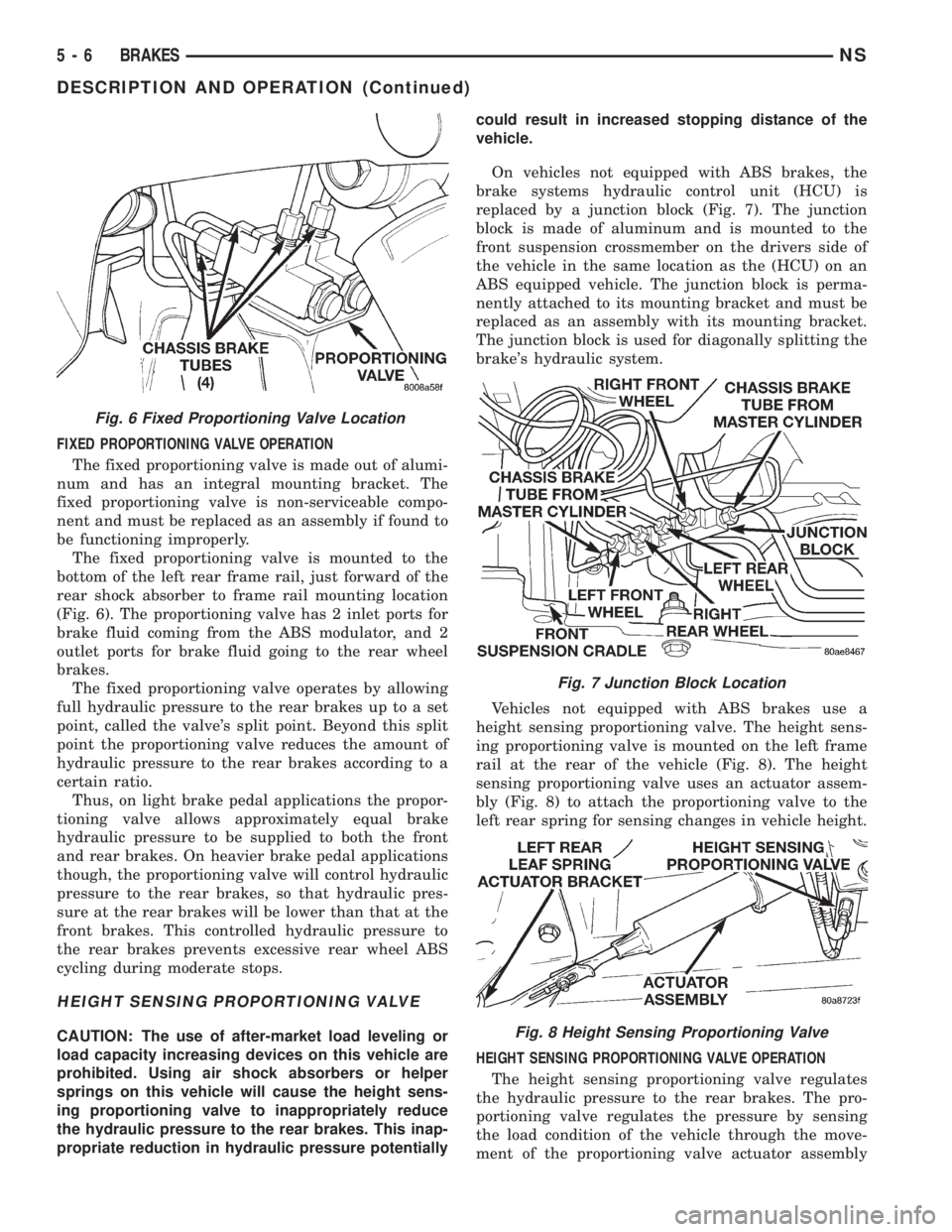
The fixed proportioning valve is mounted to the
bottom of the left rear frame rail, just forward of the
rear shock absorber to frame rail mounting location
(Fig. 6). The proportioning valve has 2 inlet ports for
brake fluid coming from the ABS modulator, and 2
outlet ports for brake fluid going to the rear wheel
brakes.
The fixed proportioning valve operates by allowing
full hydraulic pressure to the rear brakes up to a set
point, called the valve's split point. Beyond this split
point the proportioning valve reduces the amount of
hydraulic pressure to the rear brakes according to a
certain ratio.
Thus, on light brake pedal applications the propor-
tioning valve allows approximately equal brake
hydraulic pressure to be supplied to both the front
and rear brakes. On heavier brake pedal applications
though, the proportioning valve will control hydraulic
pressure to the rear brakes, so that hydraulic pres-
sure at the rear brakes will be lower than that at the
front brakes. This controlled hydraulic pressure to
the rear brakes prevents excessive rear wheel ABS
cycling during moderate stops.
HEIGHT SENSING PROPORTIONING VALVE
CAUTION: The use of after-market load leveling or
load capacity increasing devices on this vehicle are
prohibited. Using air shock absorbers or helper
springs on this vehicle will cause the height sens-
ing proportioning valve to inappropriately reduce
the hydraulic pressure to the rear brakes. This inap-
propriate reduction in hydraulic pressure potentiallycould result in increased stopping distance of the
vehicle.
On vehicles not equipped with ABS brakes, the
brake systems hydraulic control unit (HCU) is
replaced by a junction block (Fig. 7). The junction
block is made of aluminum and is mounted to the
front suspension crossmember on the drivers side of
the vehicle in the same location as the (HCU) on an
ABS equipped vehicle. The junction block is perma-
nently attached to its mounting bracket and must be
replaced as an assembly with its mounting bracket.
The junction block is used for diagonally splitting the
brake's hydraulic system.
Vehicles not equipped with ABS brakes use a
height sensing proportioning valve. The height sens-
ing proportioning valve is mounted on the left frame
rail at the rear of the vehicle (Fig. 8). The height
sensing proportioning valve uses an actuator assem-
bly (Fig. 8) to attach the proportioning valve to the
left rear spring for sensing changes in vehicle height.
HEIGHT SENSING PROPORTIONING VALVE OPERATION
The height sensing proportioning valve regulates
the hydraulic pressure to the rear brakes. The pro-
portioning valve regulates the pressure by sensing
the load condition of the vehicle through the move-
ment of the proportioning valve actuator assembly
Fig. 6 Fixed Proportioning Valve Location
Fig. 7 Junction Block Location
Fig. 8 Height Sensing Proportioning Valve
5 - 6 BRAKESNS
DESCRIPTION AND OPERATION (Continued)
Page 89 of 1938
(Fig. 8). The actuator assembly is mounted between
the height sensing proportioning valve and the actua-
tor bracket on the left rear leaf spring (Fig. 8). As the
rear height of the vehicle changes depending on the
load the vehicle is carrying the height change is
transferred to the height sensing proportioning valve.
This change in vehicle height is transferred through
the movement of the left rear leaf spring. As the posi-
tion of the left rear leaf spring changes this move-
ment is transferred through the actuator bracket
(Fig. 8) to the actuator assembly (Fig. 8) and then to
the proportioning valve.
Thus, the height sensing proportioning valve
allows the brake system to maintain the optimal
front to rear brake balance regardless of the vehicle
load condition. Under a light load condition, hydrau-
lic pressure to the rear brakes is minimized. As the
load condition of the vehicle increases, so does the
hydraulic pressure to the rear brakes.
The proportioning valve section of the valve oper-
ates by transmitting full input hydraulic pressure to
the rear brakes up to a certain point, called the split
point. Beyond the split point the proportioning valve
reduces the amount of hydraulic pressure to the rear
brakes according to a certain ratio. Thus, on light
brake applications, approximately equal hydraulic
pressure will be transmitted to the front and rear
brakes. At heavier brake applications, the hydraulic
pressure transmitted to the rear brakes will be lower
then the front brakes. This will prevent premature
rear wheel lock-up and skid.
The height sensing section of the valve thus
changes the split point of the proportioning valve,
based on the rear suspension height of the vehicle.
When the height of the rear suspension is low, the
proportioning valve interprets this as extra load and
the split point of the proportioning valve is raised to
allow more rear braking. When the height of the rear
suspension is high, the proportioning valve interprets
this as a lightly loaded vehicle and the split point of
the proportioning valve is lowered and rear braking
is reduced.
CHASSIS TUBES AND HOSES
The purpose of the chassis brake tubes and flex
hoses is to transfer the pressurized brake fluid devel-
oped by the master cylinder to the wheel brakes of
the vehicle. The chassis tubes are steel with a corro-
sion resistant coating applied to the external surfaces
and the flex hoses are made of reinforced rubber. The
rubber flex hoses allow for the movement of the vehi-
cles suspension.
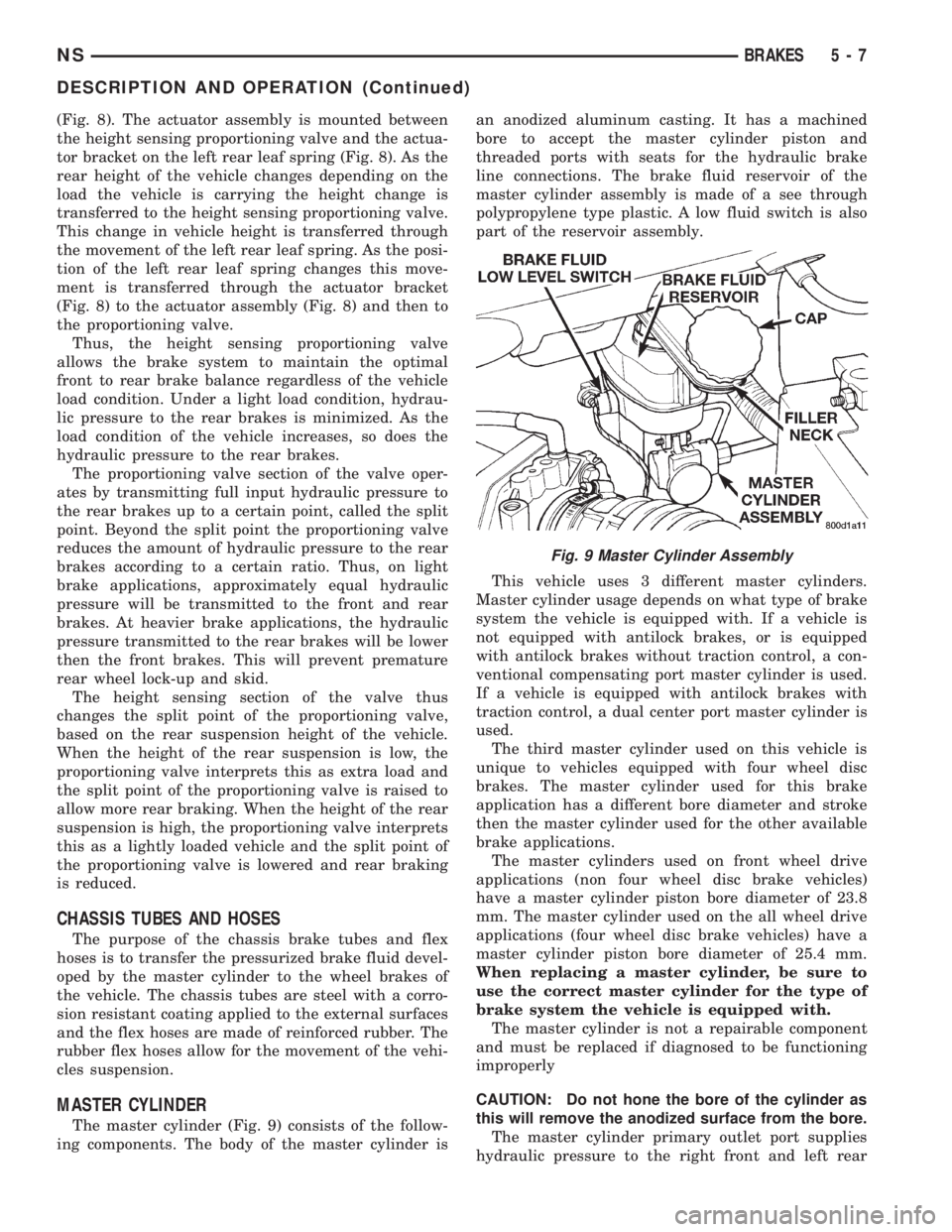
MASTER CYLINDER
The master cylinder (Fig. 9) consists of the follow-
ing components. The body of the master cylinder isan anodized aluminum casting. It has a machined
bore to accept the master cylinder piston and
threaded ports with seats for the hydraulic brake
line connections. The brake fluid reservoir of the
master cylinder assembly is made of a see through
polypropylene type plastic. A low fluid switch is also
part of the reservoir assembly.
This vehicle uses 3 different master cylinders.
Master cylinder usage depends on what type of brake
system the vehicle is equipped with. If a vehicle is
not equipped with antilock brakes, or is equipped
with antilock brakes without traction control, a con-
ventional compensating port master cylinder is used.
If a vehicle is equipped with antilock brakes with
traction control, a dual center port master cylinder is
used.
The third master cylinder used on this vehicle is
unique to vehicles equipped with four wheel disc
brakes. The master cylinder used for this brake
application has a different bore diameter and stroke
then the master cylinder used for the other available
brake applications.
The master cylinders used on front wheel drive
applications (non four wheel disc brake vehicles)
have a master cylinder piston bore diameter of 23.8
mm. The master cylinder used on the all wheel drive
applications (four wheel disc brake vehicles) have a
master cylinder piston bore diameter of 25.4 mm.
When replacing a master cylinder, be sure to
use the correct master cylinder for the type of
brake system the vehicle is equipped with.
The master cylinder is not a repairable component
and must be replaced if diagnosed to be functioning
improperly
CAUTION: Do not hone the bore of the cylinder as
this will remove the anodized surface from the bore.
The master cylinder primary outlet port supplies
hydraulic pressure to the right front and left rear
Fig. 9 Master Cylinder Assembly
NSBRAKES 5 - 7
DESCRIPTION AND OPERATION (Continued)
Page 99 of 1938
(4) Remove the 2 bolts (Fig. 19) attaching the pro-
portioning valve to the frame rail.
CAUTION: When lowering the proportioning valve,
care must be taken not to kink any of the chassis
brake lines.
(5) Carefully lower the proportioning valve for
clearance to install the proportioning valve test fit-
tings.
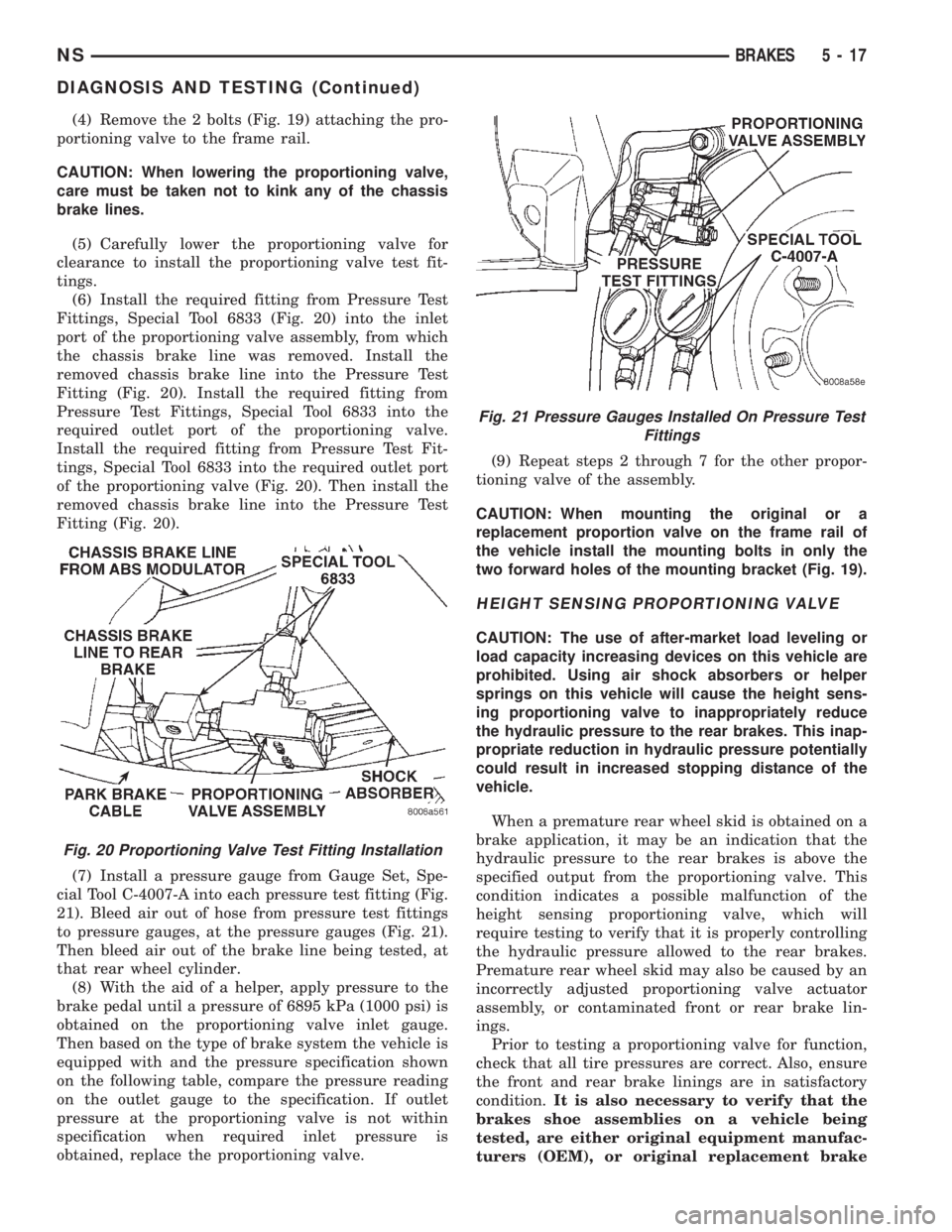
(6) Install the required fitting from Pressure Test
Fittings, Special Tool 6833 (Fig. 20) into the inlet
port of the proportioning valve assembly, from which
the chassis brake line was removed. Install the
removed chassis brake line into the Pressure Test
Fitting (Fig. 20). Install the required fitting from
Pressure Test Fittings, Special Tool 6833 into the
required outlet port of the proportioning valve.
Install the required fitting from Pressure Test Fit-
tings, Special Tool 6833 into the required outlet port
of the proportioning valve (Fig. 20). Then install the
removed chassis brake line into the Pressure Test
Fitting (Fig. 20).
(7) Install a pressure gauge from Gauge Set, Spe-
cial Tool C-4007-A into each pressure test fitting (Fig.
21). Bleed air out of hose from pressure test fittings
to pressure gauges, at the pressure gauges (Fig. 21).
Then bleed air out of the brake line being tested, at
that rear wheel cylinder.
(8) With the aid of a helper, apply pressure to the
brake pedal until a pressure of 6895 kPa (1000 psi) is
obtained on the proportioning valve inlet gauge.
Then based on the type of brake system the vehicle is
equipped with and the pressure specification shown
on the following table, compare the pressure reading
on the outlet gauge to the specification. If outlet
pressure at the proportioning valve is not within
specification when required inlet pressure is
obtained, replace the proportioning valve.(9) Repeat steps 2 through 7 for the other propor-
tioning valve of the assembly.
CAUTION: When mounting the original or a
replacement proportion valve on the frame rail of
the vehicle install the mounting bolts in only the
two forward holes of the mounting bracket (Fig. 19).
HEIGHT SENSING PROPORTIONING VALVE
CAUTION: The use of after-market load leveling or
load capacity increasing devices on this vehicle are
prohibited. Using air shock absorbers or helper
springs on this vehicle will cause the height sens-
ing proportioning valve to inappropriately reduce
the hydraulic pressure to the rear brakes. This inap-
propriate reduction in hydraulic pressure potentially
could result in increased stopping distance of the
vehicle.
When a premature rear wheel skid is obtained on a
brake application, it may be an indication that the
hydraulic pressure to the rear brakes is above the
specified output from the proportioning valve. This
condition indicates a possible malfunction of the
height sensing proportioning valve, which will
require testing to verify that it is properly controlling
the hydraulic pressure allowed to the rear brakes.
Premature rear wheel skid may also be caused by an
incorrectly adjusted proportioning valve actuator
assembly, or contaminated front or rear brake lin-
ings.
Prior to testing a proportioning valve for function,
check that all tire pressures are correct. Also, ensure
the front and rear brake linings are in satisfactory
condition.It is also necessary to verify that the
brakes shoe assemblies on a vehicle being
tested, are either original equipment manufac-
turers (OEM), or original replacement brake
Fig. 20 Proportioning Valve Test Fitting Installation
Fig. 21 Pressure Gauges Installed On Pressure Test
Fittings
NSBRAKES 5 - 17
DIAGNOSIS AND TESTING (Continued)
Page 100 of 1938
shoe assemblies meeting the OEM lining mate-
rial specification. The vehicles brake system is
not balanced for after market brake shoe
assembly lining material.
If both front and rear brakes check OK, proceed to
verify that the actuator assembly for the height sens-
ing proportioning valve is adjusted correctly. See
Height Sensing Proportioning Valve in the Adjust-
ment Section in this group of the service manual for
the adjustment procedure. If the proportioning valve
is adjusted correctly, proceed with the test procedure
for the height sensing proportioning valve as follows:
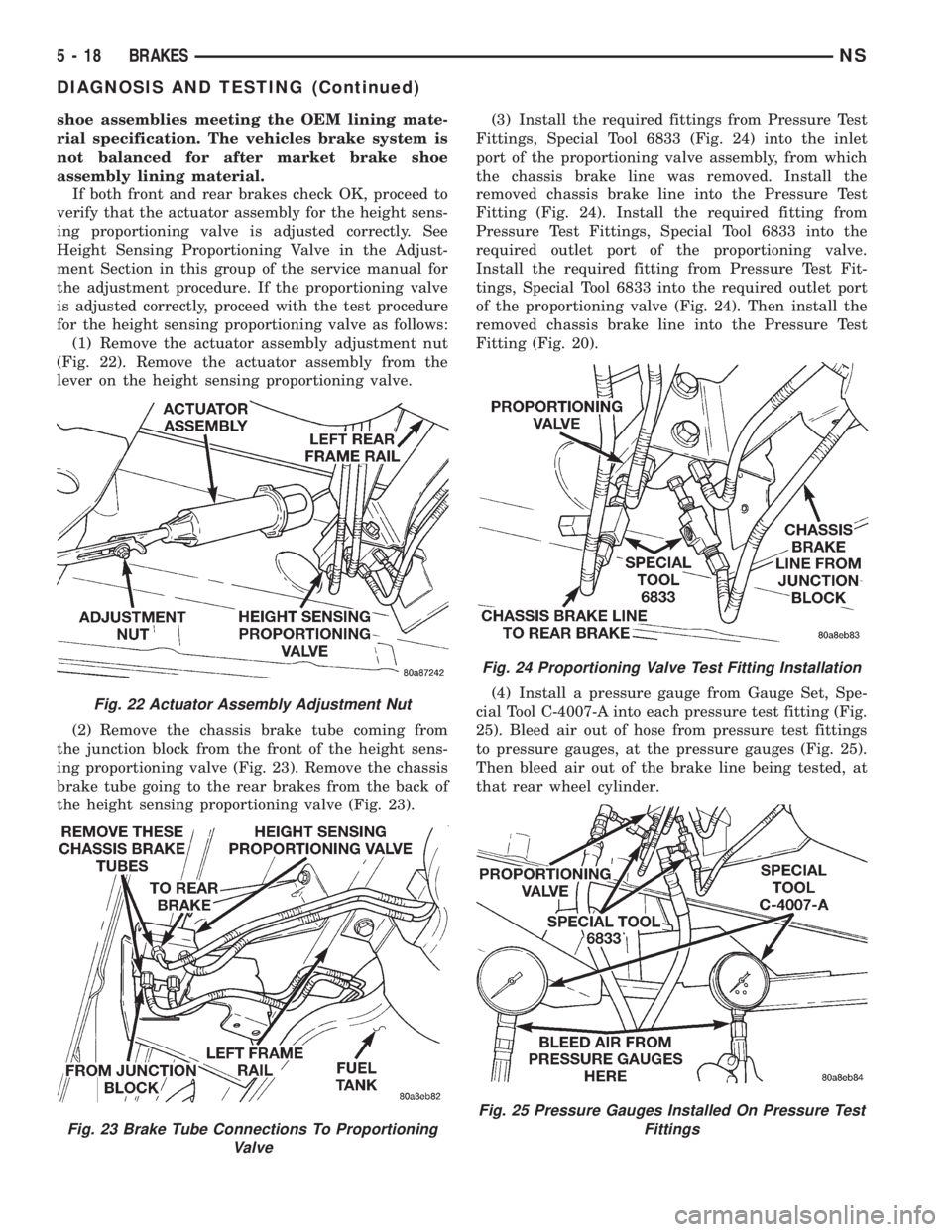
(1) Remove the actuator assembly adjustment nut
(Fig. 22). Remove the actuator assembly from the
lever on the height sensing proportioning valve.
(2) Remove the chassis brake tube coming from
the junction block from the front of the height sens-
ing proportioning valve (Fig. 23). Remove the chassis
brake tube going to the rear brakes from the back of
the height sensing proportioning valve (Fig. 23).(3) Install the required fittings from Pressure Test
Fittings, Special Tool 6833 (Fig. 24) into the inlet
port of the proportioning valve assembly, from which
the chassis brake line was removed. Install the
removed chassis brake line into the Pressure Test
Fitting (Fig. 24). Install the required fitting from
Pressure Test Fittings, Special Tool 6833 into the
required outlet port of the proportioning valve.
Install the required fitting from Pressure Test Fit-
tings, Special Tool 6833 into the required outlet port
of the proportioning valve (Fig. 24). Then install the
removed chassis brake line into the Pressure Test
Fitting (Fig. 20).
(4) Install a pressure gauge from Gauge Set, Spe-
cial Tool C-4007-A into each pressure test fitting (Fig.
25). Bleed air out of hose from pressure test fittings
to pressure gauges, at the pressure gauges (Fig. 25).
Then bleed air out of the brake line being tested, at
that rear wheel cylinder.
Fig. 22 Actuator Assembly Adjustment Nut
Fig. 23 Brake Tube Connections To Proportioning
Valve
Fig. 24 Proportioning Valve Test Fitting Installation
Fig. 25 Pressure Gauges Installed On Pressure Test
Fittings
5 - 18 BRAKESNS
DIAGNOSIS AND TESTING (Continued)
Page 101 of 1938
(5) With the aid of a helper, apply pressure to the
brake pedal until a pressure of 6895 kPa (1000 psi) is
obtained on the proportioning valve inlet gauge.
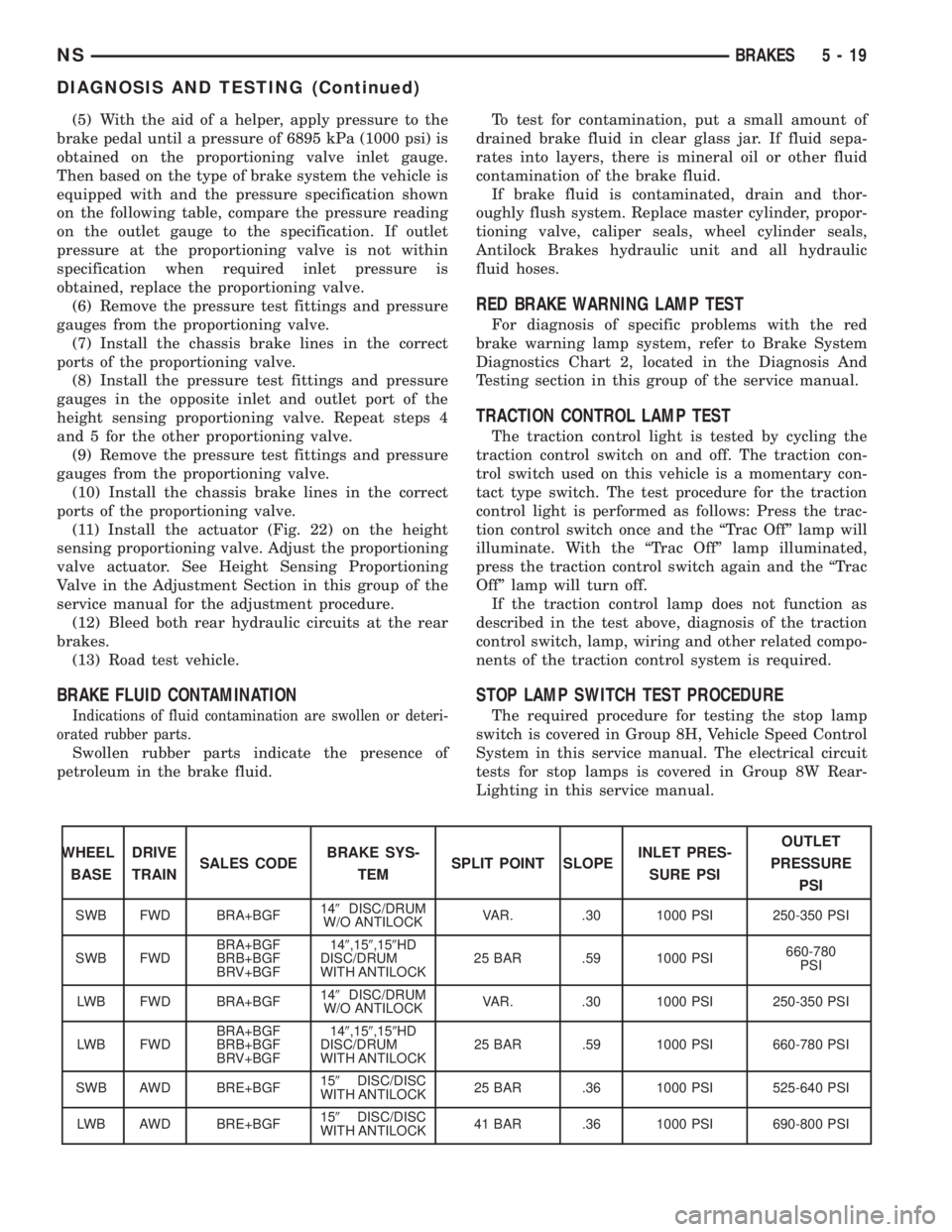
Then based on the type of brake system the vehicle is
equipped with and the pressure specification shown
on the following table, compare the pressure reading
on the outlet gauge to the specification. If outlet
pressure at the proportioning valve is not within
specification when required inlet pressure is
obtained, replace the proportioning valve.
(6) Remove the pressure test fittings and pressure
gauges from the proportioning valve.
(7) Install the chassis brake lines in the correct
ports of the proportioning valve.
(8) Install the pressure test fittings and pressure
gauges in the opposite inlet and outlet port of the
height sensing proportioning valve. Repeat steps 4
and 5 for the other proportioning valve.
(9) Remove the pressure test fittings and pressure
gauges from the proportioning valve.
(10) Install the chassis brake lines in the correct
ports of the proportioning valve.
(11) Install the actuator (Fig. 22) on the height
sensing proportioning valve. Adjust the proportioning
valve actuator. See Height Sensing Proportioning
Valve in the Adjustment Section in this group of the
service manual for the adjustment procedure.
(12) Bleed both rear hydraulic circuits at the rear
brakes.
(13) Road test vehicle.
BRAKE FLUID CONTAMINATION
Indications of fluid contamination are swollen or deteri-
orated rubber parts.
Swollen rubber parts indicate the presence of
petroleum in the brake fluid.To test for contamination, put a small amount of
drained brake fluid in clear glass jar. If fluid sepa-
rates into layers, there is mineral oil or other fluid
contamination of the brake fluid.
If brake fluid is contaminated, drain and thor-
oughly flush system. Replace master cylinder, propor-
tioning valve, caliper seals, wheel cylinder seals,
Antilock Brakes hydraulic unit and all hydraulic
fluid hoses.
RED BRAKE WARNING LAMP TEST
For diagnosis of specific problems with the red
brake warning lamp system, refer to Brake System
Diagnostics Chart 2, located in the Diagnosis And
Testing section in this group of the service manual.
TRACTION CONTROL LAMP TEST
The traction control light is tested by cycling the
traction control switch on and off. The traction con-
trol switch used on this vehicle is a momentary con-
tact type switch. The test procedure for the traction
control light is performed as follows: Press the trac-
tion control switch once and the ªTrac Offº lamp will
illuminate. With the ªTrac Offº lamp illuminated,
press the traction control switch again and the ªTrac
Offº lamp will turn off.
If the traction control lamp does not function as
described in the test above, diagnosis of the traction
control switch, lamp, wiring and other related compo-
nents of the traction control system is required.
STOP LAMP SWITCH TEST PROCEDURE
The required procedure for testing the stop lamp
switch is covered in Group 8H, Vehicle Speed Control
System in this service manual. The electrical circuit
tests for stop lamps is covered in Group 8W Rear-
Lighting in this service manual.
WHEEL
BASEDRIVE
TRAINSALES CODEBRAKE SYS-
TEMSPLIT POINT SLOPEINLET PRES-
SURE PSIOUTLET
PRESSURE
PSI
SWB FWD BRA+BGF149DISC/DRUM
W/O ANTILOCKVAR. .30 1000 PSI 250-350 PSI
SWB FWDBRA+BGF
BRB+BGF
BRV+BGF149,159,159HD
DISC/DRUM
WITH ANTILOCK25 BAR .59 1000 PSI660-780
PSI
LWB FWD BRA+BGF149DISC/DRUM
W/O ANTILOCKVAR. .30 1000 PSI 250-350 PSI
LWB FWDBRA+BGF
BRB+BGF
BRV+BGF149,159,159HD
DISC/DRUM
WITH ANTILOCK25 BAR .59 1000 PSI 660-780 PSI
SWB AWD BRE+BGF159DISC/DISC
WITH ANTILOCK25 BAR .36 1000 PSI 525-640 PSI
LWB AWD BRE+BGF159DISC/DISC
WITH ANTILOCK41 BAR .36 1000 PSI 690-800 PSI
NSBRAKES 5 - 19
DIAGNOSIS AND TESTING (Continued)
Page 139 of 1938
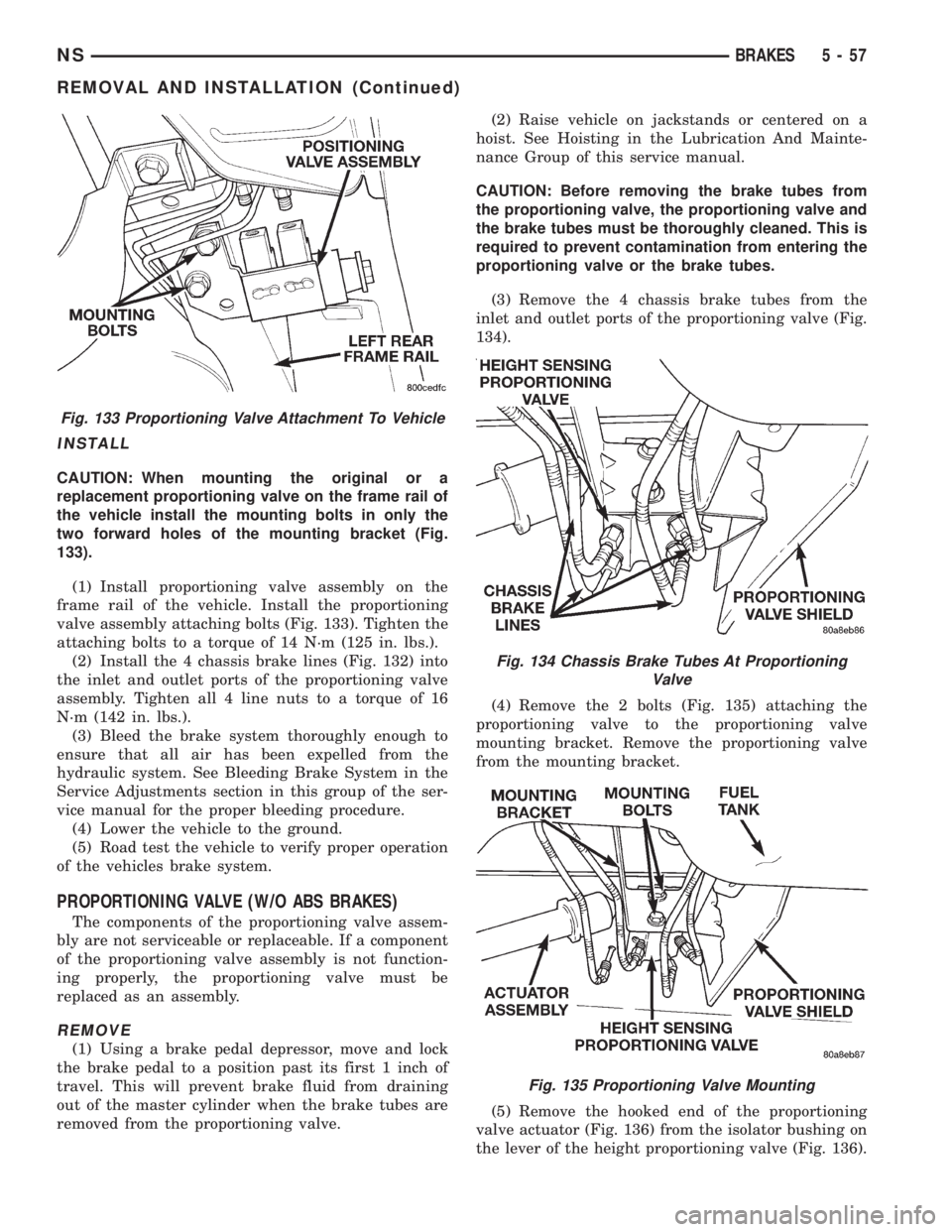
INSTALL
CAUTION: When mounting the original or a
replacement proportioning valve on the frame rail of
the vehicle install the mounting bolts in only the
two forward holes of the mounting bracket (Fig.
133).
(1) Install proportioning valve assembly on the
frame rail of the vehicle. Install the proportioning
valve assembly attaching bolts (Fig. 133). Tighten the
attaching bolts to a torque of 14 N´m (125 in. lbs.).
(2) Install the 4 chassis brake lines (Fig. 132) into
the inlet and outlet ports of the proportioning valve
assembly. Tighten all 4 line nuts to a torque of 16
N´m (142 in. lbs.).
(3) Bleed the brake system thoroughly enough to
ensure that all air has been expelled from the
hydraulic system. See Bleeding Brake System in the
Service Adjustments section in this group of the ser-
vice manual for the proper bleeding procedure.
(4) Lower the vehicle to the ground.
(5) Road test the vehicle to verify proper operation
of the vehicles brake system.
PROPORTIONING VALVE (W/O ABS BRAKES)
The components of the proportioning valve assem-
bly are not serviceable or replaceable. If a component
of the proportioning valve assembly is not function-
ing properly, the proportioning valve must be
replaced as an assembly.
REMOVE
(1) Using a brake pedal depressor, move and lock
the brake pedal to a position past its first 1 inch of
travel. This will prevent brake fluid from draining
out of the master cylinder when the brake tubes are
removed from the proportioning valve.(2) Raise vehicle on jackstands or centered on a
hoist. See Hoisting in the Lubrication And Mainte-
nance Group of this service manual.
CAUTION: Before removing the brake tubes from
the proportioning valve, the proportioning valve and
the brake tubes must be thoroughly cleaned. This is
required to prevent contamination from entering the
proportioning valve or the brake tubes.
(3) Remove the 4 chassis brake tubes from the
inlet and outlet ports of the proportioning valve (Fig.
134).
(4) Remove the 2 bolts (Fig. 135) attaching the
proportioning valve to the proportioning valve
mounting bracket. Remove the proportioning valve
from the mounting bracket.
(5) Remove the hooked end of the proportioning
valve actuator (Fig. 136) from the isolator bushing on
the lever of the height proportioning valve (Fig. 136).
Fig. 133 Proportioning Valve Attachment To Vehicle
Fig. 134 Chassis Brake Tubes At Proportioning
Valve
Fig. 135 Proportioning Valve Mounting
NSBRAKES 5 - 57
REMOVAL AND INSTALLATION (Continued)
Page 140 of 1938
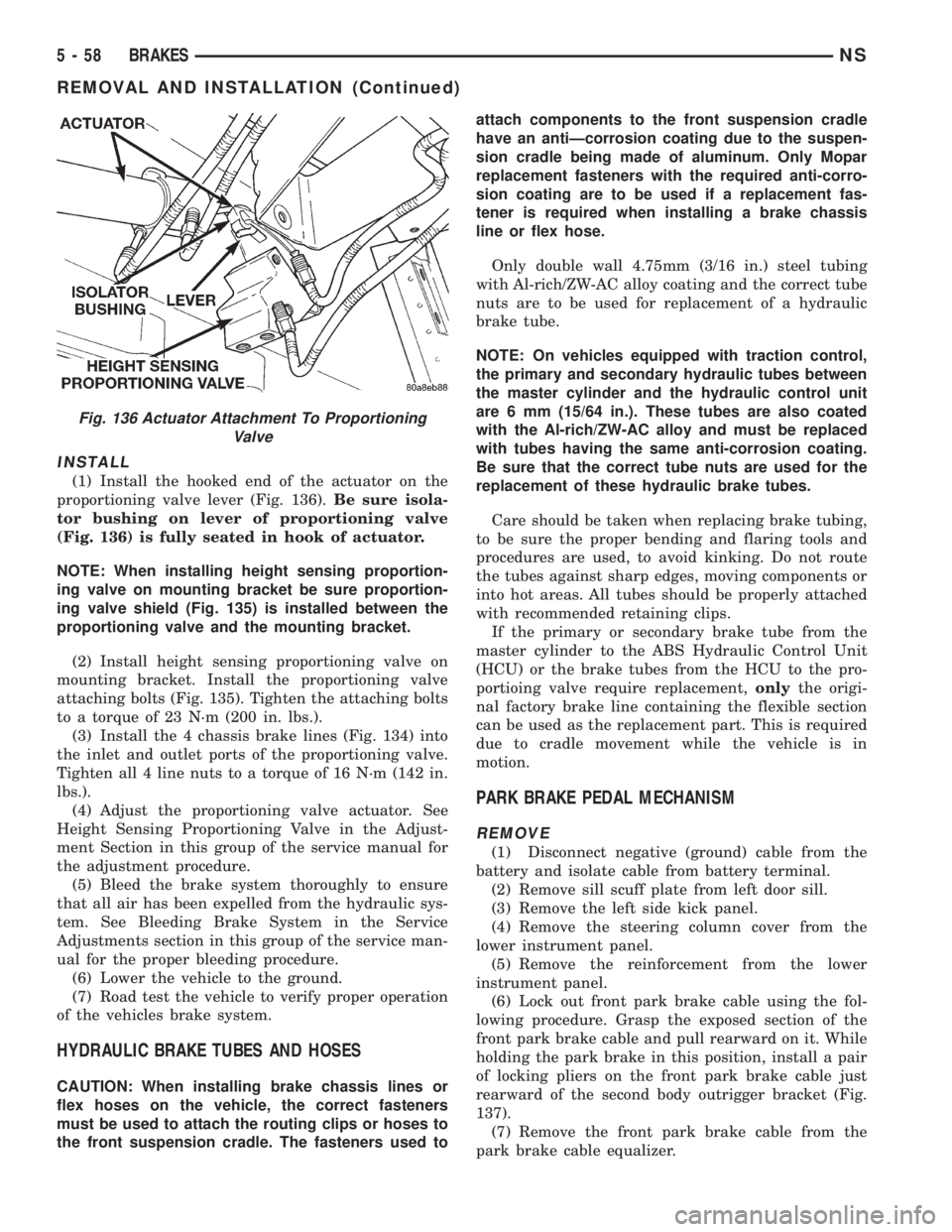
INSTALL
(1) Install the hooked end of the actuator on the
proportioning valve lever (Fig. 136).Be sure isola-
tor bushing on lever of proportioning valve
(Fig. 136) is fully seated in hook of actuator.
NOTE: When installing height sensing proportion-
ing valve on mounting bracket be sure proportion-
ing valve shield (Fig. 135) is installed between the
proportioning valve and the mounting bracket.
(2) Install height sensing proportioning valve on
mounting bracket. Install the proportioning valve
attaching bolts (Fig. 135). Tighten the attaching bolts
to a torque of 23 N´m (200 in. lbs.).
(3) Install the 4 chassis brake lines (Fig. 134) into
the inlet and outlet ports of the proportioning valve.
Tighten all 4 line nuts to a torque of 16 N´m (142 in.
lbs.).
(4) Adjust the proportioning valve actuator. See
Height Sensing Proportioning Valve in the Adjust-
ment Section in this group of the service manual for
the adjustment procedure.
(5) Bleed the brake system thoroughly to ensure
that all air has been expelled from the hydraulic sys-
tem. See Bleeding Brake System in the Service
Adjustments section in this group of the service man-
ual for the proper bleeding procedure.
(6) Lower the vehicle to the ground.
(7) Road test the vehicle to verify proper operation
of the vehicles brake system.
HYDRAULIC BRAKE TUBES AND HOSES
CAUTION: When installing brake chassis lines or
flex hoses on the vehicle, the correct fasteners
must be used to attach the routing clips or hoses to
the front suspension cradle. The fasteners used toattach components to the front suspension cradle
have an antiÐcorrosion coating due to the suspen-
sion cradle being made of aluminum. Only Mopar
replacement fasteners with the required anti-corro-
sion coating are to be used if a replacement fas-
tener is required when installing a brake chassis
line or flex hose.
Only double wall 4.75mm (3/16 in.) steel tubing
with Al-rich/ZW-AC alloy coating and the correct tube
nuts are to be used for replacement of a hydraulic
brake tube.
NOTE: On vehicles equipped with traction control,
the primary and secondary hydraulic tubes between
the master cylinder and the hydraulic control unit
are 6 mm (15/64 in.). These tubes are also coated
with the Al-rich/ZW-AC alloy and must be replaced
with tubes having the same anti-corrosion coating.
Be sure that the correct tube nuts are used for the
replacement of these hydraulic brake tubes.
Care should be taken when replacing brake tubing,
to be sure the proper bending and flaring tools and
procedures are used, to avoid kinking. Do not route
the tubes against sharp edges, moving components or
into hot areas. All tubes should be properly attached
with recommended retaining clips.
If the primary or secondary brake tube from the
master cylinder to the ABS Hydraulic Control Unit
(HCU) or the brake tubes from the HCU to the pro-
portioing valve require replacement,onlythe origi-
nal factory brake line containing the flexible section
can be used as the replacement part. This is required
due to cradle movement while the vehicle is in
motion.
PARK BRAKE PEDAL MECHANISM
REMOVE
(1) Disconnect negative (ground) cable from the
battery and isolate cable from battery terminal.
(2) Remove sill scuff plate from left door sill.
(3) Remove the left side kick panel.
(4) Remove the steering column cover from the
lower instrument panel.
(5) Remove the reinforcement from the lower
instrument panel.
(6) Lock out front park brake cable using the fol-
lowing procedure. Grasp the exposed section of the
front park brake cable and pull rearward on it. While
holding the park brake in this position, install a pair
of locking pliers on the front park brake cable just
rearward of the second body outrigger bracket (Fig.
137).
(7) Remove the front park brake cable from the
park brake cable equalizer.
Fig. 136 Actuator Attachment To Proportioning
Valve
5 - 58 BRAKESNS
REMOVAL AND INSTALLATION (Continued)