tow CHRYSLER VOYAGER 1996 User Guide
[x] Cancel search | Manufacturer: CHRYSLER, Model Year: 1996, Model line: VOYAGER, Model: CHRYSLER VOYAGER 1996Pages: 1938, PDF Size: 55.84 MB
Page 41 of 1938

FRONT SUSPENSION
INDEX
page page
DESCRIPTION AND OPERATION
BALL JOINT............................ 11
COIL SPRING........................... 11
FRONT SUSPENSION DESCRIPTION......... 9
HUB AND BEARING ASSEMBLY............ 10
LOWER CONTROL ARM.................. 10
Mc PHERSON STRUT ASSEMBLY........... 10
STABILIZER BAR ATTACHING LINK.......... 10
STABILIZER BAR........................ 10
STEERING KNUCKLE.................... 10
SUSPENSION CRADLE (CROSSMEMBER)..... 9
WHEEL MOUNTING STUDS................ 11
DIAGNOSIS AND TESTING
BALL JOINT (LOWER).................... 12
HUB AND BEARING ASSEMBLY............ 12
LOWER CONTROL ARM.................. 12
Mc PHERSON STRUT.................... 11
STABILIZER BAR........................ 12
STEERING KNUCKLE.................... 12SERVICE PROCEDURES
SUSPENSION CRADLE THREAD REPAIR
PROCEDURE......................... 12
REMOVAL AND INSTALLATION
BALL JOINT............................ 22
FRONT WHEEL MOUNTING STUDS......... 28
HUB AND BEARING ASSEMBLY............ 25
LOWER CONTROL ARM.................. 19
Mc PHERSON STRUT.................... 13
REAR WHEEL MOUNTING STUDS.......... 29
STABILIZER BAR........................ 23
STEERING KNUCKLE.................... 14
DISASSEMBLY AND ASSEMBLY
BALL JOINT SEAL BOOT.................. 33
LOWER CONTROL ARM FRONT BUSHING.... 34
LOWER CONTROL ARM REAR BUSHING..... 35
Mc PHERSON STRUT.................... 30
STABILIZER BAR BUSHING................ 35
SPECIFICATIONS
FRONT SUSPENSION FASTENER TORQUES . . 36
SPECIAL TOOLS
FRONT SUSPENSION.................... 37
DESCRIPTION AND OPERATION
FRONT SUSPENSION DESCRIPTION
An independent Mc Pherson Strut type front sus-
pension is used on these vehicles. Vertical shock
absorbing Mc Pherson Struts attach to the top of the
steering knuckle and to the front strut tower. This
interconnection between the steering knuckle and the
body of the vehicle, provides for the correct steering
knuckle position. This steering knuckle position pro-
vides for the correct front Caster and Camber set-
tings for the vehicle, at the time the vehicle is
designed.
Lower control arms are attached inboard to the
cast aluminum front suspension cradle and outboard
to the bottom of the steering knuckle. Attachment of
the lower control arm to the steering knuckle is done
through a ball joint in the lower control arm.
During steering maneuvers, the strut and the
steering knuckle (through the ball joint and a pivot
bearing in the strut's upper retainer) turn as an
assembly.
SUSPENSION CRADLE (CROSSMEMBER)
This vehicle uses a one piece cast aluminum cradle
for the front suspension. The cradle is used as theattaching points for the lower control arms, stabilizer
bar and steering gear. The cradle also has the power
steering hoses and the chassis brake tubes attached
to it.
The cradle is mounted to the front frame rails at
four points, two on each side of the vehicle. The cra-
dle is isolated from the body of the vehicle using four
isolators, one located at each mounting bolt location.
WARNING: If a threaded hole in the suspension
cradle needs to be repaired, only use the type of
thread insert and installation procedure specified
for this application.
The threaded holes in the cradle that are
used for attachment of the lower control arm
rear bushing retainer, power steering hose and
chassis brake tubes can be repaired. The repair
is done by the installation of a Heli-Coilt
thread insert which has been specifically devel-
oped for this application. Refer to the Mopar
Parts Catalog for the specified Heli-Coil thread
insert to be used for this application. The pro-
cedure for installing the Heli-Coiltthread
insert is detailed in the Service Procedures sec-
tion in this group of the service manual.
NSSUSPENSION 2 - 9
Page 42 of 1938
Mc PHERSON STRUT ASSEMBLY
The front suspension of the vehicle is supported by
coil springs positioned around the strut assembly.
The springs are contained between an upper seat,
located just below the top strut mount assembly and
a lower spring seat on the strut fluid reservoir.
The top of each strut assembly is bolted to the
upper fender reinforcement (strut tower) through a
rubber isolated mount.
The bottom of the strut assembly attaches to the
steering knuckle with two through bolts. Caster is a
fixed setting on all vehicles and is not adjustable
when an alignment is performed. In the event the
camber setting on a vehicle requires adjustment, a
service strut is available which will provide a method
by which the camber can be adjusted.
The strut assemblies on this vehicle are inter-con-
nected by the front stabilizer bar through 2 link
assemblies attaching the struts to the stabilizer bar.
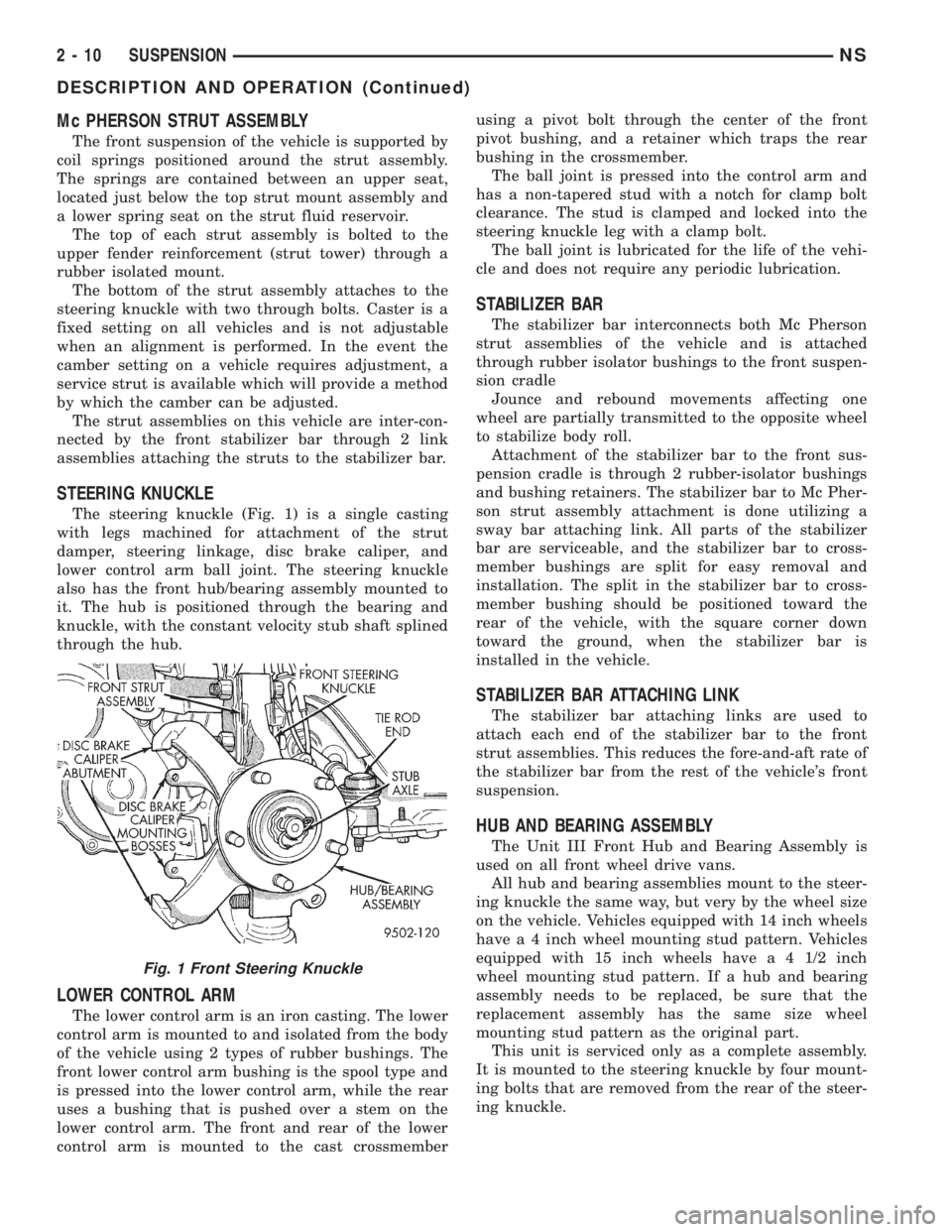
STEERING KNUCKLE
The steering knuckle (Fig. 1) is a single casting
with legs machined for attachment of the strut
damper, steering linkage, disc brake caliper, and
lower control arm ball joint. The steering knuckle
also has the front hub/bearing assembly mounted to
it. The hub is positioned through the bearing and
knuckle, with the constant velocity stub shaft splined
through the hub.
LOWER CONTROL ARM
The lower control arm is an iron casting. The lower
control arm is mounted to and isolated from the body
of the vehicle using 2 types of rubber bushings. The
front lower control arm bushing is the spool type and
is pressed into the lower control arm, while the rear
uses a bushing that is pushed over a stem on the
lower control arm. The front and rear of the lower
control arm is mounted to the cast crossmemberusing a pivot bolt through the center of the front
pivot bushing, and a retainer which traps the rear
bushing in the crossmember.
The ball joint is pressed into the control arm and
has a non-tapered stud with a notch for clamp bolt
clearance. The stud is clamped and locked into the
steering knuckle leg with a clamp bolt.
The ball joint is lubricated for the life of the vehi-
cle and does not require any periodic lubrication.
STABILIZER BAR
The stabilizer bar interconnects both Mc Pherson
strut assemblies of the vehicle and is attached
through rubber isolator bushings to the front suspen-
sion cradle
Jounce and rebound movements affecting one
wheel are partially transmitted to the opposite wheel
to stabilize body roll.
Attachment of the stabilizer bar to the front sus-
pension cradle is through 2 rubber-isolator bushings
and bushing retainers. The stabilizer bar to Mc Pher-
son strut assembly attachment is done utilizing a
sway bar attaching link. All parts of the stabilizer
bar are serviceable, and the stabilizer bar to cross-
member bushings are split for easy removal and
installation. The split in the stabilizer bar to cross-
member bushing should be positioned toward the
rear of the vehicle, with the square corner down
toward the ground, when the stabilizer bar is
installed in the vehicle.
STABILIZER BAR ATTACHING LINK
The stabilizer bar attaching links are used to
attach each end of the stabilizer bar to the front
strut assemblies. This reduces the fore-and-aft rate of
the stabilizer bar from the rest of the vehicle's front
suspension.
HUB AND BEARING ASSEMBLY
The Unit III Front Hub and Bearing Assembly is
used on all front wheel drive vans.
All hub and bearing assemblies mount to the steer-
ing knuckle the same way, but very by the wheel size
on the vehicle. Vehicles equipped with 14 inch wheels
have a 4 inch wheel mounting stud pattern. Vehicles
equipped with 15 inch wheels have a 4 1/2 inch
wheel mounting stud pattern. If a hub and bearing
assembly needs to be replaced, be sure that the
replacement assembly has the same size wheel
mounting stud pattern as the original part.
This unit is serviced only as a complete assembly.
It is mounted to the steering knuckle by four mount-
ing bolts that are removed from the rear of the steer-
ing knuckle.
Fig. 1 Front Steering Knuckle
2 - 10 SUSPENSIONNS
DESCRIPTION AND OPERATION (Continued)
Page 45 of 1938
instructions included with the thread insert for the
detailed procedure used for the installation of the
thread insert.
NOTE: The thread inserts for this application are
for the repair of M8x1.25 and M10x1.5 threads. Be
sure the correct tools are used for the required
thread insert size.
TOOL REQUIREMENT FOR M8x1.25 Thread
²8.3mm (5/16 in.) Drill Bit
²120É Countersink
²Heli-CoiltTap #4863-8
²Heli-CoiltGage #4624-8
²Heli-CoiltHand Inserting Tool 7751-8
²Needle Nose Pliers ± For Removal Of Thread
Insert Driving Tang
TOOL REQUIREMENT FOR M10x1.5 Thread
²10.5mm (25/64 in.) Drill Bit
²120É Countersink
²Heli-CoiltTap #4863-10
²Heli-CoiltGage #4624-10
²Heli-CoiltHand Inserting Tool 7751-10
²Needle Nose Pliers ± For Removal Of Thread
Insert Driving Tang
REMOVAL AND INSTALLATION
Mc PHERSON STRUT
REMOVAL
WARNING: DO NOT REMOVE THE NUT FROM THE
STRUT ROD WHILE STRUT ASSEMBLY IS
INSTALLED IN VEHICLE, OR BEFORE STRUT
ASSEMBLY SPRING IS COMPRESSED.
(1) Raise vehicle on jack stands or centered on a
frame contact type hoist. See Hoisting in the Lubri-
cation and Maintenance section of this service man-
ual, for the required lifting procedure to be used for
this vehicle.
(2) Remove the wheel and tire assembly from loca-
tion on front of vehicle requiring strut removal.
(3) If both strut assemblies are to be removed,
mark the strut assemblies right or left according to
which side of the vehicle they were removed from.
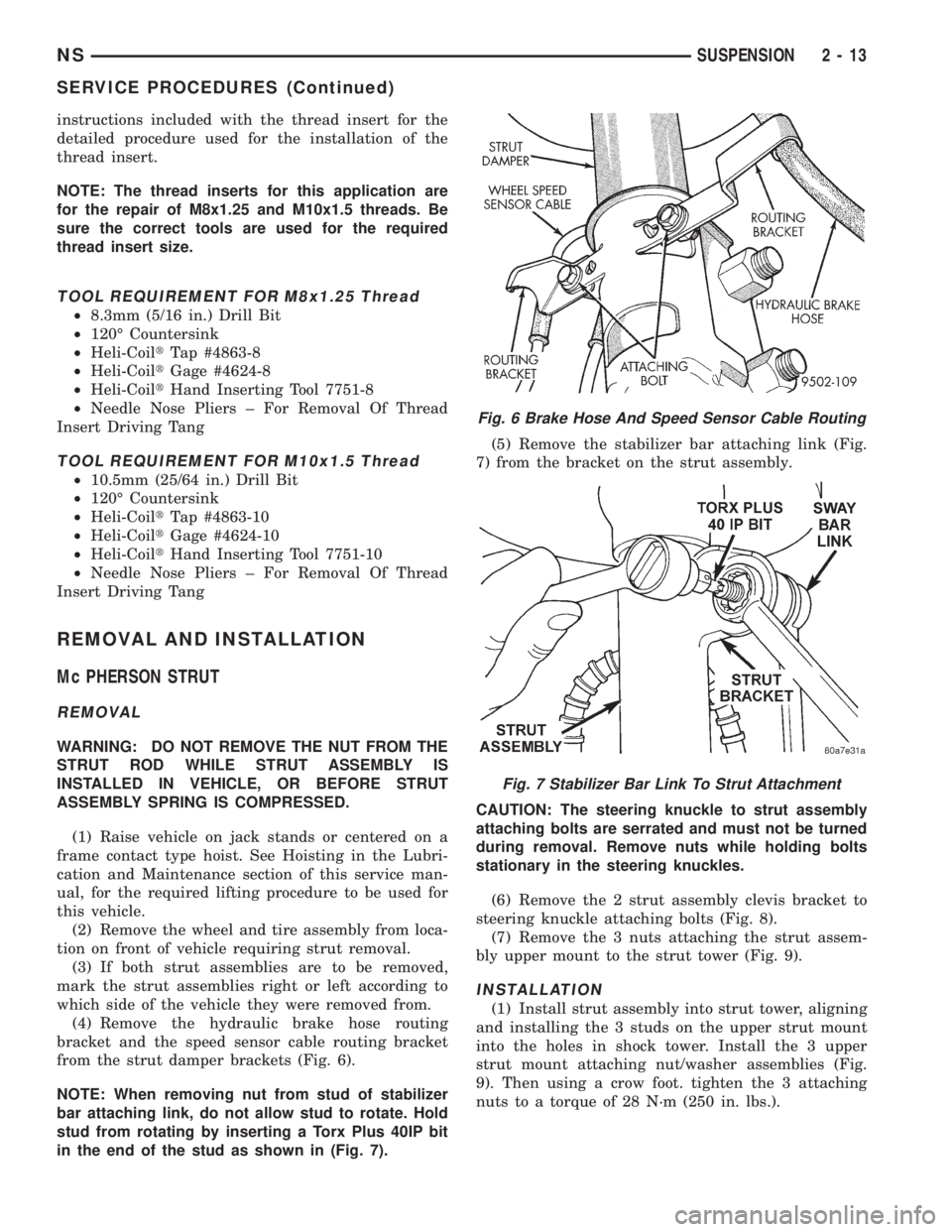
(4) Remove the hydraulic brake hose routing
bracket and the speed sensor cable routing bracket
from the strut damper brackets (Fig. 6).
NOTE: When removing nut from stud of stabilizer
bar attaching link, do not allow stud to rotate. Hold
stud from rotating by inserting a Torx Plus 40IP bit
in the end of the stud as shown in (Fig. 7).(5) Remove the stabilizer bar attaching link (Fig.
7) from the bracket on the strut assembly.
CAUTION: The steering knuckle to strut assembly
attaching bolts are serrated and must not be turned
during removal. Remove nuts while holding bolts
stationary in the steering knuckles.
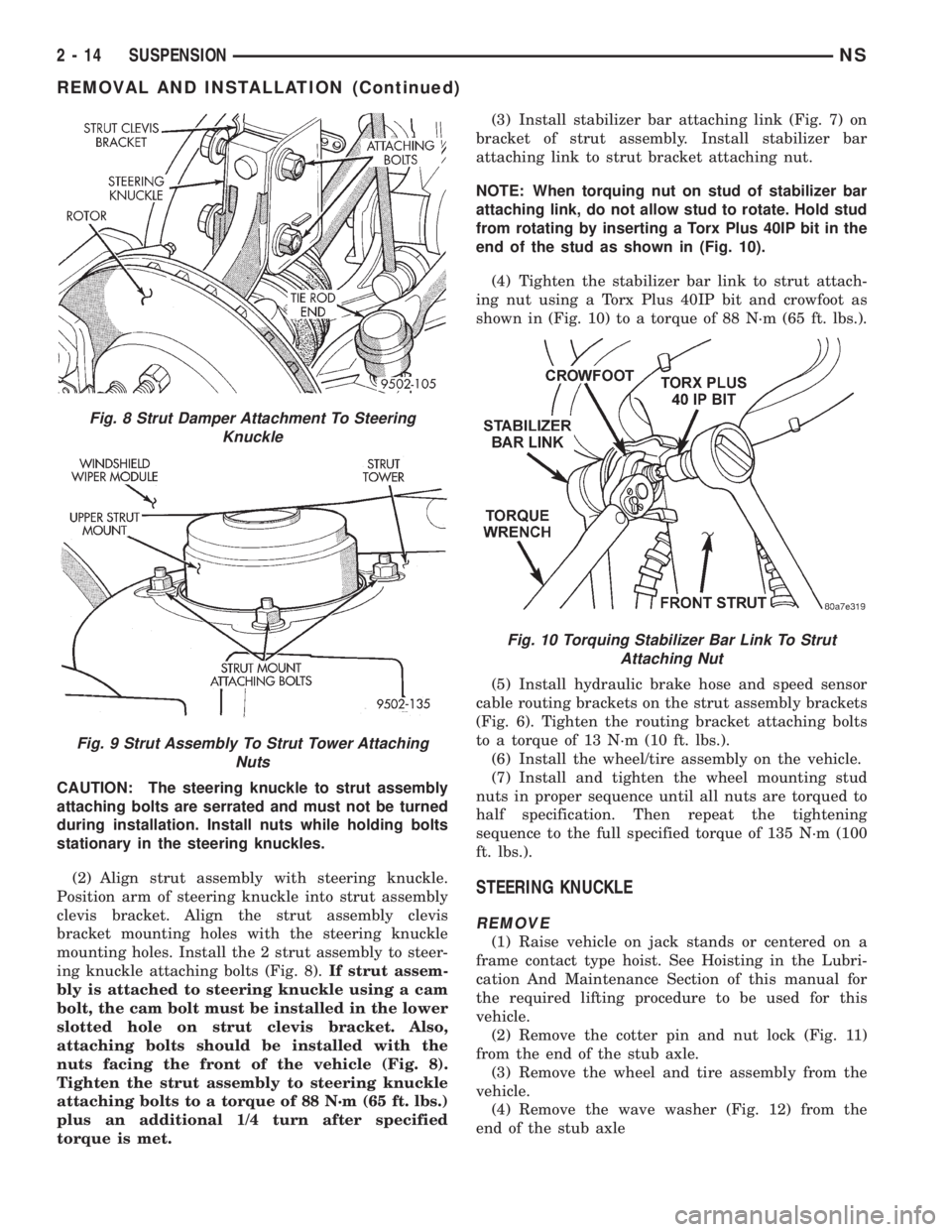
(6) Remove the 2 strut assembly clevis bracket to
steering knuckle attaching bolts (Fig. 8).
(7) Remove the 3 nuts attaching the strut assem-
bly upper mount to the strut tower (Fig. 9).
INSTALLATION
(1) Install strut assembly into strut tower, aligning
and installing the 3 studs on the upper strut mount
into the holes in shock tower. Install the 3 upper
strut mount attaching nut/washer assemblies (Fig.
9). Then using a crow foot. tighten the 3 attaching
nuts to a torque of 28 N´m (250 in. lbs.).
Fig. 6 Brake Hose And Speed Sensor Cable Routing
Fig. 7 Stabilizer Bar Link To Strut Attachment
NSSUSPENSION 2 - 13
SERVICE PROCEDURES (Continued)
Page 46 of 1938
CAUTION: The steering knuckle to strut assembly
attaching bolts are serrated and must not be turned
during installation. Install nuts while holding bolts
stationary in the steering knuckles.
(2) Align strut assembly with steering knuckle.
Position arm of steering knuckle into strut assembly
clevis bracket. Align the strut assembly clevis
bracket mounting holes with the steering knuckle
mounting holes. Install the 2 strut assembly to steer-
ing knuckle attaching bolts (Fig. 8).If strut assem-
bly is attached to steering knuckle using a cam
bolt, the cam bolt must be installed in the lower
slotted hole on strut clevis bracket. Also,
attaching bolts should be installed with the
nuts facing the front of the vehicle (Fig. 8).
Tighten the strut assembly to steering knuckle
attaching bolts to a torque of 88 N´m (65 ft. lbs.)
plus an additional 1/4 turn after specified
torque is met.(3) Install stabilizer bar attaching link (Fig. 7) on
bracket of strut assembly. Install stabilizer bar
attaching link to strut bracket attaching nut.
NOTE: When torquing nut on stud of stabilizer bar
attaching link, do not allow stud to rotate. Hold stud
from rotating by inserting a Torx Plus 40IP bit in the
end of the stud as shown in (Fig. 10).
(4) Tighten the stabilizer bar link to strut attach-
ing nut using a Torx Plus 40IP bit and crowfoot as
shown in (Fig. 10) to a torque of 88 N´m (65 ft. lbs.).
(5) Install hydraulic brake hose and speed sensor
cable routing brackets on the strut assembly brackets
(Fig. 6). Tighten the routing bracket attaching bolts
to a torque of 13 N´m (10 ft. lbs.).
(6) Install the wheel/tire assembly on the vehicle.
(7) Install and tighten the wheel mounting stud
nuts in proper sequence until all nuts are torqued to
half specification. Then repeat the tightening
sequence to the full specified torque of 135 N´m (100
ft. lbs.).
STEERING KNUCKLE
REMOVE
(1) Raise vehicle on jack stands or centered on a
frame contact type hoist. See Hoisting in the Lubri-
cation And Maintenance Section of this manual for
the required lifting procedure to be used for this
vehicle.
(2) Remove the cotter pin and nut lock (Fig. 11)
from the end of the stub axle.
(3) Remove the wheel and tire assembly from the
vehicle.
(4) Remove the wave washer (Fig. 12) from the
end of the stub axle
Fig. 8 Strut Damper Attachment To Steering
Knuckle
Fig. 9 Strut Assembly To Strut Tower Attaching
Nuts
Fig. 10 Torquing Stabilizer Bar Link To Strut
Attaching Nut
2 - 14 SUSPENSIONNS
REMOVAL AND INSTALLATION (Continued)
Page 56 of 1938

(3) Remove the nuts (Fig. 47) attaching the stabi-
lizer bar attaching links to the stabilizer bar. Then
remove the attaching links from the stabilizer bar.
(4) Remove the stabilizer bar bushing retainers
from the front suspension cradle (Fig. 48).
(5) Remove the stabilizer bar and bushings as an
assembly from the front suspension cradle.
INSTALL
(1) If the stabilizer bar to front suspension cradle
bushings require replacement at time of inspection,
install new bushings before installing stabilizer bar.
Bushings are replaced by opening slit on bushings
and peeling them off stabilizer bar. Install new bush-
ings on stabilizer bar by spreading bushing at slit
and forcing them on the stabilizer bar.Bushings
must be installed on stabilizer bar so slit in
bushing will be facing toward the rear of vehi-
cle with the square corner toward the ground,when the stabilizer bar is installed on the vehi-
cle (Fig. 49).
(2) Position stabilizer bar into front suspension
cradle so stabilizer bar bushings are aligned with
depressions in cradle. Install stabilizer bar bushing
retainers onto crossmember aligning raised bead on
retainer with cutouts in bushings (Fig. 50).Do not
tighten Stabilizer bar bushing retainers at this
time.
(3) Check position of the stabilizer bar in the front
suspension cradle. The center of the curved section of
the stabilizer bar must be aligned with the raised
line in the center of the front suspension cradle (Fig.
51).
(4) Align holes in stabilizer bar with attaching link
assemblies. Install the stabilizer bar attaching links
into the stabilizer bar and install the attaching nuts
(Fig. 47).
Fig. 46 Cradle Plate And Mounting Bolts
Fig. 47 Stabilizer Bar Link Attachment To Stabilizer
Bar
Fig. 48 Front Stabilizer Bar Bushing Retainers
Fig. 49 Correctly Installed Stabilizer Bar To Cradle
Bushing
2 - 24 SUSPENSIONNS
REMOVAL AND INSTALLATION (Continued)
Page 59 of 1938
INSTALL
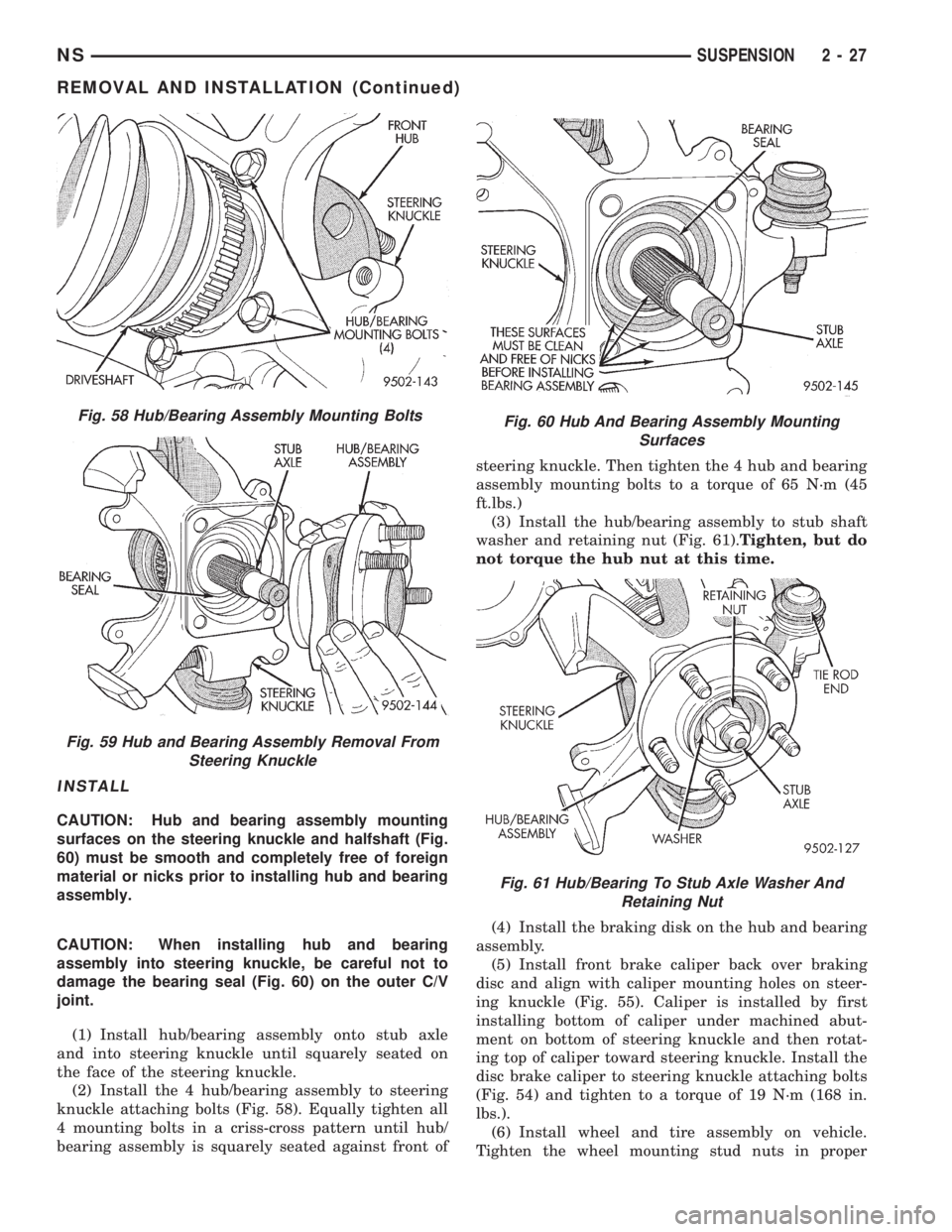
CAUTION: Hub and bearing assembly mounting
surfaces on the steering knuckle and halfshaft (Fig.
60) must be smooth and completely free of foreign
material or nicks prior to installing hub and bearing
assembly.
CAUTION: When installing hub and bearing
assembly into steering knuckle, be careful not to
damage the bearing seal (Fig. 60) on the outer C/V
joint.
(1) Install hub/bearing assembly onto stub axle
and into steering knuckle until squarely seated on
the face of the steering knuckle.
(2) Install the 4 hub/bearing assembly to steering
knuckle attaching bolts (Fig. 58). Equally tighten all
4 mounting bolts in a criss-cross pattern until hub/
bearing assembly is squarely seated against front ofsteering knuckle. Then tighten the 4 hub and bearing
assembly mounting bolts to a torque of 65 N´m (45
ft.lbs.)
(3) Install the hub/bearing assembly to stub shaft
washer and retaining nut (Fig. 61).Tighten, but do
not torque the hub nut at this time.
(4) Install the braking disk on the hub and bearing
assembly.
(5) Install front brake caliper back over braking
disc and align with caliper mounting holes on steer-
ing knuckle (Fig. 55). Caliper is installed by first
installing bottom of caliper under machined abut-
ment on bottom of steering knuckle and then rotat-
ing top of caliper toward steering knuckle. Install the
disc brake caliper to steering knuckle attaching bolts
(Fig. 54) and tighten to a torque of 19 N´m (168 in.
lbs.).
(6) Install wheel and tire assembly on vehicle.
Tighten the wheel mounting stud nuts in proper
Fig. 58 Hub/Bearing Assembly Mounting Bolts
Fig. 59 Hub and Bearing Assembly Removal From
Steering Knuckle
Fig. 60 Hub And Bearing Assembly Mounting
Surfaces
Fig. 61 Hub/Bearing To Stub Axle Washer And
Retaining Nut
NSSUSPENSION 2 - 27
REMOVAL AND INSTALLATION (Continued)
Page 64 of 1938
²Inspect jounce bumper for cracks and signs of
deterioration.
(13) Replace any components of the strut assembly
found to be worn or defective during the inspection,
before re-assembling the strut.
ASSEMBLY
(1) Clamp strut in vise, with strut in vertical posi-
tion.Do not clamp strut in vise by body of strut,
only by the clevis bracket (Fig. 68).
(2) Install the spring isolator on the strut lower
spring seat (Fig. 74). When installing the spring iso-
lator, be sure the 2 retaining tabs on the spring iso-
lator (Fig. 74) are installed in the 2 holes in the
spring seat. When properly installed, the oversize
holes in the spring seat should line up with the holes
in the spring isolator.
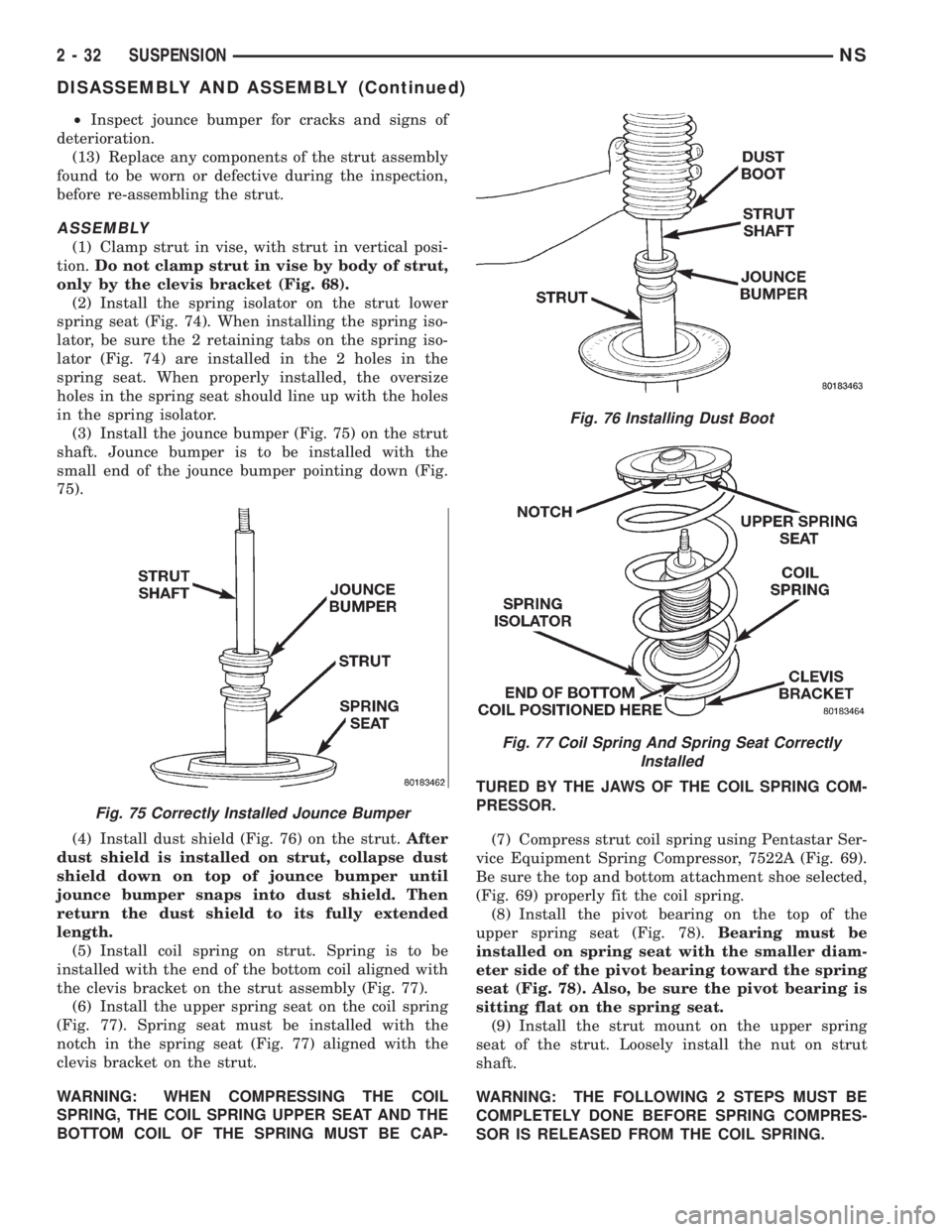
(3) Install the jounce bumper (Fig. 75) on the strut
shaft. Jounce bumper is to be installed with the
small end of the jounce bumper pointing down (Fig.
75).
(4) Install dust shield (Fig. 76) on the strut.After
dust shield is installed on strut, collapse dust
shield down on top of jounce bumper until
jounce bumper snaps into dust shield. Then
return the dust shield to its fully extended
length.
(5) Install coil spring on strut. Spring is to be
installed with the end of the bottom coil aligned with
the clevis bracket on the strut assembly (Fig. 77).
(6) Install the upper spring seat on the coil spring
(Fig. 77). Spring seat must be installed with the
notch in the spring seat (Fig. 77) aligned with the
clevis bracket on the strut.
WARNING: WHEN COMPRESSING THE COIL
SPRING, THE COIL SPRING UPPER SEAT AND THE
BOTTOM COIL OF THE SPRING MUST BE CAP-TURED BY THE JAWS OF THE COIL SPRING COM-
PRESSOR.
(7) Compress strut coil spring using Pentastar Ser-
vice Equipment Spring Compressor, 7522A (Fig. 69).
Be sure the top and bottom attachment shoe selected,
(Fig. 69) properly fit the coil spring.
(8) Install the pivot bearing on the top of the
upper spring seat (Fig. 78).Bearing must be
installed on spring seat with the smaller diam-
eter side of the pivot bearing toward the spring
seat (Fig. 78). Also, be sure the pivot bearing is
sitting flat on the spring seat.
(9) Install the strut mount on the upper spring
seat of the strut. Loosely install the nut on strut
shaft.
WARNING: THE FOLLOWING 2 STEPS MUST BE
COMPLETELY DONE BEFORE SPRING COMPRES-
SOR IS RELEASED FROM THE COIL SPRING.
Fig. 75 Correctly Installed Jounce Bumper
Fig. 76 Installing Dust Boot
Fig. 77 Coil Spring And Spring Seat Correctly
Installed
2 - 32 SUSPENSIONNS
DISASSEMBLY AND ASSEMBLY (Continued)
Page 68 of 1938
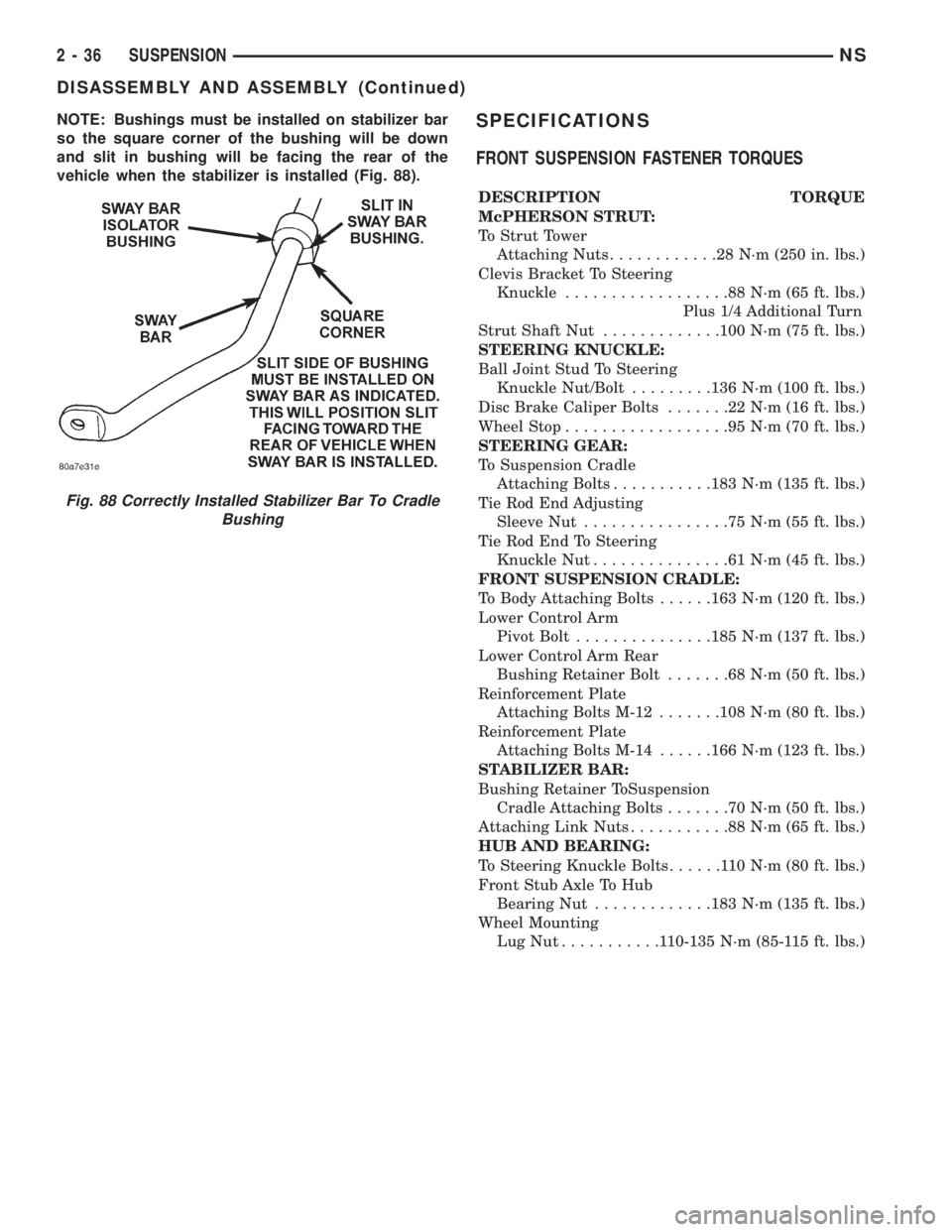
NOTE: Bushings must be installed on stabilizer bar
so the square corner of the bushing will be down
and slit in bushing will be facing the rear of the
vehicle when the stabilizer is installed (Fig. 88).SPECIFICATIONS
FRONT SUSPENSION FASTENER TORQUES
DESCRIPTION TORQUE
McPHERSON STRUT:
To Strut Tower
Attaching Nuts............28N´m(250 in. lbs.)
Clevis Bracket To Steering
Knuckle..................88N´m(65ft.lbs.)
Plus 1/4 Additional Turn
Strut Shaft Nut.............100 N´m (75 ft. lbs.)
STEERING KNUCKLE:
Ball Joint Stud To Steering
Knuckle Nut/Bolt.........136 N´m (100 ft. lbs.)
Disc Brake Caliper Bolts.......22N´m(16ft.lbs.)
Wheel Stop..................95N´m(70ft.lbs.)
STEERING GEAR:
To Suspension Cradle
Attaching Bolts...........183 N´m (135 ft. lbs.)
Tie Rod End Adjusting
Sleeve Nut................75N´m(55ft.lbs.)
Tie Rod End To Steering
Knuckle Nut...............61N´m(45ft.lbs.)
FRONT SUSPENSION CRADLE:
To Body Attaching Bolts......163 N´m (120 ft. lbs.)
Lower Control Arm
Pivot Bolt...............185 N´m (137 ft. lbs.)
Lower Control Arm Rear
Bushing Retainer Bolt.......68N´m(50ft.lbs.)
Reinforcement Plate
Attaching Bolts M-12.......108 N´m (80 ft. lbs.)
Reinforcement Plate
Attaching Bolts M-14......166 N´m (123 ft. lbs.)
STABILIZER BAR:
Bushing Retainer ToSuspension
Cradle Attaching Bolts.......70N´m(50ft.lbs.)
Attaching Link Nuts...........88N´m(65ft.lbs.)
HUB AND BEARING:
To Steering Knuckle Bolts......110N´m(80ft.lbs.)
Front Stub Axle To Hub
Bearing Nut.............183 N´m (135 ft. lbs.)
Wheel Mounting
LugNut...........110-135 N´m (85-115 ft. lbs.)
Fig. 88 Correctly Installed Stabilizer Bar To Cradle
Bushing
2 - 36 SUSPENSIONNS
DISASSEMBLY AND ASSEMBLY (Continued)
Page 77 of 1938

SHOCK ABSORBER
REMOVE/INSTALL
(1) Raise vehicle. Vehicle is to be raised and sup-
ported on jackstands or on a frame contact type
hoist. See Hoisting in the Lubrication And Mainte-
nance section of this service manual.
(2) Support the rear axle of the vehicle using 2
jackstands positioned at the outer ends of the axle.
NOTE: If the shock absorber lower mounting bolt
deflects upward during removal, raise axle by
adjusting the support jack. If the lower shock
absorber bolt deflects downward during removal,
lower the axle by adjusting the support jack.
(3) Remove the shock absorber lower mounting
bolt.
(4) While holding shock absorber, remove the
shock absorber upper mounting bolt.
(5) To install the shock absorber use the reverse
sequence of its removal.
(6) Lower the vehicle to the ground so the full
weight of the vehicle is supported by the suspension.
(7) Tighten the upper and lower shock absorber
mounting bolt to their specified torques.
REAR TRACK BAR
REMOVE
(1) Remove the nut and bolt mounting the track
bar to the rear axle (Fig. 19).
(2) Remove the nut and bolt attaching the track
bar to the track bar mount on the body of the vehicle.
Remove the track bar from the track bar mount.
INSTALL
(1) Install the track bar first into the body mount
for the track bar (Fig. 20). Install the track bar boltwith the head of the bolt facing toward the rear of
the vehicle (Fig. 21). Do not tighten.
(2) Install the track bar into its mounting bracket
on the rear axle (Fig. 19). Install the track bar bolt
with the head of the bolt facing toward the rear of
the vehicle. Do not tighten.
(3) Lower the vehicle to the ground until the full
weight of the vehicle is supported by the wheels.
Tighten both track bar attaching bolts to a torque of
95 N´m (70 ft. lbs.).
TRACK BAR MOUNT
REMOVE
(1) Remove the track bar from the track bar
mount.
(2) Remove the three bolts attaching the track bar
mount to the body (Fig. 22).
Fig. 19 Track Bar Mounting To Axle
Fig. 20 Track Bar Installation
Fig. 21 Track Bar Bolt Installation
NSSUSPENSION 2 - 45
REMOVAL AND INSTALLATION (Continued)
Page 83 of 1938
BRAKES
CONTENTS
page page
ANTILOCK BRAKE SYSTEM ±
TEVES MARK-20....................... 85BASE BRAKE SYSTEM..................... 3
GENERAL INFORMATION................... 1
GENERAL INFORMATION
INDEX
page page
GENERAL INFORMATION
BASE BRAKE SYSTEM COMPONENT
DESCRIPTION......................... 1GENERAL VEHICLE SERVICE CAUTIONS...... 1
GENERAL INFORMATION
GENERAL VEHICLE SERVICE CAUTIONS
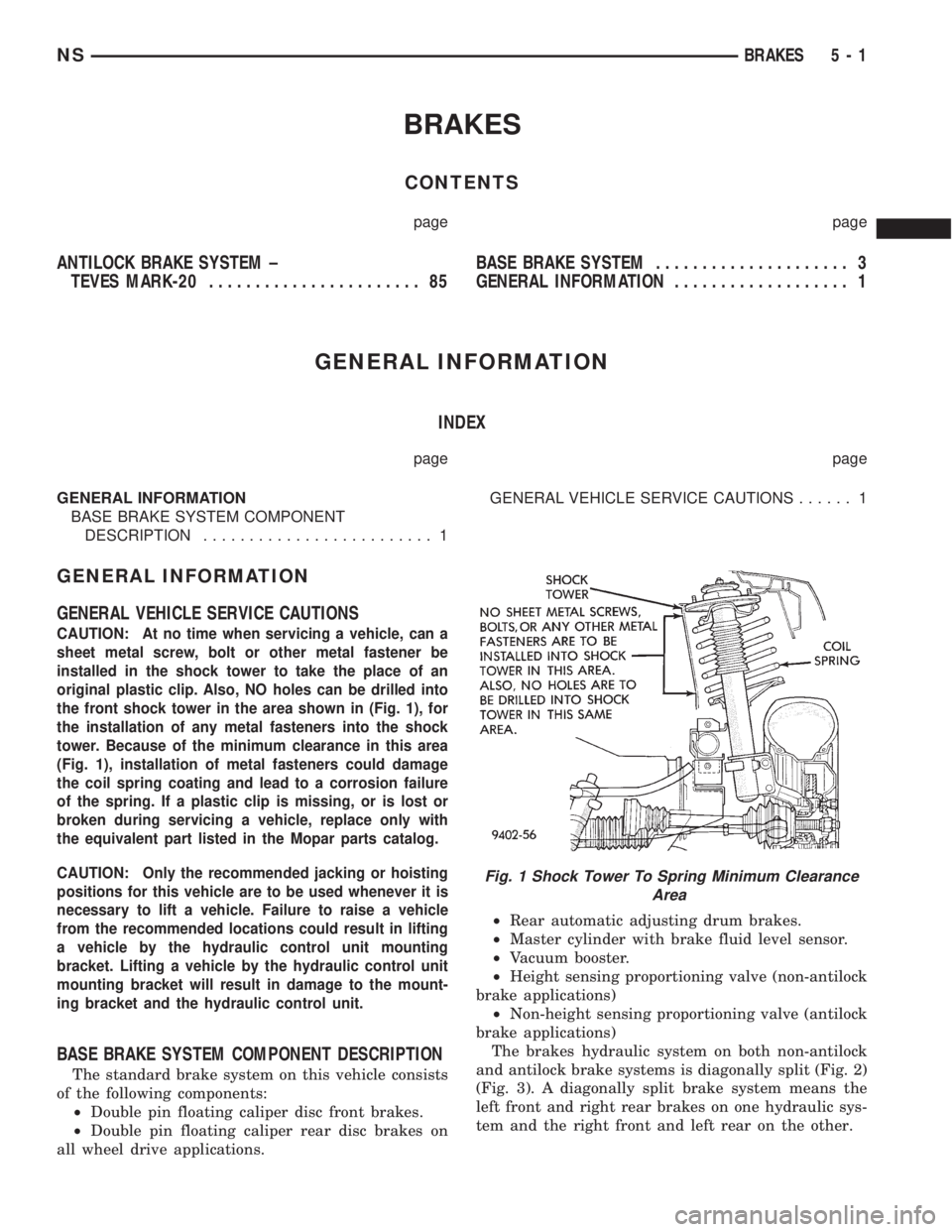
CAUTION: At no time when servicing a vehicle, can a
sheet metal screw, bolt or other metal fastener be
installed in the shock tower to take the place of an
original plastic clip. Also, NO holes can be drilled into
the front shock tower in the area shown in (Fig. 1), for
the installation of any metal fasteners into the shock
tower. Because of the minimum clearance in this area
(Fig. 1), installation of metal fasteners could damage
the coil spring coating and lead to a corrosion failure
of the spring. If a plastic clip is missing, or is lost or
broken during servicing a vehicle, replace only with
the equivalent part listed in the Mopar parts catalog.
CAUTION: Only the recommended jacking or hoisting
positions for this vehicle are to be used whenever it is
necessary to lift a vehicle. Failure to raise a vehicle
from the recommended locations could result in lifting
a vehicle by the hydraulic control unit mounting
bracket. Lifting a vehicle by the hydraulic control unit
mounting bracket will result in damage to the mount-
ing bracket and the hydraulic control unit.
BASE BRAKE SYSTEM COMPONENT DESCRIPTION
The standard brake system on this vehicle consists
of the following components:
²Double pin floating caliper disc front brakes.
²Double pin floating caliper rear disc brakes on
all wheel drive applications.²Rear automatic adjusting drum brakes.
²Master cylinder with brake fluid level sensor.
²Vacuum booster.
²Height sensing proportioning valve (non-antilock
brake applications)
²Non-height sensing proportioning valve (antilock
brake applications)
The brakes hydraulic system on both non-antilock
and antilock brake systems is diagonally split (Fig. 2)
(Fig. 3). A diagonally split brake system means the
left front and right rear brakes on one hydraulic sys-
tem and the right front and left rear on the other.
Fig. 1 Shock Tower To Spring Minimum Clearance
Area
NSBRAKES 5 - 1