tow CHRYSLER VOYAGER 1996 Workshop Manual
[x] Cancel search | Manufacturer: CHRYSLER, Model Year: 1996, Model line: VOYAGER, Model: CHRYSLER VOYAGER 1996Pages: 1938, PDF Size: 55.84 MB
Page 240 of 1938
and the remove the splash shield to gain access to
the drive belts.
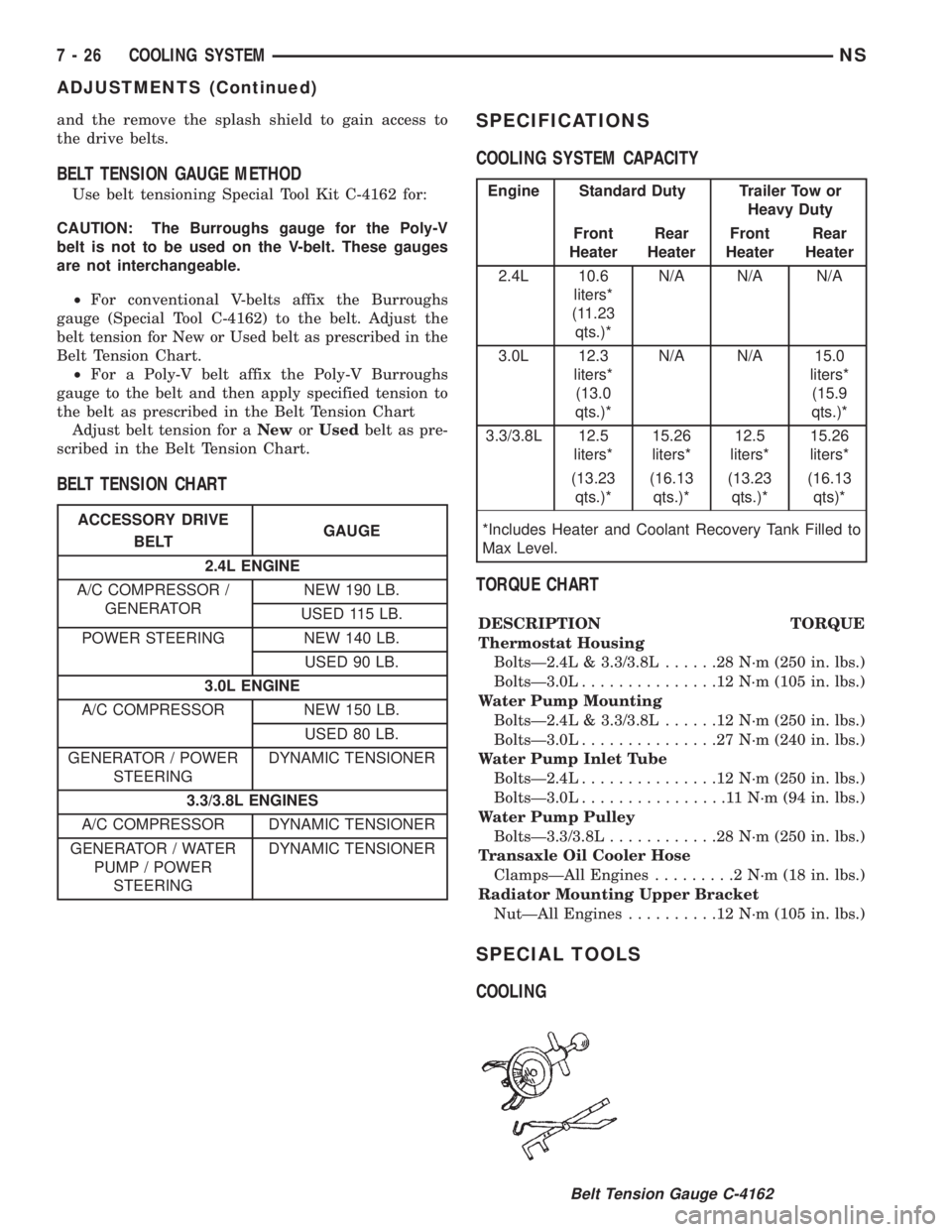
BELT TENSION GAUGE METHOD
Use belt tensioning Special Tool Kit C-4162 for:
CAUTION: The Burroughs gauge for the Poly-V
belt is not to be used on the V-belt. These gauges
are not interchangeable.
²For conventional V-belts affix the Burroughs
gauge (Special Tool C-4162) to the belt. Adjust the
belt tension for New or Used belt as prescribed in the
Belt Tension Chart.
²For a Poly-V belt affix the Poly-V Burroughs
gauge to the belt and then apply specified tension to
the belt as prescribed in the Belt Tension Chart
Adjust belt tension for aNeworUsedbelt as pre-
scribed in the Belt Tension Chart.
BELT TENSION CHARTSPECIFICATIONS
COOLING SYSTEM CAPACITY
TORQUE CHART
DESCRIPTION TORQUE
Thermostat Housing
BoltsÐ2.4L & 3.3/3.8L......28N´m(250 in. lbs.)
BoltsÐ3.0L...............12N´m(105 in. lbs.)
Water Pump Mounting
BoltsÐ2.4L & 3.3/3.8L......12N´m(250 in. lbs.)
BoltsÐ3.0L...............27N´m(240 in. lbs.)
Water Pump Inlet Tube
BoltsÐ2.4L...............12N´m(250 in. lbs.)
BoltsÐ3.0L................11N´m(94in.lbs.)
Water Pump Pulley
BoltsÐ3.3/3.8L............28N´m(250 in. lbs.)
Transaxle Oil Cooler Hose
ClampsÐAll Engines.........2N´m(18in.lbs.)
Radiator Mounting Upper Bracket
NutÐAll Engines..........12N´m(105 in. lbs.)
SPECIAL TOOLS
COOLING
ACCESSORY DRIVE
BELTGAUGE
2.4L ENGINE
A/C COMPRESSOR /
GENERATORNEW 190 LB.
USED 115 LB.
POWER STEERING NEW 140 LB.
USED 90 LB.
3.0L ENGINE
A/C COMPRESSOR NEW 150 LB.
USED 80 LB.
GENERATOR / POWER
STEERINGDYNAMIC TENSIONER
3.3/3.8L ENGINES
A/C COMPRESSOR DYNAMIC TENSIONER
GENERATOR / WATER
PUMP / POWER
STEERINGDYNAMIC TENSIONER
Engine Standard Duty Trailer Tow or
Heavy Duty
Front
HeaterRear
HeaterFront
HeaterRear
Heater
2.4L 10.6
liters*
(11.23
qts.)*N/A N/A N/A
3.0L 12.3
liters*
(13.0
qts.)*N/A N/A 15.0
liters*
(15.9
qts.)*
3.3/3.8L 12.5
liters*15.26
liters*12.5
liters*15.26
liters*
(13.23
qts.)*(16.13
qts.)*(13.23
qts.)*(16.13
qts)*
*Includes Heater and Coolant Recovery Tank Filled to
Max Level.
Belt Tension Gauge C-4162
7 - 26 COOLING SYSTEMNS
ADJUSTMENTS (Continued)
Page 259 of 1938
After the battery has been charged to 12.4 volts or
greater, perform a load test to determine cranking
capacity. Refer to Battery Load Test in this Group. If
the battery passes the load test, return the battery to
use. If battery will not endure a load test, it must be
replaced. Properly clean and inspect battery hold
downs, tray, terminals, cables, posts, and top before
completing service.
CHARGING COMPLETELY DISCHARGED BATTERY
The following procedure should be used to recharge
a completely discharged battery. Unless procedure is
properly followed, a good battery may be needlessly
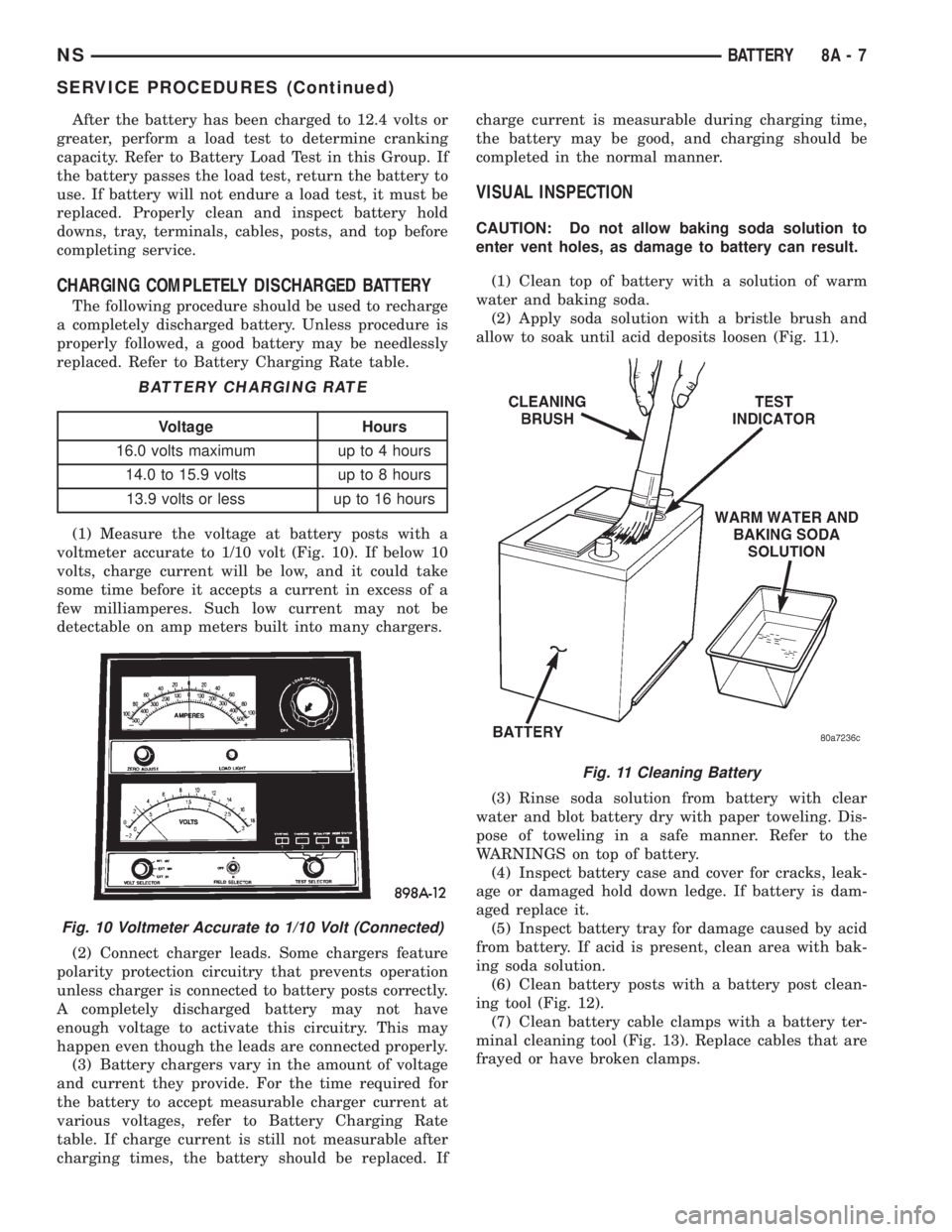
replaced. Refer to Battery Charging Rate table.
(1) Measure the voltage at battery posts with a
voltmeter accurate to 1/10 volt (Fig. 10). If below 10
volts, charge current will be low, and it could take
some time before it accepts a current in excess of a
few milliamperes. Such low current may not be
detectable on amp meters built into many chargers.
(2) Connect charger leads. Some chargers feature
polarity protection circuitry that prevents operation
unless charger is connected to battery posts correctly.
A completely discharged battery may not have
enough voltage to activate this circuitry. This may
happen even though the leads are connected properly.
(3) Battery chargers vary in the amount of voltage
and current they provide. For the time required for
the battery to accept measurable charger current at
various voltages, refer to Battery Charging Rate
table. If charge current is still not measurable after
charging times, the battery should be replaced. Ifcharge current is measurable during charging time,
the battery may be good, and charging should be
completed in the normal manner.
VISUAL INSPECTION
CAUTION: Do not allow baking soda solution to
enter vent holes, as damage to battery can result.
(1) Clean top of battery with a solution of warm
water and baking soda.
(2) Apply soda solution with a bristle brush and
allow to soak until acid deposits loosen (Fig. 11).
(3) Rinse soda solution from battery with clear
water and blot battery dry with paper toweling. Dis-
pose of toweling in a safe manner. Refer to the
WARNINGS on top of battery.
(4) Inspect battery case and cover for cracks, leak-
age or damaged hold down ledge. If battery is dam-
aged replace it.
(5) Inspect battery tray for damage caused by acid
from battery. If acid is present, clean area with bak-
ing soda solution.
(6) Clean battery posts with a battery post clean-
ing tool (Fig. 12).
(7) Clean battery cable clamps with a battery ter-
minal cleaning tool (Fig. 13). Replace cables that are
frayed or have broken clamps.
BATTERY CHARGING RATE
Voltage Hours
16.0 volts maximum up to 4 hours
14.0 to 15.9 volts up to 8 hours
13.9 volts or less up to 16 hours
Fig. 10 Voltmeter Accurate to 1/10 Volt (Connected)
Fig. 11 Cleaning Battery
NSBATTERY 8A - 7
SERVICE PROCEDURES (Continued)
Page 269 of 1938
CAUTION: Disconnect the battery NEGATIVE cable
first (Fig. 4) before charging battery to avoid dam-
age to electrical systems. Do not exceed 16.0 volts
while charging battery. Refer to the instructions
supplied with charging equipment
A battery is considered fully charged when it will
meet all the following requirements.
²It has an open circuit voltage charge of at least
12.4 volts (Fig. 10).
²It passes the 15 second load test, refer to the
Load Test Temperature chart.
²The specific gravity reading is 1.285 plus 0.015
or minus 0.010.
Battery electrolyte will bubble inside of battery
case while being charged properly. If the electrolyte
boils violently, or is discharged from the vent holes
while charging, immediately reduce charging rate or
turn off charger. Evaluate battery condition. Battery
damage may occur if charging is excessive.
Some battery chargers are equipped with polarity
sensing devices to protect the charger or battery from
being damaged if improperly connected. If the bat-
tery state of charge is too low for the polarity sensor
to detect, the sensor must be bypassed for charger to
operate. Refer to operating instructions provided
with battery charger being used.
CAUTION: Do not overcharge Battery.
Test the battery until the specific gravity reading
is 1.285 plus 0.015 or minus 0.010.
After the battery has been charged to 12.4 volts or
greater, perform a load test to determine cranking
capacity. Refer to Battery Load Test in this Group. If
the battery passes the load test, return the battery to
use. If battery will not endure a load test, it must be
replaced. Properly clean and inspect battery hold
downs, tray, terminals, cables, posts, and top before
completing service.
CHARGING COMPLETELY DISCHARGED BATTERY
The following procedure should be used to recharge
a completely discharged battery. Unless procedure is
properly followed, a good battery may be needlessly
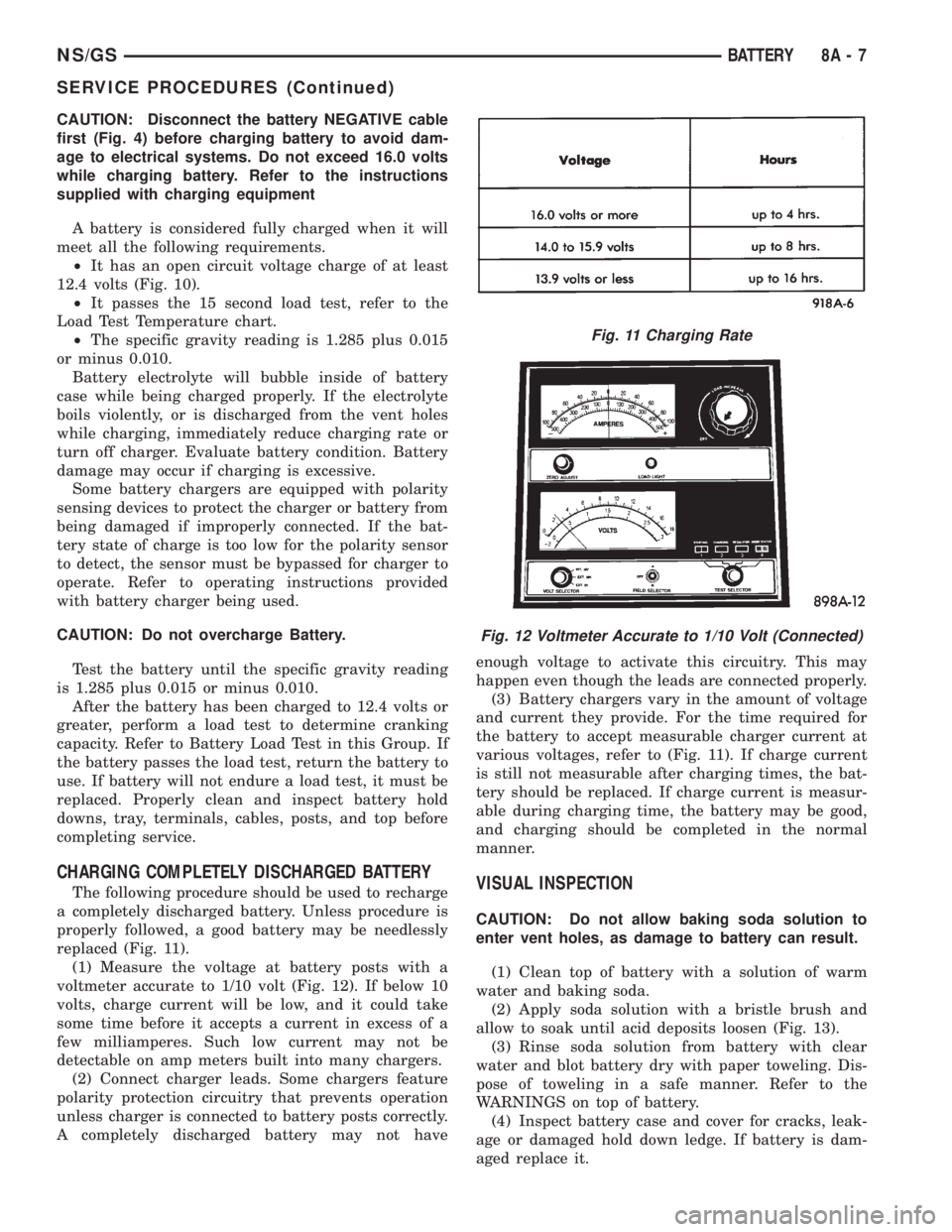
replaced (Fig. 11).
(1) Measure the voltage at battery posts with a
voltmeter accurate to 1/10 volt (Fig. 12). If below 10
volts, charge current will be low, and it could take
some time before it accepts a current in excess of a
few milliamperes. Such low current may not be
detectable on amp meters built into many chargers.
(2) Connect charger leads. Some chargers feature
polarity protection circuitry that prevents operation
unless charger is connected to battery posts correctly.
A completely discharged battery may not haveenough voltage to activate this circuitry. This may
happen even though the leads are connected properly.
(3) Battery chargers vary in the amount of voltage
and current they provide. For the time required for
the battery to accept measurable charger current at
various voltages, refer to (Fig. 11). If charge current
is still not measurable after charging times, the bat-
tery should be replaced. If charge current is measur-
able during charging time, the battery may be good,
and charging should be completed in the normal
manner.VISUAL INSPECTION
CAUTION: Do not allow baking soda solution to
enter vent holes, as damage to battery can result.
(1) Clean top of battery with a solution of warm
water and baking soda.
(2) Apply soda solution with a bristle brush and
allow to soak until acid deposits loosen (Fig. 13).
(3) Rinse soda solution from battery with clear
water and blot battery dry with paper toweling. Dis-
pose of toweling in a safe manner. Refer to the
WARNINGS on top of battery.
(4) Inspect battery case and cover for cracks, leak-
age or damaged hold down ledge. If battery is dam-
aged replace it.
Fig. 11 Charging Rate
Fig. 12 Voltmeter Accurate to 1/10 Volt (Connected)
NS/GSBATTERY 8A - 7
SERVICE PROCEDURES (Continued)
Page 278 of 1938
INSTALLATION
(1) Place starter in position on vehicle.
(2) Install bolts to hold starter to transaxle bell-
housing.
(3) Place solenoid and B+ wires in position on
starter terminals.
(4) Install nut to hold B+ wire to terminal.
(5) Connect solenoid wire connector onto terminal.
(6) Lower vehicle.
(7) Connect battery negative cable.
(8) Verify starter operation.
STARTERÐ3.0L ENGINE
REMOVAL
(1) Release hood latch and open hood.
(2) Disconnect battery negative cable (Fig. 8).
(3) Hoist and support vehicle on safety stands.
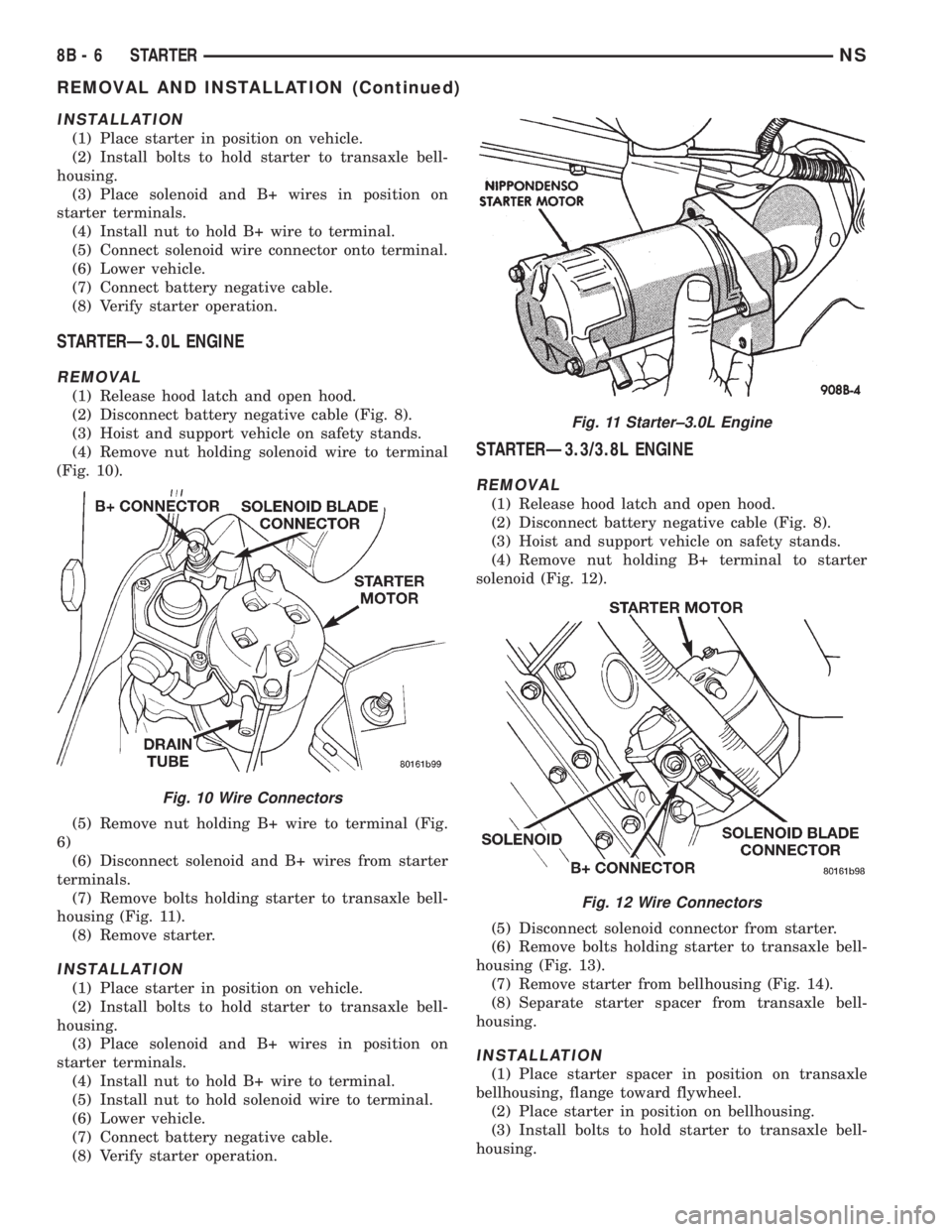
(4) Remove nut holding solenoid wire to terminal
(Fig. 10).
(5) Remove nut holding B+ wire to terminal (Fig.
6)
(6) Disconnect solenoid and B+ wires from starter
terminals.
(7) Remove bolts holding starter to transaxle bell-
housing (Fig. 11).
(8) Remove starter.
INSTALLATION
(1) Place starter in position on vehicle.
(2) Install bolts to hold starter to transaxle bell-
housing.
(3) Place solenoid and B+ wires in position on
starter terminals.
(4) Install nut to hold B+ wire to terminal.
(5) Install nut to hold solenoid wire to terminal.
(6) Lower vehicle.
(7) Connect battery negative cable.
(8) Verify starter operation.
STARTERÐ3.3/3.8L ENGINE
REMOVAL
(1) Release hood latch and open hood.
(2) Disconnect battery negative cable (Fig. 8).
(3) Hoist and support vehicle on safety stands.
(4) Remove nut holding B+ terminal to starter
solenoid (Fig. 12).
(5) Disconnect solenoid connector from starter.
(6) Remove bolts holding starter to transaxle bell-
housing (Fig. 13).
(7) Remove starter from bellhousing (Fig. 14).
(8) Separate starter spacer from transaxle bell-
housing.
INSTALLATION
(1) Place starter spacer in position on transaxle
bellhousing, flange toward flywheel.
(2) Place starter in position on bellhousing.
(3) Install bolts to hold starter to transaxle bell-
housing.
Fig. 10 Wire Connectors
Fig. 11 Starter±3.0L Engine
Fig. 12 Wire Connectors
8B - 6 STARTERNS
REMOVAL AND INSTALLATION (Continued)
Page 284 of 1938
(7) Remove bolts holding starter to transaxle bell-
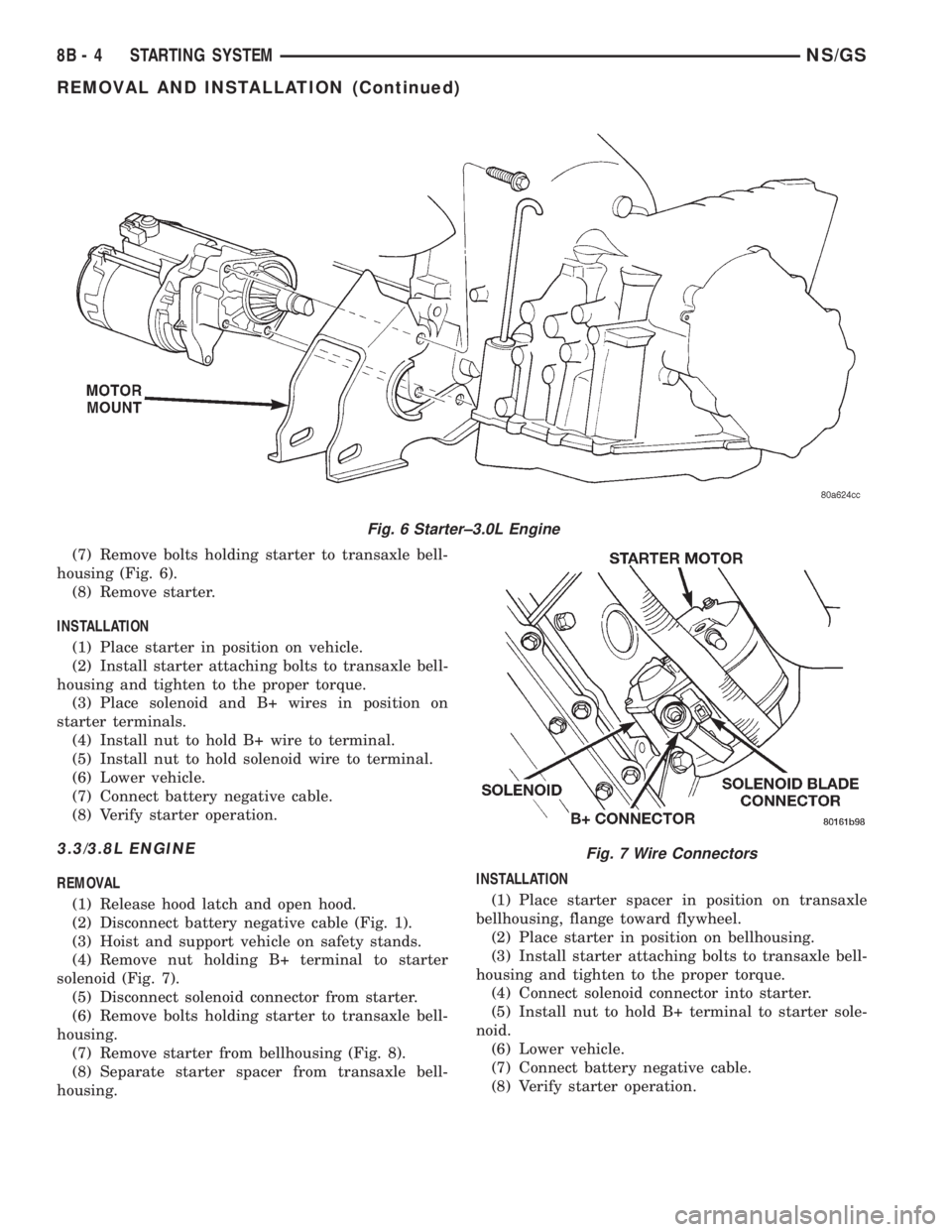
housing (Fig. 6).
(8) Remove starter.
INSTALLATION
(1) Place starter in position on vehicle.
(2) Install starter attaching bolts to transaxle bell-
housing and tighten to the proper torque.
(3) Place solenoid and B+ wires in position on
starter terminals.
(4) Install nut to hold B+ wire to terminal.
(5) Install nut to hold solenoid wire to terminal.
(6) Lower vehicle.
(7) Connect battery negative cable.
(8) Verify starter operation.
3.3/3.8L ENGINE
REMOVAL
(1) Release hood latch and open hood.
(2) Disconnect battery negative cable (Fig. 1).
(3) Hoist and support vehicle on safety stands.
(4) Remove nut holding B+ terminal to starter
solenoid (Fig. 7).
(5) Disconnect solenoid connector from starter.
(6) Remove bolts holding starter to transaxle bell-
housing.
(7) Remove starter from bellhousing (Fig. 8).
(8) Separate starter spacer from transaxle bell-
housing.INSTALLATION
(1) Place starter spacer in position on transaxle
bellhousing, flange toward flywheel.
(2) Place starter in position on bellhousing.
(3) Install starter attaching bolts to transaxle bell-
housing and tighten to the proper torque.
(4) Connect solenoid connector into starter.
(5) Install nut to hold B+ terminal to starter sole-
noid.
(6) Lower vehicle.
(7) Connect battery negative cable.
(8) Verify starter operation.
Fig. 6 Starter±3.0L Engine
Fig. 7 Wire Connectors
8B - 4 STARTING SYSTEMNS/GS
REMOVAL AND INSTALLATION (Continued)
Page 296 of 1938

(4) Install bolt to hold bottom of generator to lower
pivot bracket.
(5) Install bolt to hold top of generator to mount
bracket.
(6) Install accessory drive belt, refer to Group 7,
Cooling System for proper procedures.
(7) Install windshield wiper housing, refer to
Group 8K, Windshield Wipers and Washers for
proper procedures.
(8) Connect battery negative cable.
(9) Verify generator charge rate.
GENERATORÐ3.3/3.8 L ENGINE
REMOVAL
(1) Release hood latch and open hood.
(2) Disconnect battery negative cable (Fig. 3).
(3) Remove windshield wiper housing, refer to
Group 8K, Windshield Wipers and Washers for
proper procedures.
(4) Remove accessory drive belt, refer to Group 7,
Cooling System for proper procedures.
(5) Remove bolt holding top of generator mount
bracket to engine air intake plenum (Fig. 7).
(6) Remove bolts holding outside of generator
mount bracket to generator mount plate.
(7) Remove bolt holding top of generator to mount
bracket.
(8) Remove generator mount bracket from vehicle.
(9) Rotate generator toward rear dash panel.
(10) Disconnect the push-in field wire connector
from back of generator (Fig. 6).
(11) Remove nut holding B+ wire terminal to back
of generator.
(12) Separate B+ terminal from generator.
(13) Remove bolt holding bottom of generator to
lower pivot bracket (Fig. 8).
(14) Remove generator from vehicle (Fig. 9).
INSTALLATION
(1) Place generator in position on vehicle.
Fig. 6 Generator±3.0L EngineFig. 7 Generator Mounting Bracket
Fig. 8 Generator pivot Bolt
Fig. 9 Generator±3.3/3.8 L Engine
8C - 10 CHARGING SYSTEMNS
REMOVAL AND INSTALLATION (Continued)
Page 301 of 1938
All engines use resistor spark plugs. They have
resistance values ranging from 6,000 to 20,000 ohms
when checked with at least a 1000 volt spark plug
tester.
Do not use an ohm meter to check the resis-
tance of the spark plugs. This will give an inac-
curate reading.
Remove the spark plugs and examine them for
burned electrodes and fouled, cracked or broken por-
celain insulators. Keep plugs arranged in the order
in which they were removed from the engine. An iso-
lated plug displaying an abnormal condition indicates
that a problem exists in the corresponding cylinder.
Replace spark plugs at the intervals recommended in
Group O - Lubrication and Maintenance.
Spark plugs that have low mileage may be cleaned
and reused if not otherwise defective, carbon or oil
fouled. Refer to the Spark Plug Condition section of
this group.
The spark plugs are double platinum and have a
recommended service life of 100,000 miles for normal
driving conditions per schedule A in this manual. The
spark plugs have a recommended service life of
75,000 miles for serve driving conditions per schedule
B in this manual. A thin platinum pad is welded to
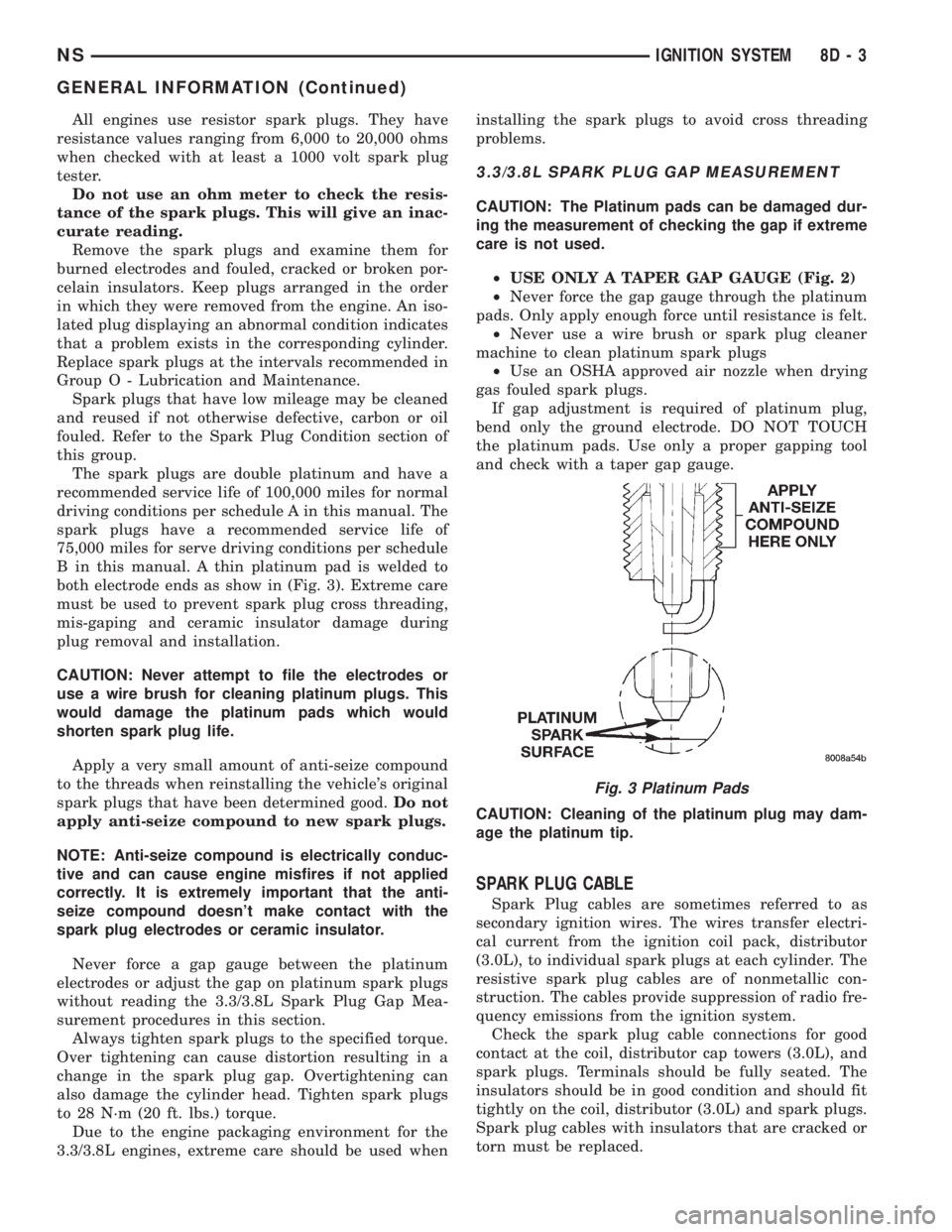
both electrode ends as show in (Fig. 3). Extreme care
must be used to prevent spark plug cross threading,
mis-gaping and ceramic insulator damage during
plug removal and installation.
CAUTION: Never attempt to file the electrodes or
use a wire brush for cleaning platinum plugs. This
would damage the platinum pads which would
shorten spark plug life.
Apply a very small amount of anti-seize compound
to the threads when reinstalling the vehicle's original
spark plugs that have been determined good.Do not
apply anti-seize compound to new spark plugs.
NOTE: Anti-seize compound is electrically conduc-
tive and can cause engine misfires if not applied
correctly. It is extremely important that the anti-
seize compound doesn't make contact with the
spark plug electrodes or ceramic insulator.
Never force a gap gauge between the platinum
electrodes or adjust the gap on platinum spark plugs
without reading the 3.3/3.8L Spark Plug Gap Mea-
surement procedures in this section.
Always tighten spark plugs to the specified torque.
Over tightening can cause distortion resulting in a
change in the spark plug gap. Overtightening can
also damage the cylinder head. Tighten spark plugs
to 28 N´m (20 ft. lbs.) torque.
Due to the engine packaging environment for the
3.3/3.8L engines, extreme care should be used wheninstalling the spark plugs to avoid cross threading
problems.
3.3/3.8L SPARK PLUG GAP MEASUREMENT
CAUTION: The Platinum pads can be damaged dur-
ing the measurement of checking the gap if extreme
care is not used.
²USE ONLY A TAPER GAP GAUGE (Fig. 2)
²Never force the gap gauge through the platinum
pads. Only apply enough force until resistance is felt.
²Never use a wire brush or spark plug cleaner
machine to clean platinum spark plugs
²Use an OSHA approved air nozzle when drying
gas fouled spark plugs.
If gap adjustment is required of platinum plug,
bend only the ground electrode. DO NOT TOUCH
the platinum pads. Use only a proper gapping tool
and check with a taper gap gauge.
CAUTION: Cleaning of the platinum plug may dam-
age the platinum tip.
SPARK PLUG CABLE
Spark Plug cables are sometimes referred to as
secondary ignition wires. The wires transfer electri-
cal current from the ignition coil pack, distributor
(3.0L), to individual spark plugs at each cylinder. The
resistive spark plug cables are of nonmetallic con-
struction. The cables provide suppression of radio fre-
quency emissions from the ignition system.
Check the spark plug cable connections for good
contact at the coil, distributor cap towers (3.0L), and
spark plugs. Terminals should be fully seated. The
insulators should be in good condition and should fit
tightly on the coil, distributor (3.0L) and spark plugs.
Spark plug cables with insulators that are cracked or
torn must be replaced.
Fig. 3 Platinum Pads
NSIGNITION SYSTEM 8D - 3
GENERAL INFORMATION (Continued)
Page 306 of 1938
NOTE: Over or under tightening effects knock sen-
sor performance, possibly causing improper spark
control.
DIAGNOSIS AND TESTING
TESTING FOR SPARK AT COILÐ2.4/3.3/3.8L
ENGINES
WARNING: THE DIRECT IGNITION SYSTEMS GEN-
ERATES APPROXIMATELY 40,000 VOLTS. PER-
SONAL INJURY COULD RESULT FROM CONTACT
WITH THIS SYSTEM.
The coil pack contains independent coils. Each coil
must be checked individually.
CAUTION: Spark plug wire damage may occur if
the spark plug is moved more than 1/4 inch away
from the engine ground.
CAUTION: Do not leave any one spark plug cable
disconnected any longer than 30 seconds or possi-
ble heat damage to catalytic converter will occur.
CAUTION: Test must be performed at idle and in
park only with the parking brake on.
Use a new spark plug and spark plug cable
for the following test.
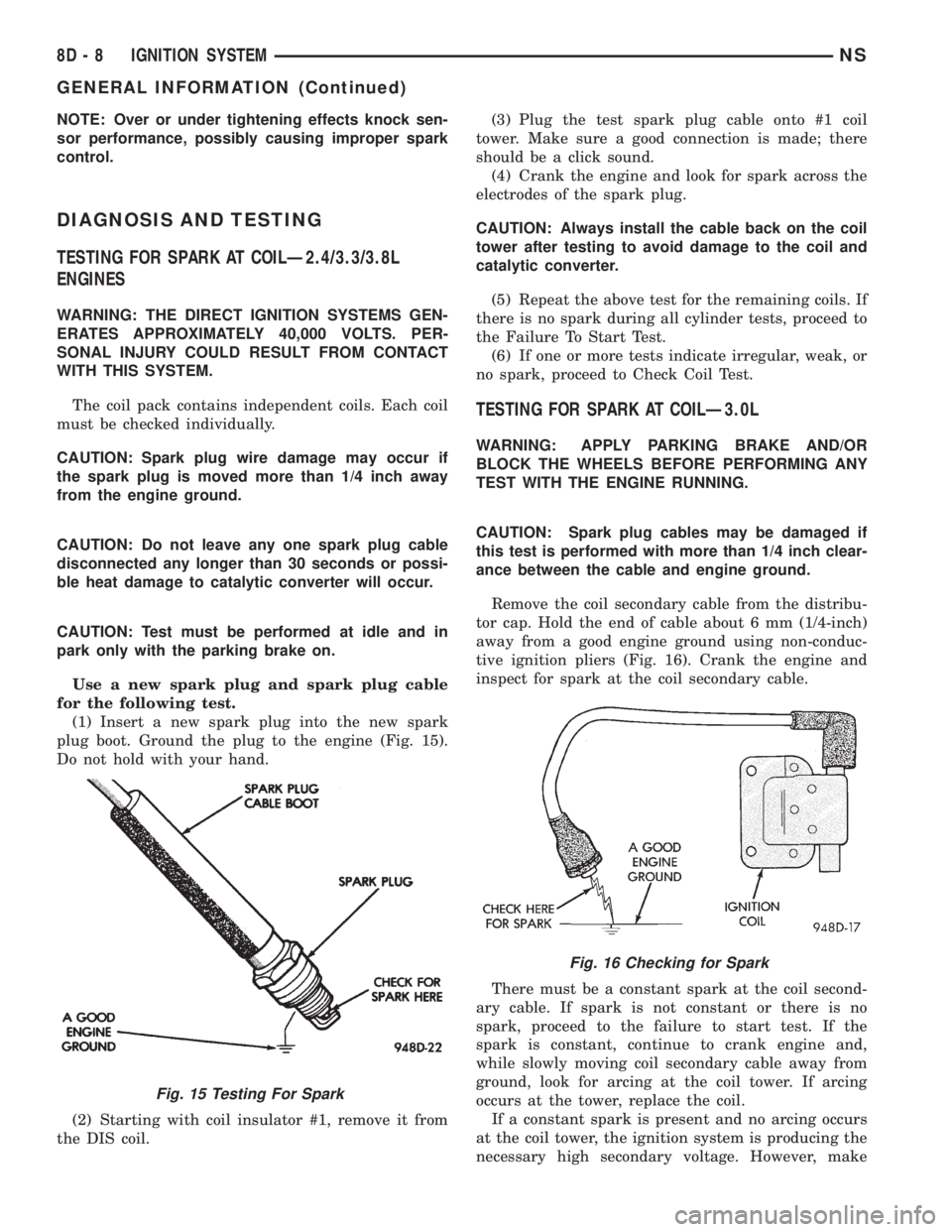
(1) Insert a new spark plug into the new spark
plug boot. Ground the plug to the engine (Fig. 15).
Do not hold with your hand.
(2) Starting with coil insulator #1, remove it from
the DIS coil.(3) Plug the test spark plug cable onto #1 coil
tower. Make sure a good connection is made; there
should be a click sound.
(4) Crank the engine and look for spark across the
electrodes of the spark plug.
CAUTION: Always install the cable back on the coil
tower after testing to avoid damage to the coil and
catalytic converter.
(5) Repeat the above test for the remaining coils. If
there is no spark during all cylinder tests, proceed to
the Failure To Start Test.
(6) If one or more tests indicate irregular, weak, or
no spark, proceed to Check Coil Test.
TESTING FOR SPARK AT COILÐ3.0L
WARNING: APPLY PARKING BRAKE AND/OR
BLOCK THE WHEELS BEFORE PERFORMING ANY
TEST WITH THE ENGINE RUNNING.
CAUTION: Spark plug cables may be damaged if
this test is performed with more than 1/4 inch clear-
ance between the cable and engine ground.
Remove the coil secondary cable from the distribu-
tor cap. Hold the end of cable about 6 mm (1/4-inch)
away from a good engine ground using non-conduc-
tive ignition pliers (Fig. 16). Crank the engine and
inspect for spark at the coil secondary cable.
There must be a constant spark at the coil second-
ary cable. If spark is not constant or there is no
spark, proceed to the failure to start test. If the
spark is constant, continue to crank engine and,
while slowly moving coil secondary cable away from
ground, look for arcing at the coil tower. If arcing
occurs at the tower, replace the coil.
If a constant spark is present and no arcing occurs
at the coil tower, the ignition system is producing the
necessary high secondary voltage. However, make
Fig. 15 Testing For Spark
Fig. 16 Checking for Spark
8D - 8 IGNITION SYSTEMNS
GENERAL INFORMATION (Continued)
Page 307 of 1938
sure that the spark plugs are firing. Inspect the dis-
tributor rotor, cap, spark plug cables, and spark
plugs. If they are in proper working order, the igni-
tion system is not the reason why the engine will not
start. Inspect the fuel system and engine for proper
operation.
CHECK COIL TESTÐ2.4L
Coil one fires cylinders 1 and 4, coil two fires
cylinders 2 and 3. Each coil tower is labeled
with the number of the corresponding cylinder.
(1) Remove ignition cables and measure the resis-
tance of the cables. Resistance must be within the
range shown in the Cable Resistance Chart in Spec-
ifications. Replace any cable not within tolerance.
(2) Disconnect the electrical connector from the
coil pack.
(3) Measure the primary resistance of each coil. At
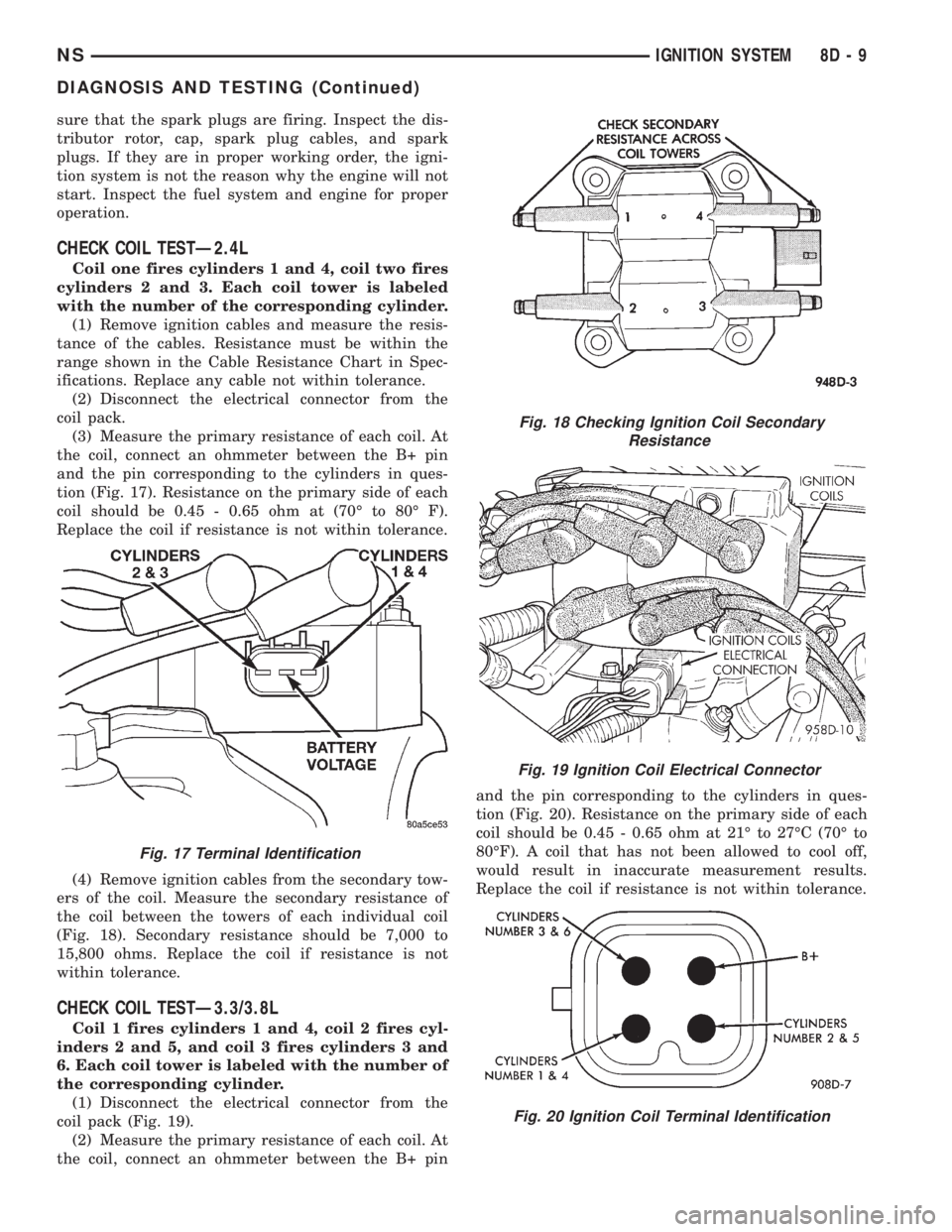
the coil, connect an ohmmeter between the B+ pin
and the pin corresponding to the cylinders in ques-
tion (Fig. 17). Resistance on the primary side of each
coil should be 0.45 - 0.65 ohm at (70É to 80É F).
Replace the coil if resistance is not within tolerance.
(4) Remove ignition cables from the secondary tow-
ers of the coil. Measure the secondary resistance of
the coil between the towers of each individual coil
(Fig. 18). Secondary resistance should be 7,000 to
15,800 ohms. Replace the coil if resistance is not
within tolerance.
CHECK COIL TESTÐ3.3/3.8L
Coil 1 fires cylinders 1 and 4, coil 2 fires cyl-
inders 2 and 5, and coil 3 fires cylinders 3 and
6. Each coil tower is labeled with the number of
the corresponding cylinder.
(1) Disconnect the electrical connector from the
coil pack (Fig. 19).
(2) Measure the primary resistance of each coil. At
the coil, connect an ohmmeter between the B+ pinand the pin corresponding to the cylinders in ques-
tion (Fig. 20). Resistance on the primary side of each
coil should be 0.45 - 0.65 ohm at 21É to 27ÉC (70É to
80ÉF). A coil that has not been allowed to cool off,
would result in inaccurate measurement results.
Replace the coil if resistance is not within tolerance.
Fig. 17 Terminal Identification
Fig. 18 Checking Ignition Coil Secondary
Resistance
Fig. 19 Ignition Coil Electrical Connector
Fig. 20 Ignition Coil Terminal Identification
NSIGNITION SYSTEM 8D - 9
DIAGNOSIS AND TESTING (Continued)
Page 308 of 1938

(3) Remove ignition cables from the secondary tow-
ers of the coil. Measure the secondary resistance of
the coil between the towers of each individual coil
(Fig. 21). Secondary resistance should be 7,000 to
15,800 ohms. Replace the coil if resistance is not
within tolerance.
FAILURE TO START TEST
This no-start test checks the camshaft position sen-
sor and crankshaft position sensor.
The Powertrain Control Module (PCM) supplies 8
volts to the camshaft position sensor and crankshaft
position sensor through one circuit. If the 8 volt sup-
ply circuit shorts to ground, neither sensor will pro-
duce a signal (output voltage to the PCM).
When the ignition key is turned and left in the On
position, the PCM automatically energizes the Auto
Shutdown (ASD) relay. However, the controller de-en-
ergizes the relay within one second because it has
not received a camshaft position sensor signal indi-
cating engine rotation.
During cranking, the ASD relay will not energize
until the PCM receives a camshaft position sensor
signal. Secondly, the ASD relay remains energized
only if the controller senses a crankshaft position
sensor signal immediately after detecting the cam-
shaft position sensor signal.
(1) Check battery voltage. Voltage should be
approximately 12.66 volts or higher to perform fail-
ure to start test.
(2) Disconnect the harness connector from the coil
pack.
(3) Connect a test light to the B+ (battery voltage)
terminal of the coil electrical connector and ground
as shown in (Fig. 22). The B+ wire for the DIS coil is
dark green with an orange tracer.Do not spread
the terminal with the test light probe.(4) Turn the ignition key to theON position.The
test light should flash On and then Off.Do not turn
the Key to off position, leave it in the On posi-
tion.
(a) If the test light flashes momentarily, the
PCM grounded the Auto Shutdown (ASD) relay.
Proceed to step 5.
(b) If the test light did not flash, the ASD relay
did not energize. The cause is either the relay or
one of the relay circuits. Use the DRB scan tool to
test the ASD relay and circuits. Refer to the appro-
priate Powertrain Diagnostics Procedure Manual.
Refer to the wiring diagrams section for circuit
information.
(5) Crank the engine. (If the key was placed in the
off position after step 4, place the key in the On posi-
tion before cranking. Wait for the test light to flash
once, then crank the engine.)
(6) If the test light momentarily flashes during
cranking, the PCM is not receiving a crankshaft posi-
tion sensor signal. Use the DRB scan tool to test the
crankshaft position sensor and sensor circuits. Refer
to the appropriate Powertrain Diagnostics Procedure
Manual. Refer to the wiring diagrams section for cir-
cuit information.
(7) If the test light did not flash during cranking,
unplug the crankshaft position sensor connector.
Turn the ignition key to the off position. Turn the
key to the On position, wait for the test light to
momentarily flash once, then crank the engine. If the
test light momentarily flashes, the crankshaft posi-
tion sensor is shorted and must be replaced. If the
light did not flash, the cause of the no-start is in
Fig. 21 Checking Ignition Coil Secondary
ResistanceFig. 22 Ignition Coil Engine Harness Connector
8D - 10 IGNITION SYSTEMNS
DIAGNOSIS AND TESTING (Continued)