shaft CHRYSLER VOYAGER 1996 Owner's Manual
[x] Cancel search | Manufacturer: CHRYSLER, Model Year: 1996, Model line: VOYAGER, Model: CHRYSLER VOYAGER 1996Pages: 1938, PDF Size: 55.84 MB
Page 142 of 1938
(23) Install the negative (ground) cable on the bat-
tery.
(24) Cycle the park brake pedal one time. This will
seat the park brake cables and will allow the auto-
matic self adjuster to properly tension the park brake
cables.
PARK BRAKE SHOES (WITH REAR DISC BRAKES)
On this vehicle, the park brake shoes are removed
from the disc brake adapter with the disc brake
adapter removed from the vehicle.
REMOVE
(1) Set the parking brake.The parking brake is
set to keep the hub/bearing and axle shaft from
rotating when loosening the hub nut.
(2) Raise vehicle. Vehicle is to be raised and sup-
ported on jackstands or on a frame contact type
hoist. See Hoisting in the Lubrication And Mainte-
nance section of this service manual.
(3) Remove the wheel/tire.
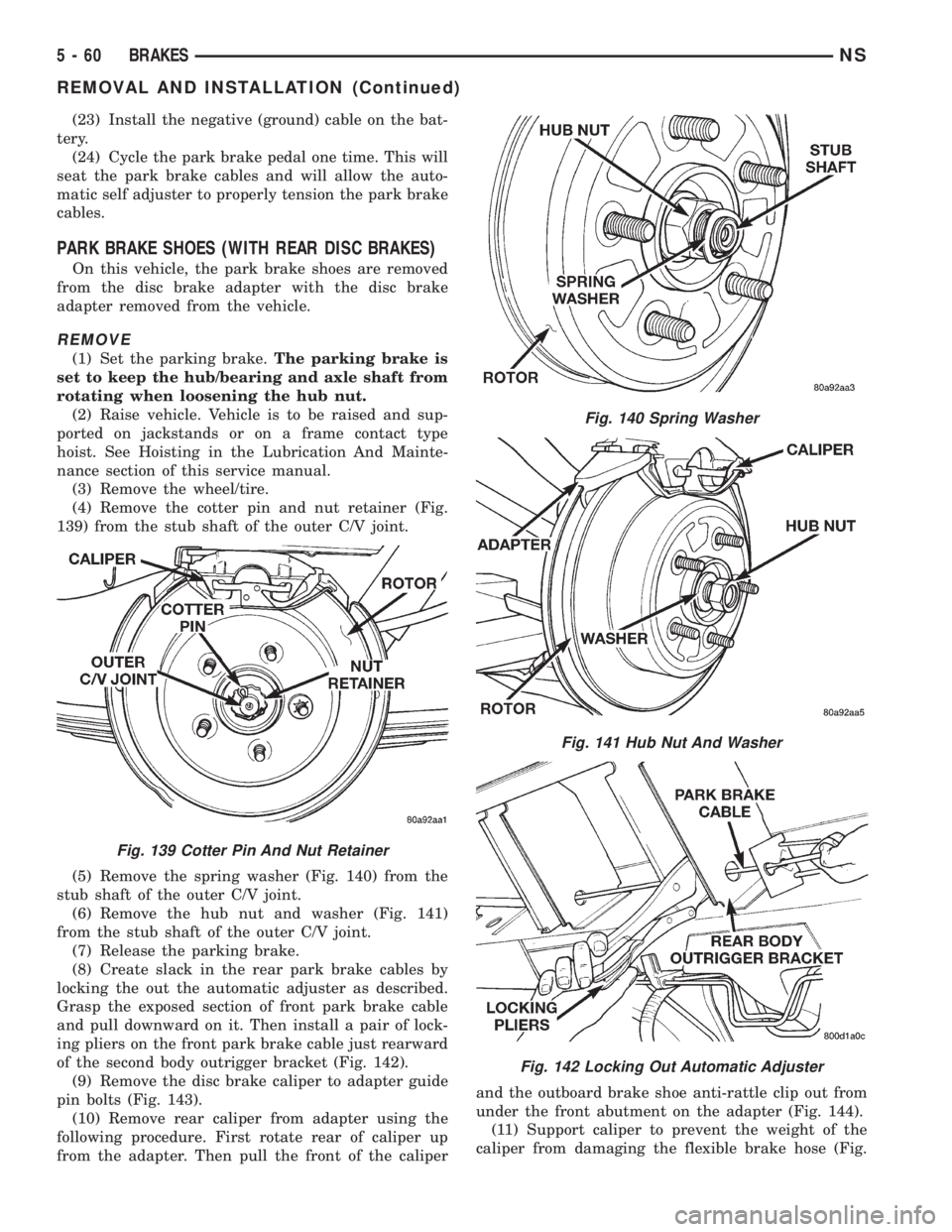
(4) Remove the cotter pin and nut retainer (Fig.
139) from the stub shaft of the outer C/V joint.
(5) Remove the spring washer (Fig. 140) from the
stub shaft of the outer C/V joint.
(6) Remove the hub nut and washer (Fig. 141)
from the stub shaft of the outer C/V joint.
(7) Release the parking brake.
(8) Create slack in the rear park brake cables by
locking the out the automatic adjuster as described.
Grasp the exposed section of front park brake cable
and pull downward on it. Then install a pair of lock-
ing pliers on the front park brake cable just rearward
of the second body outrigger bracket (Fig. 142).
(9) Remove the disc brake caliper to adapter guide
pin bolts (Fig. 143).
(10) Remove rear caliper from adapter using the
following procedure. First rotate rear of caliper up
from the adapter. Then pull the front of the caliperand the outboard brake shoe anti-rattle clip out from
under the front abutment on the adapter (Fig. 144).
(11) Support caliper to prevent the weight of the
caliper from damaging the flexible brake hose (Fig.
Fig. 139 Cotter Pin And Nut Retainer
Fig. 140 Spring Washer
Fig. 141 Hub Nut And Washer
Fig. 142 Locking Out Automatic Adjuster
5 - 60 BRAKESNS
REMOVAL AND INSTALLATION (Continued)
Page 143 of 1938
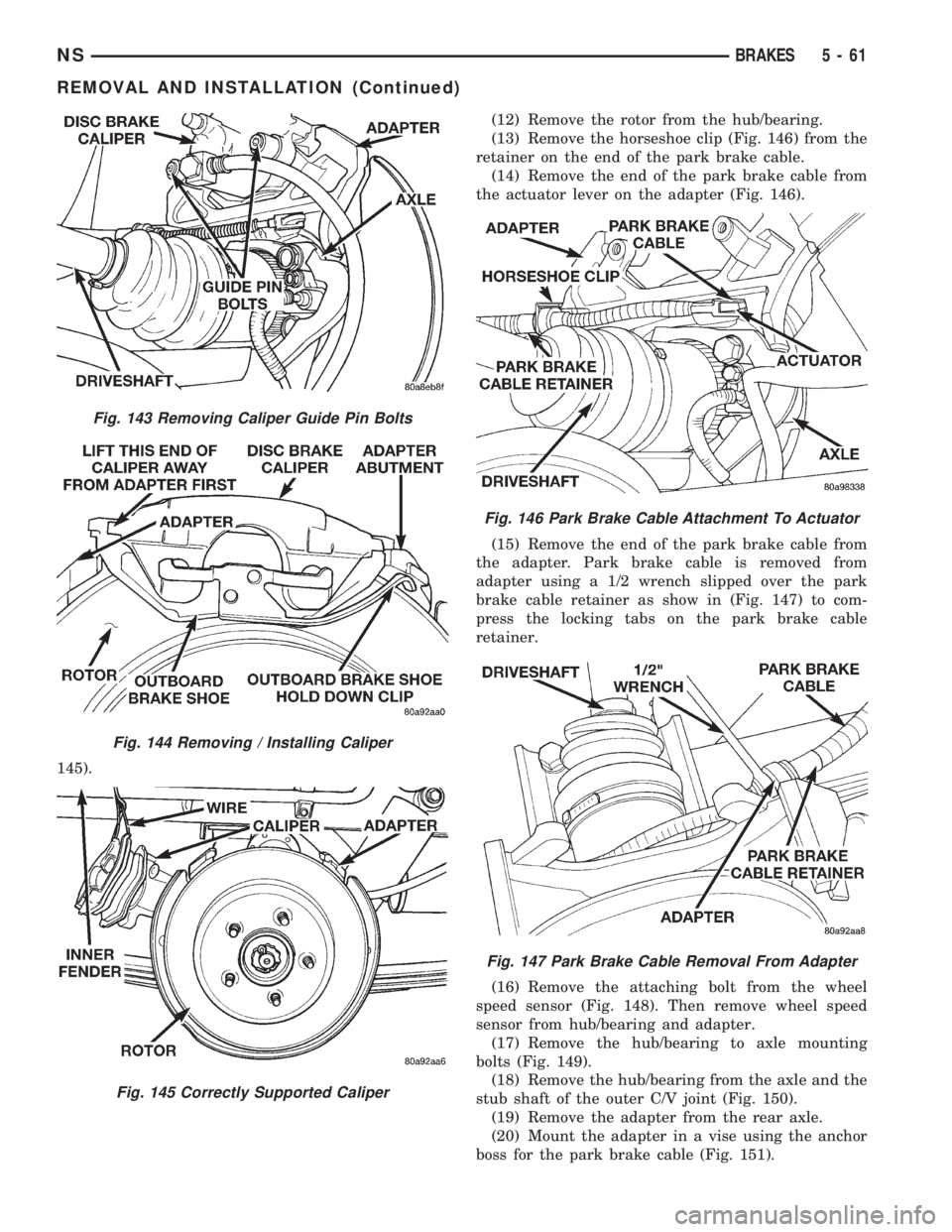
145).(12) Remove the rotor from the hub/bearing.
(13) Remove the horseshoe clip (Fig. 146) from the
retainer on the end of the park brake cable.
(14) Remove the end of the park brake cable from
the actuator lever on the adapter (Fig. 146).
(15) Remove the end of the park brake cable from
the adapter. Park brake cable is removed from
adapter using a 1/2 wrench slipped over the park
brake cable retainer as show in (Fig. 147) to com-
press the locking tabs on the park brake cable
retainer.
(16) Remove the attaching bolt from the wheel
speed sensor (Fig. 148). Then remove wheel speed
sensor from hub/bearing and adapter.
(17) Remove the hub/bearing to axle mounting
bolts (Fig. 149).
(18) Remove the hub/bearing from the axle and the
stub shaft of the outer C/V joint (Fig. 150).
(19) Remove the adapter from the rear axle.
(20) Mount the adapter in a vise using the anchor
boss for the park brake cable (Fig. 151).
Fig. 143 Removing Caliper Guide Pin Bolts
Fig. 144 Removing / Installing Caliper
Fig. 145 Correctly Supported Caliper
Fig. 146 Park Brake Cable Attachment To Actuator
Fig. 147 Park Brake Cable Removal From Adapter
NSBRAKES 5 - 61
REMOVAL AND INSTALLATION (Continued)
Page 146 of 1938
NOTE: When the hold down pin is installed, the
long part of the hold down pin is to be positioned
strait up and down. This will ensure that the hold
down pin is correctly engaged with the adapter.
(6) Install the hold down spring and pin (Fig. 153)
on the leading park brake shoe.
(7) Install the lower return spring (Fig. 152) on
the leading and trailing park brake shoes.When
installing the hold down spring it is to be
installed behind the park brake shoes (Fig.
152).
(8) Install the 4 mounting bolts for the adapter
and hub/bearing into the bolt holes in the axle.
(9) Position the adapter on the 4 mounting bolts
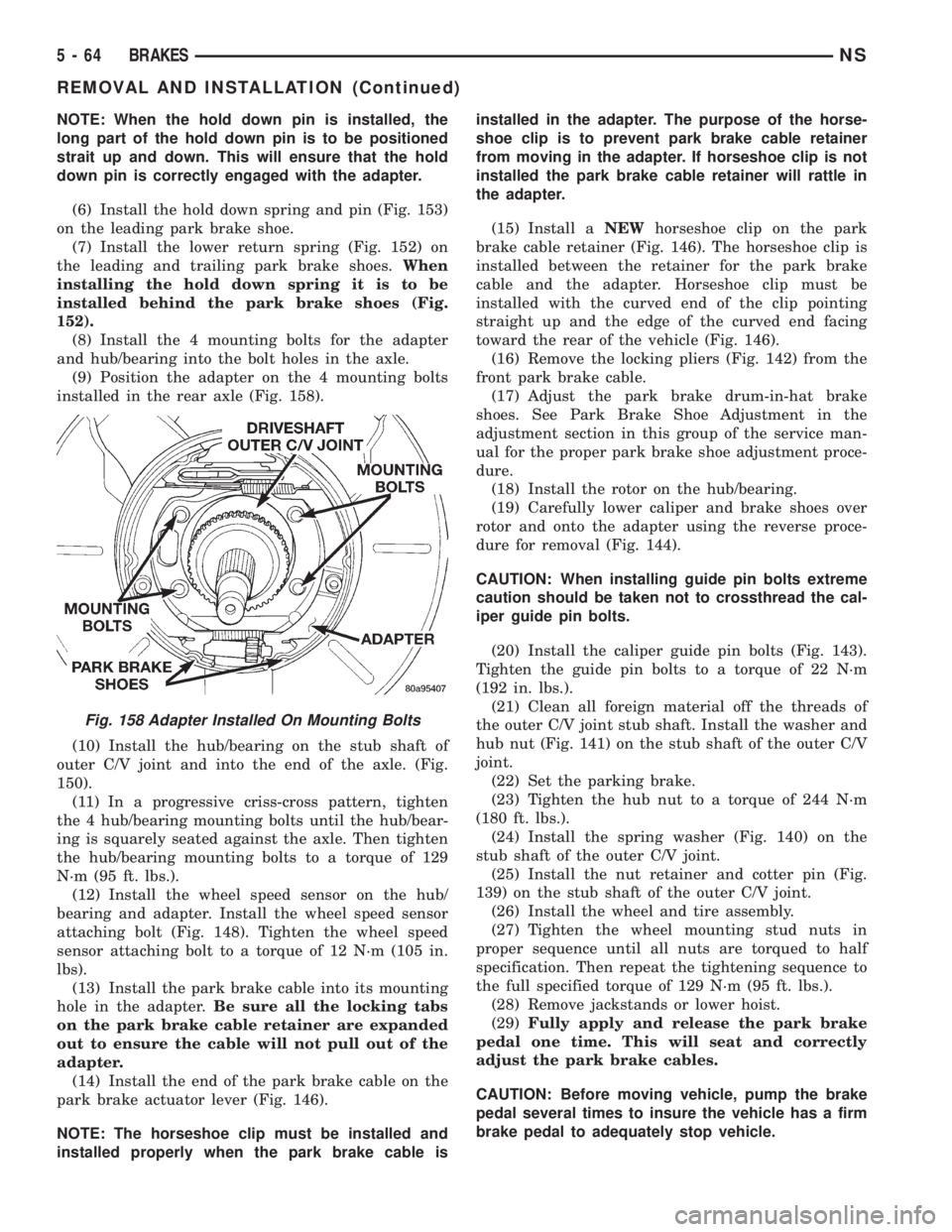
installed in the rear axle (Fig. 158).
(10) Install the hub/bearing on the stub shaft of
outer C/V joint and into the end of the axle. (Fig.
150).
(11) In a progressive criss-cross pattern, tighten
the 4 hub/bearing mounting bolts until the hub/bear-
ing is squarely seated against the axle. Then tighten
the hub/bearing mounting bolts to a torque of 129
N´m (95 ft. lbs.).
(12) Install the wheel speed sensor on the hub/
bearing and adapter. Install the wheel speed sensor
attaching bolt (Fig. 148). Tighten the wheel speed
sensor attaching bolt to a torque of 12 N´m (105 in.
lbs).
(13) Install the park brake cable into its mounting
hole in the adapter.Be sure all the locking tabs
on the park brake cable retainer are expanded
out to ensure the cable will not pull out of the
adapter.
(14) Install the end of the park brake cable on the
park brake actuator lever (Fig. 146).
NOTE: The horseshoe clip must be installed and
installed properly when the park brake cable isinstalled in the adapter. The purpose of the horse-
shoe clip is to prevent park brake cable retainer
from moving in the adapter. If horseshoe clip is not
installed the park brake cable retainer will rattle in
the adapter.
(15) Install aNEWhorseshoe clip on the park
brake cable retainer (Fig. 146). The horseshoe clip is
installed between the retainer for the park brake
cable and the adapter. Horseshoe clip must be
installed with the curved end of the clip pointing
straight up and the edge of the curved end facing
toward the rear of the vehicle (Fig. 146).
(16) Remove the locking pliers (Fig. 142) from the
front park brake cable.
(17) Adjust the park brake drum-in-hat brake
shoes. See Park Brake Shoe Adjustment in the
adjustment section in this group of the service man-
ual for the proper park brake shoe adjustment proce-
dure.
(18) Install the rotor on the hub/bearing.
(19) Carefully lower caliper and brake shoes over
rotor and onto the adapter using the reverse proce-
dure for removal (Fig. 144).
CAUTION: When installing guide pin bolts extreme
caution should be taken not to crossthread the cal-
iper guide pin bolts.
(20) Install the caliper guide pin bolts (Fig. 143).
Tighten the guide pin bolts to a torque of 22 N´m
(192 in. lbs.).
(21) Clean all foreign material off the threads of
the outer C/V joint stub shaft. Install the washer and
hub nut (Fig. 141) on the stub shaft of the outer C/V
joint.
(22) Set the parking brake.
(23) Tighten the hub nut to a torque of 244 N´m
(180 ft. lbs.).
(24) Install the spring washer (Fig. 140) on the
stub shaft of the outer C/V joint.
(25) Install the nut retainer and cotter pin (Fig.
139) on the stub shaft of the outer C/V joint.
(26) Install the wheel and tire assembly.
(27) Tighten the wheel mounting stud nuts in
proper sequence until all nuts are torqued to half
specification. Then repeat the tightening sequence to
the full specified torque of 129 N´m (95 ft. lbs.).
(28) Remove jackstands or lower hoist.
(29)Fully apply and release the park brake
pedal one time. This will seat and correctly
adjust the park brake cables.
CAUTION: Before moving vehicle, pump the brake
pedal several times to insure the vehicle has a firm
brake pedal to adequately stop vehicle.
Fig. 158 Adapter Installed On Mounting Bolts
5 - 64 BRAKESNS
REMOVAL AND INSTALLATION (Continued)
Page 172 of 1938
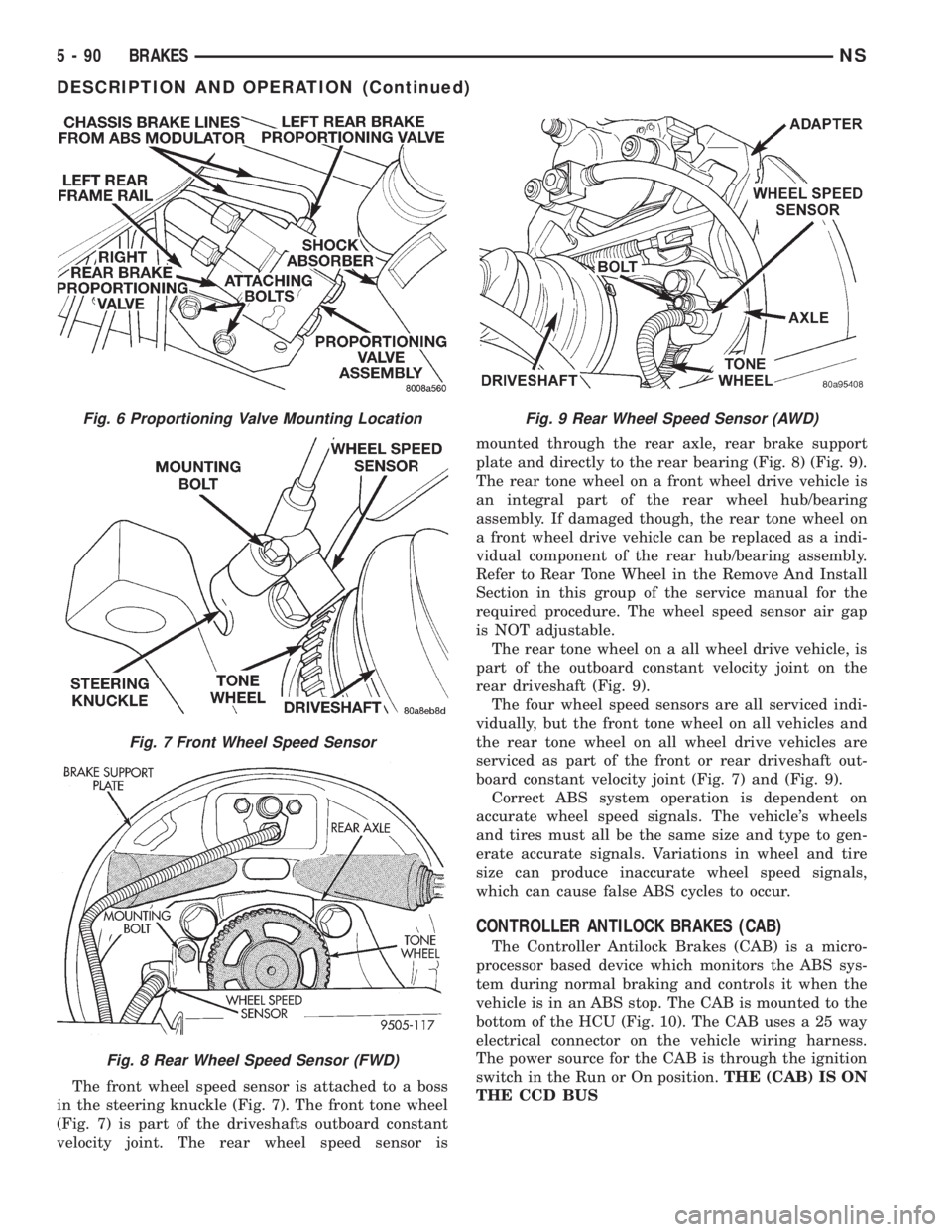
The front wheel speed sensor is attached to a boss
in the steering knuckle (Fig. 7). The front tone wheel
(Fig. 7) is part of the driveshafts outboard constant
velocity joint. The rear wheel speed sensor ismounted through the rear axle, rear brake support
plate and directly to the rear bearing (Fig. 8) (Fig. 9).
The rear tone wheel on a front wheel drive vehicle is
an integral part of the rear wheel hub/bearing
assembly. If damaged though, the rear tone wheel on
a front wheel drive vehicle can be replaced as a indi-
vidual component of the rear hub/bearing assembly.
Refer to Rear Tone Wheel in the Remove And Install
Section in this group of the service manual for the
required procedure. The wheel speed sensor air gap
is NOT adjustable.
The rear tone wheel on a all wheel drive vehicle, is
part of the outboard constant velocity joint on the
rear driveshaft (Fig. 9).
The four wheel speed sensors are all serviced indi-
vidually, but the front tone wheel on all vehicles and
the rear tone wheel on all wheel drive vehicles are
serviced as part of the front or rear driveshaft out-
board constant velocity joint (Fig. 7) and (Fig. 9).
Correct ABS system operation is dependent on
accurate wheel speed signals. The vehicle's wheels
and tires must all be the same size and type to gen-
erate accurate signals. Variations in wheel and tire
size can produce inaccurate wheel speed signals,
which can cause false ABS cycles to occur.
CONTROLLER ANTILOCK BRAKES (CAB)
The Controller Antilock Brakes (CAB) is a micro-
processor based device which monitors the ABS sys-
tem during normal braking and controls it when the
vehicle is in an ABS stop. The CAB is mounted to the
bottom of the HCU (Fig. 10). The CAB uses a 25 way
electrical connector on the vehicle wiring harness.
The power source for the CAB is through the ignition
switch in the Run or On position.THE (CAB) IS ON
THE CCD BUS
Fig. 6 Proportioning Valve Mounting Location
Fig. 7 Front Wheel Speed Sensor
Fig. 8 Rear Wheel Speed Sensor (FWD)
Fig. 9 Rear Wheel Speed Sensor (AWD)
5 - 90 BRAKESNS
DESCRIPTION AND OPERATION (Continued)
Page 180 of 1938

these inputs to the CAB should be investigated if a
complaint of intermittent warning system operation
is encountered.
(12) Low system voltage. If Low System Voltage is
detected by the CAB, the CAB will turn on the ABS
Warning Lamp until normal system voltage is
achieved. Once normal voltage is seen at the CAB,
normal operation resumes.
(13) High system voltage. If high system voltage is
detected by the CAB, the CAB will turn on the
Amber ABS Warning Lamp until normal system volt-
age is achieved. Once normal voltage is again
detected by the CAB, normal ABS operation will be
resumed at the next key on cycle.
(14) Additionally, any condition which results in
interruption of electrical current to the CAB or mod-
ulator assembly may cause the ABS Warning Lamp
to turn on intermittently.
(15) The body controller can turn on the (yellow)
ABS warning lamp if CCD communication between
the body controller and the CAB is interupted.
TONEWHEEL INSPECTION
CAUTION: The tone wheels used on this vehicle
equipped with the Teves Mark 20 Antilock Brake
System are different then those used on past mod-
els of this vehicle equipped with antilock brakes.
Reduced braking performance will result if this part
is used on earlier model vehicles and an accident
could result. Do not use on pre-1998 model year
vehicles.
Carefully inspect tonewheel at the suspected faulty
wheel speed sensor for missing, chipped or broken
teeth, this can cause erratic speed sensor signals.
Tonewheels should show no evidence of contact
with the wheel speed sensors. If contact was made,
determine cause and correct before replacing the
wheel speed sensor.
Excessive runout of the tonewheel can cause
erratic wheel speed sensor signals. Refer to Tone-
wheel Runout in the Specification Section in this sec-
tion of the service manual for the tonewheel runout
specification. Replace drive shaft assembly or rear
hub/bearing assembly if tonewheel runout exceeds
the specification.
Inspect tonewheels for looseness on their mounting
surfaces. Tonewheels are pressed onto their mounting
surfaces and should not rotate independently from
the mounting surface.
Check the wheel speed sensor head alignment to
the tone wheel. Also check the gap between the speed
sensor head and the tone wheel to ensure it is at
specification. Refer to Wheel Speed Sensor Clearance
in the Specification Section in this section of the ser-
vice manual.
PROPORTIONING VALVE
CAUTION: Proportioning valves (Fig. 18) should
never be disassembled.
If premature rear wheel skid occurs on hard brake
application, it could be an indication that a malfunc-
tion has occurred with one of the proportioning
valves.
If a malfunctioning proportioning valve is sus-
pected on a vehicle, refer to Proportioning Valve Test
in the Proportioning Valves Section in this group of
the service manual for the required test procedure.
BRAKE FLUID CONTAMINATION
Indications of fluid contamination are swollen or
deteriorated rubber parts.
Swollen rubber parts indicate the presence of
petroleum in the brake fluid.
To test for contamination, put a small amount of
drained brake fluid in clear glass jar. If fluid sepa-
rates into layers, there is mineral oil or other fluid
contamination of the brake fluid.
If brake fluid is contaminated, drain and thor-
oughly flush system. Replace master cylinder, propor-
tioning valve, caliper seals, wheel cylinder seals,
Antilock Brakes hydraulic unit and all hydraulic
fluid hoses.
TEST DRIVING ABS COMPLAINT VEHICLE
Most ABS complaints will require a test drive as a
part of the diagnostic procedure. The purpose of the
test drive is to duplicate the condition.
NOTE: Remember conditions that result in the
turning on of the Red BRAKE Warning Lamp may
indicate reduced braking ability. The following pro-
cedure should be used to test drive an ABS com-
plaint vehicle.
Fig. 18 Brake Proportioning Valve Identification
5 - 98 BRAKESNS
DIAGNOSIS AND TESTING (Continued)
Page 193 of 1938
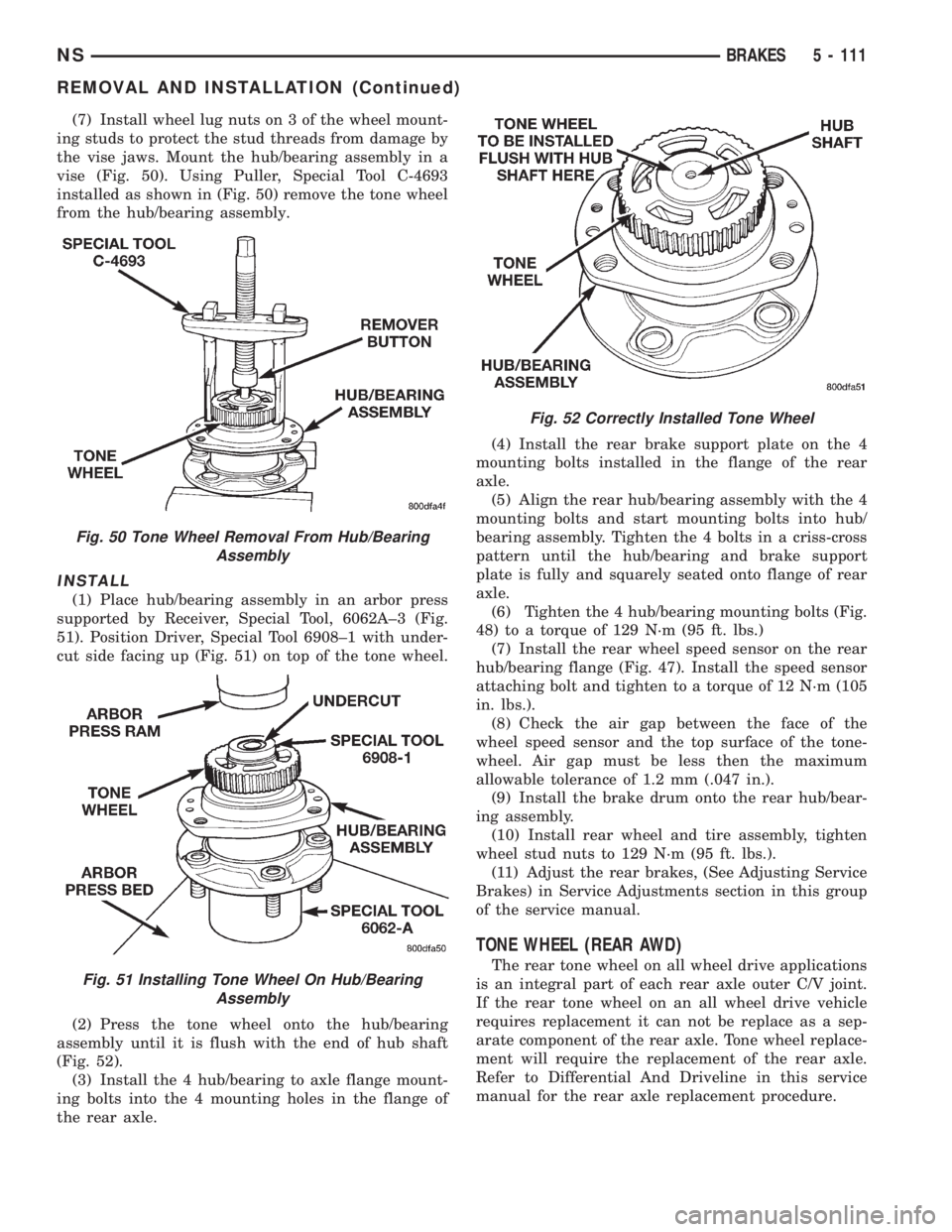
(7) Install wheel lug nuts on 3 of the wheel mount-
ing studs to protect the stud threads from damage by
the vise jaws. Mount the hub/bearing assembly in a
vise (Fig. 50). Using Puller, Special Tool C-4693
installed as shown in (Fig. 50) remove the tone wheel
from the hub/bearing assembly.
INSTALL
(1) Place hub/bearing assembly in an arbor press
supported by Receiver, Special Tool, 6062A±3 (Fig.
51). Position Driver, Special Tool 6908±1 with under-
cut side facing up (Fig. 51) on top of the tone wheel.
(2) Press the tone wheel onto the hub/bearing
assembly until it is flush with the end of hub shaft
(Fig. 52).
(3) Install the 4 hub/bearing to axle flange mount-
ing bolts into the 4 mounting holes in the flange of
the rear axle.(4) Install the rear brake support plate on the 4
mounting bolts installed in the flange of the rear
axle.
(5) Align the rear hub/bearing assembly with the 4
mounting bolts and start mounting bolts into hub/
bearing assembly. Tighten the 4 bolts in a criss-cross
pattern until the hub/bearing and brake support
plate is fully and squarely seated onto flange of rear
axle.
(6) Tighten the 4 hub/bearing mounting bolts (Fig.
48) to a torque of 129 N´m (95 ft. lbs.)
(7) Install the rear wheel speed sensor on the rear
hub/bearing flange (Fig. 47). Install the speed sensor
attaching bolt and tighten to a torque of 12 N´m (105
in. lbs.).
(8) Check the air gap between the face of the
wheel speed sensor and the top surface of the tone-
wheel. Air gap must be less then the maximum
allowable tolerance of 1.2 mm (.047 in.).
(9) Install the brake drum onto the rear hub/bear-
ing assembly.
(10) Install rear wheel and tire assembly, tighten
wheel stud nuts to 129 N´m (95 ft. lbs.).
(11) Adjust the rear brakes, (See Adjusting Service
Brakes) in Service Adjustments section in this group
of the service manual.
TONE WHEEL (REAR AWD)
The rear tone wheel on all wheel drive applications
is an integral part of each rear axle outer C/V joint.
If the rear tone wheel on an all wheel drive vehicle
requires replacement it can not be replace as a sep-
arate component of the rear axle. Tone wheel replace-
ment will require the replacement of the rear axle.
Refer to Differential And Driveline in this service
manual for the rear axle replacement procedure.
Fig. 50 Tone Wheel Removal From Hub/Bearing
Assembly
Fig. 51 Installing Tone Wheel On Hub/Bearing
Assembly
Fig. 52 Correctly Installed Tone Wheel
NSBRAKES 5 - 111
REMOVAL AND INSTALLATION (Continued)
Page 195 of 1938
BRAKES
CONTENTS
page page
GENERAL INFORMATION
BASE BRAKE SYSTEM COMPONENT
DESCRIPTION........................ 1
DESCRIPTION AND OPERATION
MASTER CYLINDER..................... 1
DIAGNOSIS AND TESTING
MASTER CYLINDER FLUID LEVEL CHECK . . . 2REAR DRUM BRAKE ADJUSTMENT........ 1
REMOVAL AND INSTALLATION
BRAKE PEDAL TORQUE SHAFT ASSEMBLY . . 4
FRONT PARK BRAKE CABLE AND LEVER
ASSEMBLY-RHD&LHD VEHICLES........ 2
GENERAL INFORMATION
BASE BRAKE SYSTEM COMPONENT DESCRIPTION
The standard brake system on this vehicle contains
the same components as brake systems described in
group 5 of the service manual, with the exception of
the brake pedal system and master cylinder. These
differences are mainly related to service procedures.
The major differences are as follows:
²Use of a torque shaft assembly to transfer brake
pedal travel to the power brake booster and master
cylinder on the left side of the vehicle
²A unique power brake booster and master cylin-
der.
Refer to the Base Brake System Component
Description in the General Information section of
group 5 for more information on components used in
the base brake system.
DESCRIPTION AND OPERATION
MASTER CYLINDER
The master cylinder used on this vehicle functions
the same as master cylinders used in other brake
systems. Refer to the Master Cylinder in the Descrip-
tion and Operation section of group 5 for more infor-
mation.
DIAGNOSIS AND TESTING
REAR DRUM BRAKE ADJUSTMENT
The rear drum brakes on front wheel drive vehicles
automatically adjust, when required, during the nor-
mal operation of the vehicle every time the brakes
are applied. Use the following procedure to test the
operation of the automatic adjuster.
Place the vehicle on a hoist with a helper in the
driver's seat to apply the brakes. Remove the access
plug from the adjustment slot in each brake support
plate to provide visual access of brake adjuster star
wheel. Disconnect parking brake cable from one side
of the vehicle at the equalizer under the vehicle at
the left frame rail. Working on the side of the vehicle
that parking brake cable is connected to, hold the
adjuster lever off the star wheel with a suitable tool,
and loosen the star wheel approximately 30 notches
in relation to the adjuster lever. This is to eliminate
the possibility that the brake is already properly
adjusted. Reconnect the parking brake cable and
repeat the procedure for the other side of the vehicle.
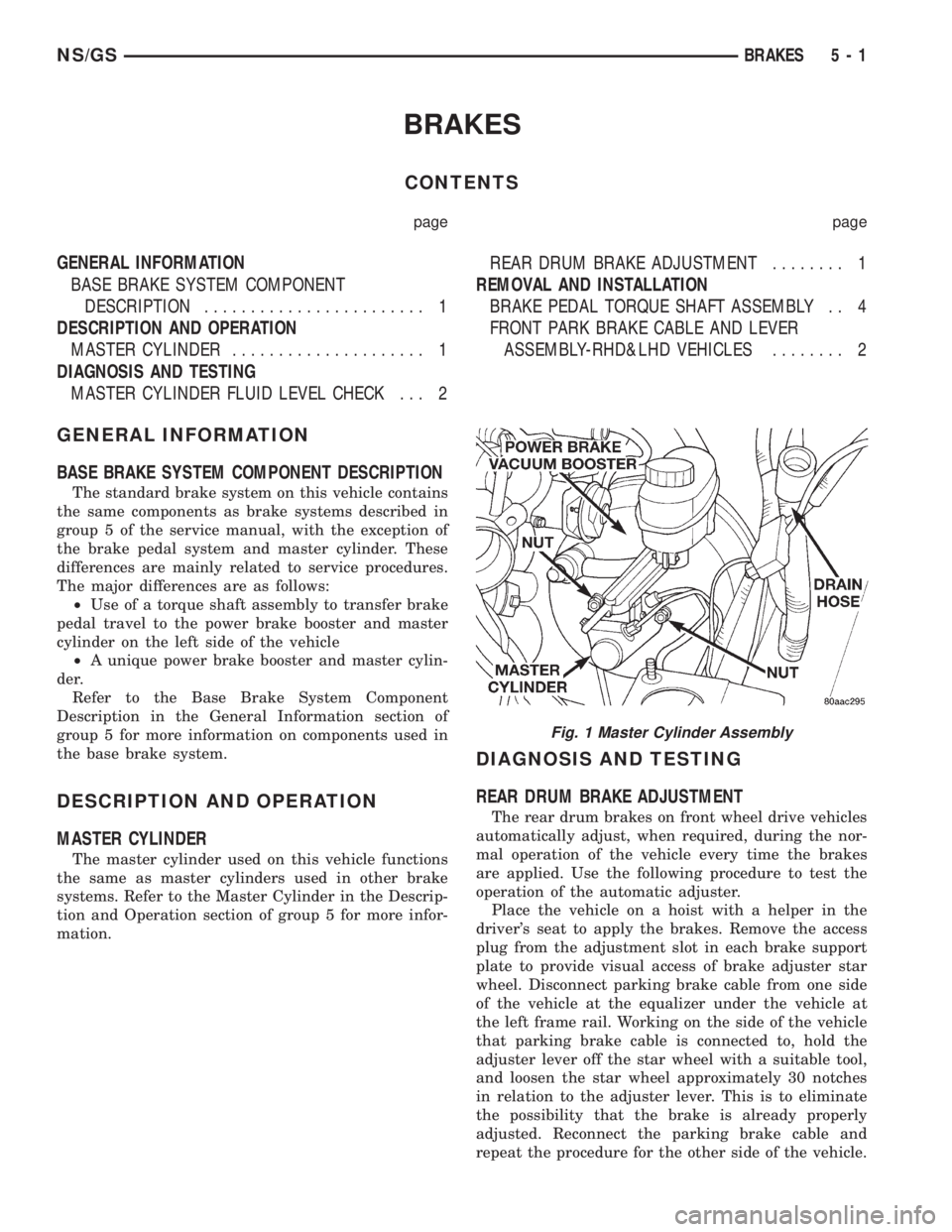
Fig. 1 Master Cylinder Assembly
NS/GSBRAKES 5 - 1
Page 198 of 1938
BRAKE PEDAL TORQUE SHAFT ASSEMBLY
REMOVE
(1) Disconnect Brake Pedal Switch Electrical Con-
nector
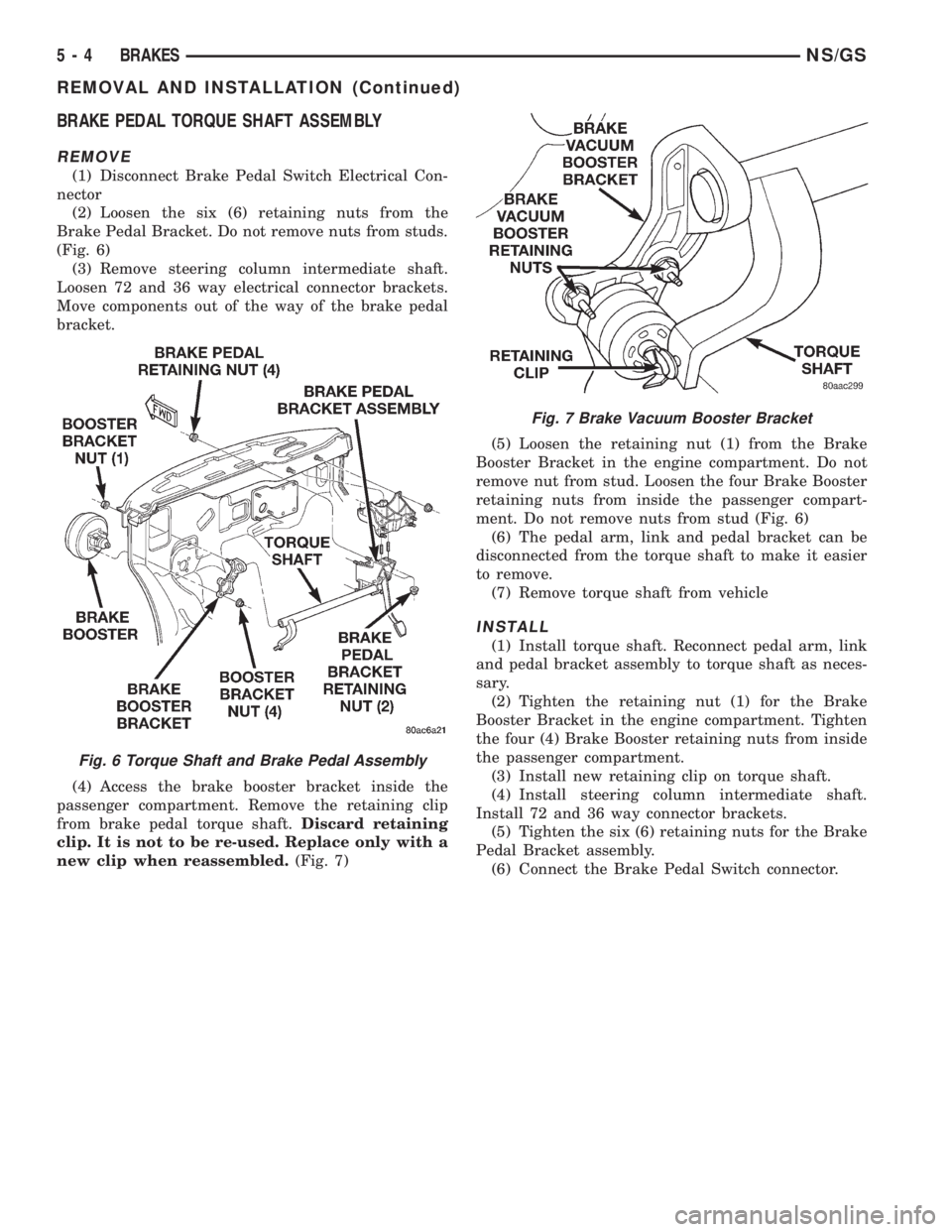
(2) Loosen the six (6) retaining nuts from the
Brake Pedal Bracket. Do not remove nuts from studs.
(Fig. 6)
(3) Remove steering column intermediate shaft.
Loosen 72 and 36 way electrical connector brackets.
Move components out of the way of the brake pedal
bracket.
(4) Access the brake booster bracket inside the
passenger compartment. Remove the retaining clip
from brake pedal torque shaft.Discard retaining
clip. It is not to be re-used. Replace only with a
new clip when reassembled.(Fig. 7)(5) Loosen the retaining nut (1) from the Brake
Booster Bracket in the engine compartment. Do not
remove nut from stud. Loosen the four Brake Booster
retaining nuts from inside the passenger compart-
ment. Do not remove nuts from stud (Fig. 6)
(6) The pedal arm, link and pedal bracket can be
disconnected from the torque shaft to make it easier
to remove.
(7) Remove torque shaft from vehicle
INSTALL
(1) Install torque shaft. Reconnect pedal arm, link
and pedal bracket assembly to torque shaft as neces-
sary.
(2) Tighten the retaining nut (1) for the Brake
Booster Bracket in the engine compartment. Tighten
the four (4) Brake Booster retaining nuts from inside
the passenger compartment.
(3) Install new retaining clip on torque shaft.
(4) Install steering column intermediate shaft.
Install 72 and 36 way connector brackets.
(5) Tighten the six (6) retaining nuts for the Brake
Pedal Bracket assembly.
(6) Connect the Brake Pedal Switch connector.
Fig. 6 Torque Shaft and Brake Pedal Assembly
Fig. 7 Brake Vacuum Booster Bracket
5 - 4 BRAKESNS/GS
REMOVAL AND INSTALLATION (Continued)
Page 199 of 1938
CLUTCH
CONTENTS
page page
GENERAL INFORMATION
CLUTCH COMPONENTS.................. 1
CLUTCH DISC AND COVER APPLICATION . . . 3
CLUTCH REPLACEMENT................. 3
DESCRIPTION AND OPERATION
CLUTCH PEDAL POSITION SWITCH........ 4
CLUTCH RELEASE SYSTEM.............. 4
DIAGNOSIS AND TESTING
CLASH±INTO±REVERSE
COMPLAINTS........................ 8
CLUTCH CHATTER COMPLAINTS.......... 8
CLUTCH COVER AND DISC RUNOUT....... 8
CLUTCH DIAGNOSIS.................... 6
CLUTCH PEDAL POSITION SWITCH........ 4
DRIVE PLATE MISALIGNMENT............ 7
REMOVAL AND INSTALLATION
CLUTCH ASSEMBLY (2.5L DIESEL)....... 13
CLUTCH CABLE SYSTEM Ð LHD.......... 8
CLUTCH PEDAL POSITION SWITCH....... 10CLUTCH RELEASE BEARING AND FORK . . . 14
HYDRAULIC CLUTCH LINKAGE SYSTEM Ð
RHD ............................... 11
MASTER CYLINDER SYSTEM
Ð RHD ............................ 12
MODULAR CLUTCH ASSEMBLY (2.0L AND
2.4L GASOLINE)..................... 13
QUICK CONNECT COUPLING
Ð RHD ............................ 12
SLAVE CYLINDER ASSEMBLY
Ð RHD ............................ 12
CLEANING AND INSPECTION
CLEANING PRECAUTIONS............... 15
CLUTCH CONTAMINATION.............. 15
ADJUSTMENTS
CLUTCH CABLE Ð LHD................ 16
CLUTCH PEDAL POSITION SWITCH....... 16
SPECIFICATIONS
CLUTCH TIGHTENING REFERENCE........ 16
GENERAL INFORMATION
CLUTCH COMPONENTS
The clutch used in the 2.0 liter and 2.4 liter gaso-
line engine is a single, dry-disc modular clutch
assembly. The modular clutch assembly combines the
pressure plate cover, pressure plate, disc, and fly-
wheel into one unit. The unit rides on the input shaft
of the transmission and is bolted to the drive plate
mounted on the rear of the crankshaft. The clutch
used in the 2.5 liter diesel engine is a conventional
clutch and pressure plate arrangement.
CLUTCH CABLE AND PEDAL Ð LHD
The clutch cable has a unique self-adjuster mecha-
nism built into the cable which compensates for
clutch disc wear. The cable requires no maintenance
or lubrication. There are no serviceable components
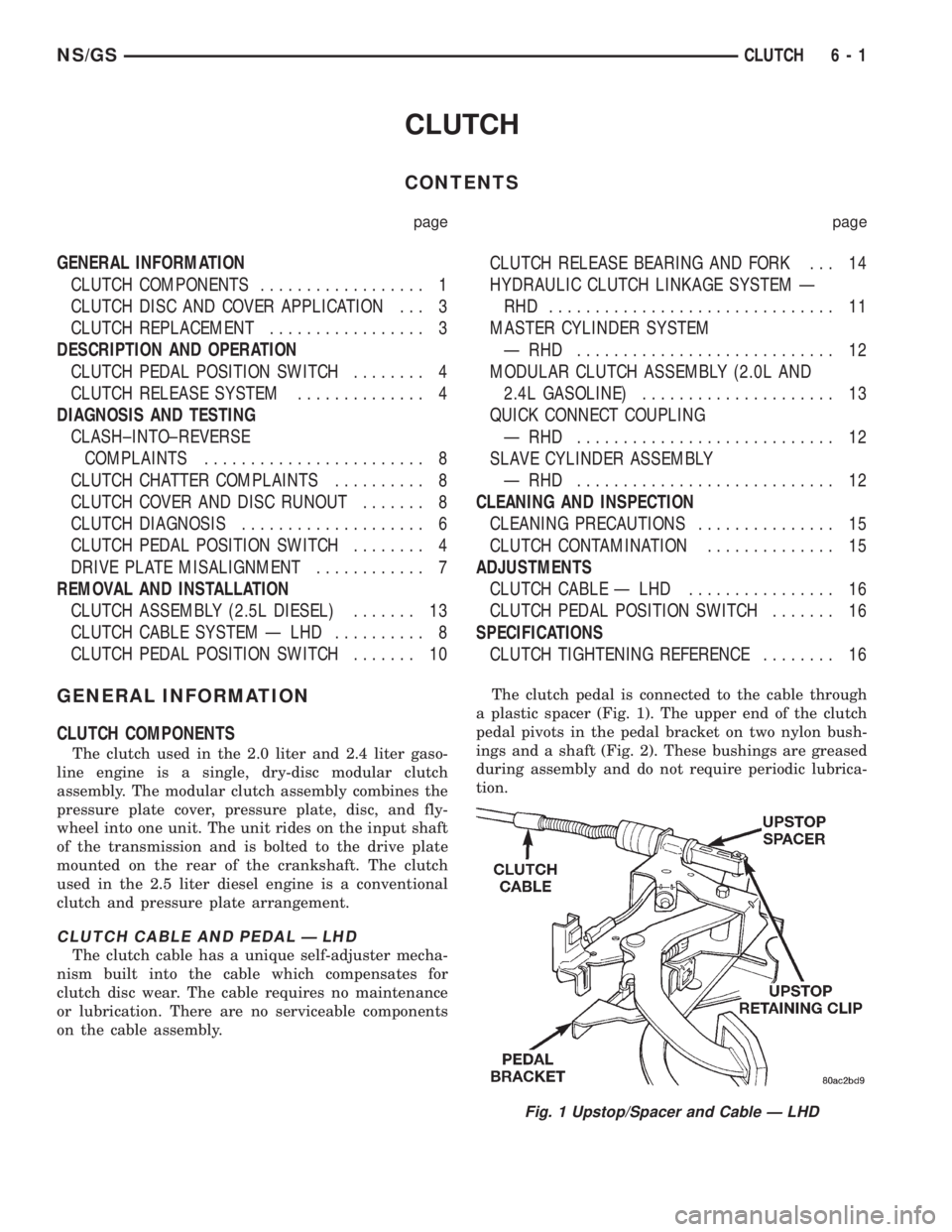
on the cable assembly.The clutch pedal is connected to the cable through
a plastic spacer (Fig. 1). The upper end of the clutch
pedal pivots in the pedal bracket on two nylon bush-
ings and a shaft (Fig. 2). These bushings are greased
during assembly and do not require periodic lubrica-
tion.
Fig. 1 Upstop/Spacer and Cable Ð LHD
NS/GSCLUTCH 6 - 1
Page 204 of 1938
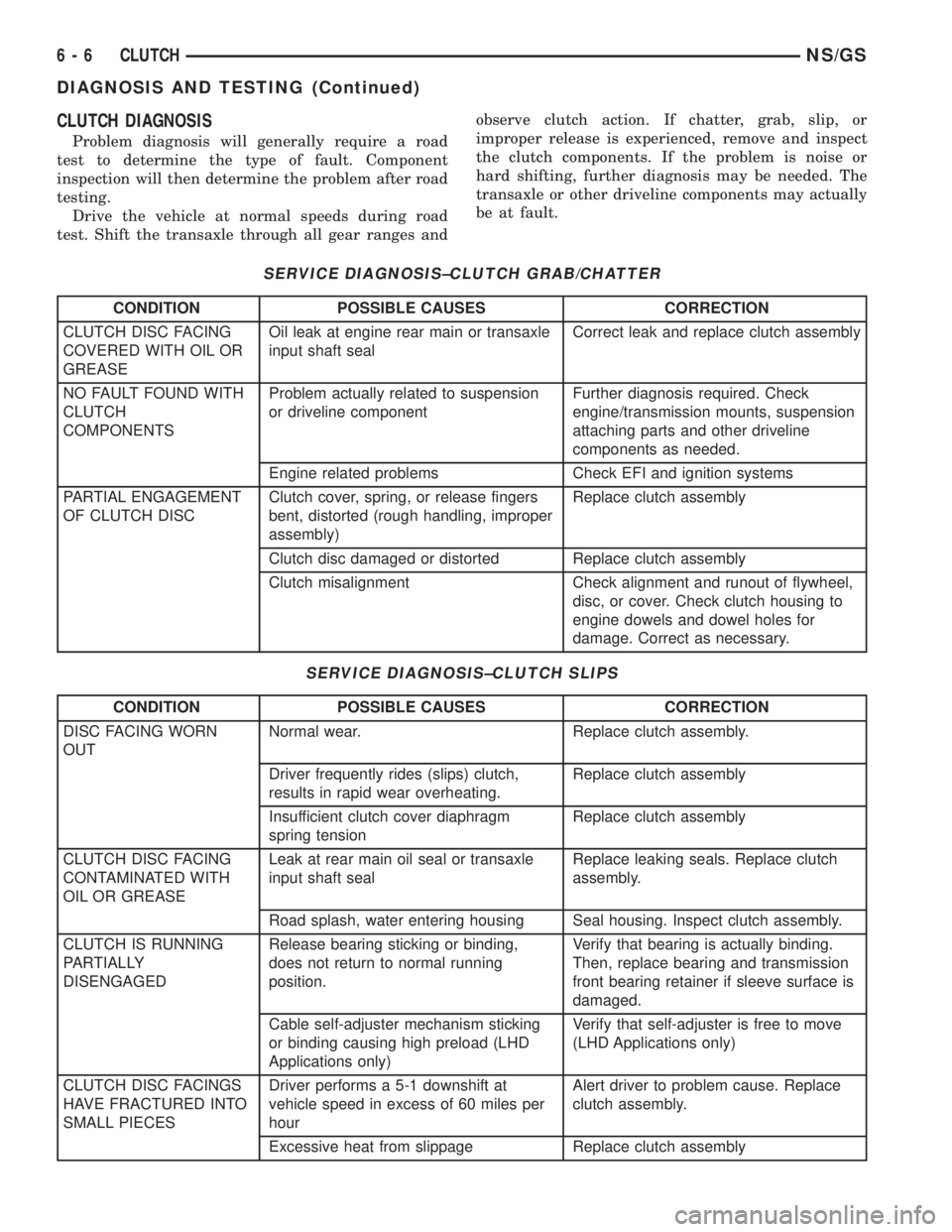
CLUTCH DIAGNOSIS
Problem diagnosis will generally require a road
test to determine the type of fault. Component
inspection will then determine the problem after road
testing.
Drive the vehicle at normal speeds during road
test. Shift the transaxle through all gear ranges andobserve clutch action. If chatter, grab, slip, or
improper release is experienced, remove and inspect
the clutch components. If the problem is noise or
hard shifting, further diagnosis may be needed. The
transaxle or other driveline components may actually
be at fault.
SERVICE DIAGNOSIS±CLUTCH GRAB/CHATTER
CONDITION POSSIBLE CAUSES CORRECTION
CLUTCH DISC FACING
COVERED WITH OIL OR
GREASEOil leak at engine rear main or transaxle
input shaft sealCorrect leak and replace clutch assembly
NO FAULT FOUND WITH
CLUTCH
COMPONENTSProblem actually related to suspension
or driveline componentFurther diagnosis required. Check
engine/transmission mounts, suspension
attaching parts and other driveline
components as needed.
Engine related problems Check EFI and ignition systems
PARTIAL ENGAGEMENT
OF CLUTCH DISCClutch cover, spring, or release fingers
bent, distorted (rough handling, improper
assembly)Replace clutch assembly
Clutch disc damaged or distorted Replace clutch assembly
Clutch misalignment Check alignment and runout of flywheel,
disc, or cover. Check clutch housing to
engine dowels and dowel holes for
damage. Correct as necessary.
SERVICE DIAGNOSIS±CLUTCH SLIPS
CONDITION POSSIBLE CAUSES CORRECTION
DISC FACING WORN
OUTNormal wear. Replace clutch assembly.
Driver frequently rides (slips) clutch,
results in rapid wear overheating.Replace clutch assembly
Insufficient clutch cover diaphragm
spring tensionReplace clutch assembly
CLUTCH DISC FACING
CONTAMINATED WITH
OIL OR GREASELeak at rear main oil seal or transaxle
input shaft sealReplace leaking seals. Replace clutch
assembly.
Road splash, water entering housing Seal housing. Inspect clutch assembly.
CLUTCH IS RUNNING
PARTIALLY
DISENGAGEDRelease bearing sticking or binding,
does not return to normal running
position.Verify that bearing is actually binding.
Then, replace bearing and transmission
front bearing retainer if sleeve surface is
damaged.
Cable self-adjuster mechanism sticking
or binding causing high preload (LHD
Applications only)Verify that self-adjuster is free to move
(LHD Applications only)
CLUTCH DISC FACINGS
HAVE FRACTURED INTO
SMALL PIECESDriver performs a 5-1 downshift at
vehicle speed in excess of 60 miles per
hourAlert driver to problem cause. Replace
clutch assembly.
Excessive heat from slippage Replace clutch assembly
6 - 6 CLUTCHNS/GS
DIAGNOSIS AND TESTING (Continued)