shaft CHRYSLER VOYAGER 1996 Owner's Guide
[x] Cancel search | Manufacturer: CHRYSLER, Model Year: 1996, Model line: VOYAGER, Model: CHRYSLER VOYAGER 1996Pages: 1938, PDF Size: 55.84 MB
Page 205 of 1938
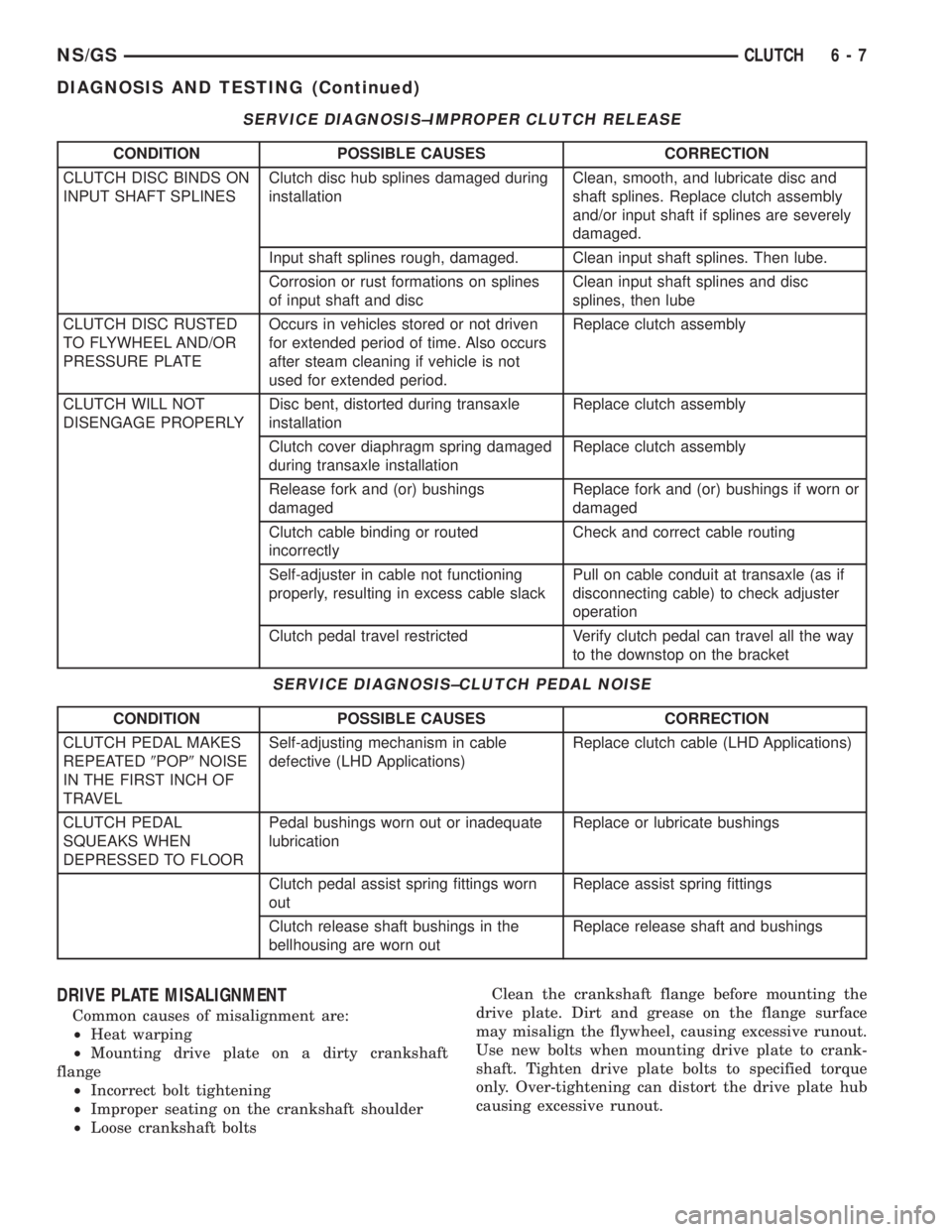
SERVICE DIAGNOSIS±IMPROPER CLUTCH RELEASE
CONDITION POSSIBLE CAUSES CORRECTION
CLUTCH DISC BINDS ON
INPUT SHAFT SPLINESClutch disc hub splines damaged during
installationClean, smooth, and lubricate disc and
shaft splines. Replace clutch assembly
and/or input shaft if splines are severely
damaged.
Input shaft splines rough, damaged. Clean input shaft splines. Then lube.
Corrosion or rust formations on splines
of input shaft and discClean input shaft splines and disc
splines, then lube
CLUTCH DISC RUSTED
TO FLYWHEEL AND/OR
PRESSURE PLATEOccurs in vehicles stored or not driven
for extended period of time. Also occurs
after steam cleaning if vehicle is not
used for extended period.Replace clutch assembly
CLUTCH WILL NOT
DISENGAGE PROPERLYDisc bent, distorted during transaxle
installationReplace clutch assembly
Clutch cover diaphragm spring damaged
during transaxle installationReplace clutch assembly
Release fork and (or) bushings
damagedReplace fork and (or) bushings if worn or
damaged
Clutch cable binding or routed
incorrectlyCheck and correct cable routing
Self-adjuster in cable not functioning
properly, resulting in excess cable slackPull on cable conduit at transaxle (as if
disconnecting cable) to check adjuster
operation
Clutch pedal travel restricted Verify clutch pedal can travel all the way
to the downstop on the bracket
SERVICE DIAGNOSIS±CLUTCH PEDAL NOISE
CONDITION POSSIBLE CAUSES CORRECTION
CLUTCH PEDAL MAKES
REPEATED9POP9NOISE
IN THE FIRST INCH OF
TRAVELSelf-adjusting mechanism in cable
defective (LHD Applications)Replace clutch cable (LHD Applications)
CLUTCH PEDAL
SQUEAKS WHEN
DEPRESSED TO FLOORPedal bushings worn out or inadequate
lubricationReplace or lubricate bushings
Clutch pedal assist spring fittings worn
outReplace assist spring fittings
Clutch release shaft bushings in the
bellhousing are worn outReplace release shaft and bushings
DRIVE PLATE MISALIGNMENT
Common causes of misalignment are:
²Heat warping
²Mounting drive plate on a dirty crankshaft
flange
²Incorrect bolt tightening
²Improper seating on the crankshaft shoulder
²Loose crankshaft boltsClean the crankshaft flange before mounting the
drive plate. Dirt and grease on the flange surface
may misalign the flywheel, causing excessive runout.
Use new bolts when mounting drive plate to crank-
shaft. Tighten drive plate bolts to specified torque
only. Over-tightening can distort the drive plate hub
causing excessive runout.
NS/GSCLUTCH 6 - 7
DIAGNOSIS AND TESTING (Continued)
Page 206 of 1938
CLUTCH COVER AND DISC RUNOUT
Check condition of the clutch cover before installa-
tion. A warped cover or diaphragm spring will cause
grab and/or incomplete release or engagement. Use
care when handling the clutch assembly. Impact can
distort the cover, diaphragm spring, and release fin-
gers.
CLUTCH CHATTER COMPLAINTS
For all clutch chatter complaints, do the following:
(1) Check for loose, misaligned, or broken engine
and transmission mounts. If present, they should be
corrected at this time. Test vehicle for chatter. If
chatter is gone, there is no need to go any further. If
chatter persists:
(2) Check to see if clutch cable routing is correct
and operates smoothly (LHD applications).
(3) Check for loose connections in drivetrain. Cor-
rect any problems and determine if clutch chatter
complaints have been satisfied. If not:
(4) Remove transaxle. See Group 21, Manual Tran-
saxle for procedure.
(5) Check to see if the release bearing is sticky or
binding. Replace bearing, if needed.
(6) Check linkage for excessive wear on the pivot
shaft, fork, and bushings. Replace all worn parts.
(7) Check clutch assembly for contamination (dirt,
oil). Replace clutch assembly, if required.
(8) Check to see if the clutch disc hub splines are
damaged. Replace with new clutch assembly, if nec-
essary.
(9) Check input shaft splines for damage. Replace,
if necessary.
(10) Check for uneven wear on clutch fingers.
(11) Check for broken clutch cover diaphragm
spring fingers. Replace with new clutch assembly, if
necessary.
CLASH±INTO±REVERSE COMPLAINTS
(1) Depress clutch pedal to floor and hold. After
three seconds, shift to reverse. If clash is present,
clutch has excessive spin time.
NOTE: Verify that nothing is obstructing pedal
travel. Floormats or other articles located under-
neath the clutch pedal could prevent the clutch
from disengaging fully.
(2) Remove transaxle. See Group 21, Manual Tran-
saxle for procedure.
(3) Check the input shaft spline, clutch disc
splines, and release bearing for dry rust. If present,
clean rust off and apply a light coat of bearing grease
to the input shaft splines. Apply grease on the input
shaft splines only where the clutch disc slides. Verify
that the clutch disc slides freely along the input shaft
spline.(4) Check to see if the clutch disc hub splines are
damaged, and replace with new clutch assembly if
required.
(5) Check the input shaft for damaged splines.
Replace as necessary.
(6) Check for broken clutch cover diaphragm
spring fingers.
(7) Install clutch assembly and transaxle.
REMOVAL AND INSTALLATION
CLUTCH CABLE SYSTEM Ð LHD
REMOVAL
(1) Hoist vehicle
(2) Using a pair of pliers, grasp end of clutch cable
and pull downward.
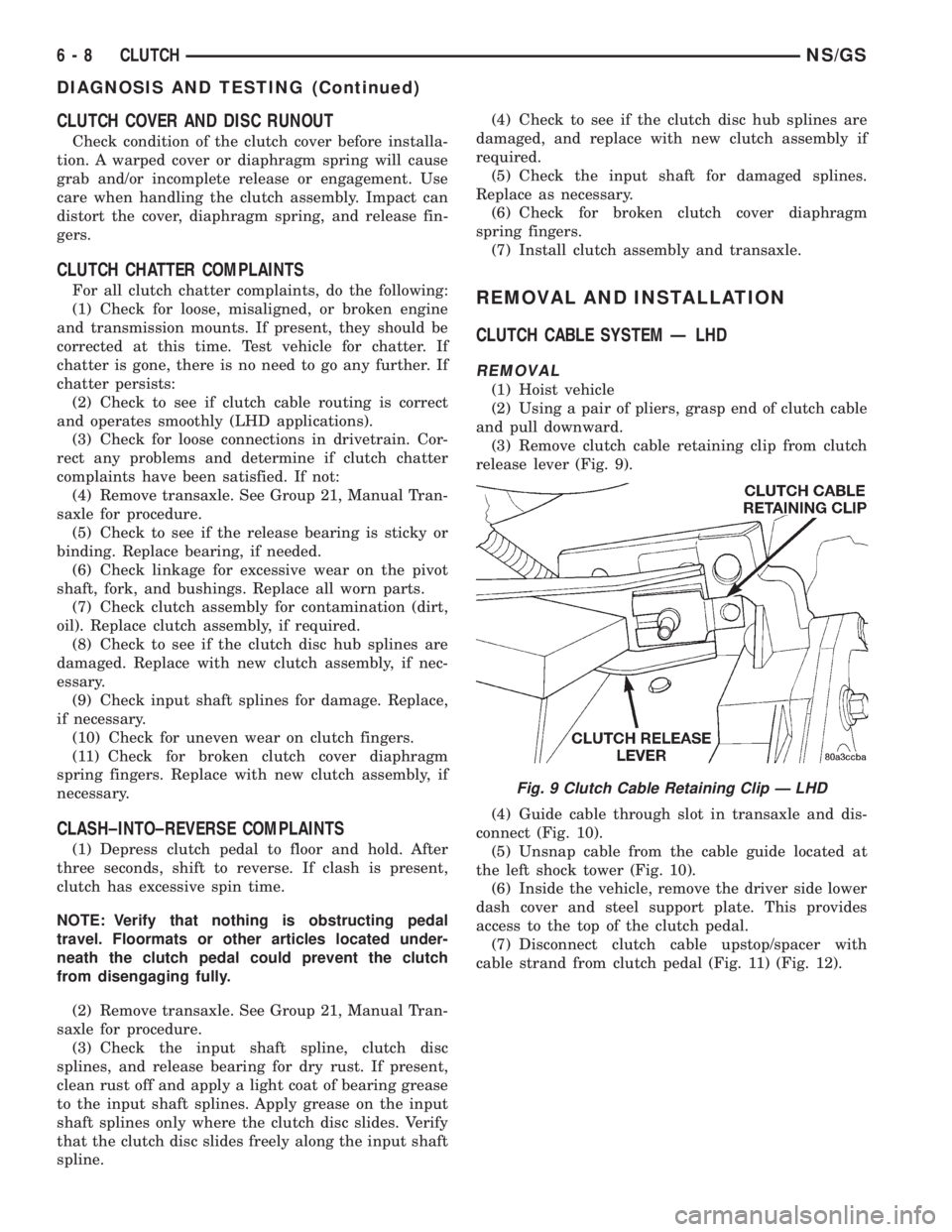
(3) Remove clutch cable retaining clip from clutch
release lever (Fig. 9).
(4) Guide cable through slot in transaxle and dis-
connect (Fig. 10).
(5) Unsnap cable from the cable guide located at
the left shock tower (Fig. 10).
(6) Inside the vehicle, remove the driver side lower
dash cover and steel support plate. This provides
access to the top of the clutch pedal.
(7) Disconnect clutch cable upstop/spacer with
cable strand from clutch pedal (Fig. 11) (Fig. 12).
Fig. 9 Clutch Cable Retaining Clip Ð LHD
6 - 8 CLUTCHNS/GS
DIAGNOSIS AND TESTING (Continued)
Page 211 of 1938
INSTALLATION
1. Position the slave cylinder assembly to the tran-
saxle deck and secure with the nut and washer
assemblies (2) and tighten to specifications (Fig. 14).
2. Make sure the slave cylinder pushrod is prop-
erly seated in the cup end of the clutch release lever.
3. Connect the quick connect coupling. Refer to the
ªQuick Connect Couplingº removal and installation
procedure in this section.
MODULAR CLUTCH ASSEMBLY (2.0L AND 2.4L
GASOLINE)
The transaxle must be removed to service the mod-
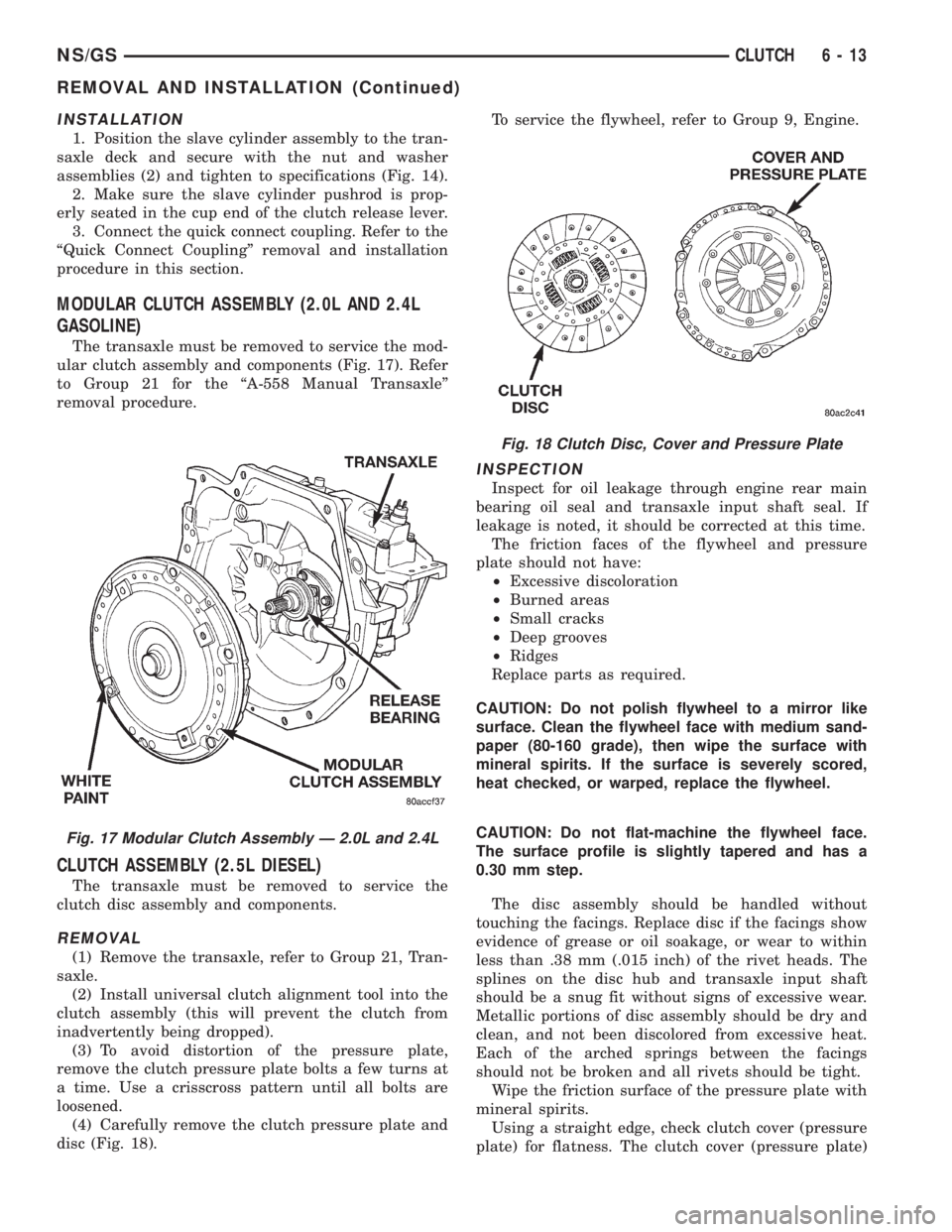
ular clutch assembly and components (Fig. 17). Refer
to Group 21 for the ªA-558 Manual Transaxleº
removal procedure.
CLUTCH ASSEMBLY (2.5L DIESEL)
The transaxle must be removed to service the
clutch disc assembly and components.
REMOVAL
(1) Remove the transaxle, refer to Group 21, Tran-
saxle.
(2) Install universal clutch alignment tool into the
clutch assembly (this will prevent the clutch from
inadvertently being dropped).
(3) To avoid distortion of the pressure plate,
remove the clutch pressure plate bolts a few turns at
a time. Use a crisscross pattern until all bolts are
loosened.
(4) Carefully remove the clutch pressure plate and
disc (Fig. 18).To service the flywheel, refer to Group 9, Engine.
INSPECTION
Inspect for oil leakage through engine rear main
bearing oil seal and transaxle input shaft seal. If
leakage is noted, it should be corrected at this time.
The friction faces of the flywheel and pressure
plate should not have:
²Excessive discoloration
²Burned areas
²Small cracks
²Deep grooves
²Ridges
Replace parts as required.
CAUTION: Do not polish flywheel to a mirror like
surface. Clean the flywheel face with medium sand-
paper (80-160 grade), then wipe the surface with
mineral spirits. If the surface is severely scored,
heat checked, or warped, replace the flywheel.
CAUTION: Do not flat-machine the flywheel face.
The surface profile is slightly tapered and has a
0.30 mm step.
The disc assembly should be handled without
touching the facings. Replace disc if the facings show
evidence of grease or oil soakage, or wear to within
less than .38 mm (.015 inch) of the rivet heads. The
splines on the disc hub and transaxle input shaft
should be a snug fit without signs of excessive wear.
Metallic portions of disc assembly should be dry and
clean, and not been discolored from excessive heat.
Each of the arched springs between the facings
should not be broken and all rivets should be tight.
Wipe the friction surface of the pressure plate with
mineral spirits.
Using a straight edge, check clutch cover (pressure
plate) for flatness. The clutch cover (pressure plate)
Fig. 17 Modular Clutch Assembly Ð 2.0L and 2.4L
Fig. 18 Clutch Disc, Cover and Pressure Plate
NS/GSCLUTCH 6 - 13
REMOVAL AND INSTALLATION (Continued)
Page 212 of 1938
friction area should be slightly concave, with the
inner diameter 0.02 mm to 0.1 mm (.0008 in. to .0039
in.) below the outer diameter. It should also be free
from discoloration, burned areas, cracks, grooves, or
ridges.
Using a surface plate, test cover for flatness. All
sections around attaching bolt holes should be in con-
tact with surface plate within .015 inch.
The cover should be a snug fit on flywheel dowels.
If the clutch assembly does not meet these require-
ments, it should be replaced.
INSTALLATION
(1) Position the clutch and pressure plate onto the
flywheel.
(2) Insert the universal clutch alignment tool into
the clutch disc.
(3) To avoid distortion of the pressure plate, bolts
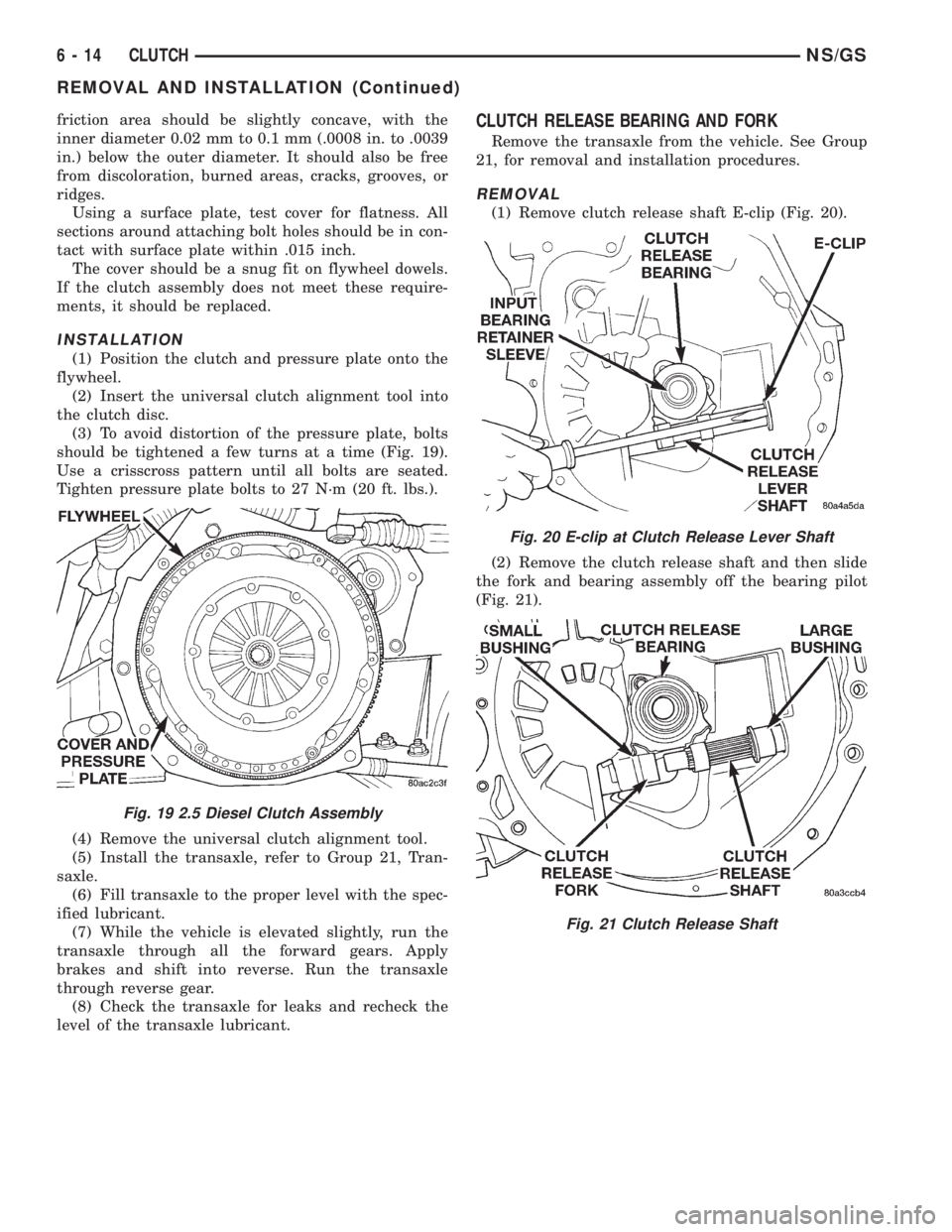
should be tightened a few turns at a time (Fig. 19).
Use a crisscross pattern until all bolts are seated.
Tighten pressure plate bolts to 27 N´m (20 ft. lbs.).
(4) Remove the universal clutch alignment tool.
(5) Install the transaxle, refer to Group 21, Tran-
saxle.
(6) Fill transaxle to the proper level with the spec-
ified lubricant.
(7) While the vehicle is elevated slightly, run the
transaxle through all the forward gears. Apply
brakes and shift into reverse. Run the transaxle
through reverse gear.
(8) Check the transaxle for leaks and recheck the
level of the transaxle lubricant.
CLUTCH RELEASE BEARING AND FORK
Remove the transaxle from the vehicle. See Group
21, for removal and installation procedures.
REMOVAL
(1) Remove clutch release shaft E-clip (Fig. 20).
(2) Remove the clutch release shaft and then slide
the fork and bearing assembly off the bearing pilot
(Fig. 21).
Fig. 19 2.5 Diesel Clutch Assembly
Fig. 20 E-clip at Clutch Release Lever Shaft
Fig. 21 Clutch Release Shaft
6 - 14 CLUTCHNS/GS
REMOVAL AND INSTALLATION (Continued)
Page 213 of 1938
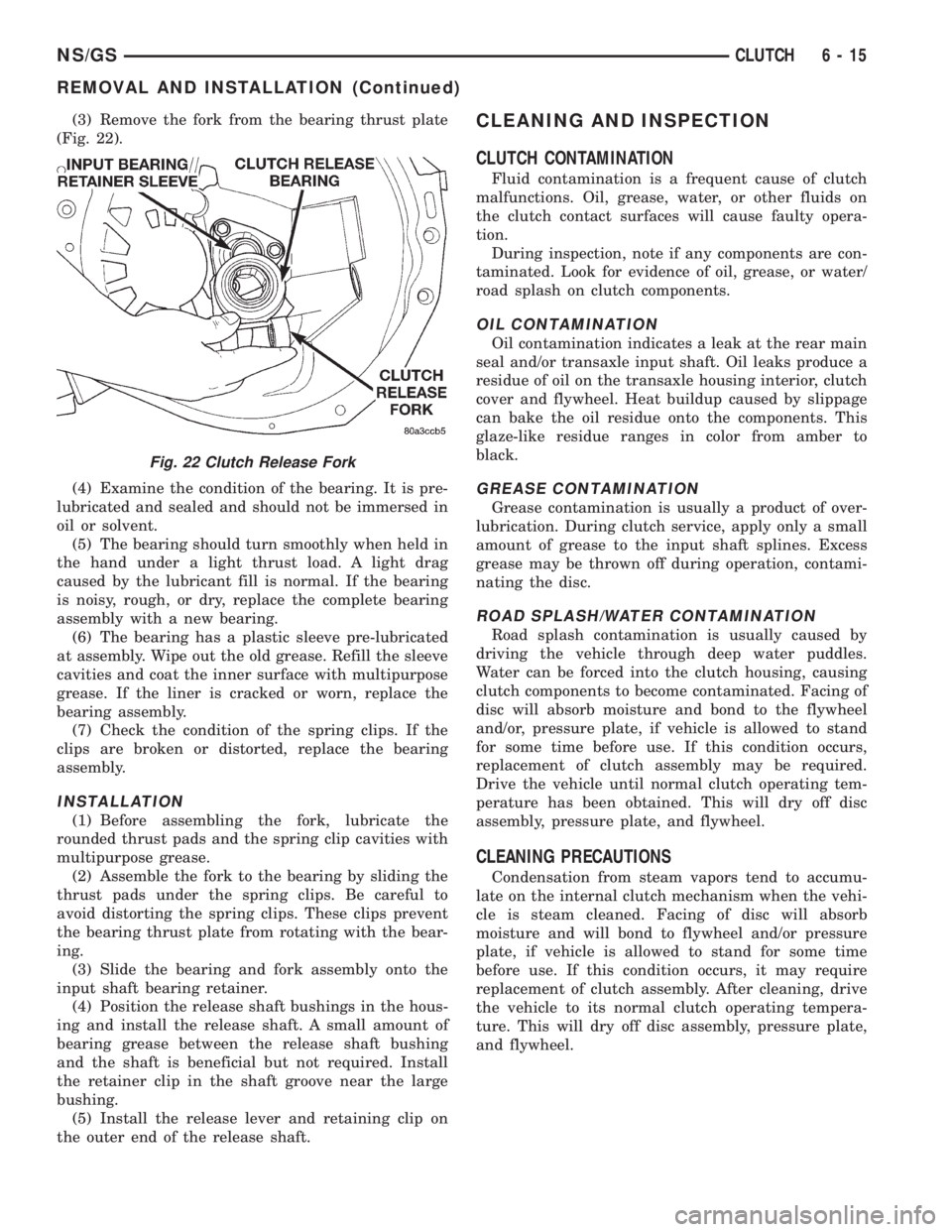
(3) Remove the fork from the bearing thrust plate
(Fig. 22).
(4) Examine the condition of the bearing. It is pre-
lubricated and sealed and should not be immersed in
oil or solvent.
(5) The bearing should turn smoothly when held in
the hand under a light thrust load. A light drag
caused by the lubricant fill is normal. If the bearing
is noisy, rough, or dry, replace the complete bearing
assembly with a new bearing.
(6) The bearing has a plastic sleeve pre-lubricated
at assembly. Wipe out the old grease. Refill the sleeve
cavities and coat the inner surface with multipurpose
grease. If the liner is cracked or worn, replace the
bearing assembly.
(7) Check the condition of the spring clips. If the
clips are broken or distorted, replace the bearing
assembly.
INSTALLATION
(1) Before assembling the fork, lubricate the
rounded thrust pads and the spring clip cavities with
multipurpose grease.
(2) Assemble the fork to the bearing by sliding the
thrust pads under the spring clips. Be careful to
avoid distorting the spring clips. These clips prevent
the bearing thrust plate from rotating with the bear-
ing.
(3) Slide the bearing and fork assembly onto the
input shaft bearing retainer.
(4) Position the release shaft bushings in the hous-
ing and install the release shaft. A small amount of
bearing grease between the release shaft bushing
and the shaft is beneficial but not required. Install
the retainer clip in the shaft groove near the large
bushing.
(5) Install the release lever and retaining clip on
the outer end of the release shaft.
CLEANING AND INSPECTION
CLUTCH CONTAMINATION
Fluid contamination is a frequent cause of clutch
malfunctions. Oil, grease, water, or other fluids on
the clutch contact surfaces will cause faulty opera-
tion.
During inspection, note if any components are con-
taminated. Look for evidence of oil, grease, or water/
road splash on clutch components.
OIL CONTAMINATION
Oil contamination indicates a leak at the rear main
seal and/or transaxle input shaft. Oil leaks produce a
residue of oil on the transaxle housing interior, clutch
cover and flywheel. Heat buildup caused by slippage
can bake the oil residue onto the components. This
glaze-like residue ranges in color from amber to
black.
GREASE CONTAMINATION
Grease contamination is usually a product of over-
lubrication. During clutch service, apply only a small
amount of grease to the input shaft splines. Excess
grease may be thrown off during operation, contami-
nating the disc.
ROAD SPLASH/WATER CONTAMINATION
Road splash contamination is usually caused by
driving the vehicle through deep water puddles.
Water can be forced into the clutch housing, causing
clutch components to become contaminated. Facing of
disc will absorb moisture and bond to the flywheel
and/or, pressure plate, if vehicle is allowed to stand
for some time before use. If this condition occurs,
replacement of clutch assembly may be required.
Drive the vehicle until normal clutch operating tem-
perature has been obtained. This will dry off disc
assembly, pressure plate, and flywheel.
CLEANING PRECAUTIONS
Condensation from steam vapors tend to accumu-
late on the internal clutch mechanism when the vehi-
cle is steam cleaned. Facing of disc will absorb
moisture and will bond to flywheel and/or pressure
plate, if vehicle is allowed to stand for some time
before use. If this condition occurs, it may require
replacement of clutch assembly. After cleaning, drive
the vehicle to its normal clutch operating tempera-
ture. This will dry off disc assembly, pressure plate,
and flywheel.
Fig. 22 Clutch Release Fork
NS/GSCLUTCH 6 - 15
REMOVAL AND INSTALLATION (Continued)
Page 231 of 1938
Continue filling system until full, this provides bet-
ter heater performance.Be careful not to spill
coolant on drive belts or the generator.
Fill coolant reserve system to at least the MAX
mark with 50/50 solution. It may be necessary to add
coolant to the reserve tank after three or four warm
up/cool down cycles to maintain coolant level between
the MAX and MIN mark. This will allow trapped air
to be removed from the system.
REMOVAL AND INSTALLATION
WATER PUMPÐ2.4L ENGINE
REMOVAL
(1) Disconnect negative cable from battery.
(2) Raise vehicle on a hoist. Remove right inner
splash shield.
(3) Remove accessory drive belts. Refer to Acces-
sory Drive Belt service in this section.
(4) Drain cooling system. Refer to Cooling System
Draining in this section.
(5) Support engine from the bottom and remove
right engine mount.
(6) Remove right engine mount bracket.
(7) Remove timing belt. Refer to Group 9, Engine
for procedure.
(8) Remove timing belt idler pulley.
(9) Hold camshaft sprocket with Special tool
C-4687 and adaptor C-4687-1 while removing bolt.
Remove both cam sprockets.
(10) Remove rear timing belt cover.
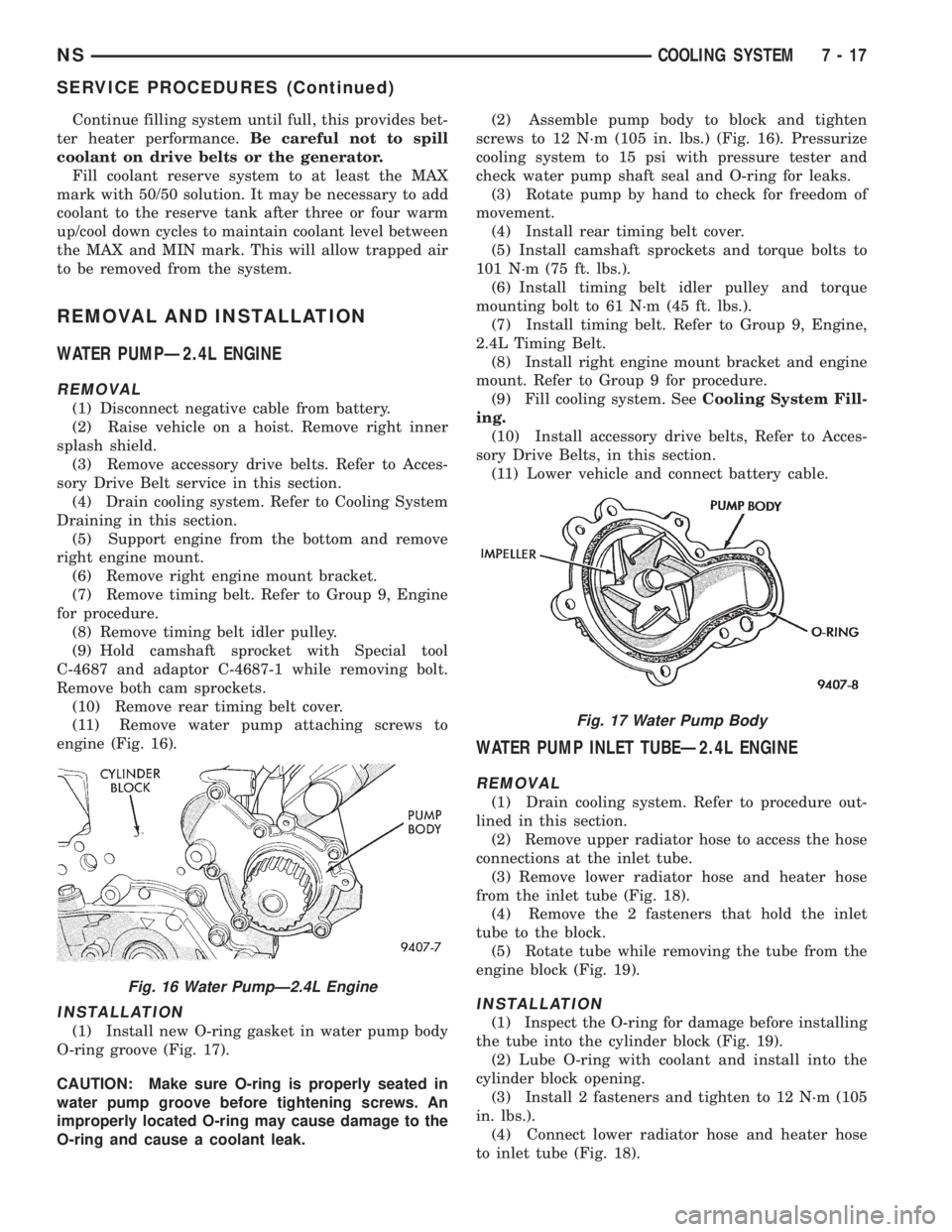
(11) Remove water pump attaching screws to
engine (Fig. 16).
INSTALLATION
(1) Install new O-ring gasket in water pump body
O-ring groove (Fig. 17).
CAUTION: Make sure O-ring is properly seated in
water pump groove before tightening screws. An
improperly located O-ring may cause damage to the
O-ring and cause a coolant leak.(2) Assemble pump body to block and tighten
screws to 12 N´m (105 in. lbs.) (Fig. 16). Pressurize
cooling system to 15 psi with pressure tester and
check water pump shaft seal and O-ring for leaks.
(3) Rotate pump by hand to check for freedom of
movement.
(4) Install rear timing belt cover.
(5) Install camshaft sprockets and torque bolts to
101 N´m (75 ft. lbs.).
(6) Install timing belt idler pulley and torque
mounting bolt to 61 N´m (45 ft. lbs.).
(7) Install timing belt. Refer to Group 9, Engine,
2.4L Timing Belt.
(8) Install right engine mount bracket and engine
mount. Refer to Group 9 for procedure.
(9) Fill cooling system. SeeCooling System Fill-
ing.
(10) Install accessory drive belts, Refer to Acces-
sory Drive Belts, in this section.
(11) Lower vehicle and connect battery cable.
WATER PUMP INLET TUBEÐ2.4L ENGINE
REMOVAL
(1) Drain cooling system. Refer to procedure out-
lined in this section.
(2) Remove upper radiator hose to access the hose
connections at the inlet tube.
(3) Remove lower radiator hose and heater hose
from the inlet tube (Fig. 18).
(4) Remove the 2 fasteners that hold the inlet
tube to the block.
(5) Rotate tube while removing the tube from the
engine block (Fig. 19).
INSTALLATION
(1) Inspect the O-ring for damage before installing
the tube into the cylinder block (Fig. 19).
(2) Lube O-ring with coolant and install into the
cylinder block opening.
(3) Install 2 fasteners and tighten to 12 N´m (105
in. lbs.).
(4) Connect lower radiator hose and heater hose
to inlet tube (Fig. 18).
Fig. 16 Water PumpÐ2.4L Engine
Fig. 17 Water Pump Body
NSCOOLING SYSTEM 7 - 17
SERVICE PROCEDURES (Continued)
Page 232 of 1938
(5) Install upper radiator hose.
(6) Fill cooling system. Refer to procedure outlined
in this section.
WATER PUMPÐ3.0L ENGINE
REMOVAL
(1) Drain cooling system. Refer to Draining Cool-
ing System in this group.
(2) To gain access to water pump refer to Group 9,
Engine for Timing Belt Removal.
(3) Remove mounting bolts.
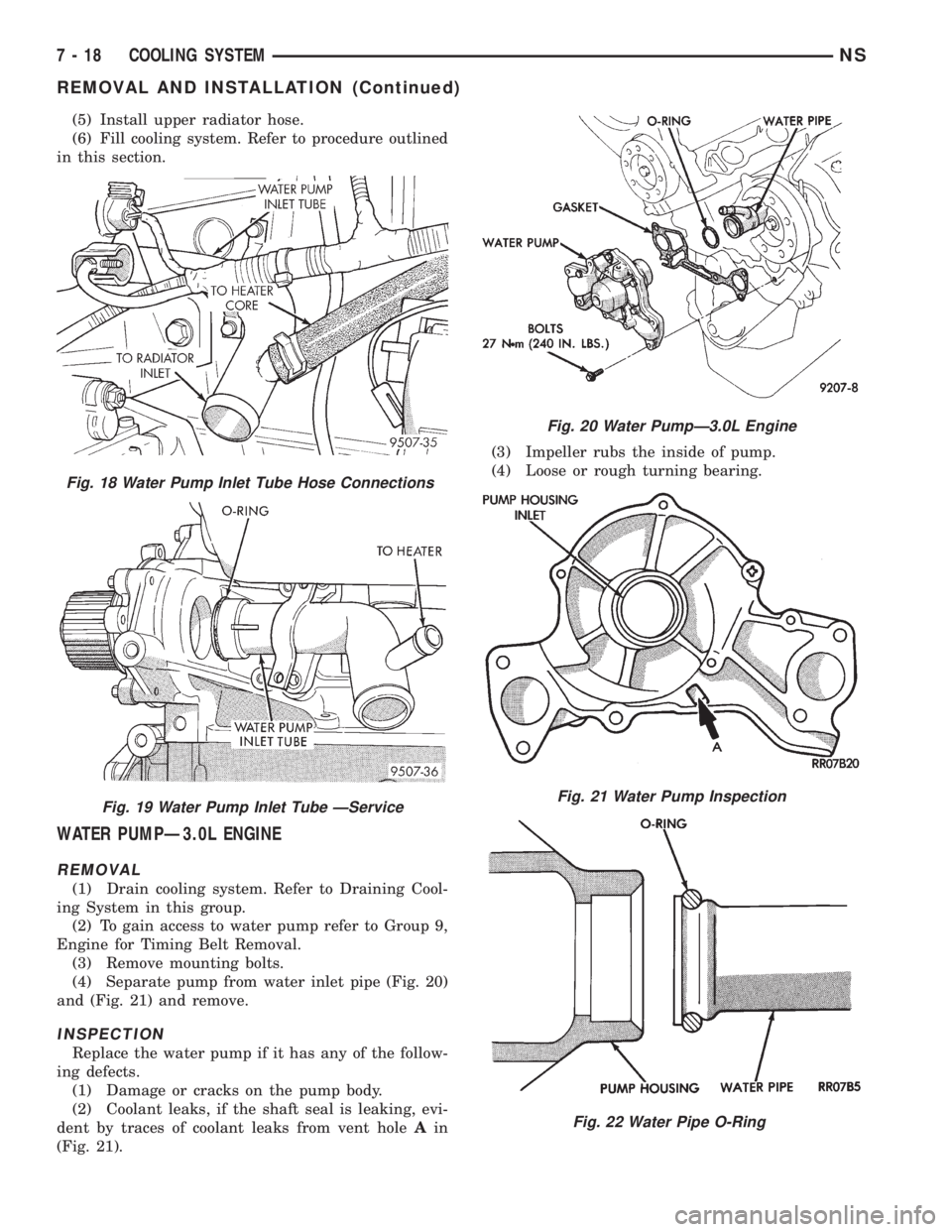
(4) Separate pump from water inlet pipe (Fig. 20)
and (Fig. 21) and remove.
INSPECTION
Replace the water pump if it has any of the follow-
ing defects.
(1) Damage or cracks on the pump body.
(2) Coolant leaks, if the shaft seal is leaking, evi-
dent by traces of coolant leaks from vent holeAin
(Fig. 21).(3) Impeller rubs the inside of pump.
(4) Loose or rough turning bearing.
Fig. 18 Water Pump Inlet Tube Hose Connections
Fig. 19 Water Pump Inlet Tube ÐService
Fig. 20 Water PumpÐ3.0L Engine
Fig. 21 Water Pump Inspection
Fig. 22 Water Pipe O-Ring
7 - 18 COOLING SYSTEMNS
REMOVAL AND INSTALLATION (Continued)
Page 239 of 1938
NOTE: It is normal for the water pump to weep a
small amount of coolant from the weep hole (black
stain on water pump body). Do not replace the
water pump if this condition exists. Replace the
water pump if a heavy deposit or a steady flow of
green/brown engine coolant is evident on water
pump body from the weep hole (shaft seal failure).
Be sure to perform a thorough analysis before
replacing water pump.
ACCESSORY DRIVE BELT
When inspecting serpentine drive belts, small
cracks that run across the ribbed surface of the belt
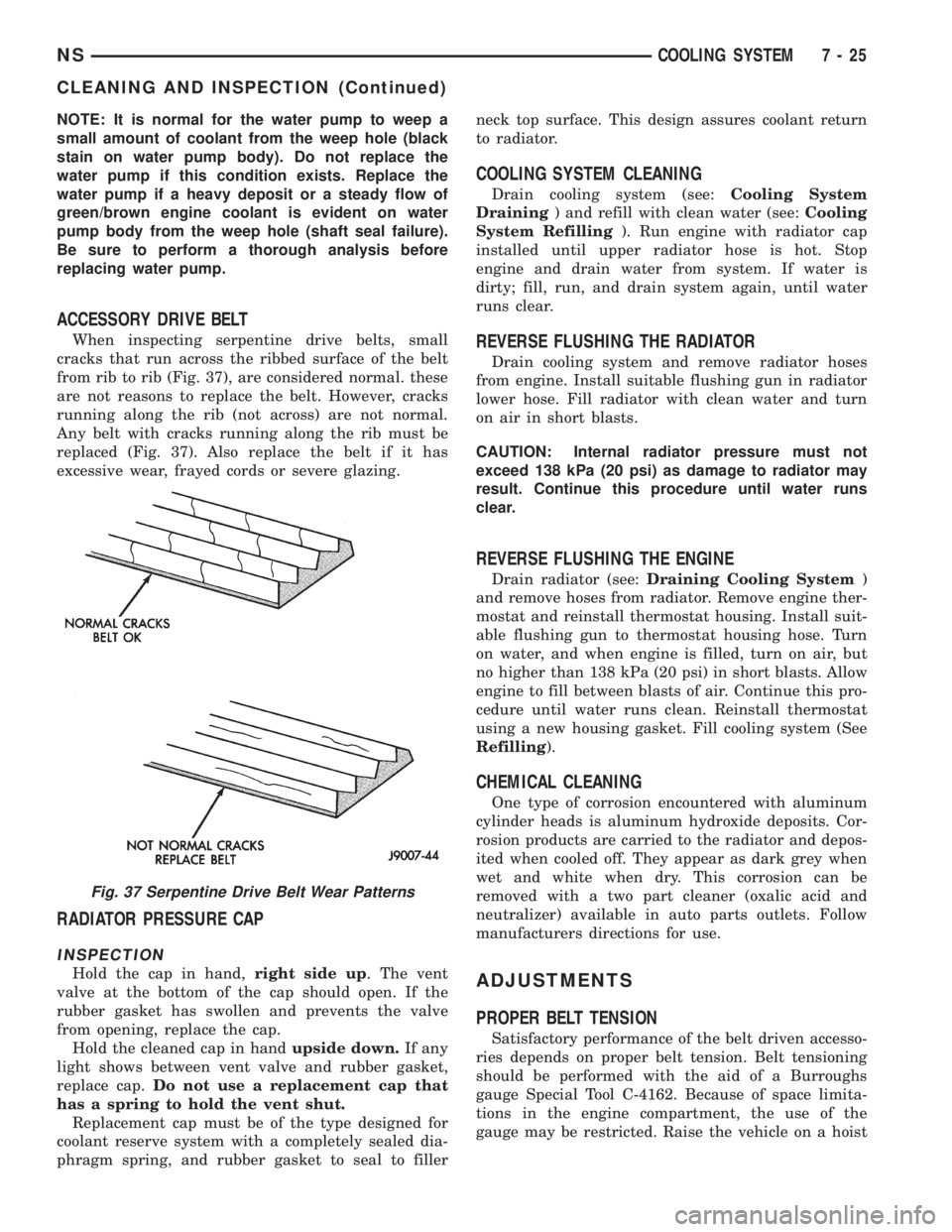
from rib to rib (Fig. 37), are considered normal. these
are not reasons to replace the belt. However, cracks
running along the rib (not across) are not normal.
Any belt with cracks running along the rib must be
replaced (Fig. 37). Also replace the belt if it has
excessive wear, frayed cords or severe glazing.
RADIATOR PRESSURE CAP
INSPECTION
Hold the cap in hand,right side up. The vent
valve at the bottom of the cap should open. If the
rubber gasket has swollen and prevents the valve
from opening, replace the cap.
Hold the cleaned cap in handupside down.If any
light shows between vent valve and rubber gasket,
replace cap.Do not use a replacement cap that
has a spring to hold the vent shut.
Replacement cap must be of the type designed for
coolant reserve system with a completely sealed dia-
phragm spring, and rubber gasket to seal to fillerneck top surface. This design assures coolant return
to radiator.
COOLING SYSTEM CLEANING
Drain cooling system (see:Cooling System
Draining) and refill with clean water (see:Cooling
System Refilling). Run engine with radiator cap
installed until upper radiator hose is hot. Stop
engine and drain water from system. If water is
dirty; fill, run, and drain system again, until water
runs clear.
REVERSE FLUSHING THE RADIATOR
Drain cooling system and remove radiator hoses
from engine. Install suitable flushing gun in radiator
lower hose. Fill radiator with clean water and turn
on air in short blasts.
CAUTION: Internal radiator pressure must not
exceed 138 kPa (20 psi) as damage to radiator may
result. Continue this procedure until water runs
clear.
REVERSE FLUSHING THE ENGINE
Drain radiator (see:Draining Cooling System)
and remove hoses from radiator. Remove engine ther-
mostat and reinstall thermostat housing. Install suit-
able flushing gun to thermostat housing hose. Turn
on water, and when engine is filled, turn on air, but
no higher than 138 kPa (20 psi) in short blasts. Allow
engine to fill between blasts of air. Continue this pro-
cedure until water runs clean. Reinstall thermostat
using a new housing gasket. Fill cooling system (See
Refilling).
CHEMICAL CLEANING
One type of corrosion encountered with aluminum
cylinder heads is aluminum hydroxide deposits. Cor-
rosion products are carried to the radiator and depos-
ited when cooled off. They appear as dark grey when
wet and white when dry. This corrosion can be
removed with a two part cleaner (oxalic acid and
neutralizer) available in auto parts outlets. Follow
manufacturers directions for use.
ADJUSTMENTS
PROPER BELT TENSION
Satisfactory performance of the belt driven accesso-
ries depends on proper belt tension. Belt tensioning
should be performed with the aid of a Burroughs
gauge Special Tool C-4162. Because of space limita-
tions in the engine compartment, the use of the
gauge may be restricted. Raise the vehicle on a hoist
Fig. 37 Serpentine Drive Belt Wear Patterns
NSCOOLING SYSTEM 7 - 25
CLEANING AND INSPECTION (Continued)
Page 248 of 1938
(3) Remove power steering pump bracket bolts and
set pump and bracket assembly aside. Power steering
lines do not need to be disconnected.
(4) Remove timing belt.
(5) Remove inner timing belt cover.
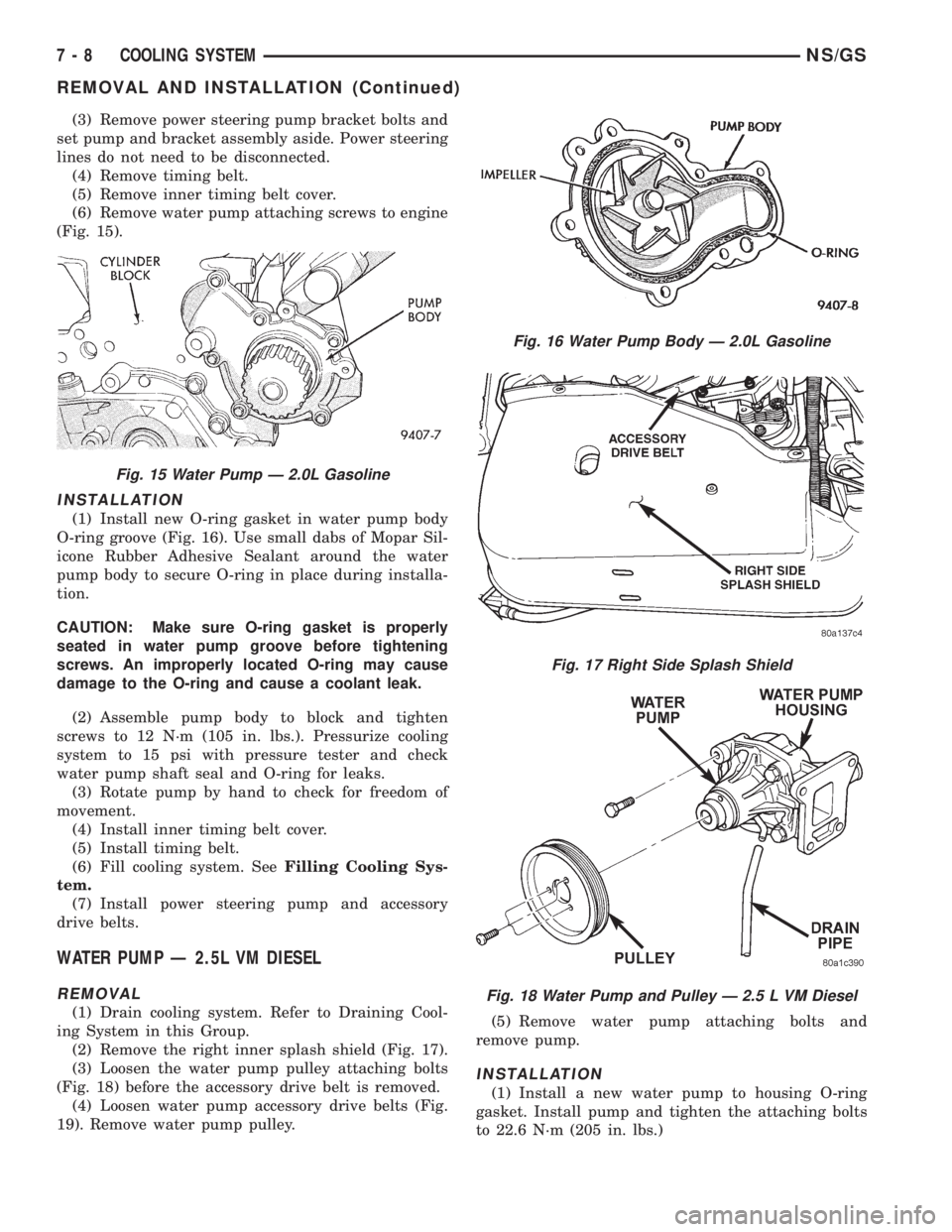
(6) Remove water pump attaching screws to engine
(Fig. 15).
INSTALLATION
(1) Install new O-ring gasket in water pump body
O-ring groove (Fig. 16). Use small dabs of Mopar Sil-
icone Rubber Adhesive Sealant around the water
pump body to secure O-ring in place during installa-
tion.
CAUTION: Make sure O-ring gasket is properly
seated in water pump groove before tightening
screws. An improperly located O-ring may cause
damage to the O-ring and cause a coolant leak.
(2) Assemble pump body to block and tighten
screws to 12 N´m (105 in. lbs.). Pressurize cooling
system to 15 psi with pressure tester and check
water pump shaft seal and O-ring for leaks.
(3) Rotate pump by hand to check for freedom of
movement.
(4) Install inner timing belt cover.
(5) Install timing belt.
(6) Fill cooling system. SeeFilling Cooling Sys-
tem.
(7) Install power steering pump and accessory
drive belts.
WATER PUMP Ð 2.5L VM DIESEL
REMOVAL
(1) Drain cooling system. Refer to Draining Cool-
ing System in this Group.
(2) Remove the right inner splash shield (Fig. 17).
(3) Loosen the water pump pulley attaching bolts
(Fig. 18) before the accessory drive belt is removed.
(4) Loosen water pump accessory drive belts (Fig.
19). Remove water pump pulley.(5) Remove water pump attaching bolts and
remove pump.
INSTALLATION
(1) Install a new water pump to housing O-ring
gasket. Install pump and tighten the attaching bolts
to 22.6 N´m (205 in. lbs.)
Fig. 15 Water Pump Ð 2.0L Gasoline
Fig. 16 Water Pump Body Ð 2.0L Gasoline
Fig. 17 Right Side Splash Shield
Fig. 18 Water Pump and Pulley Ð 2.5 L VM Diesel
7 - 8 COOLING SYSTEMNS/GS
REMOVAL AND INSTALLATION (Continued)
Page 251 of 1938
(2) Coolant leaks; if the seal is leaking, this will be
evident by traces of thick deposits of greenish-brown
dried glycol running down the pump body and com-
ponents below. A thin black stain below pump weep
hole is considered normal operation.
(3) Impeller rubs inside of the cylinder block 2.0L
engine. Impeller rubs inside of the water pump hous-
ing 2.5L VM diesel engine.
(4) Excessively loose or rough turning bearing.
NOTE: It is normal for the water pump to weep a
small amount of coolant from the weep hole (black
stain on water pump body). Do not replace the
water pump if this condition exists. Replace the
water pump if a heavy deposit or a steady flow of
green/brown engine coolant is evident on water
pump body from the weep hole (shaft seal failure).
Be sure to perform a thorough analysis before
replacing water pump.
ADJUSTMENTS
BELT TENSION GAUGE METHOD
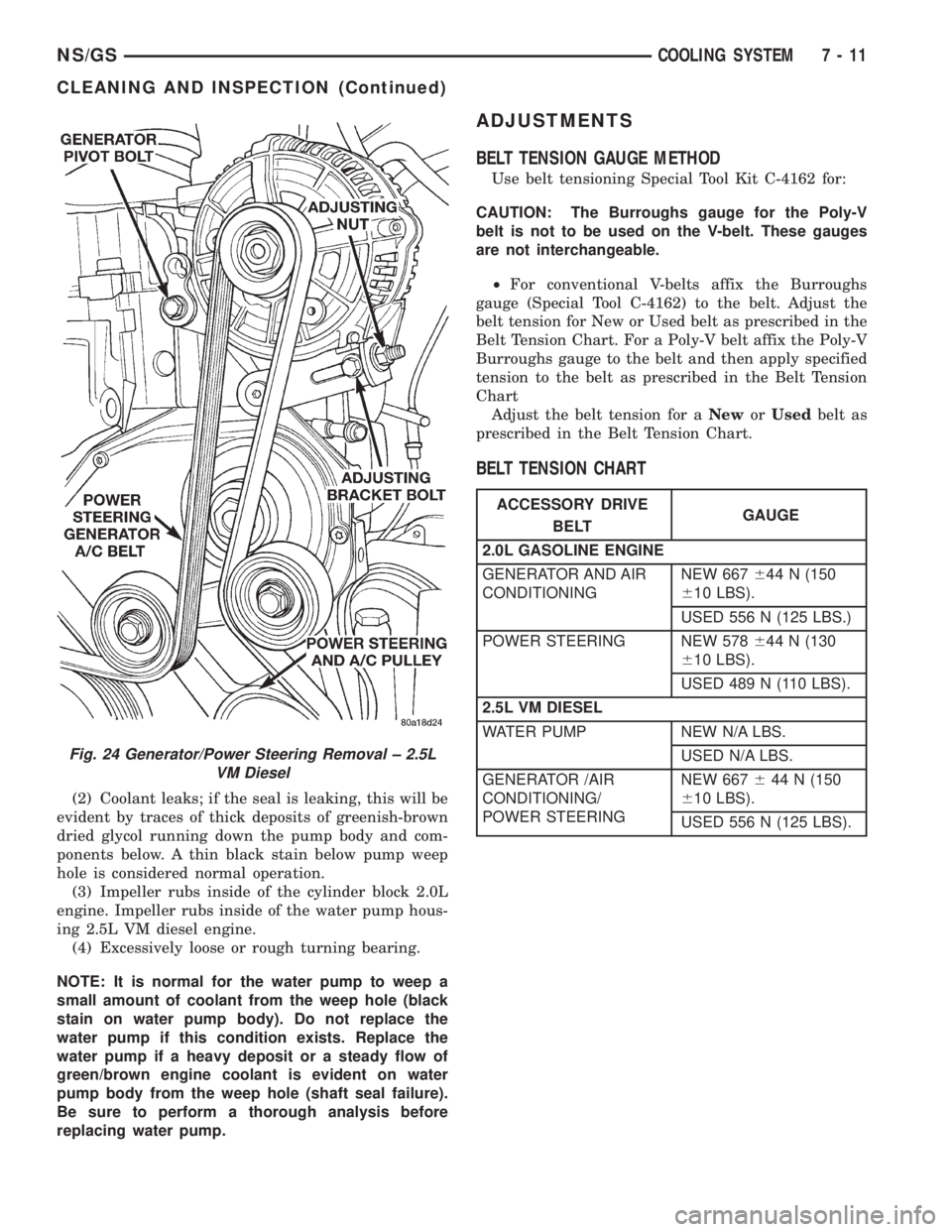
Use belt tensioning Special Tool Kit C-4162 for:
CAUTION: The Burroughs gauge for the Poly-V
belt is not to be used on the V-belt. These gauges
are not interchangeable.
²For conventional V-belts affix the Burroughs
gauge (Special Tool C-4162) to the belt. Adjust the
belt tension for New or Used belt as prescribed in the
Belt Tension Chart. For a Poly-V belt affix the Poly-V
Burroughs gauge to the belt and then apply specified
tension to the belt as prescribed in the Belt Tension
Chart
Adjust the belt tension for aNeworUsedbelt as
prescribed in the Belt Tension Chart.
BELT TENSION CHART
Fig. 24 Generator/Power Steering Removal ± 2.5L
VM Diesel
ACCESSORY DRIVE
BELTGAUGE
2.0L GASOLINE ENGINE
GENERATOR AND AIR
CONDITIONINGNEW 667644 N (150
610 LBS).
USED 556 N (125 LBS.)
POWER STEERING NEW 578644 N (130
610 LBS).
USED 489 N (110 LBS).
2.5L VM DIESEL
WATER PUMP NEW N/A LBS.
USED N/A LBS.
GENERATOR /AIR
CONDITIONING/
POWER STEERINGNEW 667644 N (150
610 LBS).
USED 556 N (125 LBS).
NS/GSCOOLING SYSTEM 7 - 11
CLEANING AND INSPECTION (Continued)