shaft CHRYSLER VOYAGER 1996 User Guide
[x] Cancel search | Manufacturer: CHRYSLER, Model Year: 1996, Model line: VOYAGER, Model: CHRYSLER VOYAGER 1996Pages: 1938, PDF Size: 55.84 MB
Page 63 of 1938
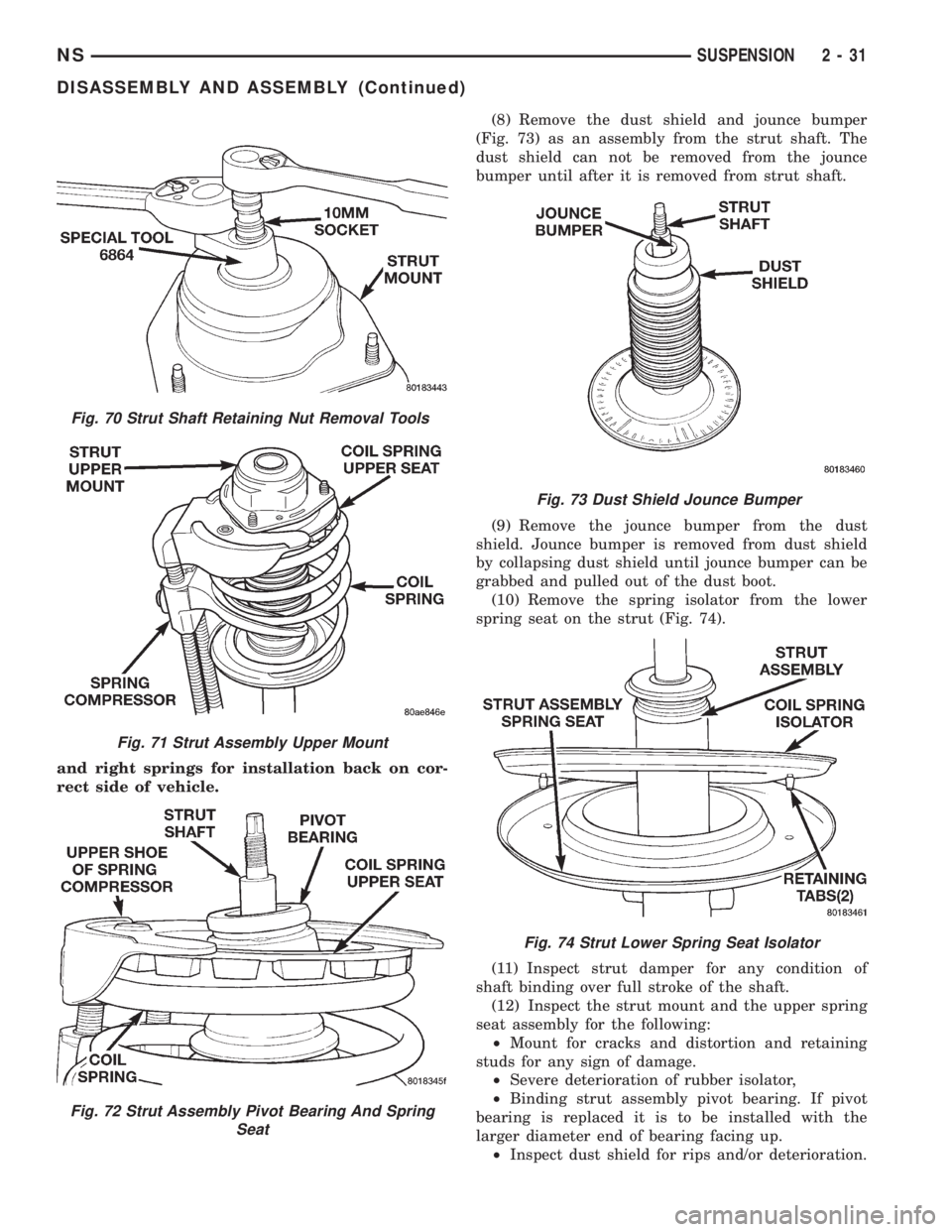
and right springs for installation back on cor-
rect side of vehicle.(8) Remove the dust shield and jounce bumper
(Fig. 73) as an assembly from the strut shaft. The
dust shield can not be removed from the jounce
bumper until after it is removed from strut shaft.
(9) Remove the jounce bumper from the dust
shield. Jounce bumper is removed from dust shield
by collapsing dust shield until jounce bumper can be
grabbed and pulled out of the dust boot.
(10) Remove the spring isolator from the lower
spring seat on the strut (Fig. 74).
(11) Inspect strut damper for any condition of
shaft binding over full stroke of the shaft.
(12) Inspect the strut mount and the upper spring
seat assembly for the following:
²Mount for cracks and distortion and retaining
studs for any sign of damage.
²Severe deterioration of rubber isolator,
²Binding strut assembly pivot bearing. If pivot
bearing is replaced it is to be installed with the
larger diameter end of bearing facing up.
²Inspect dust shield for rips and/or deterioration.
Fig. 70 Strut Shaft Retaining Nut Removal Tools
Fig. 71 Strut Assembly Upper Mount
Fig. 72 Strut Assembly Pivot Bearing And Spring
Seat
Fig. 73 Dust Shield Jounce Bumper
Fig. 74 Strut Lower Spring Seat Isolator
NSSUSPENSION 2 - 31
DISASSEMBLY AND ASSEMBLY (Continued)
Page 64 of 1938
²Inspect jounce bumper for cracks and signs of
deterioration.
(13) Replace any components of the strut assembly
found to be worn or defective during the inspection,
before re-assembling the strut.
ASSEMBLY
(1) Clamp strut in vise, with strut in vertical posi-
tion.Do not clamp strut in vise by body of strut,
only by the clevis bracket (Fig. 68).
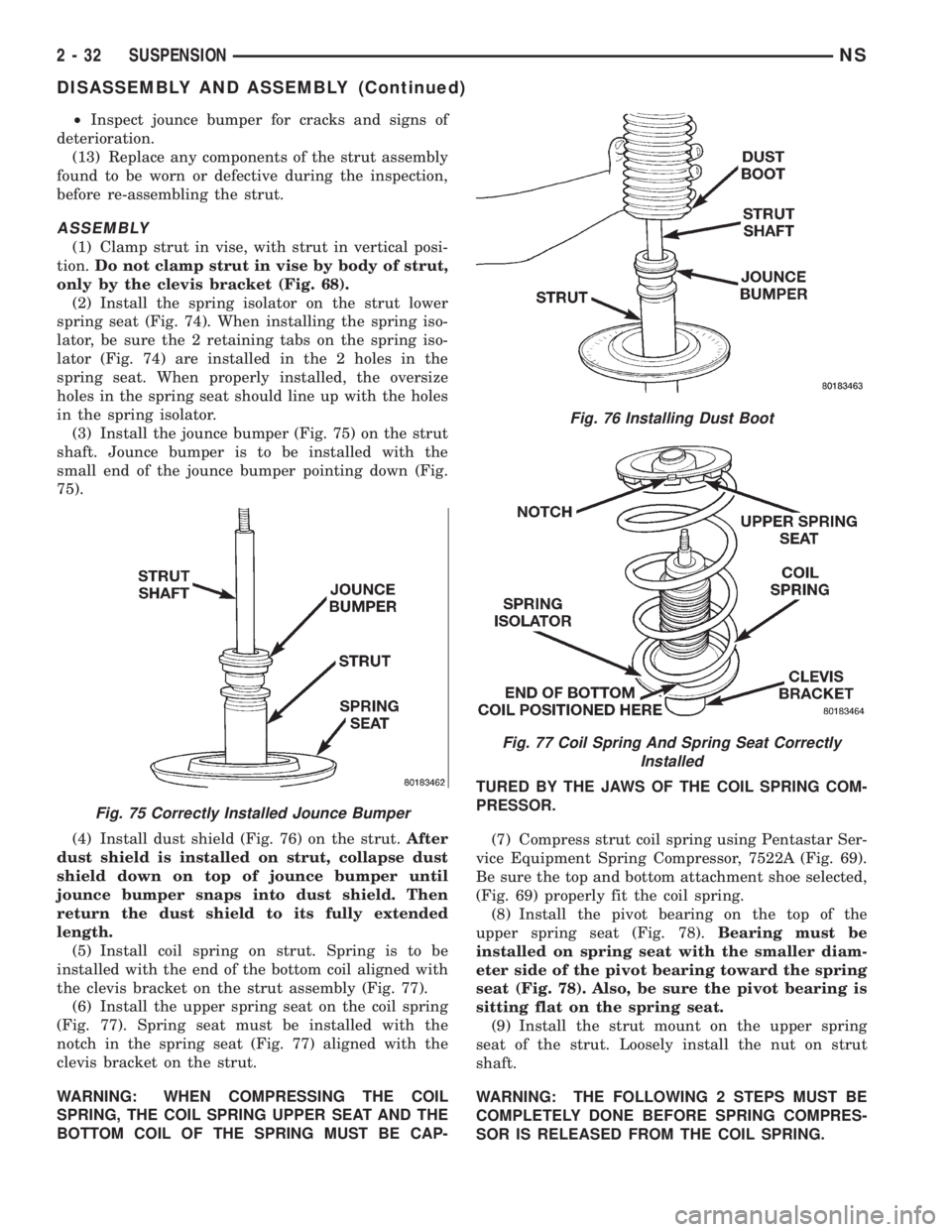
(2) Install the spring isolator on the strut lower
spring seat (Fig. 74). When installing the spring iso-
lator, be sure the 2 retaining tabs on the spring iso-
lator (Fig. 74) are installed in the 2 holes in the
spring seat. When properly installed, the oversize
holes in the spring seat should line up with the holes
in the spring isolator.
(3) Install the jounce bumper (Fig. 75) on the strut
shaft. Jounce bumper is to be installed with the
small end of the jounce bumper pointing down (Fig.
75).
(4) Install dust shield (Fig. 76) on the strut.After
dust shield is installed on strut, collapse dust
shield down on top of jounce bumper until
jounce bumper snaps into dust shield. Then
return the dust shield to its fully extended
length.
(5) Install coil spring on strut. Spring is to be
installed with the end of the bottom coil aligned with
the clevis bracket on the strut assembly (Fig. 77).
(6) Install the upper spring seat on the coil spring
(Fig. 77). Spring seat must be installed with the
notch in the spring seat (Fig. 77) aligned with the
clevis bracket on the strut.
WARNING: WHEN COMPRESSING THE COIL
SPRING, THE COIL SPRING UPPER SEAT AND THE
BOTTOM COIL OF THE SPRING MUST BE CAP-TURED BY THE JAWS OF THE COIL SPRING COM-
PRESSOR.
(7) Compress strut coil spring using Pentastar Ser-
vice Equipment Spring Compressor, 7522A (Fig. 69).
Be sure the top and bottom attachment shoe selected,
(Fig. 69) properly fit the coil spring.
(8) Install the pivot bearing on the top of the
upper spring seat (Fig. 78).Bearing must be
installed on spring seat with the smaller diam-
eter side of the pivot bearing toward the spring
seat (Fig. 78). Also, be sure the pivot bearing is
sitting flat on the spring seat.
(9) Install the strut mount on the upper spring
seat of the strut. Loosely install the nut on strut
shaft.
WARNING: THE FOLLOWING 2 STEPS MUST BE
COMPLETELY DONE BEFORE SPRING COMPRES-
SOR IS RELEASED FROM THE COIL SPRING.
Fig. 75 Correctly Installed Jounce Bumper
Fig. 76 Installing Dust Boot
Fig. 77 Coil Spring And Spring Seat Correctly
Installed
2 - 32 SUSPENSIONNS
DISASSEMBLY AND ASSEMBLY (Continued)
Page 65 of 1938
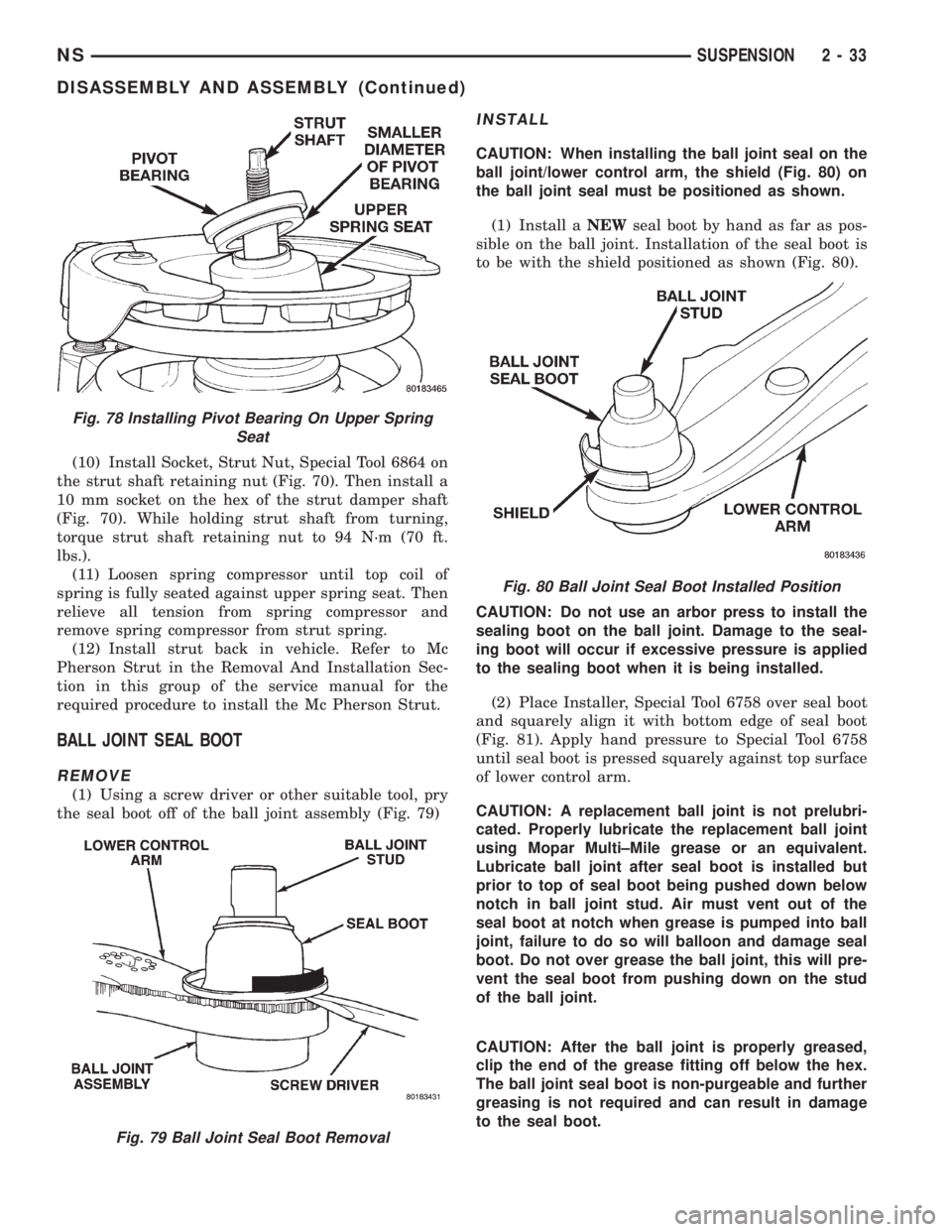
(10) Install Socket, Strut Nut, Special Tool 6864 on
the strut shaft retaining nut (Fig. 70). Then install a
10 mm socket on the hex of the strut damper shaft
(Fig. 70). While holding strut shaft from turning,
torque strut shaft retaining nut to 94 N´m (70 ft.
lbs.).
(11) Loosen spring compressor until top coil of
spring is fully seated against upper spring seat. Then
relieve all tension from spring compressor and
remove spring compressor from strut spring.
(12) Install strut back in vehicle. Refer to Mc
Pherson Strut in the Removal And Installation Sec-
tion in this group of the service manual for the
required procedure to install the Mc Pherson Strut.
BALL JOINT SEAL BOOT
REMOVE
(1) Using a screw driver or other suitable tool, pry
the seal boot off of the ball joint assembly (Fig. 79)
INSTALL
CAUTION: When installing the ball joint seal on the
ball joint/lower control arm, the shield (Fig. 80) on
the ball joint seal must be positioned as shown.
(1) Install aNEWseal boot by hand as far as pos-
sible on the ball joint. Installation of the seal boot is
to be with the shield positioned as shown (Fig. 80).
CAUTION: Do not use an arbor press to install the
sealing boot on the ball joint. Damage to the seal-
ing boot will occur if excessive pressure is applied
to the sealing boot when it is being installed.
(2) Place Installer, Special Tool 6758 over seal boot
and squarely align it with bottom edge of seal boot
(Fig. 81). Apply hand pressure to Special Tool 6758
until seal boot is pressed squarely against top surface
of lower control arm.
CAUTION: A replacement ball joint is not prelubri-
cated. Properly lubricate the replacement ball joint
using Mopar Multi±Mile grease or an equivalent.
Lubricate ball joint after seal boot is installed but
prior to top of seal boot being pushed down below
notch in ball joint stud. Air must vent out of the
seal boot at notch when grease is pumped into ball
joint, failure to do so will balloon and damage seal
boot. Do not over grease the ball joint, this will pre-
vent the seal boot from pushing down on the stud
of the ball joint.
CAUTION: After the ball joint is properly greased,
clip the end of the grease fitting off below the hex.
The ball joint seal boot is non-purgeable and further
greasing is not required and can result in damage
to the seal boot.
Fig. 78 Installing Pivot Bearing On Upper Spring
Seat
Fig. 79 Ball Joint Seal Boot Removal
Fig. 80 Ball Joint Seal Boot Installed Position
NSSUSPENSION 2 - 33
DISASSEMBLY AND ASSEMBLY (Continued)
Page 68 of 1938
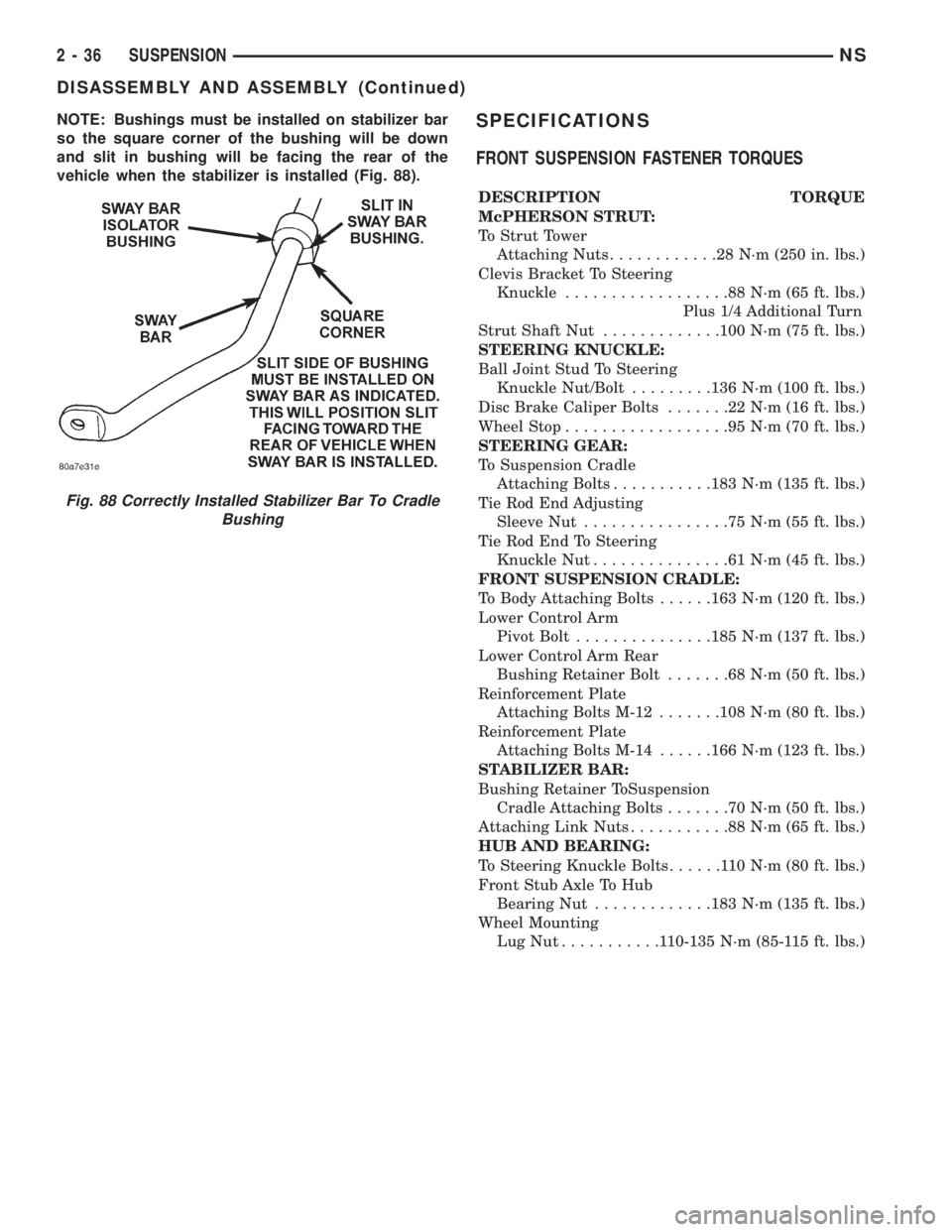
NOTE: Bushings must be installed on stabilizer bar
so the square corner of the bushing will be down
and slit in bushing will be facing the rear of the
vehicle when the stabilizer is installed (Fig. 88).SPECIFICATIONS
FRONT SUSPENSION FASTENER TORQUES
DESCRIPTION TORQUE
McPHERSON STRUT:
To Strut Tower
Attaching Nuts............28N´m(250 in. lbs.)
Clevis Bracket To Steering
Knuckle..................88N´m(65ft.lbs.)
Plus 1/4 Additional Turn
Strut Shaft Nut.............100 N´m (75 ft. lbs.)
STEERING KNUCKLE:
Ball Joint Stud To Steering
Knuckle Nut/Bolt.........136 N´m (100 ft. lbs.)
Disc Brake Caliper Bolts.......22N´m(16ft.lbs.)
Wheel Stop..................95N´m(70ft.lbs.)
STEERING GEAR:
To Suspension Cradle
Attaching Bolts...........183 N´m (135 ft. lbs.)
Tie Rod End Adjusting
Sleeve Nut................75N´m(55ft.lbs.)
Tie Rod End To Steering
Knuckle Nut...............61N´m(45ft.lbs.)
FRONT SUSPENSION CRADLE:
To Body Attaching Bolts......163 N´m (120 ft. lbs.)
Lower Control Arm
Pivot Bolt...............185 N´m (137 ft. lbs.)
Lower Control Arm Rear
Bushing Retainer Bolt.......68N´m(50ft.lbs.)
Reinforcement Plate
Attaching Bolts M-12.......108 N´m (80 ft. lbs.)
Reinforcement Plate
Attaching Bolts M-14......166 N´m (123 ft. lbs.)
STABILIZER BAR:
Bushing Retainer ToSuspension
Cradle Attaching Bolts.......70N´m(50ft.lbs.)
Attaching Link Nuts...........88N´m(65ft.lbs.)
HUB AND BEARING:
To Steering Knuckle Bolts......110N´m(80ft.lbs.)
Front Stub Axle To Hub
Bearing Nut.............183 N´m (135 ft. lbs.)
Wheel Mounting
LugNut...........110-135 N´m (85-115 ft. lbs.)
Fig. 88 Correctly Installed Stabilizer Bar To Cradle
Bushing
2 - 36 SUSPENSIONNS
DISASSEMBLY AND ASSEMBLY (Continued)
Page 75 of 1938
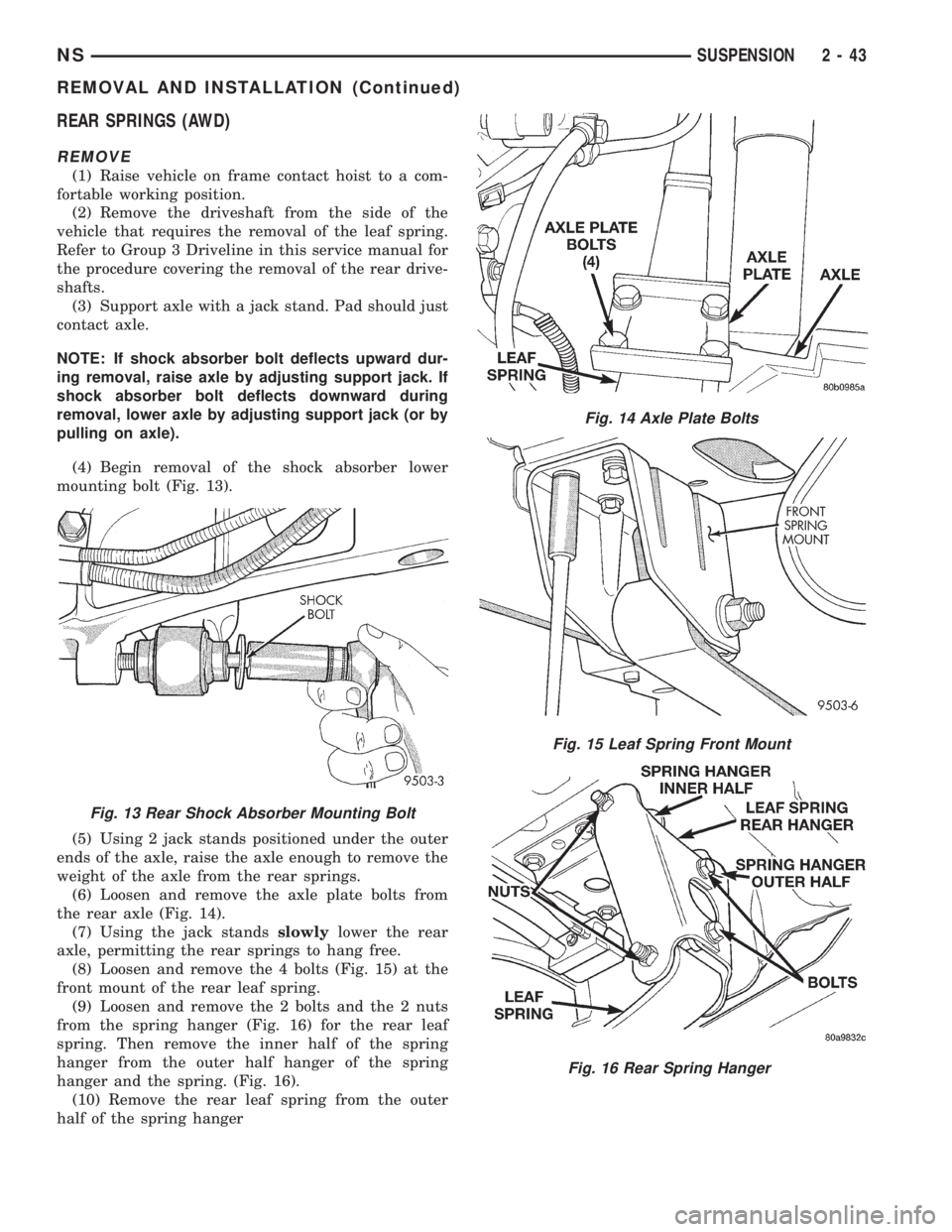
REAR SPRINGS (AWD)
REMOVE
(1) Raise vehicle on frame contact hoist to a com-
fortable working position.
(2) Remove the driveshaft from the side of the
vehicle that requires the removal of the leaf spring.
Refer to Group 3 Driveline in this service manual for
the procedure covering the removal of the rear drive-
shafts.
(3) Support axle with a jack stand. Pad should just
contact axle.
NOTE: If shock absorber bolt deflects upward dur-
ing removal, raise axle by adjusting support jack. If
shock absorber bolt deflects downward during
removal, lower axle by adjusting support jack (or by
pulling on axle).
(4) Begin removal of the shock absorber lower
mounting bolt (Fig. 13).
(5) Using 2 jack stands positioned under the outer
ends of the axle, raise the axle enough to remove the
weight of the axle from the rear springs.
(6) Loosen and remove the axle plate bolts from
the rear axle (Fig. 14).
(7) Using the jack standsslowlylower the rear
axle, permitting the rear springs to hang free.
(8) Loosen and remove the 4 bolts (Fig. 15) at the
front mount of the rear leaf spring.
(9) Loosen and remove the 2 bolts and the 2 nuts
from the spring hanger (Fig. 16) for the rear leaf
spring. Then remove the inner half of the spring
hanger from the outer half hanger of the spring
hanger and the spring. (Fig. 16).
(10) Remove the rear leaf spring from the outer
half of the spring hanger
Fig. 13 Rear Shock Absorber Mounting Bolt
Fig. 14 Axle Plate Bolts
Fig. 15 Leaf Spring Front Mount
Fig. 16 Rear Spring Hanger
NSSUSPENSION 2 - 43
REMOVAL AND INSTALLATION (Continued)
Page 104 of 1938
MASTER CYLINDER BLEEDING PROCEDURE
CAUTION: When clamping master cylinder in vise,
only clamp master cylinder by its mounting flange,
do not clamp on primary piston, seal\boot or body
of master cylinder.
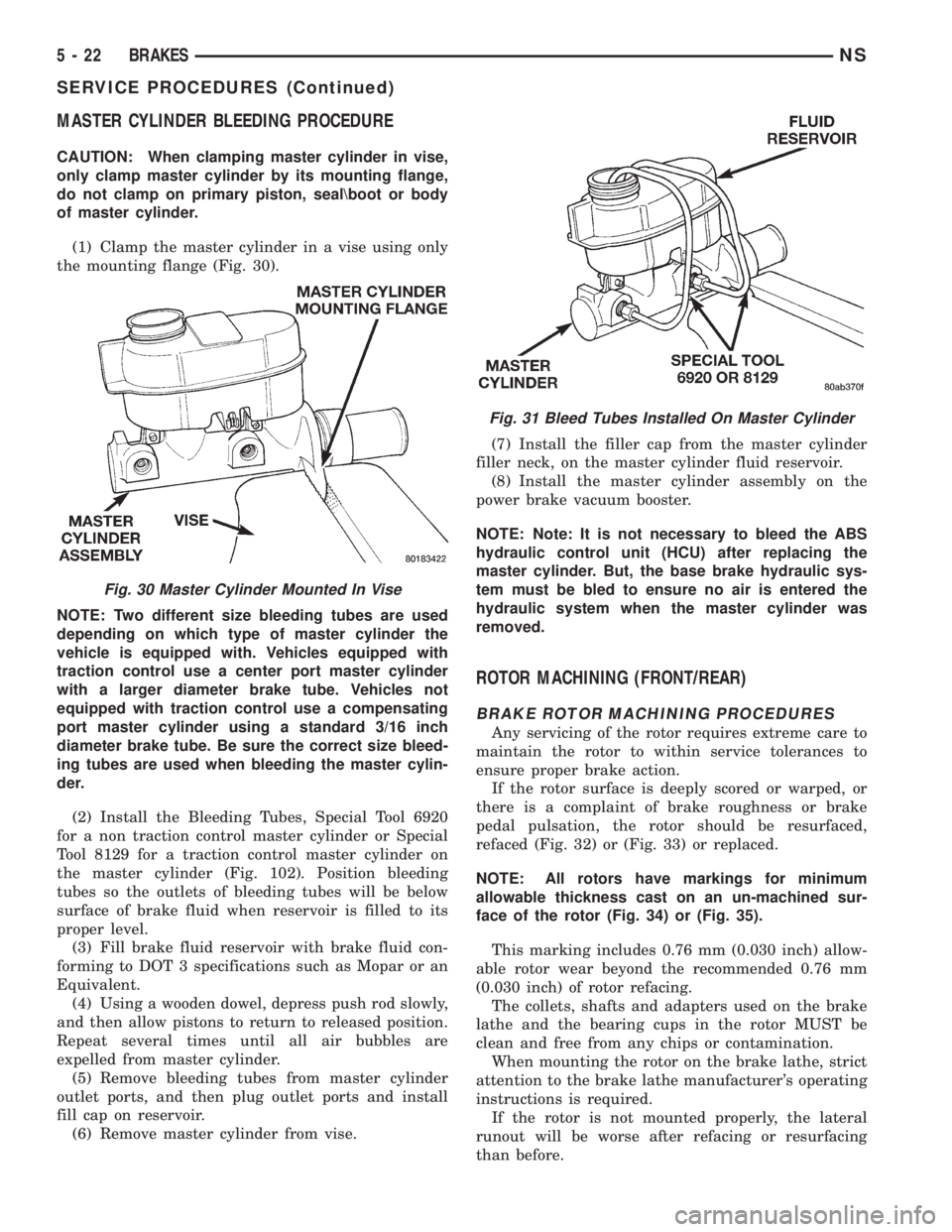
(1) Clamp the master cylinder in a vise using only
the mounting flange (Fig. 30).
NOTE: Two different size bleeding tubes are used
depending on which type of master cylinder the
vehicle is equipped with. Vehicles equipped with
traction control use a center port master cylinder
with a larger diameter brake tube. Vehicles not
equipped with traction control use a compensating
port master cylinder using a standard 3/16 inch
diameter brake tube. Be sure the correct size bleed-
ing tubes are used when bleeding the master cylin-
der.
(2) Install the Bleeding Tubes, Special Tool 6920
for a non traction control master cylinder or Special
Tool 8129 for a traction control master cylinder on
the master cylinder (Fig. 102). Position bleeding
tubes so the outlets of bleeding tubes will be below
surface of brake fluid when reservoir is filled to its
proper level.
(3) Fill brake fluid reservoir with brake fluid con-
forming to DOT 3 specifications such as Mopar or an
Equivalent.
(4) Using a wooden dowel, depress push rod slowly,
and then allow pistons to return to released position.
Repeat several times until all air bubbles are
expelled from master cylinder.
(5) Remove bleeding tubes from master cylinder
outlet ports, and then plug outlet ports and install
fill cap on reservoir.
(6) Remove master cylinder from vise.(7) Install the filler cap from the master cylinder
filler neck, on the master cylinder fluid reservoir.
(8) Install the master cylinder assembly on the
power brake vacuum booster.
NOTE: Note: It is not necessary to bleed the ABS
hydraulic control unit (HCU) after replacing the
master cylinder. But, the base brake hydraulic sys-
tem must be bled to ensure no air is entered the
hydraulic system when the master cylinder was
removed.
ROTOR MACHINING (FRONT/REAR)
BRAKE ROTOR MACHINING PROCEDURES
Any servicing of the rotor requires extreme care to
maintain the rotor to within service tolerances to
ensure proper brake action.
If the rotor surface is deeply scored or warped, or
there is a complaint of brake roughness or brake
pedal pulsation, the rotor should be resurfaced,
refaced (Fig. 32) or (Fig. 33) or replaced.
NOTE: All rotors have markings for minimum
allowable thickness cast on an un-machined sur-
face of the rotor (Fig. 34) or (Fig. 35).
This marking includes 0.76 mm (0.030 inch) allow-
able rotor wear beyond the recommended 0.76 mm
(0.030 inch) of rotor refacing.
The collets, shafts and adapters used on the brake
lathe and the bearing cups in the rotor MUST be
clean and free from any chips or contamination.
When mounting the rotor on the brake lathe, strict
attention to the brake lathe manufacturer's operating
instructions is required.
If the rotor is not mounted properly, the lateral
runout will be worse after refacing or resurfacing
than before.
Fig. 30 Master Cylinder Mounted In Vise
Fig. 31 Bleed Tubes Installed On Master Cylinder
5 - 22 BRAKESNS
SERVICE PROCEDURES (Continued)
Page 123 of 1938
(d) Align bolt in Special Tool 8214-2 with pilot
hole in Special Tool 8214-1. Tighten bolt against
Special Tool 8214-1.
(e) Press hub/bearing out of axle by continuing
to tighten bolt in Special Tool 8214-2 against Spe-
cial Tool 8214-1.
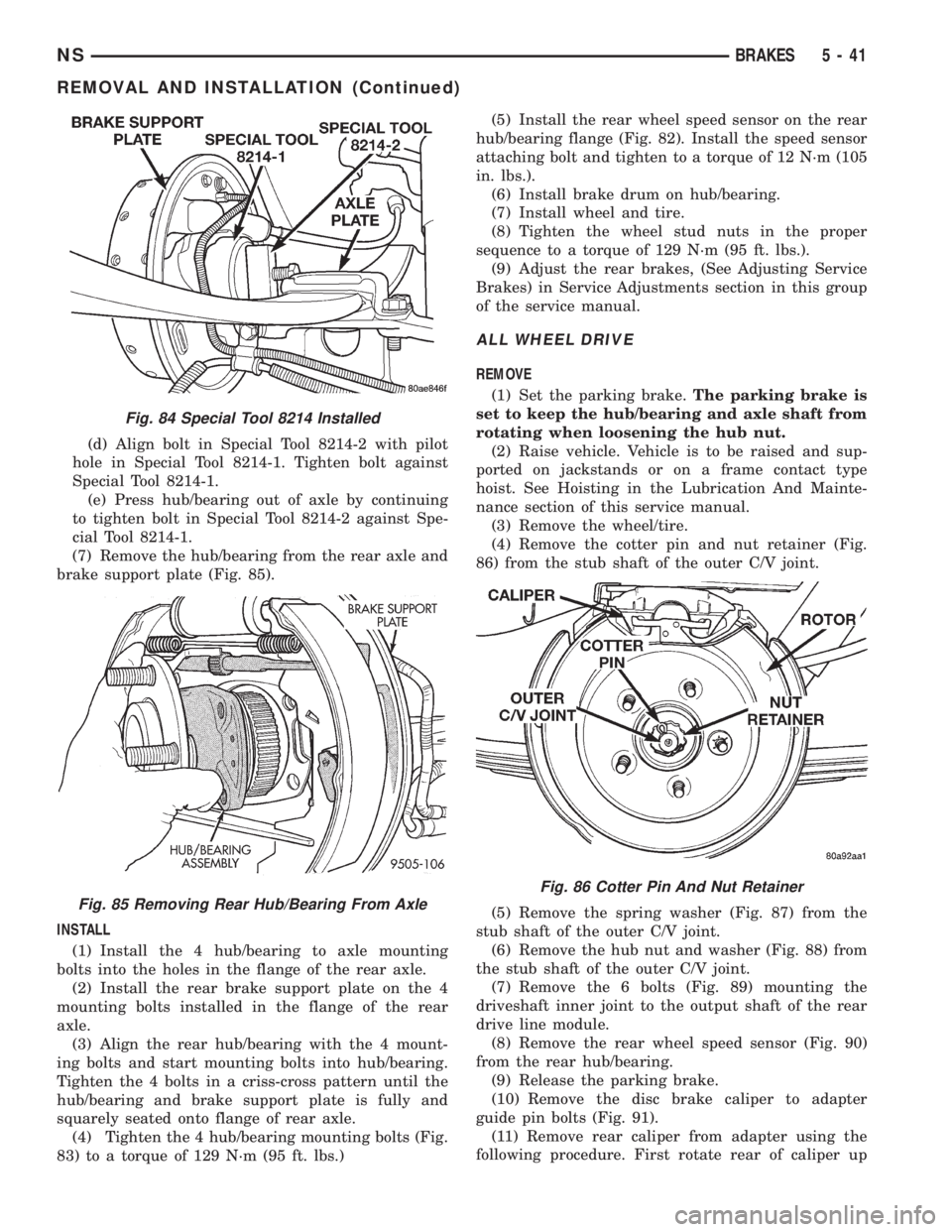
(7) Remove the hub/bearing from the rear axle and
brake support plate (Fig. 85).
INSTALL
(1) Install the 4 hub/bearing to axle mounting
bolts into the holes in the flange of the rear axle.
(2) Install the rear brake support plate on the 4
mounting bolts installed in the flange of the rear
axle.
(3) Align the rear hub/bearing with the 4 mount-
ing bolts and start mounting bolts into hub/bearing.
Tighten the 4 bolts in a criss-cross pattern until the
hub/bearing and brake support plate is fully and
squarely seated onto flange of rear axle.
(4) Tighten the 4 hub/bearing mounting bolts (Fig.
83) to a torque of 129 N´m (95 ft. lbs.)(5) Install the rear wheel speed sensor on the rear
hub/bearing flange (Fig. 82). Install the speed sensor
attaching bolt and tighten to a torque of 12 N´m (105
in. lbs.).
(6) Install brake drum on hub/bearing.
(7) Install wheel and tire.
(8) Tighten the wheel stud nuts in the proper
sequence to a torque of 129 N´m (95 ft. lbs.).
(9) Adjust the rear brakes, (See Adjusting Service
Brakes) in Service Adjustments section in this group
of the service manual.
ALL WHEEL DRIVE
REMOVE
(1) Set the parking brake.The parking brake is
set to keep the hub/bearing and axle shaft from
rotating when loosening the hub nut.
(2) Raise vehicle. Vehicle is to be raised and sup-
ported on jackstands or on a frame contact type
hoist. See Hoisting in the Lubrication And Mainte-
nance section of this service manual.
(3) Remove the wheel/tire.
(4) Remove the cotter pin and nut retainer (Fig.
86) from the stub shaft of the outer C/V joint.
(5) Remove the spring washer (Fig. 87) from the
stub shaft of the outer C/V joint.
(6) Remove the hub nut and washer (Fig. 88) from
the stub shaft of the outer C/V joint.
(7) Remove the 6 bolts (Fig. 89) mounting the
driveshaft inner joint to the output shaft of the rear
drive line module.
(8) Remove the rear wheel speed sensor (Fig. 90)
from the rear hub/bearing.
(9) Release the parking brake.
(10) Remove the disc brake caliper to adapter
guide pin bolts (Fig. 91).
(11) Remove rear caliper from adapter using the
following procedure. First rotate rear of caliper up
Fig. 84 Special Tool 8214 Installed
Fig. 85 Removing Rear Hub/Bearing From Axle
Fig. 86 Cotter Pin And Nut Retainer
NSBRAKES 5 - 41
REMOVAL AND INSTALLATION (Continued)
Page 124 of 1938

from the adapter. Then pull the front of the caliper
and the outboard brake shoe anti-rattle clip out from
under the front abutment on the adapter (Fig. 92).(12) Support caliper to prevent the weight of the
caliper from damaging the flexible brake hose (Fig.
93).
(13) Remove the rotor from the hub/bearing.
Fig. 87 Spring Washer
Fig. 88 Hub Nut And Washer
Fig. 89 Driveshaft Attachment To Driveline Module
Fig. 90 Wheel Speed Sensor
Fig. 91 Caliper Guide Pin Bolts
Fig. 92 Removing / Installing Caliper
5 - 42 BRAKESNS
REMOVAL AND INSTALLATION (Continued)
Page 125 of 1938
(14) Remove driveshaft from rear drive line mod-
ule and hub/bearing. Driveshaft is removed by first
compressing the inner joint on the driveshaft and
removing it from the drive line module. Then, slide
the outer joint of the driveshaft out of the hub/bear-
ing.
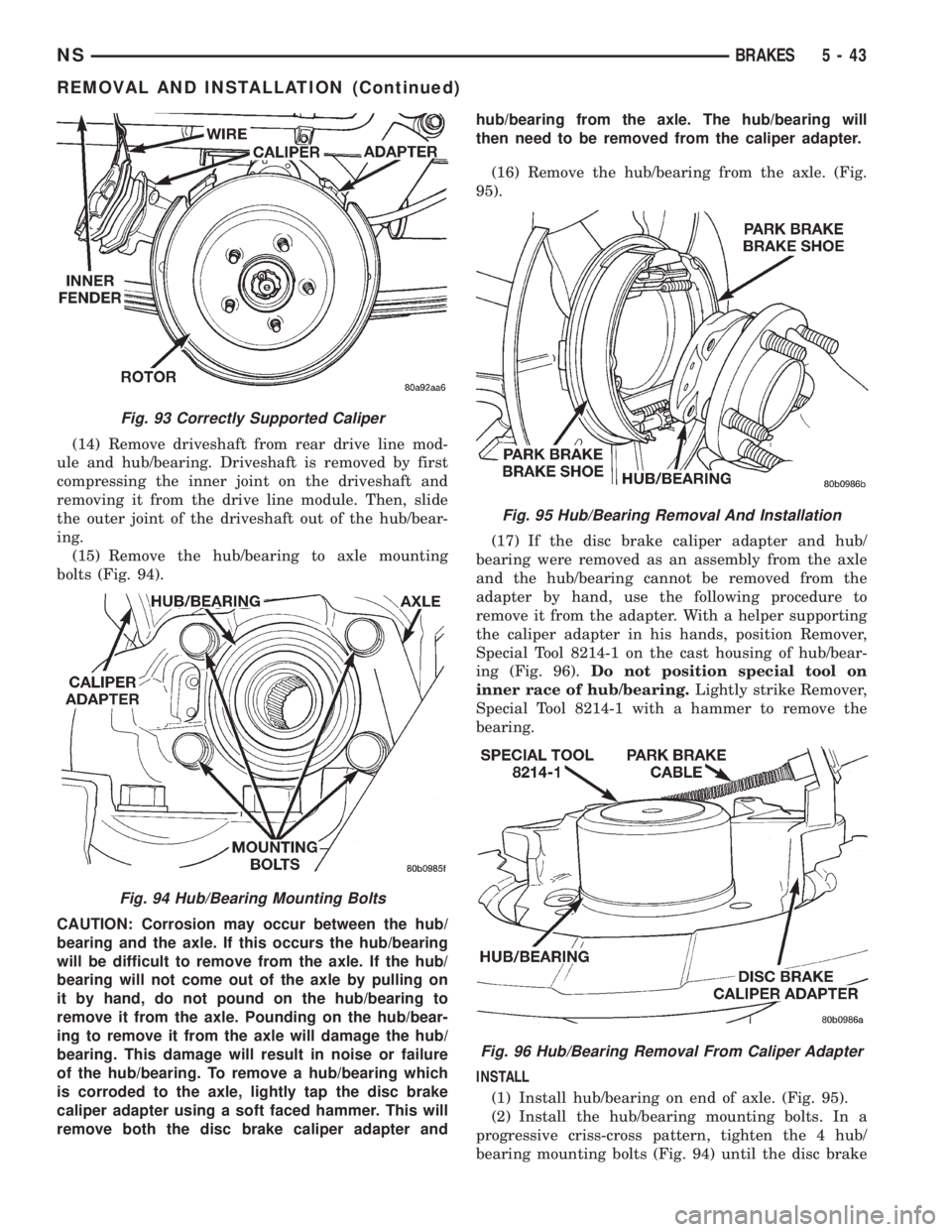
(15) Remove the hub/bearing to axle mounting
bolts (Fig. 94).
CAUTION: Corrosion may occur between the hub/
bearing and the axle. If this occurs the hub/bearing
will be difficult to remove from the axle. If the hub/
bearing will not come out of the axle by pulling on
it by hand, do not pound on the hub/bearing to
remove it from the axle. Pounding on the hub/bear-
ing to remove it from the axle will damage the hub/
bearing. This damage will result in noise or failure
of the hub/bearing. To remove a hub/bearing which
is corroded to the axle, lightly tap the disc brake
caliper adapter using a soft faced hammer. This will
remove both the disc brake caliper adapter andhub/bearing from the axle. The hub/bearing will
then need to be removed from the caliper adapter.
(16) Remove the hub/bearing from the axle. (Fig.
95).
(17) If the disc brake caliper adapter and hub/
bearing were removed as an assembly from the axle
and the hub/bearing cannot be removed from the
adapter by hand, use the following procedure to
remove it from the adapter. With a helper supporting
the caliper adapter in his hands, position Remover,
Special Tool 8214-1 on the cast housing of hub/bear-
ing (Fig. 96).Do not position special tool on
inner race of hub/bearing.Lightly strike Remover,
Special Tool 8214-1 with a hammer to remove the
bearing.
INSTALL
(1) Install hub/bearing on end of axle. (Fig. 95).
(2) Install the hub/bearing mounting bolts. In a
progressive criss-cross pattern, tighten the 4 hub/
bearing mounting bolts (Fig. 94) until the disc brake
Fig. 93 Correctly Supported Caliper
Fig. 94 Hub/Bearing Mounting Bolts
Fig. 95 Hub/Bearing Removal And Installation
Fig. 96 Hub/Bearing Removal From Caliper Adapter
NSBRAKES 5 - 43
REMOVAL AND INSTALLATION (Continued)
Page 126 of 1938

caliper adapter and hub/bearing are squarely seated
against the axle. Then tighten the hub/bearing
mounting bolts to a torque of 129 N´m (95 ft. lbs.).
(3) Install driveshaft in hub/bearing and on output
shaft of rear drive line module. Driveshaft is
installed by first sliding the outer joint of the drive-
shaft into the hub/bearing and then compressing the
inner joint on the driveshaft and installing it on the
output shaft the drive line module.
(4) Install rotor on hub/bearing.
(5) Carefully lower disc brake caliper and brake
shoes over rotor and onto caliper adapter by revers-
ing the removal procedure (Fig. 92).
CAUTION: When installing guide pin bolts extreme
caution should be taken not to crossthread the cal-
iper guide pin bolts.
(6) Install the disc brake caliper guide pin bolts
(Fig. 91). Tighten the guide pin bolts to a torque of
22 N´m (192 in. lbs.).
(7) Clean all foreign material off the threads of the
outer C/V joint stub shaft. Install the washer and
hub nut (Fig. 88) on the stub shaft of the outer C/V
joint.
(8) Lower vehicle.
(9) Set the park brake.This is required to keep
the driveshaft from rotating when tightening
and torquing the hub nut and driveshaft inner
joint to driveline module mounting nuts.
(10) Raise vehicle.
(11) Tighten the driveshaft inner joint to drive line
module output shaft mounting bolts (Fig. 89) to a
torque of 61 N´m (45 ft. lbs.).
(12) Tighten the outer C/V joint hub nut (Fig. 88)
to a torque of 244 N´m (180 ft. lbs.).
(13) Install the spring washer (Fig. 87) on the stub
shaft of the outer C/V joint.
(14) Install the nut retainer and cotter pin (Fig.
86) on the stub shaft of the outer C/V joint.
(15) Install the wheel speed sensor on the hub/
bearing and adapter. Install the wheel speed sensor
attaching bolt (Fig. 90). Tighten the wheel speed sen-
sor attaching bolt to a torque of 12 N´m (105 in. lbs).
(16) Install wheel and tire.
(17) Tighten the wheel mounting stud nuts in
proper sequence until all nuts are torqued to half
specification. Then repeat the tightening sequence to
the full specified torque of 129 N´m (95 ft. lbs.).
(18) Remove jackstands or lower hoist.
CAUTION: Before moving vehicle, pump the brake
pedal several times to insure the vehicle has a firm
brake pedal to adequately stop vehicle.
(19) Road test vehicle to ensure proper operation
of the brake system.MASTER CYLINDER
CAUTION: Different types of master cylinders are
used on this vehicle. Vehicles equipped with trac-
tion control use a center port master cylinder. Vehi-
cles not equipped with traction control use a
compensating port master cylinder. Be sure to ver-
ify if the vehicle is equipped with traction control
and that the correct replacement master cylinder is
used. Also, vehicles that are equipped with four
wheel disc brakes have a master with a different
size piston bore than the other master cylinders. If
a new master cylinder is being installed, be sure
the correct master cylinder is used for the type of
brake system the vehicle is equipped with.
REMOVE
CAUTION: Vacuum in the power brake booster
must be pumped down (removed) before removing
master cylinder from power brake booster. This is
necessary to prevent the power brake booster from
sucking in any contamination as the master cylin-
der is removed. This can be done simply by pump-
ing the brake pedal, with the vehicle's engine not
running, until a firm feeling brake pedal is achieved.
(1) With engine not running, pump the brake
pedal until a firm pedal is achieved (4-5 strokes).
CAUTION: Before removing the master cylinder
filler tube from the brake fluid reservoir, the filler
tube, brake fluid reservoir and master cylinder must
be thoroughly cleaned. This must be done to pre-
vent dirt particles from falling into the brake fluid
reservoir and entering the brakes hydraulic system.
(2) Thoroughly clean all surfaces of the filler neck,
brake fluid reservoir, and master cylinder. Use only a
solvent such as Mopar Brake Parts Cleaner or an
equivalent.
(3) Remove master cylinder filler tube from brake
fluid reservoir by pushing down and rotating (Fig.
97). Then remove the cap from the removed filler
tube and install it on the master cylinder reservoir.
(4) Remove vehicle wiring harness connector, from
the brake fluid level sensor, in master cylinder brake
fluid reservoir (Fig. 98).
(5) Disconnect the primary and secondary brake
tubes from the master cylinder housing (Fig. 99).
Install sealing plugs in the open brake tube outlets
on master cylinder assembly.
5 - 44 BRAKESNS
REMOVAL AND INSTALLATION (Continued)