engine oil CHRYSLER VOYAGER 1996 Workshop Manual
[x] Cancel search | Manufacturer: CHRYSLER, Model Year: 1996, Model line: VOYAGER, Model: CHRYSLER VOYAGER 1996Pages: 1938, PDF Size: 55.84 MB
Page 320 of 1938
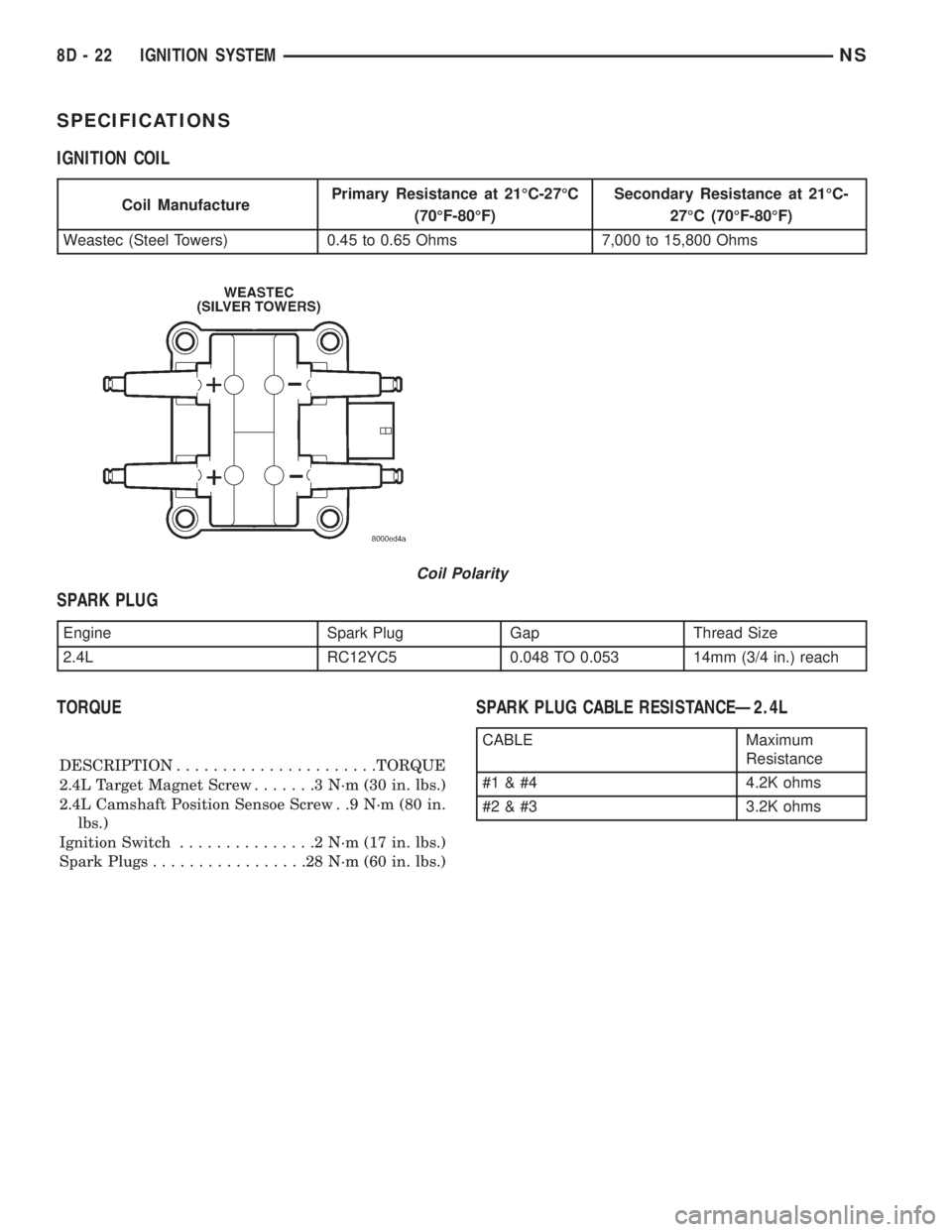
SPECIFICATIONS
IGNITION COIL
SPARK PLUG
TORQUE
DESCRIPTION......................TORQUE
2.4L Target Magnet Screw.......3N´m(30in.lbs.)
2.4L Camshaft Position Sensoe Screw . .9 N´m (80 in.
lbs.)
Ignition Switch...............2N´m(17in.lbs.)
Spark Plugs.................28N´m(60in.lbs.)
SPARK PLUG CABLE RESISTANCEÐ2.4L
Coil ManufacturePrimary Resistance at 21ÉC-27ÉC
(70ÉF-80ÉF)Secondary Resistance at 21ÉC-
27ÉC (70ÉF-80ÉF)
Weastec (Steel Towers) 0.45 to 0.65 Ohms 7,000 to 15,800 Ohms
Coil Polarity
Engine Spark Plug Gap Thread Size
2.4L RC12YC5 0.048 TO 0.053 14mm (3/4 in.) reach
CABLE Maximum
Resistance
#1 & #4 4.2K ohms
#2 & #3 3.2K ohms
8D - 22 IGNITION SYSTEMNS
Page 321 of 1938

3.0L ENGINE
INDEX
page page
DESCRIPTION AND OPERATION
CAMSHAFT POSITION SENSOR............ 23
FIRING ORDERÐ3.0L.................... 23
MANIFOLD ABSOLUTE PRESSURE (MAP)
SENSOR............................. 23
REMOVAL AND INSTALLATION
CRANKSHAFT POSITION SENSOR.......... 25
ENGINE COOLANT TEMPERATURE SENSORÐ
3.0L................................. 25
IGNITION COILÐ3.OL.................... 24
MANIFOLD ABSOLUTE PRESSURE (MAP)
SENSORÐ3.0L........................ 24SPARK PLUG SERVICE................... 24
THROTTLE POSITION SENSOR............ 25
DISASSEMBLY AND ASSEMBLY
DISTRIBUTORÐ3.0L..................... 26
CLEANING AND INSPECTION
DISTRIBUTOR CAP...................... 26
DISTRIBUTOR ROTORÐ3.0L............... 27
SPECIFICATIONS
SPARK PLUG CABLE RESISTANCEÐ3.0L..... 27
SPARK PLUG........................... 27
TORQUE.............................. 27
DESCRIPTION AND OPERATION
FIRING ORDERÐ3.0L
MANIFOLD ABSOLUTE PRESSURE (MAP) SENSOR
The MAP sensor reacts to absolute pressure in the
intake manifold and provides an input voltage to the
Powertrain Control Module (PCM). As engine load
changes, manifold pressure varies. The changes in
engine load cause the MAP sensors resistance to
change. The change in MAP sensor resistance results
in a different input voltage to the PCM.
The input voltage level supplies the PCM with
information relating to ambient barometric pressure
during engine start-up (cranking) and engine load
while its operating. Based on MAP sensor voltage
and inputs from other sensors, the PCM adjusts
spark advance and the air-fuel mixture.
CAMSHAFT POSITION SENSOR
The PCM determines fuel injection synchronization
and cylinder identification from inputs provided by
the camshaft position sensor and crankshaft position
sensor. From the two inputs, the PCM determines
crankshaft position.
The 3.0L engine is equipped with a camshaft
driven mechanical distributor, containing a shaft
driven distributor rotor. The distributor is also
equipped with an internal camshaft position (fuel
sync) sensor (Fig. 1). This sensor provides fuel injec-
tion synchronization and cylinder identification to
the PCM.
The camshaft position sensor contains a hall effect
device callled a sync signal generator. This sync sig-
nal generator detects a rotating pulse ring (shutter)
on the distributor shaft. The pulse ring rotates 180
through the sync signal generator. Its signal is used
in conjunction with the crankshaft position sensor to
differentiate between fuel injection and spark events.
It is also used to synchronize the fuel injectors with
their respective cylinders.
When the leading edge of the shutter enters the
sync signal generator, the interruption of magnetic
field causes the voltage to switch high. This causes a
sync signal of approximately 5 volts.
When the trailing edge of the shutter leaves the
sync signal generator, the change of magnetic field
causes the sync signal voltage to switch low to 0
volts.
Since the shutter rotates at half crankshaft speed,
it may take 1 engine revolution during cranking for
the PCM to determine the position of piston number
6.
SPARK PLUG WIRE ROUTINGÐ3.0L ENGINE
NSIGNITION SYSTEM 8D - 23
Page 322 of 1938

REMOVAL AND INSTALLATION
SPARK PLUG SERVICE
When replacing the spark plugs and spark plug
cables, route the cables correctly and secure them in
the appropriate retainers. Failure to route the cables
properly can cause the radio to reproduce ignition
noise, cross ignition of the spark plugs orshort cir-
cuit the cables to ground.
Never Wire Brush Spark Plugs.The spark plug
insulator tip is harder than the bristles of wire
brushes. Bristles of wire brushes can leave a conduc-
tive, metallic film on the insulator which could lead
to conductive deposits. Conductive deposits can cause
spark plug failure and engine misfire. Use a jewelers
file to remove deposits from the electrode gap or use
a spark plug cleaning machine to clean spark plugs.
REMOVAL
Always remove cables by grasping at the boot,
rotating the boot 1/2 turn, and pulling straight back
in a steady motion.
(1) Prior to removing the spark plug, spray com-
pressed air around the spark plug hole and the area
around the spark plug.
(2) Remove the spark plug using a quality socket
with a foam insert.
(3) Inspect the spark plug condition. Refer to
Spark Plug Condition in this section.
INSTALLATION
(1) To avoid cross threading, start the spark plug
into the cylinder head by hand.
(2) Tighten spark plugs to 28 N´m (20 ft. lbs.)
torque.
(3) Install spark plug cables over spark plugs. A
click will be heard and felt when the cable properly
attaches to the spark plug.
IGNITION COILÐ3.OL
The ignition coil is located at the back of the
intake manifold (Fig. 2).
REMOVAL
(1) Remove air cleaner assembly.
(2) Disconnect ignition cable from coil.
(3) Disconnect wiring harness connector from coil.
(4) Remove coil mounting screws.
INSTALLATION
(1) Loosely install ignition coil on intake manifold.
Tighten the intake manifold fastener to 13 N´m (115
in. lbs.) torque. Tighten ignition coil bracket fasten-
ers to 10 N´m (96 in. lbs.) torque.
(2) Connect the wiring harness connector.
(3) Connect the coil to distributor ignition cable.
(4) Install the air cleaner assembly. Tighten the
air cleaner fasteners to 25 N´m (225 in. lbs.) torque.
MANIFOLD ABSOLUTE PRESSURE (MAP)
SENSORÐ3.0L
REMOVAL
(1) Remove vacuum hose and mounting screws
from manifold absolute pressure (MAP) sensor (Fig.
3).
(2) Disconnect electrical connector from sensor.
Remove sensor.
Fig. 1 Camshaft Position SensorÐ3.0L Engine
Fig. 2 Ignition CoilÐ3.0L Engine
8D - 24 IGNITION SYSTEMNS
DESCRIPTION AND OPERATION (Continued)
Page 325 of 1938
When replacing the distributor cap, transfer spark
plug wires from the original cap to the new cap one
at a time. Ensure that each wire is installed into the
tower of the new cap that corresponds to its tower
position in the original cap. Fully seat the wires into
the towers. If necessary, refer to the engine firing
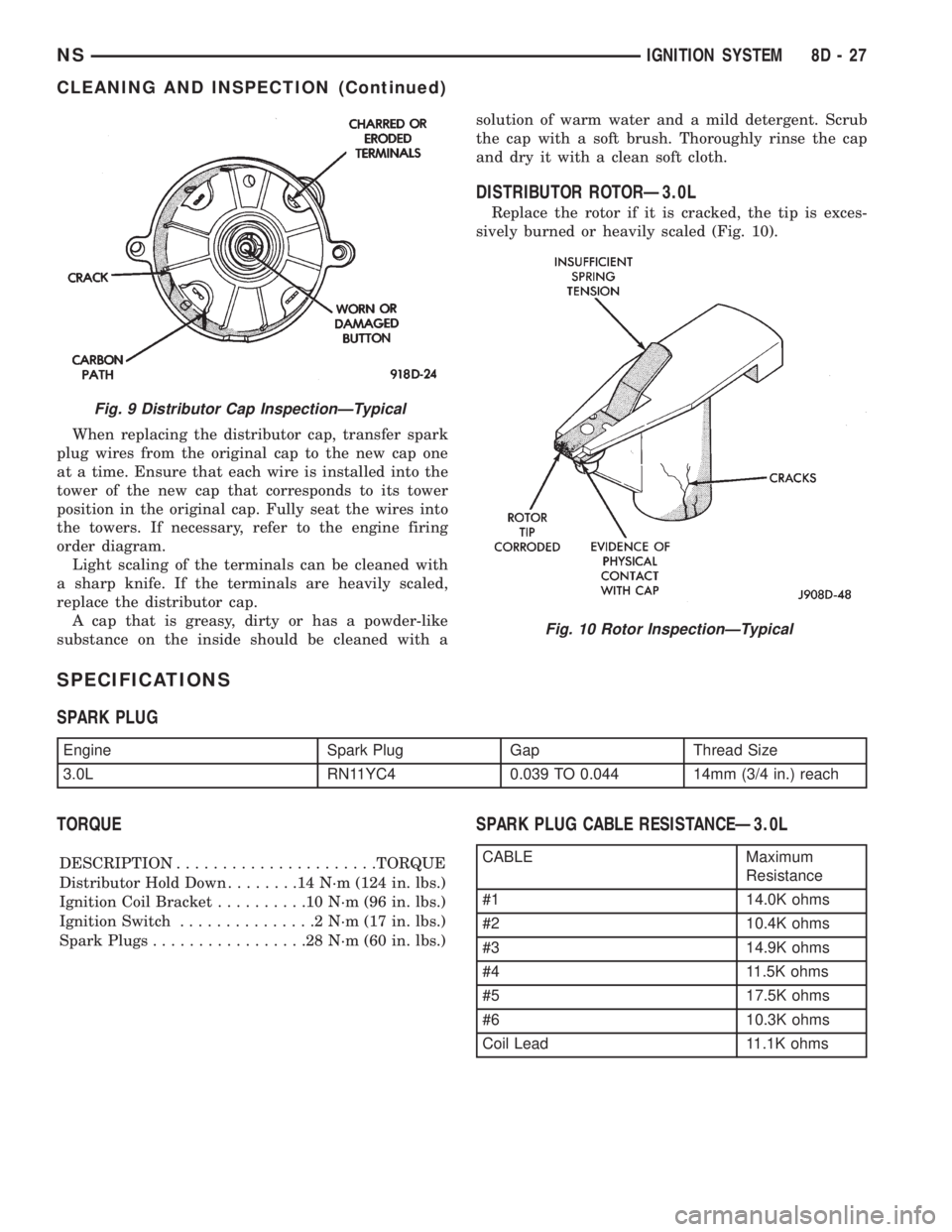
order diagram.
Light scaling of the terminals can be cleaned with
a sharp knife. If the terminals are heavily scaled,
replace the distributor cap.
A cap that is greasy, dirty or has a powder-like
substance on the inside should be cleaned with asolution of warm water and a mild detergent. Scrub
the cap with a soft brush. Thoroughly rinse the cap
and dry it with a clean soft cloth.
DISTRIBUTOR ROTORÐ3.0L
Replace the rotor if it is cracked, the tip is exces-
sively burned or heavily scaled (Fig. 10).
SPECIFICATIONS
SPARK PLUG
TORQUE
DESCRIPTION......................TORQUE
Distributor Hold Down........14N´m(124 in. lbs.)
Ignition Coil Bracket..........10N´m(96in.lbs.)
Ignition Switch...............2N´m(17in.lbs.)
Spark Plugs.................28N´m(60in.lbs.)
SPARK PLUG CABLE RESISTANCEÐ3.0L
Fig. 9 Distributor Cap InspectionÐTypical
Fig. 10 Rotor InspectionÐTypical
Engine Spark Plug Gap Thread Size
3.0L RN11YC4 0.039 TO 0.044 14mm (3/4 in.) reach
CABLE Maximum
Resistance
#1 14.0K ohms
#2 10.4K ohms
#3 14.9K ohms
#4 11.5K ohms
#5 17.5K ohms
#6 10.3K ohms
Coil Lead 11.1K ohms
NSIGNITION SYSTEM 8D - 27
CLEANING AND INSPECTION (Continued)
Page 326 of 1938
3.3/3.8L ENGINE
INDEX
page page
DESCRIPTION AND OPERATION
FIRING ORDERÐ3.3/3.8L................. 28
REMOVAL AND INSTALLATION
CAMSHAFT POSITION SENSOR............ 31
CRANKSHAFT POSITION SENSOR.......... 30
ENGINE COOLANT TEMPERATURE SENSOR . . 32
IGNITION COIL......................... 30
KNOCK SENSORÐ3.3/3.8L................ 32
MANIFOLD ABSOLUTE PRESSURE (MAP)
SENSOR............................. 32SPARK PLUG CABLE SERVICEÐ3.3/3.8L
ENGINES............................ 28
SPARK PLUG SERVICEÐ3.3/3.8L ENGINES . . . 29
THROTTLE POSITION SENSOR............ 32
SPECIFICATIONS
IGNITION COIL......................... 33
SPARK PLUG CABLE RESISTANCEÐ3.3/3.8L . . 34
SPARK PLUG........................... 33
TORQUE.............................. 34
DESCRIPTION AND OPERATION
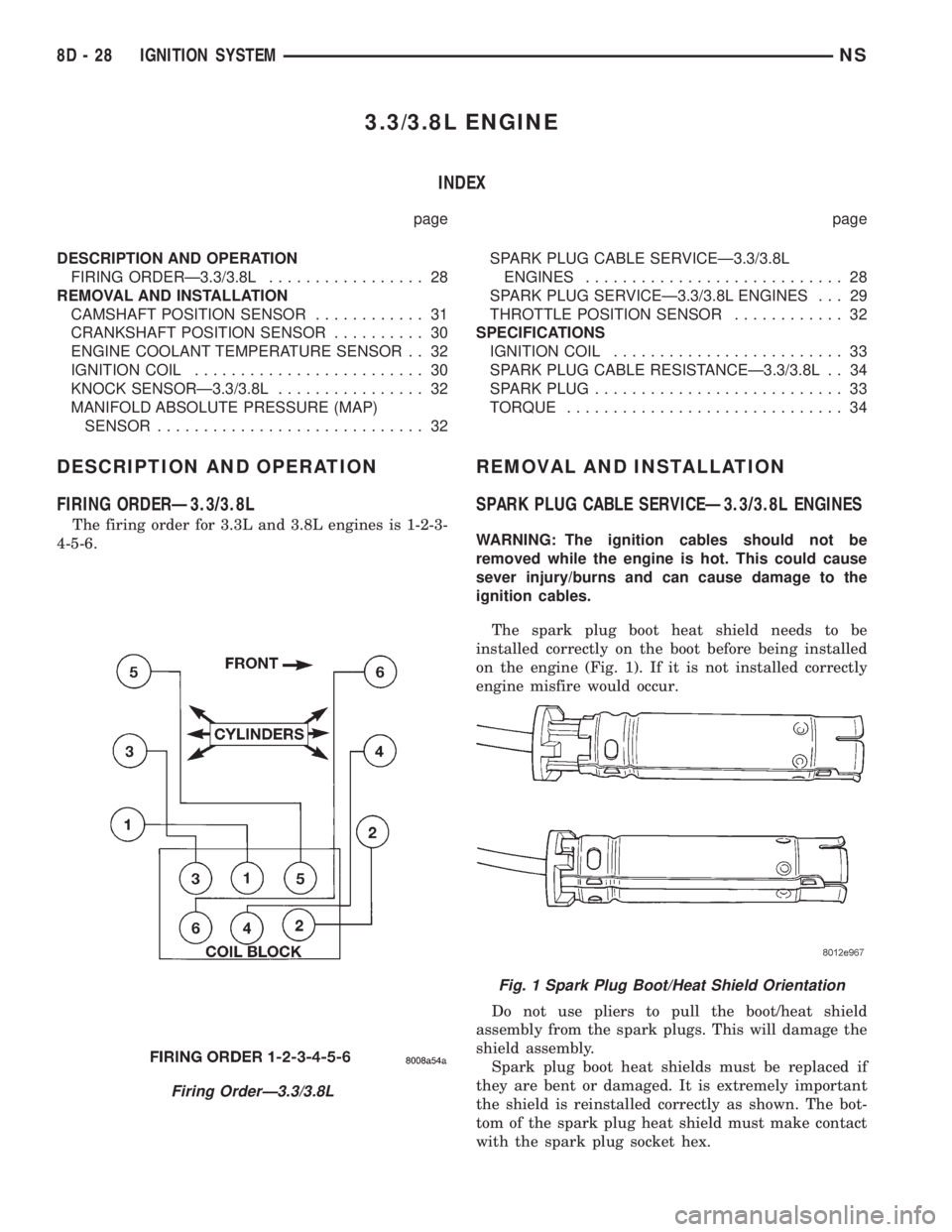
FIRING ORDERÐ3.3/3.8L
The firing order for 3.3L and 3.8L engines is 1-2-3-
4-5-6.
REMOVAL AND INSTALLATION
SPARK PLUG CABLE SERVICEÐ3.3/3.8L ENGINES
WARNING: The ignition cables should not be
removed while the engine is hot. This could cause
sever injury/burns and can cause damage to the
ignition cables.
The spark plug boot heat shield needs to be
installed correctly on the boot before being installed
on the engine (Fig. 1). If it is not installed correctly
engine misfire would occur.
Do not use pliers to pull the boot/heat shield
assembly from the spark plugs. This will damage the
shield assembly.
Spark plug boot heat shields must be replaced if
they are bent or damaged. It is extremely important
the shield is reinstalled correctly as shown. The bot-
tom of the spark plug heat shield must make contact
with the spark plug socket hex.
Firing OrderÐ3.3/3.8L
Fig. 1 Spark Plug Boot/Heat Shield Orientation
8D - 28 IGNITION SYSTEMNS
Page 327 of 1938
CAUTION: Never coat the inside of spark plug
boots with silicone grease. Some types of silicone
grease can damage the ignition cable conductor.
SPARK PLUG CABLES #3 AND #5
REMOVAL
(1) Remove the resonator.
(2) Grasp the spark plug boot/heat shield as close
as possible to the spark plug.Twist the boot
slightly to break its seal with the plug and pull
straight back. Do not use pliers, pull on the
ignition cable, or pull the spark plug boot at an
angle.This could damage the spark plug insulator,
terminal, or the cable insulation. Wipe spark plug
insulator clean with a dry cloth before installation.
(3) Remove the cable from the retaining bracket.
Make sure that they are also detached from the rear
retaining clip mounted on the rear of the intake
manifold.
INSTALLATION
(1) When installing the spark plug cables, make
sure the coil and spark plug insulator and terminals
are fully seated. Aclick sound should be heard or
terminal engagement is felt when the terminals
are properly attached.
(2) Install the cable into the retaining bracket.
Make sure that they are also attached to the rear
retaining clip mounted on the rear of the intake
manifold.
(3) Install the resonator.
SPARK PLUG CABLE #1
REMOVAL
(1) Remove the accessory drive belt, refer to Group
7, Cooling.
(2) Remove the four bolts from the upper half of
the generator bracket.
(3) Push the Generator rearward.
(4) Grasp the spark plug boot/shield assembly as
close as possible to the spark plug.Twist the boot
slightly to break its seal with the plug and pull
straight back. Do not use pliers, pull on the
ignition cable, or pull the spark plug boot at an
angle.This could damage the spark plug insulator,
terminal, or the cable insulation. Wipe spark plug
insulator clean with a dry cloth before installation.
(5) Remove the cable from the retaining bracket.
INSTALLATION
(1) When installing the spark plug cables, make
sure the coil and spark plug insulator and terminals
are fully seated. Aclick sound should be heard orterminal engagement is felt when the terminals
are properly attached.
(2) Rotate Generator back into place.
(3) Install upper Generator bracket with the four
bolts.
(4) Install the accessory drive belt, refer to Group
7, Cooling.
SPARK PLUG SERVICEÐ3.3/3.8L ENGINES
WARNING: The ignition cables should not be
removed while the engine is hot. This could cause
server injury/burns and can cause damage to the
ignition cables.
Use extreme care when removing and installing
the spark plug cables.
The spark plug boot heat shield needs to be
installed correctly on the boot before being installed
on the engine (Fig. 1). If it is not installed correctly
engine misfire would occur.
Do not use pliers to pull the boot/heat shield
assembly from the spark plugs. This will damage the
shield assembly.
SPARK PLUG #3 AND #5
REMOVAL
(1) Remove the resonator.
(2) Remove intake strut to cylinder head bolt at
cylinder head.
(3) Loosen bolt for intake strut at intake.
(4) Swing strut away.
(5) Grasp the spark plug boot/shield assembly as
close as possible to the spark plug.Twist the boot/
shield assembly slightly to break the seal with
the plug and pull straight out. Do not use pli-
ers, pull on the ignition cable, or pull the spark
plug boot at an angle.This could damage the
spark plug insulator, terminal, heat shield or the
insulation. Wipe spark plug insulator clean with a
dry cloth before installation.
(6) Remove spark plug
INSTALLATION
(1) Install spark plug and tighten to 28 N´m (20 ft.
lbs.).
(2) When installing the spark plug cables, make
sure spark plug insulator and terminals are fully
seated. Aclick sound should be heard or felt
when the terminals are properly attached.
(3) Install the cable into the retaining bracket.
Make sure that they are also attached to the rear
retaining clip mounted on the rear of the intake
manifold.
(4) Swing strut back into place.
NSIGNITION SYSTEM 8D - 29
REMOVAL AND INSTALLATION (Continued)
Page 329 of 1938

While holding the sensor in this position, and install
and tighten the retaining bolt to 11.9 N´m (105 in.
lbs.) torque.
(2) Raise and support vehicle.
(3) Connect crankshaft position sensor electrical
connector to the wiring harness connector.
CAMSHAFT POSITION SENSOR
REMOVAL
(1) Disconnect camshaft position sensor electrical
connector from the wiring harness connector (Fig. 5).
(2) Remove bolt holding sensor (Fig. 6).There is a
hole in the bracket for tool access to the sensor
bolt.
(3) Rotate sensor away from block (Fig. 7).
(4) Pull sensor up out of the chain case cover.Do
not pull on the sensor lead.There is an O-ring on
the sensor case. The O-ring may make removal diffi-
cult. A light tap to top of sensor prior to removal may
reduce force needed for removal.
INSTALLATION
If the removed sensor is reinstalled, clean off
the old spacer on the sensor face. A NEW
SPACER must be attached to the face beforeinstallation.Inspect O-ring for damage, replace if
necessary. If the sensor is being replaced, confirm
that the paper spacer is attached to the face and O-
ring is positioned in groove of the new sensor (Fig. 8).
(1) Apply a couple drops of clean engine oil to the
O-ring prior to installation.
(2) Install sensor in the chain case cover and
rotate into position.
(3) Push sensor down until contact is made with
the camshaft gear. While holding the sensor in this
position, install and tighten the retaining bolt 14
N´m (125 in. lbs.) torque.
(4) Connect camshaft position sensor electrical
connector to harness connector.
Fig. 4 Crankshaft Position Sensor and Spacer
Fig. 5 Camshaft Position Sensor
Fig. 6 Camshaft Sensor Bolt Removal/Installation
Fig. 7 Camshaft Sensor Removal/Installation
NSIGNITION SYSTEM 8D - 31
REMOVAL AND INSTALLATION (Continued)
Page 330 of 1938

MANIFOLD ABSOLUTE PRESSURE (MAP) SENSOR
REMOVAL
(1) Disconnect electrical connector from MAP sen-
sor.
(2) Remove 2 screws holding sensor to intake man-
ifold (Fig. 9).
(3) Remove sensor from manifold.
INSTALLATION
Reverse the above procedure for installation.
ENGINE COOLANT TEMPERATURE SENSOR
The Engine Coolant Temperature (ECT) sensor is
located below the ignition coil (Fig. 10).
REMOVAL
(1) Drain cooling system until coolant level is
below sensor. Refer to Group 7, Cooling System.
(2) Remove electrical connector from coil (Fig. 11).
(3) Remove coil mounting screws.
(4) Rotate coil away from engine coolant tempera-
ture sensor.
(5) Disconnect electrical connector from engine
coolant temperature sensor.
(6) Remove sensor from engine.
INSTALLATION
(1) Tighten the sensor to 7 N´m (60 in. lbs.) torque.
(2) Connect electrical connector to sensor.
(3) Fill cooling system. Refer to Group 7, Cooling
System.
(4) Install coil. Tighten coil mounting screws to 12
N´m (105 in. lbs.) torque.
(5) Connect electrical connector to coil.
THROTTLE POSITION SENSOR
Refer to Group 14, Fuel Injection Section, for
Removal/Installation.
KNOCK SENSORÐ3.3/3.8L
The knock sensor threads into the side of the cyl-
inder block in front of the starter (Fig. 12).
Fig. 8 Camshaft Position Sensor and Spacer
Fig. 9 Manifold Absolute Pressure Sensor
Fig. 10 Engine Coolant Temperature Sensor
Fig. 11 Ignition Coil Removal
8D - 32 IGNITION SYSTEMNS
REMOVAL AND INSTALLATION (Continued)
Page 332 of 1938

SPARK PLUG
* New Spark Plug Gap
TORQUE
DESCRIPTION......................TORQUE
3.3L Camshaft Position
Sensor Screw.............12N´m(105 in. lbs.)
3.3L Engine Coolant Sensor......7N´m(60in.lbs.)
3.3L Crankshaft Position
Sensor Screw.............12N´m(105 in. lbs.)
3.3/3.8L Ignition Coil.........12N´m(105 in. lbs.)
Ignition Switch...............2N´m(17in.lbs.)
Spark Plugs.................28N´m(20ft.lbs.)
SPARK PLUG CABLE RESISTANCEÐ3.3/3.8L
Engine Spark Plug Gap * Thread Size
3.3L RN14PMP5 0.048 TO 0.053 14mm (3/4 in.) reach
3.8L RN14PMP5 0.048 TO 0.053 14mm (3/4 in. ) reach
CABLE Maximum
Resistance
#1 18.5K ohms
#2 15.5K ohms
#3 20.4K ohms
#4 21.2K ohms
#5 27.7K ohms
#6 26.7K ohms
8D - 34 IGNITION SYSTEMNS
SPECIFICATIONS (Continued)
Page 477 of 1938
BULB APPLICATION
INDEX
page page
GENERAL INFORMATION
INTRODUCTION......................... 25SPECIFICATIONS
EXTERIOR LAMP BULBS.................. 25
INTERIOR LAMP BULBS.................. 25
GENERAL INFORMATION
INTRODUCTION
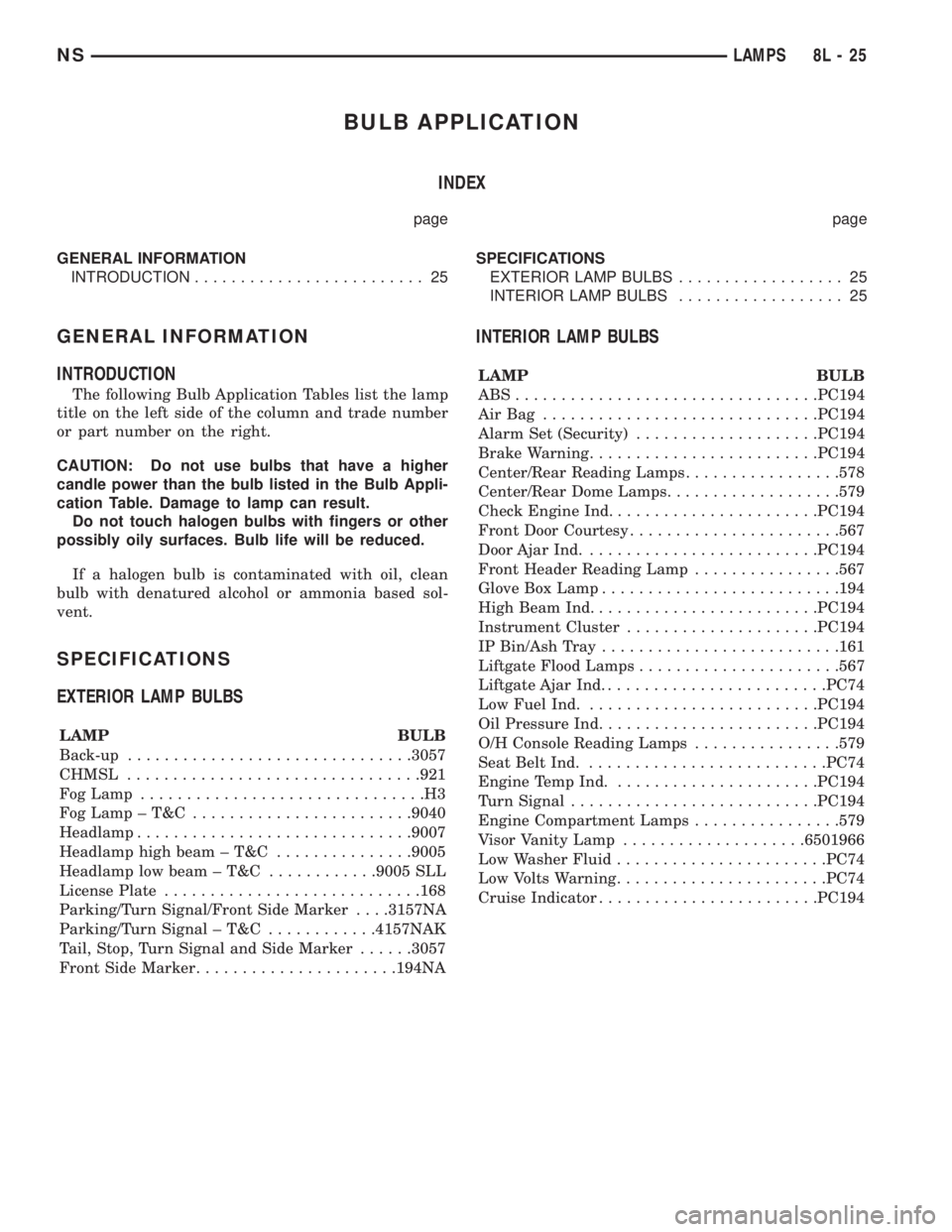
The following Bulb Application Tables list the lamp
title on the left side of the column and trade number
or part number on the right.
CAUTION: Do not use bulbs that have a higher
candle power than the bulb listed in the Bulb Appli-
cation Table. Damage to lamp can result.
Do not touch halogen bulbs with fingers or other
possibly oily surfaces. Bulb life will be reduced.
If a halogen bulb is contaminated with oil, clean
bulb with denatured alcohol or ammonia based sol-
vent.
SPECIFICATIONS
EXTERIOR LAMP BULBS
LAMP BULB
Back-up...............................3057
CHMSL................................921
Fog Lamp...............................H3
FogLamp±T&C ........................9040
Headlamp..............................9007
Headlamp high beam ± T&C...............9005
Headlamp low beam ± T&C............9005 SLL
License Plate............................168
Parking/Turn Signal/Front Side Marker. . . .3157NA
Parking/Turn Signal ± T&C............4157NAK
Tail, Stop, Turn Signal and Side Marker......3057
Front Side Marker......................194NA
INTERIOR LAMP BULBS
LAMP BULB
ABS.................................PC194
AirBag ..............................PC194
Alarm Set (Security)....................PC194
Brake Warning.........................PC194
Center/Rear Reading Lamps.................578
Center/Rear Dome Lamps...................579
Check Engine Ind.......................PC194
Front Door Courtesy.......................567
Door Ajar Ind..........................PC194
Front Header Reading Lamp................567
Glove Box Lamp..........................194
High Beam Ind.........................PC194
Instrument Cluster.....................PC194
IP Bin/Ash Tray..........................161
Liftgate Flood Lamps......................567
Liftgate Ajar Ind.........................PC74
Low Fuel Ind..........................PC194
Oil Pressure Ind........................PC194
O/H Console Reading Lamps................579
Seat Belt Ind...........................PC74
Engine Temp Ind.......................PC194
Turn Signal...........................PC194
Engine Compartment Lamps................579
Visor Vanity Lamp....................6501966
Low Washer Fluid.......................PC74
Low Volts Warning.......................PC74
Cruise Indicator........................PC194
NSLAMPS 8L - 25