ABS CHRYSLER VOYAGER 1996 Repair Manual
[x] Cancel search | Manufacturer: CHRYSLER, Model Year: 1996, Model line: VOYAGER, Model: CHRYSLER VOYAGER 1996Pages: 1938, PDF Size: 55.84 MB
Page 214 of 1938
ADJUSTMENTS
CLUTCH CABLE Ð LHD
The manual transaxle clutch release system has a
unique self-adjusting mechanism to compensate for
clutch disc wear. This adjuster mechanism is located
within the clutch cable assembly. The preload spring
maintains tension on the cable. This tension keeps
the clutch release bearing continuously loaded
against the fingers of the clutch cover assembly.
ADJUSTER MECHANISM FUNCTION CHECK Ð
LHD
(1) With slight pressure, pull the clutch release
lever end of the cable to draw the cable taut. Push
the clutch cable housing toward the dash panel (With
less than 20 lbs. of effort, the cable housing should
move 30-50mm.). This indicates proper adjuster
mechanism function. If the cable does not adjust,
determine if the mechanism is properly seated on the
bracket.
(2) If the adjust mechanism functions properly,
route cable to the transaxle.
(3) Insert cable into transaxle and through clutch
release lever. Ensure the cable is routed through the
smaller hole in the transaxle deck (Fig. 10).
(4) Pull down on cable and insert cable retaining
clip onto clutch cable end.
(5) Check clutch pedal position switch operation.
CLUTCH PEDAL POSITION SWITCH
The clutch pedal position switch is mounted to a
bracket located behind the clutch pedal. The switch
is held in place by four plastic wing tabs.
The clutch pedal position switch IS NOT adjust-
able. The pedal blade contacts the switch in the down
position.
SPECIFICATIONS
CLUTCH TIGHTENING REFERENCE
2.0/2.4 LITER GASOLINE ENGINE
DESCRIPTION TORQUE
Drive Plate Bolts............95N´m(70ft.lbs.)
Lower Trans. Cover.........12N´m(105 in. lbs.)
Modular Clutch Bolts.........74N´m(55ft.lbs.)
Upper Trans. Cover.........12N´m(105 in. lbs.)
2.5 LITER DIESEL ENGINE
DESCRIPTION TORQUE
Flywheel Bolts..............95N´m(70ft.lbs.)
Lower Trans. Cover.........12N´m(105 in. lbs.)
Clutch Pressure Plate Bolts....27N´m(20ft.lbs.)
Upper Trans. Cover.........12N´m(105 in. lbs.)
6 - 16 CLUTCHNS/GS
Page 248 of 1938
(3) Remove power steering pump bracket bolts and
set pump and bracket assembly aside. Power steering
lines do not need to be disconnected.
(4) Remove timing belt.
(5) Remove inner timing belt cover.
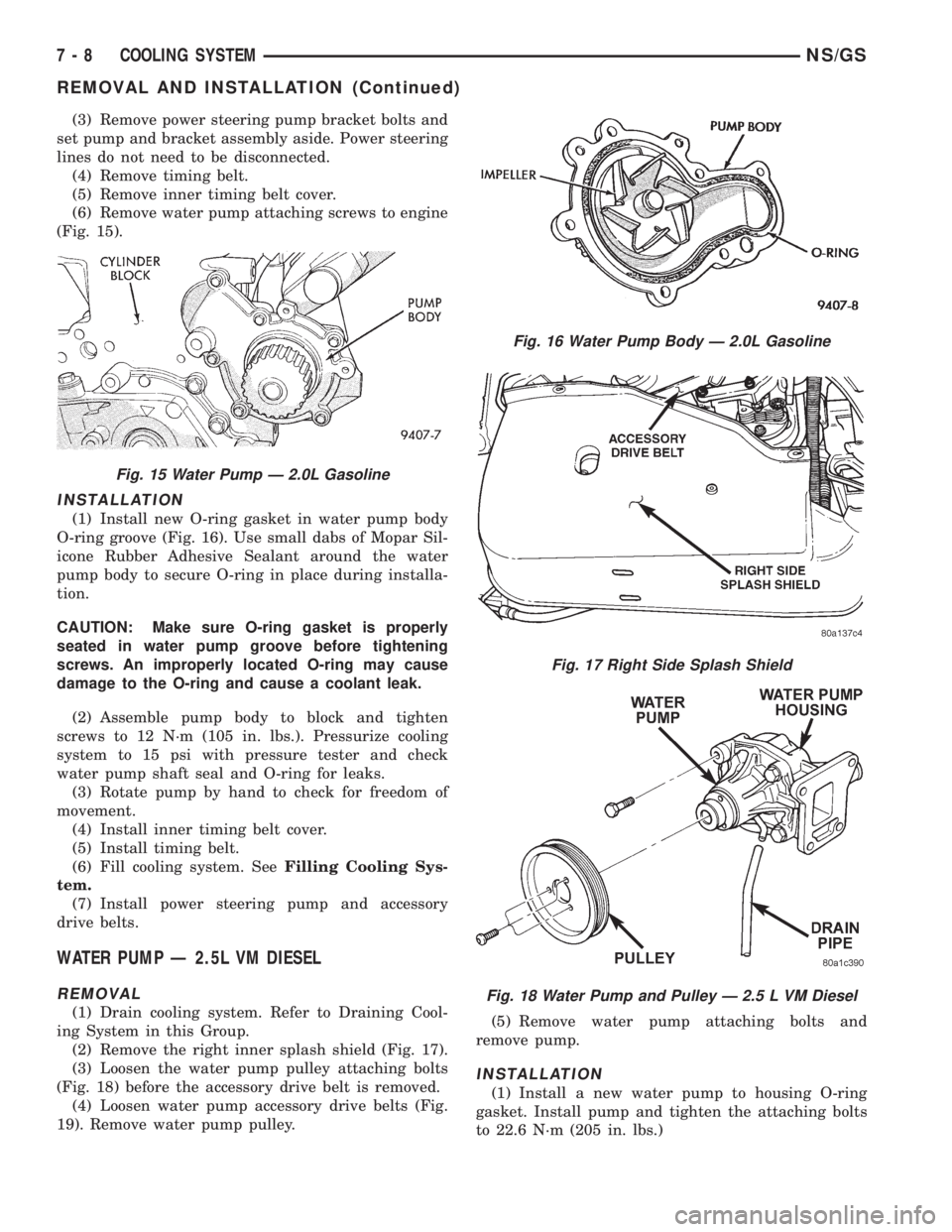
(6) Remove water pump attaching screws to engine
(Fig. 15).
INSTALLATION
(1) Install new O-ring gasket in water pump body
O-ring groove (Fig. 16). Use small dabs of Mopar Sil-
icone Rubber Adhesive Sealant around the water
pump body to secure O-ring in place during installa-
tion.
CAUTION: Make sure O-ring gasket is properly
seated in water pump groove before tightening
screws. An improperly located O-ring may cause
damage to the O-ring and cause a coolant leak.
(2) Assemble pump body to block and tighten
screws to 12 N´m (105 in. lbs.). Pressurize cooling
system to 15 psi with pressure tester and check
water pump shaft seal and O-ring for leaks.
(3) Rotate pump by hand to check for freedom of
movement.
(4) Install inner timing belt cover.
(5) Install timing belt.
(6) Fill cooling system. SeeFilling Cooling Sys-
tem.
(7) Install power steering pump and accessory
drive belts.
WATER PUMP Ð 2.5L VM DIESEL
REMOVAL
(1) Drain cooling system. Refer to Draining Cool-
ing System in this Group.
(2) Remove the right inner splash shield (Fig. 17).
(3) Loosen the water pump pulley attaching bolts
(Fig. 18) before the accessory drive belt is removed.
(4) Loosen water pump accessory drive belts (Fig.
19). Remove water pump pulley.(5) Remove water pump attaching bolts and
remove pump.
INSTALLATION
(1) Install a new water pump to housing O-ring
gasket. Install pump and tighten the attaching bolts
to 22.6 N´m (205 in. lbs.)
Fig. 15 Water Pump Ð 2.0L Gasoline
Fig. 16 Water Pump Body Ð 2.0L Gasoline
Fig. 17 Right Side Splash Shield
Fig. 18 Water Pump and Pulley Ð 2.5 L VM Diesel
7 - 8 COOLING SYSTEMNS/GS
REMOVAL AND INSTALLATION (Continued)
Page 299 of 1938

IGNITION SYSTEM
CONTENTS
page page
GENERAL INFORMATION................... 1
2.4L ENGINE............................ 16
3.0L ENGINE............................ 233.3/3.8L ENGINE........................ 28
IGNITION SWITCH AND LOCK CYLINDER..... 35
GENERAL INFORMATION
INDEX
page page
GENERAL INFORMATION
AUTOMATIC SHUTDOWN (ASD) RELAY....... 4
CAMSHAFT POSITION SENSOR............. 5
CRANKSHAFT POSITION SENSOR........... 5
ENGINE COOLANT TEMPERATURE (ECT)
SENSOR.............................. 6
IGNITION COIL.......................... 4
IGNITION SYSTEM....................... 2
INTRODUCTION......................... 1
KNOCK SENSOR......................... 7
LOCK KEY CYLINDER..................... 7
MANIFOLD ABSOLUTE PRESSURE (MAP)
SENSOR.............................. 6
POWERTRAIN CONTROL MODULE........... 1
SPARK PLUG CABLE...................... 3
SPARK PLUGSÐ2.4/3.0L................... 2
SPARK PLUGSÐ3.3/3.8L................... 2
THROTTLE POSITION SENSOR (TPS)........ 7DIAGNOSIS AND TESTING
CAMSHAFT POSITION SENSOR AND
CRANKSHAFT POSITION SENSOR......... 11
CHECK COIL TESTÐ2.4L.................. 9
CHECK COIL TESTÐ3.3/3.8L................ 9
ENGINE COOLANT TEMPERATURE SENSOR . . 11
FAILURE TO START TEST................. 10
IGNITION TIMING PROCEDURE............ 11
INTAKE AIR TEMPERATURE SENSOR........ 11
MANIFOLD ABSOLUTE PRESSURE (MAP)
SENSOR TEST........................ 11
SPARK PLUG CONDITION................. 11
TESTING FOR SPARK AT COILÐ2.4/3.3/3.8L
ENGINES............................. 8
TESTING FOR SPARK AT COILÐ3.0L......... 8
THROTTLE POSITION SENSOR............ 13
SERVICE PROCEDURES
IGNITION TIMING PROCEDURE............ 15
POWERTRAIN CONTROL MODULE.......... 13
SPARK PLUG GAP ADJUSTMENT........... 13
GENERAL INFORMATION
INTRODUCTION
This group describes the ignition systems for the
2.4, 3.0, and 3.3/3.8L engines.
On Board Diagnostics is described in Group 25 -
Emission Control Systems.
Group 0 - Lubrication and Maintenance, contains
general maintenance information for ignition related
items. The Owner's Manual also contains mainte-
nance information.
POWERTRAIN CONTROL MODULE
The ignition system is regulated by the Powertrain
Control Module (PCM) (Fig. 1). The PCM supplies
battery voltage to the ignition coil through the Auto
Shutdown (ASD) Relay. The PCM also controls
ground circuit for the ignition coil. By switching the
ground path for the coil on and off, the PCM adjusts
ignition timing to meet changing engine operating
conditions.
During the crank-start period the PCM advances
ignition timing a set amount. During engine opera-
tion, the amount of spark advance provided by the
PCM is determined by the following input factors:
NSIGNITION SYSTEM 8D - 1
Page 302 of 1938
Clean Spark Plug cables with a cloth moistened
with a non-flammable solvent. Wipe the cables dry.
Check for brittle or cracked insulation.
SPARK PLUG CABLESÐ3.3/3.8L
The spark plug cables and spark plug boots are
made from high temperature silicone materials. The
spark plug boots utilize metal heat shields for ther-
mal protection from the exhaust manifold. The heat
shields slide over the spark plug boots. The notches
on the heat shields ensure the spark plug boot and
shield twist together during spark plug boot removal.
They also identify proper heat shield installation on
the boot for service.Refer to 3.3/3.8L Spark Plug
Cable removal and installation.All spark plug
cable leads are properly identified with cylinder num-
bers. The inside of the spark plug boot is coated with
a special high temperature silicone grease for greater
sealing and to minimize boot bonding to the spark
plug insulator. The convoluted tubing on the rear
plug cables are made of a high temperature plastic
material. Under normal driving conditions, the spark
plug cables have a recommended service life of a
100,000 miles. The spark plugs have a recommended
service life of 75,000 miles for severe driving condi-
tions per schedule B in this manual.
The spark plug heat shield can be reused if an
ignition cable is replaced due to failure. Never reuse
heat shield's that have heat shield anti-twist, side or
spark plug attachment tabs bent or missing. Ensure
that the heat shield is properly attached to the spark
plug to avoid RFI problems. The bottom of the spark
plug heat shield must make contact with the spark
plug hex.
The front ignition cables must not make contact
with the oil dip stick tube and #5 cable must not
touch the coil mounting bolt to avoid abrasion/dielec-
tric failures.
IGNITION COIL
WARNING: THE DIRECT IGNITION SYSTEM GEN-
ERATES APPROXIMATELY 40,000 VOLTS. PER-
SONAL INJURY COULD RESULT FROM CONTACT
WITH THIS SYSTEM.
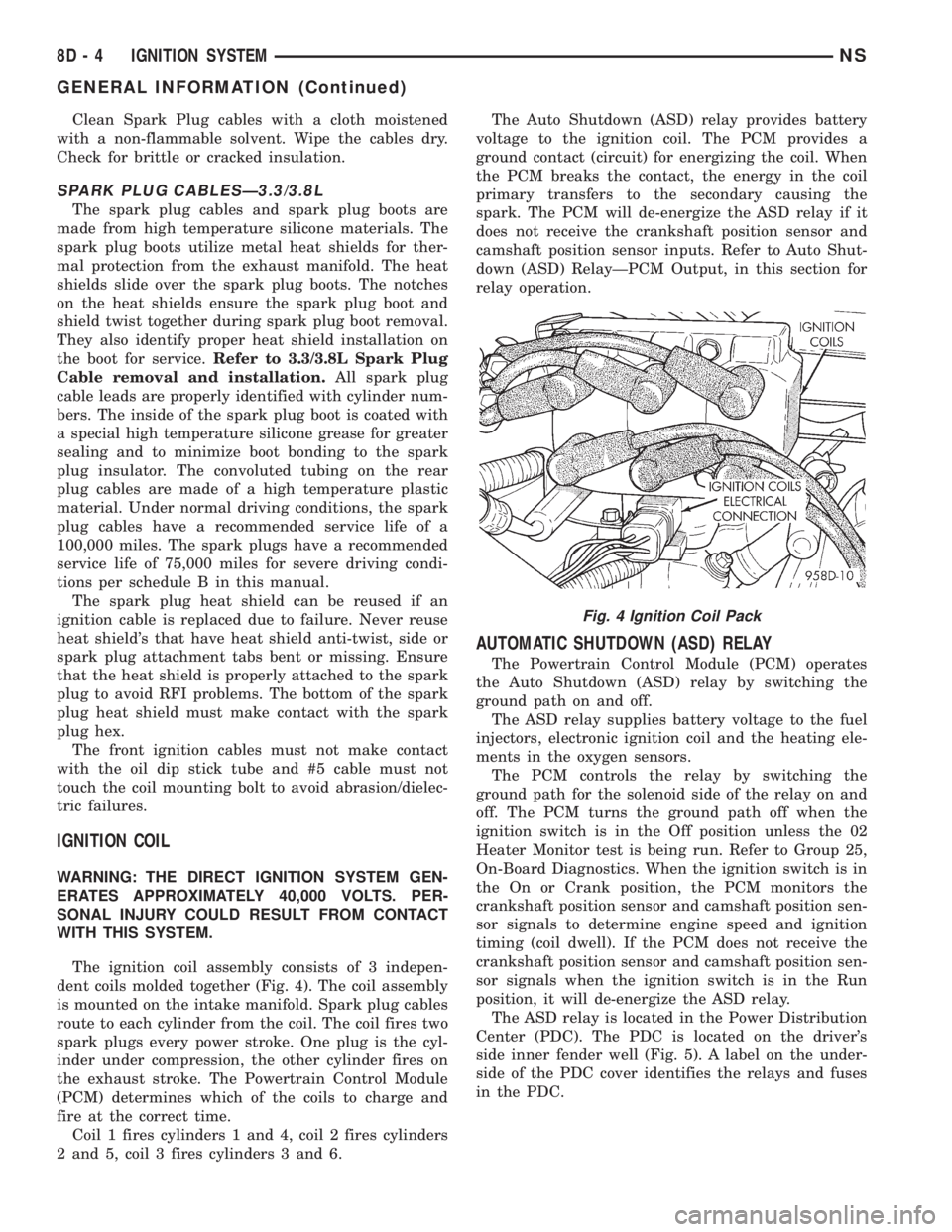
The ignition coil assembly consists of 3 indepen-
dent coils molded together (Fig. 4). The coil assembly
is mounted on the intake manifold. Spark plug cables
route to each cylinder from the coil. The coil fires two
spark plugs every power stroke. One plug is the cyl-
inder under compression, the other cylinder fires on
the exhaust stroke. The Powertrain Control Module
(PCM) determines which of the coils to charge and
fire at the correct time.
Coil 1 fires cylinders 1 and 4, coil 2 fires cylinders
2 and 5, coil 3 fires cylinders 3 and 6.The Auto Shutdown (ASD) relay provides battery
voltage to the ignition coil. The PCM provides a
ground contact (circuit) for energizing the coil. When
the PCM breaks the contact, the energy in the coil
primary transfers to the secondary causing the
spark. The PCM will de-energize the ASD relay if it
does not receive the crankshaft position sensor and
camshaft position sensor inputs. Refer to Auto Shut-
down (ASD) RelayÐPCM Output, in this section for
relay operation.
AUTOMATIC SHUTDOWN (ASD) RELAY
The Powertrain Control Module (PCM) operates
the Auto Shutdown (ASD) relay by switching the
ground path on and off.
The ASD relay supplies battery voltage to the fuel
injectors, electronic ignition coil and the heating ele-
ments in the oxygen sensors.
The PCM controls the relay by switching the
ground path for the solenoid side of the relay on and
off. The PCM turns the ground path off when the
ignition switch is in the Off position unless the 02
Heater Monitor test is being run. Refer to Group 25,
On-Board Diagnostics. When the ignition switch is in
the On or Crank position, the PCM monitors the
crankshaft position sensor and camshaft position sen-
sor signals to determine engine speed and ignition
timing (coil dwell). If the PCM does not receive the
crankshaft position sensor and camshaft position sen-
sor signals when the ignition switch is in the Run
position, it will de-energize the ASD relay.
The ASD relay is located in the Power Distribution
Center (PDC). The PDC is located on the driver's
side inner fender well (Fig. 5). A label on the under-
side of the PDC cover identifies the relays and fuses
in the PDC.
Fig. 4 Ignition Coil Pack
8D - 4 IGNITION SYSTEMNS
GENERAL INFORMATION (Continued)
Page 304 of 1938

cylinder 4 crankshaft timing marks follow. One cam-
shaft pulse after the 3 pulses indicates cylinder 5.
The 2 camshaft pulses after cylinder 5 signals cylin-
der 6 (Fig. 10). The PCM can synchronize on cylin-
ders1or4.
When metal aligns with the sensor, voltage goes
low (less than 0.3 volts). When a notch aligns with
the sensor, voltage switches high (5.0 volts). As a
group of notches pass under the sensor, the voltage
switches from low (metal) to high (notch) then back
to low. The number of notches determine the amount
of pulses. If available, an oscilloscope can display the
square wave patterns of each timing event.
Top Dead Center (TDC) does not occur when
notches on the camshaft sprocket pass below the cyl-
inder. TDC occurs after the camshaft pulse (or
pulses) and after the 4 crankshaft pulses associated
with the particular cylinder. The arrows and cylinder
call outs on Figure 4 represent which cylinder the
flat spot and notches identify, they do not indicate
TDC position.
The camshaft position sensor is mounted in the
front of the timing case cover (Fig. 11).
MANIFOLD ABSOLUTE PRESSURE (MAP) SENSOR
The MAP sensor reacts to absolute pressure in the
intake manifold and provides an input voltage to the
Powertrain Control Module (PCM). As engine load
changes, manifold pressure varies. The changes in
engine load cause the MAP sensors resistance to
change. The change in MAP sensor resistance results
in a different input voltage to the PCM.
The input voltage level supplies the PCM with
information relating to ambient barometric pressure
during engine start-up (cranking) and engine load
while its operating. Based on MAP sensor voltage
and inputs from other sensors, the PCM adjusts
spark advance and the air-fuel mixture.
ENGINE COOLANT TEMPERATURE (ECT) SENSOR
The ECT sensor is located next to the thermostat
housing (Fig. 12). The sensor provides an input volt-
age to the Powertrain Control Module (PCM). Thesensor is a variable resistance (thermistor) with a
range of -40ÉF to 265ÉF. As coolant temperature var-
ies, the sensors resistance changes, resulting in a dif-
ferent input voltage to the PCM.
The PCM contains different spark advance sched-
ules for cold and warm engine operation. The sched-
ules reduce engine emission and improve driveability.
When the engine is cold, the PCM will demand
slightly richer air-fuel mixtures and higher idle
speeds until normal operating temperatures are
reached.
The ECT sensor input is also used for cooling fan
control.
Fig. 9 Camshaft Position Sensor
Fig. 10 Camshaft Sprocket
Fig. 11 Camshaft Position Sensor Location
8D - 6 IGNITION SYSTEMNS
GENERAL INFORMATION (Continued)
Page 309 of 1938
either the crankshaft position sensor/camshaft posi-
tion sensor 8 volt supply circuit, or the camshaft
position sensor output or ground circuits. Use the
DRB scan tool to test the camshaft position sensor
and the sensor circuits. Refer to the appropriate Pow-
ertrain Diagnostics Procedure Manual. Refer to the
wiring diagrams section for circuit information.
IGNITION TIMING PROCEDURE
The engines for this vehicle, use a fixed ignition
system. The PCM regulates ignition timing. Basic
ignition timing is not adjustable.
MANIFOLD ABSOLUTE PRESSURE (MAP) SENSOR
TEST
Refer to Group 14, Fuel System for Diagnosis and
Testing.
CAMSHAFT POSITION SENSOR AND CRANKSHAFT
POSITION SENSOR
The output voltage of a properly operating cam-
shaft position sensor or crankshaft position sensor
switches from high (5.0 volts) to low (0.3 volts). By
connecting an Moper Diagonostic System (MDS) and
engine analyzer to the vehicle, technicians can view
the square wave pattern.
ENGINE COOLANT TEMPERATURE SENSOR
Refer to Group 14, Fuel System for Diagnosis and
Testing.
INTAKE AIR TEMPERATURE SENSOR
Refer to Group 14, Fuel System, for Diagnosis and
Testing.
SPARK PLUG CONDITION
NORMAL OPERATING CONDITIONS
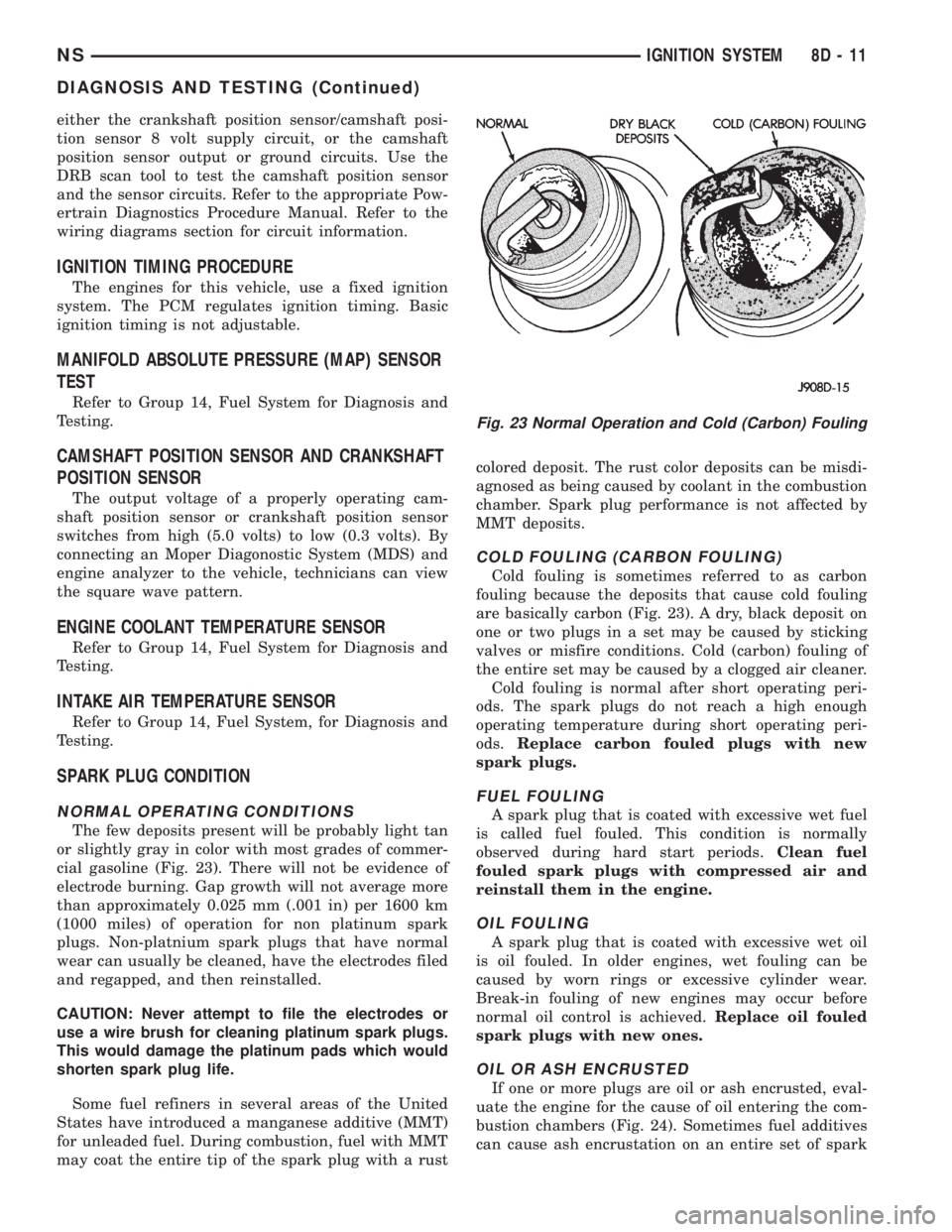
The few deposits present will be probably light tan
or slightly gray in color with most grades of commer-
cial gasoline (Fig. 23). There will not be evidence of
electrode burning. Gap growth will not average more
than approximately 0.025 mm (.001 in) per 1600 km
(1000 miles) of operation for non platinum spark
plugs. Non-platnium spark plugs that have normal
wear can usually be cleaned, have the electrodes filed
and regapped, and then reinstalled.
CAUTION: Never attempt to file the electrodes or
use a wire brush for cleaning platinum spark plugs.
This would damage the platinum pads which would
shorten spark plug life.
Some fuel refiners in several areas of the United
States have introduced a manganese additive (MMT)
for unleaded fuel. During combustion, fuel with MMT
may coat the entire tip of the spark plug with a rustcolored deposit. The rust color deposits can be misdi-
agnosed as being caused by coolant in the combustion
chamber. Spark plug performance is not affected by
MMT deposits.
COLD FOULING (CARBON FOULING)
Cold fouling is sometimes referred to as carbon
fouling because the deposits that cause cold fouling
are basically carbon (Fig. 23). A dry, black deposit on
one or two plugs in a set may be caused by sticking
valves or misfire conditions. Cold (carbon) fouling of
the entire set may be caused by a clogged air cleaner.
Cold fouling is normal after short operating peri-
ods. The spark plugs do not reach a high enough
operating temperature during short operating peri-
ods.Replace carbon fouled plugs with new
spark plugs.
FUEL FOULING
A spark plug that is coated with excessive wet fuel
is called fuel fouled. This condition is normally
observed during hard start periods.Clean fuel
fouled spark plugs with compressed air and
reinstall them in the engine.
OIL FOULING
A spark plug that is coated with excessive wet oil
is oil fouled. In older engines, wet fouling can be
caused by worn rings or excessive cylinder wear.
Break-in fouling of new engines may occur before
normal oil control is achieved.Replace oil fouled
spark plugs with new ones.
OIL OR ASH ENCRUSTED
If one or more plugs are oil or ash encrusted, eval-
uate the engine for the cause of oil entering the com-
bustion chambers (Fig. 24). Sometimes fuel additives
can cause ash encrustation on an entire set of spark
Fig. 23 Normal Operation and Cold (Carbon) Fouling
NSIGNITION SYSTEM 8D - 11
DIAGNOSIS AND TESTING (Continued)
Page 312 of 1938

(7) Pull PDC rearward to remove from front
bracket. Lay PDC aside to allow access to Powertrain
Control Module (PCM).
(8) Squeeze tabs on 40-way connector. Pull connec-
tor rearward to remove from PCM (Fig. 35). Remove
both way connectors.
(9) Remove 3 screws holding PCM to fender (Fig.
36).
(10) Remove PCM from vehicle.INSTALLATION
(1) Connect 2 40-Way electrical connectors to PCM
(Fig. 35).
(2) Install PCM. Tighten mounting screws.
(3) Install PDC bracket.
(4) Install battery.
Fig. 30 Setting Spark Plug Electrode GapÐTypical
Fig. 31 Power Distribution Center Retaining Screws
Fig. 32 Battery Heat Shield
Fig. 33 Battery Clamp
8D - 14 IGNITION SYSTEMNS
SERVICE PROCEDURES (Continued)
Page 314 of 1938
2.4L ENGINE
INDEX
page page
DESCRIPTION AND OPERATION
CAMSHAFT POSITION SENSOR............ 17
CRANKSHAFT POSITION SENSOR.......... 16
FIRING ORDERÐ2.4L.................... 16
INTAKE AIR TEMPERATURE SENSORÐ2.4L . . . 17
REMOVAL AND INSTALLATION
CAMSHAFT POSITION SENSOR............ 19
CRANKSHAFT POSITION SENSOR.......... 19
ENGINE COOLANT TEMPERATURE SENSORÐ
2.4L................................. 20
IGNITION COILÐ2.4L..................... 18
INTAKE AIR TEMPERATURE SENSORÐ2.4L . . . 21KNOCK SENSORÐ2.4L................... 21
MANIFOLD ABSOLUTE PRESSURE (MAP)
SENSORÐ2.4/3.3/3.8L.................. 20
SPARK PLUG CABLE SERVICEÐ2.4L........ 18
SPARK PLUG SERVICE................... 18
THROTTLE POSITION SENSOR............ 20
SPECIFICATIONS
IGNITION COIL......................... 22
SPARK PLUG CABLE RESISTANCEÐ2.4L..... 22
SPARK PLUG........................... 22
TORQUE.............................. 22
DESCRIPTION AND OPERATION
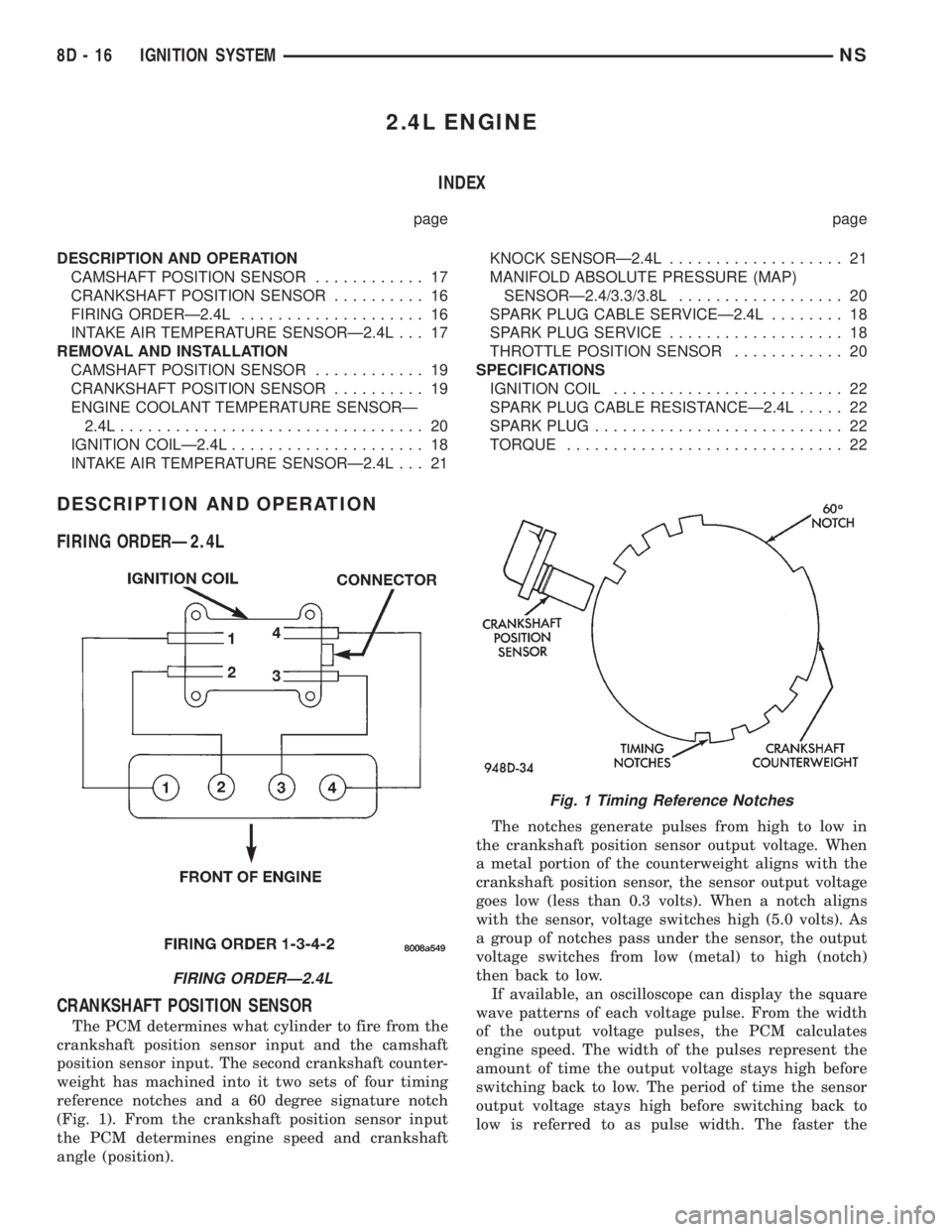
FIRING ORDERÐ2.4L
CRANKSHAFT POSITION SENSOR
The PCM determines what cylinder to fire from the
crankshaft position sensor input and the camshaft
position sensor input. The second crankshaft counter-
weight has machined into it two sets of four timing
reference notches and a 60 degree signature notch
(Fig. 1). From the crankshaft position sensor input
the PCM determines engine speed and crankshaft
angle (position).The notches generate pulses from high to low in
the crankshaft position sensor output voltage. When
a metal portion of the counterweight aligns with the
crankshaft position sensor, the sensor output voltage
goes low (less than 0.3 volts). When a notch aligns
with the sensor, voltage switches high (5.0 volts). As
a group of notches pass under the sensor, the output
voltage switches from low (metal) to high (notch)
then back to low.
If available, an oscilloscope can display the square
wave patterns of each voltage pulse. From the width
of the output voltage pulses, the PCM calculates
engine speed. The width of the pulses represent the
amount of time the output voltage stays high before
switching back to low. The period of time the sensor
output voltage stays high before switching back to
low is referred to as pulse width. The faster the
FIRING ORDERÐ2.4L
Fig. 1 Timing Reference Notches
8D - 16 IGNITION SYSTEMNS
Page 318 of 1938

(1) Install target magnet in end of camshaft.
Tighten mounting screw to 5.65 N´m (50 in. lbs.)
torque.
(2) Install a new O-ring on sensor.
(3) Install camshaft position sensor. Tighten sensor
mounting screws to 9.6 N´m (85 in. lbs.) torque.
(4) Attach engine harness connector to camshaft
position sensor.
(5) Install air cleaner inlet tube and filtered air
tube.
MANIFOLD ABSOLUTE PRESSURE (MAP)
SENSORÐ2.4/3.3/3.8L
REMOVAL
(1) Disconnect electrical connector from MAP sen-
sor (Fig. 12).
(2) Remove two screws holding sensor to the
intake manifold.
INSTALLATION
(1) Reverse the above procedure for installation.
THROTTLE POSITION SENSOR
Refer to Group 14, Fuel Injection Section, for
Removal/Installation.
ENGINE COOLANT TEMPERATURE SENSORÐ2.4L
The coolant sensor threads into the top of the ther-
mostat housing (Fig. 13). New sensors have sealant
applied to the threads.
WARNING: HOT, PRESSURIZED COOLANT CAN
CAUSE INJURY BY SCALDING. COOLING SYSTEM
MUST BE PARTIALLY DRAINED BEFORE REMOV-
ING THE COOLANT TEMPERATURE SENSOR.
REFER TO GROUP 7- COOLING.
Fig. 10 Target Magnet
Fig. 11 Target Magnet Installation
Fig. 12 Map Absolute Pressure Sensor
Fig. 13 Engine Coolant Temperature SensorÐ2.4L
8D - 20 IGNITION SYSTEMNS
REMOVAL AND INSTALLATION (Continued)
Page 321 of 1938

3.0L ENGINE
INDEX
page page
DESCRIPTION AND OPERATION
CAMSHAFT POSITION SENSOR............ 23
FIRING ORDERÐ3.0L.................... 23
MANIFOLD ABSOLUTE PRESSURE (MAP)
SENSOR............................. 23
REMOVAL AND INSTALLATION
CRANKSHAFT POSITION SENSOR.......... 25
ENGINE COOLANT TEMPERATURE SENSORÐ
3.0L................................. 25
IGNITION COILÐ3.OL.................... 24
MANIFOLD ABSOLUTE PRESSURE (MAP)
SENSORÐ3.0L........................ 24SPARK PLUG SERVICE................... 24
THROTTLE POSITION SENSOR............ 25
DISASSEMBLY AND ASSEMBLY
DISTRIBUTORÐ3.0L..................... 26
CLEANING AND INSPECTION
DISTRIBUTOR CAP...................... 26
DISTRIBUTOR ROTORÐ3.0L............... 27
SPECIFICATIONS
SPARK PLUG CABLE RESISTANCEÐ3.0L..... 27
SPARK PLUG........................... 27
TORQUE.............................. 27
DESCRIPTION AND OPERATION
FIRING ORDERÐ3.0L
MANIFOLD ABSOLUTE PRESSURE (MAP) SENSOR
The MAP sensor reacts to absolute pressure in the
intake manifold and provides an input voltage to the
Powertrain Control Module (PCM). As engine load
changes, manifold pressure varies. The changes in
engine load cause the MAP sensors resistance to
change. The change in MAP sensor resistance results
in a different input voltage to the PCM.
The input voltage level supplies the PCM with
information relating to ambient barometric pressure
during engine start-up (cranking) and engine load
while its operating. Based on MAP sensor voltage
and inputs from other sensors, the PCM adjusts
spark advance and the air-fuel mixture.
CAMSHAFT POSITION SENSOR
The PCM determines fuel injection synchronization
and cylinder identification from inputs provided by
the camshaft position sensor and crankshaft position
sensor. From the two inputs, the PCM determines
crankshaft position.
The 3.0L engine is equipped with a camshaft
driven mechanical distributor, containing a shaft
driven distributor rotor. The distributor is also
equipped with an internal camshaft position (fuel
sync) sensor (Fig. 1). This sensor provides fuel injec-
tion synchronization and cylinder identification to
the PCM.
The camshaft position sensor contains a hall effect
device callled a sync signal generator. This sync sig-
nal generator detects a rotating pulse ring (shutter)
on the distributor shaft. The pulse ring rotates 180
through the sync signal generator. Its signal is used
in conjunction with the crankshaft position sensor to
differentiate between fuel injection and spark events.
It is also used to synchronize the fuel injectors with
their respective cylinders.
When the leading edge of the shutter enters the
sync signal generator, the interruption of magnetic
field causes the voltage to switch high. This causes a
sync signal of approximately 5 volts.
When the trailing edge of the shutter leaves the
sync signal generator, the change of magnetic field
causes the sync signal voltage to switch low to 0
volts.
Since the shutter rotates at half crankshaft speed,
it may take 1 engine revolution during cranking for
the PCM to determine the position of piston number
6.
SPARK PLUG WIRE ROUTINGÐ3.0L ENGINE
NSIGNITION SYSTEM 8D - 23