wiring CHRYSLER VOYAGER 2001 Service Manual
[x] Cancel search | Manufacturer: CHRYSLER, Model Year: 2001, Model line: VOYAGER, Model: CHRYSLER VOYAGER 2001Pages: 4284, PDF Size: 83.53 MB
Page 742 of 4284

TEST ACTION APPLICABILITY
4 Turn the ignition off.
Disconnect the EVIC harness connector.
Disconnect the Automatic Day/Night Mirror harness connector.
Measure the resistance of the Automatic Headlamp Switch Sensor circuit in the
EVIC harness connector to ground.
Is the resistance below 5.0 ohms?All
Ye s®Repair the Automatic Headlamp Switch Sensor circuit for a short
to ground.
Perform BODY VERIFICATION TEST - VER 1.
No®Go To 5
5 Turn the ignition off.
Disconnect the Automatic Day/Night Mirror harness connector.
Disconnect the EVIC harness connector.
Using a 12 volt test light connected to ground, probe the Automatic Headlamp Switch
Sensor circuit in the Automatic Day/Night Mirror harness connector.
Does the test illuminate brightly?All
Ye s®Repair the Automatic Headlamp Switch Sensor circuit for a
shorted to voltage.
Perform BODY VERIFICATION TEST - VER 1.
No®Go To 6
6 If there are no possible causes remaining, view repair. All
Repair
Replace the CMTC/EVIC Module.
Perform BODY VERIFICATION TEST - VER 1.
7WARNING: WHEN THE ENGINE IS OPERATING, DO NOT STAND IN A
DIRECT LINE WITH THE FAN. DO NOT PUT YOUR HANDS NEAR THE
PULLEYS, BELTS OR FAN. DO NOT WEAR LOOSE CLOTHING.
NOTE: The conditions that set the DTC are not present at this time. The
following list may help in identifying the intermittent condition.
With the engine running at normal operating temperature, monitor the DRB
parameters related to the DTC while wiggling the wiring harness. Look for param-
eter values to change and/or a DTC to set.
Refer to any Technical Service Bulletins (TSB) that may apply.
Visually inspect the related wiring harness. Look for any chafed, pierced, pinched, or
partially broken wires.
Visually inspect the related wiring harness connectors. Look for broken, bent, pushed
out, or corroded terminals.
Were any of the above conditions present?All
Ye s®Repair as necessary
Perform BODY VERIFICATION TEST - VER 1.
No®Test Complete.
713
OVERHEAD CONSOLE
EC MIRROR DAY/NIGHT LINE FAULT ÐContinued
Page 745 of 4284

TEST ACTION APPLICABILITY
3 Turn the ignition off.
Install a substitute CMTC/EVIC Module in place of the original module.
With the DRBIIIt, erase DTCs.
Turn the ignition on.
Cycle the ignition on and off, leaving the ignition in the on position for at least 15
seconds each time.
With the DRBIIIt, read DTCs.
Did the DTC reset?All
Ye s®Replace the Body Control Module.
Perform BODY VERIFICATION TEST - VER 1.
No®Replace the CMTC/EVIC Module.
Perform BODY VERIFICATION TEST - VER 1.
4WARNING: WHEN THE ENGINE IS OPERATING, DO NOT STAND IN A
DIRECT LINE WITH THE FAN. DO NOT PUT YOUR HANDS NEAR THE
PULLEYS, BELTS OR FAN. DO NOT WEAR LOOSE CLOTHING.
NOTE: The conditions that set the DTC are not present at this time. The
following list may help in identifying the intermittent condition.
With the engine running at normal operating temperature, monitor the DRB
parameters related to the DTC while wiggling the wiring harness. Look for param-
eter values to change and/or a DTC to set.
Refer to any Technical Service Bulletins (TSB) that may apply.
Visually inspect the related wiring harness. Look for any chafed, pierced, pinched, or
partially broken wires.
Visually inspect the related wiring harness connectors. Look for broken, bent, pushed
out, or corroded terminals.
Were any of the above conditions present?All
Ye s®Repair as necessary
Perform BODY VERIFICATION TEST - VER 1.
No®Test Complete.
716
OVERHEAD CONSOLE
OTIS MODULE MESSAGE MISMATCH ÐContinued
Page 747 of 4284

TEST ACTION APPLICABILITY
3 Turn the ignition off.
Install a substitute CMTC/EVIC Module in place of the original module.
With the DRBIIIt, erase DTCs.
Turn the ignition on.
Cycle the ignition on and off, leaving the ignition in the on position for at least 15
seconds each time.
With the DRBIIIt, read DTCs.
Did the DTC reset?All
Ye s®Replace the Front Control Module.
Perform BODY VERIFICATION TEST - VER 1.
No®Replace the CMTC/EVIC Module.
Perform BODY VERIFICATION TEST - VER 1.
4WARNING: WHEN THE ENGINE IS OPERATING, DO NOT STAND IN A
DIRECT LINE WITH THE FAN. DO NOT PUT YOUR HANDS NEAR THE
PULLEYS, BELTS OR FAN. DO NOT WEAR LOOSE CLOTHING.
NOTE: The conditions that set the DTC are not present at this time. The
following list may help in identifying the intermittent condition.
With the engine running at normal operating temperature, monitor the DRB
parameters related to the DTC while wiggling the wiring harness. Look for param-
eter values to change and/or a DTC to set.
Refer to any Technical Service Bulletins (TSB) that may apply.
Visually inspect the related wiring harness. Look for any chafed, pierced, pinched, or
partially broken wires.
Visually inspect the related wiring harness connectors. Look for broken, bent, pushed
out, or corroded terminals.
Were any of the above conditions present?All
Ye s®Repair as necessary
Perform BODY VERIFICATION TEST - VER 1.
No®Test Complete.
718
OVERHEAD CONSOLE
OTIS MODULE MESSAGE MISMATCH (DIESEL) ÐContinued
Page 751 of 4284
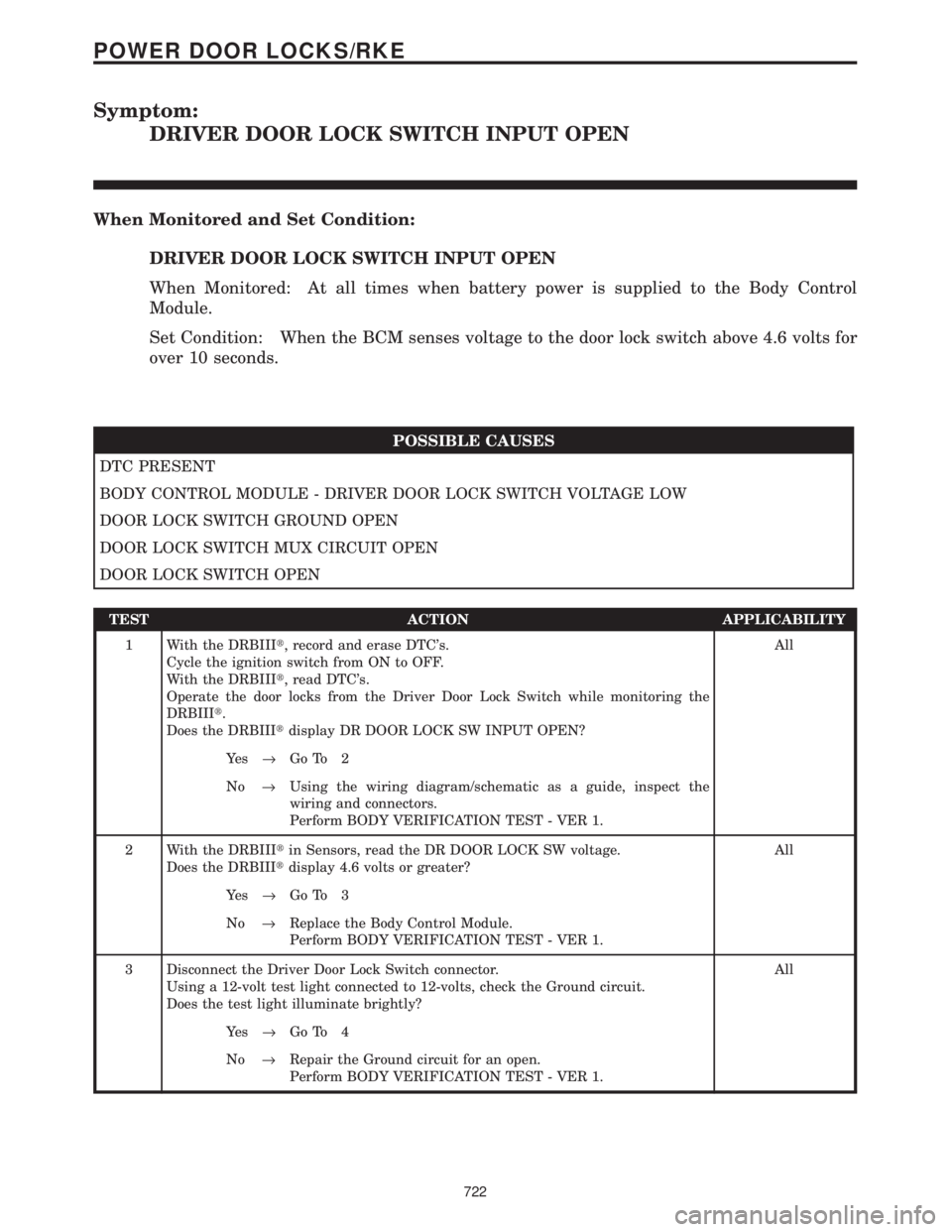
Symptom:
DRIVER DOOR LOCK SWITCH INPUT OPEN
When Monitored and Set Condition:
DRIVER DOOR LOCK SWITCH INPUT OPEN
When Monitored: At all times when battery power is supplied to the Body Control
Module.
Set Condition: When the BCM senses voltage to the door lock switch above 4.6 volts for
over 10 seconds.
POSSIBLE CAUSES
DTC PRESENT
BODY CONTROL MODULE - DRIVER DOOR LOCK SWITCH VOLTAGE LOW
DOOR LOCK SWITCH GROUND OPEN
DOOR LOCK SWITCH MUX CIRCUIT OPEN
DOOR LOCK SWITCH OPEN
TEST ACTION APPLICABILITY
1 With the DRBIIIt, record and erase DTC's.
Cycle the ignition switch from ON to OFF.
With the DRBIIIt, read DTC's.
Operate the door locks from the Driver Door Lock Switch while monitoring the
DRBIIIt.
Does the DRBIIItdisplay DR DOOR LOCK SW INPUT OPEN?All
Ye s®Go To 2
No®Using the wiring diagram/schematic as a guide, inspect the
wiring and connectors.
Perform BODY VERIFICATION TEST - VER 1.
2 With the DRBIIItin Sensors, read the DR DOOR LOCK SW voltage.
Does the DRBIIItdisplay 4.6 volts or greater?All
Ye s®Go To 3
No®Replace the Body Control Module.
Perform BODY VERIFICATION TEST - VER 1.
3 Disconnect the Driver Door Lock Switch connector.
Using a 12-volt test light connected to 12-volts, check the Ground circuit.
Does the test light illuminate brightly?All
Ye s®Go To 4
No®Repair the Ground circuit for an open.
Perform BODY VERIFICATION TEST - VER 1.
722
POWER DOOR LOCKS/RKE
Page 753 of 4284
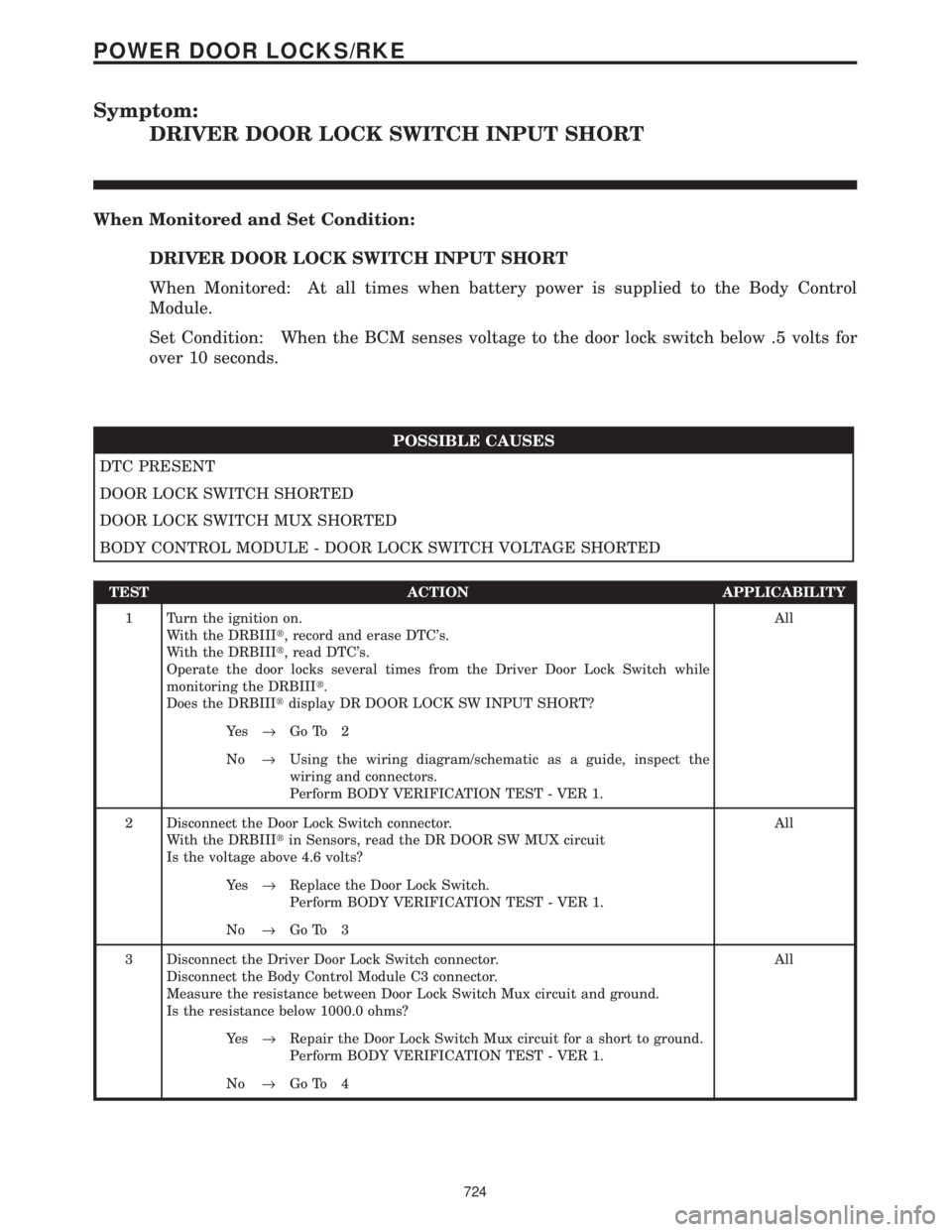
Symptom:
DRIVER DOOR LOCK SWITCH INPUT SHORT
When Monitored and Set Condition:
DRIVER DOOR LOCK SWITCH INPUT SHORT
When Monitored: At all times when battery power is supplied to the Body Control
Module.
Set Condition: When the BCM senses voltage to the door lock switch below .5 volts for
over 10 seconds.
POSSIBLE CAUSES
DTC PRESENT
DOOR LOCK SWITCH SHORTED
DOOR LOCK SWITCH MUX SHORTED
BODY CONTROL MODULE - DOOR LOCK SWITCH VOLTAGE SHORTED
TEST ACTION APPLICABILITY
1 Turn the ignition on.
With the DRBIIIt, record and erase DTC's.
With the DRBIIIt, read DTC's.
Operate the door locks several times from the Driver Door Lock Switch while
monitoring the DRBIIIt.
Does the DRBIIItdisplay DR DOOR LOCK SW INPUT SHORT?All
Ye s®Go To 2
No®Using the wiring diagram/schematic as a guide, inspect the
wiring and connectors.
Perform BODY VERIFICATION TEST - VER 1.
2 Disconnect the Door Lock Switch connector.
With the DRBIIItin Sensors, read the DR DOOR SW MUX circuit
Is the voltage above 4.6 volts?All
Ye s®Replace the Door Lock Switch.
Perform BODY VERIFICATION TEST - VER 1.
No®Go To 3
3 Disconnect the Driver Door Lock Switch connector.
Disconnect the Body Control Module C3 connector.
Measure the resistance between Door Lock Switch Mux circuit and ground.
Is the resistance below 1000.0 ohms?All
Ye s®Repair the Door Lock Switch Mux circuit for a short to ground.
Perform BODY VERIFICATION TEST - VER 1.
No®Go To 4
724
POWER DOOR LOCKS/RKE
Page 755 of 4284
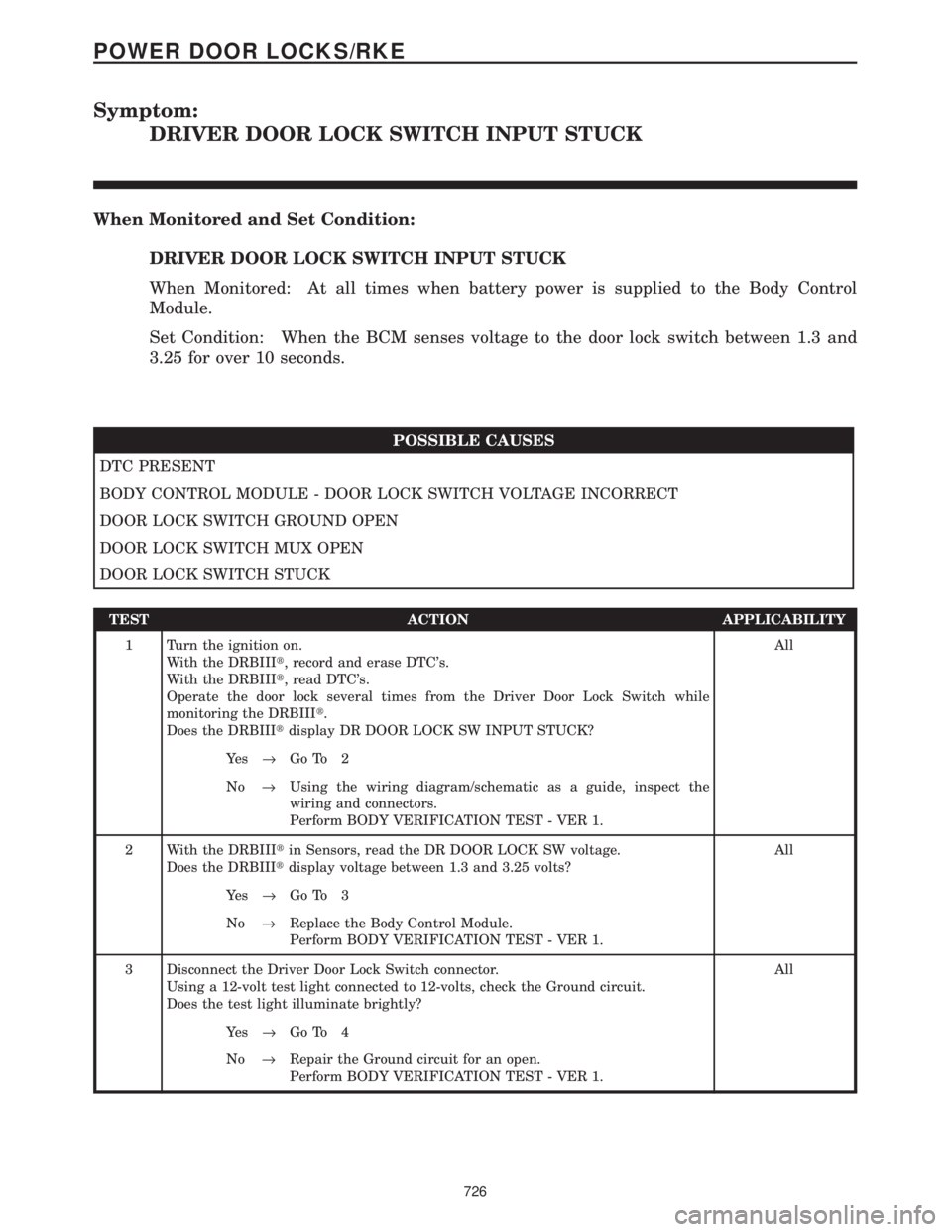
Symptom:
DRIVER DOOR LOCK SWITCH INPUT STUCK
When Monitored and Set Condition:
DRIVER DOOR LOCK SWITCH INPUT STUCK
When Monitored: At all times when battery power is supplied to the Body Control
Module.
Set Condition: When the BCM senses voltage to the door lock switch between 1.3 and
3.25 for over 10 seconds.
POSSIBLE CAUSES
DTC PRESENT
BODY CONTROL MODULE - DOOR LOCK SWITCH VOLTAGE INCORRECT
DOOR LOCK SWITCH GROUND OPEN
DOOR LOCK SWITCH MUX OPEN
DOOR LOCK SWITCH STUCK
TEST ACTION APPLICABILITY
1 Turn the ignition on.
With the DRBIIIt, record and erase DTC's.
With the DRBIIIt, read DTC's.
Operate the door lock several times from the Driver Door Lock Switch while
monitoring the DRBIIIt.
Does the DRBIIItdisplay DR DOOR LOCK SW INPUT STUCK?All
Ye s®Go To 2
No®Using the wiring diagram/schematic as a guide, inspect the
wiring and connectors.
Perform BODY VERIFICATION TEST - VER 1.
2 With the DRBIIItin Sensors, read the DR DOOR LOCK SW voltage.
Does the DRBIIItdisplay voltage between 1.3 and 3.25 volts?All
Ye s®Go To 3
No®Replace the Body Control Module.
Perform BODY VERIFICATION TEST - VER 1.
3 Disconnect the Driver Door Lock Switch connector.
Using a 12-volt test light connected to 12-volts, check the Ground circuit.
Does the test light illuminate brightly?All
Ye s®Go To 4
No®Repair the Ground circuit for an open.
Perform BODY VERIFICATION TEST - VER 1.
726
POWER DOOR LOCKS/RKE
Page 757 of 4284
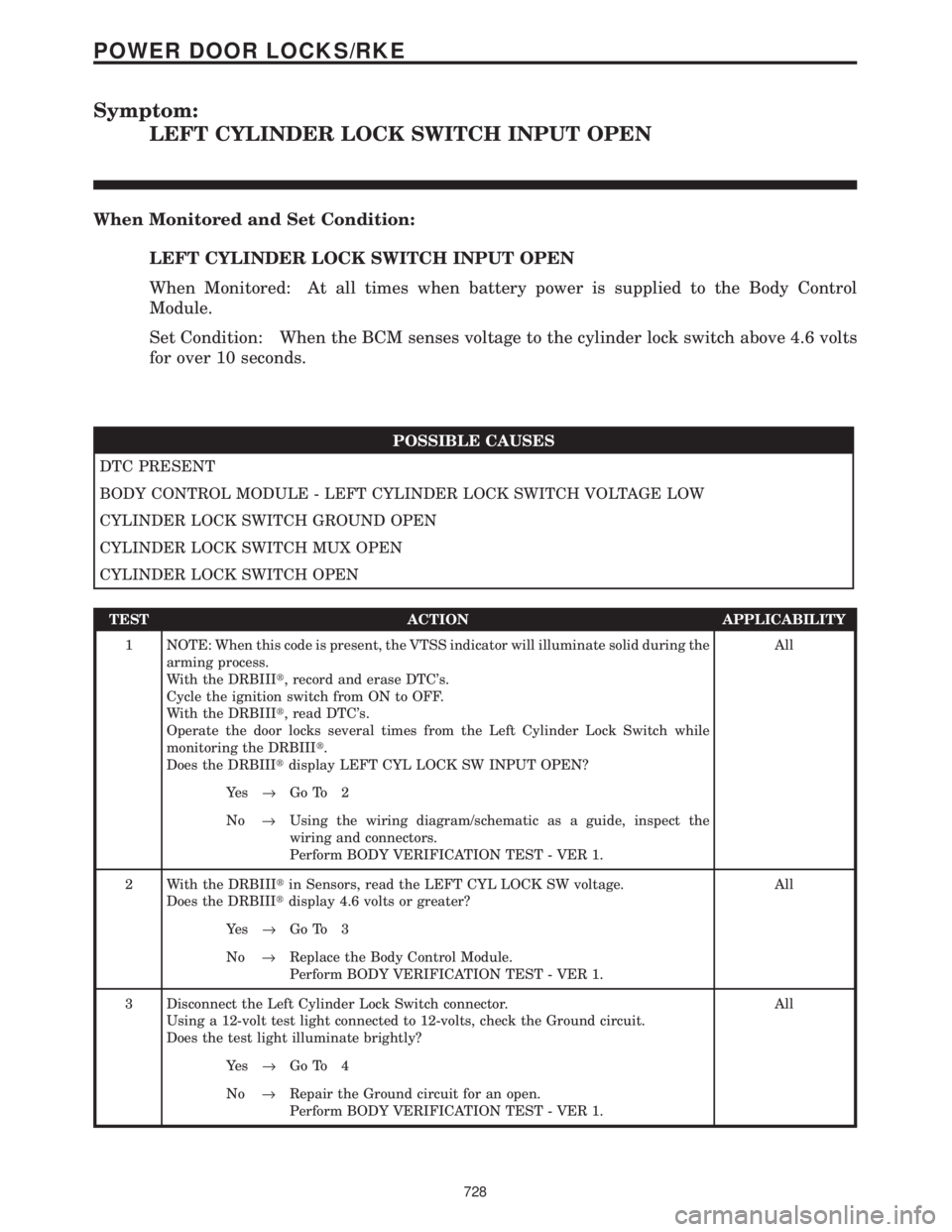
Symptom:
LEFT CYLINDER LOCK SWITCH INPUT OPEN
When Monitored and Set Condition:
LEFT CYLINDER LOCK SWITCH INPUT OPEN
When Monitored: At all times when battery power is supplied to the Body Control
Module.
Set Condition: When the BCM senses voltage to the cylinder lock switch above 4.6 volts
for over 10 seconds.
POSSIBLE CAUSES
DTC PRESENT
BODY CONTROL MODULE - LEFT CYLINDER LOCK SWITCH VOLTAGE LOW
CYLINDER LOCK SWITCH GROUND OPEN
CYLINDER LOCK SWITCH MUX OPEN
CYLINDER LOCK SWITCH OPEN
TEST ACTION APPLICABILITY
1 NOTE: When this code is present, the VTSS indicator will illuminate solid during the
arming process.
With the DRBIIIt, record and erase DTC's.
Cycle the ignition switch from ON to OFF.
With the DRBIIIt, read DTC's.
Operate the door locks several times from the Left Cylinder Lock Switch while
monitoring the DRBIIIt.
Does the DRBIIItdisplay LEFT CYL LOCK SW INPUT OPEN?All
Ye s®Go To 2
No®Using the wiring diagram/schematic as a guide, inspect the
wiring and connectors.
Perform BODY VERIFICATION TEST - VER 1.
2 With the DRBIIItin Sensors, read the LEFT CYL LOCK SW voltage.
Does the DRBIIItdisplay 4.6 volts or greater?All
Ye s®Go To 3
No®Replace the Body Control Module.
Perform BODY VERIFICATION TEST - VER 1.
3 Disconnect the Left Cylinder Lock Switch connector.
Using a 12-volt test light connected to 12-volts, check the Ground circuit.
Does the test light illuminate brightly?All
Ye s®Go To 4
No®Repair the Ground circuit for an open.
Perform BODY VERIFICATION TEST - VER 1.
728
POWER DOOR LOCKS/RKE
Page 759 of 4284
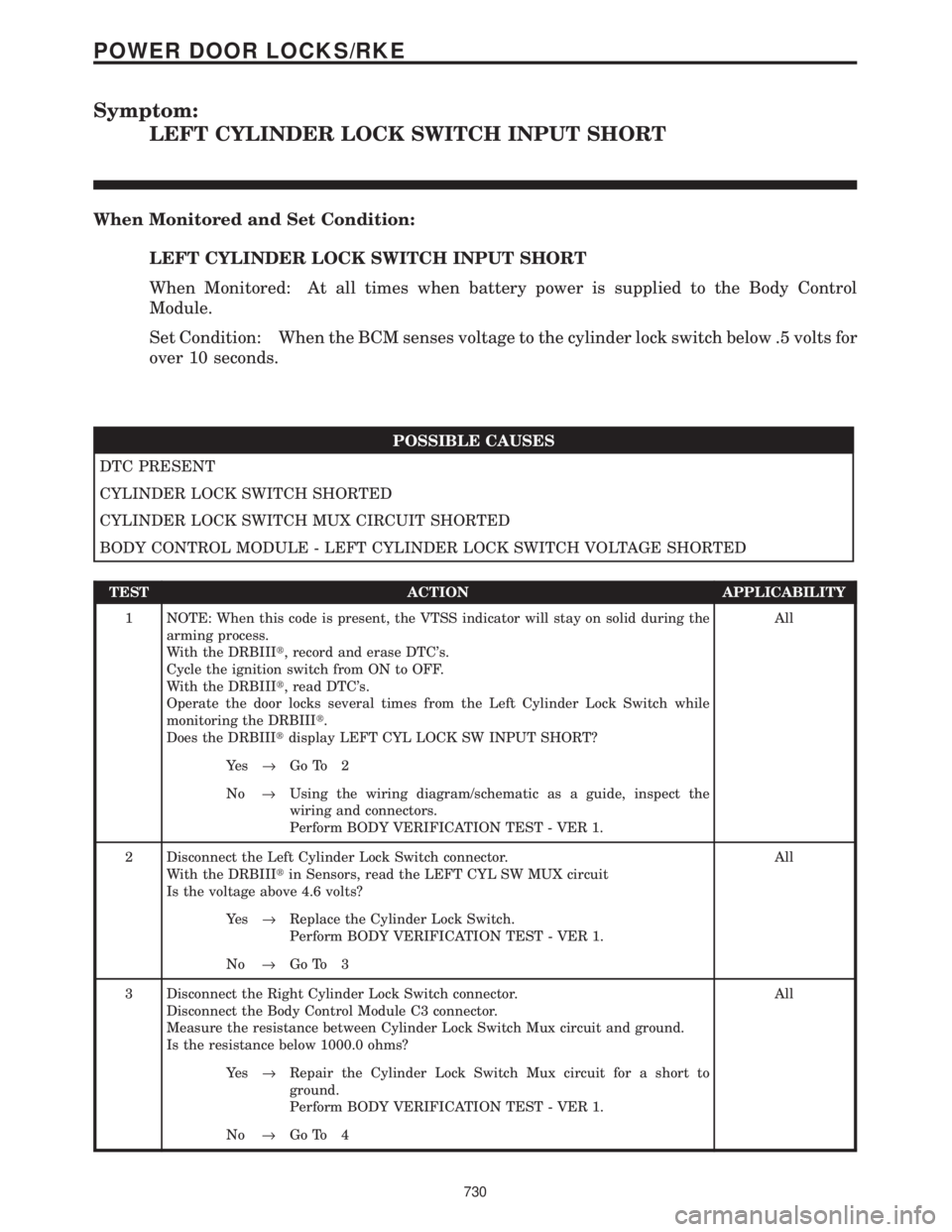
Symptom:
LEFT CYLINDER LOCK SWITCH INPUT SHORT
When Monitored and Set Condition:
LEFT CYLINDER LOCK SWITCH INPUT SHORT
When Monitored: At all times when battery power is supplied to the Body Control
Module.
Set Condition: When the BCM senses voltage to the cylinder lock switch below .5 volts for
over 10 seconds.
POSSIBLE CAUSES
DTC PRESENT
CYLINDER LOCK SWITCH SHORTED
CYLINDER LOCK SWITCH MUX CIRCUIT SHORTED
BODY CONTROL MODULE - LEFT CYLINDER LOCK SWITCH VOLTAGE SHORTED
TEST ACTION APPLICABILITY
1 NOTE: When this code is present, the VTSS indicator will stay on solid during the
arming process.
With the DRBIIIt, record and erase DTC's.
Cycle the ignition switch from ON to OFF.
With the DRBIIIt, read DTC's.
Operate the door locks several times from the Left Cylinder Lock Switch while
monitoring the DRBIIIt.
Does the DRBIIItdisplay LEFT CYL LOCK SW INPUT SHORT?All
Ye s®Go To 2
No®Using the wiring diagram/schematic as a guide, inspect the
wiring and connectors.
Perform BODY VERIFICATION TEST - VER 1.
2 Disconnect the Left Cylinder Lock Switch connector.
With the DRBIIItin Sensors, read the LEFT CYL SW MUX circuit
Is the voltage above 4.6 volts?All
Ye s®Replace the Cylinder Lock Switch.
Perform BODY VERIFICATION TEST - VER 1.
No®Go To 3
3 Disconnect the Right Cylinder Lock Switch connector.
Disconnect the Body Control Module C3 connector.
Measure the resistance between Cylinder Lock Switch Mux circuit and ground.
Is the resistance below 1000.0 ohms?All
Ye s®Repair the Cylinder Lock Switch Mux circuit for a short to
ground.
Perform BODY VERIFICATION TEST - VER 1.
No®Go To 4
730
POWER DOOR LOCKS/RKE
Page 761 of 4284
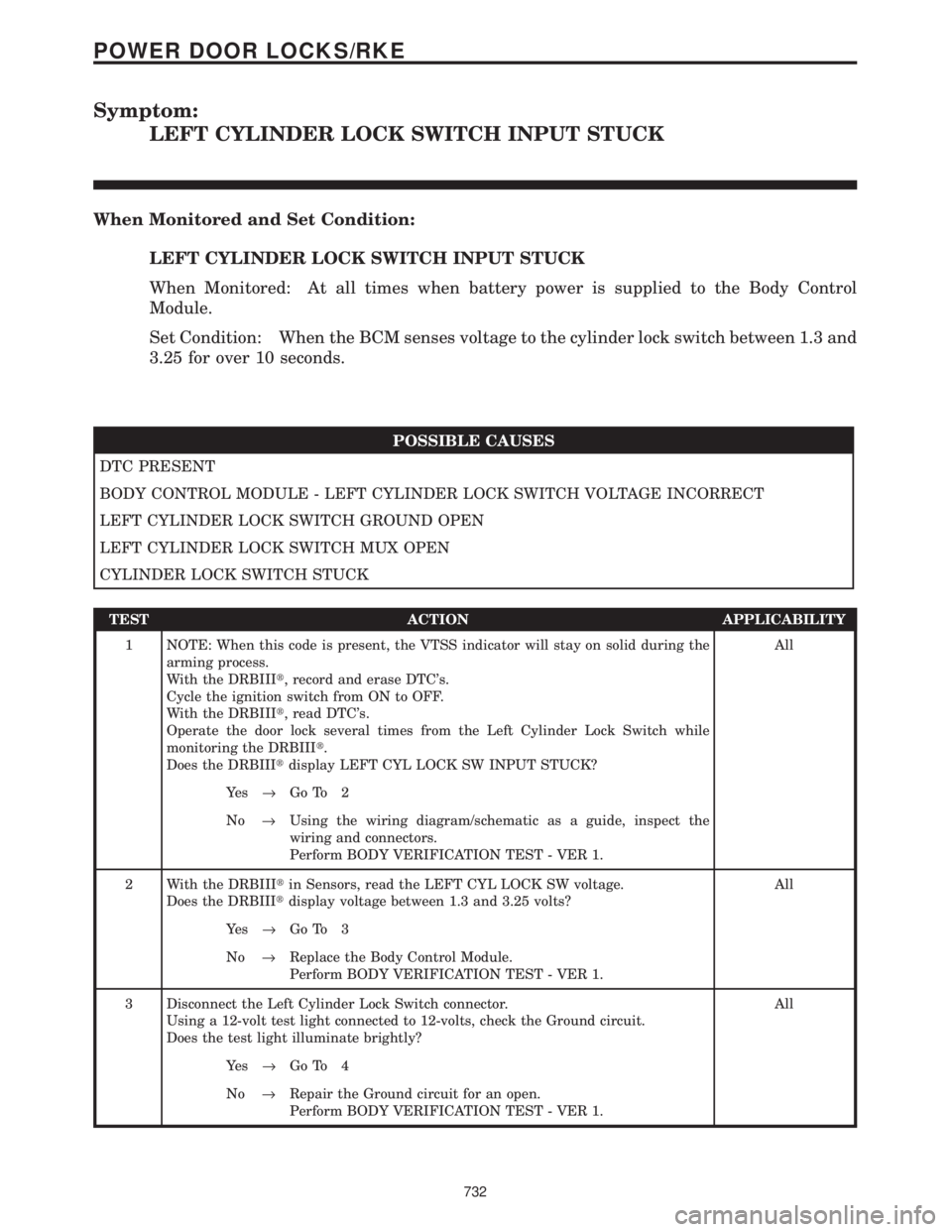
Symptom:
LEFT CYLINDER LOCK SWITCH INPUT STUCK
When Monitored and Set Condition:
LEFT CYLINDER LOCK SWITCH INPUT STUCK
When Monitored: At all times when battery power is supplied to the Body Control
Module.
Set Condition: When the BCM senses voltage to the cylinder lock switch between 1.3 and
3.25 for over 10 seconds.
POSSIBLE CAUSES
DTC PRESENT
BODY CONTROL MODULE - LEFT CYLINDER LOCK SWITCH VOLTAGE INCORRECT
LEFT CYLINDER LOCK SWITCH GROUND OPEN
LEFT CYLINDER LOCK SWITCH MUX OPEN
CYLINDER LOCK SWITCH STUCK
TEST ACTION APPLICABILITY
1 NOTE: When this code is present, the VTSS indicator will stay on solid during the
arming process.
With the DRBIIIt, record and erase DTC's.
Cycle the ignition switch from ON to OFF.
With the DRBIIIt, read DTC's.
Operate the door lock several times from the Left Cylinder Lock Switch while
monitoring the DRBIIIt.
Does the DRBIIItdisplay LEFT CYL LOCK SW INPUT STUCK?All
Ye s®Go To 2
No®Using the wiring diagram/schematic as a guide, inspect the
wiring and connectors.
Perform BODY VERIFICATION TEST - VER 1.
2 With the DRBIIItin Sensors, read the LEFT CYL LOCK SW voltage.
Does the DRBIIItdisplay voltage between 1.3 and 3.25 volts?All
Ye s®Go To 3
No®Replace the Body Control Module.
Perform BODY VERIFICATION TEST - VER 1.
3 Disconnect the Left Cylinder Lock Switch connector.
Using a 12-volt test light connected to 12-volts, check the Ground circuit.
Does the test light illuminate brightly?All
Ye s®Go To 4
No®Repair the Ground circuit for an open.
Perform BODY VERIFICATION TEST - VER 1.
732
POWER DOOR LOCKS/RKE
Page 763 of 4284
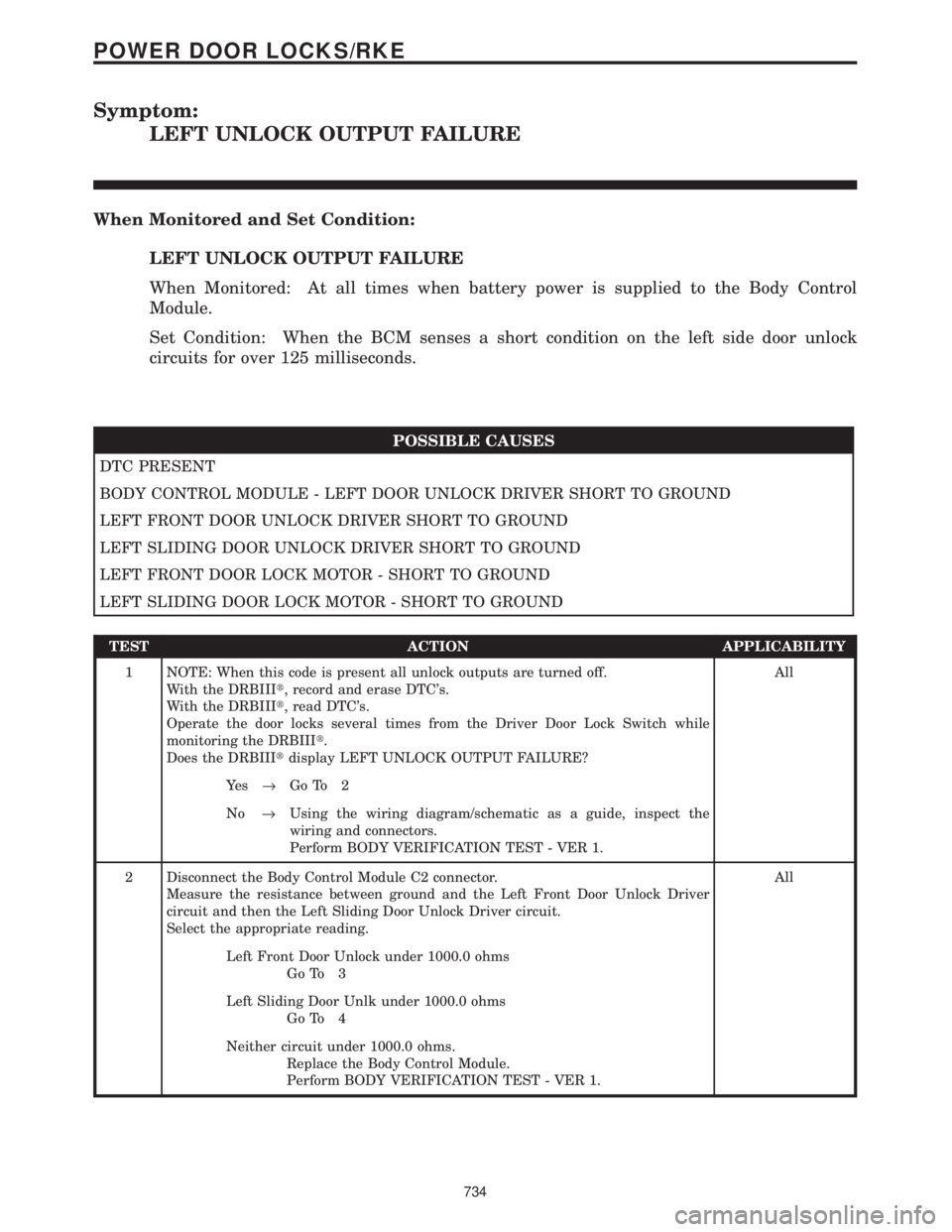
Symptom:
LEFT UNLOCK OUTPUT FAILURE
When Monitored and Set Condition:
LEFT UNLOCK OUTPUT FAILURE
When Monitored: At all times when battery power is supplied to the Body Control
Module.
Set Condition: When the BCM senses a short condition on the left side door unlock
circuits for over 125 milliseconds.
POSSIBLE CAUSES
DTC PRESENT
BODY CONTROL MODULE - LEFT DOOR UNLOCK DRIVER SHORT TO GROUND
LEFT FRONT DOOR UNLOCK DRIVER SHORT TO GROUND
LEFT SLIDING DOOR UNLOCK DRIVER SHORT TO GROUND
LEFT FRONT DOOR LOCK MOTOR - SHORT TO GROUND
LEFT SLIDING DOOR LOCK MOTOR - SHORT TO GROUND
TEST ACTION APPLICABILITY
1 NOTE: When this code is present all unlock outputs are turned off.
With the DRBIIIt, record and erase DTC's.
With the DRBIIIt, read DTC's.
Operate the door locks several times from the Driver Door Lock Switch while
monitoring the DRBIIIt.
Does the DRBIIItdisplay LEFT UNLOCK OUTPUT FAILURE?All
Ye s®Go To 2
No®Using the wiring diagram/schematic as a guide, inspect the
wiring and connectors.
Perform BODY VERIFICATION TEST - VER 1.
2 Disconnect the Body Control Module C2 connector.
Measure the resistance between ground and the Left Front Door Unlock Driver
circuit and then the Left Sliding Door Unlock Driver circuit.
Select the appropriate reading.All
Left Front Door Unlock under 1000.0 ohms
Go To 3
Left Sliding Door Unlk under 1000.0 ohms
Go To 4
Neither circuit under 1000.0 ohms.
Replace the Body Control Module.
Perform BODY VERIFICATION TEST - VER 1.
734
POWER DOOR LOCKS/RKE