ignition CHRYSLER VOYAGER 2001 Owner's Manual
[x] Cancel search | Manufacturer: CHRYSLER, Model Year: 2001, Model line: VOYAGER, Model: CHRYSLER VOYAGER 2001Pages: 4284, PDF Size: 83.53 MB
Page 53 of 4284
seconds instead of 5, the CMTC will set the
variance to 8 and enter the fast calibration
mode.
3. The VAR light will come on and the last variance
setting will be displayed.
4. Press the STEP button to set the zone number.
5. Press the US/M button and resume normal op-
eration.
NOTE: Do not attach any magnetic device
such as a magnetic CB antenna to the
vehicle. This can cause the compass to give
false readings.
3.15 POWER DOOR LOCK SYSTEM
When the BCM receives input for a lock request
from a door lock switch, RKE or cylinder lock switch
(only with VTSS), it will turn the lock driver on for
a specified time of 375 msec. If the request is there
beyond 375 msec, the BCM considers the door lock
signal stuck. Once a door lock or unlock signal is
stuck for longer than 10 seconds, the BCM will set
a trouble code and the signal input is ignored until
the stuck condition disappears. The door lock
switches provide a variable amount of resistance
thereby dropping the voltage of the multiplexed
(MUX) circuit and the BCM will respond to that
command.
3.15.1 SLIDING DOOR MEMORY LOCK
When the BCM receives an input for a lock
request and a sliding door is open, the BCM will
turn on the lock driver as described above, and will
turn it on again when all sliding doors are closed.
NOTE: If the BCM receives an unlock input before
a sliding door is closed, this will cancel the memory
lock.
3.15.2 DOOR LOCK INHIBIT
When the key is in the ignition and in any
position and either front door is open, the door lock
switches LOCK functions are disabled. The UN-
LOCK functions are still functional. This protects
against locking the vehicle with the keys still in the
ignition. The RKE key fob will still lock the doors as
usual. This allows the driver to lock the vehicle with
the engine running for warm up.
3.15.3 AUTOMATIC DOOR LOCKS
This feature can be enabled or disabled by using
either the DRBIIItor the customer programming
method. When enabled all the doors will lock when
the vehicle reaches a speed of 18 MPH (29 KMH)
and all the doors are closed. If a door is opened and
the vehicle slows to below 18 MPH (29 KMH), thedoor locks will operate again once all doors are
closed and the speed is above 15 MPH (24 KMH).
3.15.4 REMOTE KEYLESS ENTRY (RKE)
The body control module interfaces with the RKE
module via a one-way serial bus interface. The RKE
module is not on the PCI bus. The RKE module
sends a 0-5 volt pulse width signal to the BCM
depending on which button on the transmitter was
pressed. The BCM controls the door lock/unlock
functions and the arming/disarming of the Vehicle
Theft Security System (if equipped) and the activa-
tion of illuminated entry. The BCM will also send
the appropriate messages to the Power Sliding
Doors and Power Liftgate modules. The Intelligent
Power Module (IPM) activates the park lamps,
headlamps, and horn for horn chirp when sent the
appropriate message from the BCM as received
from the RKE transmitter. When a one-button
press is made for unlock, both driver side doors will
unlock and the front and rear turn signal will flash.
When a second press is initiated (within 5 seconds
of the first) both passenger doors will unlock and all
four turn signals will flash.
The RKE module is capable of retaining up to 4
individual access codes (4 transmitters). If the
PRNDL is in any position except park, the BCM will
ground the interface thereby disabling the RKE.
The 2 button transmitter will have 2-CR2016
batteries in series. The 5 button transmitter will
have 1-CR2016 battery. The minimum battery life
should be approximately 4.7 years based on 20
transmissions a day at 84ÉF (25ÉC). Using the
DRBIIItand selecting RKE FOB Test can test the
transmitter.
The RKE module can be programmed via the
DRBIIItor the customer programming method.
The BCM will only allow programming mode to be
entered when the ignition is in the on position, the
PRNDL is in park position, and the VTSS (if
equipped) is in the disarmed mode.
3.16 POWER FOLDING MIRRORS
The power folding mirrors are powered to two
positions: folded and unfolded. The driver may
choose fold or unfold with a switch that is located on
the right side of the steering column. The folding
mirror switch grounds a sense wire that comes from
the Body Control Module when it is placed in the
fold position. The mirrors will move to the position
designated by the switch whether the ignition
switch is the On or Off position and both front doors
are closed. When the Power Folding Mirror switch
is left in the fold position during a vehicle exit the
mirrors will automatically unfold then refold after
both front doors are closed. This is to prevent mirror
contact with either front door when opened. When
24
GENERAL INFORMATION
Page 55 of 4284
manual sliding door. When the child lock out switch
is on, the B pillar switches are disabled.
There is only one part number for the power
sliding door module (PSDM). The driver sliding
door harness has an additional ground circuit which
will identify it as the driver side. This eliminates
the need for a left and a right side module.
3.18.2 DIAGNOSTIC FEATURES
The PSDM can be flashed on vehicle via PCI bus
with a DRBIIItdiagnostic tool. The DRBIIItcan
read all inputs, actuate all outputs, read module
information, and read diagnostic trouble codes. As a
reminder, some DTC's can be set during normal
PSD operation.
3.18.3 SYSTEM INHIBITORS
1. Battery voltage too high or too low (above 16V,
below 9.5V)
2. Vehicle in gear
3. Vehicle speed > 0 mph/km/h
4. Child locks enabled inhibit the B pillar switch
operation
5. O/H console lockout will inhibit the B pillar
switches
6. Doors locked will inhibit all interior switches
from opening (Overhead Console, B Pillar). A
locked sliding door can be power closed.
3.19 REAR WINDOW DEFOG/HEATED
MIRROR/FRONT WIPER DE-ICE
The defroster button located on the HVAC control
controls the rear window defogger, heated side view
mirrors and front wiper de-icer grid. In addition the
front wiper de-ice function is turned on when front
defog/defrost mode is selected.
When the defroster button is pushed, the HVAC
control sends a bus message over the PCI bus to the
Front Control Module (FCM) which controls the
Rear Window Defogger relay. The defroster LED
will illuminate when the defroster function is on.
The defroster will function for 10 minutes or can be
cycled off sooner by pressing the defroster button
again. The front wiper de-icer grid receives its 12
volts from the accessory relay through fuse 11 and
the HVAC control module supplies the grid ground.
3.20 VEHICLE THEFT SECURITY SYSTEM
3.20.1 BASE ALARM SYSTEM
The Vehicle Theft Security System (VTSS) is part
of the Body Control Module (BCM). The BCM
monitors the vehicle doors, liftgate, hood, and theignition for unauthorized operation. The alarm ac-
tivates by sounding the horn, flashing the head-
lamps and the VTSS indicator lamp. The VTSS does
not prevent engine operation, this is done with the
Sentry Key Immobilizer Module (SKIM). Passive
arming occurs in one of two ways. Upon normal
vehicle exit by removing the ignition key, opening
the driver door, locking the doors with the power
lock, and closing the driver door, or by removing the
ignition key, opening the driver door, closing the
driver door, and locking the doors with the Remote
Keyless Entry (RKE) transmitter. The VTSS indi-
cator lamp will flash for approximately 15 seconds
during the arming process. If there is no interrup-
tion during the arming process, upon completion
the VTSS indicator lamp will flash at a slower rate.
When the BCM receives an input to trigger the
alarm, the BCM will control the outputs of the
headlamps, horn, and VTSS lamp for approxi-
mately 18 minutes.
Arming (Active and Passive)
Active arming occurs when the RKE transmitter
is used to lock the vehicle doors, whether the doors
are open or closed. The arming process is complete
only after all doors are closed.
Passive arming occurs when the ignition key is
removed, the driver door is opened, and the doors
are locked with the power door lock switch, and the
door is closed.
Disarming (Active and Passive)
Active disarming occurs when the RKE transmit-
ter is used to unlock the vehicle doors. This disarm-
ing will also halt the alarm once it has been acti-
vated.
Passive disarming occurs upon normal vehicle
entry (unlocking driver door with the key). This
disarming will also halt the alarm once it has been
activated.
Tamper Alert
The VTSS tamper alert will sound the horn three
times upon disarming to indicate a tamper condi-
tion has occurred.
Manual Override
The system will not arm if the doors are locked
using the manual lock control or if the locks are
actuated by an inside occupant after the doors are
closed.
Diagnosis
For complaints about the Vehicle Theft Alarm
triggering on its own, use the DRBIIItand read the
Last VTSS Cause status.
26
GENERAL INFORMATION
Page 56 of 4284

NOTE: A POWERTRAIN CONTROL MODULE
FROM A VEHICLE EQUIPPED WITH A
VEHICLE THEFT SECURITY SYSTEM
CANNOT BE USED IN A VEHICLE THAT IS
NOT EQUIPPED WITH A VEHICLE THEFT
SECURITY SYSTEM IF THE VTSS INDICATOR
LAMP COMES ON AFTER IGNITION ON AND
STAYS ON, THE PCI BUS COMMUNICATION
WITH THE POWERTRAIN CONTROL
MODULE HAS POSSIBLY BEEN LOST.
3.20.2 THATCHAM ALARM SYSTEM
The Thatcham Alarm Module monitors the vehi-
cle doors, liftgate, hood and the interior of the
vehicle for unauthorized operation. The vehicle
doors, liftgate, and hood use ajar switches as inputs
to the BCM to indicate their current status. The
interior of the vehicle is secured by the use of
Intrusion Sensors. The Intrusion Sensors are used
as inputs to the RKE/Thatcham Alarm Module to
report any motion in the interior of the vehicle. The
alarm activates by sounding the siren, flashing the
hazard lamps, and the VTSS Indicator Lamp.
Arming
Before arming, all doors, liftgate, and the hood
must be completely closed. The system can then be
armed by following a normal exit sequence, of
opening the door and then locking the doors with
the door lock switch and then closing the door. The
system can also be armed by opening the door,
closing the door and then locking the doors with the
RKE transmitter.
Disarming
To disarm the alarm system, the RKE transmit-
ter is used. The RKE transmitter will unlock the
vehicle doors and disarm the alarm system. The
RKE transmitter can also be used to halt the alarm
once it has been activated.
3.21 WIPER SYSTEM
3.21.1 FRONT WIPER
The front wiper/washer system consists of the
following features: lo-hi-speed, mist wipers, inter-
mittent wipers and wipe after wash. The front
wiper system is only active when the ignition switch
is in the RUN/ACC position. The vehicle operator
selects the front wiper function using the front
wiper switch (a resistive multiplexed stalk switch)
which is integral to the Multi-Function Switch. The
front wiper switch is hardwired to the Body Control
Module (BCM). Upon receiving a wiper switch sig-
nal, the BCM sends a PCI Bus message to the Front
Control Module (FCM). The FCM controls the ON/OFF relay, the HIGH/LOW relay and the front and
rear washer pump motors.
The Wiper system utilizes the BCM to control the
on/off and hi/low relays for the low and hi speed
wiper functions, intermittent wiper delay as the
switch position changes, pulse wipe, wipe after
wash mode and wiper motor functions. The BCM
uses the vehicle speed input to double the usual
delay time below 10 MPH (6 KPH).
3.21.2 SPEED SENSITIVE INTERMITTENT
WIPE MODE
There are 5 individual delay time settings with a
minimum delay of 1.7 seconds to a maximum of 18.4
seconds. When the vehicle speed is under 10 MPH
(6 KPM), the delay time is doubled, providing a
delay range of 3.4 seconds to 36.8 seconds.
3.21.3 PULSE WIPE
When the wiper is in the off position and the
driver presses the wash button for more than .062
seconds, but less than .5 seconds, 2 wipe cycles in
low speed mode will be provided.
3.21.4 PARK AFTER IGNITION OFF
Because the wiper relays are powered from the
battery, the BCM can run the wipers to park after
the ignition is turned off.
3.21.5 WIPE AFTER WASH
When the driver presses the wash button for over
.5 seconds and releases it, the wiper will continue to
run for 2 additional wipe cycles.
3.21.6 REAR WIPER
The rear wiper/washer system consists of the
following features: mist wipers, intermittent wipers
and wipe after wash. The rear wiper system is only
active when the ignition switch is in the RUN/ACC
position. The vehicle operator selects the rear wiper
function using one of the three buttons on the dash
mounted rear wiper switch. The rear wiper switch
is hardwired to the Body Control Module (BCM).
Upon receiving a wiper switch signal, the BCM
provides 12 volts to the rear wiper motor. Rear
washer occurs when the BCM receives a rear
washer switch ON input. The BCM sends a PCI Bus
message to the FCM requesting rear washer on.
The FCM activates the rear washer by providing a
ground for the rear washer motor.
3.21.7 SPEED SENSITIVE INTERMITTENT
WIPE MODE
The delay setting of the rear wiper system is
based solely on the vehicle speed. The delay time is
27
GENERAL INFORMATION
Page 58 of 4284
When diagnosing a chassis system problem, it is
important to follow approved procedures where
applicable. These procedures can be found in this
General Information Section or in the service man-
ual procedures. Following these procedures is very
important to safety of individuals performing diag-
nostic tests.
4.2.2 VEHICLE PREPARATION FOR
TESTING
Make sure the vehicle being tested has a fully
charged battery. If it does not, false diagnostic codes
or error messages may occur.
4.2.3 SERVICING SUB-ASSEMBLIES
Some components of the chassis system are in-
tended to be serviced as an assembly only. Attempt-
ing to remove or repair certain system sub-
components may result in personal injury and/or
improper system operation. Only those components
with approved repair and installation procedures in
the service manual should be serviced.
4.2.4 DRBIIITSAFETY INFORMATION
WARNING: EXCEEDING THE LIMITS OF THE
DRBIIITMULTIMETER IS DANGEROUS. IT
CAN EXPOSE YOU TO SERIOUS OR
POSSIBLY FATAL INJURY. CAREFULLY
READ AND UNDERSTAND THE CAUTIONS
AND THE SPECIFICATION LIMITS.
²Follow the vehicle manufacturer 's service speci-
fications at all times.
²Do not use the DRBIIItif it has been damaged.
²Do not use the test leads if the insulation is
damaged or if metal is exposed.
²To avoid electrical shock, do not touch the test
leads, tips, or the circuit being tested.
²Choose the proper range and functions for the
measurement. Do not try voltage or current mea-
surement that may exceed the rated capacity.
²Do not exceed the limits shown in the table below:
FUNCTION INPUT LIMIT
Volts 0 - 500 peak volts AC
0 - 500 volts DC
Ohms (resistance)* 0 -1.12 megohms
Frequency Measured
Frequency Generated0-10kHz
Temperature -58 - 1100ÉF
-50 - 600ÉC* Ohms cannot be measured if voltage is present.
Ohms can be measured only in a non-powered
circuit.
²Voltage between any terminal and ground must
not exceed 500v DC or 500v peak AC.
²Use caution when measuring voltage above 25v
DC or 25v AC.
²Use the low current shunt to measure circuits up
to 10A. Use the high current clamp to measure
circuits exceeding 10A.
²When testing for the presence of voltage or cur-
rent, make sure the meter is functioning cor-
rectly. Take a reading of a known voltage or
current before accepting a zero reading.
²When measuring current, connect the meter in
series with the load.
²Disconnect the live test lead before disconnecting
the common test lead.
²When using the meter function, keep the
DRBIIItaway from spark plug or coil wires to
avoid measuring error from outside interference.
4.3 WARNINGS
4.3.1 VEHICLE DAMAGE WARNINGS
Before disconnecting any control module, make
sure the ignition is ªoffº. Failure to do so could
damage the module.
When testing voltage or continuity at any control
module, use the terminal side (not the wire end) of
the connector. Do not probe a wire through the
insulation; this will damage it and eventually cause
it to fail because of corrosion. Be careful when
performing electrical tests so as to prevent acciden-
tal shorting of terminals. Such mistakes can dam-
age fuses or components. Also, a second code could
be set, making diagnosis of the original problem
more difficult.
4.3.2 ROAD TESTING A COMPLAINT
VEHICLE
Some complaints will require a test drive as part
of the repair verification procedure. The purpose of
the test drive is to try to duplicate the diagnostic
code or symptom condition.
29
GENERAL INFORMATION
Page 61 of 4284
Symptom List:
FCM, ORC RUN ONLY DRIVER OPEN - ACTIVE
FCM, ORC RUN ONLY DRIVER OVER CURRENT - ACTIVE
FCM, ORC RUN ONLY DRIVER OVER TEMP - ACTIVE
FCM, ORC RUN ONLY DRIVER OVER VOLT - ACTIVE
FCM, ORC RUN ONLY DRIVER SHORT TO GROUND - ACTIVE
ORC, LOSS OF IGNITION RUN ONLY - ACTIVE
Test Note: All symptoms listed above are diagnosed using the same tests.
The title for the tests will be FCM, ORC RUN ONLY DRIVER
OPEN - ACTIVE.
When Monitored and Set Condition:
FCM, ORC RUN ONLY DRIVER OPEN - ACTIVE
When Monitored: When the ignition is turned OFF, the microprocessor controlled
transistor (high side driver) places a diagnostic voltage on the ORC Run-Start circuit for
60 seconds. An open high side driver (HSD) circuit voltage is between 2.4 and 5.0 volts.
Set Condition: This code will set within 10 second, if the microprocessor senses 2.4 to 5.0
volts on the HSD. Note: the diagnostic voltage will only last for 60 seconds after the
ignition is turned off.
FCM, ORC RUN ONLY DRIVER OVER CURRENT - ACTIVE
When Monitored: The FCM uses a microprocessor controlled transistor (high side driver)
to supply power to the ORC. The microprocessor monitors the high side driver (HSD)
internal temperature when the ignition is in the Run Only position.
Set Condition: The code will set within 1 second, if the microprocessor senses HSD
internal temperature. The high temperature is caused by over current.
FCM, ORC RUN ONLY DRIVER OVER TEMP - ACTIVE
When Monitored: The FCM uses a microprocessor controlled transistor (high side driver)
to supply power to the ORC. The microprocessor monitors the high side driver (HSD)
internal temperature when the ignition is in the Run position.
Set Condition: The code will set within 2.5 second, if the microprocessor senses high HSD
internal temperature. The high temperature is caused by over current.
FCM, ORC RUN ONLY DRIVER OVER VOLT - ACTIVE
When Monitored: The FCM uses a microprocessor controlled transistor (high side driver)
to supply power to the ORC. The microprocessor monitors the high side driver (HSD)
battery voltage when the ignition is in the run position.
Set Condition: The code will set if the microprocessor senses HSD battery voltage is over
30 volts.
32
AIRBAG
Page 62 of 4284
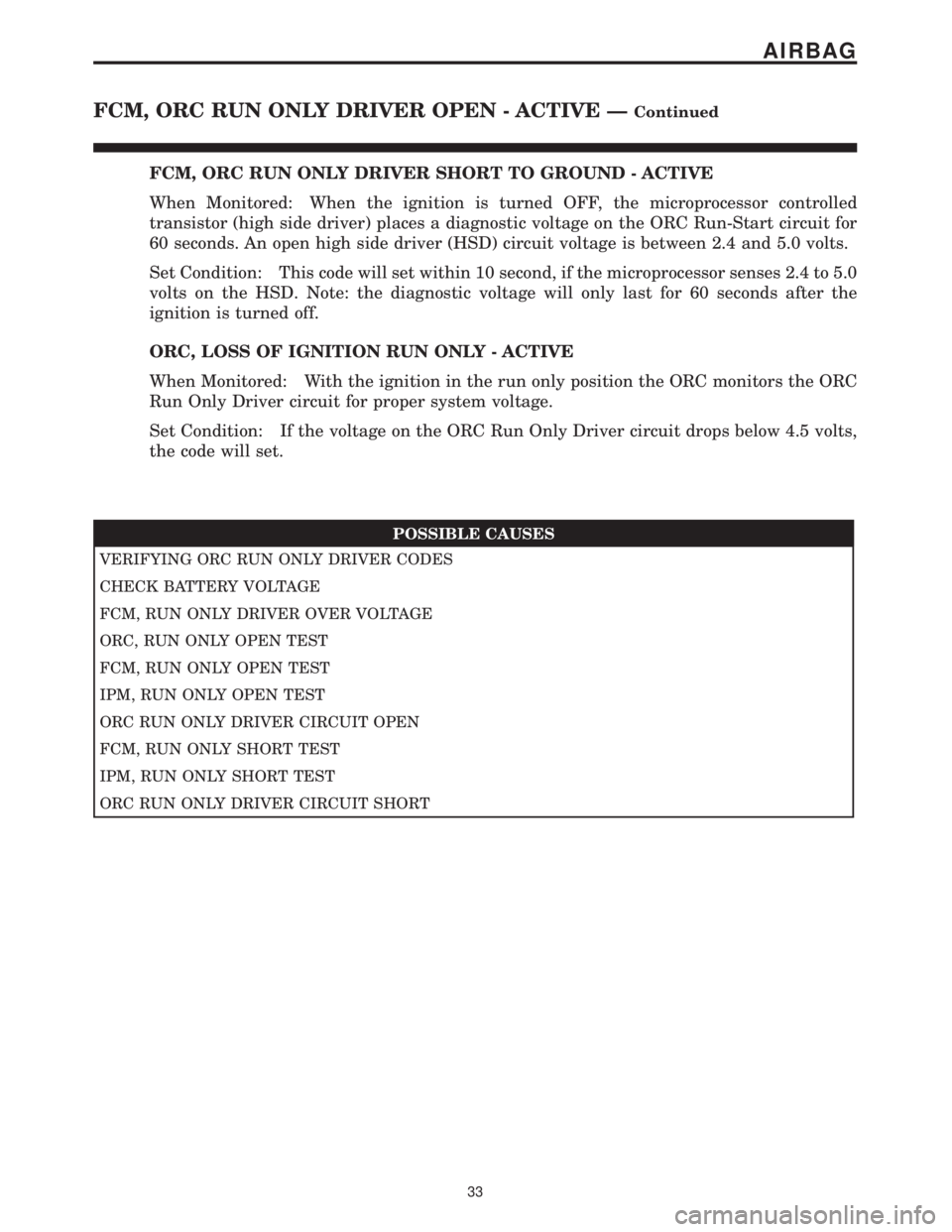
FCM, ORC RUN ONLY DRIVER SHORT TO GROUND - ACTIVE
When Monitored: When the ignition is turned OFF, the microprocessor controlled
transistor (high side driver) places a diagnostic voltage on the ORC Run-Start circuit for
60 seconds. An open high side driver (HSD) circuit voltage is between 2.4 and 5.0 volts.
Set Condition: This code will set within 10 second, if the microprocessor senses 2.4 to 5.0
volts on the HSD. Note: the diagnostic voltage will only last for 60 seconds after the
ignition is turned off.
ORC, LOSS OF IGNITION RUN ONLY - ACTIVE
When Monitored: With the ignition in the run only position the ORC monitors the ORC
Run Only Driver circuit for proper system voltage.
Set Condition: If the voltage on the ORC Run Only Driver circuit drops below 4.5 volts,
the code will set.
POSSIBLE CAUSES
VERIFYING ORC RUN ONLY DRIVER CODES
CHECK BATTERY VOLTAGE
FCM, RUN ONLY DRIVER OVER VOLTAGE
ORC, RUN ONLY OPEN TEST
FCM, RUN ONLY OPEN TEST
IPM, RUN ONLY OPEN TEST
ORC RUN ONLY DRIVER CIRCUIT OPEN
FCM, RUN ONLY SHORT TEST
IPM, RUN ONLY SHORT TEST
ORC RUN ONLY DRIVER CIRCUIT SHORT
33
AIRBAG
FCM, ORC RUN ONLY DRIVER OPEN - ACTIVE ÐContinued
Page 63 of 4284
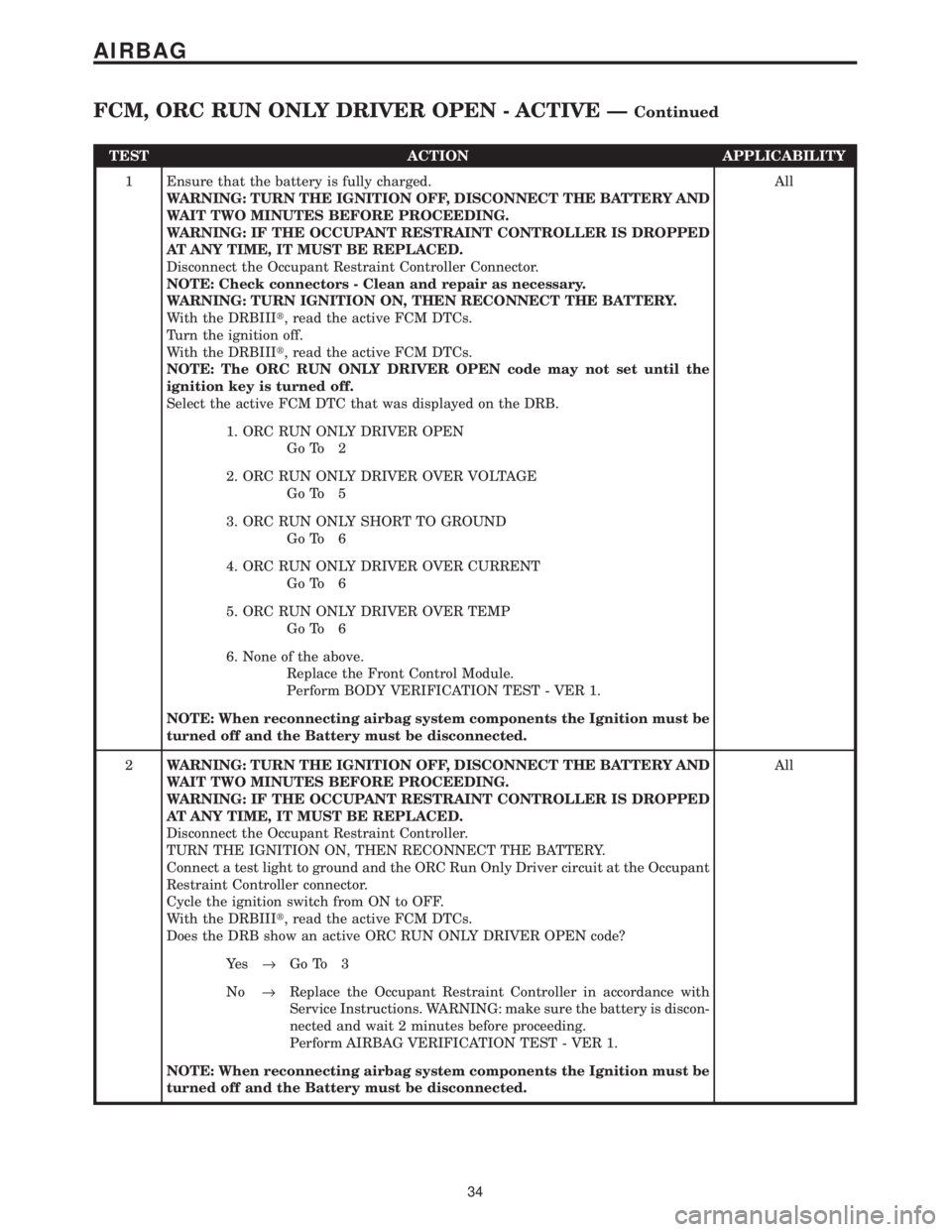
TEST ACTION APPLICABILITY
1 Ensure that the battery is fully charged.
WARNING: TURN THE IGNITION OFF, DISCONNECT THE BATTERY AND
WAIT TWO MINUTES BEFORE PROCEEDING.
WARNING: IF THE OCCUPANT RESTRAINT CONTROLLER IS DROPPED
AT ANY TIME, IT MUST BE REPLACED.
Disconnect the Occupant Restraint Controller Connector.
NOTE: Check connectors - Clean and repair as necessary.
WARNING: TURN IGNITION ON, THEN RECONNECT THE BATTERY.
With the DRBIIIt, read the active FCM DTCs.
Turn the ignition off.
With the DRBIIIt, read the active FCM DTCs.
NOTE: The ORC RUN ONLY DRIVER OPEN code may not set until the
ignition key is turned off.
Select the active FCM DTC that was displayed on the DRB.All
1. ORC RUN ONLY DRIVER OPEN
Go To 2
2. ORC RUN ONLY DRIVER OVER VOLTAGE
Go To 5
3. ORC RUN ONLY SHORT TO GROUND
Go To 6
4. ORC RUN ONLY DRIVER OVER CURRENT
Go To 6
5. ORC RUN ONLY DRIVER OVER TEMP
Go To 6
6. None of the above.
Replace the Front Control Module.
Perform BODY VERIFICATION TEST - VER 1.
NOTE: When reconnecting airbag system components the Ignition must be
turned off and the Battery must be disconnected.
2WARNING: TURN THE IGNITION OFF, DISCONNECT THE BATTERY AND
WAIT TWO MINUTES BEFORE PROCEEDING.
WARNING: IF THE OCCUPANT RESTRAINT CONTROLLER IS DROPPED
AT ANY TIME, IT MUST BE REPLACED.
Disconnect the Occupant Restraint Controller.
TURN THE IGNITION ON, THEN RECONNECT THE BATTERY.
Connect a test light to ground and the ORC Run Only Driver circuit at the Occupant
Restraint Controller connector.
Cycle the ignition switch from ON to OFF.
With the DRBIIIt, read the active FCM DTCs.
Does the DRB show an active ORC RUN ONLY DRIVER OPEN code?All
Ye s®Go To 3
No®Replace the Occupant Restraint Controller in accordance with
Service Instructions. WARNING: make sure the battery is discon-
nected and wait 2 minutes before proceeding.
Perform AIRBAG VERIFICATION TEST - VER 1.
NOTE: When reconnecting airbag system components the Ignition must be
turned off and the Battery must be disconnected.
34
AIRBAG
FCM, ORC RUN ONLY DRIVER OPEN - ACTIVE ÐContinued
Page 64 of 4284
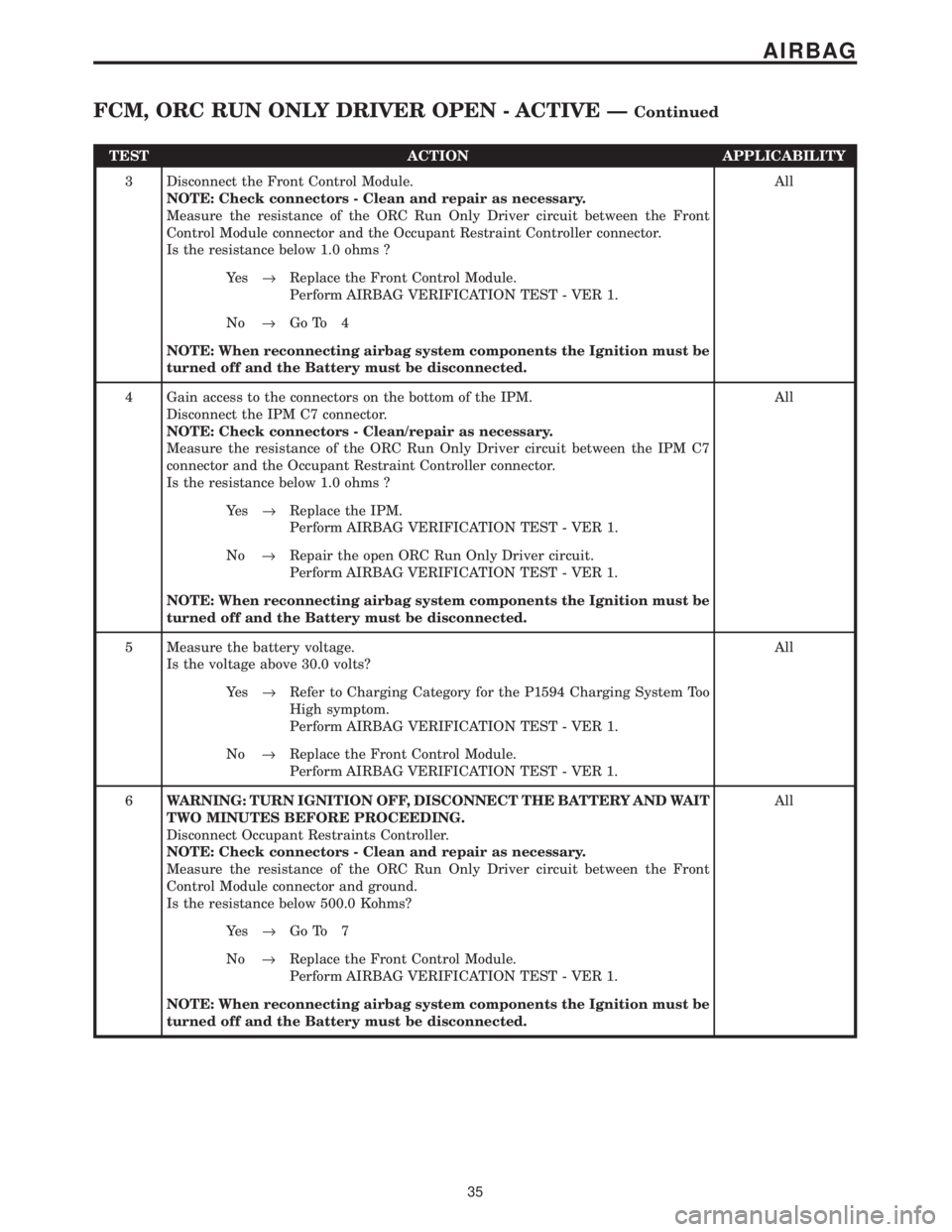
TEST ACTION APPLICABILITY
3 Disconnect the Front Control Module.
NOTE: Check connectors - Clean and repair as necessary.
Measure the resistance of the ORC Run Only Driver circuit between the Front
Control Module connector and the Occupant Restraint Controller connector.
Is the resistance below 1.0 ohms ?All
Ye s®Replace the Front Control Module.
Perform AIRBAG VERIFICATION TEST - VER 1.
No®Go To 4
NOTE: When reconnecting airbag system components the Ignition must be
turned off and the Battery must be disconnected.
4 Gain access to the connectors on the bottom of the IPM.
Disconnect the IPM C7 connector.
NOTE: Check connectors - Clean/repair as necessary.
Measure the resistance of the ORC Run Only Driver circuit between the IPM C7
connector and the Occupant Restraint Controller connector.
Is the resistance below 1.0 ohms ?All
Ye s®Replace the IPM.
Perform AIRBAG VERIFICATION TEST - VER 1.
No®Repair the open ORC Run Only Driver circuit.
Perform AIRBAG VERIFICATION TEST - VER 1.
NOTE: When reconnecting airbag system components the Ignition must be
turned off and the Battery must be disconnected.
5 Measure the battery voltage.
Is the voltage above 30.0 volts?All
Ye s®Refer to Charging Category for the P1594 Charging System Too
High symptom.
Perform AIRBAG VERIFICATION TEST - VER 1.
No®Replace the Front Control Module.
Perform AIRBAG VERIFICATION TEST - VER 1.
6WARNING: TURN IGNITION OFF, DISCONNECT THE BATTERY AND WAIT
TWO MINUTES BEFORE PROCEEDING.
Disconnect Occupant Restraints Controller.
NOTE: Check connectors - Clean and repair as necessary.
Measure the resistance of the ORC Run Only Driver circuit between the Front
Control Module connector and ground.
Is the resistance below 500.0 Kohms?All
Ye s®Go To 7
No®Replace the Front Control Module.
Perform AIRBAG VERIFICATION TEST - VER 1.
NOTE: When reconnecting airbag system components the Ignition must be
turned off and the Battery must be disconnected.
35
AIRBAG
FCM, ORC RUN ONLY DRIVER OPEN - ACTIVE ÐContinued
Page 65 of 4284
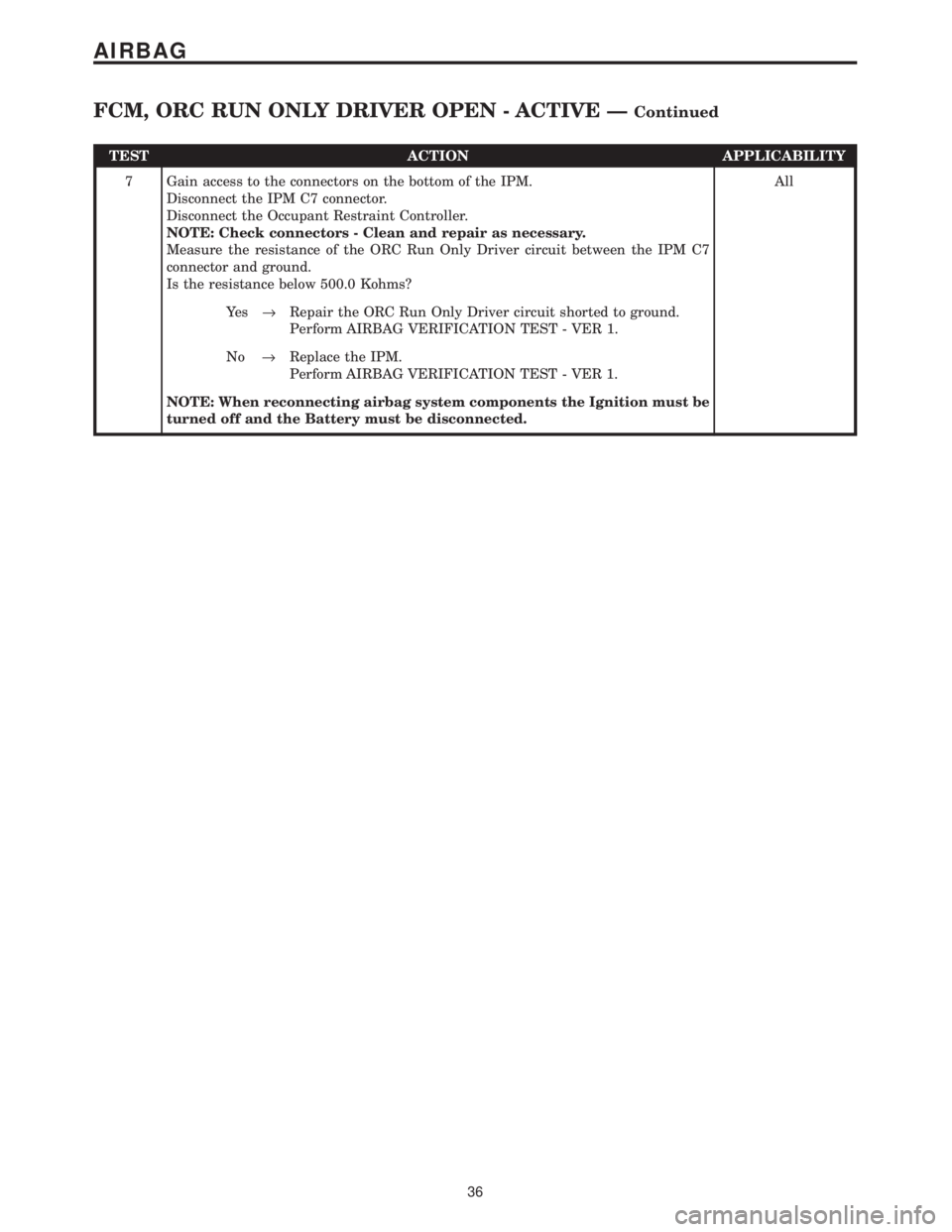
TEST ACTION APPLICABILITY
7 Gain access to the connectors on the bottom of the IPM.
Disconnect the IPM C7 connector.
Disconnect the Occupant Restraint Controller.
NOTE: Check connectors - Clean and repair as necessary.
Measure the resistance of the ORC Run Only Driver circuit between the IPM C7
connector and ground.
Is the resistance below 500.0 Kohms?All
Ye s®Repair the ORC Run Only Driver circuit shorted to ground.
Perform AIRBAG VERIFICATION TEST - VER 1.
No®Replace the IPM.
Perform AIRBAG VERIFICATION TEST - VER 1.
NOTE: When reconnecting airbag system components the Ignition must be
turned off and the Battery must be disconnected.
36
AIRBAG
FCM, ORC RUN ONLY DRIVER OPEN - ACTIVE ÐContinued
Page 66 of 4284
Symptom List:
FCM, ORC RUN ONLY DRIVER OPEN - STORED
FCM, ORC RUN ONLY DRIVER OVER CURRENT - STORED
FCM, ORC RUN ONLY DRIVER OVER TEMP - STORED
FCM, ORC RUN ONLY DRIVER OVER VOLT - STORED
FCM, ORC RUN ONLY DRIVER SHORT TO GROUND - STORED
FCM, ORC RUN-START DRIVER OPEN - STORED
FCM, ORC RUN-START DRIVER OVER CURRENT - STORED
FCM, ORC RUN-START DRIVER OVER TEMP - STORED
FCM, ORC RUN-START DRIVER OVER VOLT - STORED
FCM, ORC RUN-START DRIVER SHORT TO GROUND - STORED
FCM, SIACM RUN-START DRIVER OPEN - STORED
FCM, SIACM RUN-START DRIVER OVER CURRENT - STORED
FCM, SIACM RUN-START DRIVER OVER TEMP - STORED
FCM, SIACM RUN-START DRIVER OVER VOLT - STORED
FCM, SIACM RUN-START DRIVER SHORT TO GROUND - STORED
Test Note: All symptoms listed above are diagnosed using the same tests.
The title for the tests will be FCM, ORC RUN ONLY DRIVER
OPEN - STORED.
When Monitored and Set Condition:
FCM, ORC RUN ONLY DRIVER OPEN - STORED
When Monitored: When the ignition is turned OFF, the microprocessor controlled
transistor (high side driver) places a diagnostic voltage on the ORC Run-Start circuit for
60 seconds. An open high side driver (HSD) circuit voltage is between 2.4 and 5.0 volts.
Set Condition: This code will set within 10 second, if the microprocessor senses 2.4 to 5.0
volts on the HSD. Note: the diagnostic voltage will only last for 60 seconds after the
ignition is turned off.
FCM, ORC RUN ONLY DRIVER OVER CURRENT - STORED
When Monitored: The FCM uses a microprocessor controlled transistor (high side driver)
to supply power to the ORC. The microprocessor monitors the high side driver (HSD)
internal temperature when the ignition is in the Run Only position.
Set Condition: The code will set within 1 second, if the microprocessor senses HSD
internal temperature. The high temperature is caused by over current.
FCM, ORC RUN ONLY DRIVER OVER TEMP - STORED
When Monitored: The FCM uses a microprocessor controlled transistor (high side driver)
to supply power to the ORC. The microprocessor monitors the high side driver (HSD)
internal temperature when the ignition is in the Run position.
Set Condition: The code will set within 2.5 second, if the microprocessor senses high HSD
internal temperature. The high temperature is caused by over current.
37
AIRBAG