ignition CHRYSLER VOYAGER 2001 Service Manual
[x] Cancel search | Manufacturer: CHRYSLER, Model Year: 2001, Model line: VOYAGER, Model: CHRYSLER VOYAGER 2001Pages: 4284, PDF Size: 83.53 MB
Page 374 of 4284
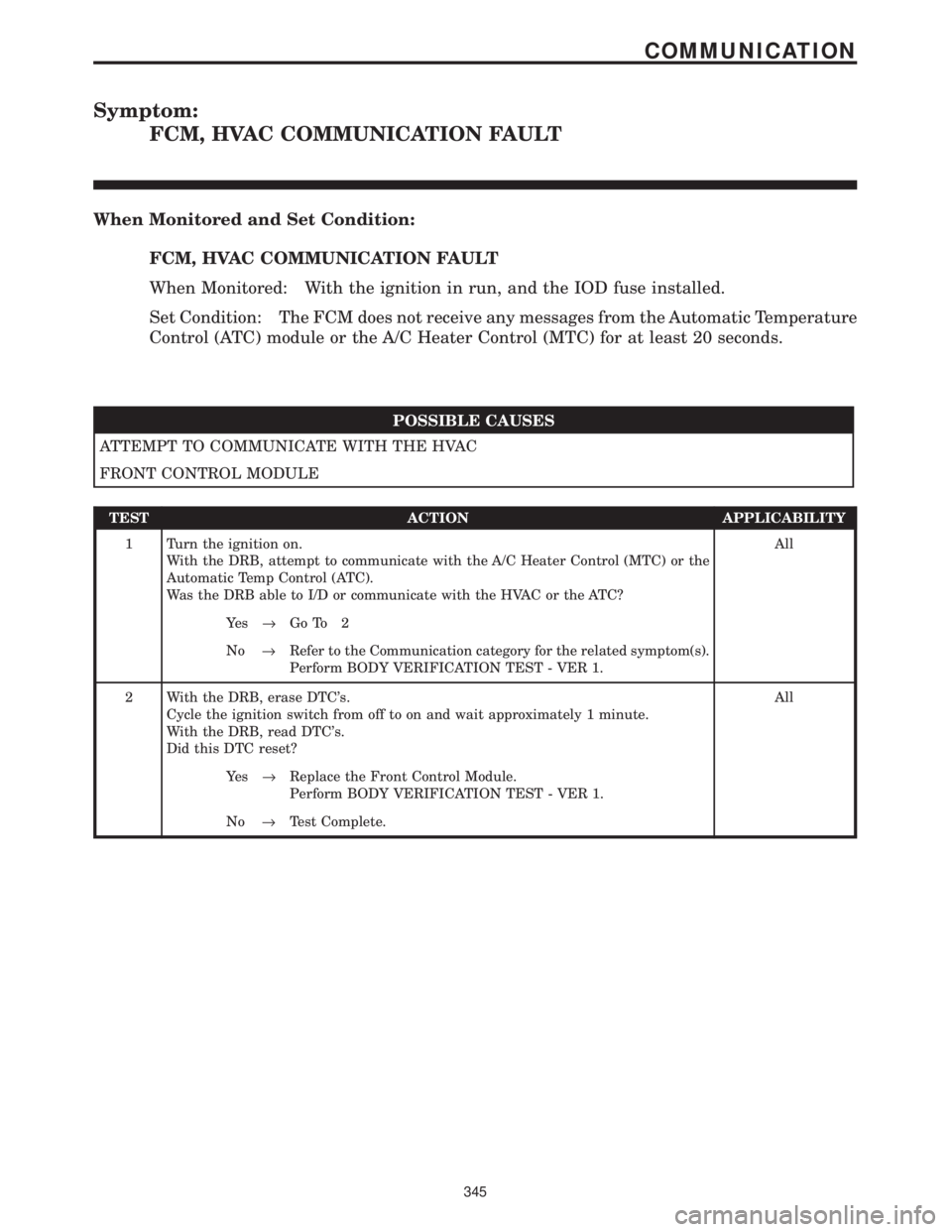
Symptom:
FCM, HVAC COMMUNICATION FAULT
When Monitored and Set Condition:
FCM, HVAC COMMUNICATION FAULT
When Monitored: With the ignition in run, and the IOD fuse installed.
Set Condition: The FCM does not receive any messages from the Automatic Temperature
Control (ATC) module or the A/C Heater Control (MTC) for at least 20 seconds.
POSSIBLE CAUSES
ATTEMPT TO COMMUNICATE WITH THE HVAC
FRONT CONTROL MODULE
TEST ACTION APPLICABILITY
1 Turn the ignition on.
With the DRB, attempt to communicate with the A/C Heater Control (MTC) or the
Automatic Temp Control (ATC).
Was the DRB able to I/D or communicate with the HVAC or the ATC?All
Ye s®Go To 2
No®Refer to the Communication category for the related symptom(s).
Perform BODY VERIFICATION TEST - VER 1.
2 With the DRB, erase DTC's.
Cycle the ignition switch from off to on and wait approximately 1 minute.
With the DRB, read DTC's.
Did this DTC reset?All
Ye s®Replace the Front Control Module.
Perform BODY VERIFICATION TEST - VER 1.
No®Test Complete.
345
COMMUNICATION
Page 375 of 4284
Symptom:
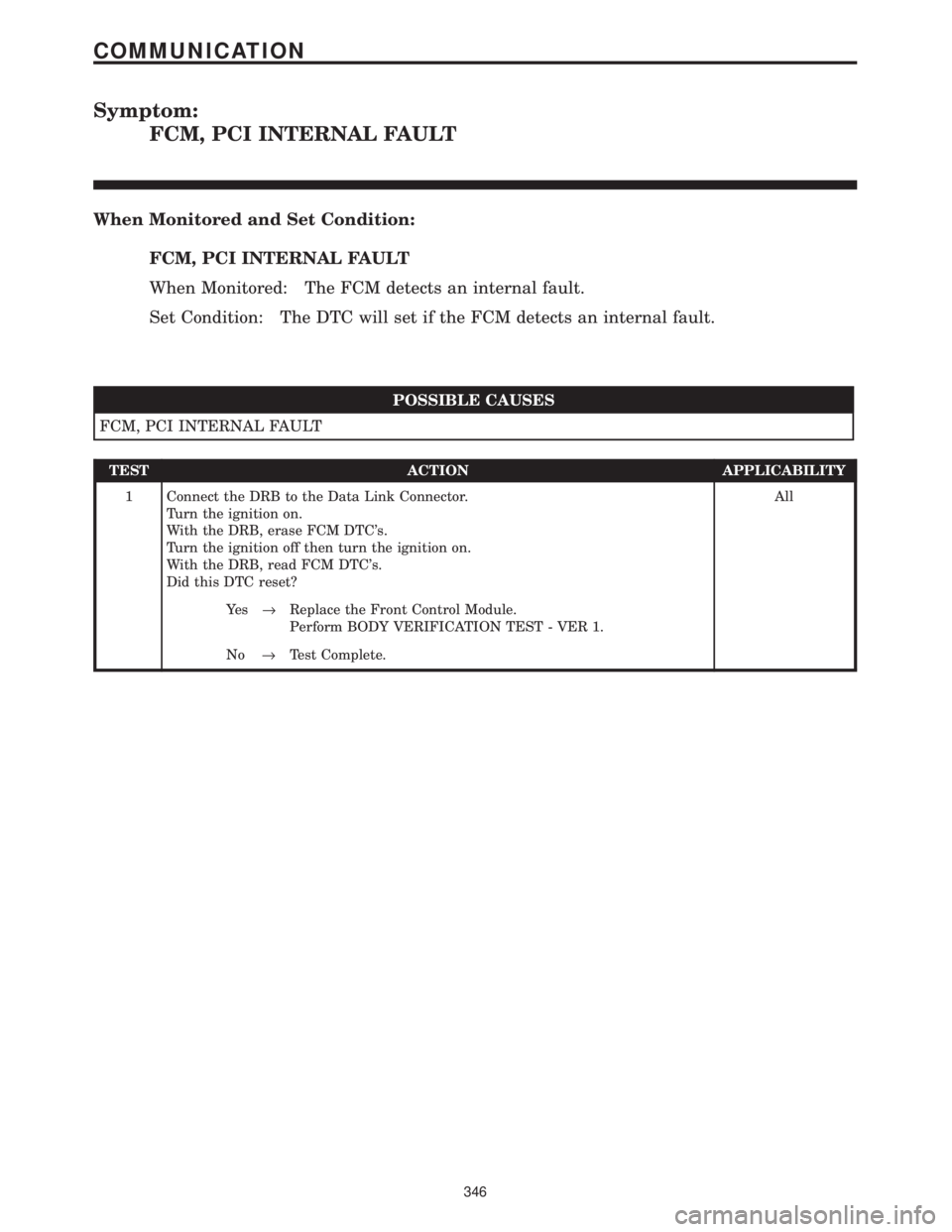
FCM, PCI INTERNAL FAULT
When Monitored and Set Condition:
FCM, PCI INTERNAL FAULT
When Monitored: The FCM detects an internal fault.
Set Condition: The DTC will set if the FCM detects an internal fault.
POSSIBLE CAUSES
FCM, PCI INTERNAL FAULT
TEST ACTION APPLICABILITY
1 Connect the DRB to the Data Link Connector.
Turn the ignition on.
With the DRB, erase FCM DTC's.
Turn the ignition off then turn the ignition on.
With the DRB, read FCM DTC's.
Did this DTC reset?All
Ye s®Replace the Front Control Module.
Perform BODY VERIFICATION TEST - VER 1.
No®Test Complete.
346
COMMUNICATION
Page 376 of 4284
Symptom:
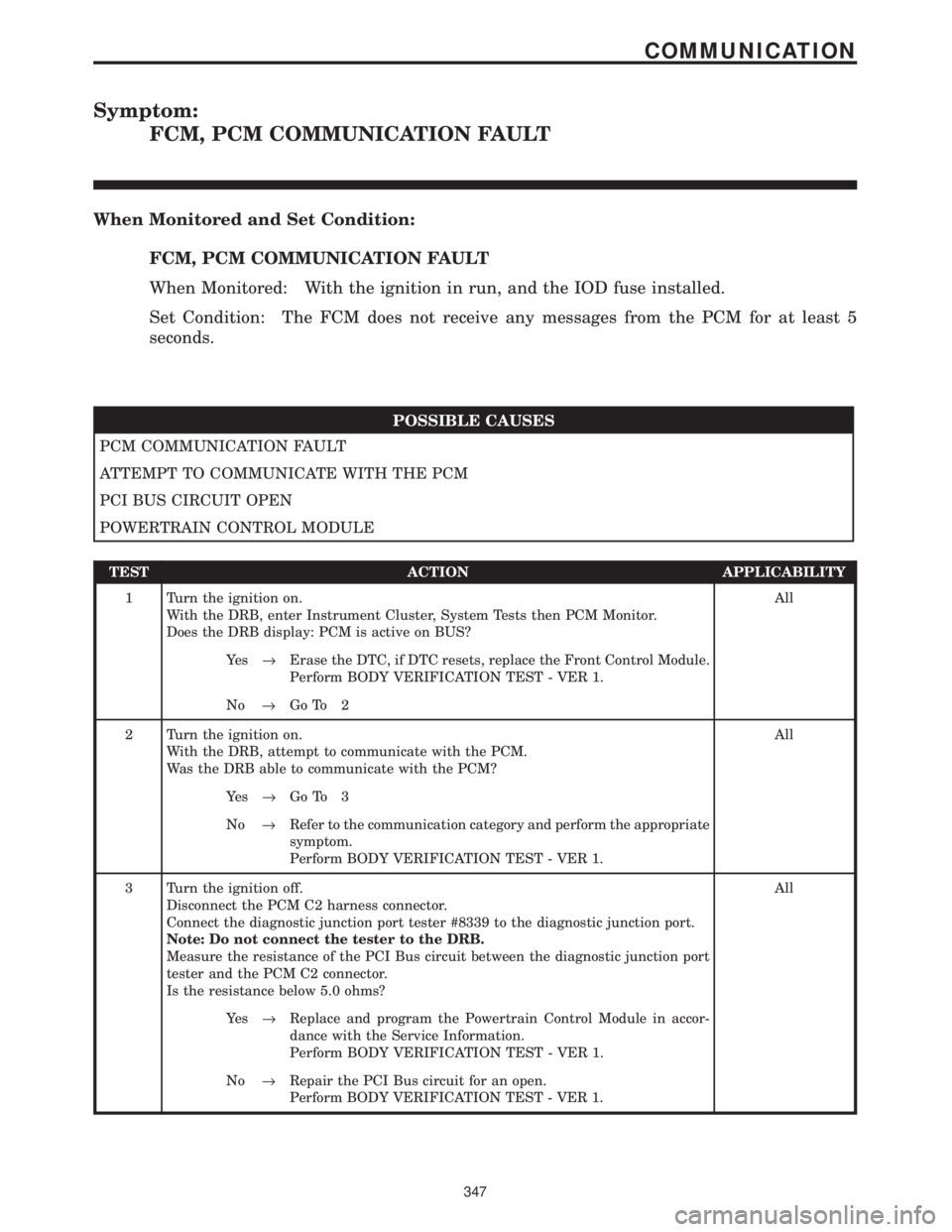
FCM, PCM COMMUNICATION FAULT
When Monitored and Set Condition:
FCM, PCM COMMUNICATION FAULT
When Monitored: With the ignition in run, and the IOD fuse installed.
Set Condition: The FCM does not receive any messages from the PCM for at least 5
seconds.
POSSIBLE CAUSES
PCM COMMUNICATION FAULT
ATTEMPT TO COMMUNICATE WITH THE PCM
PCI BUS CIRCUIT OPEN
POWERTRAIN CONTROL MODULE
TEST ACTION APPLICABILITY
1 Turn the ignition on.
With the DRB, enter Instrument Cluster, System Tests then PCM Monitor.
Does the DRB display: PCM is active on BUS?All
Ye s®Erase the DTC, if DTC resets, replace the Front Control Module.
Perform BODY VERIFICATION TEST - VER 1.
No®Go To 2
2 Turn the ignition on.
With the DRB, attempt to communicate with the PCM.
Was the DRB able to communicate with the PCM?All
Ye s®Go To 3
No®Refer to the communication category and perform the appropriate
symptom.
Perform BODY VERIFICATION TEST - VER 1.
3 Turn the ignition off.
Disconnect the PCM C2 harness connector.
Connect the diagnostic junction port tester #8339 to the diagnostic junction port.
Note: Do not connect the tester to the DRB.
Measure the resistance of the PCI Bus circuit between the diagnostic junction port
tester and the PCM C2 connector.
Is the resistance below 5.0 ohms?All
Ye s®Replace and program the Powertrain Control Module in accor-
dance with the Service Information.
Perform BODY VERIFICATION TEST - VER 1.
No®Repair the PCI Bus circuit for an open.
Perform BODY VERIFICATION TEST - VER 1.
347
COMMUNICATION
Page 377 of 4284
Symptom:
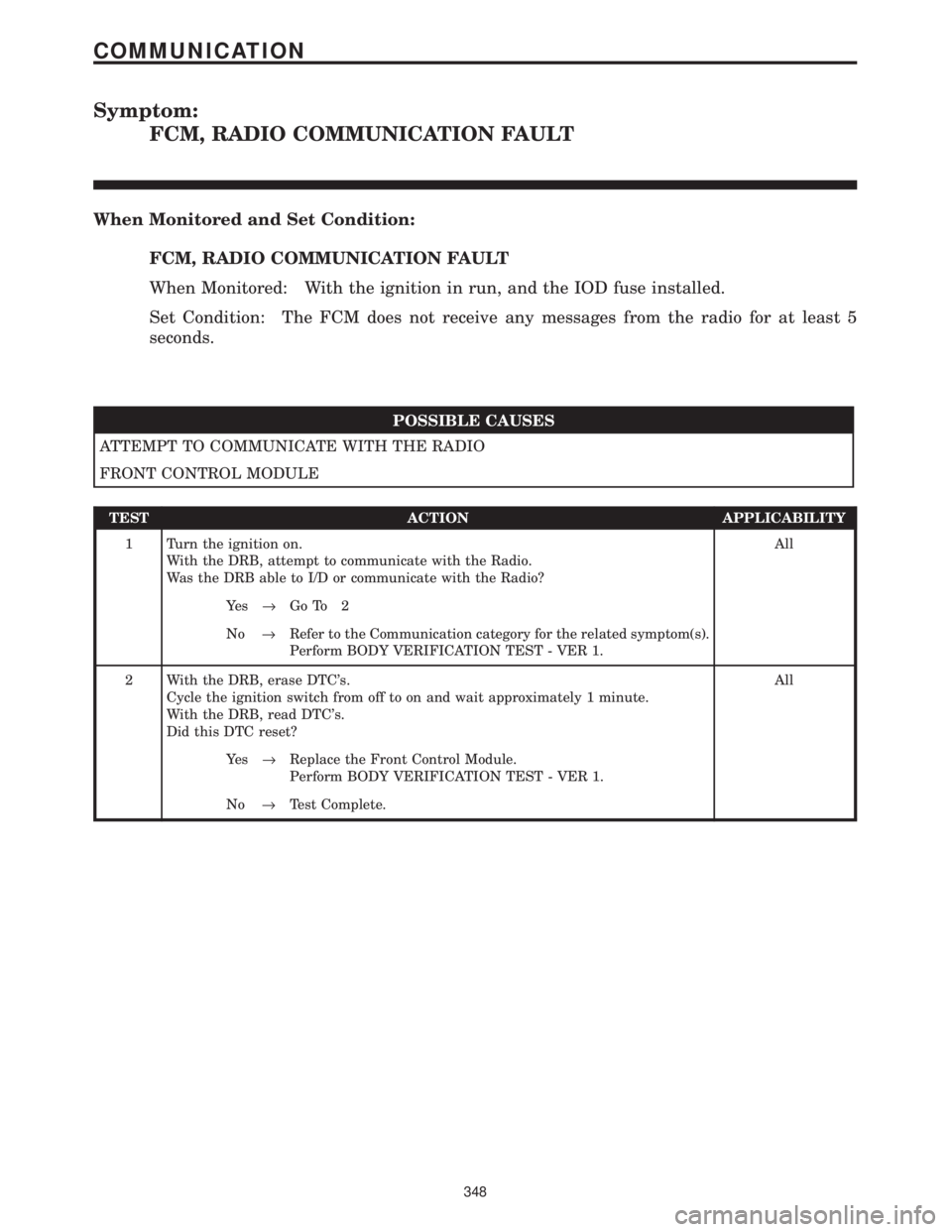
FCM, RADIO COMMUNICATION FAULT
When Monitored and Set Condition:
FCM, RADIO COMMUNICATION FAULT
When Monitored: With the ignition in run, and the IOD fuse installed.
Set Condition: The FCM does not receive any messages from the radio for at least 5
seconds.
POSSIBLE CAUSES
ATTEMPT TO COMMUNICATE WITH THE RADIO
FRONT CONTROL MODULE
TEST ACTION APPLICABILITY
1 Turn the ignition on.
With the DRB, attempt to communicate with the Radio.
Was the DRB able to I/D or communicate with the Radio?All
Ye s®Go To 2
No®Refer to the Communication category for the related symptom(s).
Perform BODY VERIFICATION TEST - VER 1.
2 With the DRB, erase DTC's.
Cycle the ignition switch from off to on and wait approximately 1 minute.
With the DRB, read DTC's.
Did this DTC reset?All
Ye s®Replace the Front Control Module.
Perform BODY VERIFICATION TEST - VER 1.
No®Test Complete.
348
COMMUNICATION
Page 378 of 4284
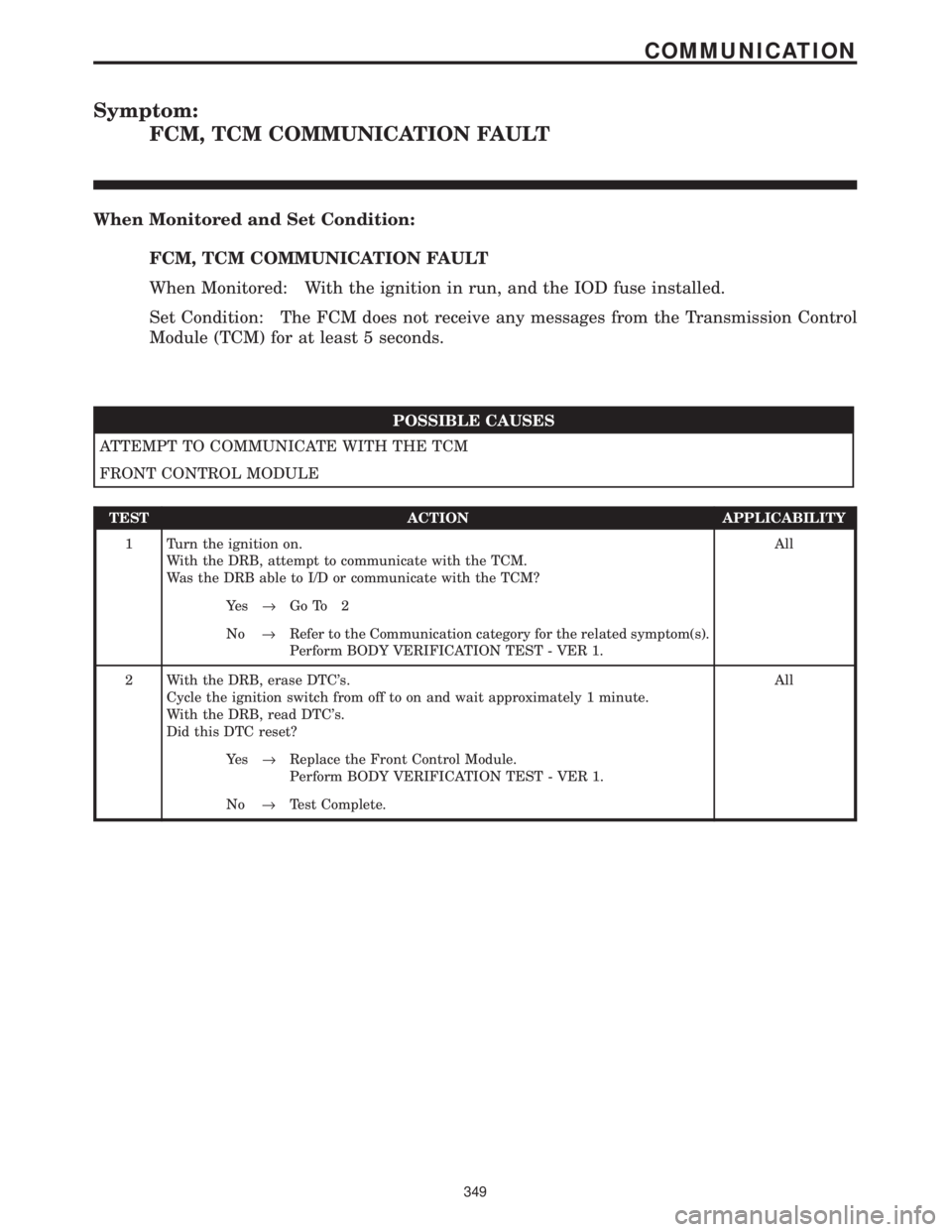
Symptom:
FCM, TCM COMMUNICATION FAULT
When Monitored and Set Condition:
FCM, TCM COMMUNICATION FAULT
When Monitored: With the ignition in run, and the IOD fuse installed.
Set Condition: The FCM does not receive any messages from the Transmission Control
Module (TCM) for at least 5 seconds.
POSSIBLE CAUSES
ATTEMPT TO COMMUNICATE WITH THE TCM
FRONT CONTROL MODULE
TEST ACTION APPLICABILITY
1 Turn the ignition on.
With the DRB, attempt to communicate with the TCM.
Was the DRB able to I/D or communicate with the TCM?All
Ye s®Go To 2
No®Refer to the Communication category for the related symptom(s).
Perform BODY VERIFICATION TEST - VER 1.
2 With the DRB, erase DTC's.
Cycle the ignition switch from off to on and wait approximately 1 minute.
With the DRB, read DTC's.
Did this DTC reset?All
Ye s®Replace the Front Control Module.
Perform BODY VERIFICATION TEST - VER 1.
No®Test Complete.
349
COMMUNICATION
Page 379 of 4284
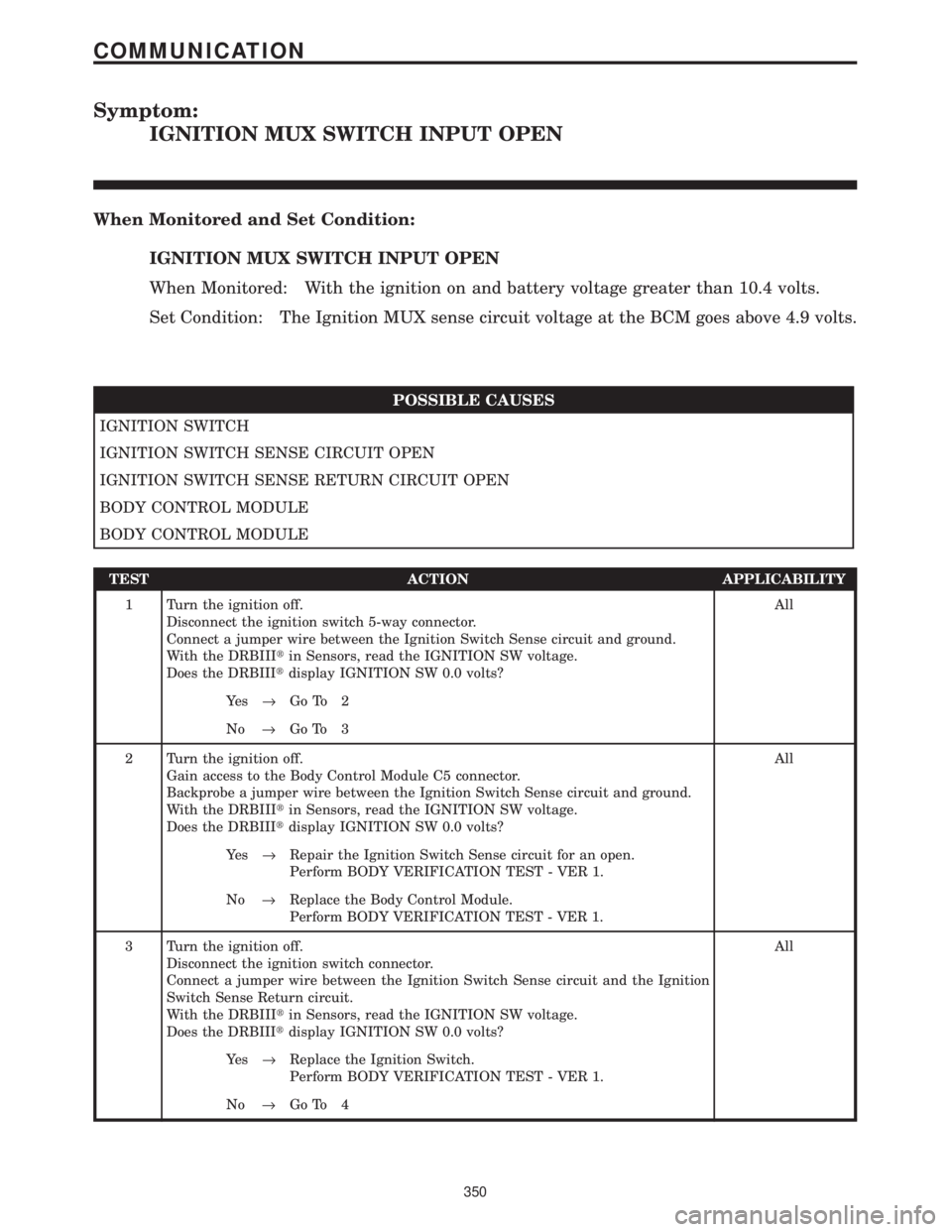
Symptom:
IGNITION MUX SWITCH INPUT OPEN
When Monitored and Set Condition:
IGNITION MUX SWITCH INPUT OPEN
When Monitored: With the ignition on and battery voltage greater than 10.4 volts.
Set Condition: The Ignition MUX sense circuit voltage at the BCM goes above 4.9 volts.
POSSIBLE CAUSES
IGNITION SWITCH
IGNITION SWITCH SENSE CIRCUIT OPEN
IGNITION SWITCH SENSE RETURN CIRCUIT OPEN
BODY CONTROL MODULE
BODY CONTROL MODULE
TEST ACTION APPLICABILITY
1 Turn the ignition off.
Disconnect the ignition switch 5-way connector.
Connect a jumper wire between the Ignition Switch Sense circuit and ground.
With the DRBIIItin Sensors, read the IGNITION SW voltage.
Does the DRBIIItdisplay IGNITION SW 0.0 volts?All
Ye s®Go To 2
No®Go To 3
2 Turn the ignition off.
Gain access to the Body Control Module C5 connector.
Backprobe a jumper wire between the Ignition Switch Sense circuit and ground.
With the DRBIIItin Sensors, read the IGNITION SW voltage.
Does the DRBIIItdisplay IGNITION SW 0.0 volts?All
Ye s®Repair the Ignition Switch Sense circuit for an open.
Perform BODY VERIFICATION TEST - VER 1.
No®Replace the Body Control Module.
Perform BODY VERIFICATION TEST - VER 1.
3 Turn the ignition off.
Disconnect the ignition switch connector.
Connect a jumper wire between the Ignition Switch Sense circuit and the Ignition
Switch Sense Return circuit.
With the DRBIIItin Sensors, read the IGNITION SW voltage.
Does the DRBIIItdisplay IGNITION SW 0.0 volts?All
Ye s®Replace the Ignition Switch.
Perform BODY VERIFICATION TEST - VER 1.
No®Go To 4
350
COMMUNICATION
Page 380 of 4284
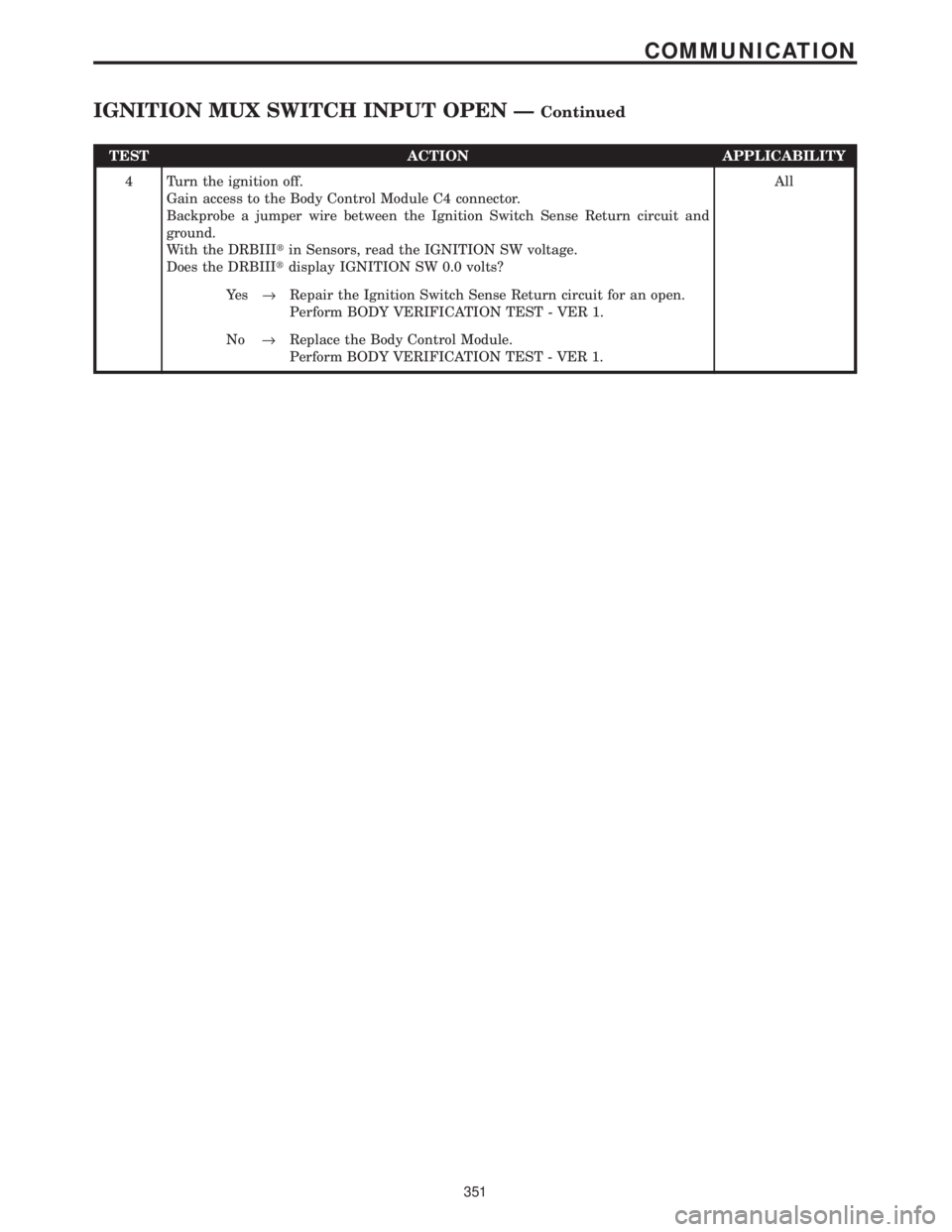
TEST ACTION APPLICABILITY
4 Turn the ignition off.
Gain access to the Body Control Module C4 connector.
Backprobe a jumper wire between the Ignition Switch Sense Return circuit and
ground.
With the DRBIIItin Sensors, read the IGNITION SW voltage.
Does the DRBIIItdisplay IGNITION SW 0.0 volts?All
Ye s®Repair the Ignition Switch Sense Return circuit for an open.
Perform BODY VERIFICATION TEST - VER 1.
No®Replace the Body Control Module.
Perform BODY VERIFICATION TEST - VER 1.
351
COMMUNICATION
IGNITION MUX SWITCH INPUT OPEN ÐContinued
Page 381 of 4284
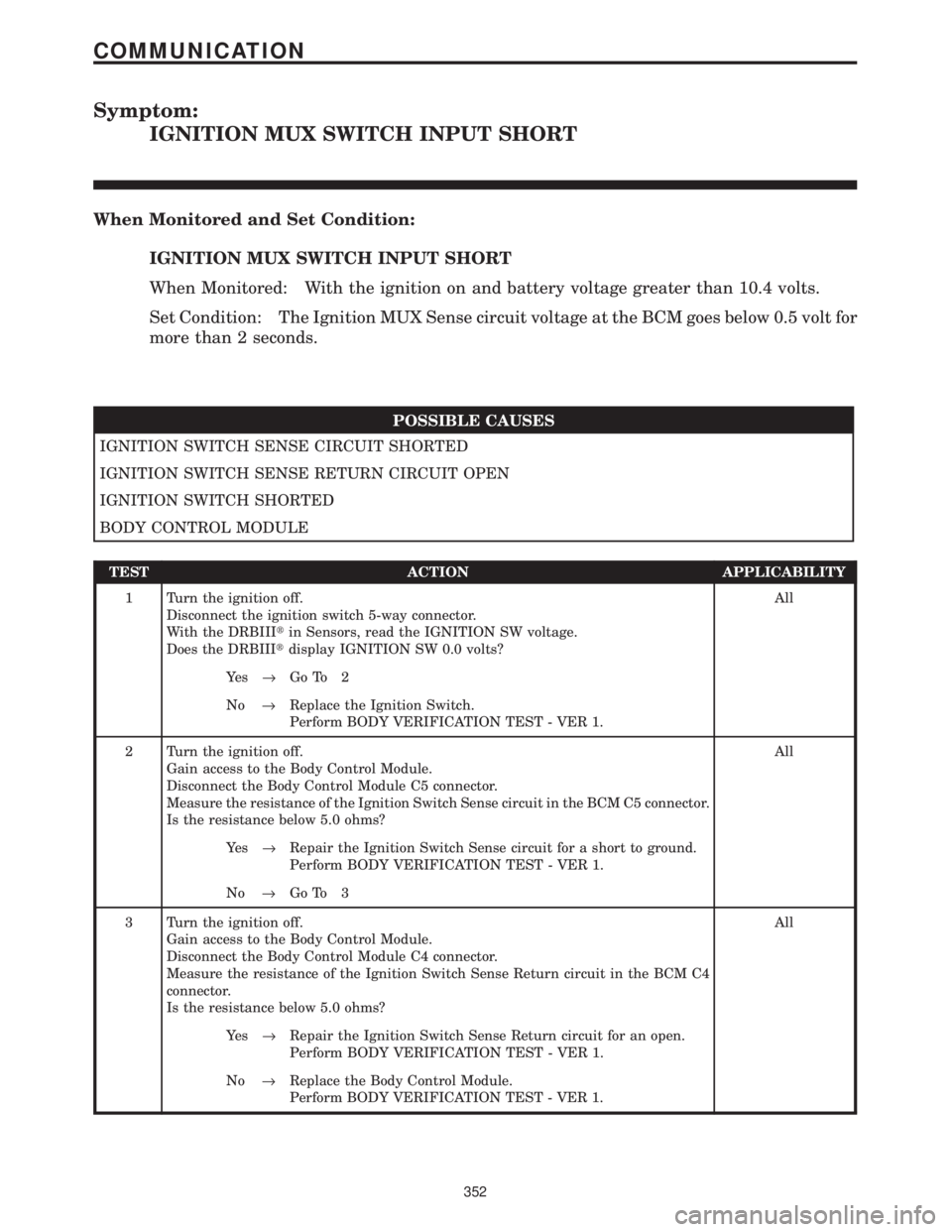
Symptom:
IGNITION MUX SWITCH INPUT SHORT
When Monitored and Set Condition:
IGNITION MUX SWITCH INPUT SHORT
When Monitored: With the ignition on and battery voltage greater than 10.4 volts.
Set Condition: The Ignition MUX Sense circuit voltage at the BCM goes below 0.5 volt for
more than 2 seconds.
POSSIBLE CAUSES
IGNITION SWITCH SENSE CIRCUIT SHORTED
IGNITION SWITCH SENSE RETURN CIRCUIT OPEN
IGNITION SWITCH SHORTED
BODY CONTROL MODULE
TEST ACTION APPLICABILITY
1 Turn the ignition off.
Disconnect the ignition switch 5-way connector.
With the DRBIIItin Sensors, read the IGNITION SW voltage.
Does the DRBIIItdisplay IGNITION SW 0.0 volts?All
Ye s®Go To 2
No®Replace the Ignition Switch.
Perform BODY VERIFICATION TEST - VER 1.
2 Turn the ignition off.
Gain access to the Body Control Module.
Disconnect the Body Control Module C5 connector.
Measure the resistance of the Ignition Switch Sense circuit in the BCM C5 connector.
Is the resistance below 5.0 ohms?All
Ye s®Repair the Ignition Switch Sense circuit for a short to ground.
Perform BODY VERIFICATION TEST - VER 1.
No®Go To 3
3 Turn the ignition off.
Gain access to the Body Control Module.
Disconnect the Body Control Module C4 connector.
Measure the resistance of the Ignition Switch Sense Return circuit in the BCM C4
connector.
Is the resistance below 5.0 ohms?All
Ye s®Repair the Ignition Switch Sense Return circuit for an open.
Perform BODY VERIFICATION TEST - VER 1.
No®Replace the Body Control Module.
Perform BODY VERIFICATION TEST - VER 1.
352
COMMUNICATION
Page 382 of 4284

Symptom:
IGNITION RUN OUTPUT SHORT
When Monitored and Set Condition:
IGNITION RUN OUTPUT SHORT
When Monitored: With the ignition on and battery voltage greater than 10.4 volts.
Set Condition: The Ignition Switch Output circuit(s) from the BCM to the HVAC,
Overhead Console, or the ABS controller are open or go below 0.5 volt for more than 2
seconds.
POSSIBLE CAUSES
TEST FOR CURRENT DTC'S
BODY CONTROL MODULE IGNITION OUTPUT INOPERATIVE (HVAC)
BODY CONTROL MODULE IGNITION OUTPUT CIRCUIT OPEN (HVAC)
BODY CONTROL MODULE IGNITION OUTPUT CIRCUIT SHORTED (HVAC)
BODY CONTROL MODULE IGNITION OUTPUT INOPERATIVE (OVERHEAD)
BODY CONTROL MODULE IGNITION OUTPUT CIRCUIT OPEN (OVERHEAD)
BODY CONTROL MODULE IGNITION OUTPUT CIRCUIT SHORTED (OVERHEAD)
BODY CONTROL MODULE IGNITION OUTPUT INOPERATIVE (ABS)
BODY CONTROL MODULE IGNITION OUTPUT CIRCUIT OPEN (ABS)
BODY CONTROL MODULE IGNITION OUTPUT CIRCUIT SHORTED (ABS)
BODY CONTROL MODULE
TEST ACTION APPLICABILITY
1 With the DRBIIIt, record and erase DTC's.
Cycle the ignition from ON to OFF.
Start the vehicle and observe the DRBIIIt.
With the DRBIIIt, read DTC's.
Does the DRBIIItdisplay IGNITION RUN OUTPUT SHORT?All
Ye s®Go To 2
No®The condition that caused this DTC is currently not present. Use
the wiring diagram/schematic as a guide, and inspect the related
wiring harness for a possible intermittent condition.
2 A failure in the HVAC, Overhead Console, or the ABS system could cause this DTC
to set. The Ignition Switch Run (HVAC) circuit will be diagnosed first.
Continue to the HVAC circuit for further diagnosis.All
HVAC circuit diagnostics.
Go To 3
353
COMMUNICATION
Page 383 of 4284
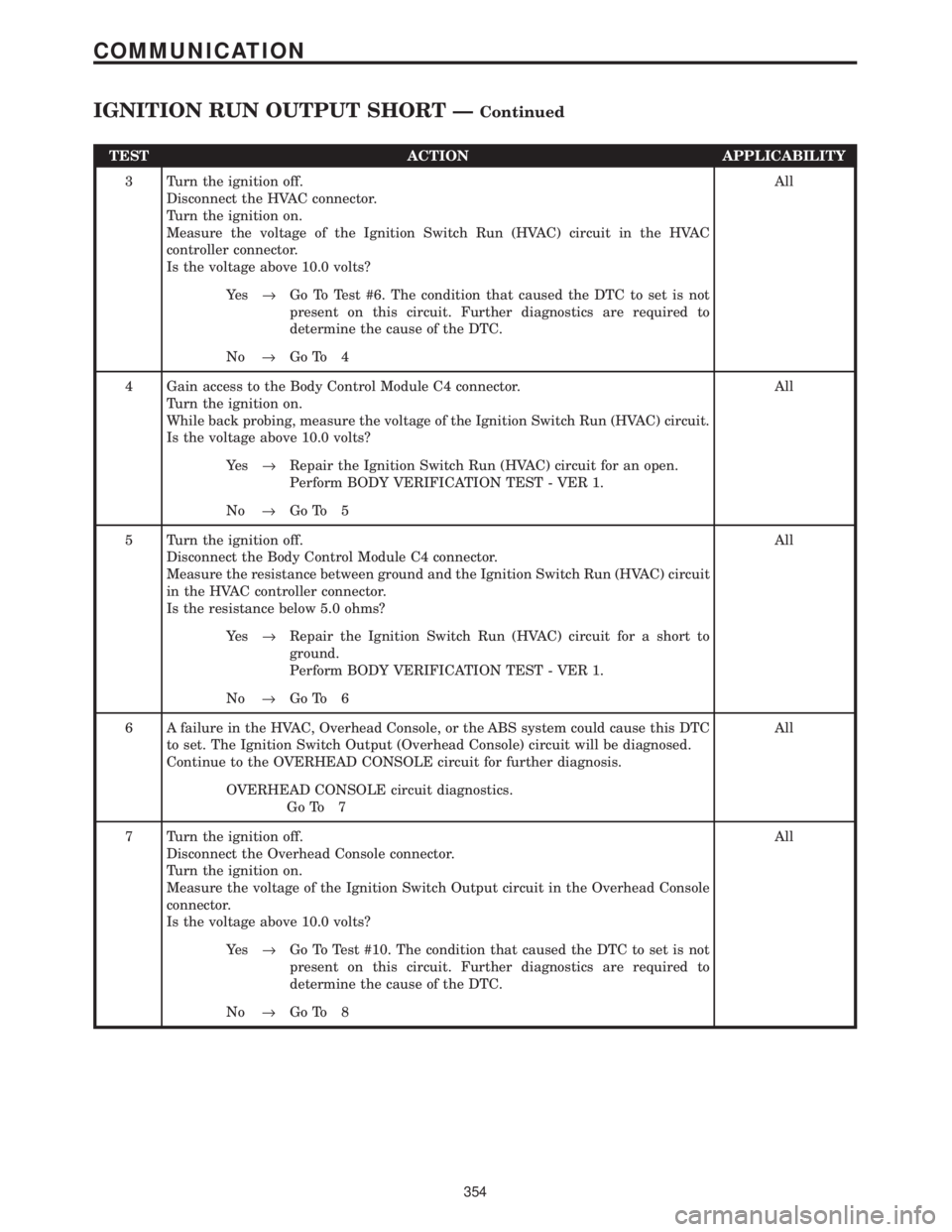
TEST ACTION APPLICABILITY
3 Turn the ignition off.
Disconnect the HVAC connector.
Turn the ignition on.
Measure the voltage of the Ignition Switch Run (HVAC) circuit in the HVAC
controller connector.
Is the voltage above 10.0 volts?All
Ye s®Go To Test #6. The condition that caused the DTC to set is not
present on this circuit. Further diagnostics are required to
determine the cause of the DTC.
No®Go To 4
4 Gain access to the Body Control Module C4 connector.
Turn the ignition on.
While back probing, measure the voltage of the Ignition Switch Run (HVAC) circuit.
Is the voltage above 10.0 volts?All
Ye s®Repair the Ignition Switch Run (HVAC) circuit for an open.
Perform BODY VERIFICATION TEST - VER 1.
No®Go To 5
5 Turn the ignition off.
Disconnect the Body Control Module C4 connector.
Measure the resistance between ground and the Ignition Switch Run (HVAC) circuit
in the HVAC controller connector.
Is the resistance below 5.0 ohms?All
Ye s®Repair the Ignition Switch Run (HVAC) circuit for a short to
ground.
Perform BODY VERIFICATION TEST - VER 1.
No®Go To 6
6 A failure in the HVAC, Overhead Console, or the ABS system could cause this DTC
to set. The Ignition Switch Output (Overhead Console) circuit will be diagnosed.
Continue to the OVERHEAD CONSOLE circuit for further diagnosis.All
OVERHEAD CONSOLE circuit diagnostics.
Go To 7
7 Turn the ignition off.
Disconnect the Overhead Console connector.
Turn the ignition on.
Measure the voltage of the Ignition Switch Output circuit in the Overhead Console
connector.
Is the voltage above 10.0 volts?All
Ye s®Go To Test #10. The condition that caused the DTC to set is not
present on this circuit. Further diagnostics are required to
determine the cause of the DTC.
No®Go To 8
354
COMMUNICATION
IGNITION RUN OUTPUT SHORT ÐContinued