battery CHRYSLER VOYAGER 2001 Service Manual
[x] Cancel search | Manufacturer: CHRYSLER, Model Year: 2001, Model line: VOYAGER, Model: CHRYSLER VOYAGER 2001Pages: 4284, PDF Size: 83.53 MB
Page 3822 of 4284
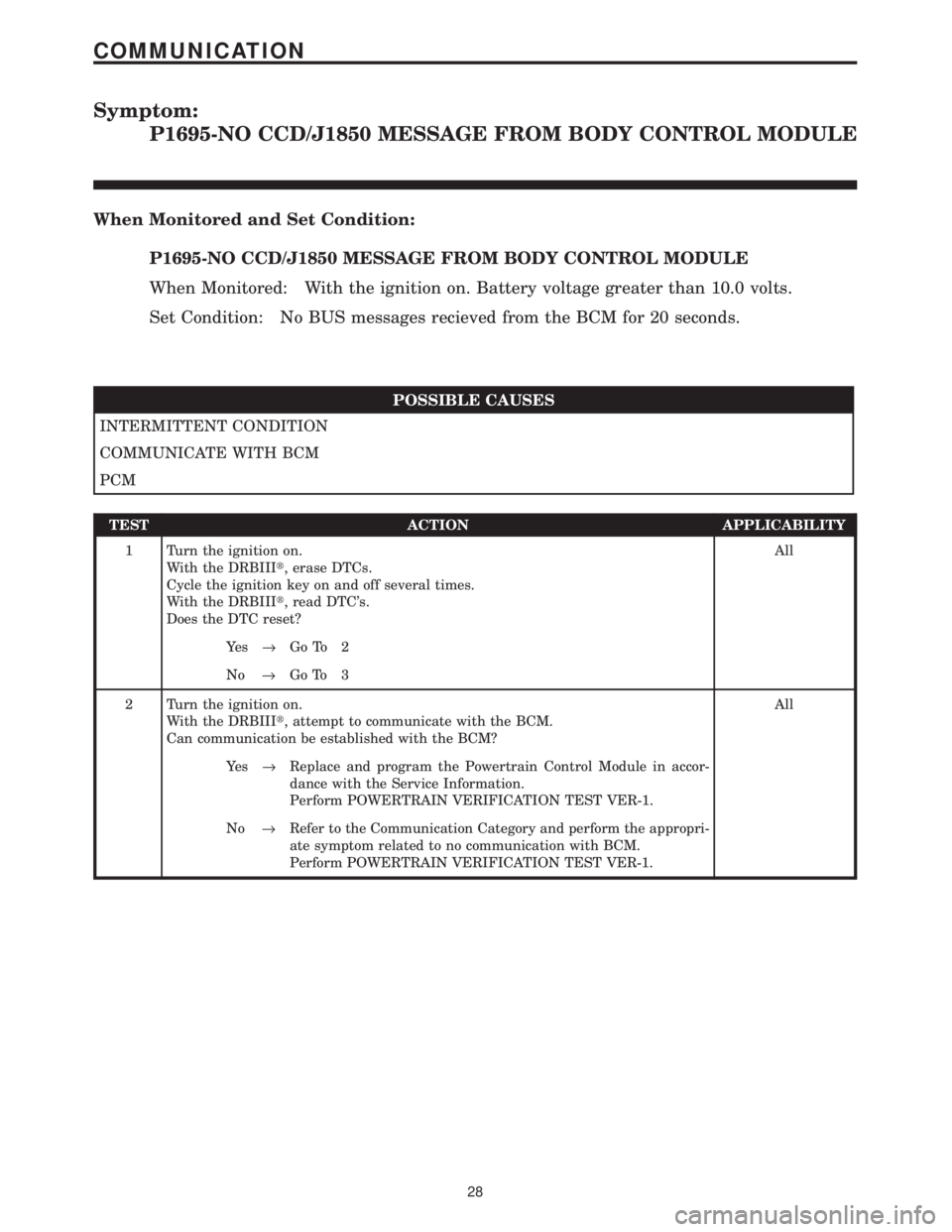
Symptom:
P1695-NO CCD/J1850 MESSAGE FROM BODY CONTROL MODULE
When Monitored and Set Condition:
P1695-NO CCD/J1850 MESSAGE FROM BODY CONTROL MODULE
When Monitored: With the ignition on. Battery voltage greater than 10.0 volts.
Set Condition: No BUS messages recieved from the BCM for 20 seconds.
POSSIBLE CAUSES
INTERMITTENT CONDITION
COMMUNICATE WITH BCM
PCM
TEST ACTION APPLICABILITY
1 Turn the ignition on.
With the DRBIIIt, erase DTCs.
Cycle the ignition key on and off several times.
With the DRBIIIt, read DTC's.
Does the DTC reset?All
Ye s®Go To 2
No®Go To 3
2 Turn the ignition on.
With the DRBIIIt, attempt to communicate with the BCM.
Can communication be established with the BCM?All
Ye s®Replace and program the Powertrain Control Module in accor-
dance with the Service Information.
Perform POWERTRAIN VERIFICATION TEST VER-1.
No®Refer to the Communication Category and perform the appropri-
ate symptom related to no communication with BCM.
Perform POWERTRAIN VERIFICATION TEST VER-1.
28
COMMUNICATION
Page 3826 of 4284
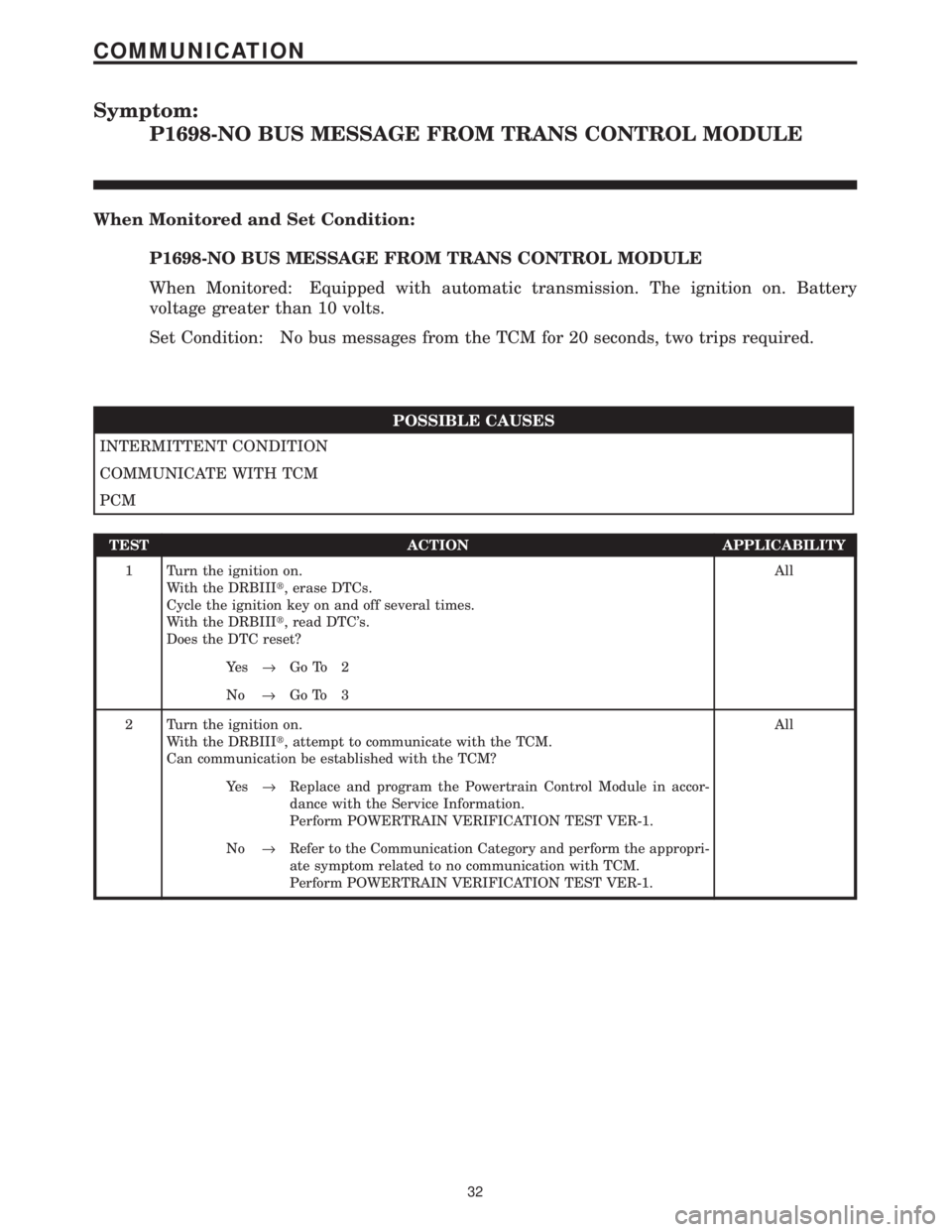
Symptom:
P1698-NO BUS MESSAGE FROM TRANS CONTROL MODULE
When Monitored and Set Condition:
P1698-NO BUS MESSAGE FROM TRANS CONTROL MODULE
When Monitored: Equipped with automatic transmission. The ignition on. Battery
voltage greater than 10 volts.
Set Condition: No bus messages from the TCM for 20 seconds, two trips required.
POSSIBLE CAUSES
INTERMITTENT CONDITION
COMMUNICATE WITH TCM
PCM
TEST ACTION APPLICABILITY
1 Turn the ignition on.
With the DRBIIIt, erase DTCs.
Cycle the ignition key on and off several times.
With the DRBIIIt, read DTC's.
Does the DTC reset?All
Ye s®Go To 2
No®Go To 3
2 Turn the ignition on.
With the DRBIIIt, attempt to communicate with the TCM.
Can communication be established with the TCM?All
Ye s®Replace and program the Powertrain Control Module in accor-
dance with the Service Information.
Perform POWERTRAIN VERIFICATION TEST VER-1.
No®Refer to the Communication Category and perform the appropri-
ate symptom related to no communication with TCM.
Perform POWERTRAIN VERIFICATION TEST VER-1.
32
COMMUNICATION
Page 3833 of 4284
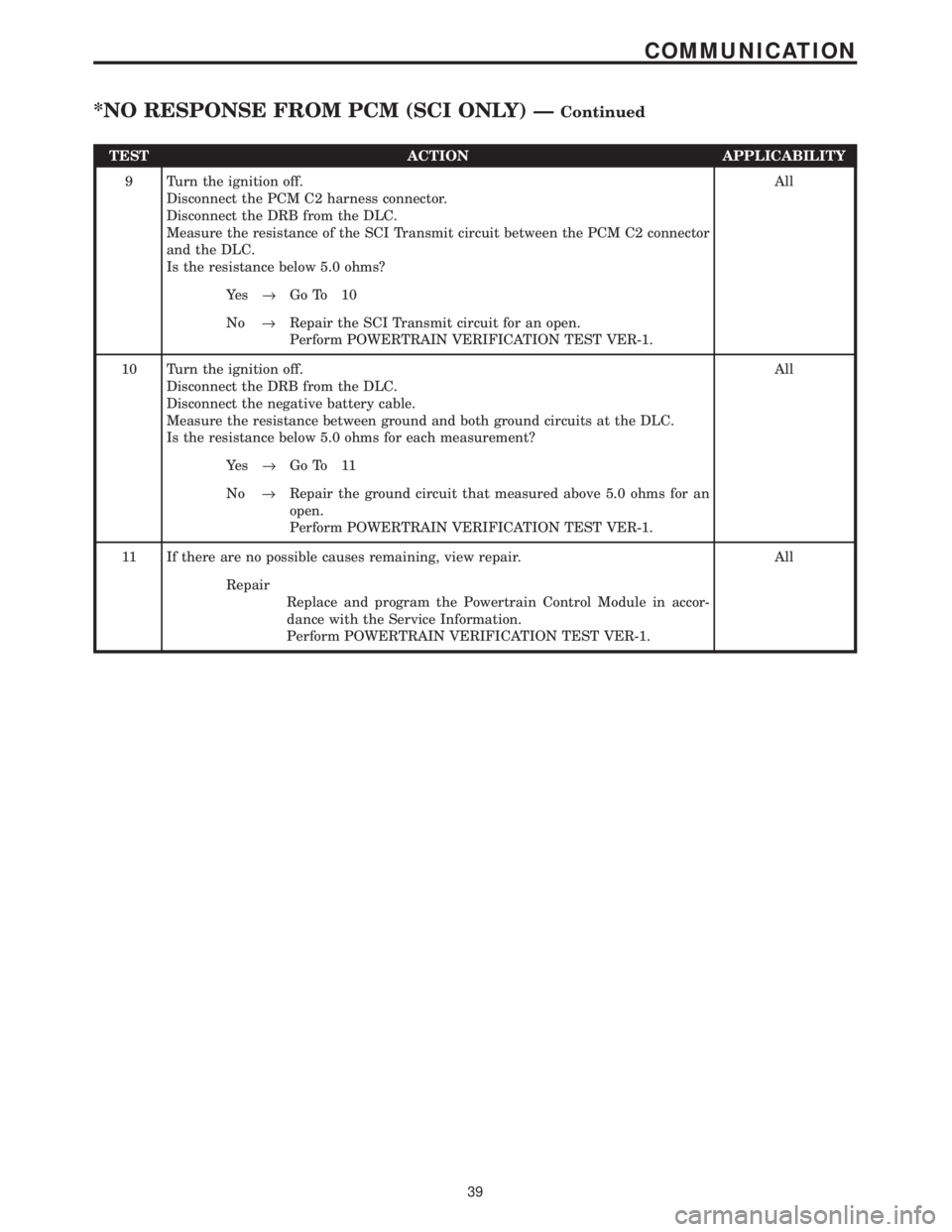
TEST ACTION APPLICABILITY
9 Turn the ignition off.
Disconnect the PCM C2 harness connector.
Disconnect the DRB from the DLC.
Measure the resistance of the SCI Transmit circuit between the PCM C2 connector
and the DLC.
Is the resistance below 5.0 ohms?All
Ye s®Go To 10
No®Repair the SCI Transmit circuit for an open.
Perform POWERTRAIN VERIFICATION TEST VER-1.
10 Turn the ignition off.
Disconnect the DRB from the DLC.
Disconnect the negative battery cable.
Measure the resistance between ground and both ground circuits at the DLC.
Is the resistance below 5.0 ohms for each measurement?All
Ye s®Go To 11
No®Repair the ground circuit that measured above 5.0 ohms for an
open.
Perform POWERTRAIN VERIFICATION TEST VER-1.
11 If there are no possible causes remaining, view repair. All
Repair
Replace and program the Powertrain Control Module in accor-
dance with the Service Information.
Perform POWERTRAIN VERIFICATION TEST VER-1.
39
COMMUNICATION
*NO RESPONSE FROM PCM (SCI ONLY) ÐContinued
Page 3835 of 4284
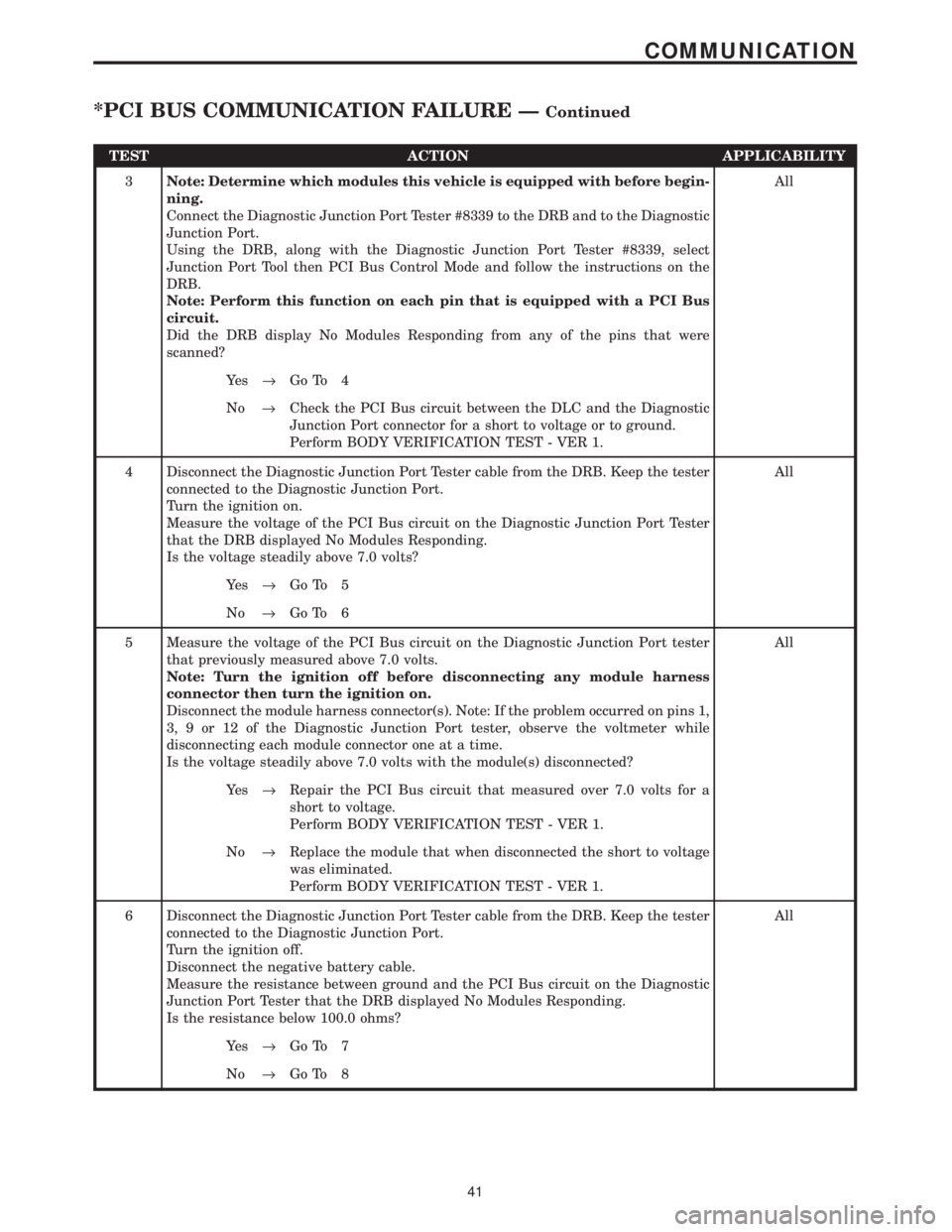
TEST ACTION APPLICABILITY
3Note: Determine which modules this vehicle is equipped with before begin-
ning.
Connect the Diagnostic Junction Port Tester #8339 to the DRB and to the Diagnostic
Junction Port.
Using the DRB, along with the Diagnostic Junction Port Tester #8339, select
Junction Port Tool then PCI Bus Control Mode and follow the instructions on the
DRB.
Note: Perform this function on each pin that is equipped with a PCI Bus
circuit.
Did the DRB display No Modules Responding from any of the pins that were
scanned?All
Ye s®Go To 4
No®Check the PCI Bus circuit between the DLC and the Diagnostic
Junction Port connector for a short to voltage or to ground.
Perform BODY VERIFICATION TEST - VER 1.
4 Disconnect the Diagnostic Junction Port Tester cable from the DRB. Keep the tester
connected to the Diagnostic Junction Port.
Turn the ignition on.
Measure the voltage of the PCI Bus circuit on the Diagnostic Junction Port Tester
that the DRB displayed No Modules Responding.
Is the voltage steadily above 7.0 volts?All
Ye s®Go To 5
No®Go To 6
5 Measure the voltage of the PCI Bus circuit on the Diagnostic Junction Port tester
that previously measured above 7.0 volts.
Note: Turn the ignition off before disconnecting any module harness
connector then turn the ignition on.
Disconnect the module harness connector(s). Note: If the problem occurred on pins 1,
3, 9 or 12 of the Diagnostic Junction Port tester, observe the voltmeter while
disconnecting each module connector one at a time.
Is the voltage steadily above 7.0 volts with the module(s) disconnected?All
Ye s®Repair the PCI Bus circuit that measured over 7.0 volts for a
short to voltage.
Perform BODY VERIFICATION TEST - VER 1.
No®Replace the module that when disconnected the short to voltage
was eliminated.
Perform BODY VERIFICATION TEST - VER 1.
6 Disconnect the Diagnostic Junction Port Tester cable from the DRB. Keep the tester
connected to the Diagnostic Junction Port.
Turn the ignition off.
Disconnect the negative battery cable.
Measure the resistance between ground and the PCI Bus circuit on the Diagnostic
Junction Port Tester that the DRB displayed No Modules Responding.
Is the resistance below 100.0 ohms?All
Ye s®Go To 7
No®Go To 8
41
COMMUNICATION
*PCI BUS COMMUNICATION FAILURE ÐContinued
Page 3836 of 4284
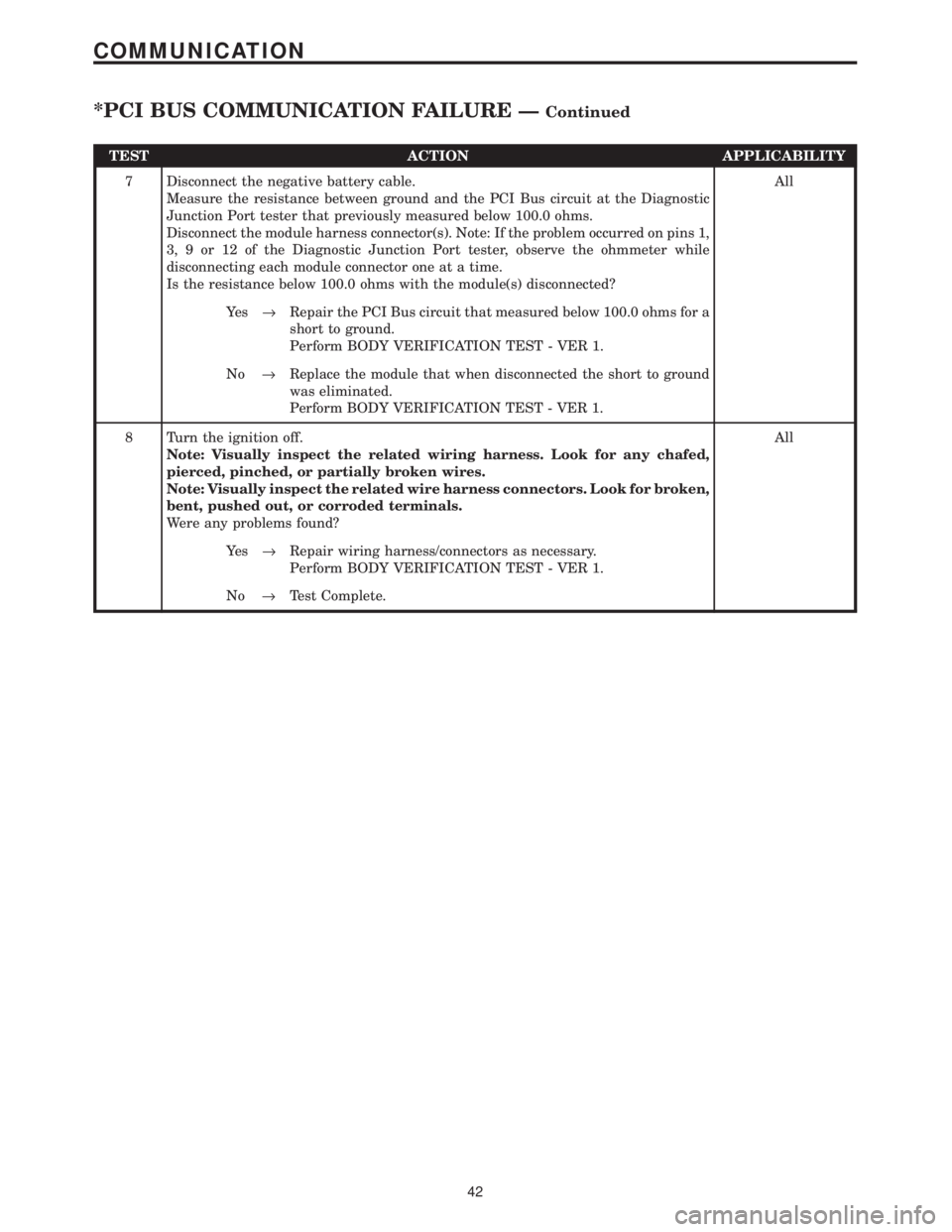
TEST ACTION APPLICABILITY
7 Disconnect the negative battery cable.
Measure the resistance between ground and the PCI Bus circuit at the Diagnostic
Junction Port tester that previously measured below 100.0 ohms.
Disconnect the module harness connector(s). Note: If the problem occurred on pins 1,
3, 9 or 12 of the Diagnostic Junction Port tester, observe the ohmmeter while
disconnecting each module connector one at a time.
Is the resistance below 100.0 ohms with the module(s) disconnected?All
Ye s®Repair the PCI Bus circuit that measured below 100.0 ohms for a
short to ground.
Perform BODY VERIFICATION TEST - VER 1.
No®Replace the module that when disconnected the short to ground
was eliminated.
Perform BODY VERIFICATION TEST - VER 1.
8 Turn the ignition off.
Note: Visually inspect the related wiring harness. Look for any chafed,
pierced, pinched, or partially broken wires.
Note: Visually inspect the related wire harness connectors. Look for broken,
bent, pushed out, or corroded terminals.
Were any problems found?All
Ye s®Repair wiring harness/connectors as necessary.
Perform BODY VERIFICATION TEST - VER 1.
No®Test Complete.
42
COMMUNICATION
*PCI BUS COMMUNICATION FAILURE ÐContinued
Page 3842 of 4284

Symptom:
P0107-MAP SENSOR VOLTAGE TOO LOW
When Monitored and Set Condition:
P0107-MAP SENSOR VOLTAGE TOO LOW
When Monitored: Engine speed between 600 to 3500 RPM. TPS voltage less than 1.2
volts. Battery voltage greater than 10 volts.
Set Condition: The MAP sensor signal voltage is below 0.0392 volt for 1.7 seconds.
POSSIBLE CAUSES
INTERMITTENT CONDITION
5 VOLT SUPPLY CIRCUIT SHORTED TO GROUND
5 VOLT SUPPLY CIRCUIT OPEN
MAP SENSOR INTERNAL FAILURE
MAP SENSOR SIGNAL CIRCUIT SHORTED TO GROUND
MAP SENSOR SIGNAL CIRCUIT SHORTED TO SENSOR GROUND CIRCUIT
PCM 5 VOLT SUPPLY CIRCUIT
PCM MAP SENSOR SIGNAL
TEST ACTION APPLICABILITY
1 Turn the ignition on.
With the DRBIIIt, read the MAP Sensor voltage.
Is the voltage below 1.2 volts.All
Ye s®Go To 3
No®Go To 2
2 Start the engine.
With the DRBIIIt, read the MAP Sensor voltage.
Is the voltage below .04 volts.All
Ye s®Go To 3
No®Go To 11
3 Turn the ignition off.
Disconnect the MAP Sensor harness connector.
Turn the ignition on.
Measure the voltage of the 5 Volt Supply circuit in the MAP Sensor harness
connector.
Is the voltage between 4.5 to 5.2 volts?All
Ye s®Go To 4
No®Go To 8
48
DRIVEABILITY - GAS
Page 3845 of 4284

Symptom:
P0108-MAP SENSOR VOLTAGE TOO HIGH
When Monitored and Set Condition:
P0108-MAP SENSOR VOLTAGE TOO HIGH
When Monitored: Engine speed between 600 to 3500 RPM. TP sensor voltage less than
1.2 volts. Battery voltage greater than 10 volts
Set Condition: The MAP sensor signal voltage is greater than 4.96 volts.
POSSIBLE CAUSES
INTERMITTENT CONDITION
MAP SENSOR SIGNAL CIRCUIT SHORTED TO 5 VOLT SUPPLY CIRCUIT
MAP SENSOR SIGNAL CIRCUIT SHORTED TO BATTERY VOLTAGE
MAP SENSOR INTERNAL FAILURE
MAP SENSOR SIGNAL CIRCUIT OPEN
SENSOR GROUND CIRCUIT OPEN
PCM
TEST ACTION APPLICABILITY
1 Start the engine.
With the DRBIIIt, read the MAP Sensor voltage.
Is the voltage above 4.6 volts.All
Ye s®Go To 2
No®Go To 8
2 Turn the ignition off.
Disconnect the MAP Sensor harness connector.
Disconnect the PCM harness connector.
Measure the resistance between the MAP Sensor Signal circuit and the 5 Volt Supply
circuit in the MAP Sensor harness connector.
Is the resistance below 100 ohms?All
Ye s®Repair the MAP Sensor Signal circuit for a short to the 5 Volt
Supply circuit.
Perform POWERTRAIN VERIFICATION TEST VER - 5.
No®Go To 3
51
DRIVEABILITY - GAS
Page 3846 of 4284
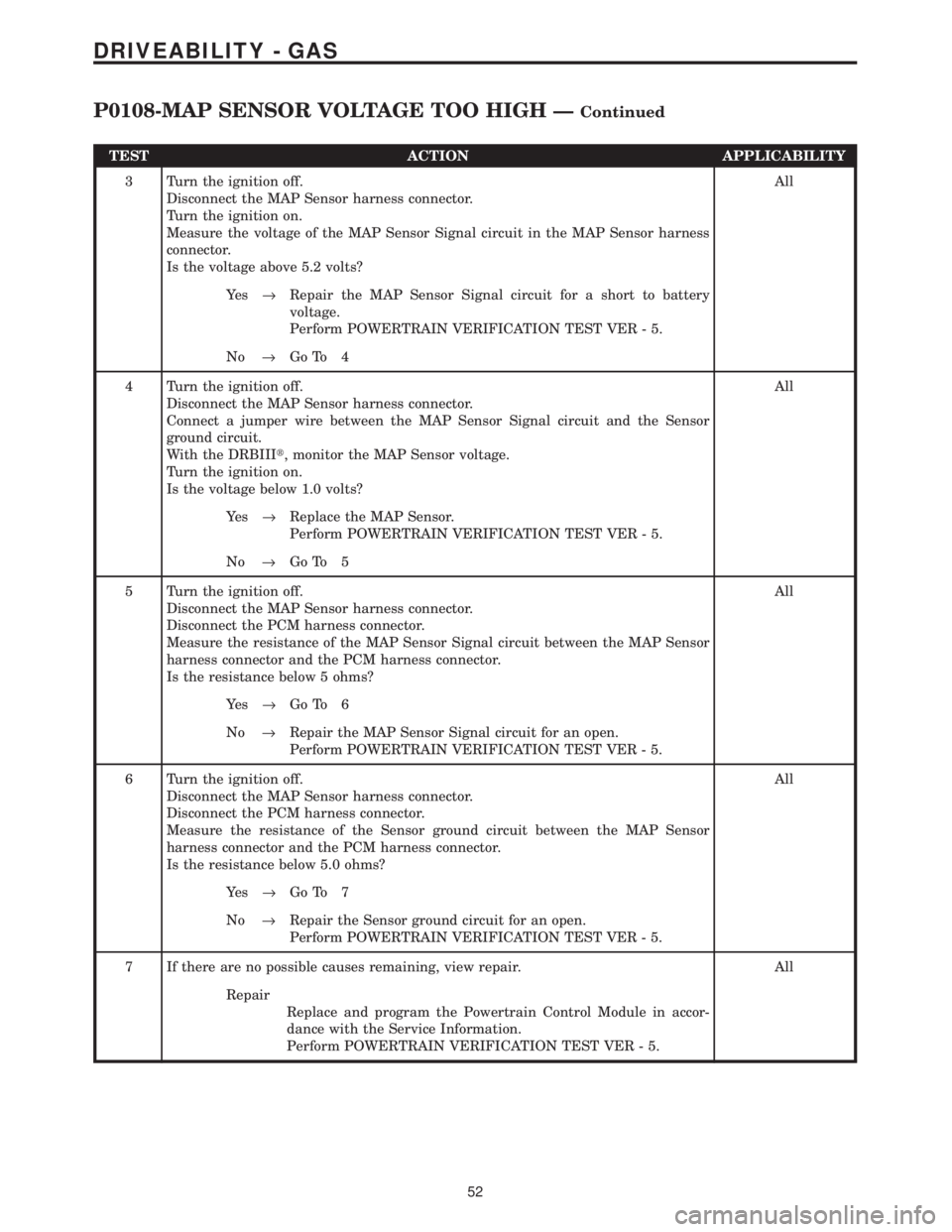
TEST ACTION APPLICABILITY
3 Turn the ignition off.
Disconnect the MAP Sensor harness connector.
Turn the ignition on.
Measure the voltage of the MAP Sensor Signal circuit in the MAP Sensor harness
connector.
Is the voltage above 5.2 volts?All
Ye s®Repair the MAP Sensor Signal circuit for a short to battery
voltage.
Perform POWERTRAIN VERIFICATION TEST VER - 5.
No®Go To 4
4 Turn the ignition off.
Disconnect the MAP Sensor harness connector.
Connect a jumper wire between the MAP Sensor Signal circuit and the Sensor
ground circuit.
With the DRBIIIt, monitor the MAP Sensor voltage.
Turn the ignition on.
Is the voltage below 1.0 volts?All
Ye s®Replace the MAP Sensor.
Perform POWERTRAIN VERIFICATION TEST VER - 5.
No®Go To 5
5 Turn the ignition off.
Disconnect the MAP Sensor harness connector.
Disconnect the PCM harness connector.
Measure the resistance of the MAP Sensor Signal circuit between the MAP Sensor
harness connector and the PCM harness connector.
Is the resistance below 5 ohms?All
Ye s®Go To 6
No®Repair the MAP Sensor Signal circuit for an open.
Perform POWERTRAIN VERIFICATION TEST VER - 5.
6 Turn the ignition off.
Disconnect the MAP Sensor harness connector.
Disconnect the PCM harness connector.
Measure the resistance of the Sensor ground circuit between the MAP Sensor
harness connector and the PCM harness connector.
Is the resistance below 5.0 ohms?All
Ye s®Go To 7
No®Repair the Sensor ground circuit for an open.
Perform POWERTRAIN VERIFICATION TEST VER - 5.
7 If there are no possible causes remaining, view repair. All
Repair
Replace and program the Powertrain Control Module in accor-
dance with the Service Information.
Perform POWERTRAIN VERIFICATION TEST VER - 5.
52
DRIVEABILITY - GAS
P0108-MAP SENSOR VOLTAGE TOO HIGH ÐContinued
Page 3848 of 4284

Symptom:
P0117-ECT SENSOR VOLTAGE TOO LOW
When Monitored and Set Condition:
P0117-ECT SENSOR VOLTAGE TOO LOW
When Monitored: With the ignition on. Battery voltage greater than 10 volts.
Set Condition: The Engine Coolant Temperature (ECT) sensor circuit voltage at the PCM
is less than 0.8 volt for more than 2.6 seconds.
POSSIBLE CAUSES
INTERMITTENT CONDITION
ECT SENSOR INTERNAL FAILURE
ECT SENSOR SIGNAL SHORTED TO GROUND
ECT SENSOR SIGNAL SHORTED TO SENSOR GROUND CIRCUIT
PCM
TEST ACTION APPLICABILITY
1 Turn the ignition on.
With the DRBIIIt, read the ECT voltage.
Is the voltage below 1.0 volt?All
Ye s®Go To 2
No®Go To 6
2 Turn the ignition off.
Disconnect the ECT harness connector.
Turn the ignition on.
With the DRBIIIt, read ECT voltage.
Is the voltage above 1.0 volt?All
Ye s®Replace the ECT Sensor.
Perform POWERTRAIN VERIFICATION TEST VER - 5.
No®Go To 3
3 Turn the ignition off.
Disconnect the ECT Sensor harness connector.
Disconnect the PCM harness connector.
Measure the resistance of the ECT Sensor Signal circuit in the ECT Sensor harness
connector to ground.
Is the resistance below 100 ohms?All
Ye s®Repair the ECT Sensor Signal circuit for a short to ground.
Perform POWERTRAIN VERIFICATION TEST VER - 5.
No®Go To 4
54
DRIVEABILITY - GAS
Page 3850 of 4284

Symptom:
P0118-ECT SENSOR VOLTAGE TOO HIGH
When Monitored and Set Condition:
P0118-ECT SENSOR VOLTAGE TOO HIGH
When Monitored: With the ignition on. Battery voltage greater than 10 volts.
Set Condition: The Engine Coolant Temperature (ECT) sensor circuit voltage at the PCM
is greater than 4.96 volts for more than 2.6 seconds.
POSSIBLE CAUSES
INTERMITTENT CONDITION
ECT SENSOR SIGNAL CIRCUIT SHORTED TO BATTERY VOLTAGE
ECT SENSOR INTERNAL FAILURE
ECT SENSOR SIGNAL CIRCUIT OPEN
SENSOR GROUND CIRCUIT OPEN
PCM
TEST ACTION APPLICABILITY
1 Turn the ignition on.
With the DRBIIIt, read the ECT voltage.
Is the voltage above 4.6 volts?All
Ye s®Go To 2
No®Go To 7
2 Turn the ignition off.
Disconnect the ECT Sensor harness connector.
Turn the ignition on.
Measure the voltage of the ECT Sensor Signal circuit in the ECT Sensor harness
connector.
Is the voltage above 5.2 volts?All
Ye s®Repair the ECT Sensor Signal circuit for a short to battery
voltage.
Perform POWERTRAIN VERIFICATION TEST VER - 5.
No®Go To 3
56
DRIVEABILITY - GAS