instrument panel CHRYSLER VOYAGER 2004 User Guide
[x] Cancel search | Manufacturer: CHRYSLER, Model Year: 2004, Model line: VOYAGER, Model: CHRYSLER VOYAGER 2004Pages: 2585, PDF Size: 62.54 MB
Page 282 of 2585
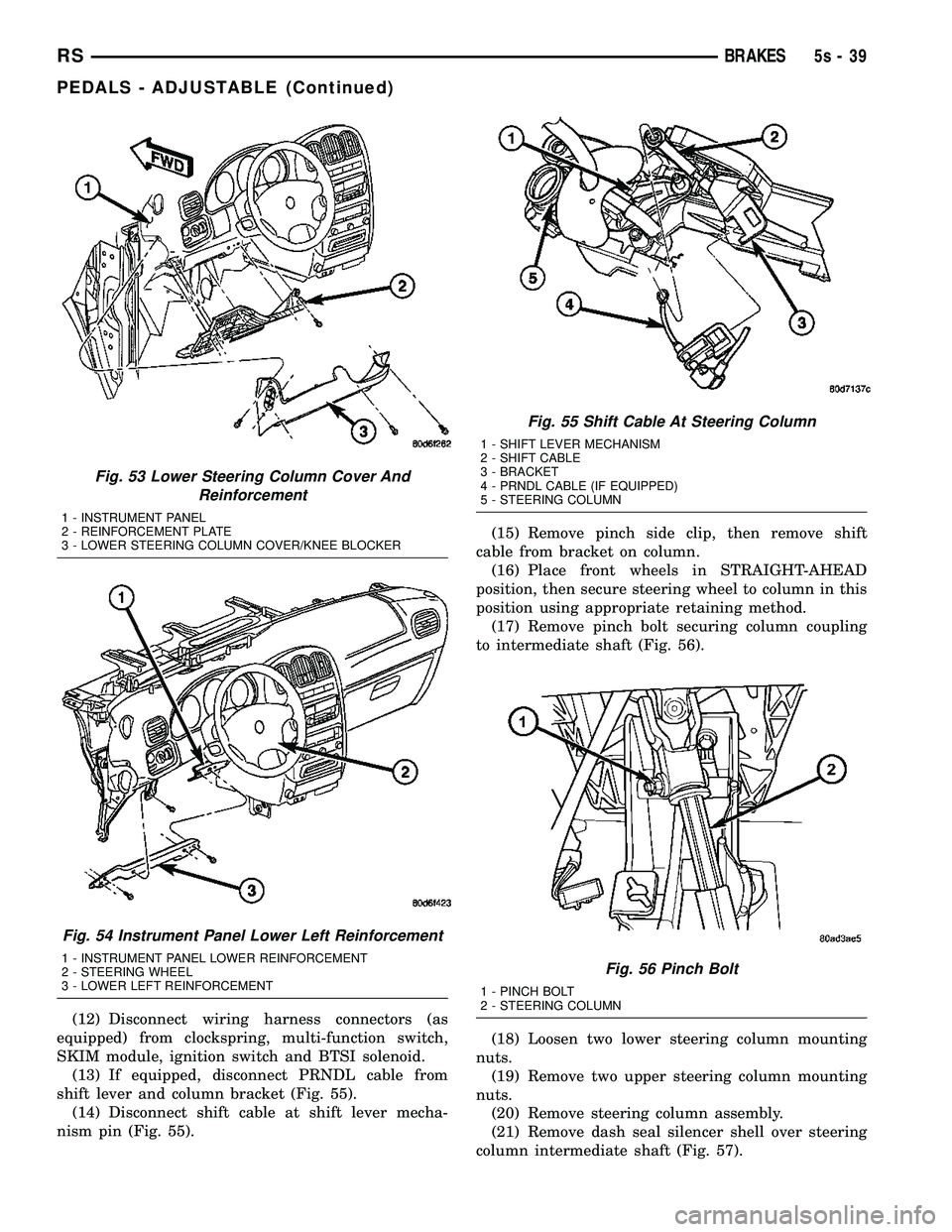
(12) Disconnect wiring harness connectors (as
equipped) from clockspring, multi-function switch,
SKIM module, ignition switch and BTSI solenoid. (13) If equipped, disconnect PRNDL cable from
shift lever and column bracket (Fig. 55). (14) Disconnect shift cable at shift lever mecha-
nism pin (Fig. 55). (15) Remove pinch side clip, then remove shift
cable from bracket on column. (16) Place front wheels in STRAIGHT-AHEAD
position, then secure steering wheel to column in this
position using appropriate retaining method. (17) Remove pinch bolt securing column coupling
to intermediate shaft (Fig. 56).
(18) Loosen two lower steering column mounting
nuts. (19) Remove two upper steering column mounting
nuts. (20) Remove steering column assembly.
(21) Remove dash seal silencer shell over steering
column intermediate shaft (Fig. 57).
Fig. 53 Lower Steering Column Cover And Reinforcement
1 - INSTRUMENT PANEL
2 - REINFORCEMENT PLATE
3 - LOWER STEERING COLUMN COVER/KNEE BLOCKER
Fig. 54 Instrument Panel Lower Left Reinforcement
1 - INSTRUMENT PANEL LOWER REINFORCEMENT
2 - STEERING WHEEL
3 - LOWER LEFT REINFORCEMENT
Fig. 55 Shift Cable At Steering Column
1 - SHIFT LEVER MECHANISM
2 - SHIFT CABLE
3 - BRACKET
4 - PRNDL CABLE (IF EQUIPPED)
5 - STEERING COLUMN
Fig. 56 Pinch Bolt
1 - PINCH BOLT
2 - STEERING COLUMN
RS BRAKES5s-39
PEDALS - ADJUSTABLE (Continued)
Page 283 of 2585
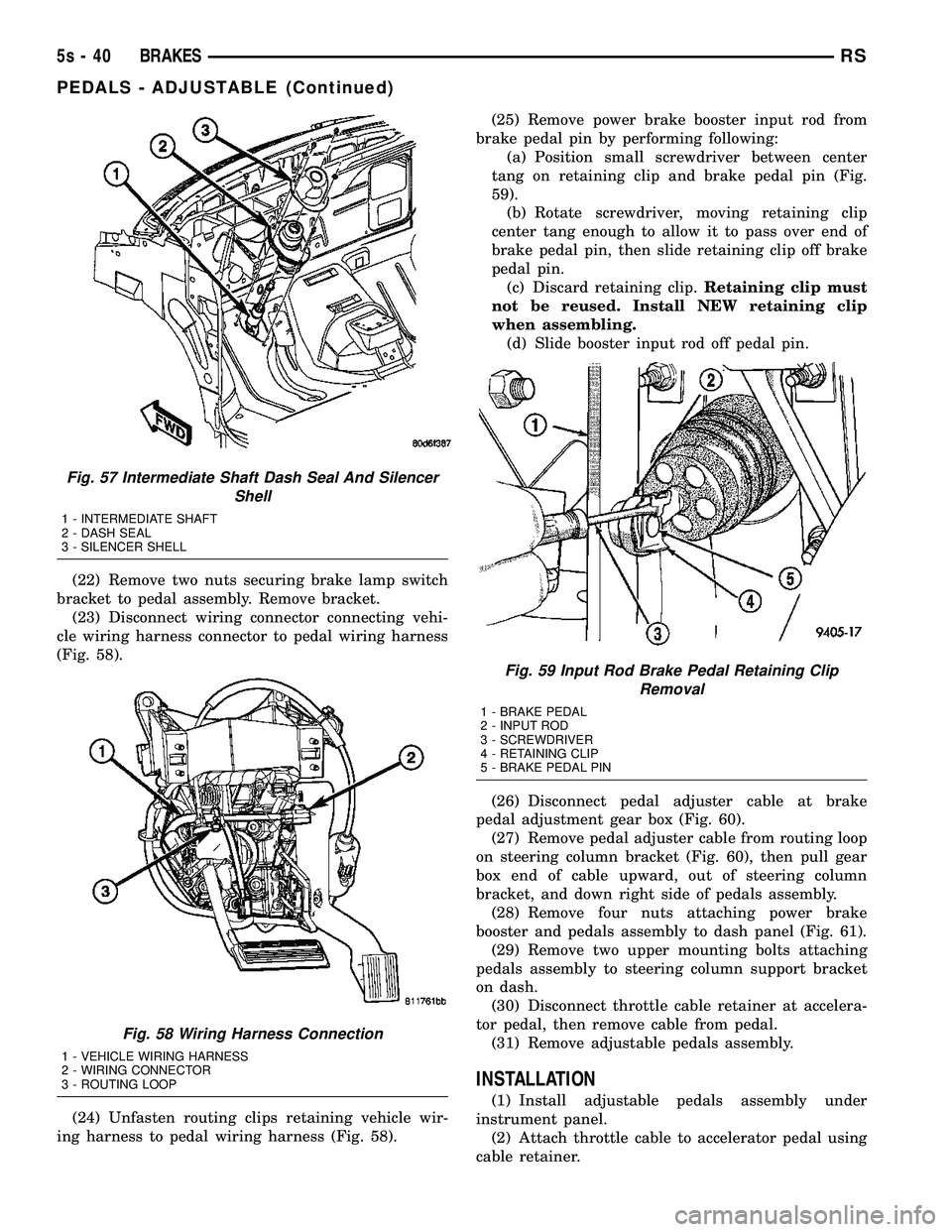
(22) Remove two nuts securing brake lamp switch
bracket to pedal assembly. Remove bracket. (23) Disconnect wiring connector connecting vehi-
cle wiring harness connector to pedal wiring harness
(Fig. 58).
(24) Unfasten routing clips retaining vehicle wir-
ing harness to pedal wiring harness (Fig. 58). (25) Remove power brake booster input rod from
brake pedal pin by performing following: (a) Position small screwdriver between center
tang on retaining clip and brake pedal pin (Fig.
59). (b) Rotate screwdriver, moving retaining clip
center tang enough to allow it to pass over end of
brake pedal pin, then slide retaining clip off brake
pedal pin. (c) Discard retaining clip. Retaining clip must
not be reused. Install NEW retaining clip
when assembling. (d) Slide booster input rod off pedal pin.
(26) Disconnect pedal adjuster cable at brake
pedal adjustment gear box (Fig. 60). (27) Remove pedal adjuster cable from routing loop
on steering column bracket (Fig. 60), then pull gear
box end of cable upward, out of steering column
bracket, and down right side of pedals assembly. (28) Remove four nuts attaching power brake
booster and pedals assembly to dash panel (Fig. 61). (29) Remove two upper mounting bolts attaching
pedals assembly to steering column support bracket
on dash. (30) Disconnect throttle cable retainer at accelera-
tor pedal, then remove cable from pedal. (31) Remove adjustable pedals assembly.
INSTALLATION
(1) Install adjustable pedals assembly under
instrument panel. (2) Attach throttle cable to accelerator pedal using
cable retainer.
Fig. 57 Intermediate Shaft Dash Seal And Silencer Shell
1 - INTERMEDIATE SHAFT
2 - DASH SEAL
3 - SILENCER SHELL
Fig. 58 Wiring Harness Connection
1 - VEHICLE WIRING HARNESS
2 - WIRING CONNECTOR
3 - ROUTING LOOP
Fig. 59 Input Rod Brake Pedal Retaining ClipRemoval
1 - BRAKE PEDAL
2 - INPUT ROD
3 - SCREWDRIVER
4 - RETAINING CLIP
5 - BRAKE PEDAL PIN
5s - 40 BRAKESRS
PEDALS - ADJUSTABLE (Continued)
Page 284 of 2585
(3) Install two upper mounting bolts attaching
pedals assembly to steering column support bracket
on dash panel. Do not fully tighten at this time.
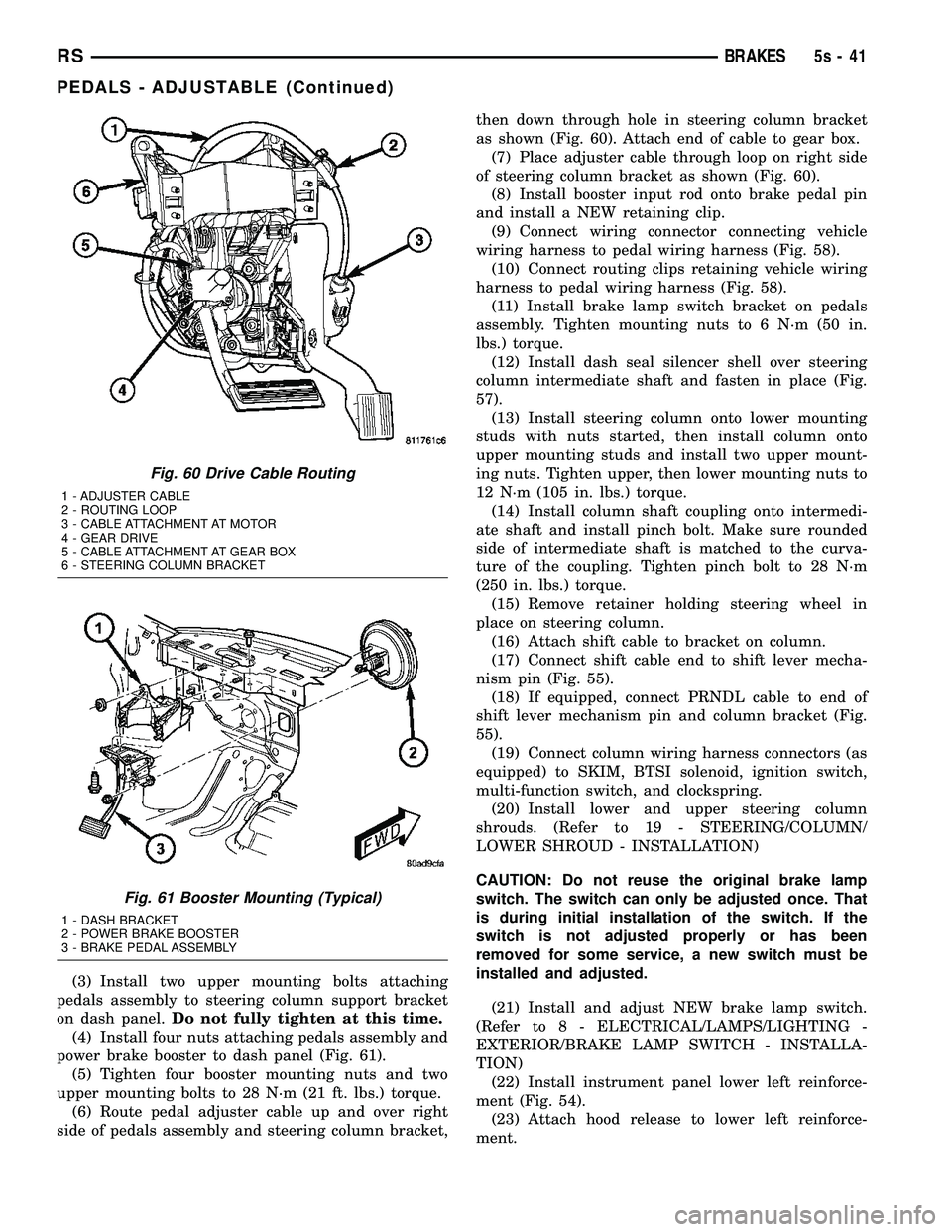
(4) Install four nuts attaching pedals assembly and
power brake booster to dash panel (Fig. 61). (5) Tighten four booster mounting nuts and two
upper mounting bolts to 28 N´m (21 ft. lbs.) torque. (6) Route pedal adjuster cable up and over right
side of pedals assembly and steering column bracket, then down through hole in steering column bracket
as shown (Fig. 60). Attach end of cable to gear box.
(7) Place adjuster cable through loop on right side
of steering column bracket as shown (Fig. 60). (8) Install booster input rod onto brake pedal pin
and install a NEW retaining clip. (9) Connect wiring connector connecting vehicle
wiring harness to pedal wiring harness (Fig. 58). (10) Connect routing clips retaining vehicle wiring
harness to pedal wiring harness (Fig. 58). (11) Install brake lamp switch bracket on pedals
assembly. Tighten mounting nuts to 6 N´m (50 in.
lbs.) torque. (12) Install dash seal silencer shell over steering
column intermediate shaft and fasten in place (Fig.
57). (13) Install steering column onto lower mounting
studs with nuts started, then install column onto
upper mounting studs and install two upper mount-
ing nuts. Tighten upper, then lower mounting nuts to
12 N´m (105 in. lbs.) torque. (14) Install column shaft coupling onto intermedi-
ate shaft and install pinch bolt. Make sure rounded
side of intermediate shaft is matched to the curva-
ture of the coupling. Tighten pinch bolt to 28 N´m
(250 in. lbs.) torque. (15) Remove retainer holding steering wheel in
place on steering column. (16) Attach shift cable to bracket on column.
(17) Connect shift cable end to shift lever mecha-
nism pin (Fig. 55). (18) If equipped, connect PRNDL cable to end of
shift lever mechanism pin and column bracket (Fig.
55). (19) Connect column wiring harness connectors (as
equipped) to SKIM, BTSI solenoid, ignition switch,
multi-function switch, and clockspring. (20) Install lower and upper steering column
shrouds. (Refer to 19 - STEERING/COLUMN/
LOWER SHROUD - INSTALLATION)
CAUTION: Do not reuse the original brake lamp
switch. The switch can only be adjusted once. That
is during initial installation of the switch. If the
switch is not adjusted properly or has been
removed for some service, a new switch must be
installed and adjusted.
(21) Install and adjust NEW brake lamp switch.
(Refer t o 8 - ELECTRICAL/LAMPS/LIGHTING -
EXTERIOR/BRAKE LAMP SWITCH - INSTALLA-
TION) (22) Install instrument panel lower left reinforce-
ment (Fig. 54). (23) Attach hood release to lower left reinforce-
ment.
Fig. 60 Drive Cable Routing
1 - ADJUSTER CABLE
2 - ROUTING LOOP
3 - CABLE ATTACHMENT AT MOTOR
4 - GEAR DRIVE
5 - CABLE ATTACHMENT AT GEAR BOX
6 - STEERING COLUMN BRACKET
Fig. 61 Booster Mounting (Typical)
1 - DASH BRACKET
2 - POWER BRAKE BOOSTER
3 - BRAKE PEDAL ASSEMBLY
RS BRAKES5s-41
PEDALS - ADJUSTABLE (Continued)
Page 285 of 2585
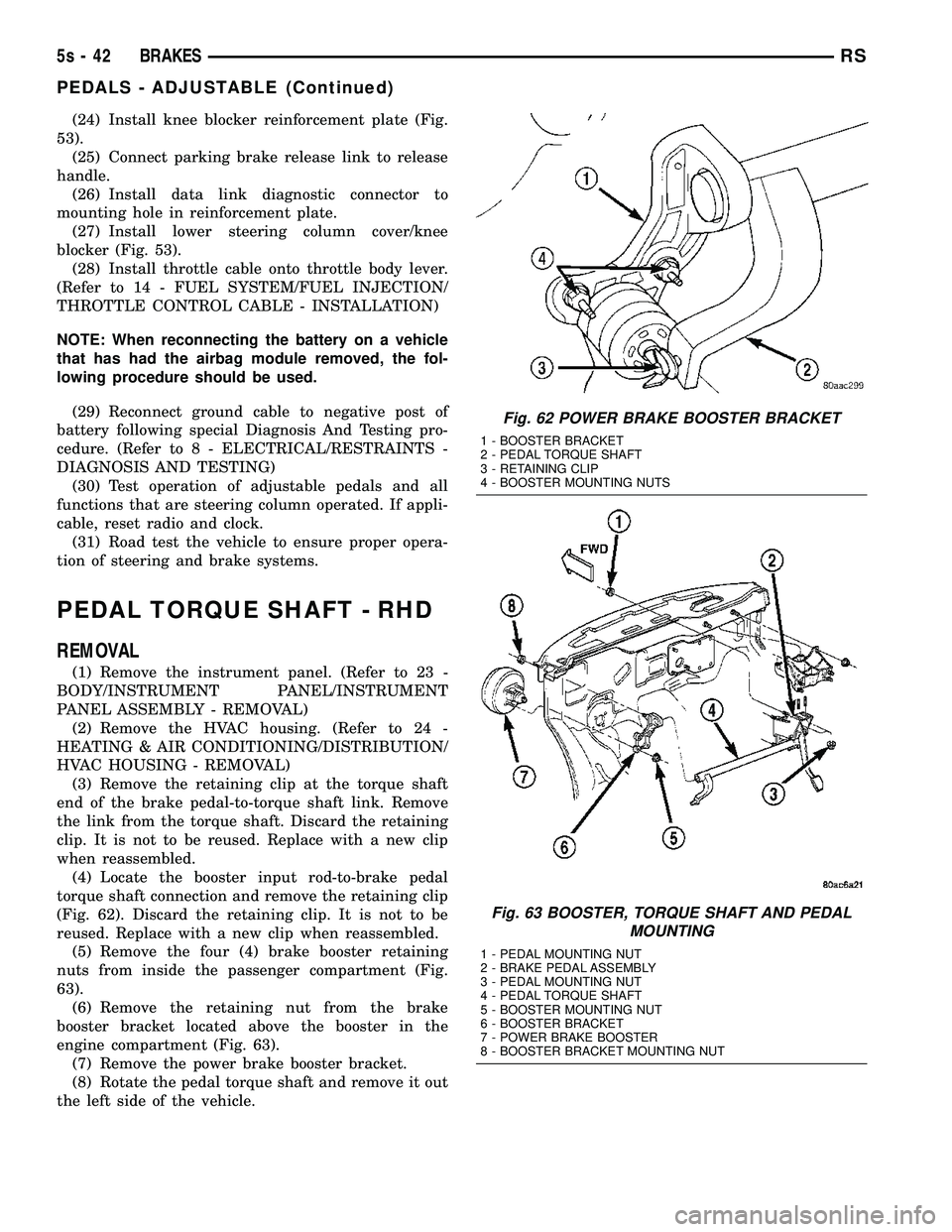
(24) Install knee blocker reinforcement plate (Fig.
53). (25) Connect parking brake release link to release
handle. (26) Install data link diagnostic connector to
mounting hole in reinforcement plate. (27) Install lower steering column cover/knee
blocker (Fig. 53). (28) Install throttle cable onto throttle body lever.
(Refer to 14 - FUEL SYSTEM/FUEL INJECTION/
THROTTLE CONTROL CABLE - INSTALLATION)
NOTE: When reconnecting the battery on a vehicle
that has had the airbag module removed, the fol-
lowing procedure should be used.
(29) Reconnect ground cable to negative post of
battery following special Diagnosis And Testing pro-
cedure. (Refer t o 8 - ELECTRICAL/RESTRAINTS -
DIAGNOSIS AND TESTING) (30) Test operation of adjustable pedals and all
functions that are steering column operated. If appli-
cable, reset radio and clock. (31) Road test the vehicle to ensure proper opera-
tion of steering and brake systems.
PEDAL TORQUE SHAFT - RHD
REMOVAL
(1) Remove the instrument panel. (Refer to 23 -
BODY/INSTRUMENT PANEL/INSTRUMENT
PANEL ASSEMBLY - REMOVAL) (2) Remove the HVAC housing. (Refer to 24 -
HEATING & AIR CONDITIONING/DISTRIBUTION/
HVAC HOUSING - REMOVAL) (3) Remove the retaining clip at the torque shaft
end of the brake pedal-to-torque shaft link. Remove
the link from the torque shaft. Discard the retaining
clip. It is not to be reused. Replace with a new clip
when reassembled. (4) Locate the booster input rod-to-brake pedal
torque shaft connection and remove the retaining clip
(Fig. 62). Discard the retaining clip. It is not to be
reused. Replace with a new clip when reassembled. (5) Remove the four (4) brake booster retaining
nuts from inside the passenger compartment (Fig.
63). (6) Remove the retaining nut from the brake
booster bracket located above the booster in the
engine compartment (Fig. 63). (7) Remove the power brake booster bracket.
(8) Rotate the pedal torque shaft and remove it out
the left side of the vehicle.
Fig. 62 POWER BRAKE BOOSTER BRACKET
1 - BOOSTER BRACKET
2 - PEDAL TORQUE SHAFT
3 - RETAINING CLIP
4 - BOOSTER MOUNTING NUTS
Fig. 63 BOOSTER, TORQUE SHAFT AND PEDAL MOUNTING
1 - PEDAL MOUNTING NUT
2 - BRAKE PEDAL ASSEMBLY
3 - PEDAL MOUNTING NUT
4 - PEDAL TORQUE SHAFT
5 - BOOSTER MOUNTING NUT
6 - BOOSTER BRACKET
7 - POWER BRAKE BOOSTER
8 - BOOSTER BRACKET MOUNTING NUT
5s - 42 BRAKESRS
PEDALS - ADJUSTABLE (Continued)
Page 286 of 2585
INSTALLATION
(1) Lubricate both ends of the torque shaft with
MS-4517 Lubricant or equivalent and install the
torque shaft from the left side reversing the removal
procedure. (2) Install the brake booster bracket on the left
end of the shaft. (3) Install the retaining nut for the brake booster
bracket in the engine compartment. Tighten the
mounting nut to a torque of 29 N´m (250 in. lbs.). (4) Install the four brake booster retaining nuts
inside the passenger compartment. Tighten the
mounting nuts to a torque of 29 N´m (250 in. lbs.). (5) Using lubriplate, or equivalent, coat the sur-
face of the brake pedal torque shaft pin where it con-
tacts the booster input rod. Also coat the surface of
the brake pedal torque shaft pin where it contacts
the brake pedal link.
CAUTION: When installing the power brake booster
input rod on the brake pedal torque shaft pin, do
not reuse the old retaining clip.
(6) Install booster input rod on brake pedal torque
shaft pin and install a NEW retaining clip (Fig. 62).
CAUTION: When installing the brake pedal link on
the brake pedal torque shaft pin, do not reuse the
old retaining clip.
(7) Connect the brake pedal link to the torque
shaft. Install a NEW retaining clip at the torque
shaft end of the brake pedal-to-torque shaft link. (8) Install the HVAC housing. (Refer to 24 - HEAT-
ING & AIR CONDITIONING/DISTRIBUTION/HVAC
HOUSING - INSTALLATION) (9) Install the instrument panel. (Refer to 23 -
BODY/INSTRUMENT PANEL/INSTRUMENT
PANEL ASSEMBLY - INSTALLATION)
CAUTION: Do not reuse the original brake lamp
switch. The switch can only be adjusted once. That
is during initial installation of the switch. If the
switch is not adjusted properly or has been
removed for some service, a new switch must be
installed and adjusted.
(10) Remove and replace the brake lamp switch
with a NEW switch. (Refer t o 8 - ELECTRICAL/
LAMPS/LIGHTING - EXTERIOR/BRAKE LAMP
SWITCH - REMOVAL), (Refer t o 8 - ELECTRICAL/
LAMPS/LIGHTING - EXTERIOR/BRAKE LAMP
SWITCH - INSTALLATION) (11) Road test vehicle to ensure proper operation of
the brakes.
POWER BRAKE BOOSTER
DESCRIPTION
The power brake booster mounts on the engine
compartment side of the dash panel. It is connected
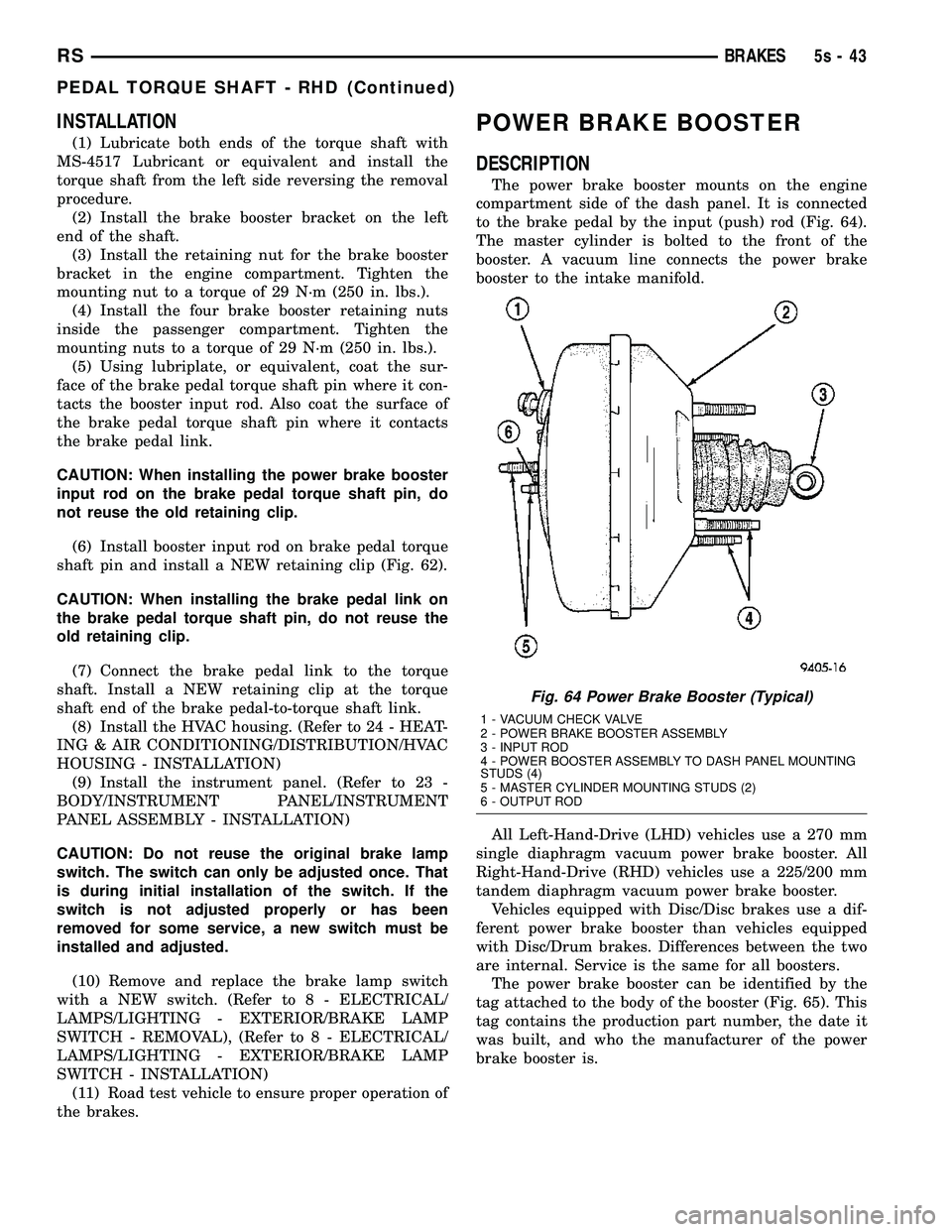
to the brake pedal by the input (push) rod (Fig. 64).
The master cylinder is bolted to the front of the
booster. A vacuum line connects the power brake
booster to the intake manifold.
All Left-Hand-Drive (LHD) vehicles use a 270 mm
single diaphragm vacuum power brake booster. All
Right-Hand-Drive (RHD) vehicles use a 225/200 mm
tandem diaphragm vacuum power brake booster. Vehicles equipped with Disc/Disc brakes use a dif-
ferent power brake booster than vehicles equipped
with Disc/Drum brakes. Differences between the two
are internal. Service is the same for all boosters. The power brake booster can be identified by the
tag attached to the body of the booster (Fig. 65). This
tag contains the production part number, the date it
was built, and who the manufacturer of the power
brake booster is.
Fig. 64 Power Brake Booster (Typical)
1 - VACUUM CHECK VALVE
2 - POWER BRAKE BOOSTER ASSEMBLY
3 - INPUT ROD
4 - POWER BOOSTER ASSEMBLY TO DASH PANEL MOUNTING
STUDS (4)
5 - MASTER CYLINDER MOUNTING STUDS (2)
6 - OUTPUT ROD
RS BRAKES5s-43
PEDAL TORQUE SHAFT - RHD (Continued)
Page 289 of 2585
(16) Disconnect vacuum hose from check valve
located on vacuum booster. DO NOT REMOVE
CHECK VALVE FROM POWER BRAKE
BOOSTER. (17) Inside vehicle, remove silencer panel under
instrument panel below steering column. (18) Locate the booster input rod to brake pedal
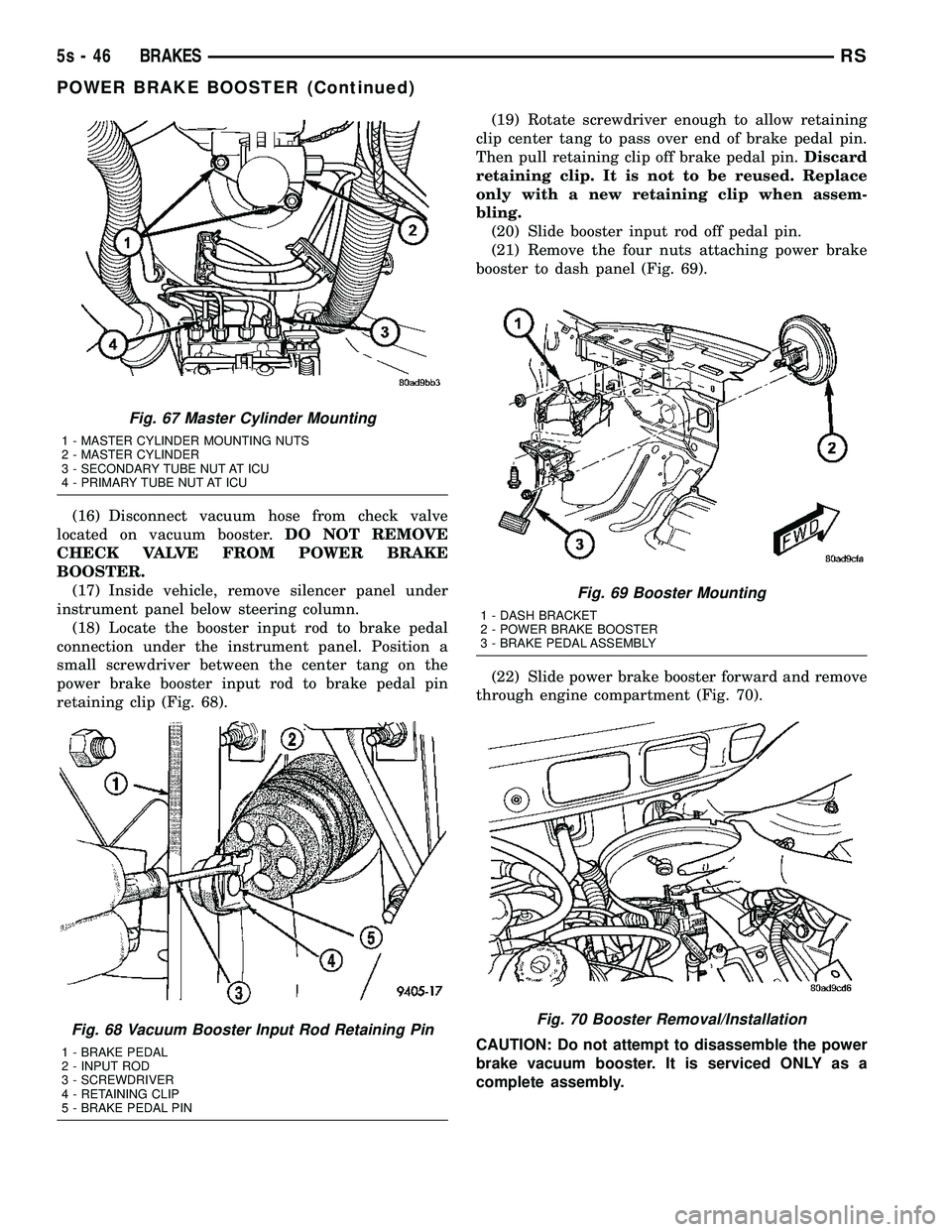
connection under the instrument panel. Position a
small screwdriver between the center tang on the
power brake booster input rod to brake pedal pin
retaining clip (Fig. 68). (19) Rotate screwdriver enough to allow retaining
clip center tang to pass over end of brake pedal pin.
Then pull retaining clip off brake pedal pin. Discard
retaining clip. It is not to be reused. Replace
only with a new retaining clip when assem-
bling. (20) Slide booster input rod off pedal pin.
(21) Remove the four nuts attaching power brake
booster to dash panel (Fig. 69).
(22) Slide power brake booster forward and remove
through engine compartment (Fig. 70).
CAUTION: Do not attempt to disassemble the power
brake vacuum booster. It is serviced ONLY as a
complete assembly.
Fig. 67 Master Cylinder Mounting
1 - MASTER CYLINDER MOUNTING NUTS
2 - MASTER CYLINDER
3 - SECONDARY TUBE NUT AT ICU
4 - PRIMARY TUBE NUT AT ICU
Fig. 68 Vacuum Booster Input Rod Retaining Pin
1 - BRAKE PEDAL
2 - INPUT ROD
3 - SCREWDRIVER
4 - RETAINING CLIP
5 - BRAKE PEDAL PIN
Fig. 69 Booster Mounting
1 - DASH BRACKET
2 - POWER BRAKE BOOSTER
3 - BRAKE PEDAL ASSEMBLY
Fig. 70 Booster Removal/Installation
5s - 46 BRAKESRS
POWER BRAKE BOOSTER (Continued)
Page 291 of 2585
(15) Under the instrument panel, remove booster
input rod trim cover. (16) Locate the booster input rod to brake pedal
torque shaft connection under the instrument panel.
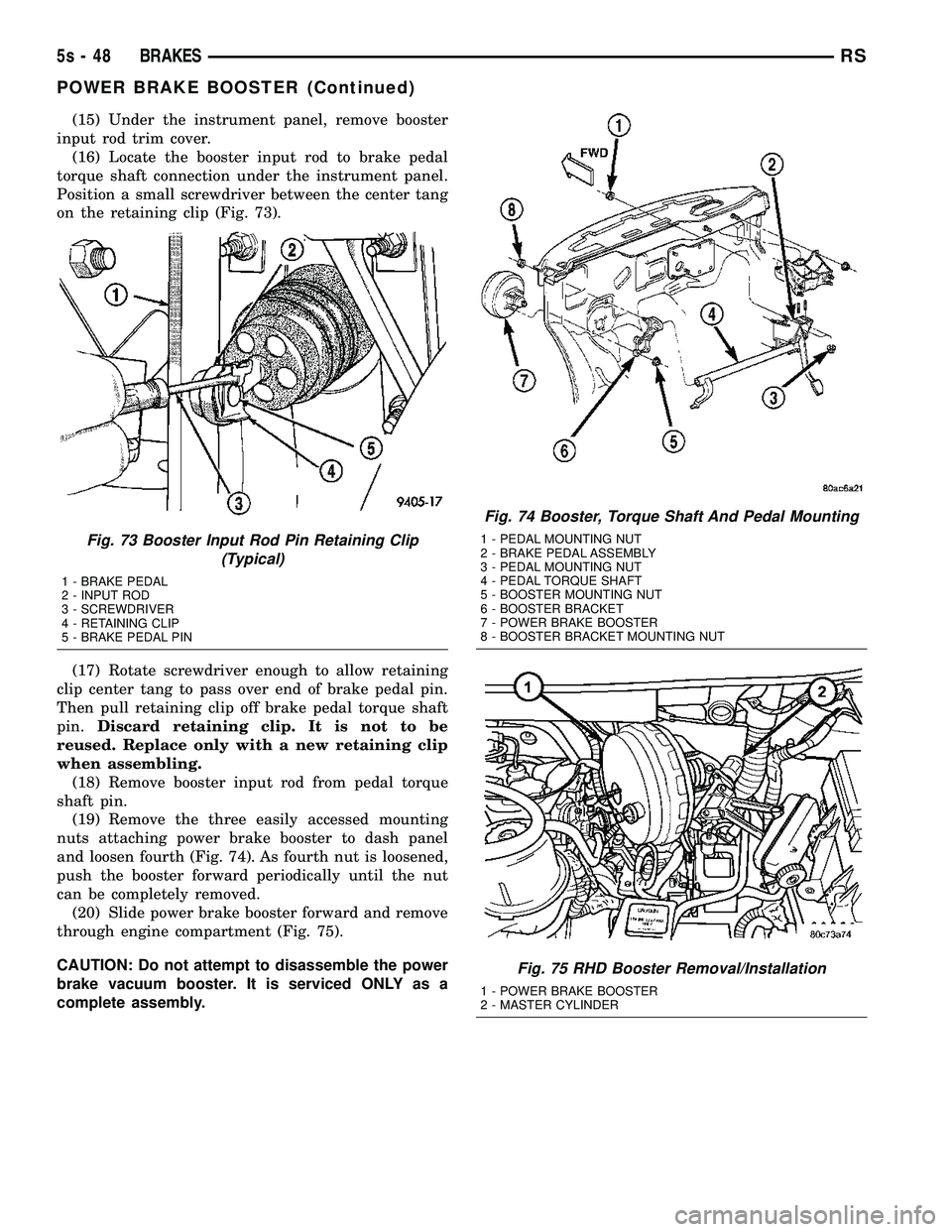
Position a small screwdriver between the center tang
on the retaining clip (Fig. 73).
(17) Rotate screwdriver enough to allow retaining
clip center tang to pass over end of brake pedal pin.
Then pull retaining clip off brake pedal torque shaft
pin. Discard retaining clip. It is not to be
reused. Replace only with a new retaining clip
when assembling. (18) Remove booster input rod from pedal torque
shaft pin. (19) Remove the three easily accessed mounting
nuts attaching power brake booster to dash panel
and loosen fourth (Fig. 74). As fourth nut is loosened,
push the booster forward periodically until the nut
can be completely removed. (20) Slide power brake booster forward and remove
through engine compartment (Fig. 75).
CAUTION: Do not attempt to disassemble the power
brake vacuum booster. It is serviced ONLY as a
complete assembly.
Fig. 73 Booster Input Rod Pin Retaining Clip (Typical)
1 - BRAKE PEDAL
2 - INPUT ROD
3 - SCREWDRIVER
4 - RETAINING CLIP
5 - BRAKE PEDAL PIN
Fig. 74 Booster, Torque Shaft And Pedal Mounting
1 - PEDAL MOUNTING NUT
2 - BRAKE PEDAL ASSEMBLY
3 - PEDAL MOUNTING NUT
4 - PEDAL TORQUE SHAFT
5 - BOOSTER MOUNTING NUT
6 - BOOSTER BRACKET
7 - POWER BRAKE BOOSTER
8 - BOOSTER BRACKET MOUNTING NUT
Fig. 75 RHD Booster Removal/Installation
1 - POWER BRAKE BOOSTER
2 - MASTER CYLINDER
5s - 48 BRAKESRS
POWER BRAKE BOOSTER (Continued)
Page 293 of 2585
the mounting nuts to a torque of 14 N´m (124 in.
lbs.).(16) Install the battery tray. Install the two nuts
and one bolt attaching the battery tray to the vehicle.
Tighten the bolt and nuts to a torque of 14 N´m (124
in. lbs.). (17) If vehicle is equipped with speed control, con-
nect the servo vacuum hose to the vacuum tank on
the battery tray. (18) Install the air inlet resonator and hoses as an
assembly on the throttle body and air cleaner hous-
ing. Securely tighten hose clamp at air cleaner hous-
ing and throttle body. (19) Secure the engine coolant filler neck to the
battery tray with its mounting screw. (20) Install the battery, clamp and mounting nut.
(21) Install the positive battery cable on the bat-
tery. (22) Install the negative battery cable on the bat-
tery. (23) Install the battery thermal guard shield.
(24) Bleed the base brakes as necessary. (Refer to
5 - BRAKES - STANDARD PROCEDURE) (25) Road test vehicle to ensure operation of the
brakes.
INSTALLATION - RHD
(1) Position power brake booster on dash panel
using the reverse procedure of its removal (Fig. 75). (2) Below instrument panel, first install the two
upper nuts mounting the booster to the dash panel,
drawing it into place, then install the two lower
mounting nuts. Tighten the mounting nuts to a
torque of 29 N´m (250 in. lbs.). (3) Using lubriplate, or equivalent, coat the sur-
face of the brake pedal torque shaft pin where it con-
tacts the booster input rod.
CAUTION: When installing the brake pedal torque
shaft pin on the power brake booster input rod, do
not re-use the old retaining clip.
(4) Install booster input rod on brake pedal torque
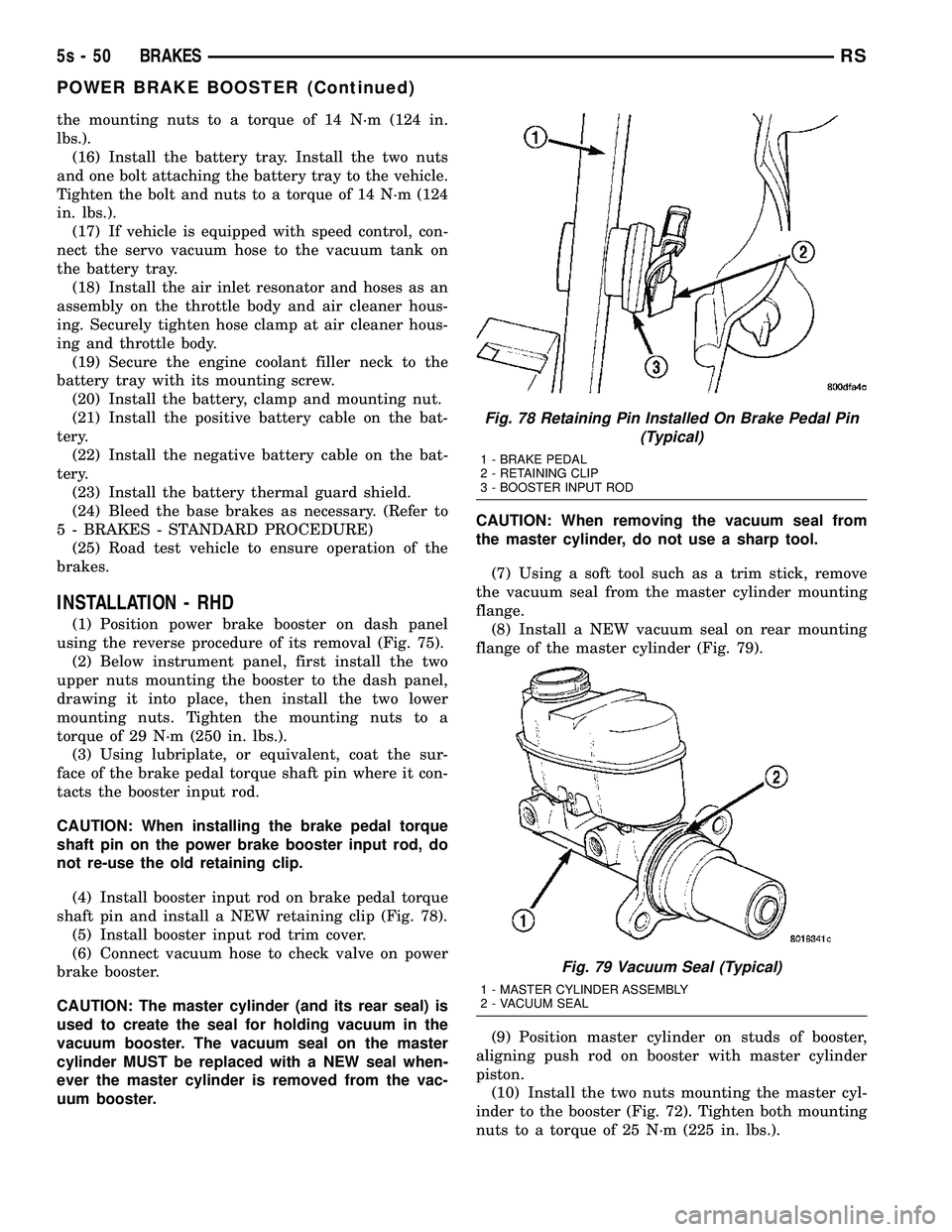
shaft pin and install a NEW retaining clip (Fig. 78). (5) Install booster input rod trim cover.
(6) Connect vacuum hose to check valve on power
brake booster.
CAUTION: The master cylinder (and its rear seal) is
used to create the seal for holding vacuum in the
vacuum booster. The vacuum seal on the master
cylinder MUST be replaced with a NEW seal when-
ever the master cylinder is removed from the vac-
uum booster. CAUTION: When removing the vacuum seal from
the master cylinder, do not use a sharp tool.
(7) Using a soft tool such as a trim stick, remove
the vacuum seal from the master cylinder mounting
flange. (8) Install a NEW vacuum seal on rear mounting
flange of the master cylinder (Fig. 79).
(9) Position master cylinder on studs of booster,
aligning push rod on booster with master cylinder
piston. (10) Install the two nuts mounting the master cyl-
inder to the booster (Fig. 72). Tighten both mounting
nuts to a torque of 25 N´m (225 in. lbs.).
Fig. 78 Retaining Pin Installed On Brake Pedal Pin (Typical)
1 - BRAKE PEDAL
2 - RETAINING CLIP
3 - BOOSTER INPUT ROD
Fig. 79 Vacuum Seal (Typical)
1 - MASTER CYLINDER ASSEMBLY
2 - VACUUM SEAL
5s - 50 BRAKESRS
POWER BRAKE BOOSTER (Continued)
Page 310 of 2585
CABLES - PARKING BRAKE
(EXPORT)
REMOVAL - FRONT CABLE
(Refer to 5 - BRAKES - BASE/PARKING BRAKE/
LEVER - REMOVAL)
INSTALLATION - FRONT CABLE
(Refer t o 5 - BRAKES - BASE/PARKING BRAKE/
LEVER - INSTALLATION)
LEVER - PARKING BRAKE
REMOVAL
(1) Manually release the automatic self-adjusting
mechanism tension of the parking brake lever (pedal)
assembly. (Refer t o 5 - BRAKES/PARKING BRAKE -
STANDARD PROCEDURE). (2) Disconnect negative (ground) cable from the
battery and isolate cable from battery terminal. (3) Remove sill scuff plate from left door sill.
(4) Remove the left side kick panel.
(5) Remove the silencer panel under the instru-
ment panel. (6) Remove the steering column cover from the
lower instrument panel. (7) Remove the reinforcement from the lower
instrument panel. (8) Remove the front parking brake cable from the
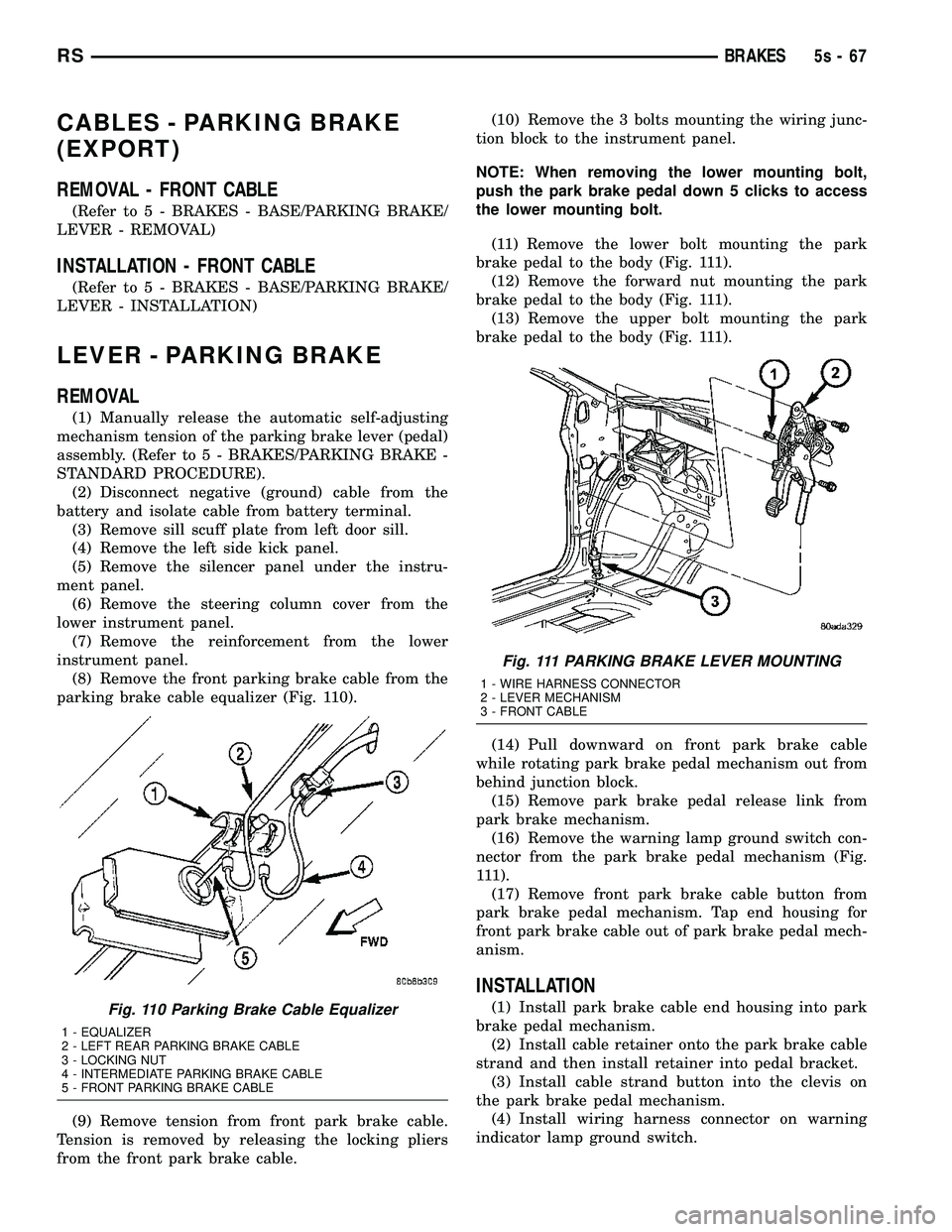
parking brake cable equalizer (Fig. 110).
(9) Remove tension from front park brake cable.
Tension is removed by releasing the locking pliers
from the front park brake cable. (10) Remove the 3 bolts mounting the wiring junc-
tion block to the instrument panel.
NOTE: When removing the lower mounting bolt,
push the park brake pedal down 5 clicks to access
the lower mounting bolt.
(11) Remove the lower bolt mounting the park
brake pedal to the body (Fig. 111). (12) Remove the forward nut mounting the park
brake pedal to the body (Fig. 111). (13) Remove the upper bolt mounting the park
brake pedal to the body (Fig. 111).
(14) Pull downward on front park brake cable
while rotating park brake pedal mechanism out from
behind junction block. (15) Remove park brake pedal release link from
park brake mechanism. (16) Remove the warning lamp ground switch con-
nector from the park brake pedal mechanism (Fig.
111). (17) Remove front park brake cable button from
park brake pedal mechanism. Tap end housing for
front park brake cable out of park brake pedal mech-
anism.
INSTALLATION
(1) Install park brake cable end housing into park
brake pedal mechanism. (2) Install cable retainer onto the park brake cable
strand and then install retainer into pedal bracket. (3) Install cable strand button into the clevis on
the park brake pedal mechanism. (4) Install wiring harness connector on warning
indicator lamp ground switch.Fig. 110 Parking Brake Cable Equalizer
1 - EQUALIZER
2 - LEFT REAR PARKING BRAKE CABLE
3 - LOCKING NUT
4 - INTERMEDIATE PARKING BRAKE CABLE
5 - FRONT PARKING BRAKE CABLE
Fig. 111 PARKING BRAKE LEVER MOUNTING
1 - WIRE HARNESS CONNECTOR
2 - LEVER MECHANISM
3 - FRONT CABLE
RS BRAKES5s-67
Page 311 of 2585
(5) Install the park brake release rod on the
release mechanism of the park brake pedal. (6) Position the park brake pedal mechanism into
its installed position on the body of the vehicle. (7) Loosely install the top bolt mounting the park
brake pedal mechanism to the body (Fig. 111). (8) Loosely install the forward nut mounting the
park brake pedal mechanism to the body (Fig. 111). (9) Loosely install the lower bolt mounting the
park brake pedal mechanism to the body (Fig. 111). (10) Tighten pedal mechanism attaching bolts and
nut to 28 N´m (250 in. lbs.). (11) Verify that the park brake pedal is in the fully
released (full up) position. (12) Raise vehicle.
(13) Install the front park brake cable on the park
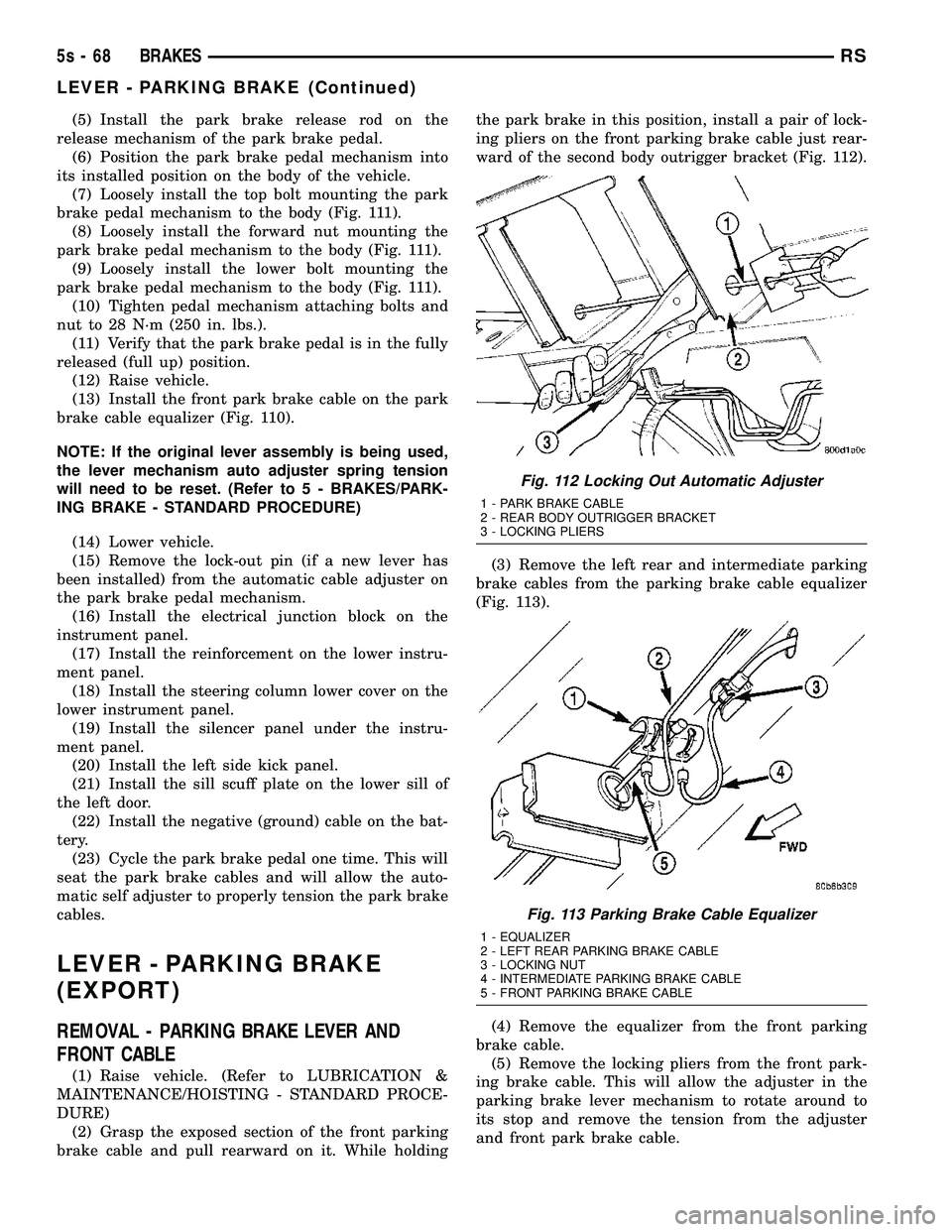
brake cable equalizer (Fig. 110).
NOTE: If the original lever assembly is being used,
the lever mechanism auto adjuster spring tension
will need to be reset. (Refer t o 5 - BRAKES/PARK-
ING BRAKE - STANDARD PROCEDURE)
(14) Lower vehicle.
(15) Remove the lock-out pin (if a new lever has
been installed) from the automatic cable adjuster on
the park brake pedal mechanism. (16) Install the electrical junction block on the
instrument panel. (17) Install the reinforcement on the lower instru-
ment panel. (18) Install the steering column lower cover on the
lower instrument panel. (19) Install the silencer panel under the instru-
ment panel. (20) Install the left side kick panel.
(21) Install the sill scuff plate on the lower sill of
the left door. (22) Install the negative (ground) cable on the bat-
tery. (23) Cycle the park brake pedal one time. This will
seat the park brake cables and will allow the auto-
matic self adjuster to properly tension the park brake
cables.
LEVER - PARKING BRAKE
(EXPORT)
REMOVAL - PARKING BRAKE LEVER AND
FRONT CABLE
(1) Raise vehicle. (Refer to LUBRICATION &
MAINTENANCE/HOISTING - STANDARD PROCE-
DURE) (2) Grasp the exposed section of the front parking
brake cable and pull rearward on it. While holding the park brake in this position, install a pair of lock-
ing pliers on the front parking brake cable just rear-
ward of the second body outrigger bracket (Fig. 112).
(3) Remove the left rear and intermediate parking
brake cables from the parking brake cable equalizer
(Fig. 113).
(4) Remove the equalizer from the front parking
brake cable. (5) Remove the locking pliers from the front park-
ing brake cable. This will allow the adjuster in the
parking brake lever mechanism to rotate around to
its stop and remove the tension from the adjuster
and front park brake cable.
Fig. 112 Locking Out Automatic Adjuster
1 - PARK BRAKE CABLE
2 - REAR BODY OUTRIGGER BRACKET
3 - LOCKING PLIERS
Fig. 113 Parking Brake Cable Equalizer
1 - EQUALIZER
2 - LEFT REAR PARKING BRAKE CABLE
3 - LOCKING NUT
4 - INTERMEDIATE PARKING BRAKE CABLE
5 - FRONT PARKING BRAKE CABLE
5s - 68 BRAKESRS
LEVER - PARKING BRAKE (Continued)