lock CHRYSLER VOYAGER 2023 Manual PDF
[x] Cancel search | Manufacturer: CHRYSLER, Model Year: 2023, Model line: VOYAGER, Model: CHRYSLER VOYAGER 2023Pages: 256, PDF Size: 13.97 MB
Page 179 of 256
IN CASE OF EMERGENCY177
3. Place the wrench on the jack screw and turn
clockwise until the jack head is properly engaged in
the described location. Do not raise the vehicle until
you are sure the jack is securely engaged.
4. Raise the vehicle by turning the jack screw clockwise, using the swivel wrench. Raise the vehicle only until
the tire just clears the surface and enough clearance
is obtained to install the compact spare tire.
Minimum tire lift provides maximum stability.
5. Remove the wheel lug nuts, for vehicles with wheel covers, remove the cover from the wheel by hand.
Do not pry the wheel cover off. Then pull the wheel off
the hub.
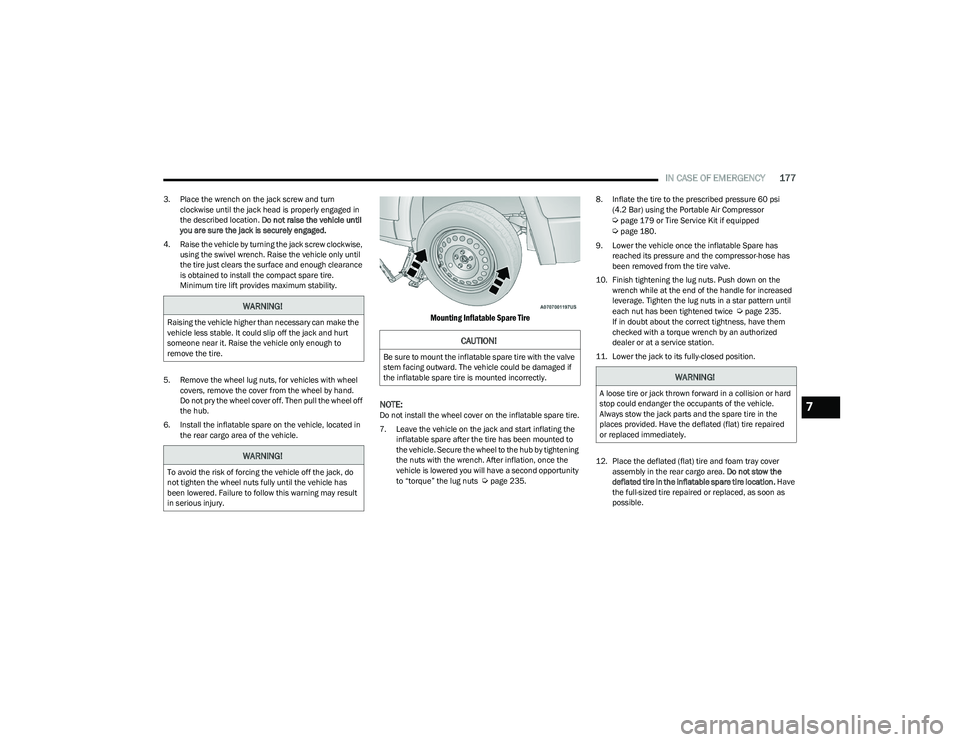
6. Install the inflatable spare on the vehicle, located in the rear cargo area of the vehicle.
Mounting Inflatable Spare Tire
NOTE:
Do not install the wheel cover on the inflatable spare tire.
7. Leave the vehicle on the jack and start inflating the inflatable spare after the tire has been mounted to
the vehicle. Secure the wheel to the hub by tightening
the nuts with the wrench. After inflation, once the
vehicle is lowered you will have a second opportunity
to “torque” the lug nuts
Úpage 235. 8. Inflate the tire to the prescribed pressure 60 psi
(4.2 Bar) using the Portable Air Compressor
Úpage 179 or Tire Service Kit if equipped Úpage 180.
9. Lower the vehicle once the inflatable Spare has reached its pressure and the compressor-hose has
been removed from the tire valve.
10. Finish tightening the lug nuts. Push down on the wrench while at the end of the handle for increased
leverage. Tighten the lug nuts in a star pattern until
each nut has been tightened twice
Úpage 235.
If in doubt about the correct tightness, have them
checked with a torque wrench by an authorized
dealer or at a service station.
11. Lower the jack to its fully-closed position.
12. Place the deflated (flat) tire and foam tray cover assembly in the rear cargo area. Do not stow the
deflated tire in the inflatable spare tire location. Have
the full-sized tire repaired or replaced, as soon as
possible.WARNING!
Raising the vehicle higher than necessary can make the
vehicle less stable. It could slip off the jack and hurt
someone near it. Raise the vehicle only enough to
remove the tire.
WARNING!
To avoid the risk of forcing the vehicle off the jack, do
not tighten the wheel nuts fully until the vehicle has
been lowered. Failure to follow this warning may result
in serious injury.
CAUTION!
Be sure to mount the inflatable spare tire with the valve
stem facing outward. The vehicle could be damaged if
the inflatable spare tire is mounted incorrectly.
WARNING!
A loose tire or jack thrown forward in a collision or hard
stop could endanger the occupants of the vehicle.
Always stow the jack parts and the spare tire in the
places provided. Have the deflated (flat) tire repaired
or replaced immediately.
7
23_RUV_OM_EN_US_t.book Page 177
Page 180 of 256
178IN CASE OF EMERGENCY
13. Stow the jack back in the stowage compartment and
place the access panel back. The stud of the storage
area must be threaded through the lower part of the
jack. Then turn the Jack Screw clockwise to secure it
in place.
NOTE:Stow the foam tray and components in the cargo area.
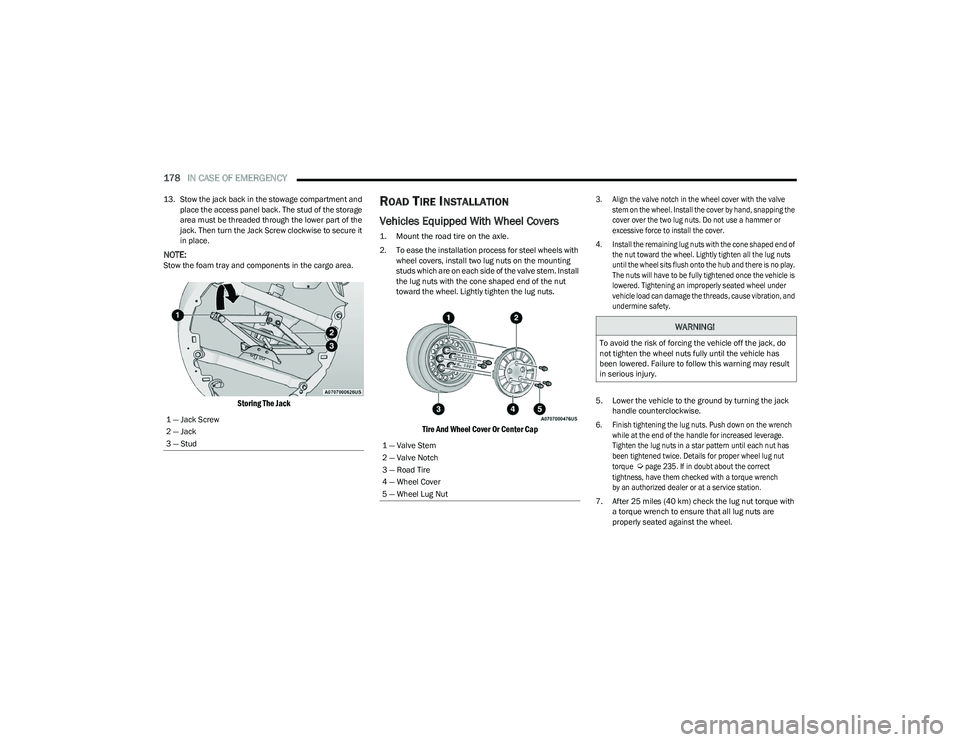
Storing The Jack
ROAD TIRE INSTALLATION
Vehicles Equipped With Wheel Covers
1. Mount the road tire on the axle.
2. To ease the installation process for steel wheels with wheel covers, install two lug nuts on the mounting
studs which are on each side of the valve stem. Install
the lug nuts with the cone shaped end of the nut
toward the wheel. Lightly tighten the lug nuts.
Tire And Wheel Cover Or Center Cap
3. Align the valve notch in the wheel cover with the valve stem on the wheel. Install the cover by hand, snapping the
cover over the two lug nuts. Do not use a hammer or
excessive force to install the cover.
4. Install the remaining lug nuts with the cone shaped end of the nut toward the wheel. Lightly tighten all the lug nuts
until the wheel sits flush onto the hub and there is no play.
The nuts will have to be fully tightened once the vehicle is
lowered. Tightening an improperly seated wheel under
vehicle load can damage the threads, cause vibration, and
undermine safety.
5. Lower the vehicle to the ground by turning the jack handle counterclockwise.
6. Finish tightening the lug nuts. Push down on the wrench while at the end of the handle for increased leverage.
Tighten the lug nuts in a star pattern until each nut has
been tightened twice. Details for proper wheel lug nut
torque
Ú
page 235. If in doubt about the correct
tightness, have them checked with a torque wrench
by an authorized dealer or at a service station.
7. After 25 miles (40 km) check the lug nut torque with a torque wrench to ensure that all lug nuts are
properly seated against the wheel.
1 — Jack Screw
2 — Jack
3 — Stud
1 — Valve Stem
2 — Valve Notch
3 — Road Tire
4 — Wheel Cover
5 — Wheel Lug Nut
WARNING!
To avoid the risk of forcing the vehicle off the jack, do
not tighten the wheel nuts fully until the vehicle has
been lowered. Failure to follow this warning may result
in serious injury.
23_RUV_OM_EN_US_t.book Page 178
Page 190 of 256
188IN CASE OF EMERGENCY
If the temperature gauge is moving towards or close to
the HOT (H) position, you can reduce the potential for
overheating by taking the appropriate action.
On highways — slow down.
In city traffic — while stopped, place the transmission in
NEUTRAL (N), but do not increase the engine idle speed
while preventing vehicle motion with the brakes.
If your Air Conditioner (A/C) is on, turn it off. The A/C
system adds heat to the engine cooling system and
turning the A/C off can help remove this heat.
You can also turn the temperature control to maximum
heat, the mode control to floor and the blower control
to high. This allows the heater core to act as a supple -
ment to the radiator and aids in removing heat from the
engine cooling system.MANUAL PARK RELEASE
To move the vehicle in cases where the transmission will
not shift out of PARK (P) (such as a depleted battery), a
Manual Park Release is available.
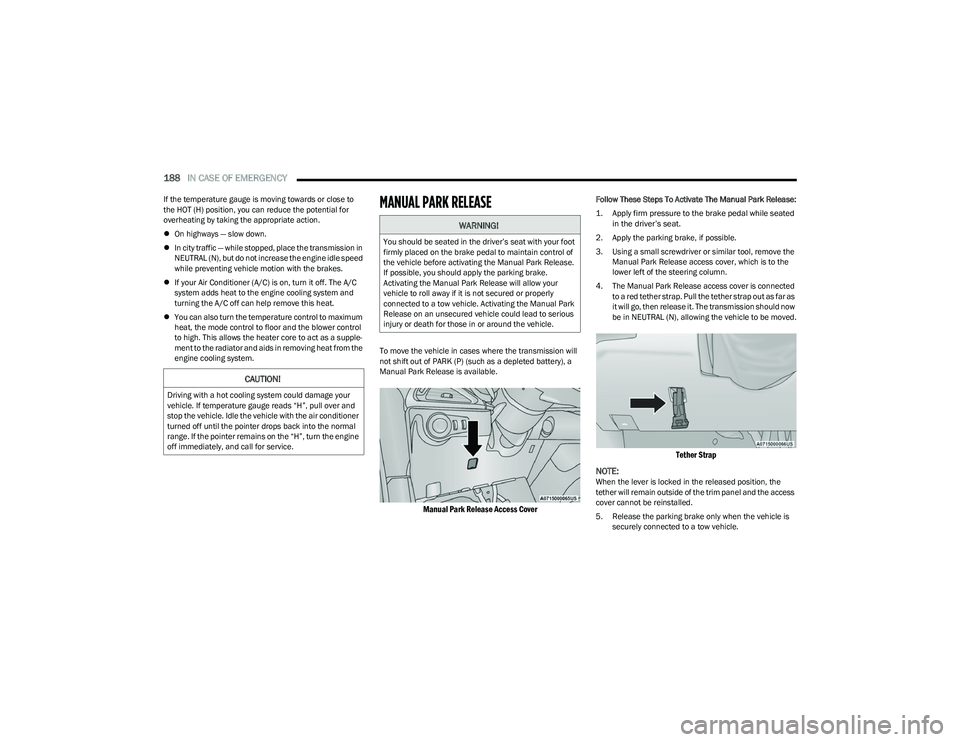
Manual Park Release Access Cover
Follow These Steps To Activate The Manual Park Release:
1. Apply firm pressure to the brake pedal while seated in the driver’s seat.
2. Apply the parking brake, if possible.
3. Using a small screwdriver or similar tool, remove the Manual Park Release access cover, which is to the
lower left of the steering column.
4. The Manual Park Release access cover is connected to a red tether strap. Pull the tether strap out as far as
it will go, then release it. The transmission should now
be in NEUTRAL (N), allowing the vehicle to be moved.
Tether Strap
NOTE:
When the lever is locked in the released position, the
tether will remain outside of the trim panel and the access
cover cannot be reinstalled.
5. Release the parking brake only when the vehicle is securely connected to a tow vehicle.
CAUTION!
Driving with a hot cooling system could damage your
vehicle. If temperature gauge reads “H”, pull over and
stop the vehicle. Idle the vehicle with the air conditioner
turned off until the pointer drops back into the normal
range. If the pointer remains on the “H”, turn the engine
off immediately, and call for service.
WARNING!
You should be seated in the driver’s seat with your foot
firmly placed on the brake pedal to maintain control of
the vehicle before activating the Manual Park Release.
If possible, you should apply the parking brake.
Activating the Manual Park Release will allow your
vehicle to roll away if it is not secured or properly
connected to a tow vehicle. Activating the Manual Park
Release on an unsecured vehicle could lead to serious
injury or death for those in or around the vehicle.
23_RUV_OM_EN_US_t.book Page 188
Page 202 of 256
200SERVICING AND MAINTENANCE
4. Open the glove compartment door as far as possible
to gain access to the cabin air filter compartment
cover.
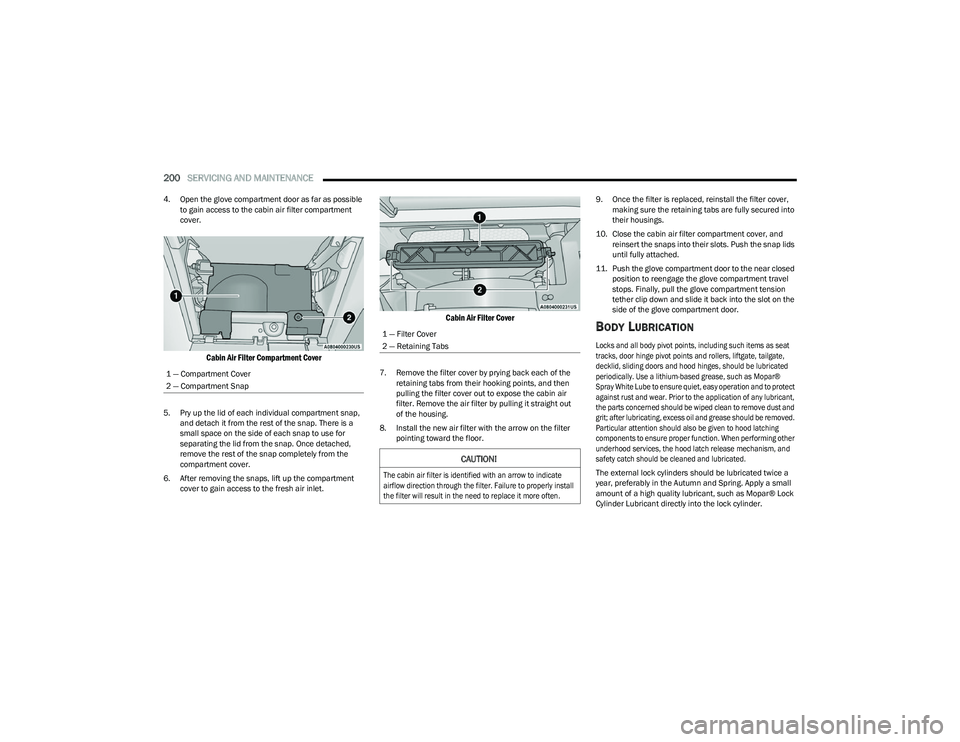
Cabin Air Filter Compartment Cover
5. Pry up the lid of each individual compartment snap, and detach it from the rest of the snap. There is a
small space on the side of each snap to use for
separating the lid from the snap. Once detached,
remove the rest of the snap completely from the
compartment cover.
6. After removing the snaps, lift up the compartment cover to gain access to the fresh air inlet.
Cabin Air Filter Cover
7. Remove the filter cover by prying back each of the retaining tabs from their hooking points, and then
pulling the filter cover out to expose the cabin air
filter. Remove the air filter by pulling it straight out
of the housing.
8. Install the new air filter with the arrow on the filter pointing toward the floor. 9. Once the filter is replaced, reinstall the filter cover,
making sure the retaining tabs are fully secured into
their housings.
10. Close the cabin air filter compartment cover, and reinsert the snaps into their slots. Push the snap lids
until fully attached.
11. Push the glove compartment door to the near closed position to reengage the glove compartment travel
stops. Finally, pull the glove compartment tension
tether clip down and slide it back into the slot on the
side of the glove compartment door.
BODY LUBRICATION
Locks and all body pivot points, including such items as seat
tracks, door hinge pivot points and rollers, liftgate, tailgate,
decklid, sliding doors and hood hinges, should be lubricated
periodically. Use a lithium-based grease, such as Mopar®
Spray White Lube to ensure quiet, easy operation and to protect
against rust and wear. Prior to the application of any lubricant,
the parts concerned should be wiped clean to remove dust and
grit; after lubricating, excess oil and grease should be removed.
Particular attention should also be given to hood latching
components to ensure proper function. When performing other
underhood services, the hood latch release mechanism, and
safety catch should be cleaned and lubricated.
The external lock cylinders should be lubricated twice a
year, preferably in the Autumn and Spring. Apply a small
amount of a high quality lubricant, such as Mopar® Lock
Cylinder Lubricant directly into the lock cylinder.
1 — Compartment Cover
2 — Compartment Snap1 — Filter Cover
2 — Retaining Tabs
CAUTION!
The cabin air filter is identified with an arrow to indicate
airflow direction through the filter. Failure to properly install
the filter will result in the need to replace it more often.
23_RUV_OM_EN_US_t.book Page 200
Page 203 of 256
SERVICING AND MAINTENANCE201
WINDSHIELD WIPER BLADES
Clean the rubber edges of the wiper blades and the
windshield periodically with a sponge or soft cloth and a
mild nonabrasive cleaner. This will remove accumulations
of salt or road film.
Operation of the wipers on dry glass for long periods may
cause deterioration of the wiper blades. Always use
washer fluid when using the wipers to remove salt or dirt
from a dry windshield.
Avoid using the wiper blades to remove frost or ice from
the windshield. Keep the blade rubber out of contact with
petroleum products such as engine oil, gasoline, etc.
NOTE:Life expectancy of wiper blades varies depending on
geographical area and frequency of use. If chattering,
marks, water lines or wet spots are present, clean the
wiper blades or replace as necessary.
The wiper blades and wiper arms should be inspected
periodically, not just when wiper performance problems
are experienced. This inspection should include the
following points:
Wear or uneven edges
Foreign material
Hardening or cracking
Deformation or fatigue
If a wiper blade or wiper arm is damaged, replace the
affected wiper arm or blade with a new unit. Do not
attempt to repair a wiper arm or blade that is damaged.
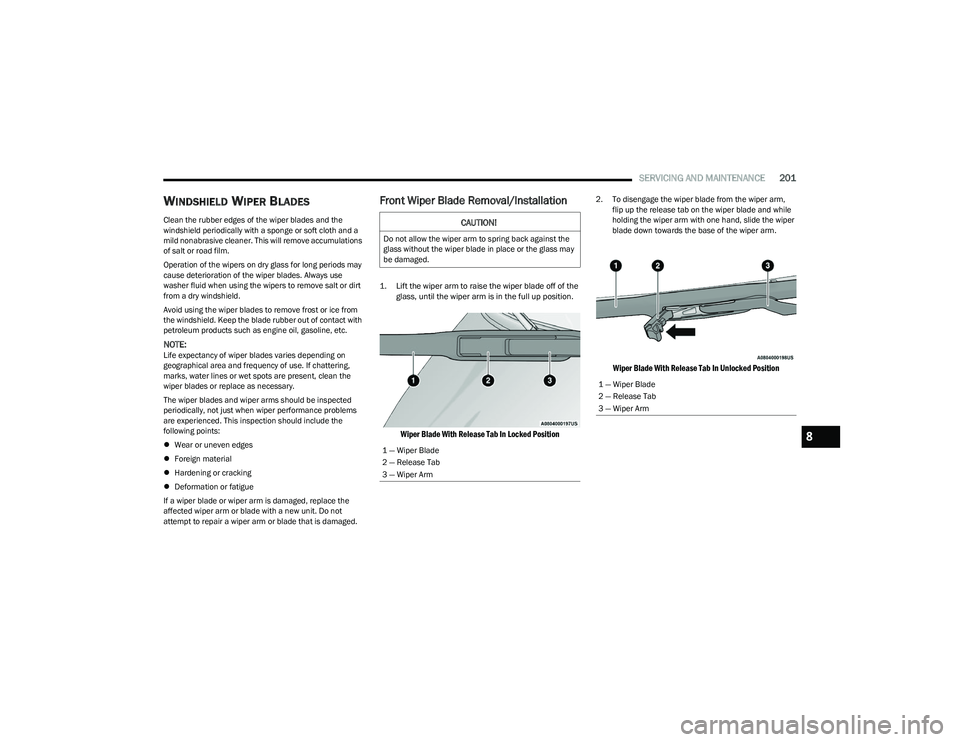
Front Wiper Blade Removal/Installation
1. Lift the wiper arm to raise the wiper blade off of the glass, until the wiper arm is in the full up position.
Wiper Blade With Release Tab In Locked Position
2. To disengage the wiper blade from the wiper arm, flip up the release tab on the wiper blade and while
holding the wiper arm with one hand, slide the wiper
blade down towards the base of the wiper arm.
Wiper Blade With Release Tab In Unlocked Position
CAUTION!
Do not allow the wiper arm to spring back against the
glass without the wiper blade in place or the glass may
be damaged.
1 — Wiper Blade
2 — Release Tab
3 — Wiper Arm
1 — Wiper Blade
2 — Release Tab
3 — Wiper Arm
8
23_RUV_OM_EN_US_t.book Page 201
Page 204 of 256
202SERVICING AND MAINTENANCE
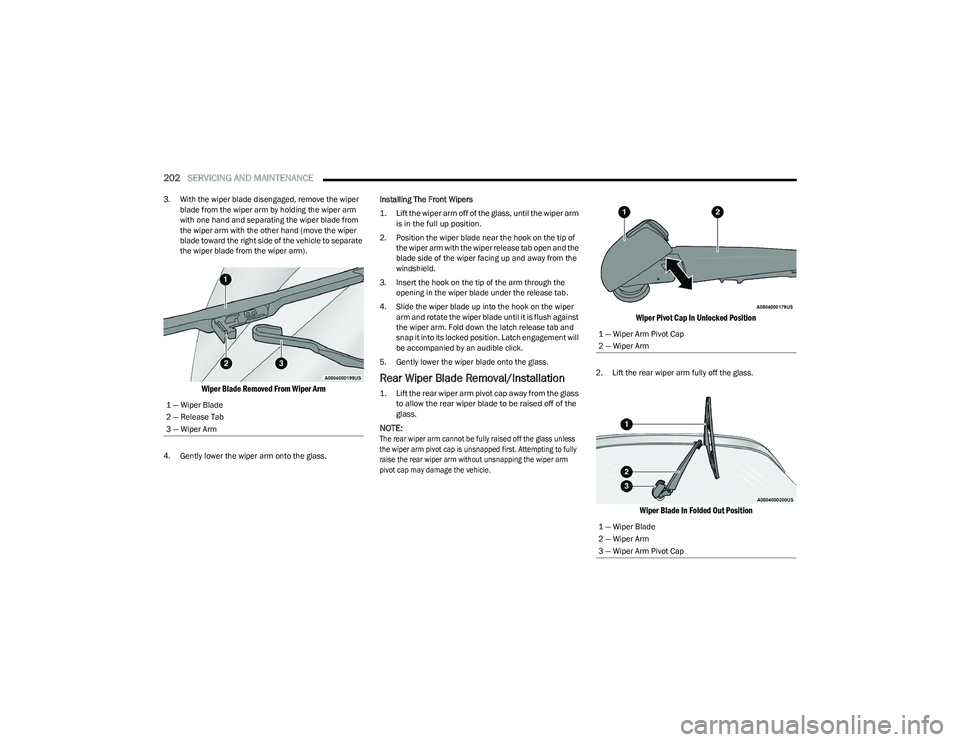
3. With the wiper blade disengaged, remove the wiper
blade from the wiper arm by holding the wiper arm
with one hand and separating the wiper blade from
the wiper arm with the other hand (move the wiper
blade toward the right side of the vehicle to separate
the wiper blade from the wiper arm).
Wiper Blade Removed From Wiper Arm
4. Gently lower the wiper arm onto the glass. Installing The Front Wipers
1. Lift the wiper arm off of the glass, until the wiper arm
is in the full up position.
2. Position the wiper blade near the hook on the tip of the wiper arm with the wiper release tab open and the
blade side of the wiper facing up and away from the
windshield.
3. Insert the hook on the tip of the arm through the opening in the wiper blade under the release tab.
4. Slide the wiper blade up into the hook on the wiper arm and rotate the wiper blade until it is flush against
the wiper arm. Fold down the latch release tab and
snap it into its locked position. Latch engagement will
be accompanied by an audible click.
5. Gently lower the wiper blade onto the glass.
Rear Wiper Blade Removal/Installation
1. Lift the rear wiper arm pivot cap away from the glass to allow the rear wiper blade to be raised off of the
glass.
NOTE:
The rear wiper arm cannot be fully raised off the glass unless
the wiper arm pivot cap is unsnapped first. Attempting to fully
raise the rear wiper arm without unsnapping the wiper arm
pivot cap may damage the vehicle.
Wiper Pivot Cap In Unlocked Position
2. Lift the rear wiper arm fully off the glass.
Wiper Blade In Folded Out Position
1 — Wiper Blade
2 — Release Tab
3 — Wiper Arm
1 — Wiper Arm Pivot Cap
2 — Wiper Arm
1 — Wiper Blade
2 — Wiper Arm
3 — Wiper Arm Pivot Cap
23_RUV_OM_EN_US_t.book Page 202
Page 210 of 256
208SERVICING AND MAINTENANCE
FUSES
General Information
The fuses protect electrical systems against excessive
current.
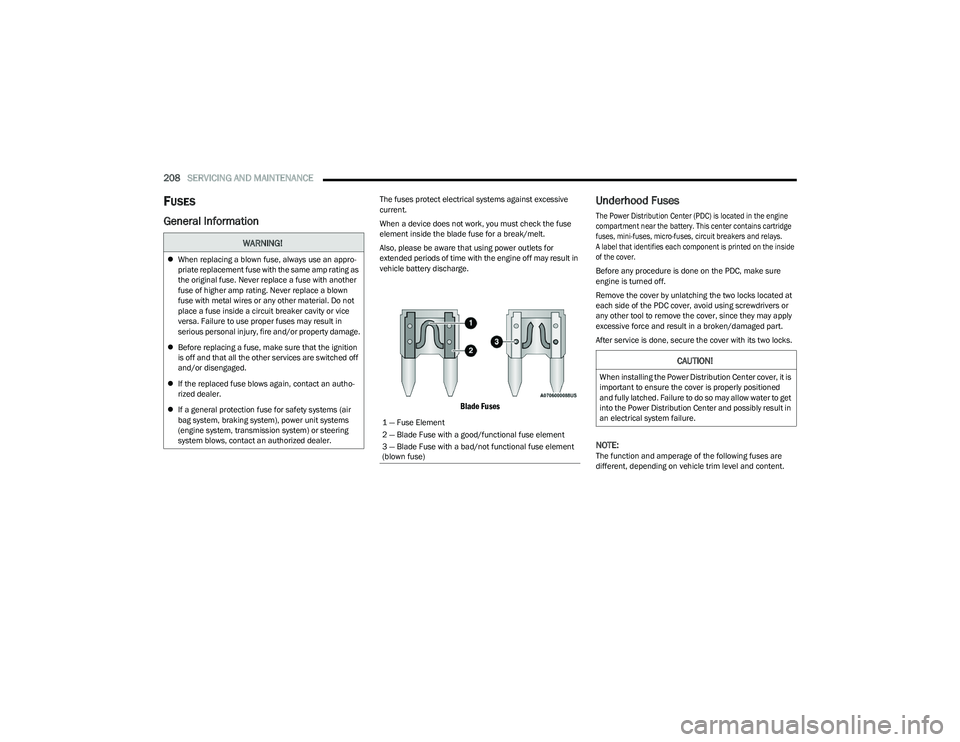
When a device does not work, you must check the fuse
element inside the blade fuse for a break/melt.
Also, please be aware that using power outlets for
extended periods of time with the engine off may result in
vehicle battery discharge.
Blade Fuses
Underhood Fuses
The Power Distribution Center (PDC) is located in the engine
compartment near the battery. This center contains cartridge
fuses, mini-fuses, micro-fuses, circuit breakers and relays.
A label that identifies each component is printed on the inside
of the cover.
Before any procedure is done on the PDC, make sure
engine is turned off.
Remove the cover by unlatching the two locks located at
each side of the PDC cover, avoid using screwdrivers or
any other tool to remove the cover, since they may apply
excessive force and result in a broken/damaged part.
After service is done, secure the cover with its two locks.
NOTE:The function and amperage of the following fuses are
different, depending on vehicle trim level and content.
WARNING!
When replacing a blown fuse, always use an appro -
priate replacement fuse with the same amp rating as
the original fuse. Never replace a fuse with another
fuse of higher amp rating. Never replace a blown
fuse with metal wires or any other material. Do not
place a fuse inside a circuit breaker cavity or vice
versa. Failure to use proper fuses may result in
serious personal injury, fire and/or property damage.
Before replacing a fuse, make sure that the ignition
is off and that all the other services are switched off
and/or disengaged.
If the replaced fuse blows again, contact an autho -
rized dealer.
If a general protection fuse for safety systems (air
bag system, braking system), power unit systems
(engine system, transmission system) or steering
system blows, contact an authorized dealer.
1 — Fuse Element
2 — Blade Fuse with a good/functional fuse element
3 — Blade Fuse with a bad/not functional fuse element
(blown fuse)
CAUTION!
When installing the Power Distribution Center cover, it is
important to ensure the cover is properly positioned
and fully latched. Failure to do so may allow water to get
into the Power Distribution Center and possibly result in
an electrical system failure.
23_RUV_OM_EN_US_t.book Page 208
Page 212 of 256
210SERVICING AND MAINTENANCE
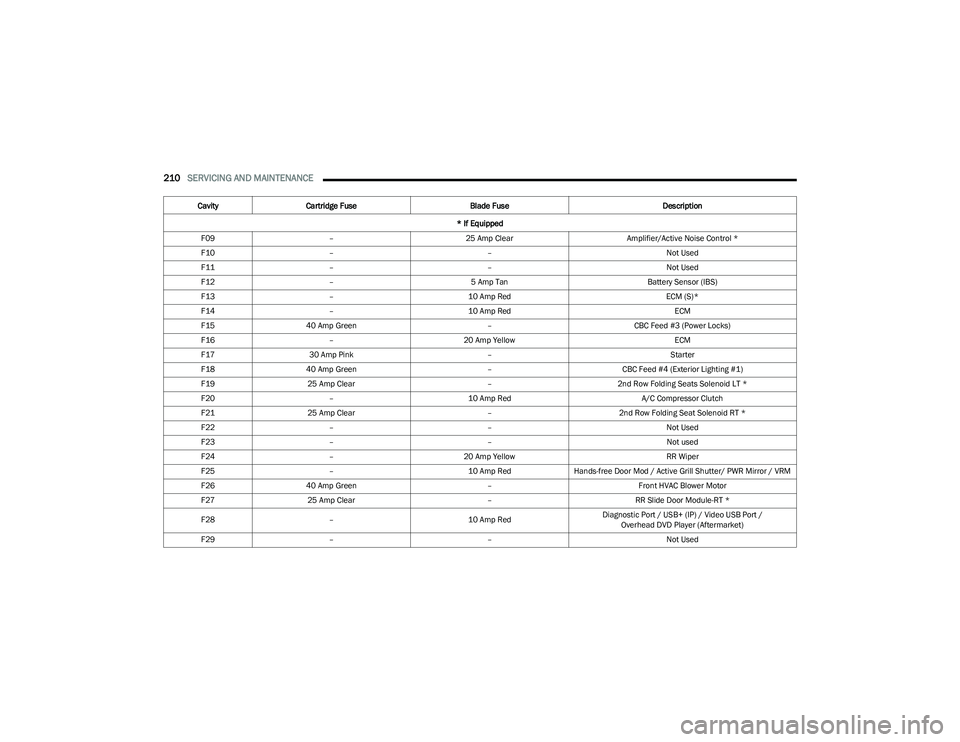
F09 – 25 Amp Clear Amplifier/Active Noise Control *
F10 – – Not Used
F11 – – Not Used
F12 – 5 Amp Tan Battery Sensor (IBS)
F13 – 10 Amp Red ECM (S)*
F14 – 10 Amp Red ECM
F15 40 Amp Green –CBC Feed #3 (Power Locks)
F16 – 20 Amp Yellow ECM
F17 30 Amp Pink – Starter
F18 40 Amp Green –CBC Feed #4 (Exterior Lighting #1)
F19 25 Amp Clear –2nd Row Folding Seats Solenoid LT *
F20 – 10 Amp Red A/C Compressor Clutch
F21 25 Amp Clear –2nd Row Folding Seat Solenoid RT *
F22 – – Not Used
F23 – – Not used
F24 – 20 Amp Yellow RR Wiper
F25 – 10 Amp RedHands-free Door Mod / Active Grill Shutter/ PWR Mirror / VRM
F26 40 Amp Green –Front HVAC Blower Motor
F27 25 Amp Clear –RR Slide Door Module-RT *
F28 – 10 Amp RedDiagnostic Port / USB+ (IP) / Video USB Port /
Overhead DVD Player (Aftermarket)
F29 – – Not Used
Cavity
Cartridge Fuse Blade Fuse Description
* If Equipped
23_RUV_OM_EN_US_t.book Page 210
Page 216 of 256
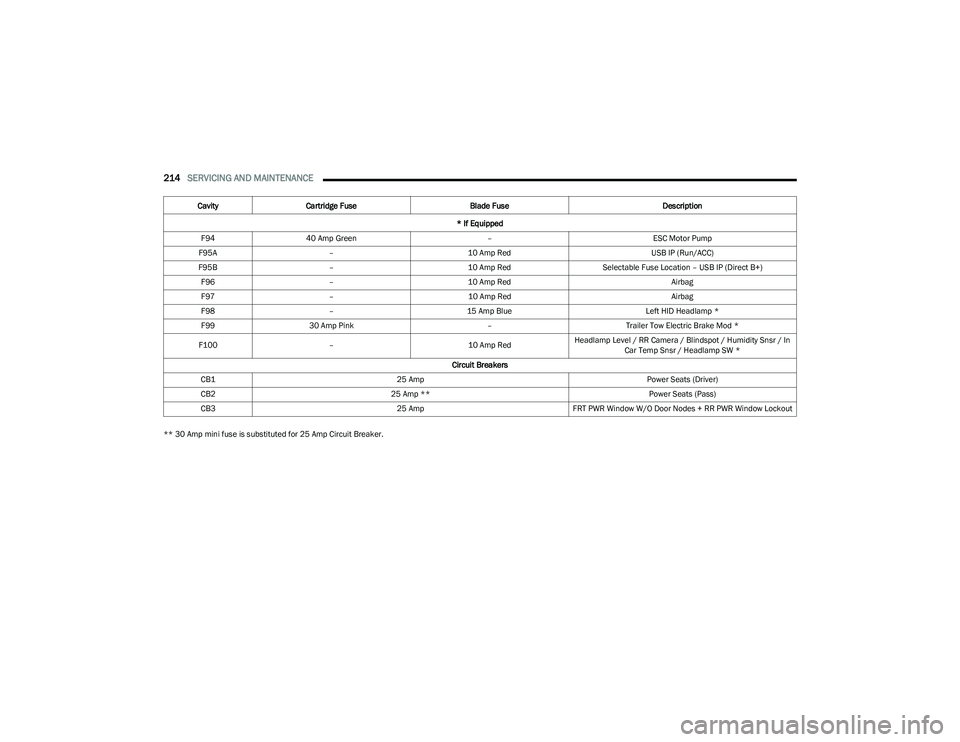
214SERVICING AND MAINTENANCE
** 30 Amp mini fuse is substituted for 25 Amp Circuit Breaker.F94
40 Amp Green –ESC Motor Pump
F95A – 10 Amp Red USB IP (Run/ACC)
F95B – 10 Amp RedSelectable Fuse Location – USB IP (Direct B+)
F96 – 10 Amp Red Airbag
F97 – 10 Amp Red Airbag
F98 – 15 Amp Blue Left HID Headlamp *
F99 30 Amp Pink –Trailer Tow Electric Brake Mod *
F100 – 10 Amp RedHeadlamp Level / RR Camera / Blindspot / Humidity Snsr / In
Car Temp Snsr / Headlamp SW *
Circuit Breakers
CB1 25 Amp Power Seats (Driver)
CB2 25 Amp ** Power Seats (Pass)
CB3 25 AmpFRT PWR Window W/O Door Nodes + RR PWR Window Lockout
Cavity
Cartridge Fuse Blade Fuse Description
* If Equipped
23_RUV_OM_EN_US_t.book Page 214
Page 218 of 256
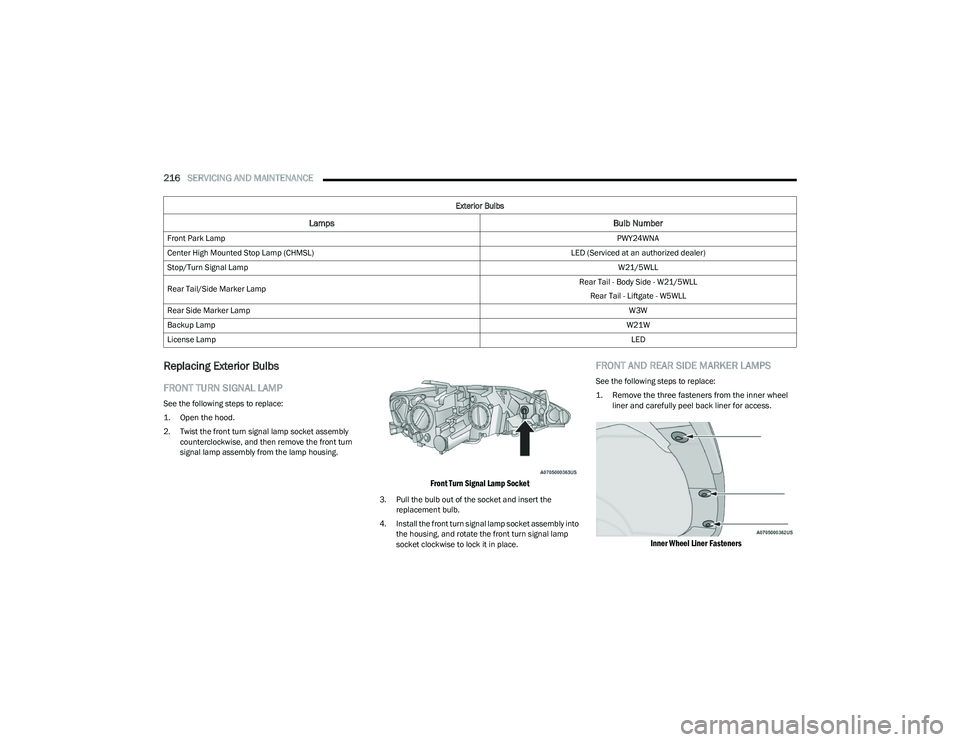
216SERVICING AND MAINTENANCE
Replacing Exterior Bulbs
FRONT TURN SIGNAL LAMP
See the following steps to replace:
1. Open the hood.
2. Twist the front turn signal lamp socket assembly
counterclockwise, and then remove the front turn
signal lamp assembly from the lamp housing.
Front Turn Signal Lamp Socket
3. Pull the bulb out of the socket and insert the replacement bulb.
4. Install the front turn signal lamp socket assembly into the housing, and rotate the front turn signal lamp
socket clockwise to lock it in place.
FRONT AND REAR SIDE MARKER LAMPS
See the following steps to replace:
1. Remove the three fasteners from the inner wheel liner and carefully peel back liner for access.
Inner Wheel Liner Fasteners
Front Park Lamp PWY24WNA
Center High Mounted Stop Lamp (CHMSL) LED (Serviced at an authorized dealer)
Stop/Turn Signal Lamp W21/5WLL
Rear Tail/Side Marker Lamp Rear Tail - Body Side - W21/5WLL
Rear Tail - Liftgate - W5WLL
Rear Side Marker Lamp W3W
Backup Lamp W21W
License Lamp LED
Exterior Bulbs
Lamps
Bulb Number
23_RUV_OM_EN_US_t.book Page 216