Start Citroen BERLINGO 2016 2.G Owner's Guide
[x] Cancel search | Manufacturer: CITROEN, Model Year: 2016, Model line: BERLINGO, Model: Citroen BERLINGO 2016 2.GPages: 264, PDF Size: 8.42 MB
Page 54 of 264
52
Berlingo-2-VU_en_Chap03_Pret-a-partir_ed01-2016Berlingo-2-VU_en_Chap03_Pret-a-partir_ed01-2016
Good practice when stopping Good practice when starting
Diesel pre-heating warning
lamp
If the temperature is high
enough, the warning lamp
comes on for less than
one second, you can start
without waiting.
In cold weather, wait for this warning
lamp to go off then operate the starter
(Starting position) until the engine
starts.
Door or bonnet open warning
lamp
If this comes on, a door or the
bonnet is not closed correctly, check!
Minimise engine and gearbox wear
When switching off the ignition, let the
engine run for a few seconds to allow
the turbocharger (Diesel engine) to
return to idle.
d
o not press the accelerator when
switching off the ignition.
There is no need to engage a gear
after parking the vehicle.
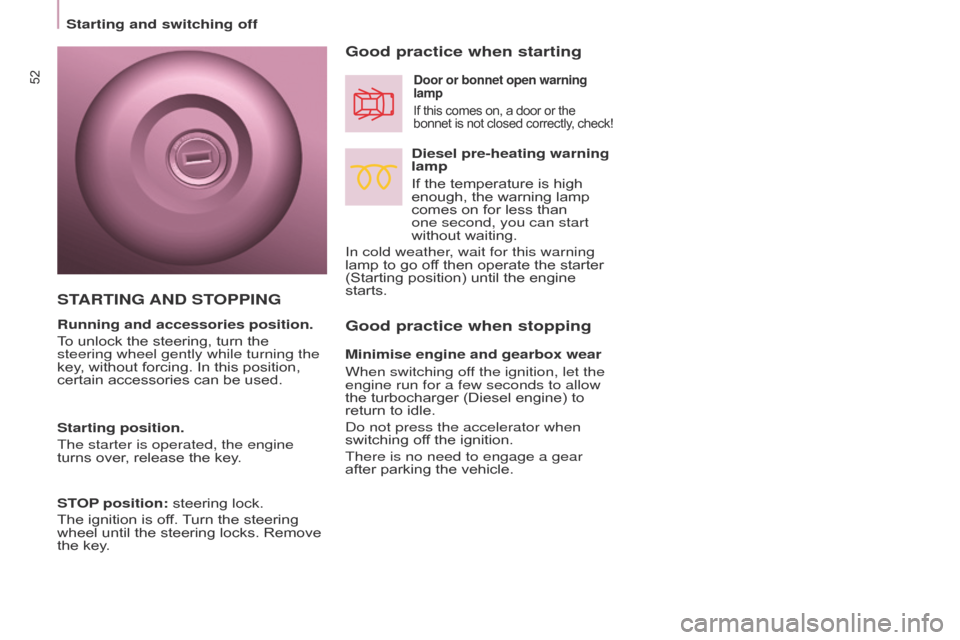
STARTING AND ST OPPING
Running and accessories position.
To unlock the steering, turn the
steering wheel gently while turning the
key, without forcing. In this position,
certain accessories can be used.
Starting position.
The starter is operated, the engine
turns over, release the key.
STOP position: steering lock.
The ignition is off. Turn the steering
wheel until the steering locks. Remove
the key.
Starting and switching off
Page 55 of 264
53
Berlingo-2-VU_en_Chap03_Pret-a-partir_ed01-2016Berlingo-2-VU_en_Chap03_Pret-a-partir_ed01-2016
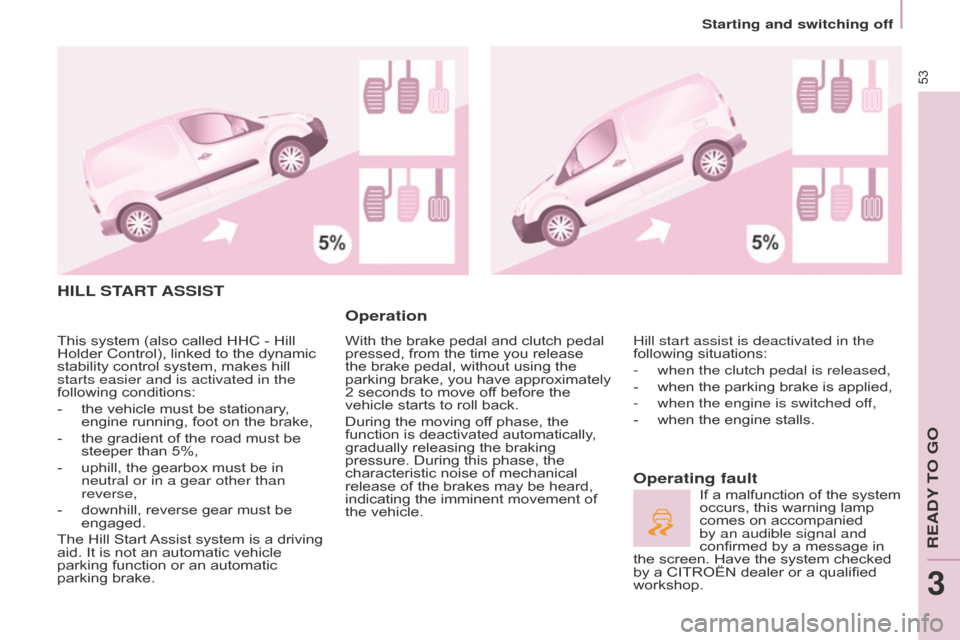
HILL START ASSIST
Operation
With the brake pedal and clutch pedal
pressed, from the time you release
the brake pedal, without using the
parking brake, you have approximately
2
seconds to move off before the
vehicle starts to roll back.
During the moving off phase, the
function is deactivated automatically,
gradually releasing the braking
pressure. During this phase, the
characteristic noise of mechanical
release of the brakes may be heard,
indicating the imminent movement of
the vehicle.
Operating fault
Hill start assist is deactivated in the
following situations:
-
when the clutch pedal is released,
-
when the parking brake is applied,
-
when the engine is switched of
f,
-
when the engine stalls. If a malfunction of the system
occurs, this warning lamp
comes on accompanied
by an audible signal and
confirmed by a message in
the screen. Have the system checked
by a CITROËN dealer or a qualified
workshop.
This system (also called HHC - Hill
Holder Control), linked to the dynamic
stability control system, makes hill
starts easier and is activated in the
following conditions:
-
the vehicle must be stationary
,
engine running, foot on the brake,
-
the gradient of the road must be
steeper than 5%,
-
uphill, the gearbox must be in
neutral or in a gear other than
reverse,
-
downhill, reverse gear must be
engaged.
The Hill Start
Assist system is a driving
aid. It is not an automatic vehicle
parking function or an automatic
parking brake.
READY TO GO
3
Starting and switching off
Page 56 of 264
54
Berlingo-2-VU_en_Chap03_Pret-a-partir_ed01-2016Berlingo-2-VU_en_Chap03_Pret-a-partir_ed01-2016
DRIVING RECOMMENDATIONS
observe the driving regulations and
remain vigilant whatever the traffic
conditions.
Pay close attention to the traffic and
keep your hands on the wheel so that
you are ready to react at any time to
any eventuality
.
On a long journey, a break every two
hours is strongly recommended.
In difficult weather, drive smoothly,
anticipate the need to brake and
increase the distance from other
vehicles.
Driving on flooded roads
We strongly advise against driving
on flooded roads, as this could cause
serious damage to the engine or
gearbox, as well as to the electrical
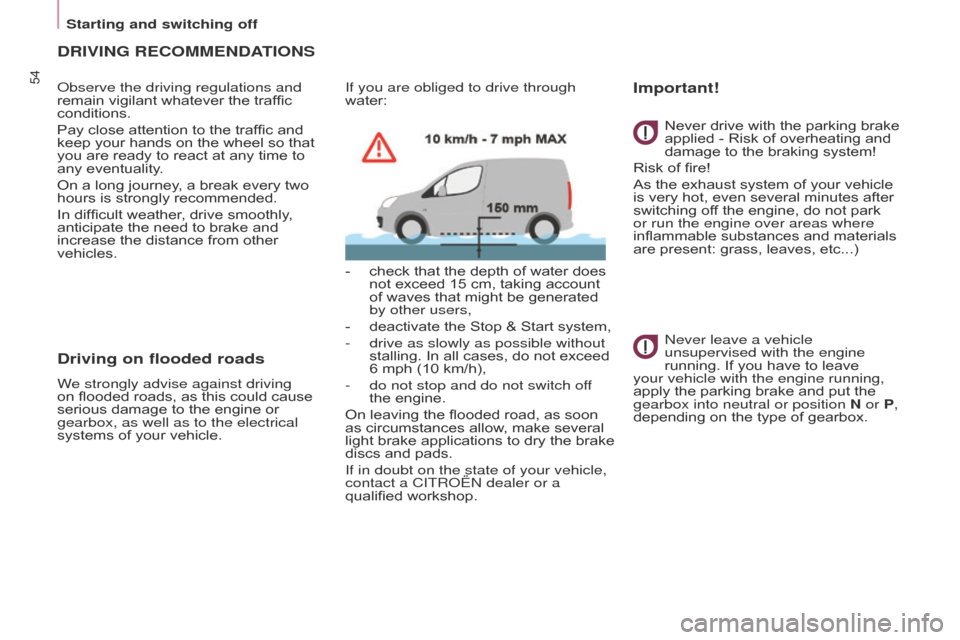
systems of your vehicle. If you are obliged to drive through
water:
-
check that the depth of water does
not exceed 15 cm, taking account
of waves that might be generated
by other users,
-
deactivate the Stop & Start system,
-
drive as slowly as possible without
stallin
g. In all cases, do not exceed
6 mph (10 km/h),
- do not stop and do not switch of f
the engine.
On leaving the flooded road, as soon
as circumstances allow, make several
light brake applications to dry the brake
discs and pads.
If in doubt on the state of your vehicle,
contact a CITR
o Ë n dealer or a
qualified workshop. Never drive with the parking brake
applied - Risk of overheating and
damage to the braking system!
Risk of fire!
As the exhaust system of your vehicle
is very hot, even several minutes after
switching off the engine, do not park
or run the engine over areas where
inflammable substances and materials
are present: grass, leaves, etc...)
n
ever leave a vehicle
unsupervised with the engine
running. If you have to leave
your vehicle with the engine running,
apply the parking brake and put the
gearbox into neutral or position N or P,
depending on the type of gearbox.
Important!
Starting and switching off
Page 59 of 264
57
Berlingo-2-VU_en_Chap04_Ergonomie_ed01-2016
Guide-me-home lighting
Keeping the dipped beam headlamps
on temporarily with the ignition off,
makes the driver's exit easier when the
light is poor.
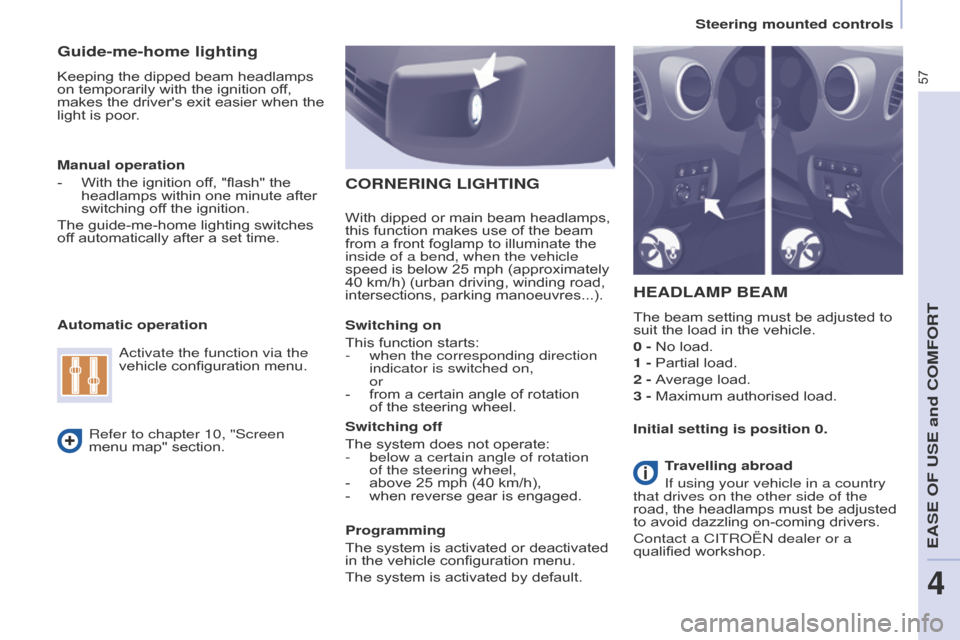
HEADLAMP BEAM
The beam setting must be adjusted to
suit the load in the vehicle.
0 - No load.
1 - Partial load.
2 - Average load.
3 - Maximum authorised load.
Manual operation
-
With the ignition of
f, "flash" the
headlamps within one minute after
switching off the ignition.
The guide-me-home lighting switches
off automatically after a set time.
Automatic operation
Refer to chapter 10, "Screen
menu map" section.
a
ctivate the function via the
vehicle configuration menu.
Initial setting is position 0.
CORNERING LIGHTING
With dipped or main beam headlamps,
this function makes use of the beam
from a front foglamp to illuminate the
inside of a bend, when the vehicle
speed is below 25 mph (approximately
40 km/h) (urban driving, winding road,
intersections, parking manoeuvres...).
Switching on
This function starts:
-
when the corresponding direction
indicator is switched on,
or
-
from a certain angle of rotation
of the steering wheel.
Switching off
The system does not operate:
-
below a certain angle of rotation
of the steering wheel,
-
above 25 mph (40 km/h),
-
when reverse gear is engaged.
Programming
The system is activated or deactivated
in the vehicle configuration menu.
The system is activated by default. T
ravelling abroad
If using your vehicle in a country
that drives on the other side of the
road, the headlamps must be adjusted
to avoid dazzling on-coming drivers.
Contact a CITR
o Ë n dealer or a
qualified workshop.
Steering mounted controls
EASE OF USE and COMFORT
4
Page 70 of 264
68
Berlingo-2-VU_en_Chap04_Ergonomie_ed01-2016Berlingo-2-VU_en_Chap04_Ergonomie_ed01-2016
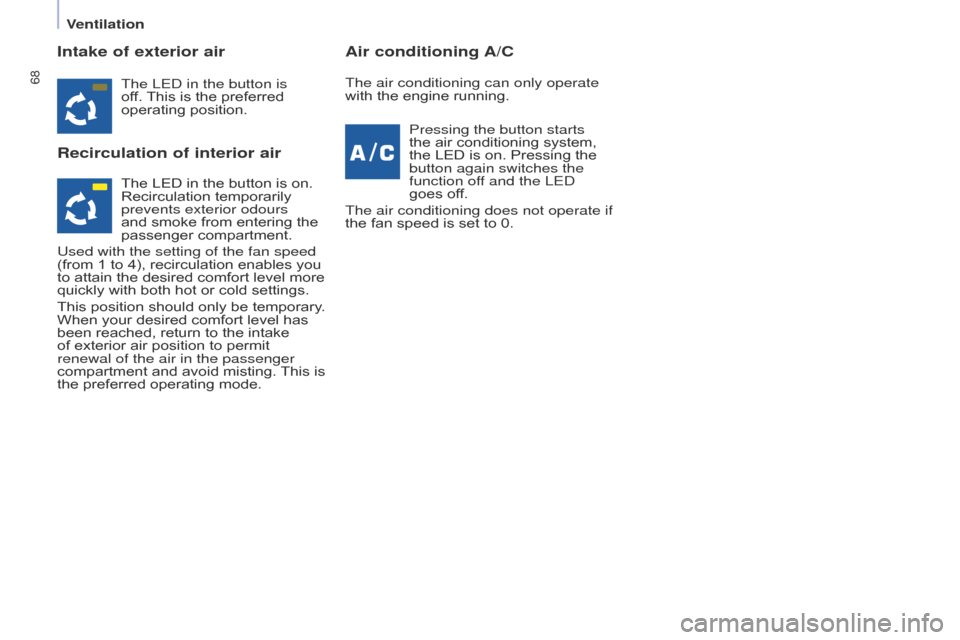
Intake of exterior air
Recirculation of interior airAir conditioning A/C
The LEd in the button is
of f. This is the preferred
operating position.
Pressing the button starts
the air conditioning system,
the LED is on. Pressing the
button again switches the
function off and the LE
d
goes off.
The air conditioning does not operate if
the fan speed is set to 0. The air conditioning can only operate
with the engine running.
The LED in the button is on.
Recirculation temporarily
prevents exterior odours
and smoke from entering the
passenger compartment.
Used with the setting of the fan speed
(from 1 to 4), recirculation enables you
to attain the desired comfort level more
quickly with both hot or cold settings.
This position should only be temporary.
When your desired comfort level has
been reached, return to the intake
of exterior air position to permit
renewal of the air in the passenger
compartment and avoid misting. This is
the preferred operating mode.
Ventilation
Page 71 of 264
69
Berlingo-2-VU_en_Chap04_Ergonomie_ed01-2016Berlingo-2-VU_en_Chap04_Ergonomie_ed01-2016
Good practice
For maximum cooling or heating of the
passenger compartment, it is possible
to exceed the value 15 by turning until
LO is displayed or the value 27 by
turning until HI is displayed.
o
n entering the vehicle, the inside
temperature may be much colder (or
warmer) than is comfortable. There is
no advantage in changing the value
displayed in order to quickly reach the
level of comfort required. The system
will use its maximum performance to
reach the comfort value set.
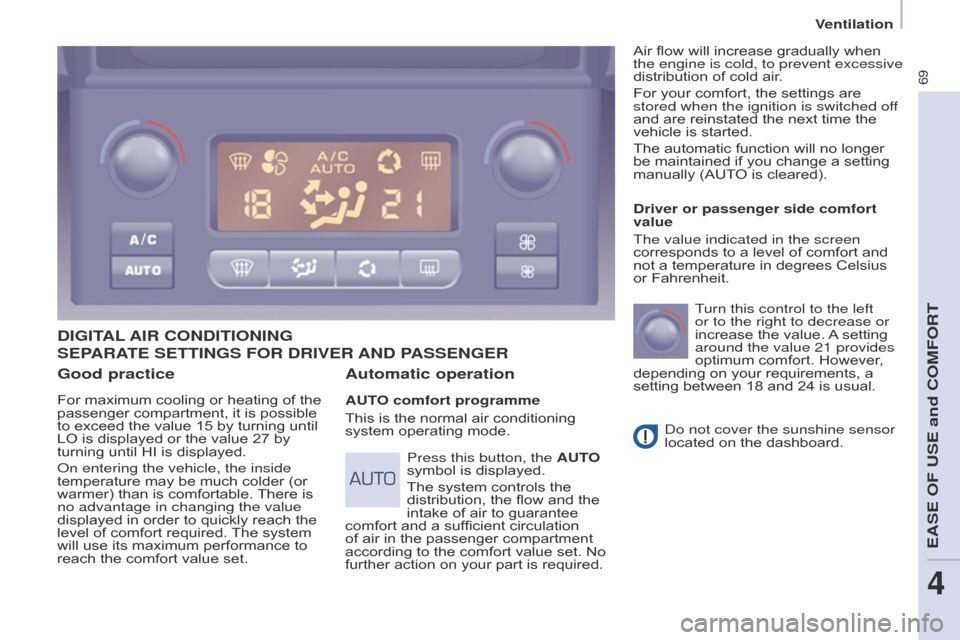
DIGITAL AIR CONDITIONING
Automatic operation
AUTO comfort programme
This is the normal air conditioning
system operating mode. Driver or passenger side comfort
value
The value indicated in the screen
corresponds to a level of comfort and
not a temperature in degrees Celsius
or Fahrenheit.
Turn this control to the left
or to the right to decrease or
increase the value. A setting
around the value 21 provides
optimum comfort. However,
depending on your requirements, a
setting between 18 and 24 is usual.
d
o not cover the sunshine sensor
located on the dashboard.
Press this button, the AUTO
symbol is displayed.
The system controls the
distribution, the flow and the
intake of air to guarantee
comfort and a sufficient circulation
of air in the passenger compartment
according to the comfort value set. No
further action on your part is required. Air flow will increase gradually when
the engine is cold, to prevent excessive
distribution of cold air.
For your comfort, the settings are
stored when the ignition is switched off
and are reinstated the next time the
vehicle is started.
The automatic function will no longer
be maintained if you change a setting
manually (AUTO is cleared).
SEPARATE SETTINGS FOR DRIVER AND
PASSENGER
EASE OF USE and COMFORT
4
Ventilation
Page 97 of 264
95
Berlingo-2-VU_en_Chap05_Securite_ed01-2016
ANTI-SLIP REGULATION (ASR)
AND
DYNAMIC STABILITY
CONTROL (DSC)
These systems are linked and
complement the ABS.
The ASR system is very useful for
maintaining optimum drive and
avoiding losses of control of the vehicle
on acceleration.
The system optimises drive to prevent
the wheels skidding, by acting on the
brakes of the drive wheels and on the
engine. It also allows the directional
stability of the vehicle to be improved
on acceleration.
Use the
d SC to hold your course
without attempting to countersteer.
If there is a variation between the
trajectory followed by the vehicle and
that required by the driver, the
d SC
system automatically acts on the
engine and the brake of one or more
wheels, in order to put the vehicle back
on course.
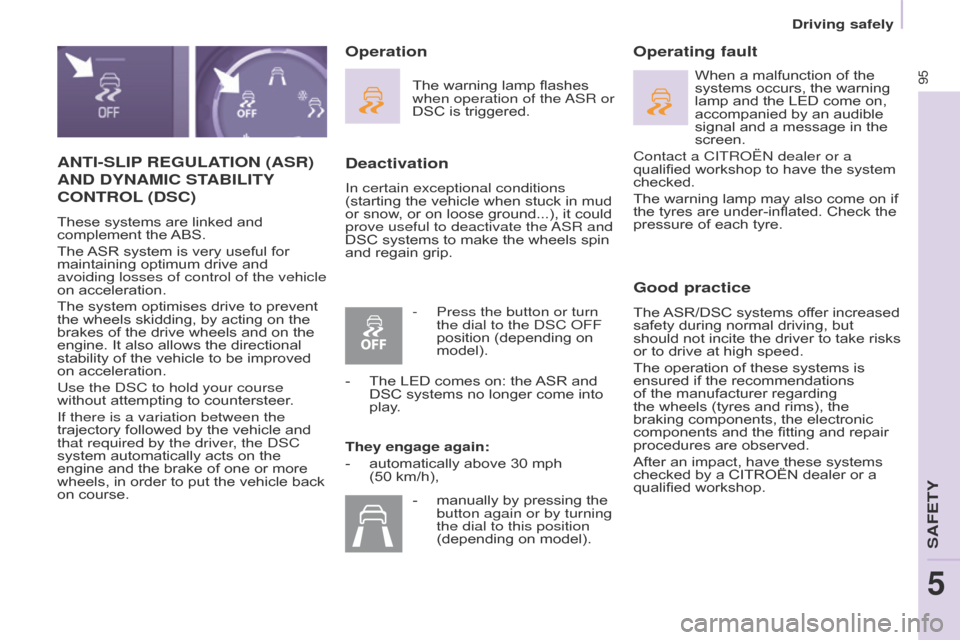
Deactivation
In certain exceptional conditions
(starting the vehicle when stuck in mud
or snow, or on loose ground...), it could
prove useful to deactivate the
a
SR and
DSC systems to make the wheels spin
and regain grip.
Operating fault
Good practice
The ASR/DSC systems offer increased
safety during normal driving, but
should not incite the driver to take risks
or to drive at high speed.
The operation of these systems is
ensured if the recommendations
of the manufacturer regarding
the wheels (tyres and rims), the
braking components, the electronic
components and the fitting and repair
procedures are observed.
After an impact, have these systems
checked by a CITROËN dealer or a
qualified workshop.
Operation
The warning lamp flashes
when operation of the a SR or
DSC is triggered.
They engage again:
-
automatically above 30 mph
(50 km/h), When a malfunction of the
systems occurs, the warning
lamp and the LED come on,
accompanied by an audible
signal and a message in the
screen.
Contact a CITR
o Ë n dealer or a
qualified workshop to have the system
checked.
The warning lamp may also come on if
the tyres are under-inflated. Check the
pressure of each tyre.
-
Press the button or turn
the dial to the
d SC o FF
position (depending on
model).
-
The LED comes on: the
ASR and
DSC systems no longer come into
play.
-
manually by pressing the
button again or by turning
the dial to this position
(depending on model).
Driving safely
SAFETY
5
Page 104 of 264
102
Berlingo-2-VU_en_Chap05_Securite_ed01-2016Berlingo-2-VU_en_Chap05_Securite_ed01-2016
SEAT BELTS
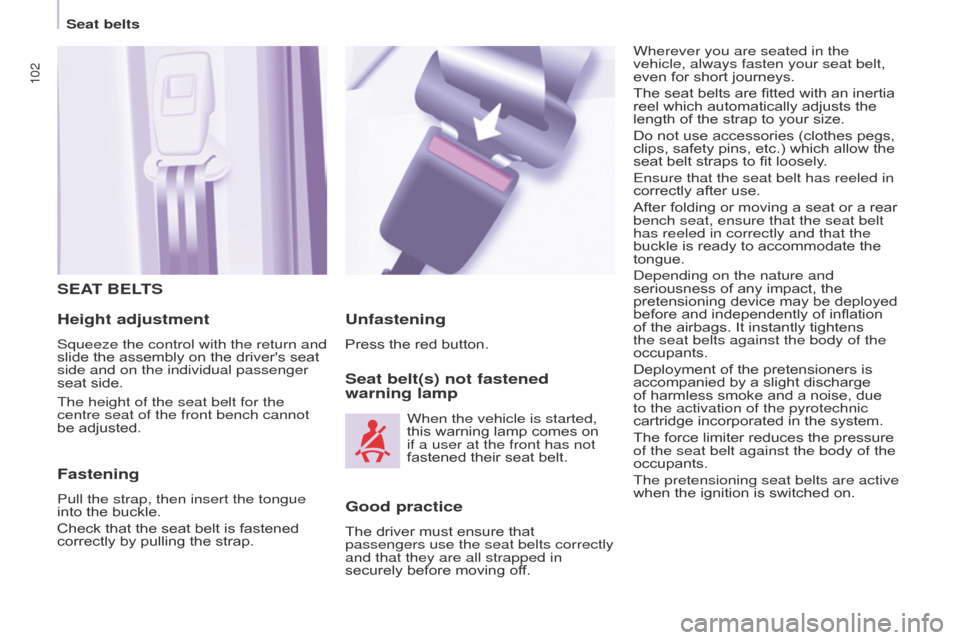
Height adjustment
Squeeze the control with the return and
slide the assembly on the driver's seat
side and on the individual passenger
seat side.
Fastening
Pull the strap, then insert the tongue
into the buckle.
Check that the seat belt is fastened
correctly by pulling the strap.
Seat belt(s) not fastened
warning lamp
Wherever you are seated in the
vehicle, always fasten your seat belt,
even for short journeys.
The seat belts are fitted with an inertia
reel which automatically adjusts the
length of the strap to your size.
Do not use accessories (clothes pegs,
clips, safety pins, etc.) which allow the
seat belt straps to fit loosely.
Ensure that the seat belt has reeled in
correctly after use.
After folding or moving a seat or a rear
bench seat, ensure that the seat belt
has reeled in correctly and that the
buckle is ready to accommodate the
tongue.
d
epending on the nature and
seriousness of any impact, the
pretensioning device may be deployed
before and independently of inflation
of the airbags. It instantly tightens
the seat belts against the body of the
occupants.
Deployment of the pretensioners is
accompanied by a slight discharge
of harmless smoke and a noise, due
to the activation of the pyrotechnic
cartridge incorporated in the system.
The force limiter reduces the pressure
of the seat belt against the body of the
occupants.
The pretensioning seat belts are active
when the ignition is switched on.
Unfastening
Press the red button.
When the vehicle is started,
this warning lamp comes on
if a user at the front has not
fastened their seat belt.
Good practice
The driver must ensure that
passengers use the seat belts correctly
and that they are all strapped in
securely before moving off.
The height of the seat belt for the
centre seat of the front bench cannot
be adjusted.
Seat belts
Page 130 of 264
128
Berlingo-2-VU_en_Chap07_Verification_ed01-2016Berlingo-2-VU_en_Chap07_Verification_ed01-2016
Cooling system
Only use the fluid recommended by the
manufacturer.
Otherwise, you risk seriously damaging
your engine.
When the engine is warm, the
temperature of the coolant is controlled
by the engine fan. As this fan can
operate with the ignition key removed
and because the cooling system is
pressurised, wait for at least one hour
after the engine has stopped before
carrying out any work.
Slacken the cap by 1/4 of a turn to
release the pressure to prevent any
risk of scalding. When the pressure
has dropped, remove the cap and top
up the level with coolant.
If fluid has to be added frequently,
this indicates a fault which must be
checked by a CITROËN dealer as
soon as possible.
Power steering fluid level
The vehicle must be parked on level
ground with the engine cold. Unscrew
the cap integrated with the gauge and
check the level which must be between
the MIN and MAX marks.In order to regenerate the filter, you
are advised to drive at a speed higher
than 40 mph (60 km/h) for at least five
minutes as soon as possible, when
traffic conditions permit (until the
message disappears and the service
warning lamp goes off).
d
uring regeneration of the particle
emission filter, the noise of a relay
operating may be heard under the
dashboard.
If the message is still displayed and
if the service warning lamp remains
on, contact a CITR
o Ë n dealer or a
qualified workshop.
Topping up
The level must be between the MIN
and MAX marks on the expansion
bottle. If more than 1 litre of fluid is
required to top up the level, have the
system checked by a CITROËN dealer
or a qualified workshop.
Screenwash and headlamp
wash level
For best quality cleaning and for your
safety, we would advise that you use
products of the CITROËN range.
For optimum cleaning and to avoid
freezing, this fluid must not be topped
up or replaced with plain water.
Capacity of the screenwash reservoir:
approximately 3 litres.
If your vehicle is fitted with headlamp
washers, the capacity of the reservoir
is 6 litres.
Diesel additive level
(Diesel with particle
filter)
Topping up
This additive must be topped up by
a CITROËN dealer or a qualified
workshop without delay.
Waste products
avoid prolonged contact of used oil
with the skin.
Brake fluid is harmful to health and
very corrosive.
Do not dispose of used oil, brake fluid
or coolant into drains or into the ground
but into the containers dedicated to this
use at a CITROËN dealer (France) or
an authorised waste disposal site.
The minimum level of this additive
is indicated by lighting of the service
warning lamp, accompanied by an
audible signal and a message in the
screen.
When this occurs with the engine
running it is due to the start of
saturation of the particle filter
(exceptionally prolonged urban type
driving conditions: low speed, long
traffic jams,...).
Levels
Page 131 of 264
129
Berlingo-2-VU_en_Chap07_Verification_ed01-2016Berlingo-2-VU_en_Chap07_Verification_ed01-2016
CHECKS
Carbon filter and passenger
compartment filter
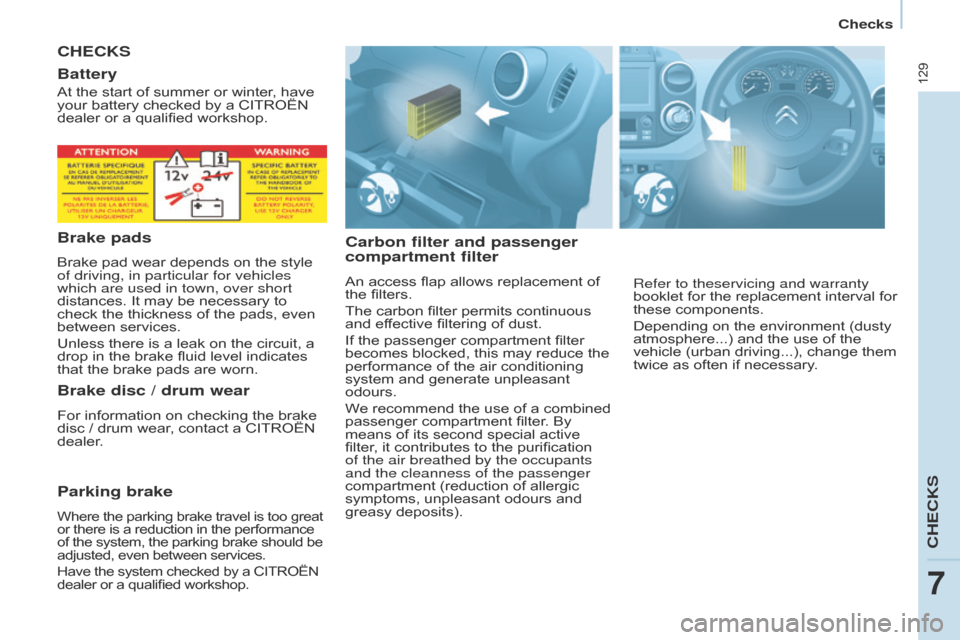
An access flap allows replacement of
the filters.
The carbon filter permits continuous
and effective filtering of dust.
If the passenger compartment filter
becomes blocked, this may reduce the
performance of the air conditioning
system and generate unpleasant
odours.
We recommend the use of a combined
passenger compartment filter. By
means of its second special active
filter, it contributes to the purification
of the air breathed by the occupants
and the cleanness of the passenger
compartment (reduction of allergic
symptoms, unpleasant odours and
greasy deposits).
Battery
At the start of summer or winter, have
your battery checked by a CITROËN
dealer or a qualified workshop.
Brake pads
Brake pad wear depends on the style
of driving, in particular for vehicles
which are used in town, over short
distances. It may be necessary to
check the thickness of the pads, even
between services.
Unless there is a leak on the circuit, a
drop in the brake fluid level indicates
that the brake pads are worn.
Brake disc / drum wear
For information on checking the brake
disc / drum wear, contact a CITROËN
dealer.
Parking brake
Where the parking brake travel is too great
or there is a reduction in the performance
of the system, the parking brake should be
adjusted, even between services.
Have the system checked by a CITROËN
dealer or a qualified workshop.
Refer to theservicing and warranty
booklet for the replacement interval for
these components.
Depending on the environment (dusty
atmosphere...) and the use of the
vehicle (urban driving...), change them
twice as often if necessary.
CHECKS
7
Checks