eco Citroen C3 2012 2.G Repair Manual
[x] Cancel search | Manufacturer: CITROEN, Model Year: 2012, Model line: C3, Model: Citroen C3 2012 2.GPages: 252, PDF Size: 8.11 MB
Page 129 of 252
9
DRIVING
REAR PARKING SENSORS
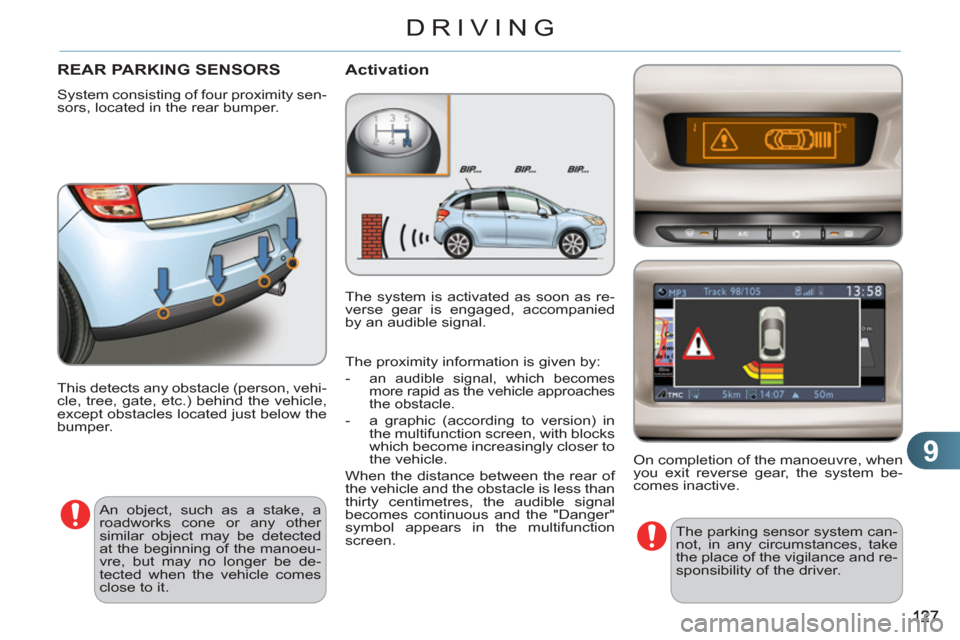
System consisting of four proximity sen-
sors, located in the rear bumper.
Activation
This detects any obstacle (person, vehi-
cle, tree, gate, etc.) behind the vehicle,
except obstacles located just below the
bumper.
An object, such as a stake, a
roadworks cone or any other
similar object may be detected
at the beginning of the manoeu-
vre, but may no longer be de-
tected when the vehicle comes
close to it.
The parking sensor system can-
not, in any circumstances, take
the place of the vigilance and re-
sponsibility of the driver. The system is activated as soon as re-
verse gear is engaged, accompanied
by an audible signal.
On completion of the manoeuvre, when
you exit reverse gear, the system be-
comes inactive. The proximity information is given by:
- an audible signal, which becomes
more rapid as the vehicle approaches
the obstacle.
- a graphic (according to version) in
the multifunction screen, with blocks
which become increasingly closer to
the vehicle.
When the distance between the rear of
the vehicle and the obstacle is less than
thirty centimetres, the audible signal
becomes continuous and the "Danger"
symbol appears in the multifunction
screen.
Page 130 of 252
9
128
DRIVING
The system will be deactivated
automatically when towing a
trailer or when a bicycle carrier is
fi tted (vehicle fi tted with a towbar
or bicycle carrier recommended
by CITROËN). In bad or wintry weather, ensure
that the sensors are not covered
with mud, frost or snow.
Programming
You can activate or deactivate the
system by means of the multifunction
screen confi guration menu. The system
state is memorised when switching off
the ignition.
For more information on access to
the parking sensors menu, refer to
"Confi guration/Vehicle parameters" in
the "Multifunction screens" section cor-
responding to your screen.
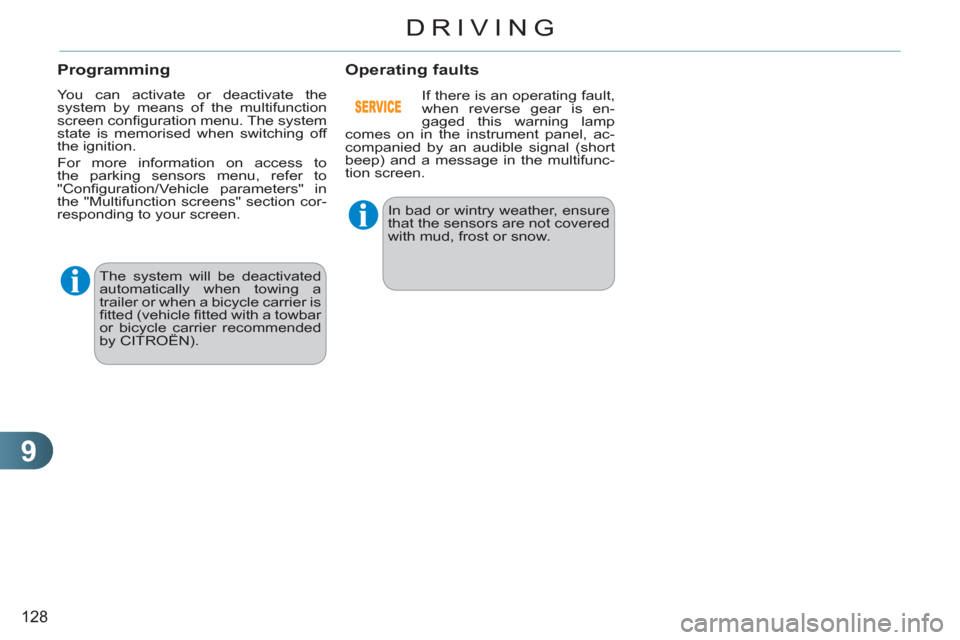
Operating faults
If there is an operating fault,
when reverse gear is en-
gaged this warning lamp
comes on in the instrument panel, ac-
companied by an audible signal (short
beep) and a message in the multifunc-
tion screen.
Page 135 of 252
10
133
CHECKS
CHECKING LEVELS
Check all of these levels regularly and
top them up if necessary, unless other-
wise indicated.
If a level drops signifi cantly, have the
corresponding system checked by a
CITROËN dealer or a qualifi ed work-
shop.
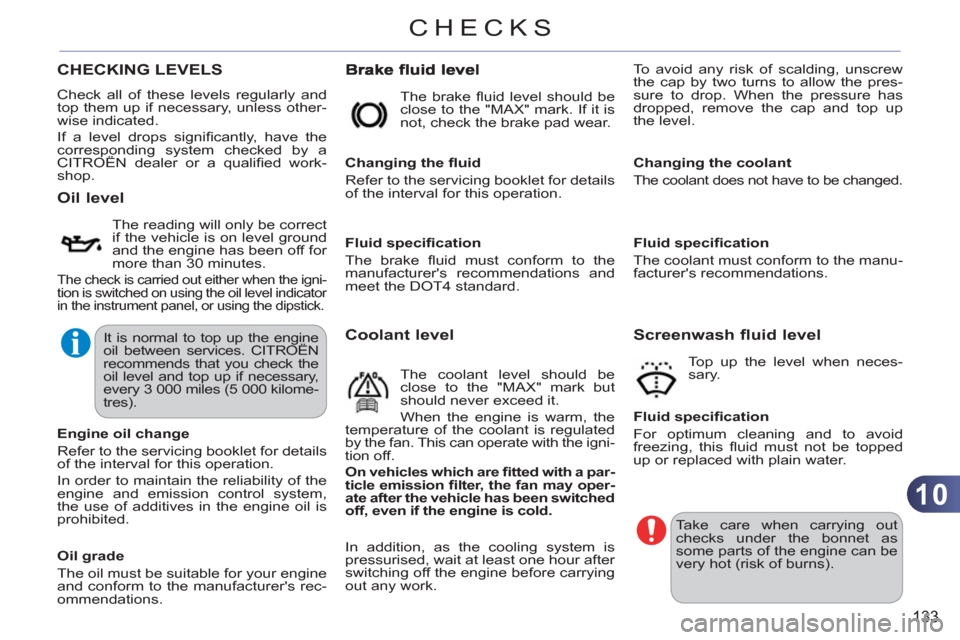
Oil level
The reading will only be correct
if the vehicle is on level ground
and the engine has been off for
more than 30 minutes.
The check is carried out either when the igni-
tion is switched on using the oil level indicator
in the instrument panel, or using the dipstick.
Engine oil change
Refer to the servicing booklet for details
of the interval for this operation.
In order to maintain the reliability of the
engine and emission control system,
the use of additives in the engine oil is
prohibited.
Oil grade
The oil must be suitable for your engine
and conform to the manufacturer's rec-
ommendations.
The brake fl uid level should be
close to the "MAX" mark. If it is
not, check the brake pad wear.
Changing the fl uid
Refer to the servicing booklet for details
of the interval for this operation.
Fluid specifi cation
The brake fl uid must conform to the
manufacturer's recommendations and
meet the DOT4 standard.
Coolant level
The coolant level should be
close to the "MAX" mark but
should never exceed it.
When the engine is warm, the
temperature of the coolant is regulated
by the fan. This can operate with the igni-
tion off.
On vehicles which are fi tted with a par-
ticle emission fi lter, the fan may oper-
ate after the vehicle has been switched
off, even if the engine is cold.
In addition, as the cooling system is
pressurised, wait at least one hour after
switching off the engine before carrying
out any work. To avoid any risk of scalding, unscrew
the cap by two turns to allow the pres-
sure to drop. When the pressure has
dropped, remove the cap and top up
the level.
Changing the coolant
The coolant does not have to be changed.
Fluid specifi cation
The coolant must conform to the manu-
facturer's recommendations.
Screenwash fluid level
Top up the level when neces-
sary.
Fluid specifi cation
For optimum cleaning and to avoid
freezing, this fl uid must not be topped
up or replaced with plain water.
Take care when carrying out
checks under the bonnet as
some parts of the engine can be
very hot (risk of burns).
It is normal to top up the engine
oil between services. CITROËN
recommends that you check the
oil level and top up if necessary,
every 3 000 miles (5 000 kilome-
tres).
Page 136 of 252
10
134
CHECKS
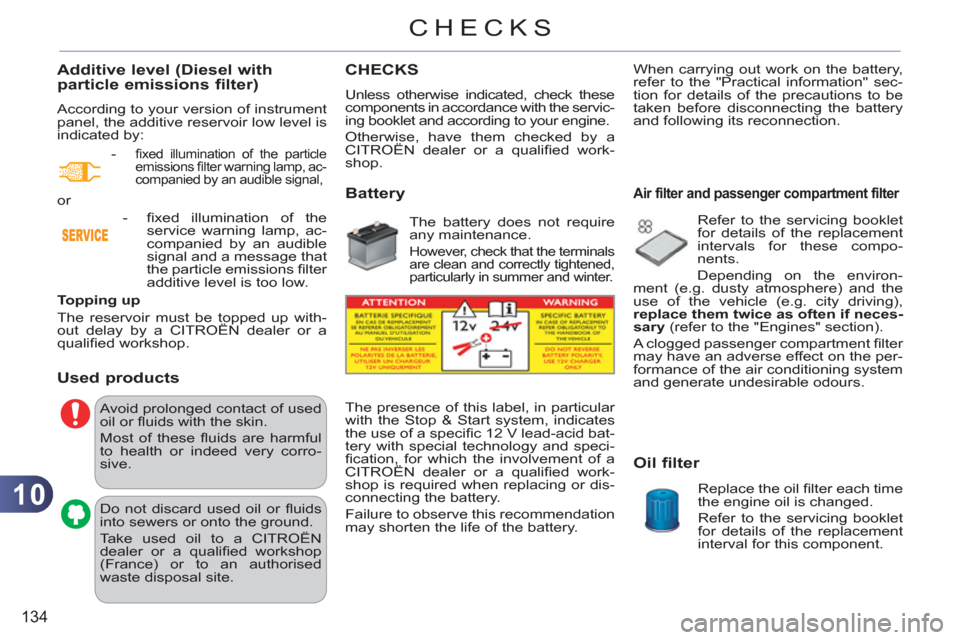
Additive level (Diesel with particle emissions filter)
According to your version of instrument
panel, the additive reservoir low level is
indicated by:
Topping up
The reservoir must be topped up with-
out delay by a CITROËN dealer or a
qualifi ed workshop.
Used products
Avoid prolonged contact of used
oil or fl uids with the skin.
Most of these fl uids are harmful
to health or indeed very corro-
sive.
Do not discard used oil or fl uids
into sewers or onto the ground.
Take used oil to a CITROËN
dealer or a qualifi ed workshop
(France) or to an authorised
waste disposal site.
CHECKS
Unless otherwise indicated, check these
components in accordance with the servic-
ing booklet and according to your engine.
Otherwise, have them checked by a
CITROËN dealer or a qualifi ed work-
shop.
Battery
The battery does not require
any maintenance.
However, check that the terminals
are clean and correctly tightened,
particularly in summer and winter.
Air filter and passenger compartment filter
Refer to the servicing booklet
for details of the replacement
intervals for these compo-
nents.
Depending on the environ-
ment (e.g. dusty atmosphere) and the
use of the vehicle (e.g. city driving),
replace them twice as often if neces-
sary
(refer to the "Engines" section).
A clogged passenger compartment fi lter
may have an adverse effect on the per-
formance of the air conditioning system
and generate undesirable odours.
Oil filter
Replace the oil fi lter each time
the engine oil is changed.
Refer to the servicing booklet
for details of the replacement
interval for this component.
The presence of this label, in particular
with the Stop & Start system, indicates
the use of a specifi c 12 V lead-acid bat-
tery with special technology and speci-
fi cation, for which the involvement of a
CITROËN dealer or a qualifi ed work-
shop is required when replacing or dis-
connecting the battery.
Failure to observe this recommendation
may shorten the life of the battery. When carrying out work on the battery,
refer to the "Practical information" sec-
tion for details of the precautions to be
taken before disconnecting the battery
and following its reconnection.
-
fi xed illumination of the particle
emissions fi lter warning lamp, ac-
companied by an audible signal,
or
- fi xed illumination of the
service warning lamp, ac-
companied by an audible
signal and a message that
the particle emissions fi lter
additive level is too low.
Page 137 of 252
10
135
CHECKS
Manual gearbox
The gearbox does not require any
maintenance (no oil change).
Refer to the servicing book-
let for the details of the level
checking interval for this com-
ponent.
Automatic gearbox
The gearbox does not re-
quire any maintenance (no oil
change).
Refer to the servicing booklet
for details of the level checking
interval for this component.
Manual parking brake
If a loss of effectiveness of this
system is noticed, the parking
brake must be checked, even
between two services.
Checking this system must be done by
a CITROËN dealer or a qualifi ed work-
shop.
Only use products recommend-
ed by CITROËN or products of
equivalent quality and specifi ca-
tion.
In order to optimise the opera-
tion of units as important as the
braking system, CITROËN se-
lects and offers very specifi c
products.
To avoid damaging the electrical
units, the use of a high pressure
washer in the engine compart-
ment is strictly prohibited
.
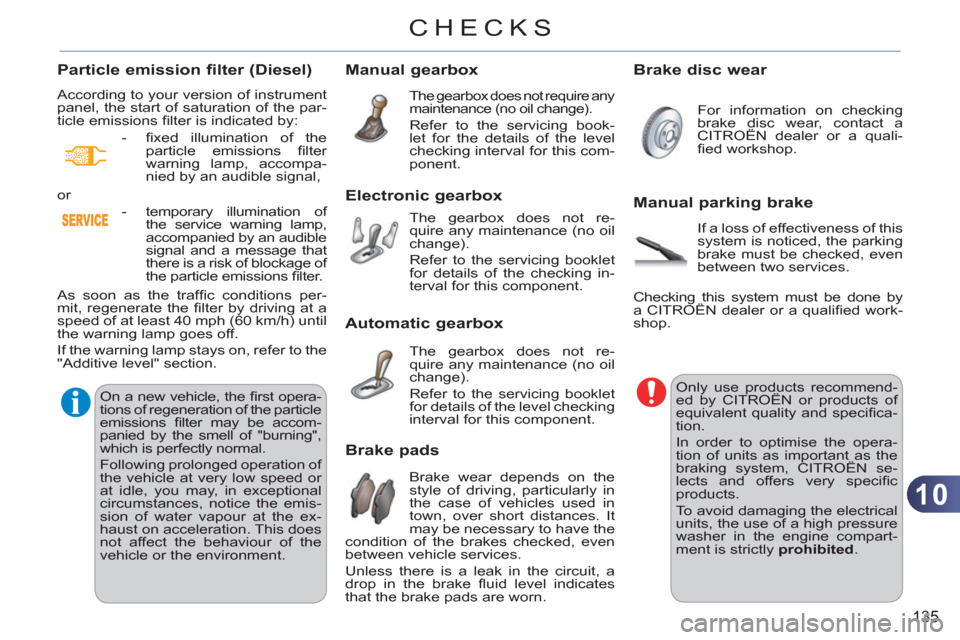
Particle emission filter (Diesel)
According to your version of instrument
panel, the start of saturation of the par-
ticle emissions fi lter is indicated by:
On a new vehicle, the fi rst opera-
tions of regeneration of the particle
emissions fi lter may be accom-
panied by the smell of "burning",
which is perfectly normal.
Following prolonged operation of
the vehicle at very low speed or
at idle, you may, in exceptional
circumstances, notice the emis-
sion of water vapour at the ex-
haust on acceleration. This does
not affect the behaviour of the
vehicle or the environment.
- fi xed illumination of the
particle emissions fi lter
warning lamp, accompa-
nied by an audible signal,
or
- temporary illumination of
the service warning lamp,
accompanied by an audible
signal and a message that
there is a risk of blockage of
the particle emissions fi lter.
As soon as the traffi c conditions per-
mit, regenerate the fi lter by driving at a
speed of at least 40 mph (60 km/h) until
the warning lamp goes off.
If the warning lamp stays on, refer to the
"Additive level" section.
Electronic gearbox
The gearbox does not re-
quire any maintenance (no oil
change).
Refer to the servicing booklet
for details of the checking in-
terval for this component.
Brake pads
Brake disc wear
Brake wear depends on the
style of driving, particularly in
the case of vehicles used in
town, over short distances. It
may be necessary to have the
condition of the brakes checked, even
between vehicle services.
Unless there is a leak in the circuit, a
drop in the brake fl uid level indicates
that the brake pads are worn. For information on checking
brake disc wear, contact a
CITROËN dealer or a quali-
fi ed workshop.
Page 153 of 252
11
151
PRACTICAL INFORMATION
CHANGING A FUSE
Procedure for replacing a faulty fuse
with a new fuse to rectify a failure of the
corresponding function.
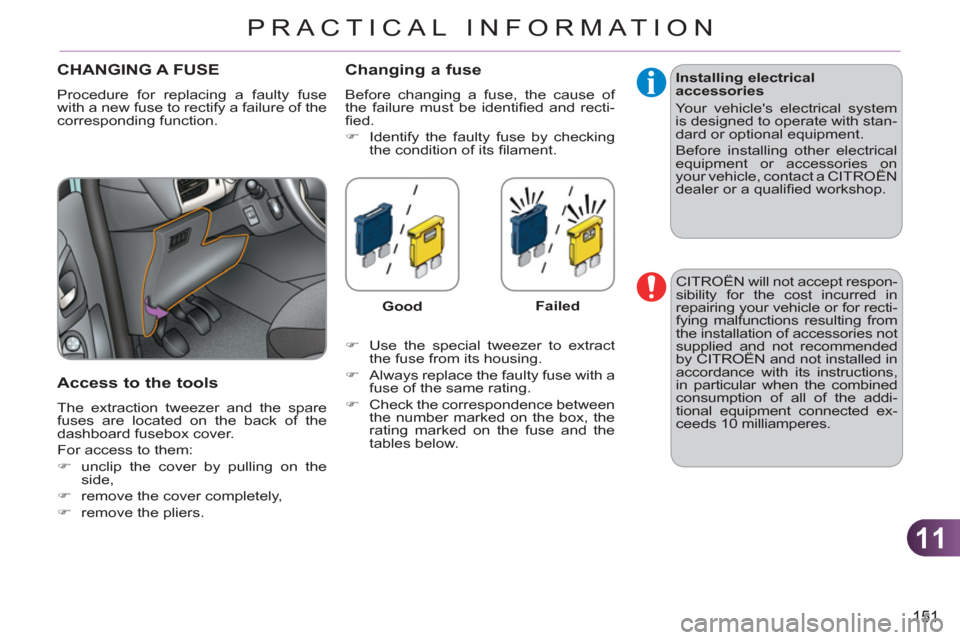
Access to the tools
The extraction tweezer and the spare
fuses are located on the back of the
dashboard fusebox cover.
For access to them:
)
unclip the cover by pulling on the
side,
)
remove the cover completely,
)
remove the pliers.
Changing a fuse
Before changing a fuse, the cause of
the failure must be identifi ed and recti-
fi ed.
)
Identify the faulty fuse by checking
the condition of its fi lament.
Good
Failed
)
Use the special tweezer to extract
the fuse from its housing.
)
Always replace the faulty fuse with a
fuse of the same rating.
)
Check the correspondence between
the number marked on the box, the
rating marked on the fuse and the
tables below.
Installing electrical
accessories
Your vehicle's electrical system
is designed to operate with stan-
dard or optional equipment.
Before installing other electrical
equipment or accessories on
your vehicle, contact a CITROËN
dealer or a qualifi ed workshop.
CITROËN will not accept respon-
sibility for the cost incurred in
repairing your vehicle or for recti-
fying malfunctions resulting from
the installation of accessories not
supplied and not recommended
by CITROËN and not installed in
accordance with its instructions,
in particular when the combined
consumption of all of the addi-
tional equipment connected ex-
ceeds 10 milliamperes.
Page 157 of 252
11
PRACTICAL INFORMATION
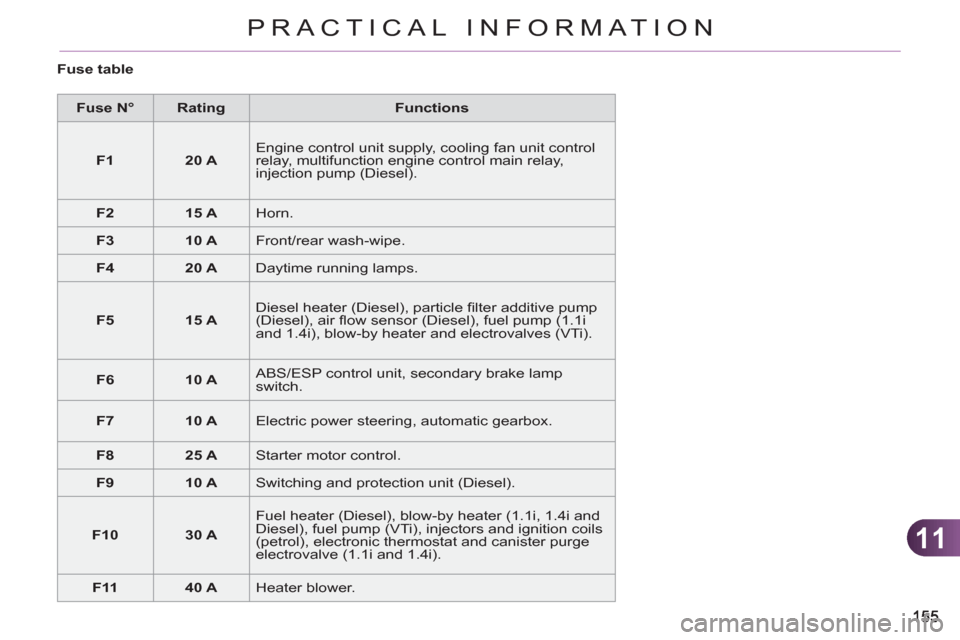
Fuse table
Fuse N°
Rating
Functions
F1
20 A
Engine control unit supply, cooling fan unit control
relay, multifunction engine control main relay,
injection pump (Diesel).
F2
15 A
Horn.
F3
10 A
Front/rear wash-wipe.
F4
20 A
Daytime running lamps.
F5
15 A
Diesel heater (Diesel), particle fi lter additive pump
(Diesel), air fl ow sensor (Diesel), fuel pump (1.1i
and 1.4i), blow-by heater and electrovalves (VTi).
F6
10 A
ABS/ESP control unit, secondary brake lamp
switch.
F7
10 A
Electric power steering, automatic gearbox.
F8
25 A
Starter motor control.
F9
10 A
Switching and protection unit (Diesel).
F10
30 A
Fuel heater (Diesel), blow-by heater (1.1i, 1.4i and
Diesel), fuel pump (VTi), injectors and ignition coils
(petrol), electronic thermostat and canister purge
electrovalve (1.1i and 1.4i).
F11
40 A
Heater blower.
Page 160 of 252
11
158
PRACTICAL INFORMATION
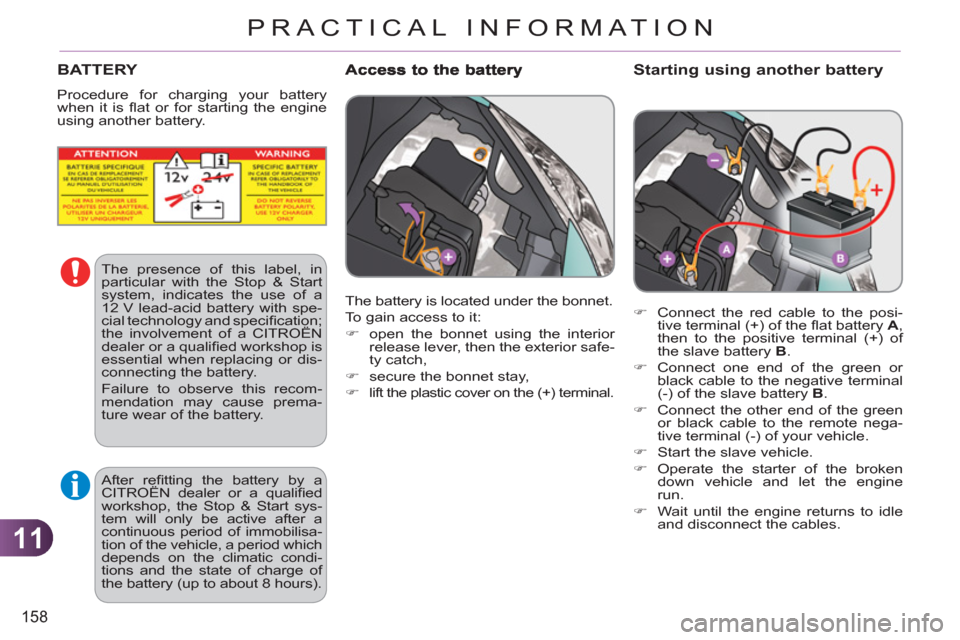
Starting using another battery
)
Connect the red cable to the posi-
tive terminal (+) of the fl at battery A
,
then to the positive terminal (+) of
the slave battery B
.
)
Connect one end of the green or
black cable to the negative terminal
(-) of the slave battery B
.
)
Connect the other end of the green
or black cable to the remote nega-
tive terminal (-) of your vehicle .
)
Start the slave vehicle.
)
Operate the starter of the broken
down vehicle and let the engine
run.
)
Wait until the engine returns to idle
and disconnect the cables.
BATTERY
Procedure for charging your battery
when it is fl at or for starting the engine
using another battery.
The battery is located under the bonnet.
To gain access to it:
)
open the bonnet using the interior
release lever, then the exterior safe-
ty catch,
)
secure the bonnet stay,
)
lift the plastic cover on the (+) terminal.
The presence of this label, in
particular with the Stop & Start
system, indicates the use of a
12 V lead-acid battery with spe-
cial technology and specifi cation;
the involvement of a CITROËN
dealer or a qualifi ed workshop is
essential when replacing or dis-
connecting the battery.
Failure to observe this recom-
mendation may cause prema-
ture wear of the battery.
After refi tting the battery by a
CITROËN dealer or a qualifi ed
workshop, the Stop & Start sys-
tem will only be active after a
continuous period of immobilisa-
tion of the vehicle, a period which
depends on the climatic condi-
tions and the state of charge of
the battery (up to about 8 hours).
Page 162 of 252
11
160
PRACTICAL INFORMATION
If the telephone is being used at
the same time on the MyWay au-
dio navigation system, it will be
interrupted after 10 minutes. A fl at battery prevents the engine
from starting (refer to the corre-
sponding paragraph).
ENERGY ECONOMY MODE
System which manages the period of
use of certain functions to conserve a
suffi cient level of charge in the battery.
After the engine has stopped, you can
still use functions such as the audio
equipment, windscreen wipers, dipped
beam headlamps, courtesy lamps, etc.
for a maximum combined period of
thirty minutes.
Switching to economy mode
Once this period has elapsed, a message ap-
pears on the multifunction screen indicating
that the vehicle has switched to economy mode
and the active functions are put on standby.
Exiting economy mode
These functions are reactivated auto-
matically the next time the vehicle is
driven.
)
In order to resume the use of these
functions immediately, start the en-
gine and let it run for a few minutes.
The time available to you will then be
double the period for which the engine is
left running. However, this period will al-
ways be between fi ve and thirty minutes.
This period may be greatly re-
duced if the battery is not fully
charged.
CHANGING A FRONT OR REARWIPER BLADE
Procedure for replacing a worn wiper
blade with a new one without the use
of tools.
Before removing a front wiper blade
)
Within one minute after switching off
the ignition, operate the wiper stalk
to position the wiper blades in the
vertical position.
This position must be used in order to
avoid damaging the wiper blade and the
bonnet.
Removal
)
Raise the corresponding wiper arm.
)
Unclip the wiper blade and remove it.
Fitting
)
At the front, check the size of the wip-
er blade as the shorter blade is fi tted
to the passenger side of the vehicle.
)
Put the corresponding new wiper
blade in place and clip it.
)
Fold down the wiper arm carefully.
After fitting a front wiper blade
)
Switch on the ignition.
)
Operate the wiper stalk again to
park the wiper blades.
Page 163 of 252
11
161
PRACTICAL INFORMATION
TOWING THE VEHICLE
Procedure for having your vehicle towed
or for towing another vehicle using a re-
movable towing eye.
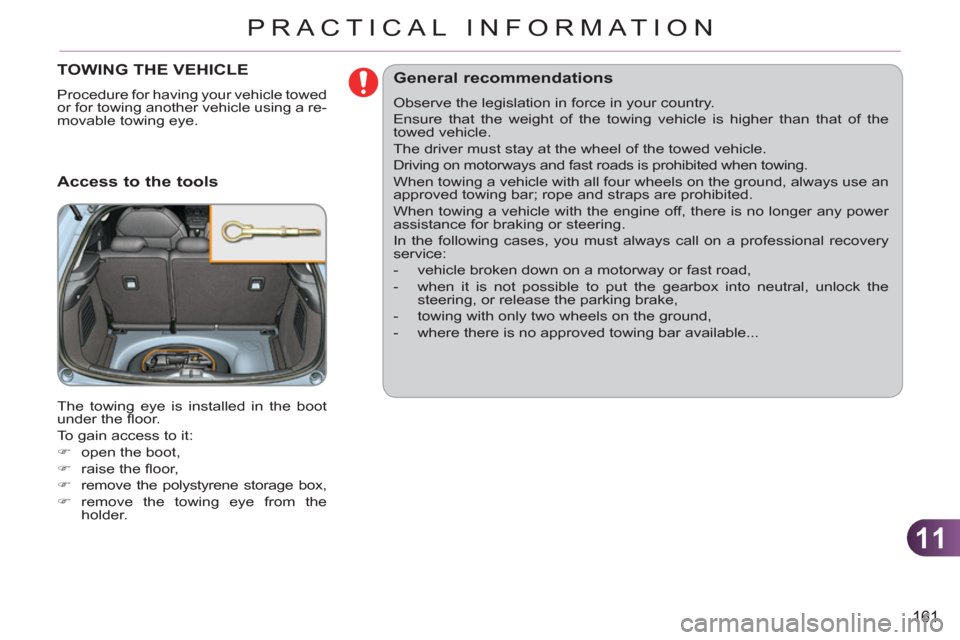
Access to the tools
The towing eye is installed in the boot
under the fl oor.
To gain access to it:
)
open the boot,
)
raise the fl oor,
)
remove the polystyrene storage box,
)
remove the towing eye from the
holder.
General recommendations
Observe the legislation in force in your country.
Ensure that the weight of the towing vehicle is higher than that of the
towed vehicle.
The driver must stay at the wheel of the towed vehicle.
Driving on motorways and fast roads is prohibited when towing.
When towing a vehicle with all four wheels on the ground, always use an
approved towing bar; rope and straps are prohibited.
When towing a vehicle with the engine off, there is no longer any power
assistance for braking or steering.
In the following cases, you must always call on a professional recovery
service:
- vehicle broken down on a motorway or fast road,
- when it is not possible to put the gearbox into neutral, unlock the
steering, or release the parking brake,
- towing with only two wheels on the ground,
- where there is no approved towing bar available...