brake Citroen C3 2014 2.G User Guide
[x] Cancel search | Manufacturer: CITROEN, Model Year: 2014, Model line: C3, Model: Citroen C3 2014 2.GPages: 284, PDF Size: 9.01 MB
Page 114 of 284
112
C3_en_Chap09_Conduite_ed01-2014
C3_en_Chap09_Conduite_ed01-2014
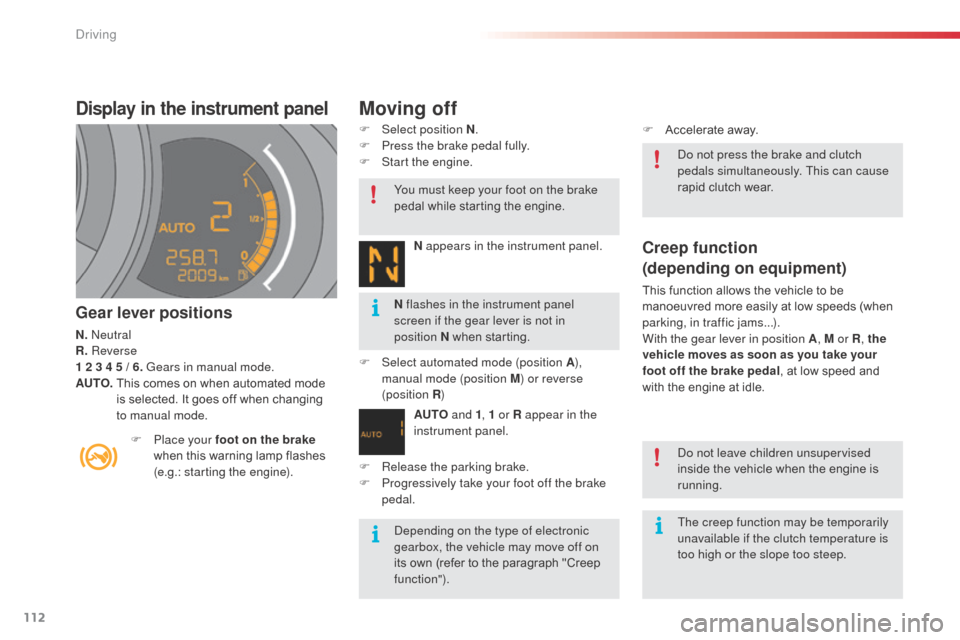
Display in the instrument panel
Gear lever positions
N. neutral
R. Reverse
1 2 3 4 5 / 6. Gears in manual mode.
AUTO.
T
his comes on when automated mode
is selected. It goes off when changing
to manual mode. F
Sel
ect position N
.
F
P
ress the brake pedal fully.
F
S
tart the engine.
N appears in the instrument panel.
F
Sel
ect automated mode (position A),
manual mode (position M) or reverse
(position R )
AUTO and 1, 1 or R appear in the
instrument panel.
F
P
lace your foot on the brake
when this warning lamp flashes
(e.g.: starting the engine).
Creep function
(depending on equipment)
This function allows the vehicle to be
manoeuvred more easily at low speeds (when
parking, in traffic jams...).
With the gear lever in position A , M or R, the
vehicle moves as soon as you take your
foot off the brake pedal , at low speed and
with the engine at idle.
F
R
elease the parking brake.
F
P
rogressively take your foot off the brake
pedal. F
A
ccelerate away.
de
pending on the type of electronic
gearbox, the vehicle may move off on
its own (refer to the paragraph "Creep
function").
do n
ot leave children unsupervised
inside the vehicle when the engine is
running.
You must keep your foot on the brake
pedal while starting the engine.
do n
ot press the brake and clutch
pedals simultaneously. This can cause
rapid clutch wear.
N flashes in the instrument panel
screen if the gear lever is not in
position
N when starting.
The creep function may be temporarily
unavailable if the clutch temperature is
too high or the slope too steep.
Moving off
driving
Page 116 of 284
114
C3_en_Chap09_Conduite_ed01-2014
C3_en_Chap09_Conduite_ed01-2014
In exceptional circumstances, the
gearbox may need an automatic
reinitialisation: starting and gear
changing are no longer possible.
Reverse
To engage reverse, the vehicle must be
immobilised with your foot on the brake.
F
Sel
ect position R .
Operating fault
With the ignition on, if this warning
lamp comes on and AUTO flashes,
accompanied by an audible signal
and a message in the multifunction
screen, this indicates a gearbox
fault.
Have it checked by a CITR
oËn
dealer or a qualified workshop.
At low speed, if reverse gear is requested,
the N warning lamp flashes and the gearbox
goes into neutral automatically.
To engage reverse, put the gear lever into
position N
, then to position R .Stopping the vehicle
Before switching off the engine:
-
c hange to position N to be in neutral,
or
-
l
eave the vehicle in gear; in this case the
vehicle cannot be moved.
Reinitialisation
(5-speed electronic
gearbox)
Following disconnection of the battery, it is
necessary to reinitialise the gearbox.
F
S
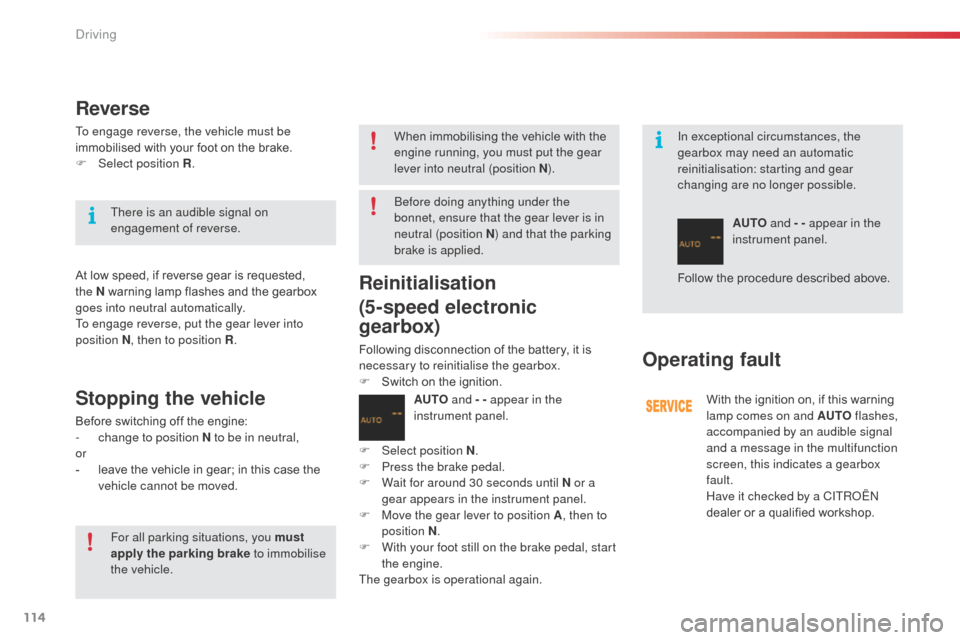
witch on the ignition.AUTO and - - appear in the
instrument panel.
F
Sel
ect position N .
F
P
ress the brake pedal.
F
W
ait for around 30 seconds until N or a
gear appears in the instrument panel.
F
M
ove the gear lever to position A , then to
position N .
F
W
ith your foot still on the brake pedal, start
the engine.
The gearbox is operational again. AUTO
and - - appear in the
instrument panel.
Follow the procedure described above.
be
fore doing anything under the
bonnet, ensure that the gear lever is in
neutral (position N ) and that the parking
brake is applied.
There is an audible signal on
engagement of reverse.
For all parking situations, you must
apply the parking brake
to immobilise
the vehicle. When immobilising the vehicle with the
engine running, you must put the gear
lever into neutral (position N
).
driving
Page 117 of 284

115
C3_en_Chap09_Conduite_ed01-2014
C3_en_Chap09_Conduite_ed01-2014
automatic gearbox
1. Gear lever.
2. bu tton "S" (spor t) .
3.
bu
tton "T " (snow) .
Gear selection
gate
P. Park.
- I mmobilisation of the vehicle, parking brake
on or off.
-
S
tarting the engine.
R.
R
everse.
-
R
eversing manoeuvres, vehicle stationary,
engine at idle.
N.
n
e
utral.
-
I
mmobilisation of the vehicle, parking brake
on.
-
S
tarting the engine.
D.
a
u
tomatic operation.
M + / -.
M
anual operation with sequential
changing of the four gears.
F
P
ush for wards to change up through the
gears.
or
F
P
ull backwards to change down through
the gears.
Gear lever
When you move the lever in the gate to select
a position, the corresponding indicator is
displayed in the instrument panel.
P.
Park
R.
Reverse
N.
n
e
utral
D.
d
r
ive (
au
tomatic driving)
S.
Sp
ort programme
T .
S
now programme
1 2 3 4.
G
ears engaged during manual
operation
-.
I
nvalid value during manual operation
Displays in the instrument panel
Foot on brake
F Press the brake pedal when this indicator lamp is displayed in the
instrument panel (e.g.: starting
the engine).
Four-speed automatic gearbox which offers a
choice between the comfort of fully automatic
operation, enhanced by sport and snow
programmes, or manual gear changing.
There are therefore four driving modes:
-
a
utomatic
operation for electronic
management of the gears by the gearbox,
-
sp
ort
programme for a more dynamic style
of driving,
-
s
now
programme to improve driving when
traction is poor,
-
s
equential
operation for manual changing
of the gears by the driver.
9
driving
Page 118 of 284

116
C3_en_Chap09_Conduite_ed01-2014
C3_en_Chap09_Conduite_ed01-2014
Moving off
F apply the parking brake.
F Sel ect position P or N .
F
S
tart the engine.
If this procedure is not followed, there is an
audible signal, accompanied by the display of
an warning message.
F
W
ith the engine running, press the brake
pedal.
F
R
elease the parking brake.
F
Sel
ect position R , D or M.
F
G
radually release the brake pedal.
The vehicle moves off immediately.
Automatic operation
F Select position D for automatic changing
of the four gears.
The gearbox then operates in auto-adaptive
mode, without any intervention on the part
of the driver. It continuously selects the most
suitable gear according to the style of driving,
the profile of the road and the load in the
vehicle.
For maximum acceleration without touching the
gear lever, press the accelerator pedal down
fully (kick down). The gearbox changes down
automatically or maintains the gear selected
until the maximum engine speed is reached.
On braking, the gearbox changes down
automatically to provide efficient engine
braking.
If you release the accelerator sharply, the
gearbox will not change to a higher gear for
safety reasons.
Sport and snow programmes
These two special programmes supplement the
automatic operation in very specific conditions
of use.
Sport programme "S"
F Press button "S" , after starting the engine.
The gearbox automatically favours a dynamic
style of driving.
Snow programme " T"
F Press button " T", after starting the engine.
The gearbox adapts to driving on slippery
roads.
This programme improves starting and drive
when traction is poor. S appears in the instrument panel.
T appears in the instrument panel.
ne
ver select position N while the
vehicle is moving.
ne
ver select positions P or R unless the
vehicle is completely stationary.
If position N is selected inadvertently
while driving, allow the engine to
return to idle then select position D to
accelerate.
When the engine is running at idle, with
the brakes released, if position R
, D or
M is selected, the vehicle moves even
without the accelerator being pressed.
When the engine is running, never
leave children in the vehicle without
supervision.
When carrying out maintenance with
the engine running, apply the parking
brake and select position P .
driving
Page 120 of 284
118
C3_en_Chap09_Conduite_ed01-2014
C3_en_Chap09_Conduite_ed01-2014
Stopping the vehicleOperating fault
When the ignition is on, the lighting
of this warning lamp, accompanied
by an audible signal and a message in the
multifunction screen, indicates a gearbox fault.
In this case, the gearbox switches to back-up
mode and is locked in 3rd gear. You may feel
a substantial knock when changing from P
to R and from N to R . This will not cause any
damage to the gearbox.
do n
ot exceed 60 mph (100 km/h), local speed
restrictions permitting.
Contact a CITR
oËn
dealer or a qualified
workshop as soon as possible. To reduce fuel consumption when at
a prolonged standstill with the engine
running (traffic jam...), put the gear lever
in the N position and apply the parking
brake.There is a risk of damage to the
gearbox:
-
i
f you press the accelerator and
brake pedals at the same time,
-
i
f you force the movement of the gear
lever from the P position to another
position when the battery is flat.
If the lever is not in position P
, when the
driver's door is opened or approximately
45 seconds after the ignition is switched
off, a warning message appears in the
screen.
F
R
eturn the lever to position P ; the
message disappears.
If the ambient temperature is below
-23°C, the engine should be left running
at idle for four minutes, in order to
ensure the correct operation and
durability of the engine and gearbox.
When traversing a flooded road or a
ford, drive at walking pace.
Before switching off the engine, you can engage
position
P or N to place the gearbox in neutral.
In both cases, apply the parking brake to
immobilise the vehicle.
driving
Page 122 of 284
120
C3_en_Chap09_Conduite_ed01-2014
C3_en_Chap09_Conduite_ed01-2014
The Stop & Start system puts the engine temporarily into standby - SToP mode - during stops in the traffic (red lights, traffic jams, or other...). The
engine restarts automatically - START mode - as soon as you want to move off. The restart takes place instantly, quickly and silently.
Per fect for urban use, the Stop & Start system reduces fuel consumption and exhaust emissions as well as the noise level
when stationary.
Operation
- with a manual gearbox , at speeds below
12 mph (20 km/h), when you put the gear
lever into neutral, and you release the
clutch pedal.
-
w
ith a 5 or 6-speed electronic gearbox ,
when stationary or at speeds below 5 mph
(8 km/h) (depending on version), when you
press the brake pedal or put the gear lever
in position N .
Going into engine STOP
mode
The "ECO" warning lamp comes
on in the instrument panel and the
engine goes into standby:
a
time counter calculates the sum
of the periods in ST
oP m
ode
during a journey. It rests itself
to zero every time the ignition is
switched on with the key.
Special cases: STOP mode not
available
STOP mode is not invoked when:
- t he driver's door is open,
-
t
he driver's seat belt is not fastened,
-
t
he vehicle has not exceeded 6 mph
(10 km/h) since the last engine start using
t h e key,
-
t
he engine is needed to maintain a
comfortable temperature in the passenger
compartment,
-
d
emisting is active,
-
s
ome special conditions (battery charge,
engine temperature, braking assistance,
ambient temperature...) where the engine is
needed to assure control of a system.
The "ECO" warning lamp flashes for
a few seconds then goes off.
This operation is perfectly normal.
Stop & Start
Never refuel with the engine in STOP
mode; you must switch off the ignition
with the key. For your comfort, during parking
manoeuvres, ST
oP m
ode is not
available for a few seconds after
coming out of reverse gear.
ST
oP m
ode does not affect the
functionality of the vehicle, such as for
example, braking, power steering...
driving
Page 123 of 284
121
C3_en_Chap09_Conduite_ed01-2014
C3_en_Chap09_Conduite_ed01-2014
Going into engine START
mode
The "ECO" warning lamp goes off
and the engine starts:
-
w
ith a manual gearbox , when you
depress the clutch pedal,
-
w
ith a 5-speed or 6-speed electronic
gearbox :
●
g
ear lever in position A or M , when you
release the brake pedal,
●
o
r gear lever in position N and the brake
pedal released, when you move the gear
lever to position A or M ,
●
o
r when you engage reverse gear.
Special cases: START invoked
automatically
For reasons of safety and for your comfort,
START mode is invoked automatically when:
-
y
ou open the driver's door,
-
y
ou unfasten the driver's seat belt,
-
t
he speed of the vehicle exceeds 7 mph
(11 km/h) with the electronic gearbox
system,
-
s
ome special conditions (battery charge,
engine temperature, braking assistance,
ambient temperature...) where the engine is
needed for control of a system.
Deactivation
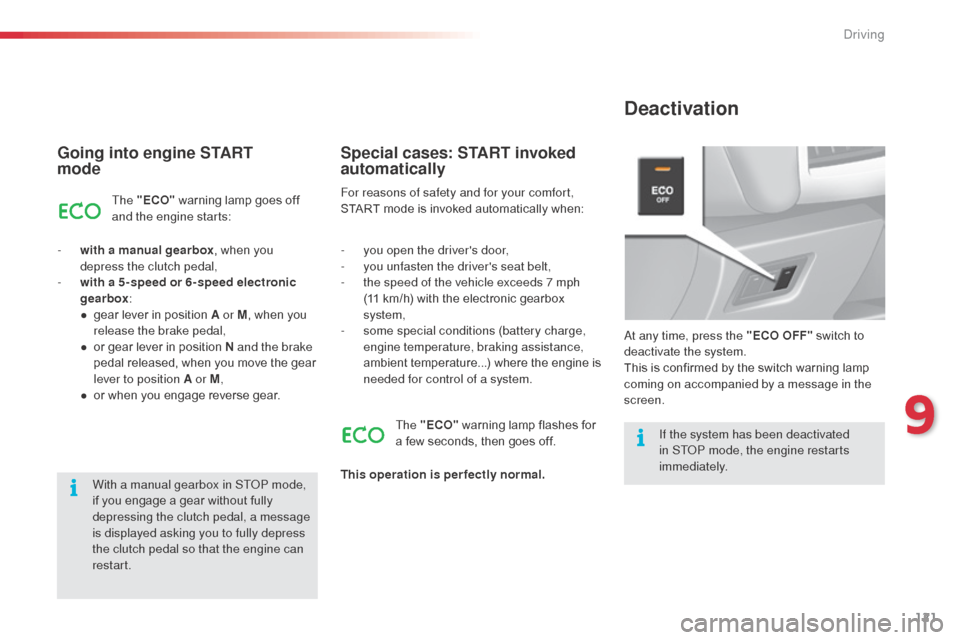
at any time, press the "ECO OFF" switch to
deactivate the system.
This is confirmed by the switch warning lamp
coming on accompanied by a message in the
screen.
The "ECO" warning lamp flashes for
a few seconds, then goes off.
This operation is perfectly normal.
With a manual gearbox in ST
oP m
ode,
if you engage a gear without fully
depressing the clutch pedal, a message
is displayed asking you to fully depress
the clutch pedal so that the engine can
restart. If the system has been deactivated
in ST
oP m
ode, the engine restarts
immediately.
9
driving
Page 125 of 284
123
C3_en_Chap09_Conduite_ed01-2014
C3_en_Chap09_Conduite_ed01-2014
Hill start assist
System which holds your vehicle temporarily
(approximately 2 seconds) when starting on a
slope, the time it takes to move your foot from
the brake pedal to the accelerator pedal.
This function is only active when:
-
t
he vehicle is completely stationary, with
your foot on the brake pedal,
-
c
ertain conditions on a slope are met,
-
w
ith the driver’s door closed.
The hill start assist function cannot be
deactivated.
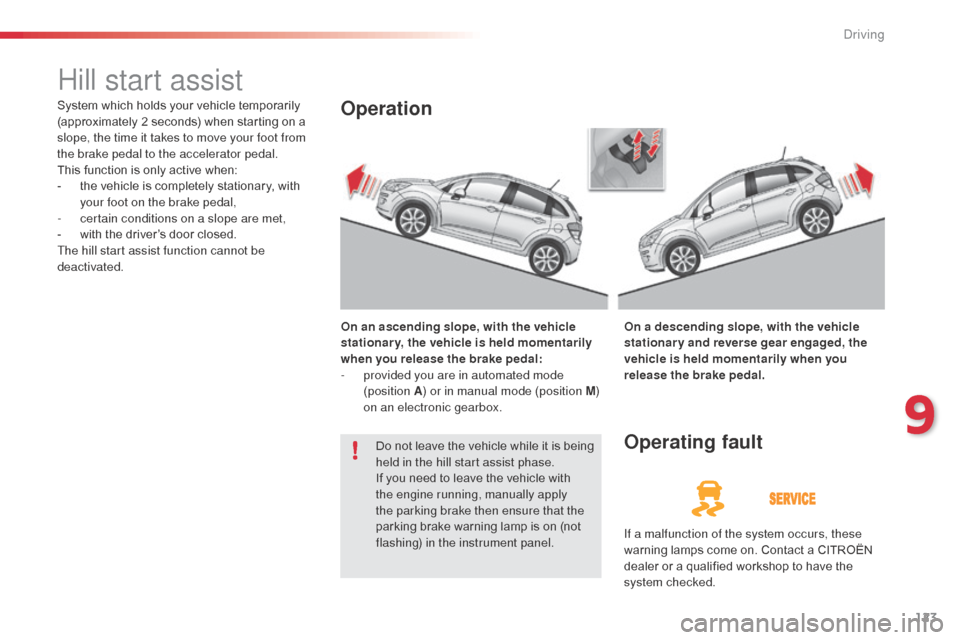
On an ascending slope, with the vehicle
stationary, the vehicle is held momentarily
when you release the brake pedal:
-
p
rovided you are in automated mode
(position A ) or in manual mode (position M )
on an electronic gearbox.
Operating fault
If a malfunction of the system occurs, these
warning lamps come on. Contact a CITROËN
dealer or a qualified workshop to have the
system checked. On a descending slope, with the vehicle
stationary and reverse gear engaged, the
vehicle is held momentarily when you
release the brake pedal.
Do not leave the vehicle while it is being
held in the hill start assist phase.
If you need to leave the vehicle with
the engine running, manually apply
the parking brake then ensure that the
parking brake warning lamp is on (not
flashing) in the instrument panel.
Operation
9
driving
Page 128 of 284
126
C3_en_Chap09_Conduite_ed01-2014
C3_en_Chap09_Conduite_ed01-2014
System which automatically maintains the
speed of the vehicle at the value programmed
by the driver, without any action on the
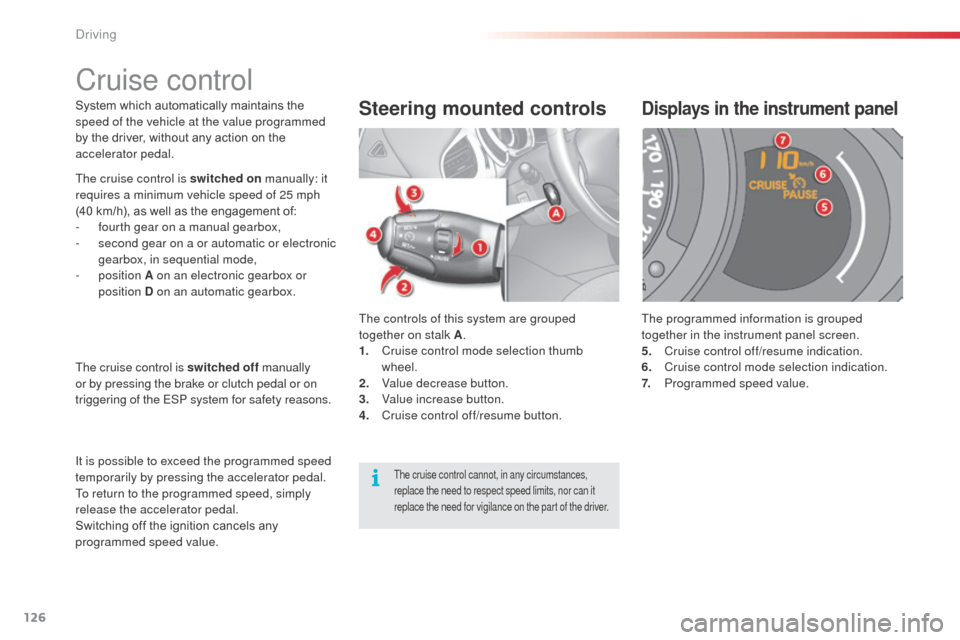
accelerator pedal.The controls of this system are grouped
together on stalk A.
1.
C
ruise control mode selection thumb
wheel.
2.
V
alue decrease button.
3.
V
alue increase button.
4.
C
ruise control off/resume button.Steering mounted controlsDisplays in the instrument panel
The programmed information is grouped
together in the instrument panel screen.
5.
C
ruise control off/resume indication.
6.
C
ruise control mode selection indication.
7.
P
rogrammed speed value.
The cruise control cannot, in any circumstances,
replace the need to respect speed limits, nor can it
replace the need for vigilance on the part of the driver.
Cruise control
The cruise control is switched on manually: it
requires a minimum vehicle speed of 25 mph
(40 km/h), as well as the engagement of:
-
f
ourth gear on a manual gearbox,
-
s
econd gear on a or automatic or electronic
gearbox, in sequential mode,
-
position A on an electronic gearbox or
position D on an automatic gearbox.
The cruise control is switched off manually
or by pressing the brake or clutch pedal or on
triggering of the ESP system for safety reasons.
It is possible to exceed the programmed speed
temporarily by pressing the accelerator pedal.
To return to the programmed speed, simply
release the accelerator pedal.
Switching off the ignition cancels any
programmed speed value.
driving
Page 139 of 284
137
The brake fluid level should be close
to the "MaX" mark. If it is not, check
the brake pad wear.
Brake fluid level
Changing the fluid
Refer to the maintenance and warranty guide
for details of the interval for this operation.
Fluid specification
The brake fluid must conform to the
manufacturer's recommendations.
Topping up the engine oil level
Refer to the "Petrol engine" or "di esel engine"
section for the location of the oil filler cap in the
engine compartment of your vehicle.
F
U
nscrew the oil filler cap to reveal the filler
aperture.
F
a
d
d oil in small quantities, avoiding any
spills on engine components (risk of fire).
F
W
ait a few minutes before checking the
level again using the dipstick.
F
a
d
d more oil if necessary.
F
a
f
ter checking the level, carefully refit the
oil filler cap and the dipstick in its tube.
After topping up the oil, the check when
switching on the ignition with the oil level
indicator in the instrument panel is not valid
during the 30 minutes after topping up.
Engine oil change
Refer to the maintenance and warranty guide
for details of the interval for this operation.
In order to maintain the reliability of the engine
and emission control system, never use
additives in the engine oil.
10
Checks