ignition Citroen C3 2014 2.G Owner's Guide
[x] Cancel search | Manufacturer: CITROEN, Model Year: 2014, Model line: C3, Model: Citroen C3 2014 2.GPages: 284, PDF Size: 9.01 MB
Page 70 of 284
68
C3_en_Chap05_Visibilite_ed01-2014
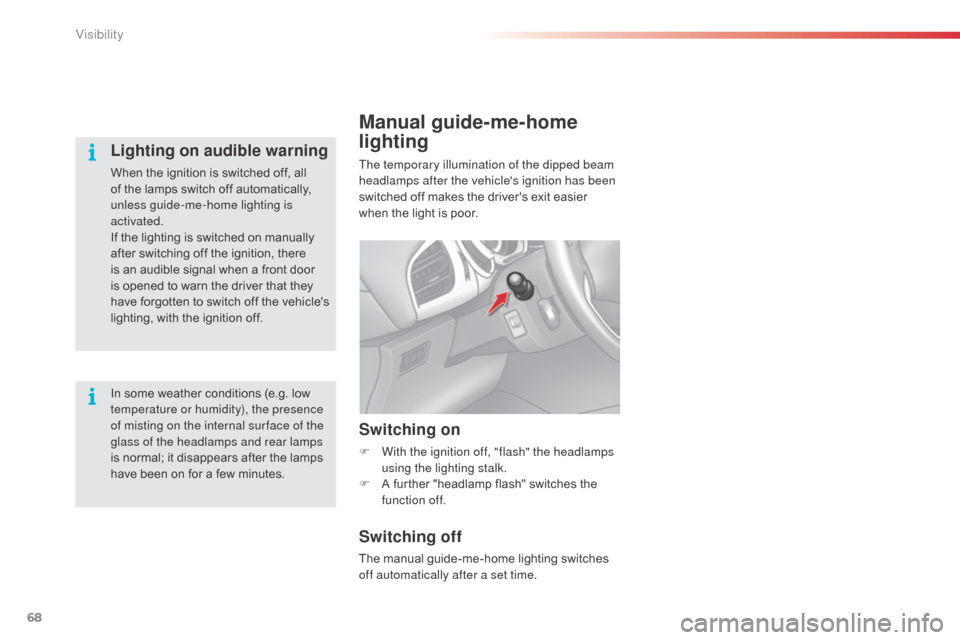
Manual guide-me-home
lighting
The temporary illumination of the dipped beam
headlamps after the vehicle's ignition has been
switched off makes the driver's exit easier
when the light is poor.
Switching on
F With the ignition off, "flash" the headlamps using the lighting stalk.
F
A f
urther "headlamp flash" switches the
function off.
Switching off
The manual guide-me-home lighting switches
off automatically after a set time.
In some weather conditions (e.g. low
temperature or humidity), the presence
of misting on the internal sur face of the
glass of the headlamps and rear lamps
is normal; it disappears after the lamps
have been on for a few minutes.
Lighting on audible warning
When the ignition is switched off, all
of the lamps switch off automatically,
unless guide-me-home lighting is
activated.
If the lighting is switched on manually
after switching off the ignition, there
is an audible signal when a front door
is opened to warn the driver that they
have forgotten to switch off the vehicle's
lighting, with the ignition off.
Visibility
Page 75 of 284
73
C3_en_Chap05_Visibilite_ed01-2014
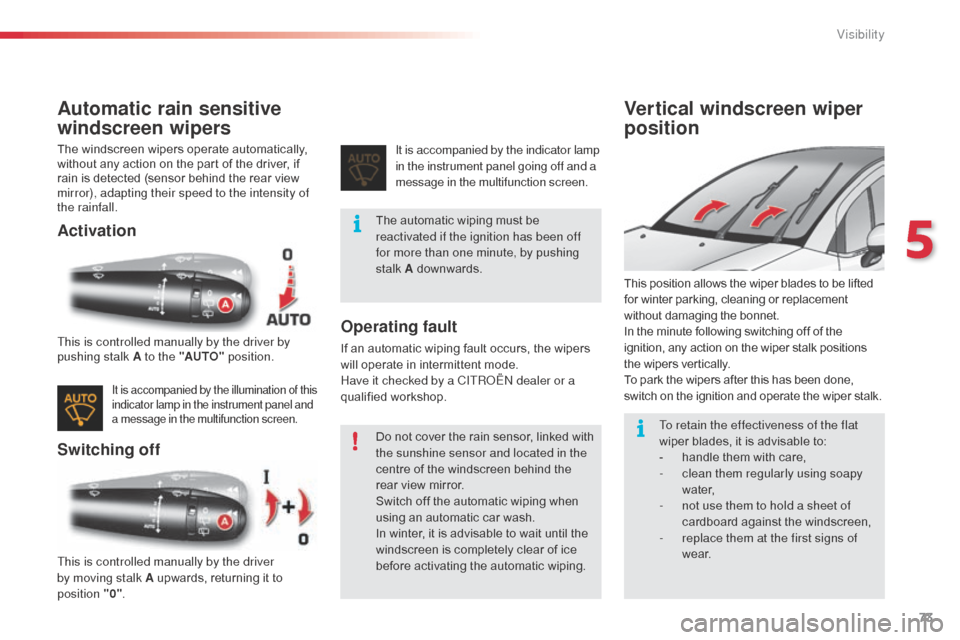
Automatic rain sensitive
windscreen wipers
The windscreen wipers operate automatically,
without any action on the part of the driver, if
rain is detected (sensor behind the rear view
mirror), adapting their speed to the intensity of
the rainfall.
Activation
Switching offOperating fault
If an automatic wiping fault occurs, the wipers
will operate in intermittent mode.
Have it checked by a CITR
oËn
dealer or a
qualified workshop.
Vertical windscreen wiper
position
This position allows the wiper blades to be lifted
for winter parking, cleaning or replacement
without damaging the bonnet.
In the minute following switching off of the
ignition, any action on the wiper stalk positions
the wipers vertically.
To park the wipers after this has been done,
switch on the ignition and operate the wiper stalk.
This is controlled manually by the driver by
pushing stalk A to the "AUTO"
position.
This is controlled manually by the driver
by moving stalk A upwards, returning it to
position
"0" . It is accompanied by the indicator lamp
in the instrument panel going off and a
message in the multifunction screen.
It is accompanied by the illumination of this
indicator lamp in the instrument panel and
a message in the multifunction screen.
The automatic wiping must be
reactivated if the ignition has been off
for more than one minute, by pushing
stalk A downwards.
Do not cover the rain sensor, linked with
the sunshine sensor and located in the
centre of the windscreen behind the
rear view mirror.
Switch off the automatic wiping when
using an automatic car wash.
In winter, it is advisable to wait until the
windscreen is completely clear of ice
before activating the automatic wiping.
To retain the effectiveness of the flat
wiper blades, it is advisable to:
-
h
andle them with care,
-
c
lean them regularly using soapy
water,
-
n
ot use them to hold a sheet of
cardboard against the windscreen,
-
r
eplace them at the first signs of
w e a r.
5
Visibility
Page 76 of 284
74
C3_en_Chap05_Visibilite_ed01-2014
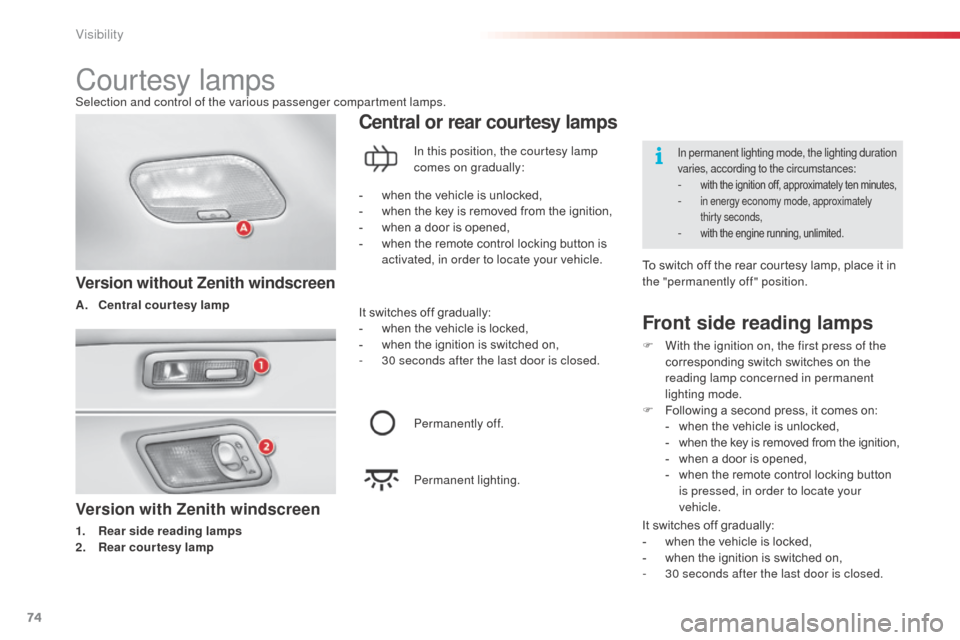
Version with Zenith windscreen
1. Rear side reading lamps
2. Rear courtesy lamp
Central or rear courtesy lamps
Version without Zenith windscreen
A. Central courtesy lamp
Front side reading lamps
F With the ignition on, the first press of the corresponding switch switches on the
reading lamp concerned in permanent
lighting mode.
F
F
ollowing a second press, it comes on:
-
w
hen the vehicle is unlocked,
-
w
hen the key is removed from the ignition,
-
w
hen a door is opened,
-
w
hen the remote control locking button
is pressed, in order to locate your
vehicle.
In this position, the courtesy lamp
comes on gradually:
-
w
hen the vehicle is unlocked,
-
w
hen the key is removed from the ignition,
-
w
hen a door is opened,
-
w
hen the remote control locking button is
activated, in order to locate your vehicle.
It switches off gradually:
-
w
hen the vehicle is locked,
-
w
hen the ignition is switched on,
-
3
0 seconds after the last door is closed.
Permanently off.
Permanent lighting. It switches off gradually:
-
w
hen the vehicle is locked,
-
w
hen the ignition is switched on,
-
3
0 seconds after the last door is closed.
To switch off the rear courtesy lamp, place it in
the "permanently off" position.
Courtesy lampsSelection and control of the various passenger compartment lamps.
In permanent lighting mode, the lighting duration
varies, according to the circumstances:
- with the ignition off, approximately ten minutes,- in energy economy mode, approximately
thirty
seconds,
- with the engine running, unlimited.
Visibility
Page 77 of 284
75
C3_en_Chap05_Visibilite_ed01-2014
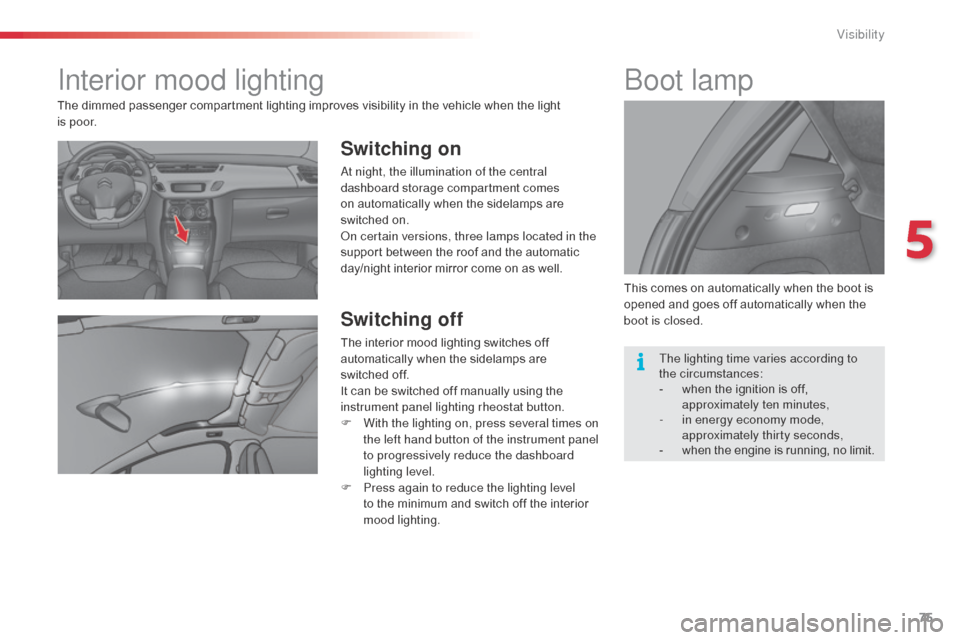
Interior mood lighting
Switching on
at night, the illumination of the central
dashboard storage compartment comes
on automatically when the sidelamps are
switched on.
on c
ertain versions, three lamps located in the
support between the roof and the automatic
day/night interior mirror come on as well.
Switching off
The interior mood lighting switches off
automatically when the sidelamps are
switched
off.
It can be switched off manually using the
instrument panel lighting rheostat button.
F
W
ith the lighting on, press several times on
the left hand button of the instrument panel
to progressively reduce the dashboard
lighting level.
F
P
ress again to reduce the lighting level
to the minimum and switch off the interior
mood lighting. This comes on automatically when the boot is
opened and goes off automatically when the
boot is closed.
boot lamp
The dimmed passenger compartment lighting improves visibility in the vehicle when the light
i s
p o o r.
The lighting time varies according to
the
circumstances:
-
w
hen the ignition is off,
approximately ten minutes,
-
i
n energy economy mode,
approximately thirty seconds,
-
w
hen the engine is running, no limit.
5
Visibility
Page 97 of 284
95
C3_en_Chap07_Securite-enfants_ed01-2014
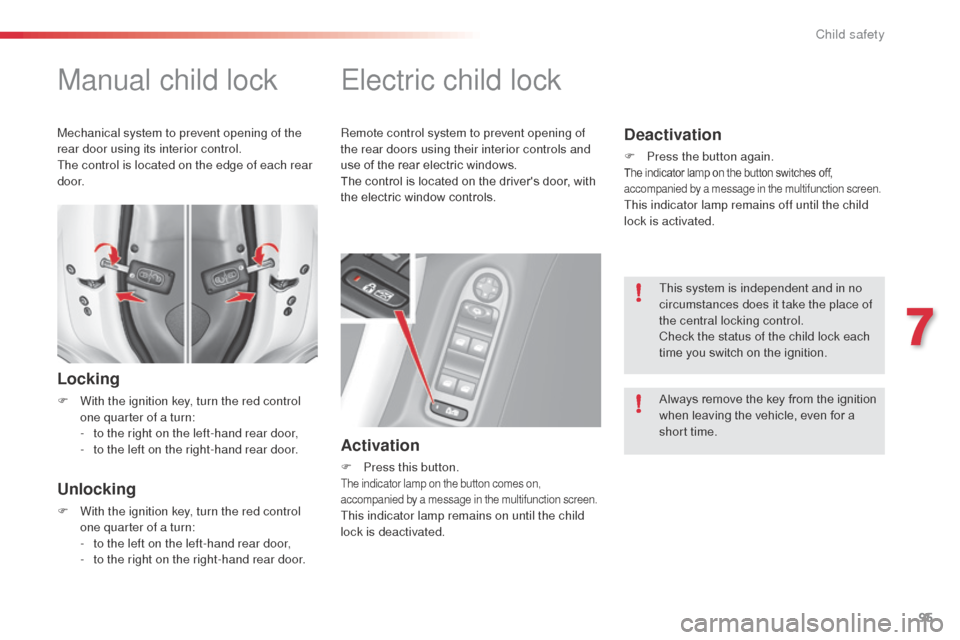
Manual child lock
Locking
F With the ignition key, turn the red control one quarter of a turn:
-
t
o the right on the left-hand rear door,
-
t
o the left on the right-hand rear door.
Unlocking
F With the ignition key, turn the red control one quarter of a turn:
-
t
o the left on the left-hand rear door,
-
t
o the right on the right-hand rear door.
Electric child lock
Activation
F Press this button.The indicator lamp on the button comes on,
accompanied by a message in the multifunction screen.
This indicator lamp remains on until the child
lock is deactivated.
Deactivation
F Press the button again.The indicator lamp on the button switches off,
accompanied by a message in the multifunction screen.
This indicator lamp remains off until the child
lock is activated.
This system is independent and in no
circumstances does it take the place of
the central locking control.
Check the status of the child lock each
time you switch on the ignition.
Always remove the key from the ignition
when leaving the vehicle, even for a
short time.
Remote control system to prevent opening of
the rear doors using their interior controls and
use of the rear electric windows.
The control is located on the driver's door, with
the electric window controls.
Mechanical system to prevent opening of the
rear door using its interior control.
The control is located on the edge of each rear
d o o r.
7
Child safety
Page 98 of 284

96
C3_en_Chap08_Securite_ed01-2014
direction indicatorsSelection of the left or right direction indicators
to signal a change of direction of the vehicle.
F
L
eft: lower the lighting stalk beyond the
point of resistance.
F
R
ight: raise the lighting stalk beyond the
point of resistance.
Three flashes of the direction
indicators
F Press briefly upwards or downwards, without going beyond the point of
resistance; the direction indicators will
flash 3 times.
Hazard warning lamps
F Press this button, the direction indicators flash.
They can operate with the ignition off.
Automatic operation of
hazard warning lamps
When braking in an emergency, depending on
the deceleration, the hazard warning lamps
come on automatically.
They switch off automatically the first time you
accelerate.
F
Y
ou can also switch them off by pressing
the button.
A visual warning by means of the direction
indicators to alert other road users to a vehicle
breakdown, towing or accident.
Safety
Page 102 of 284
100
C3_en_Chap08_Securite_ed01-2014
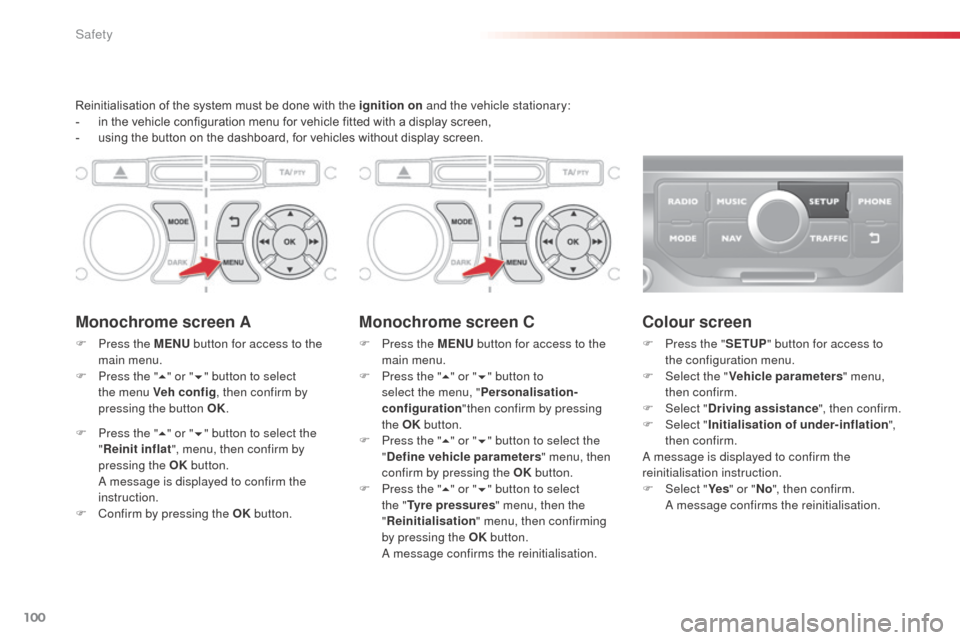
Reinitialisation of the system must be done with the ignition on and the vehicle stationary:
- i n the vehicle configuration menu for vehicle fitted with a display screen,
-
u
sing the button on the dashboard, for vehicles without display screen.
Monochrome screen A
F Press the MENU button for access to the
main menu.
F
P
ress the " 5" or " 6" button to select
the menu Veh conf ig , then confirm by
pressing the button OK.
F
P
ress the " 5" or " 6" button to select the
" Reinit inflat ", menu, then confirm by
pressing the OK button.
a message is displayed to confirm the
instruction.
F
C
onfirm by pressing the OK button.
Monochrome screen C
F Press the MENU button for access to the
main menu.
F
P
ress the " 5" or " 6" button to
select the menu, " Personalisation-
configuration "then confirm by pressing
the OK button.
F
P
ress the " 5" or " 6" button to select the
" Define vehicle parameters " menu, then
confirm by pressing the OK button.
F
P
ress the " 5" or " 6" button to select
the " Tyre pressures " menu, then the
" Reinitialisation " menu, then confirming
by pressing the OK button.
a
m
essage confirms the reinitialisation.
Colour screen
F Press the " SETUP" button for access to
the configuration menu.
F
Sel
ect the " Vehicle parameters " menu,
then confirm.
F
Sel
ect "Driving assistance ", then confirm.
F
Sel
ect "Initialisation of under-inflation ",
then confirm.
a
message is displayed to confirm the
reinitialisation instruction.
F
Sel
ect "Ye s" or " No", then confirm.
a
m
essage confirms the reinitialisation.
Safety
Page 105 of 284
103
C3_en_Chap08_Securite_ed01-2014
Trajectory control systems
Anti-slip regulation (ASR)
and dynamic stability
control (DSC)
The anti-slip regulation (also known as traction
control) optimises traction to prevent skidding
of the wheels, by acting on the brakes of the
driving wheels and on the engine.
The electronic stability control acts on the brake
of one or more wheels and on the engine to
keep the vehicle on the trajectory required by
the driver, within the limits of the laws of physics.
Activation
These systems are activated automatically
each time the vehicle is started.
They come into operation in the event of a grip
or trajectory problem.This is indicated by flashing of this
warning lamp in the instrument panel.
Deactivation
In exceptional conditions (starting a vehicle
which is bogged down, stuck in snow, on soft
ground...), if you are unable to make progress,
it may be advisable to temporarily deactivate
these systems, so that the wheels can spin
freely and allow the vehicle to move.
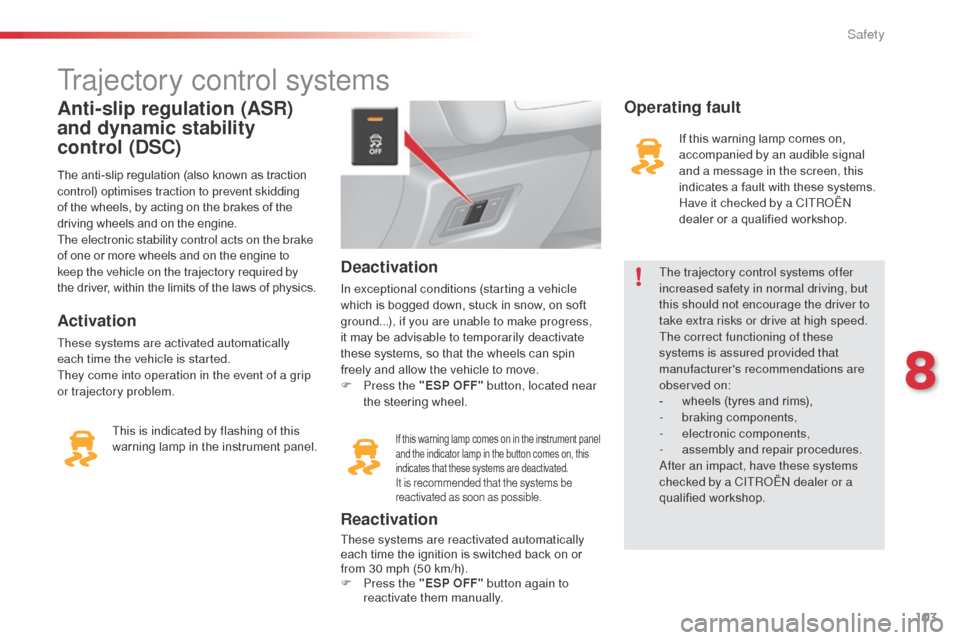
F
P
ress the "ESP OFF" button, located near
the steering wheel.
If this warning lamp comes on in the instrument panel
and the indicator lamp in the button comes on, this
indicates that these systems are deactivated.
It is recommended that the systems be
reactivated as soon as possible.
Reactivation
These systems are reactivated automatically
each time the ignition is switched back on or
from 30 mph (50 km/h).
F
P
ress the "ESP OFF" button again to
reactivate them manually.
Operating fault
If this warning lamp comes on,
accompanied by an audible signal
and a message in the screen, this
indicates a fault with these systems.
Have it checked by a CITR
oËn
dealer or a qualified workshop.
The trajectory control systems offer
increased safety in normal driving, but
this should not encourage the driver to
take extra risks or drive at high speed.
The correct functioning of these
systems is assured provided that
manufacturer's recommendations are
observed on:
-
w
heels (tyres and rims),
-
b
raking components,
-
el
ectronic components,
-
a
ssembly and repair procedures.
af
ter an impact, have these systems
checked by a CITR
oËn
dealer or a
qualified workshop.
8
Safety
Page 106 of 284
104
C3_en_Chap08_Securite_ed01-2014
Seat belts
Front seat belts
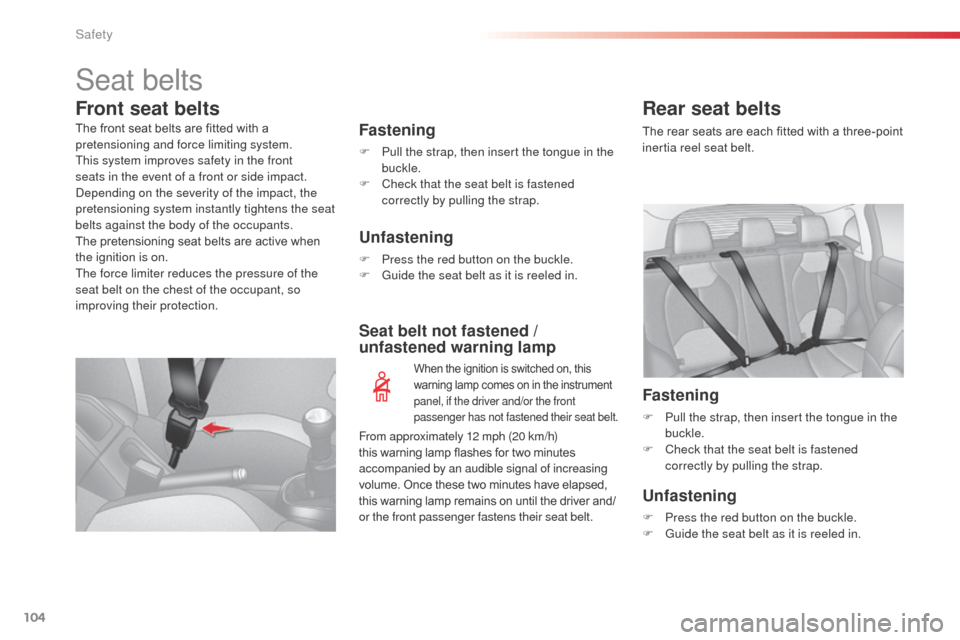
Fastening
F Pull the strap, then insert the tongue in the buckle.
F
C
heck that the seat belt is fastened
correctly by pulling the strap.
Unfastening
F Press the red button on the buckle.
F G uide the seat belt as it is reeled in.
Seat belt not fastened /
unfastened warning lamp
When the ignition is switched on, this
warning lamp comes on in the instrument
panel, if the driver and/or the front
passenger has not fastened their seat belt.
Rear seat belts
The rear seats are each fitted with a three-point
inertia reel seat belt.
Fastening
F Pull the strap, then insert the tongue in the buckle.
F
C
heck that the seat belt is fastened
correctly by pulling the strap.
Unfastening
F Press the red button on the buckle.
F G uide the seat belt as it is reeled in.
The front seat belts are fitted with a
pretensioning and force limiting system.
This system improves safety in the front
seats in the event of a front or side impact.
dep
ending on the severity of the impact, the
pretensioning system instantly tightens the seat
belts against the body of the occupants.
The pretensioning seat belts are active when
the ignition is on.
The force limiter reduces the pressure of the
seat belt on the chest of the occupant, so
improving their protection.
From approximately 12 mph (20 km/h)
this warning lamp flashes for two minutes
accompanied by an audible signal of increasing
volume. Once these two minutes have elapsed,
this warning lamp remains on until the driver and/
or the front passenger fastens their seat belt.
Safety
Page 108 of 284
106
C3_en_Chap08_Securite_ed01-2014
airbags
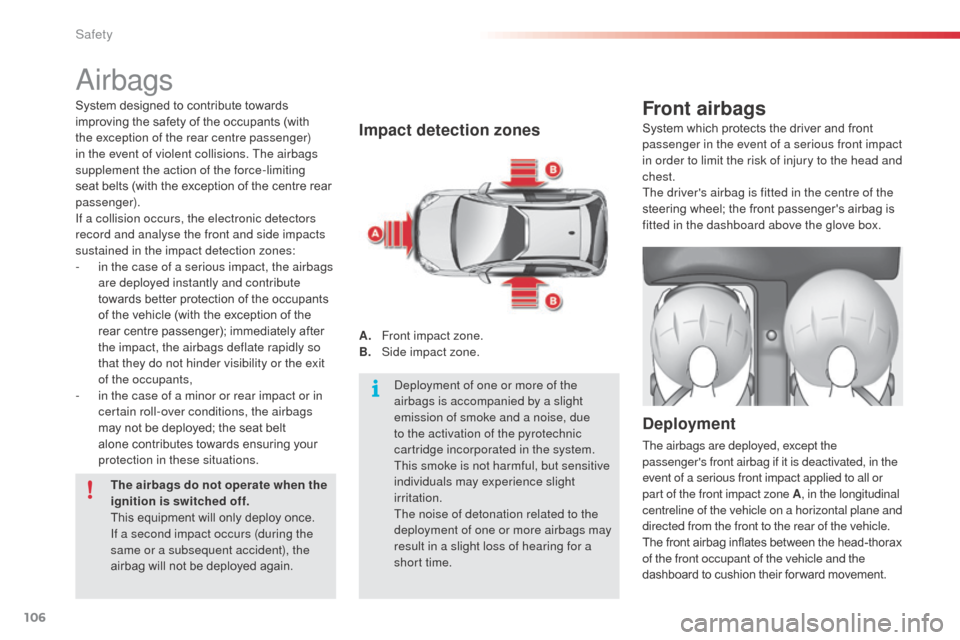
Impact detection zones
A. Front impact zone.
B. Side impact zone.
Front airbags
Deployment
The airbags are deployed, except the
passenger's front airbag if it is deactivated, in the
event of a serious front impact applied to all or
part of the front impact zone A , in the longitudinal
centreline of the vehicle on a horizontal plane and
directed from the front to the rear of the vehicle.
The front airbag inflates between the head-thorax
of the front occupant of the vehicle and the
dashboard to cushion their for ward movement.
System designed to contribute towards
improving the safety of the occupants (with
the exception of the rear centre passenger)
in the event of violent collisions. The airbags
supplement the action of the force-limiting
seat belts (with the exception of the centre rear
passenger).
If a collision occurs, the electronic detectors
record and analyse the front and side impacts
sustained in the impact detection zones:
-
i
n the case of a serious impact, the airbags
are deployed instantly and contribute
towards better protection of the occupants
of the vehicle (with the exception of the
rear centre passenger); immediately after
the impact, the airbags deflate rapidly so
that they do not hinder visibility or the exit
of the occupants,
-
i
n the case of a minor or rear impact or in
certain roll-over conditions, the airbags
may not be deployed; the seat belt
alone contributes towards ensuring your
protection in these situations.
The airbags do not operate when the
ignition is switched off.
de
ployment of one or more of the
airbags is accompanied by a slight
emission of smoke and a noise, due
to the activation of the pyrotechnic
cartridge incorporated in the system.
This smoke is not harmful, but sensitive
individuals may experience slight
irritation.
The noise of detonation related to the
deployment of one or more airbags may
result in a slight loss of hearing for a
short time. System which protects the driver and front
passenger in the event of a serious front impact
in order to limit the risk of injury to the head and
chest.
The driver's airbag is fitted in the centre of the
steering wheel; the front passenger's airbag is
fitted in the dashboard above the glove box.
This equipment will only deploy once.
If a second impact occurs (during the
same or a subsequent accident), the
airbag will not be deployed again.
Safety