ignition CITROEN C3 2023 User Guide
[x] Cancel search | Manufacturer: CITROEN, Model Year: 2023, Model line: C3, Model: CITROEN C3 2023Pages: 104, PDF Size: 2.38 MB
Page 26 of 104
24
Safety
When changing wheels (tyres and rims),
ensure that these are approved by the
manufacturer for your vehicle.
After an impact, have these systems checked by a CITROËN dealer.
Seat belts
Inertia reel
The seat belts are equipped with an inertia reel
which allows the strap length to automatically
adjust to your shape. The seat belt returns to its
storage automatically when it is not used.
The inertia reels are fitted with a device which
automatically locks the strap in the event of a
collision, emergency braking or if the vehicle rolls
over. It can be released by pulling the strap firmly
and then releasing it so that it reels in slightly.
Force limiter
This system reduces the pressure of the seat
belt on the chest of the occupant, thus improving
their protection.
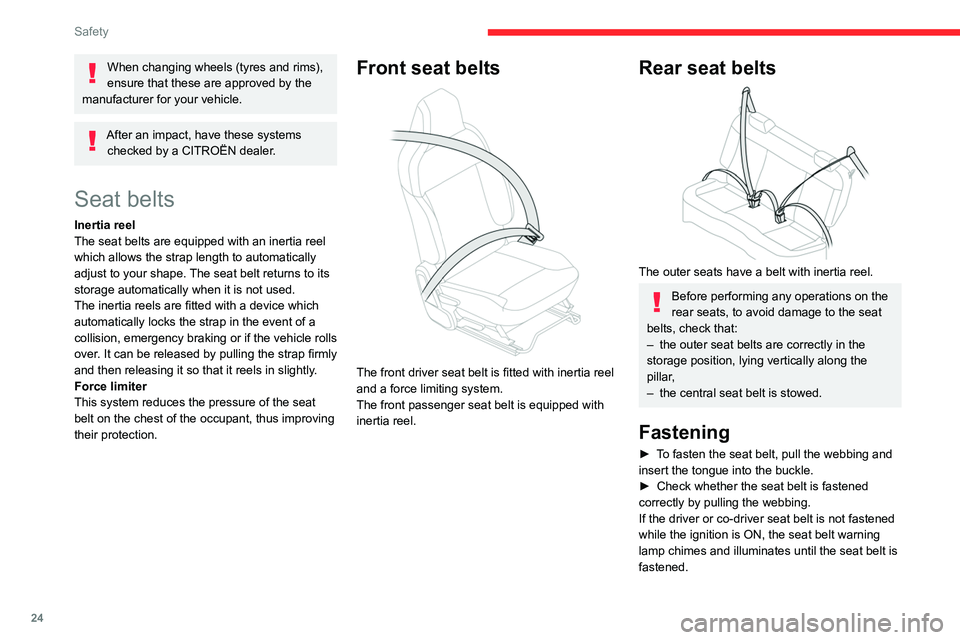
Front seat belts
The front driver seat belt is fitted with inertia reel
and a force limiting system.
The front passenger seat belt is equipped with
inertia reel.
Rear seat belts
The outer seats have a belt with inertia reel.
Before performing any operations on the
rear seats, to avoid damage to the seat
belts, check that:
–
the outer seat belts are correctly in the
storage position, lying vertically along the
pillar
,
–
the central seat belt is stowed.
Fastening
► To fasten the seat belt, pull the webbing and
insert the tongue into the buckle.
►
Check whether the seat belt is fastened
correctly by pulling the webbing.
If the driver or co-driver seat belt is not fastened
while the ignition is ON, the seat belt warning
lamp chimes and illuminates until the seat belt is
fastened.
Page 28 of 104
26
Safety
Clean the seat belt straps with soapy water or
a textile cleaning product, sold by CITROËN
dealers.
Airbags
General information
The airbags have been designed to optimise the
safety of the occupants in the event of a violent
collision.
The airbags are supplementary restraint systems
(SRS) that help cushion the impact force to the
head and chest during severe frontal collisions.
The SRS includes Airbags, Seatbelts, Airbag
ECU, Collision sensors and SRS warning lamp.
Electronic detectors record and analyse the front
impacts sustained in the impact detection zones:
–
In the event of violent impact, the airbags
deploy instantly and help better protect the
occupants of the vehicle; immediately after the
impact, the airbags deflate rapidly in order not
to hinder the visibility or the possible exit of the
occupants.
–
In the event of a slight impact, a rear impact
and under certain rollover conditions, the airbags
may not deploy; only the seat belt helps to
protect you in these situations.
During a frontal crash, children could be fatally
injured if they are sitting on driver
’s lap/standing
very close to the dashboard, as the airbags exert
severe force levels during deployment.
The seriousness of the impact depends on the
nature of the obstacle and the speed of the
vehicle at the moment of collision.
The airbags do not operate when the
ignition is switched off.
This equipment will only deploy once. If a
second impact occurs (during the same or a
subsequent accident), the airbag will not be
deployed again.
When one or more airbags are deployed,
the detonation of the pyrotechnic charge
incorporated in the system makes a noise and
releases a small quantity of smoke.
This smoke is not harmful, but sensitive
individuals may experience slight irritation.
The detonation noise associated with the
deployment of one or more airbags may result
in a slight loss of hearing for a short time.
The airbags will deploy irrespective of whether the seat belt is buckled or not. In
order to reduce the risk of SERIOUS INJURY
or DEATH, we recommend occupants to
always be buckled.
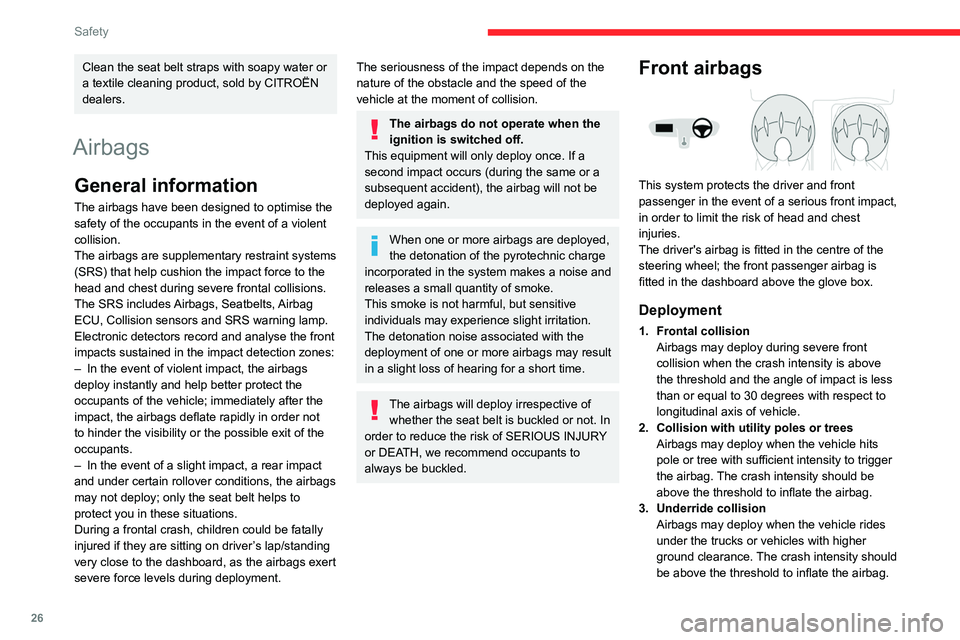
Front airbags
This system protects the driver and front
passenger in the event of a serious front impact,
in order to limit the risk of head and chest
injuries.
The driver's airbag is fitted in the centre of the
steering wheel; the front passenger airbag is
fitted in the dashboard above the glove box.
Deployment
1. Frontal collision Airbags may deploy during severe front
collision when the crash intensity is above
the threshold and the angle of impact is less
than or equal to 30 degrees with respect to
longitudinal axis of vehicle.
2. Collision with utility poles or trees Airbags may deploy when the vehicle hits
pole or tree with sufficient intensity to trigger
the airbag. The crash intensity should be
above the threshold to inflate the airbag.
3. Underride collision Airbags may deploy when the vehicle rides
under the trucks or vehicles with higher
ground clearance. The crash intensity should
be above the threshold to inflate the airbag.
Page 33 of 104
31
Driving
6Driving recommendations
► Observe the driving regulations and remain
vigilant whatever the traffic conditions.
►
Monitor your environment and keep your
hands on the wheel to be able to react to
anything that may happen any time.
►
Drive smoothly
, anticipate the need for
braking and maintain a longer safety distance,
especially in bad weather.
►
Stop the vehicle to carry out operations that
require close attention (such as adjustments).
►
During long trips, take a break every two
hours.
Important!
Never leave the engine running in a
closed space without sufficient
ventilation. Internal combustion engines emit
toxic exhaust gases such as carbon
monoxide. Danger of poisoning and death!
In severe wintry conditions, let the engine
run for 4 minutes before moving off, to
ensure the correct operation and durability of
the mechanical components of your vehicle
(engine and gearbox).
Never drive with the parking brake
applied . Risk of overheating and
damage to the braking system!
Do not park the vehicle or leave the
engine running on a flammable
surface (dry grass, dead leaves, etc.). The
exhaust system of your vehicle is very hot,
even several minutes after the engine stops.
Risk of fire!
Never leave a vehicle unattended with
the engine running. If you have to leave
your vehicle with the engine running, apply
the parking brake and put the gearbox into
neutral.
Never leave children inside the vehicle
unsupervised.
On flooded roads
We strongly advise against driving on flooded
roads, as this could cause serious damage to
the engine or gearbox, as well as to the electrical
systems of your vehicle.
If you have to drive on a flooded road:
► drive as slowly as possible without stalling. In
all cases, do not exceed 10
km/h,►
do not stop and do not switch off the engine.
On leaving the flooded road, as soon as safety
conditions allow
, make several light brake
applications to dry the brake discs and pads.
If in doubt about the state of your vehicle,
contact a CITROËN dealer.
Starting / Switching off the
engine
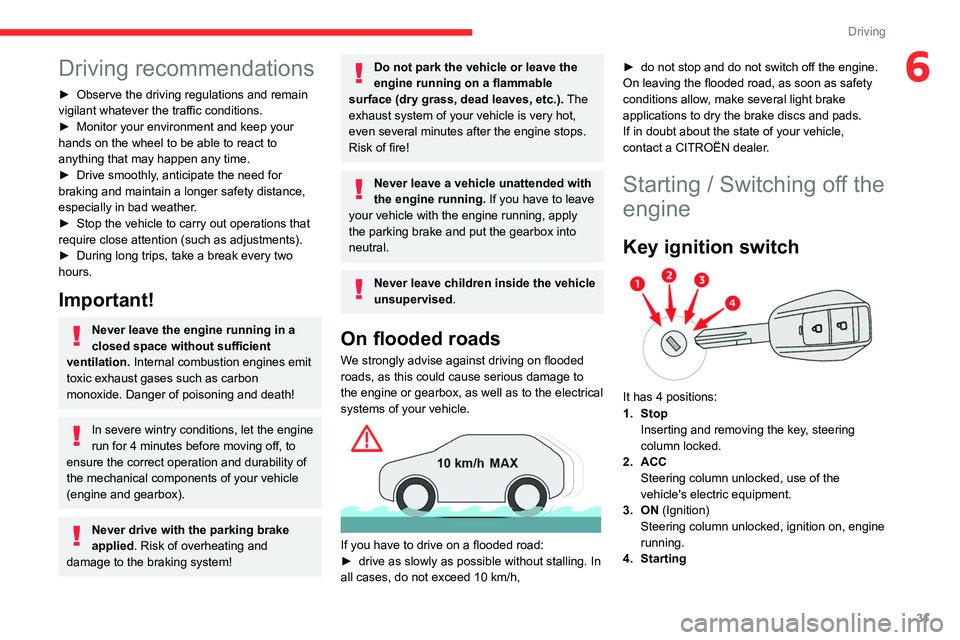
Key ignition switch
It has 4 positions:
1. Stop Inserting and removing the key, steering
column locked.
2. ACC Steering column unlocked, use of the
vehicle's electric equipment.
3. ON (Ignition) Steering column unlocked, ignition on, engine
running.
4. Starting
Page 34 of 104

32
Driving
Avoid attaching heavy objects to the key or the remote control. It would weigh
down on its shaft in the ignition switch and
could cause a malfunction.
Ignition on position
It allows the use of the vehicle's electric
equipment or portable devices to be charged.
Starting the engine
With the parking brake applied:
► Place the gear lever in neutral then fully
depress the clutch pedal.
►
Insert the key into the ignition switch; the
system recognises the code.
►
Unlock
the steering column by simultaneously
turning the steering wheel and the key.
In certain cases, you may have to apply
significant force to move the steering
wheel (wheels on full lock, for example).
►
Operate the starter motor by turning the key
to position
3 without pressing the accelerator
pedal, until the engine starts. Once the engine
starts, release the key.
After a cold start, preheating the catalytic converter can cause noticeable engine
vibrations for anything up to 2 minutes while
stationary with the engine running
(accelerated idle speed).
If the engine does not start straight away,
switch off the ignition. Wait a few
seconds before operating the starter motor
again. If the engine does not start after a few
attempts, do not keep trying - risk of
damaging the starter motor, the battery and
the engine.
Contact a CITROËN dealer.
In mild conditions, do not leave the
engine at idle to warm up but move off
straight away and drive at moderate speed.
5-speed manual gearbox
Engaging reverse gear
► Fully depress the clutch pedal.
► Push the gear lever fully to the right, then
backwards.
Only engage reverse gear when the
vehicle is stationary with the engine at
idle.
As a safety precaution and to facilitate starting the engine:
–
Always select neutral.
–
Depress the clutch pedal.
6-speed manual gearbox
Engaging 5th or 6th gear
► Move the gear selector fully to the right to
engage 5th or 6th gear.
Failure to follow this instruction could
cause permanent damage to the gearbox
(inadvertent engagement of 3
rd or 4th gear).
Engaging reverse gear
► Raise the ring under the knob and move the
gear selector to the left, then forwards.
Page 37 of 104

35
Practical information
7Refuelling
Fuel tank capacity: 30 litres.
Reserve level: approximately 5 litres.
Low fuel level
When the low fuel level is reached, this
warning lamp comes on on the instrument
panel, accompanied by an audible signal. When
it first comes on, about 5 litres of fuel remain.
Until sufficient fuel is added, this warning lamp
appears every time the ignition is switched on,
accompanied by an audible signal. When driving,
the audible signal are repeated with increasing
frequency as the fuel level drops towards 0.
You must refuel as soon as possible to avoid
running out of fuel.
Refuelling
Additions of fuel must be of at least 5 litres, in
order to be registered by the fuel gauge.
Opening the filler cap may create a noise caused
by an inrush of air. This vacuum is entirely
normal, resulting from the sealing of the fuel
system.
To refuel in complete safety:
►
Y
ou must switch off the engine.
► Lift the fuel filler flap lever , located on the
floor beside the driver's seat, to open the flap.
►
T
ake care to select the pump that delivers the
correct fuel type for the vehicle's engine (see a
reminder label on the inside of the filler flap).
► Turn the filler cap to the left and remove it.
► Introduce the filler nozzle and push it in as
far as possible before starting to refuel (risk of
blowback).
►
Fill the tank.
Do not continue past the first cut-off of the
nozzle, as this may cause malfunctions.
► Refit the filler cap.
► T urn it to the right.
►
Push the filler flap to close it.
If you have put in wrong/dirty/
contaminated fuel or H2O mixed fuel in
the vehicle, you must have the fuel tank
drained and filled with the correct fuel before
starting the engine.
Contact a CITROËN dealer for the fuel
system cleaning.
The vehicle is fitted with a catalytic converter, a
device which helps to reduce the level of harmful
emissions in the exhaust gases.
You must use unleaded fuel.
The filler neck is narrower, admitting unleaded
petrol nozzles only.
Fuel cut-off
Your vehicle is equipped with a safety device
which cuts off the fuel supply in the event of a
collision.
Bonnet
When the engine is hot, handle the
exterior safety catch and the bonnet stay
with care (risk of burns), using the protected
area.
When the bonnet is open, take care not to
damage the safety catch.
Page 39 of 104
37
Practical information
7– Air filter.
– Engine oil dipstick.
–
Engine oil filler cap.
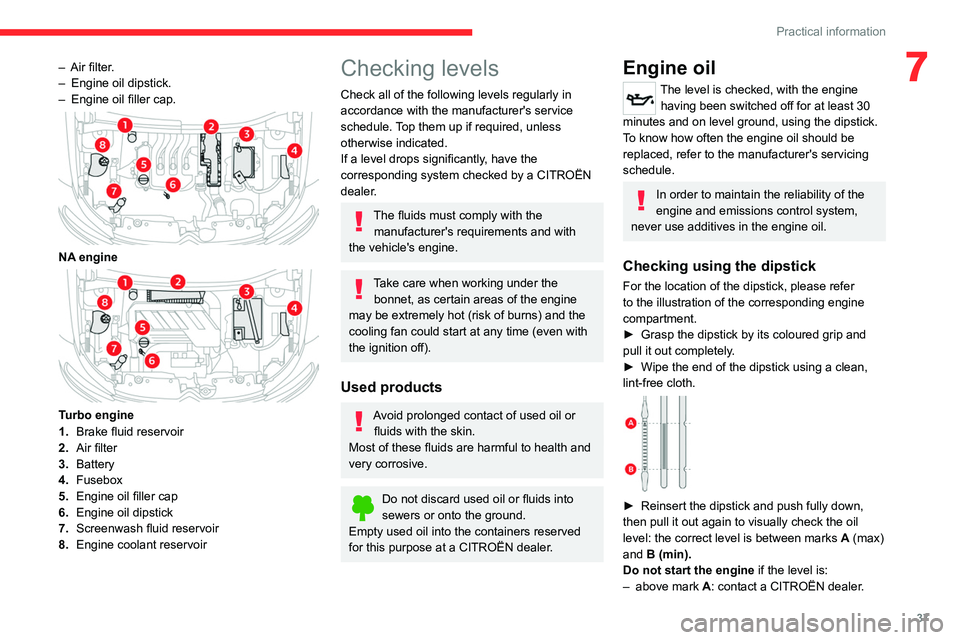
NA engine
Turbo engine
1. Brake fluid reservoir
2. Air filter
3. Battery
4. Fusebox
5. Engine oil filler cap
6. Engine oil dipstick
7. Screenwash fluid reservoir
8. Engine coolant reservoir
Checking levels
Check all of the following levels regularly in
accordance with the manufacturer's service
schedule. Top them up if required, unless
otherwise indicated.
If a level drops significantly, have the
corresponding system checked by a CITROËN
dealer.
The fluids must comply with the
manufacturer's requirements and with
the vehicle's engine.
Take care when working under the bonnet, as certain areas of the engine
may be extremely hot (risk of burns) and the
cooling fan could start at any time (even with
the ignition off).
Used products
Avoid prolonged contact of used oil or fluids with the skin.
Most of these fluids are harmful to health and
very corrosive.
Do not discard used oil or fluids into
sewers or onto the ground.
Empty used oil into the containers reserved
for this purpose at a CITROËN dealer.
Engine oil
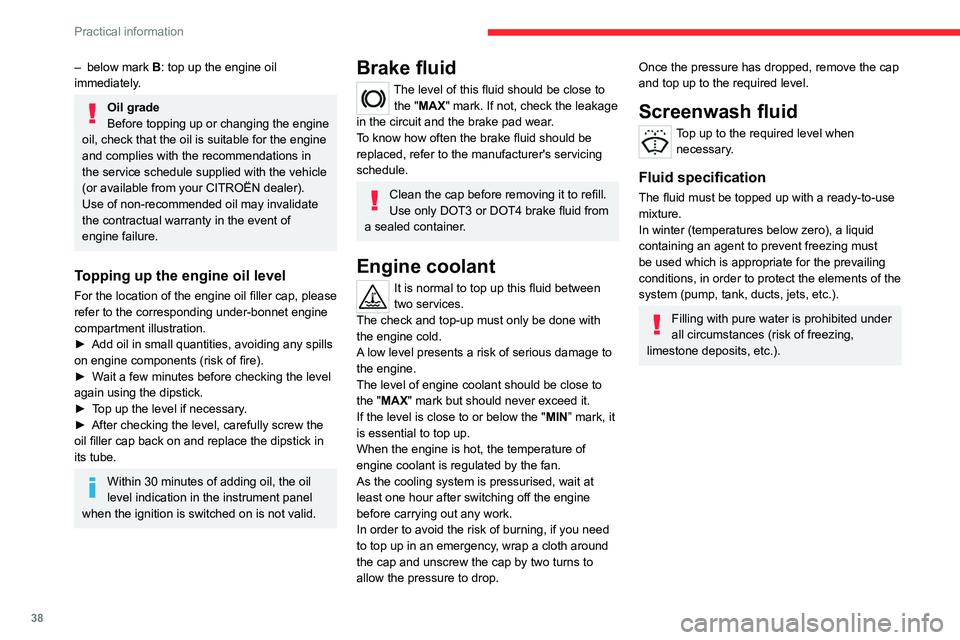
The level is checked, with the engine having been switched off for at least 30
minutes and on level ground, using the dipstick.
To know how often the engine oil should be
replaced, refer to the manufacturer's servicing
schedule.
In order to maintain the reliability of the
engine and emissions control system,
never use additives in the engine oil.
Checking using the dipstick
For the location of the dipstick, please refer
to the illustration of the corresponding engine
compartment.
►
Grasp the dipstick by its coloured grip and
pull it out completely
.
►
Wipe the end of the dipstick using a clean,
lint-free cloth.
► Reinsert the dipstick and push fully down,
then pull it out again to visually check the oil
level: the correct level is between marks A
(max)
and B (min).
Do not start the engine if the level is:
–
above mark
A: contact a CITROËN dealer.
Page 40 of 104
38
Practical information
– below mark B : top up the engine oil
immediately.
Oil grade
Before topping up or changing the engine
oil, check that the oil is suitable for the engine
and complies with the recommendations in
the service schedule supplied with the vehicle
(or available from your CITROËN dealer).
Use of non-recommended oil may invalidate
the contractual warranty in the event of
engine failure.
Topping up the engine oil level
For the location of the engine oil filler cap, please
refer to the corresponding under-bonnet engine
compartment illustration.
►
Add oil in small quantities, avoiding any spills
on engine components (risk of fire).
►
W
ait a few minutes before checking the level
again using the dipstick.
►
T
op up the level if necessary.
►
After checking the level, carefully screw the
oil filler cap back on
and replace the dipstick in
its tube.
Within 30 minutes of adding oil, the oil
level indication in the instrument panel
when the ignition is switched on is not valid.
Brake fluid
The level of this fluid should be close to
the "MAX" mark. If not, check the leakage
in the circuit and the brake pad wear.
To know how often the brake fluid should be
replaced, refer to the manufacturer's servicing
schedule.
Clean the cap before removing it to refill.
Use only DOT3 or DOT4 brake fluid from
a sealed container.
Engine coolant
It is normal to top up this fluid between
two services.
The check and top-up must only be done with
the engine cold.
A low level presents a risk of serious damage to
the engine.
The level of engine coolant should be close to
the "MAX" mark but should never exceed it.
If the level is close to or below the " MIN” mark, it
is essential to top up.
When the engine is hot, the temperature of
engine coolant is regulated by the fan.
As the cooling system is pressurised, wait at
least one hour after switching off the engine
before carrying out any work.
In order to avoid the risk of burning, if you need
to top up in an emergency, wrap a cloth around
the cap and unscrew the cap by two turns to
allow the pressure to drop.
Once the pressure has dropped, remove the cap
and top up to the required level.
Screenwash fluid
Top up to the required level when necessary.
Fluid specification
The fluid must be topped up with a ready-to-use
mixture.
In winter (temperatures below zero), a liquid
containing an agent to prevent freezing must
be used which is appropriate for the prevailing
conditions, in order to protect the elements of the
system (pump, tank, ducts, jets, etc.).
Filling with pure water is prohibited under
all circumstances (risk of freezing,
limestone deposits, etc.).
Page 45 of 104

43
In the event of a breakdown
8Removing a wheel
Parking the vehicle
Immobilise the vehicle where it does
not obstruct traffic: the ground must be level,
stable and non-slippery.
With a manual gearbox, engage first gear to
lock the wheels, apply the parking brake and
switch off the ignition.
Check for the fixed illumination of the parking
brake indicator lamps in the instrument panel.
The occupants must get out of the vehicle
and wait where they are safe.
If necessary, place a chock under the wheel
diagonally opposite the wheel to be changed.
Never go underneath a vehicle raised using a
jack; use an axle stand.
Wheel with wheel trim
When removing the wheel , first remove
the wheel trim by pulling at the valve aperture.
When refitting the wheel , refit the wheel
trim, starting by placing its aperture in line
with the valve and then pushing it into place
all round its edge with the palm of your hand.
Wheel nuts removing pattern
► Loosen the nuts on the wheel in diagonal
sequence. Do not remove wheel nuts.
► Slacken the bolts using the wheel wrench 3
only.
► Place the foot of jack 1 on the ground and
ensure that it is directly below the front A or
rear
B jacking point on the underbody, whichever
is closest to the wheel to be changed.
► Extend jack 1 with the jack handle 2 and
wheel wrench 3 until its head comes into contact
with jacking point
A
or B; contact area A or B
on the vehicle must be properly inserted into the
central part of the head of the jack.
►
Raise the vehicle until there is sufficient
space between the wheel and the ground to
admit the spare (not punctured) wheel easily
.
Page 47 of 104

45
In the event of a breakdown
8► Tighten the spare wheel fixing screw by a few
turns.
After changing a wheel
The temporary spare wheel is only intended for temporary emergency use,
until the conventional wheel can be repaired
or replaced.
Continuous use of this spare can result in tire
failure and loss of control. Always observe
these precautions when using this spare:
–
Y
our vehicle will respond differently with
this temporary spare.
–
Do not exceed 80 km/h speed.
–
Replace this spare with a standard tire and
wheel as soon as possible.
–
Use of this spare will reduce ground
clearance.
–
Set the specified tire pressure indicated
on the tire information label located on the
driver's door lock pillar
.
–
Do not use tire chains on the temporary
spare. If you must use tire chains, rearrange
the wheels so standard tires and wheels are
fitted to the front axle.
–
The temporary spare wheel has a much
shorter tread life than the conventional
wheels
on your vehicle. Replace the tire as soon as
possible as the tread wear indicator appears.
The inflation pressure of the temporary spare
wheel should be checked at least monthly. At
the same time, check that the tire is stored
securely. If it is not, tighten it.
Note that two or more temporary spare
wheels should not be used on one vehicle
simultaneously.
Changing a bulb
In some weather conditions (e.g. low
temperature or humidity), misting on the
internal surface of the glass of the headlamps
and rear lamps is normal, and will disappear
after the lamps have been on for a few
minutes.
The headlamps have polycarbonate lenses with a protective coating:
–
Do not clean them with a dry or abrasive
cloth, nor with detergent or solvent
products.
–
Use a sponge and soapy water or a pH
neutral product.
–
When using a high-pressure washer on
persistent marks, do not keep the lance
directed towards the headlamps, lamps or
their edges for too long, so as not to damage
their protective coating and seals.
Changing a bulb must only be done with
the ignition off and after the headlamp /
lamp has been switched off for several
minutes - risk of serious burns!
Do not touch the bulb directly with your
fingers; use a lint-free cloth.
It is essential only to use anti-ultraviolet
(UV) type bulbs, so as not to damage the
headlamp.
Always replace a failed bulb with a new bulb
of the same type and specification. To avoid
lighting imbalance, replace the bulbs in pairs.
Refitting the lamp units
Perform the operations in the reverse
order to dismantling.
Opening the bonnet / Accessing the
bulbs
With the engine warm, proceed with caution -
risk of burns!
Take care with objects or clothing that could
be caught in the blades of the cooling fan -
risk of strangulation!
Halogen bulbs (Hx)
To ensure good quality lighting, check
that the bulb is correctly positioned in its
housing.
Page 51 of 104

49
In the event of a breakdown
8► Unclip the cover by pulling at the top left, then
right.
Version 1
Fuse No. ColourRating (A) Functions
FF01 Red 10On-board diagnosis (OBD-II) / Spare connector
FF02 Yellow 20Body control and cluster module 1 (BCCM-1)
FF03 Green 30Body control and cluster module 2 (BCCM-2)
FF04 Yellow 20Body control and cluster module 3 (BCCM-3)
FF07 Blue 1512 V Socket
FF08 Ta n 5Cabin lamp / Spare connector
FF09 Blue 15Front wiper and washer
FF10 Ta n 5ECU's ignition
FF12 Ta n 5Airbag ECU
FF10 Ta n 5Switches ignition
FF Ta n 5Service
FF Red 10Service
FF Blue 15Service
FS01 Pink 30Body Control & Cluster Module 5 (BCCM-5)
Relays
Relay ColourRating (A) Functions
MICRO Brown 20Ignition Loads