Instrument Citroen C4 2015 2.G Owner's Guide
[x] Cancel search | Manufacturer: CITROEN, Model Year: 2015, Model line: C4, Model: Citroen C4 2015 2.GPages: 494, PDF Size: 20.49 MB
Page 127 of 494
125
C4-2_en_Chap06_visibilite_ed01-2015
C4-2_en_Chap06_visibilite_ed01-2015
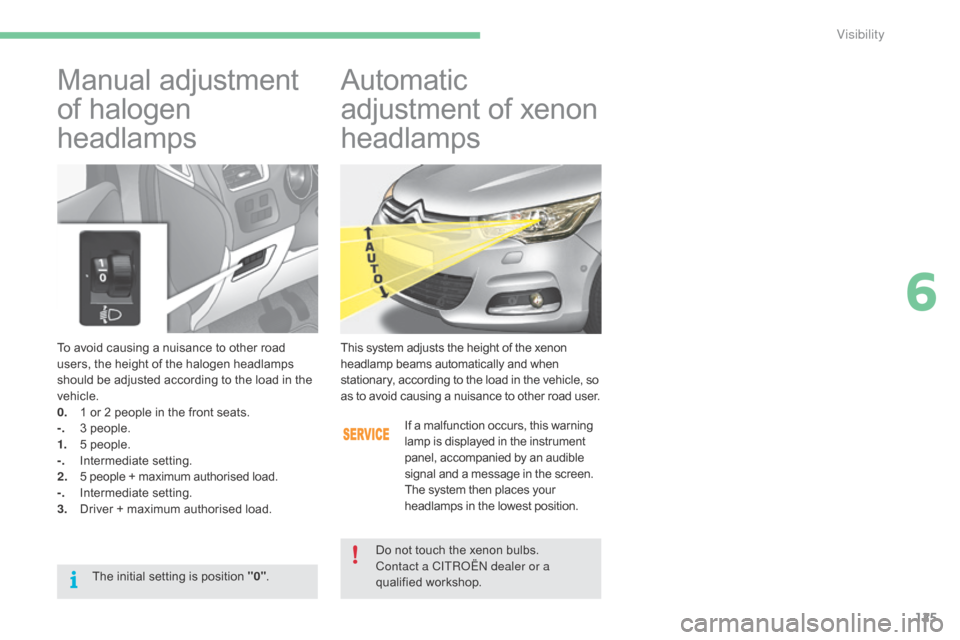
To avoid causing a nuisance to other road users, the height of the halogen headlamps
s
hould be adjusted according to the load in the
v
ehicle.
0.
1
or 2 people in the front seats.
-.
3
people.
1.
5
people.
-.
I
ntermediate
s
etting.
2.
5
people + maximum authorised load.
-.
I
ntermediate
s
etting.
3.
D
river + maximum authorised load.
Manual adjustment
o
f halogen
h
eadlamps Automatic
a djustment of xenon
h
eadlamps
This system adjusts the height of the xenon headlamp beams automatically and when s
tationary, according to the load in the vehicle, so
a
s to avoid causing a nuisance to other road user.
If
a malfunction occurs, this warning
l
amp is displayed in the instrument
p
anel, accompanied by an audible
s
ignal and a message in the screen.
The
system then places your
h
eadlamps in the lowest position.
Do
not touch the xenon bulbs.
Contact a CITR
oËn
dealer or a
qualified
w
orkshop.
The
initial
setting
is
position
"0" .
6
Visibility
Page 128 of 494
126
C4-2_en_Chap06_visibilite_ed01-2015
C4-2_en_Chap06_visibilite_ed01-2015
Directional lighting
Programming
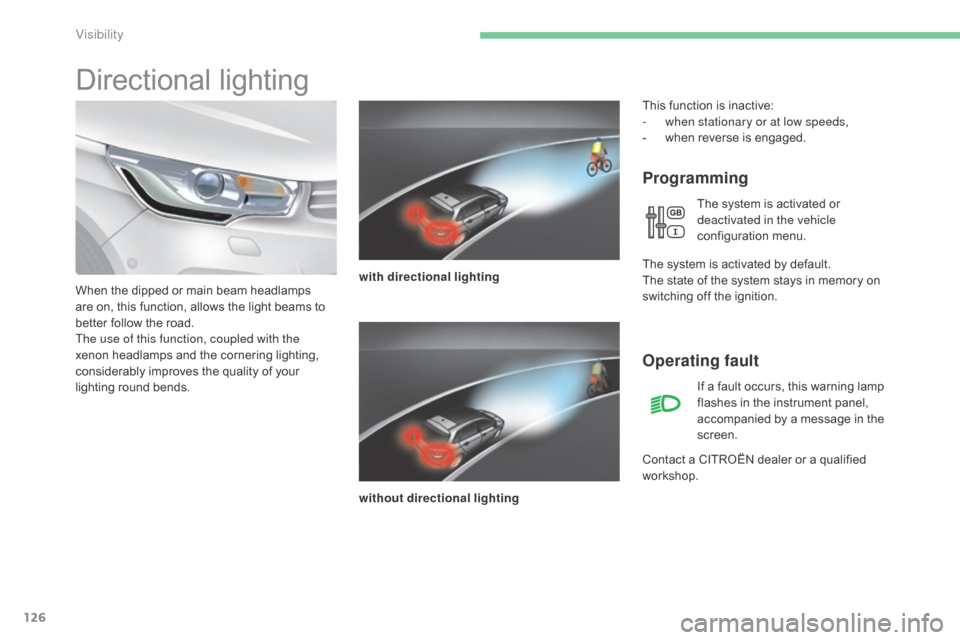
with directional lighting
without directional lighting
When
the
dipped
or
main
beam
headlamps
a
re
on,
this
function,
allows
the
light
beams
to
b
etter
follow
the
road.
The use of this function, coupled with the
xenon
headlamps
and
the
cornering
lighting,
c
onsiderably
improves
the
quality
of
your
l
ighting
r
ound
b
ends.
Operating fault
If a fault occurs, this warning lamp f lashes in the instrument panel,
a
ccompanied by a message in the
sc
reen.
Contact
a
CITROËN dealer or a qualified
w
orkshop.
This
function is inactive:
-
w
hen stationary or at low speeds,
-
w
hen
r
everse
i
s
enga
ged.
The system is activated or
d
eactivated in the vehicle
configuration
m
enu.
T
he
system is activated by default.
The
state
of the system stays in memory on
s
witching
off the ignition.
Visibility
Page 131 of 494
129
C4-2_en_Chap06_visibilite_ed01-2015
C4-2_en_Chap06_visibilite_ed01-2015
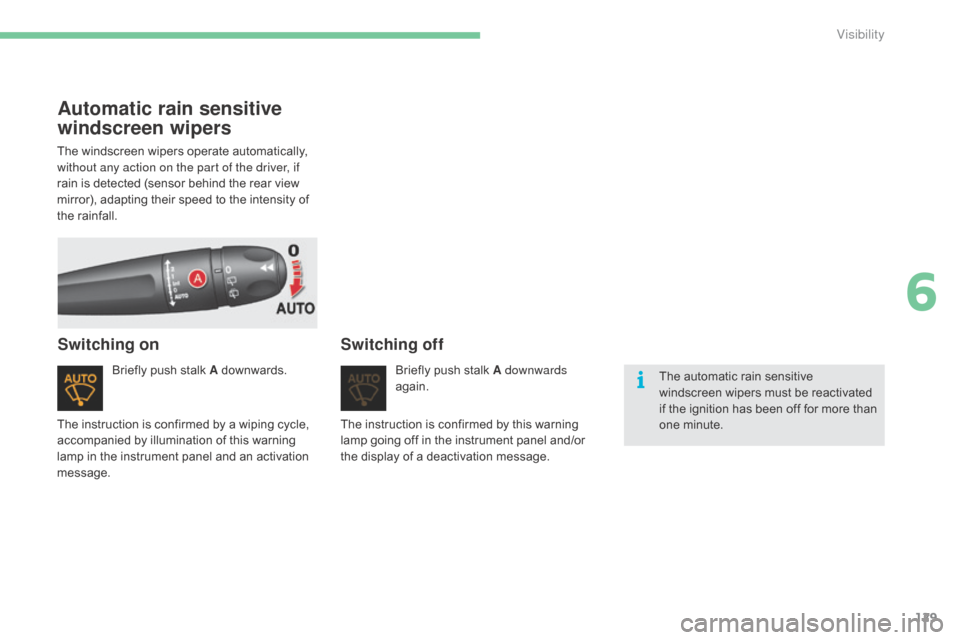
Automatic rain sensitive
windscreen wipers
Briefly push stalk A downwards.
Switching onSwitching off
Briefly push stalk A downwards
ag ain. The
automatic rain sensitive
w
indscreen wipers must be reactivated
i
f the ignition has been off for more than
o
ne minute.
The
instruction
is
confirmed
by
a
wiping
cycle,
a
ccompanied
by
illumination
of
this
warning
l
amp
in
the
instrument
panel
and
an
activation
m
essage. The
instruction is confirmed by this warning
l
amp
going off in the instrument panel and/or
t
he
display of a deactivation message.
The
windscreen
wipers
operate
automatically,
w
ithout any action on the part of the driver, if
rain
is
detected
(sensor
behind
the
rear
view
m
irror),
adapting
their
speed
to
the
intensity
of
t
he
rainfall.
6
Visibility
Page 154 of 494
152
C4-2_en_Chap08_securite_ed01-2015
C4-2_en_Chap08_securite_ed01-2015
Trajectory control systems
Anti-slip regulation (ASR)
and dynamic stability
control (DSC)
The anti-slip regulation (also known as traction control) optimises traction to prevent skidding
o
f the wheels, by acting on the brakes of the
d
riving wheels and on the engine.
The electronic stability control acts on the
brake
of one or more wheels and on the engine
t
o keep the vehicle on the trajectory required
b
y the driver, within the limits of the laws of
p
hysics.
Activation
These systems are activated automatically each time the vehicle is started.
They
come into operation in the event of a grip
o
r
t
rajectory
pro
blem.
This
is indicated by flashing of this
w
arning lamp in the instrument panel.
Intelligent traction control
system ("Snow motion")
Deactivation
In extremely severe conditions (deep snow, mud, ...), if you are unable to move off, it may
b
e useful to temporarily deactivate these
s
ystems so that the wheels can spin freely and
a
llow the vehicle to move.
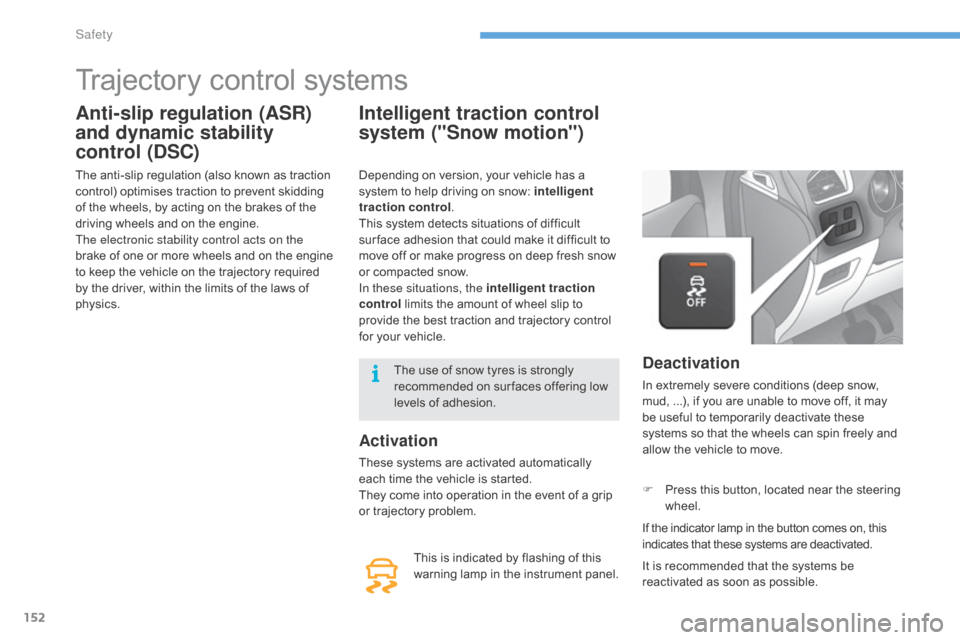
F
P
ress this button, located near the steering
w
heel.
If
the indicator lamp in the button comes on, this
i
ndicates that these systems are deactivated.
Depending
on
version,
your
vehicle
has
a
s
ystem
to
help
driving
on
snow:
intelligent
traction control .
This
system
detects
situations
of
difficult
s
ur face
adhesion
that
could
make
it
difficult
to
m
ove
off
or
make
progress
on
deep
fresh
snow
o
r
compacted
snow.
In these situations, the intelligent traction
control
limits
the
amount
of
wheel
slip
to
p
rovide
the
best
traction
and
trajectory
control
f
or
your
vehicle.
It is recommended that the systems be
r
eactivated as soon as possible.
The
use
of
snow
tyres
is
strongly
r
ecommended
on
sur faces
offering
low
l
evels
of
adhesion.
Safety
Page 155 of 494

153
C4-2_en_Chap08_securite_ed01-2015
C4-2_en_Chap08_securite_ed01-2015
Reactivation
These systems are reactivated automatically each time the ignition is switched back on or
f
rom 30 mph (50 km/h).
F
P
ress this button again to reactivate them
m
anually.
The
illumination of the indicator
l
amps in the instrument panel and
i
n this button, accompanied by an
a
udible signal and a message in the
s
creen, indicates a fault with these
systems.
Operating fault
Emergency o r
a ssistance call
This system allows you to make an emergency o
r assistance call to the emergency services or
t
o the dedicated CITROËN service.
For
more information on the use of this
f
unction, refer to the "Audio and telematics"
s
ection.
The
trajectory
control
systems
offer
i
ncreased
safety
in
normal
driving,
but
t
his
should
not
encourage
the
driver
to
t
ake
extra
risks
or
drive
at
high
speed.
The
correct
functioning
of
these
s
ystems
is
assured
provided
that
m
anufacturer's
recommendations
are
ob
served
on
:
-
w
heels
(tyres
and
rims),
-
b
raking
components,
-
el
ectronic
c
omponents,
-
a
ssembly
and
repair
procedures.
After
an
impact,
have
these
systems
c
hecked
by
a
CITROËN
dealer
or
a
q
ualified
w
orkshop.
Have
it
checked
by
a
CITROËN
dealer
or
a
q
ualified
w
orkshop.
8
Safety
Page 157 of 494
155
C4-2_en_Chap08_securite_ed01-2015
C4-2_en_Chap08_securite_ed01-2015
Seat belt not fastened / unfastened
warning lamp in the instrument
panel
When the ignition is switched on, this warning lamp comes on in the instrument p
anel if the driver and/or the front
p
assenger has not fastened their seat belt.
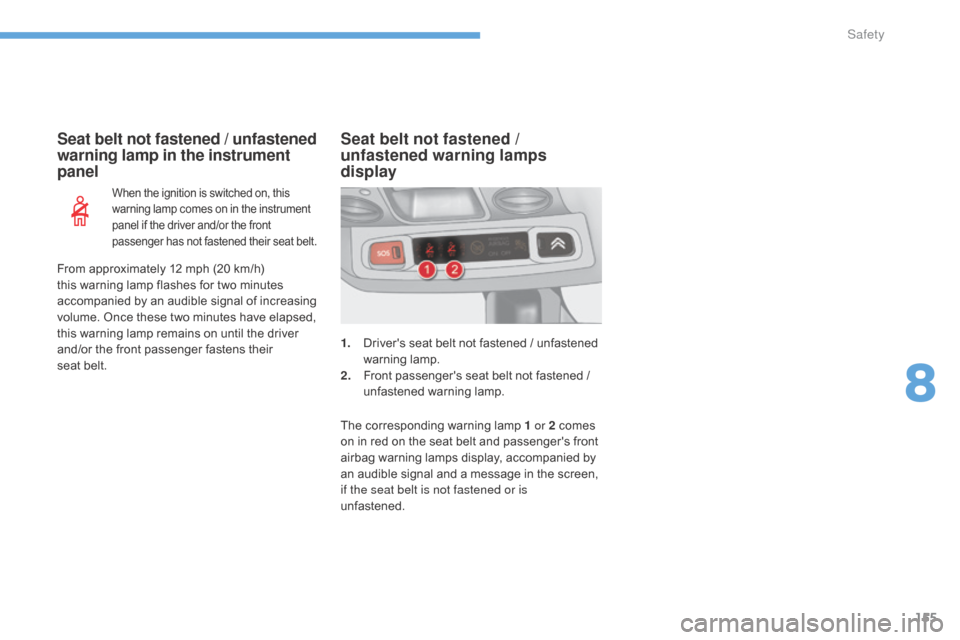
1. Driver's seat belt not fastened / unfastened w
arning lam p.
2.
F
ront passenger's seat belt not fastened /
u
nfastened warning lamp.
Seat belt not fastened /
unfastened warning lamps
display
The corresponding warning lamp 1 or 2 comes on in red on the seat belt and passenger's front
a
irbag warning lamps display, accompanied by
a
n audible signal and a message in the screen,
i
f the seat belt is not fastened or is
unfastened.
From
approximately
12
mph
(20 km/h)
t
his
warning
lamp
flashes
for
two
minutes
a
ccompanied
by
an
audible
signal
of
increasing
v
olume.
Once
these
two
minutes
have
elapsed,
t
his
warning
lamp
remains
on
until
the
driver
a
nd/or
the
front
passenger
fastens
their
seat
belt.
8
Safety
Page 158 of 494
156
C4-2_en_Chap08_securite_ed01-2015
C4-2_en_Chap08_securite_ed01-2015
Rear seat belts
Fastening
F Pull the strap, then insert the tongue in the buc
kle.
F
C
heck that the seat belt is fastened
c
orrectly by pulling the strap.
Unfastening
F Press the red button on the buckle.
F G uide the seat belt as it reels in.
F
o
n t
he outer seat belts, raise the bar to the
top
of the backrest to prevent the tongue
f
rom knocking against the side trim.
This
warning lamp comes on in the
i
nstrument
panel
when
one
or
more
rear
p
assengers
u
nfasten
t
heir
sea
t
b
elt.
Seat belt unfastened warning
lamp in the instrument panelSeat belt unfastened warning
lamps display
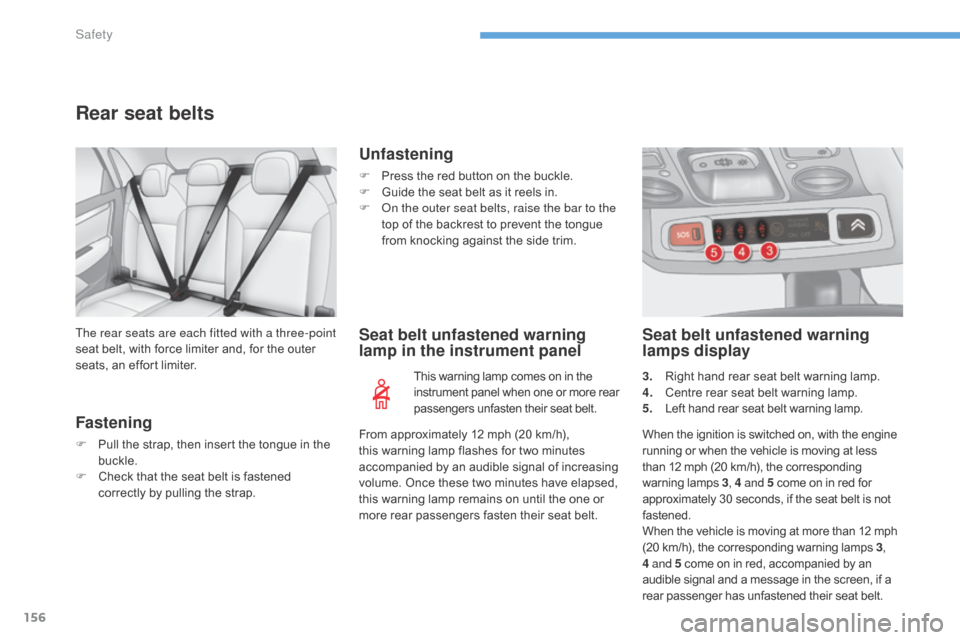
3. Right
hand rear seat belt warning lamp.
4. C entre rear seat belt warning lamp.
5.
L
eft hand rear seat belt warning lamp.
From
approximately
12 mph
(20 km/h),
t
his
warning
lamp
flashes
for
two
minutes
a
ccompanied
by
an
audible
signal
of
increasing
v
olume.
Once
these
two
minutes
have
elapsed,
t
his
warning
lamp
remains
on
until
the
one
or
m
ore
rear
passengers
fasten
their
seat
belt.
The rear seats are each fitted with a three-point
seat
belt,
with
force
limiter
and,
for
the
outer
s
eats,
an
effort
limiter.
When the ignition is switched on, with the engine
r
unning or when the vehicle is moving at less
t
han 12 mph (20 km/h), the corresponding
w
arning
lam
ps
3, 4 a
nd 5
come on in red for
a
pproximately 30 seconds, if the seat belt is not
f
astened.
When
the vehicle is moving at more than 12 mph
(
20 km/h), the corresponding warning lamps 3,
4 and 5
come on in red, accompanied by an
a
udible signal and a message in the screen, if a
r
ear passenger has unfastened their seat belt.
Safety
Page 161 of 494
159
C4-2_en_Chap08_securite_ed01-2015
C4-2_en_Chap08_securite_ed01-2015
Deactivation
Only the passenger's front airbag can be deactivated:
F
i
nsert the key in the passenger airbag
d
eactivation switch,
F
t
urn it to the "OFF" position,
F
t
hen, remove the key keeping the switch in
t
he new position.
According
to version, this warning
l
amp comes on in the instrument
p
anel and/or in the seat belt and
p
assenger's front airbag warning
l
amps display when the ignition is on
a
nd until the airbag is reactivated.
Front airbags
Deployment
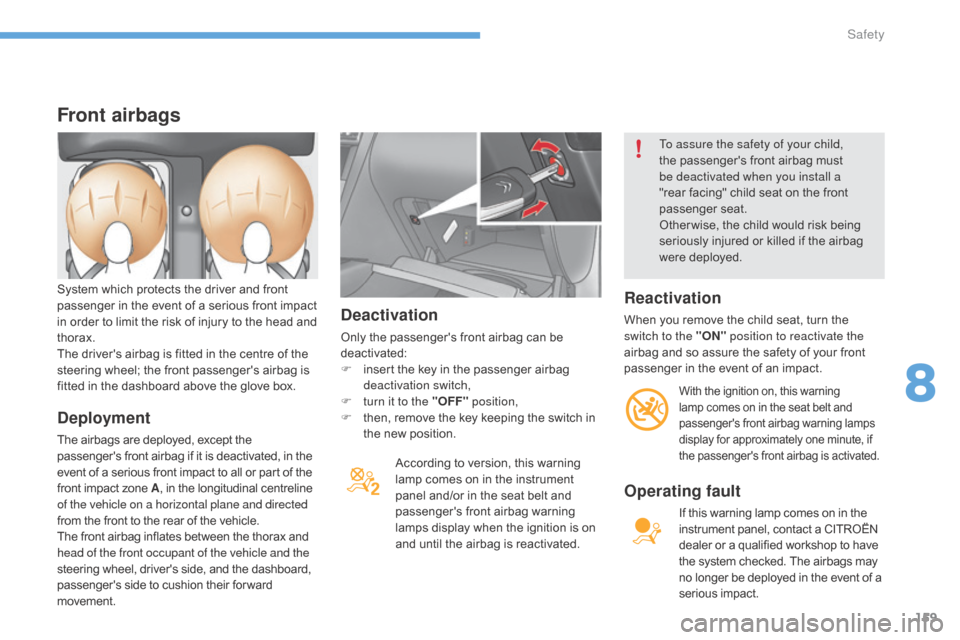
The airbags are deployed, except the passenger's front airbag if it is deactivated, in the e
vent of a serious front impact to all or part of the
f
ront impact zone A,
in the longitudinal centreline
o
f the vehicle on a horizontal plane and directed
from
the front to the rear of the vehicle.
The
front airbag inflates between the thorax and
h
ead of the front occupant of the vehicle and the
steering
wheel, driver's side, and the dashboard,
p
assenger's side to cushion their for ward
m
ovement. To assure the safety of your child,
the
passenger's front airbag must
b
e deactivated when you install a
"rear facing" child seat on the front
p
assenger
sea
t.
Other wise, the child would risk being
s
eriously injured or killed if the airbag
w
ere deployed.
System which protects the driver and front
p
assenger in the event of a serious front impact
i
n order to limit the risk of injury to the head and
t
horax.
The driver's airbag is fitted in the centre of the
s
teering wheel; the front passenger's airbag is
f
itted in the dashboard above the glove box.
Reactivation
When you remove the child seat, turn the s
witch to the "ON" position to reactivate the
airbag
and so assure the safety of your front
p
assenger in the event of an impact.
With the ignition on, this warning lamp comes on in the seat belt and p
assenger's front airbag warning lamps
d
isplay for approximately one minute, if
t
he passenger's front airbag is activated.
Operating fault
If this warning lamp comes on in the instrument panel, contact a CITROËN d
ealer or a qualified workshop to have
t
he system checked. The airbags may
n
o longer be deployed in the event of a
s
erious
im
pact.
8
Safety
Page 166 of 494
164
C4-2_en_Chap09_conduite_ed01-2015
C4-2_en_Chap09_conduite_ed01-2015
Starting the engine
F With a petrol engine, operate the starter m
otor by turning the key to position 3
without
pressing the accelerator pedal,
u
ntil the engine starts. Once the engine is
r
unning, release the key. F
W
ith a Diesel engine, turn the key to
p
osition 2
, ignition on, to operate the
eng
ine
p
re-heating
s
ystem.
Wait until this warning lamp goes off
i
n the instrument panel then operate
t
he starter motor by turning the key
t
o position 3 without pressing the
a
ccelerator pedal, until the engine
s
tarts. Once the engine is running,
r
elease the key.
If the engine does not start straight
a
way, switch off the ignition. Wait a
f
ew moments before operating the
s
tarter motor again. If the engine does
n
ot start after several attempts, do not
k
eep trying: you risk damaging the
s
tarter motor or the engine. Contact
a
CITROËN dealer or a qualified
w
orkshop.Never
leave the engine running in
a
n enclosed area without adequate
v
entilation:
in
ternal
c
ombustion
e
ngines emit toxic exhaust gases,
s
uch as carbon monoxide. Danger of
i
ntoxication and death.
In very severe wintry conditions
(temperatures below -23°C), to ensure
t
he correct operation and durability of
the mechanical components of your
v
ehicle, engine and gearbox, it is n
ecessary to leave the engine running f
or 4 minutes before moving off.
In
certain cases, you may have to apply
m
ore force to the steering (wheels on
f
ull lock, for example).
In wintry conditions, the warning lamp
c
an stay on for a longer period. When
t
he engine is hot, the warning lamp
d
oes not come on.In temperate conditions, do not leave
t
he engine at idle to warm up but move
o
ff straight away and drive at moderate
s
peed.
With the parking brake applied and the gearbox
i
n neutral or position N or P
:
F
d
epress the clutch pedal fully (manual
g
earbox),
or
F
p
ress the brake pedal firmly (electronic or
a
utomatic gearbox),
F
i
nsert the key into the ignition switch; the
s
ystem recognises the code,
F
u
nlock the steering column by
s
imultaneously turning the steering and the
k
ey.
Driving
Page 168 of 494
166
C4-2_en_Chap09_conduite_ed01-2015
C4-2_en_Chap09_conduite_ed01-2015
Starting-switching off the engine with the
" Keyless Entry and Starting" system
Starting the engine
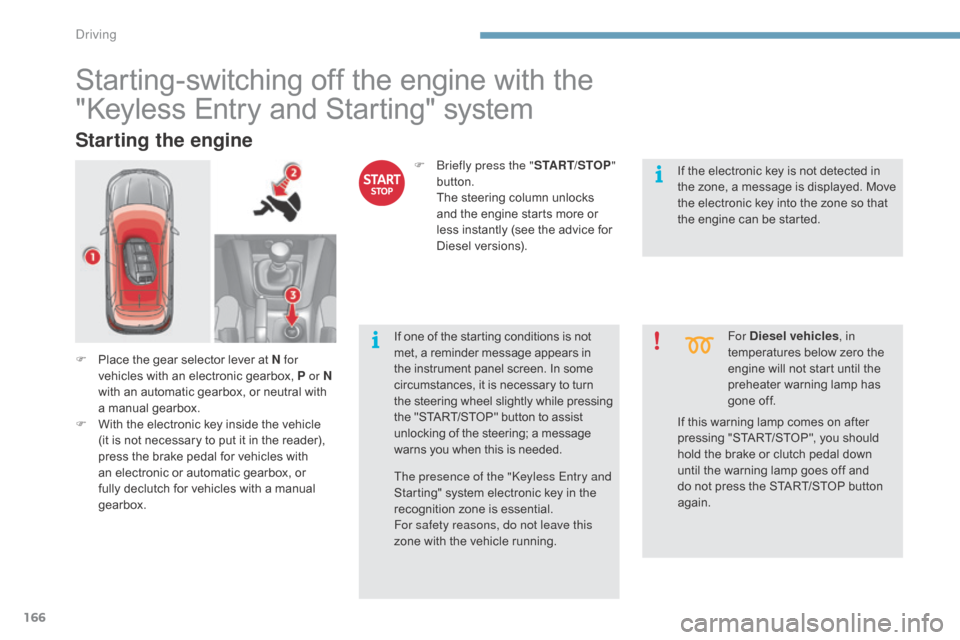
F Place the gear selector lever at N for
vehicles with an electronic gearbox, P or N
with
an automatic gearbox, or neutral with
a m
anual
g
earbox.
F
W
ith the electronic key inside the vehicle
(
it is not necessary to put it in the reader),
p
ress the brake pedal for vehicles with
a
n electronic or automatic gearbox, or
f
ully declutch for vehicles with a manual
g
earbox. F
b
r
iefly press the "
START/STOP"
button.
T
he steering column unlocks
a
nd the engine starts more or
l
ess instantly (see the advice for
D
iesel
v
ersions).
If this warning lamp comes on after
p
ressing "START/STOP", you should
h
old the brake or clutch pedal down
u
ntil the warning lamp goes off and
d
o not press the START/STOP button
ag
ain.
If
one of the starting conditions is not
m
et, a reminder message appears in t
he instrument panel screen. In some c
ircumstances, it is necessary to turn
t
he steering wheel slightly while pressing
t
he "START/STOP" button to assist
u
nlocking of the steering; a message
w
arns you when this is needed.If
the electronic key is not detected in
t
he zone, a message is displayed. Move
t
he electronic key into the zone so that
t
he engine can be started.
The presence of the "
ke
yless Entry and
Starting"
system electronic key in the
r
ecognition zone is essential.
For safety reasons, do not leave this
zone
with the vehicle running.For Diesel vehicles
, in
temperatures below zero the e
ngine will not start until the
p
reheater warning lamp has
g
one off.
driving