ECU Citroen C4 2016 2.G Owner's Guide
[x] Cancel search | Manufacturer: CITROEN, Model Year: 2016, Model line: C4, Model: Citroen C4 2016 2.GPages: 396, PDF Size: 10.22 MB
Page 166 of 396
164
C4-2_en_Chap05_securite_ed02-2015
For optimum installation o f t he fo rward f acing c
hild seat, ensure that the back of the child
s
eat is as close as possible to the backrest
o
f the vehicle's seat, in contact if possible.
You
mst remove the head restraint before
i
nstalling a child seat with backrest to a
p
assenger
sea
t.
Ensure that the head restraint is stored or
attached
securely to prevent it from being
t
hrown around the vehicle in the event of
sharp
braking. Refit the head restraint when
t
he child seat is removed.
Advice
Installing a booster seat
Children at the frontThe incorrect installation of a child seat in a
vehicle compromises the child's protection in
t
he event of an accident.
Ensure that there is no seat belt or seat belt
buckle
under the child seat, as this could
de
stabilise
i
t.
Remember
to fasten the seat belts or the
c
hild seat harnesses keeping the slack
r
elative to the child's body to a minimum,
e
ven for short journeys.
When
installing a child seat using the seat
b
elt, ensure that the seat belt is tightened
c
orrectly on the child seat and that it secures
the
child seat firmly on the seat of your
v
ehicle. If your passenger seat is adjustable,
m
ove it for wards if necessary. The
legislation on carrying children on the
f
ront passenger seat is specific to each
c
ountry. Refer to the legislation in force in
y
our country.
Deactivate
the passenger's front airbag
w
hen a rear ward facing child seat is installed
o
n the front passenger seat.
Otherwise,
t
he
c
hild
r
isks
b
eing
ser
iously
i
njured or killed if the airbag is deployed.The
chest part of the seat belt must be
p
ositioned on the child's shoulder without
t
ouching the neck.
Ensure that the lap part of the seat belt
passes
correctly over the child's thighs.
CITROËN
recommends the use of a booster
s
eat which has a back, fitted with a seat belt
g
uide at shoulder level.
At
rear seating positions, always leave
s
ufficient space between the front seat and:
-
a
rear ward facing child seat,
-
t
he child's feet for a child seat fitted
fo
rward
f
acing.
To
do this, move the front seat for wards
a
nd, if necessary, move its backrest into the
u
pright
p
osition. As
a safety precaution, do not leave:
-
a c
hild or children alone and
unsupervised in a vehicle,
-
a
child or an animal in a vehicle which
i
s exposed to the sun, with the windows
c
losed,
-
t
he keys within reach of children inside
t
he vehicle.
To
prevent accidental opening of the doors
a
nd rear windows, use the child lock.
Take
care not to open the rear windows by
m
ore than one third.
To
protect young children from the rays of
t
he sun, fit side blinds on the rear windows.
Safety
Page 167 of 396
165
C4-2_en_Chap05_securite_ed02-2015
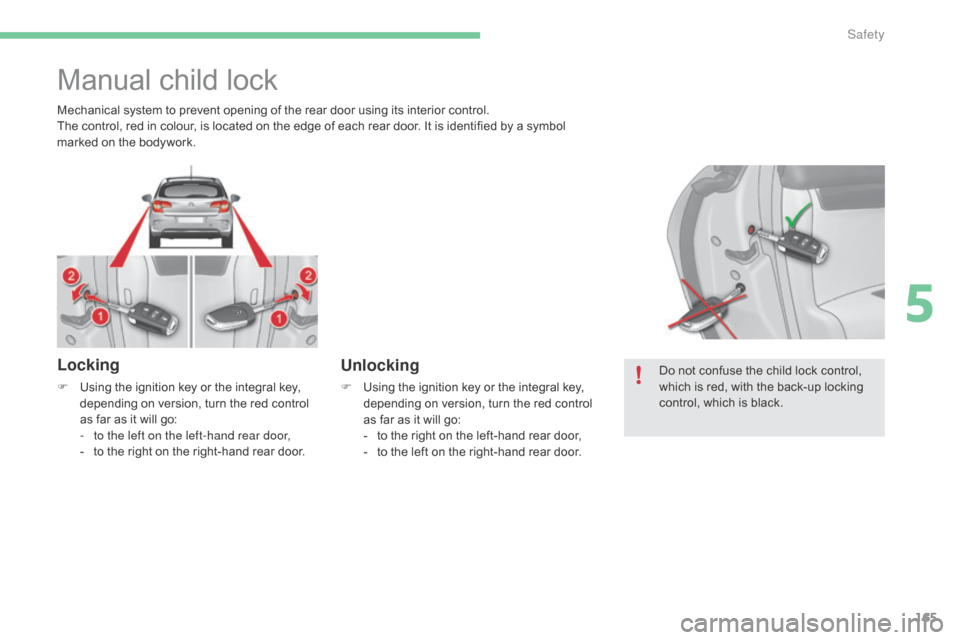
Manual child lock
Locking
F Using the ignition key or the integral key, d
epending on version, turn the red control
a
s far as it will go:
-
t
o the left on the left-hand rear door,
-
t
o the right on the right-hand rear door.
Unlocking
F Using the ignition key or the integral key, d
epending on version, turn the red control
a
s far as it will go:
-
t
o the right on the left-hand rear door,
-
t
o the left on the right-hand rear door.Do
not confuse the child lock control, w
hich is red, with the back-up locking c
ontrol, which is black.
Mechanical
system
to
prevent
opening
of
the
rear
door using its interior control.
The
control,
red
in
colour,
is
located
on
the
edge
of
each rear door. It is identified by a symbol
m
arked
on
the
bodywork.
5
Safety
Page 216 of 396
214
C4-2_en_Chap07_infos-pratiques_ed02-2015
Towbar with quickly detachable towball
Presentation
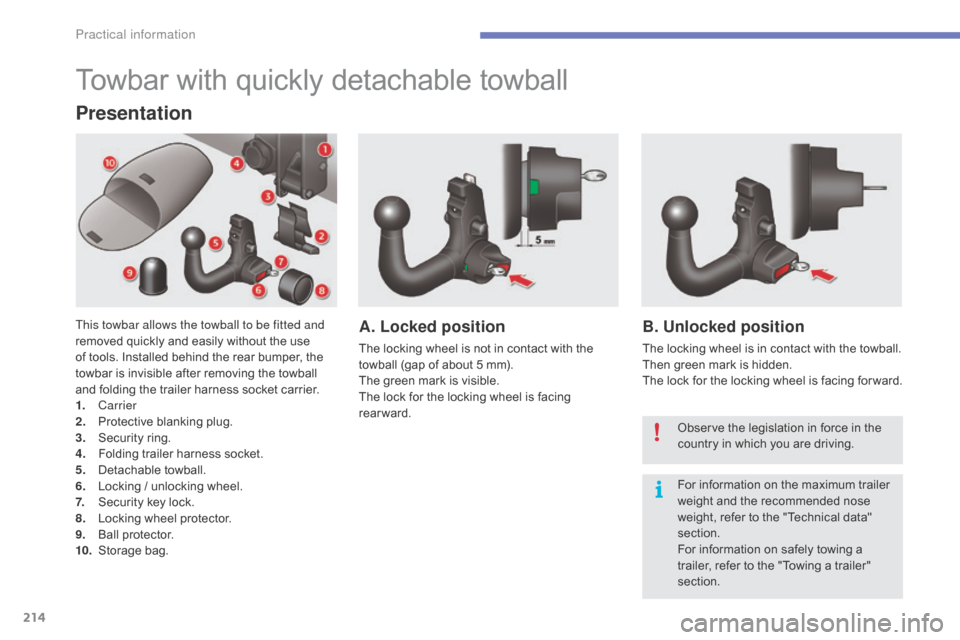
This towbar allows the towball to be fitted and
removed quickly and easily without the use
o
f tools. Installed behind the rear bumper, the
t
owbar is invisible after removing the towball
a
nd folding the trailer harness socket carrier.
1.
Carrier
2.
P
rotective blanking plug.
3.
S
ecurity ring.
4.
F
olding trailer harness socket.
5.
D
etachable
t
owball.
6.
L
ocking / unlocking wheel.
7.
S
ecurity key lock.
8.
L
ocking wheel protector.
9.
Ba
ll
pro
tector.
10.
St
orage
b
ag.A. Locked position
The locking wheel is not in contact with the towball (gap of about 5 mm).
The
green mark is visible.
The
lock for the locking wheel is facing
r
earward.
B. Unlocked position
The locking wheel is in contact with the towball.
T hen green mark is hidden.
The
lock for the locking wheel is facing for ward.
Observe
the legislation in force in the
c
ountry in which you are driving.
For
information on the maximum trailer
w
eight and the recommended nose
w
eight, refer to the "Technical data"
s
ection.
For
information on safely towing a
t
railer, refer to the "Towing a trailer"
s
ection.
Practical information
Page 217 of 396
215
C4-2_en_Chap07_infos-pratiques_ed02-2015
Before each use
Check that the towball is correctly fitted by verifying the following points:
- t he towball is correctly locked in place (position A),
-
t
he security key lock is on and the key removed; the locking wheel can no longer be
ope
rated,
-
t
he towball must no longer move at all in its carrier; try to shake it by hand.
During use
Never unlock the device when a trailer or load carrier is fitted to the towball.
N ever exceed the maximum authorised weight for the vehicle plus trailer (Gross Train
W
eight - GTW).
Before
driving, check the adjustment of the headlamp beam height.
For
more information on adjusting the headlamps, refer to the corresponding section.
After use
For journeys made without a trailer or load carrier, the trailer harness socket must be folded away, the towball removed and the blanking plug inserted in the carrier. This measure
a
pplies particularly if the towball could hinder visibility of the number plate or lighting.
7
Practical information
Page 219 of 396
217
C4-2_en_Chap07_infos-pratiques_ed02-2015
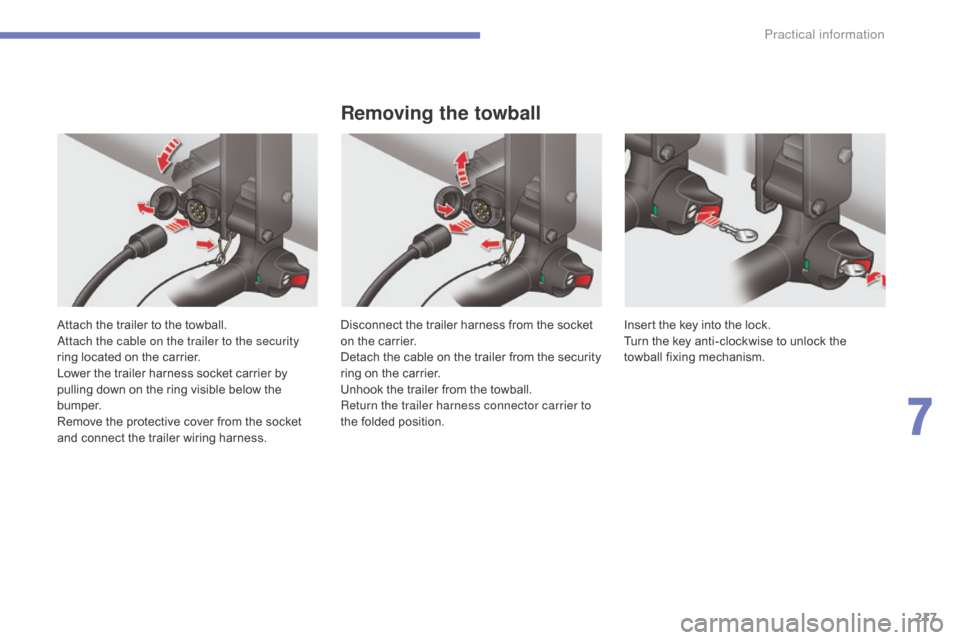
Attach the trailer to the towball.
A ttach the cable on the trailer to the security
ring
located on the carrier.
Lower
the trailer harness socket carrier by
p
ulling down on the ring visible below the
b
u m p e r.
Remove
the protective cover from the socket
a
nd connect the trailer wiring harness.
Removing the towball
Disconnect the trailer harness from the socket on the carrier.
Detach
the cable on the trailer from the security
r
ing on the carrier.
Unhook
the trailer from the towball.
Return the trailer harness connector carrier to
the
folded position. Insert
the key into the lock.
Turn the key anti-clockwise to unlock the
t
owball
f
ixing
m
echanism.
7
Practical information
Page 225 of 396
223
C4-2_en_Chap07_infos-pratiques_ed02-2015
Bonnet
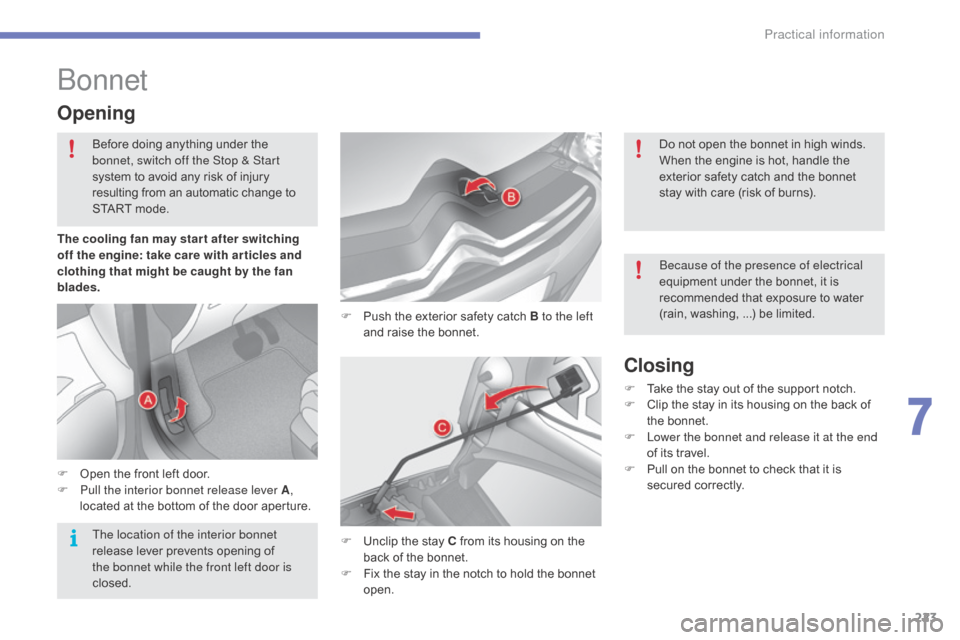
F Push the exterior safety catch B to the left
and raise the bonnet.
Opening
F Open the front left door.
F P ull the interior bonnet release lever A,
located
at the bottom of the door aperture.
F
U
nclip the stay C from its housing on the
b
ack of the bonnet.
F
F
ix the stay in the notch to hold the bonnet
ope
n.
Closing
F Take the stay out of the support notch.
F C lip the stay in its housing on the back of
t
he bonnet.
F
L
ower the bonnet and release it at the end
of
its travel.
F
P
ull on the bonnet to check that it is
s
ecured
c
orrectly.
The cooling fan may star t after switching
off the engine: take care with ar ticles and
clothing that might be caught by the fan
blades.
Before
doing
anything
under
the
b
onnet, switch off the Stop & Start
system
to
avoid
any
risk
of
injury
r
esulting
from
an
automatic
c
hange
t
o
S
TART
mode.
Do not open the bonnet in high winds.
When the engine is hot, handle the
e
xterior safety catch and the bonnet
s
tay with care (risk of burns).
Because of the presence of electrical
equipment under the bonnet, it is
r
ecommended that exposure to water
(
rain,
w
ashing, ...) be limited.
The location of the interior bonnet
release
lever
prevents
opening
of
t
he bonnet while the front left door is
closed.
7
Practical information
Page 230 of 396
228
C4-2_en_Chap07_infos-pratiques_ed02-2015
Screenwash / headlamp
wash fluid level
Specification of the fluid
To ensure optimum cleaning and to avoid freezing, the fluid should never be topped up or r
eplaced by plain water.
In wintry conditions, the use of a fluid
with
an ethyl alcohol or methanol base is
re
commended.
To
check
the
level
or
top
up
the
f
luid
on
vehicle
fitted
with
headlamp
w
ashers,
immobilise
the
vehicle
and
s
witch
of
the
engine.
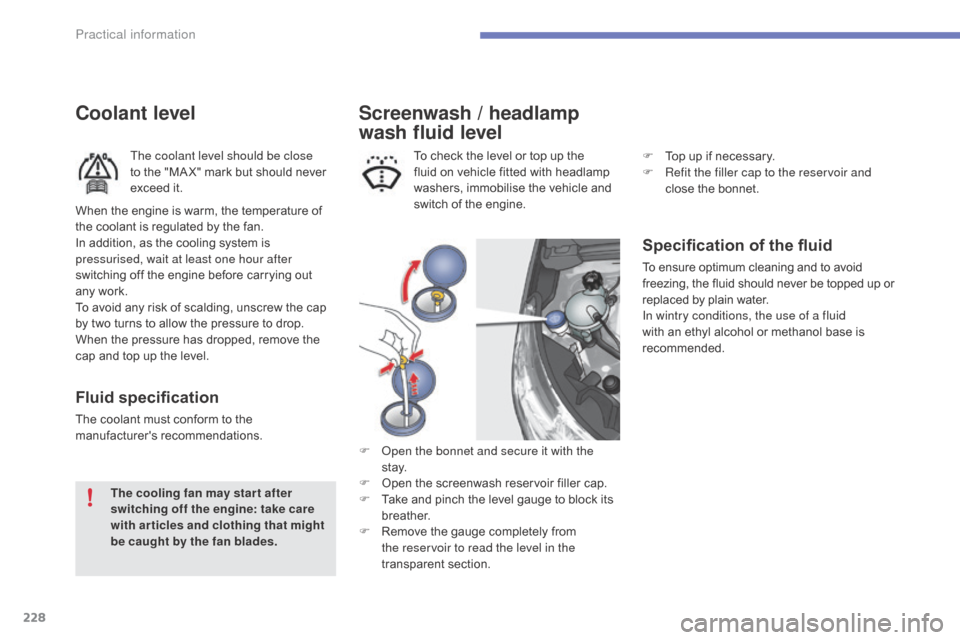
F
O
pen the bonnet and secure it with the
st ay.
F
O
pen
the
screenwash
reservoir
filler
cap.
F
T
ake
and
pinch
the
level
gauge
to
block
its
b
reather.
F
R
emove
the
gauge
completely
from
t
he reservoir to read the level in the
transparent
s
ection.
Coolant level
The coolant level should be close
to the "MA X" mark but should never
e
xceed it.
Fluid specification
The coolant must conform to the manufacturer's r ecommendations.
The cooling fan may star t after
switching off the engine: take care
with articles and clothing that might
be caught by the fan blades.
When
the engine is warm, the temperature of
t
he coolant is regulated by the fan.
In addition, as the cooling system is
p
ressurised, wait at least one hour after
switching off the engine before carrying out
any work.
To avoid any risk of scalding, unscrew the cap
b
y two turns to allow the pressure to drop.
W
hen the pressure has dropped, remove the
c
ap and top up the level. F
T
op up if necessary.
F
R
efit the filler cap to the reservoir and
close the bonnet.
Practical information
Page 236 of 396
234
C4-2_en_Chap07_infos-pratiques_ed02-2015
Recommendations on storageProcedure
F Switch off the ignition and remove the k
ey, or if your vehicle has one, press the
S
TART/STOP button to switch off the
e
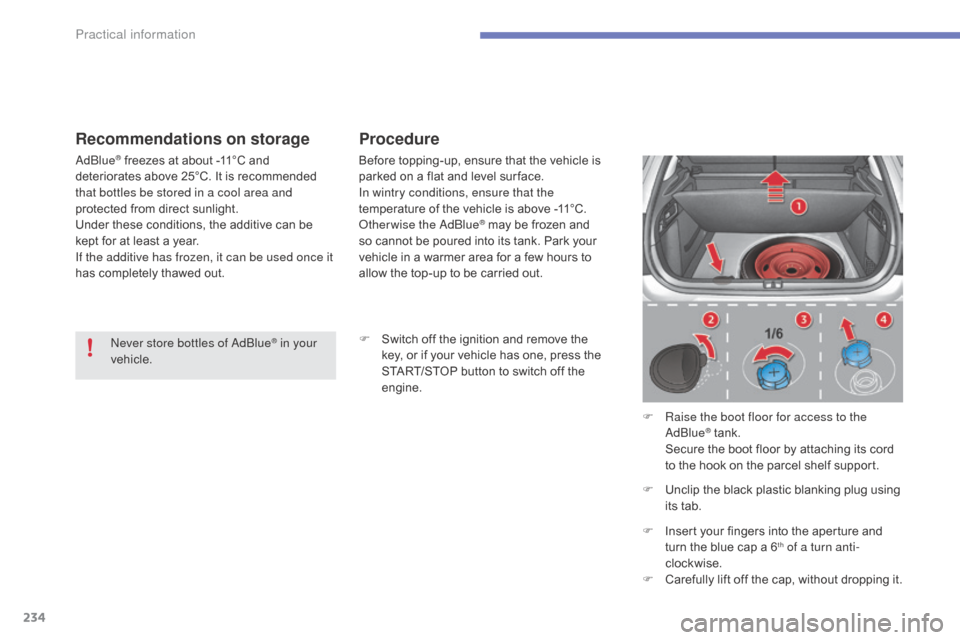
ngine. F
R
aise the boot floor for access to the
AdBlue
® tank. S
ecure
the boot floor by attaching its cord
t
o
the
hook on the parcel shelf support.
F
U
nclip
the black plastic blanking plug using
i
ts
tab.
F
I
nsert
your fingers into the aperture and
t
urn
the
blue cap a 6
th of a turn anti-
clockwise.
F
C
arefully
lift
off
the
cap, without dropping it.
Never store bottles of AdBlue
® in your
vehicle. Before
topping-up, ensure that the vehicle is
p
arked on a flat and level sur face.
In wintry conditions, ensure that the
temperature of the vehicle is above -11°C.
O
therwise the AdBlue
® may be frozen and s
o
cannot
be
poured
into its tank. Park your
v
ehicle
in
a
warmer
area for a few hours to
a
llow
the
top-up
to
be
carried out.
AdBlue
® freezes at about -11°C and d
eteriorates above 25°C. It is recommended
t
hat bottles be stored in a cool area and
protected
from direct sunlight.
Under
these conditions, the additive can be
k
ept
for
at least a year.
If the additive has frozen, it can be used once it
has
completely thawed out.
Practical information
Page 238 of 396
236
C4-2_en_Chap07_infos-pratiques_ed02-2015
Accessories
Conversion kits
You can obtain an "Enterprise" kit to convert a trade vehicle to a private car and vice-versa.
"Comfort":
door deflectors, side window blinds, rear
screen blind, insulated module, coat hanger
f
ixed to head restraint, reading lamp, mirror for
c
aravan, cruise control, scented air freshener
and
cartridges, parking sensors...
"Transport systems":
boot carpet, boot liner, boot net, boot spacers,
transverse roof bars, bicycle carrier, ski carrier,
r
oof boxes, towbars, towbar wiring harnesses...
"Styling":
gear lever knobs, aluminium foot rest, alloy wheels, wheel embellishers, chrome mirror
s
hells, chrome door
a
perture finishers, door sill
f
inishers, tailgate lower chrome finisher...
*
T
o avoid any risk of jamming the pedals:
-
e
nsure that mats are correctly positioned
a
nd secured,
-
n
ever fit one mat on top of
a
nother.
"Security and safety":
anti-intrusion alarm, microwave sensor, anti-tilt sensor, stolen vehicle tracking system, child
sea
ts and booster cushions, breathalyser, first
aid
kit, fire extinguisher, warning triangle, high
v
isibility vest, dog guard, pet seat belt, wheel
s
ecurity bolts, snow chains, non-slip covers,
front
foglamp kit...
"Protection":
mats*, seat covers compatible with l ateral a
irbags, door sill protectors, mud flaps, door
p
rotective rubbing strips, bumper protection
s
trips, protective covers for pets, vehicle
cover...
If
a
towbar
and
wiring
harness
are
fitted
o
utside
the
CITROËN
dealer
network,
t
he
installation
must
be
done
using
t
he
vehicle's
electrical
pre-equipment
a
nd
in
line
with
the
manufacturer's
r
ecommendations.
A
wide
range
of
accessories
and
genuine
parts
is
available
from
the
CITROËN
dealer
network.
These
accessories
and
parts
are
all
suitable
for
your
vehicle
and
benefit
from
CITROËN's
recommendation and warranty.
Practical information
Page 246 of 396
244
C4-2_en_Chap08_en-cas-de-panne_ed02-2015
Spare wheel
Access to the tools
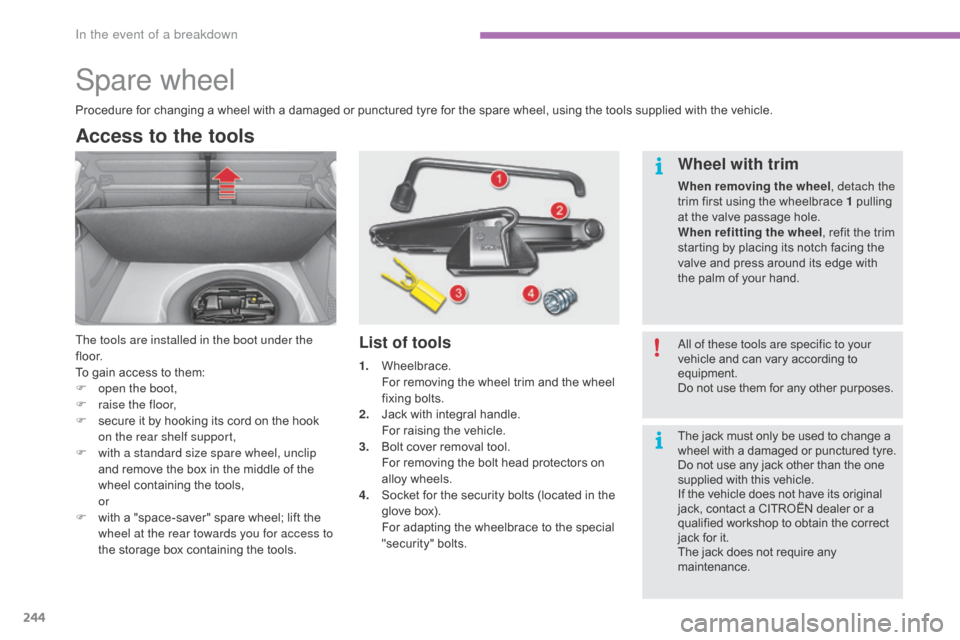
The tools are installed in the boot under the
f l o o r.
To gain access to them:
F
o
pen the boot,
F
r
aise the floor,
F
s
ecure it by hooking its cord on the hook
o
n the rear shelf support,
F
w
ith a standard size spare wheel, unclip
and
remove the box in the middle of the
w
heel containing the tools,
or
F
w
ith a "space-saver" spare wheel; lift the
w
heel at the rear towards you for access to
the
storage box containing the tools.List of tools Wheel with trim
When removing the wheel
, detach the
trim first using the wheelbrace 1 pulling
a
t the valve passage hole.
When refitting the wheel ,
refit the trim
s
tarting by placing its notch facing the
v
alve and press around its edge with
t
he palm of your hand.
Procedure
for
changing
a
wheel
with
a
damaged
or
punctured
tyre
for
the
spare
wheel,
using
the
tools
supplied with the vehicle.
All of these tools are specific to your
vehicle and can vary according to
e
quipment.
Do
not use them for any other purposes.
1.
W
heelbrace.
F
or
removing
the
wheel
trim
and
the
wheel
f
ixing
bol
ts.
2.
J
ack
with
integral
handle.
F
or
raising
the
vehicle.
3.
B
olt
cover
removal
tool.
F
or
removing
the
bolt
head
protectors
on
a
lloy
wheels.
4.
S
ocket
for
the
security
bolts
(located
in
the
g
love
box).
F
or
adapting
the
wheelbrace
to
the
special
"s
ecurity"
b
olts. The
jack must only be used to change a
w
heel with a damaged or punctured tyre.
Do
not use any jack other than the one
s
upplied with this vehicle.
If
the vehicle does not have its original
j
ack, contact a CITROËN dealer or a
q
ualified workshop to obtain the correct
j
ack for it.
The
jack does not require any
m
aintenance.
In the event of a breakdown