warning Citroen C4 2016 2.G Service Manual
[x] Cancel search | Manufacturer: CITROEN, Model Year: 2016, Model line: C4, Model: Citroen C4 2016 2.GPages: 396, PDF Size: 10.22 MB
Page 148 of 396
146
C4-2_en_Chap05_securite_ed02-2015
The driver must ensure that passengers use the seat belts correctly and that they are all
fastened
before setting off.
Wherever you are seated in the vehicle,
always fasten your seat belt, even for short
journeys.
Do
not interchange the seat belt buckles as
t
hey will not fulfil their role fully.
The seat belts are fitted with an inertia reel
permitting
automatic adjustment of the length
o
f the strap to your size. The seat belt is
s
towed automatically when not in use.
Before and after use, ensure that the seat belt
is
reeled in correctly.
The
lower part of the strap must be positioned
a
s low as possible on the pelvis.
The
upper part must be positioned in the
h
ollow of the shoulder.
The
inertia reels are fitted with an automatic
l
ocking device which comes into operation in
t
he event of a collision, emergency braking
o
r if the vehicle rolls over. You can release
t
he device by pulling the strap firmly and then
r
eleasing it so that it reels in slightly.Recommendations for children
Use a suitable child seat if the passenger is less than 12 years old or shorter than one
and
a half metres.
Never
use the same seat belt to secure more
t
han one person.
Never
allow a child to travel on your lap.
For
more information on child seats, refer to
t
he corresponding section.
In the event of an impact
Depending on the nature and seriousness
of the impact,
the pretensioning device may
b
e deployed before and independently of the
airbags.
Deployment of the pretensioners
i
s accompanied by a slight discharge of
h
armless smoke and a noise, due to the
a
ctivation of the pyrotechnic cartridge
i
ncorporated in the system.
In
all cases, the airbag warning lamp comes on.
Following
an impact, have the seat belts
s
ystem checked, and if necessary replaced,
b
y a CITROËN dealer or a qualified
w
orkshop.
Advice
In order to be effective, a seat belt must:
- b e tightened as close to the body as
p
ossible,
-
b
e pulled in front of you with a smooth
m
ovement, checking that it does not
t
wist,
-
b
e used to restrain only one person,
-
n
ot bear any trace of cuts or fraying,
-
n
ot be converted or modified to avoid
a
ffecting
it
s
p
erformance.
In accordance with current safety
regulations,
for all repairs on your vehicle's
s
eat belts, go to a qualified workshop with
t
he skills and equipment needed, which a
C
ITROËN dealer is able to provide.
Have
your seat belts checked regularly by
a
CITROËN dealer or a qualified workshop,
p
articularly if the straps show signs of
d
amage.
Clean the seat belt straps with soapy
water
or a textile cleaning product, sold by
C
ITROËN dealers.
After
folding or moving a seat or rear bench
s
eat, ensure that the seat belt is positioned
and
reeled in correctly.
Safety
Page 150 of 396
148
C4-2_en_Chap05_securite_ed02-2015
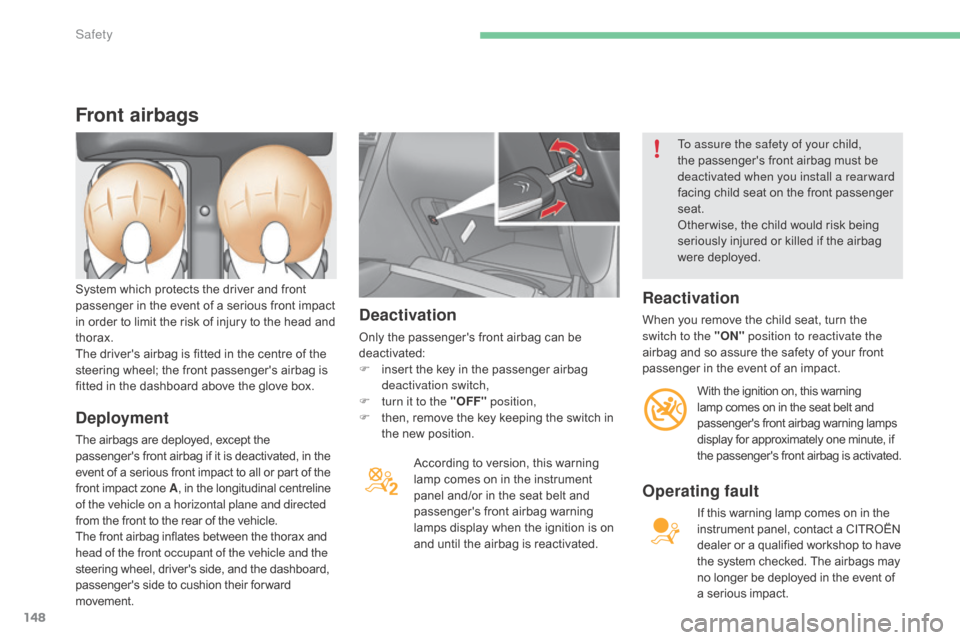
Deactivation
Only the passenger's front airbag can be deactivated:
F
i
nsert the key in the passenger airbag
d
eactivation switch,
F
t
urn it to the "OFF" position,
F
t
hen, remove the key keeping the switch in
t
he new position.
According
to version, this warning
l
amp comes on in the instrument
p
anel and/or in the seat belt and
p
assenger's front airbag warning
l
amps display when the ignition is on
a
nd until the airbag is reactivated.
Front airbags
Deployment
The airbags are deployed, except the passenger's front airbag if it is deactivated, in the e
vent of a serious front impact to all or part of the
f
ront impact zone A,
in the longitudinal centreline
o
f the vehicle on a horizontal plane and directed
from
the front to the rear of the vehicle.
The
front airbag inflates between the thorax and
h
ead of the front occupant of the vehicle and the
steering
wheel, driver's side, and the dashboard,
p
assenger's side to cushion their for ward
m
ovement. To assure the safety of your child,
the
passenger's front airbag must be
d
eactivated when you install a rear ward
facing child seat on the front passenger
sea
t.
Other wise, the child would risk being
s
eriously injured or killed if the airbag
w
ere deployed.
System which protects the driver and front
p
assenger in the event of a serious front impact
i
n order to limit the risk of injury to the head and
t
horax.
The driver's airbag is fitted in the centre of the
s
teering wheel; the front passenger's airbag is
f
itted in the dashboard above the glove box.
Reactivation
When you remove the child seat, turn the s
witch to the "ON" position to reactivate the
airbag
and so assure the safety of your front
p
assenger in the event of an impact.
With
the ignition on, this warning
l
amp comes on in the seat belt and
p
assenger's front airbag warning lamps
d
isplay for approximately one minute, if
t
he passenger's front airbag is activated.
Operating fault
If this warning lamp comes on in the instrument panel, contact a CITROËN d
ealer or a qualified workshop to have
t
he system checked. The airbags may
n
o longer be deployed in the event of
a
serious impact.
Safety
Page 155 of 396
153
C4-2_en_Chap05_securite_ed02-2015
Passenger airbag OFF
Deactivating the passenger's front airbag
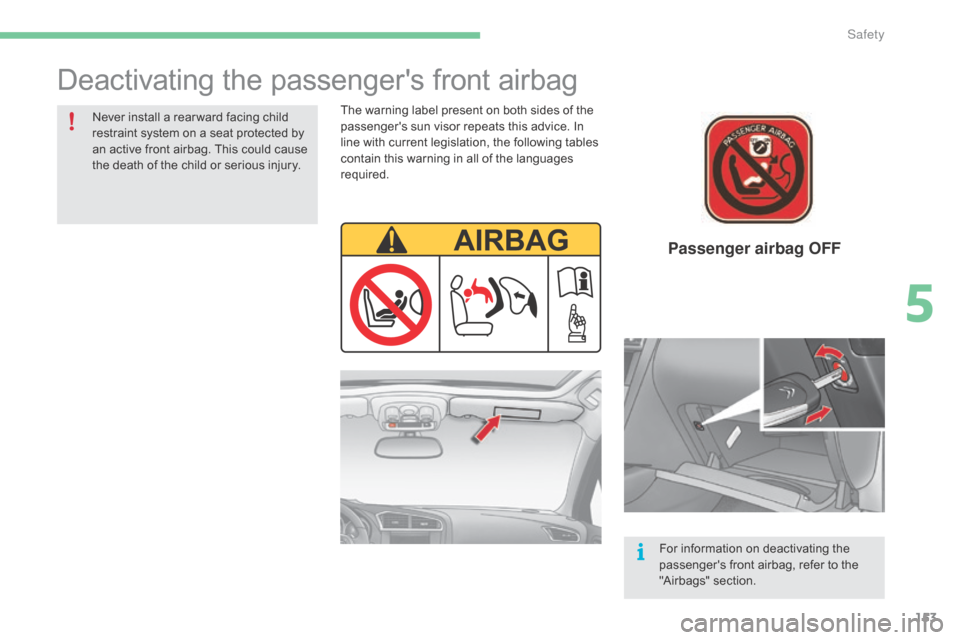
The warning label present on both sides of the passenger's sun visor repeats this advice. In
l
ine with current legislation, the following tables
c
ontain this warning in all of the languages
r
equired.
For
information on deactivating the
p
assenger's front airbag, refer to the
"
Airbags" section.
Never
install
a
rear ward
facing
child
r
estraint
system
on
a
seat
protected
by
a
n
active
front
airbag.
This
could
cause
t
he
death
of
the
child
or
serious
injury.
5
Safety
Page 169 of 396
167
C4-2_en_Chap06_conduite_ed02-2015
When towing
Distribution of loads
F Distribute the load in the trailer so that the heaviest items are as close as possible to t
he axle and the nose weight approaches the
m
aximum permitted without exceeding it.
Air density decreases with altitude,
thus
r
educing
e
ngine
p
erformance.
A
bove 1 000 metres, the maximum towed
l
oad must be reduced by 10 % for every
1 0
00 metres of altitude.
Side wind
F Take into account the increased sensitivity t
o side wind.
For
more information on weights (and the
t
owed loads which apply to your vehicle) refer
t
o the corresponding section.
F
I
f the warning lamp and the
S
TOP
warning lamp come on,
s
top the vehicle and switch off
the engine as soon as possible.
Braking
Towing a trailer increases the braking distance.
T o avoid overheating of the brakes, the use of
e
ngine braking is recommended.
Ty r e s
F Check the tyre pressures of the towing v
ehicle and of the trailer, observing the
re
commended
p
ressures.
Lighting
F Check the electrical lighting and signalling o
n the trailer and the hadlamp beam height
o
f your vehicle.
For
more information on adjusting the
h
eadlamp beam height, refer to the
c
orresponding
s
ection.
The
rear parking sensors will be
d
eactivated automatically if a genuine
C
ITROËN towbar is used.
Cooling
Towing a trailer on a slope increases the temperature of the coolant.
As
the fan is electrically controlled, its cooling
c
apacity is not dependent on the engine speed.
F
T
o lower the engine speed, reduce your
s
peed.
The
maximum towed load on a long incline
d
epends on the gradient and the ambient
t
emperature.
In
all cases, keep a check on the coolant
t
emperature.
6
Driving
Page 171 of 396
169
C4-2_en_Chap06_conduite_ed02-2015
Starting the engine
F With a petrol engine, operate the starter m
otor by turning the key to position 3
without
pressing the accelerator pedal,
u
ntil the engine starts. Once the engine is
r
unning, release the key. F
W
ith a Diesel engine, turn the key to
p
osition 2
, ignition on, to operate the
eng
ine
p
re-heating
s
ystem.
Wait until this warning lamp goes off
i
n the instrument panel then operate
t
he starter motor by turning the key
t
o position 3 without pressing the
a
ccelerator pedal, until the engine
s
tarts. Once the engine is running,
r
elease the key.
If the engine does not start straight
a
way, switch off the ignition. Wait a
f
ew moments before operating the
s
tarter motor again. If the engine does
n
ot start after several attempts, do not
k
eep trying: you risk damaging the
s
tarter motor or the engine. Contact
a
CITROËN dealer or a qualified
w
orkshop.Never
leave the engine running in
a
n enclosed area without adequate
v
entilation:
in
ternal
c
ombustion
e
ngines emit toxic exhaust gases,
s
uch as carbon monoxide. Danger of
i
ntoxication and death!
In very severe wintry conditions
(temperatures below -23°C), to ensure
t
he correct operation and durability of
the mechanical components of your
v
ehicle, engine and gearbox, it is n
ecessary to leave the engine running f
or 4 minutes before moving off.
In
certain cases, you may have to apply
m
ore force to the steering (wheels on
f
ull lock, for example).
In wintry conditions, the warning lamp
c
an stay on for a longer period. When
t
he engine is hot, the warning lamp
d
oes not come on.In temperate conditions, do not leave
t
he engine at idle to warm up but move
o
ff straight away and drive at moderate
s
peed.
With the parking brake applied and the gearbox
i
n neutral or position N or P
:
F
d
epress the clutch pedal fully (manual
g
earbox),
or
F
p
ress the brake pedal firmly (automatic
g
earbox),
F
i
nsert the key into the ignition switch; the
s
ystem recognises the code,
F
u
nlock the steering column by
s
imultaneously turning the steering and
t
he key.
6
Driving
Page 173 of 396
171
C4-2_en_Chap06_conduite_ed02-2015
Starting / Switching off the engine with Keyless Entry and
S
tarting
Starting the engine
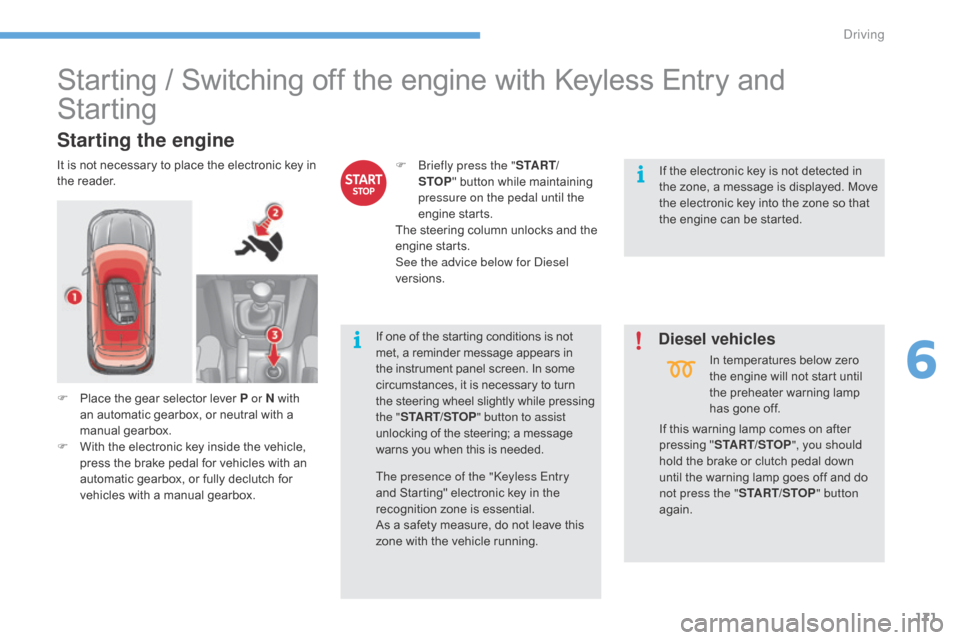
It is not necessary to place the electronic key in t
he r eader. F
B riefly press the "S TA R T/
STOP "
button while maintaining
p
ressure on the pedal until the
engine
s
tarts.
The
steering column unlocks and the
e
ngine
s
tarts.
See the advice below for Diesel
versions.
If
this warning lamp comes on after
p
ressing "START/STOP ", you should
hold
the brake or clutch pedal down
u
ntil the warning lamp goes off and do
n
ot press the "START/STOP " button
again.
If
one of the starting conditions is not
m
et, a reminder message appears in
t
he instrument panel screen. In some
c
ircumstances, it is necessary to turn
t
he steering wheel slightly while pressing
t
he "START/STOP " button to assist
unlocking
of the steering; a message
w
arns you when this is needed.If
the electronic key is not detected in
t
he zone, a message is displayed. Move
t
he electronic key into the zone so that
t
he engine can be started.
The presence of the "Keyless Entry
and
Starting" electronic key in the
r
ecognition zone is essential.
As
a safety measure, do not leave this
z
one with the vehicle running.In
temperatures below zero
t
he engine will not start until
t
he preheater warning lamp
h
as gone off.
F
P
lace the gear selector lever P or N with
an
automatic gearbox, or neutral with a
m
anual
g
earbox.
F
W
ith the electronic key inside the vehicle,
p
ress the brake pedal for vehicles with an
a
utomatic gearbox, or fully declutch for
v
ehicles with a manual gearbox.
Diesel vehicles
6
Driving
Page 176 of 396
174
C4-2_en_Chap06_conduite_ed02-2015
Manual parking brake
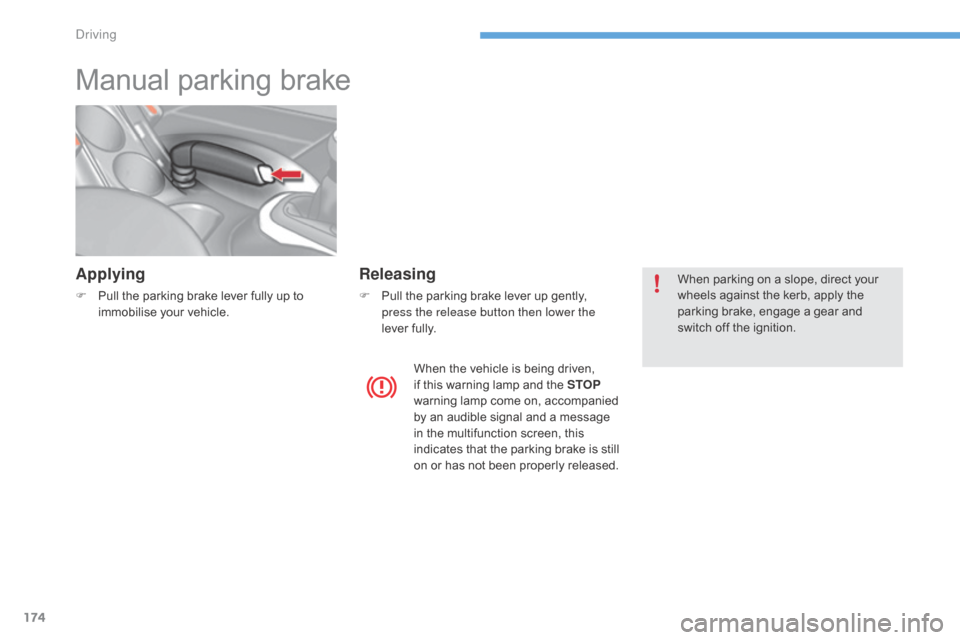
Applying
F Pull the parking brake lever fully up to i
mmobilise your vehicle.
Releasing
F Pull the parking brake lever up gently, p
ress the release button then lower the
lever
f
ully.
When
the vehicle is being driven,
i
f this warning lamp and the STOP
warning
lamp come on, accompanied
b
y an audible signal and a message
i
n the multifunction screen, this
i
ndicates that the parking brake is still
o
n or has not been properly released.When
parking on a slope, direct your w
heels against the kerb, apply the p
arking brake, engage a gear and
s
witch off the ignition.
Driving
Page 177 of 396
175
C4-2_en_Chap06_conduite_ed02-2015
Electric parking brake
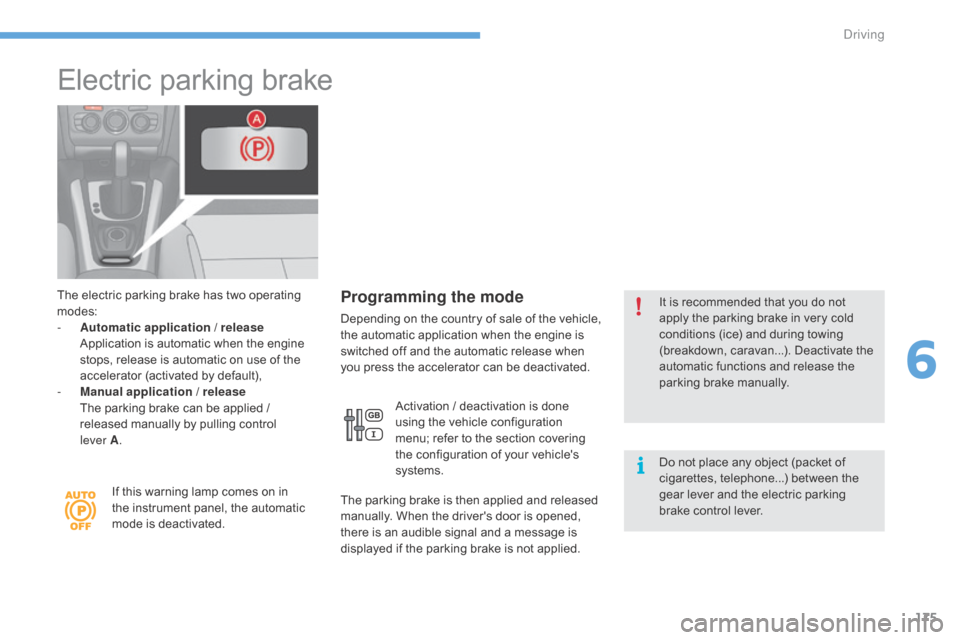
The electric parking brake has two operating modes:
-
A
utomatic application / release
A
pplication is automatic when the engine
s
tops, release is automatic on use of the
a
ccelerator (activated by default),
-
M
anual application / release
T
he parking brake can be applied /
r
eleased manually by pulling control
l
ever
A.
If
this warning lamp comes on in
t
he instrument panel, the automatic
m
ode is deactivated.Programming the mode
Depending on t he c ountry o f s ale o f t he v ehicle, t
he automatic application when the engine is
s
witched off and the automatic release when
y
ou press the accelerator can be deactivated.
Activation
/ deactivation is done
u
sing the vehicle configuration
m
enu; refer to the section covering
t
he configuration of your vehicle's
s
ystems.
The
parking brake is then applied and released
m
anually. When the driver's door is opened,
t
here is an audible signal and a message is
d
isplayed if the parking brake is not applied.It
is recommended that you do not a
pply the parking brake in very cold c
onditions (ice) and during towing
(
breakdown, caravan...). Deactivate the
a
utomatic functions and release the
par
king
b
rake
m
anually.
Do
not place any object (packet of
c
igarettes, telephone...) between the
g
ear lever and the electric parking
b
rake control lever.
6
Driving
Page 178 of 396
176
C4-2_en_Chap06_conduite_ed02-2015
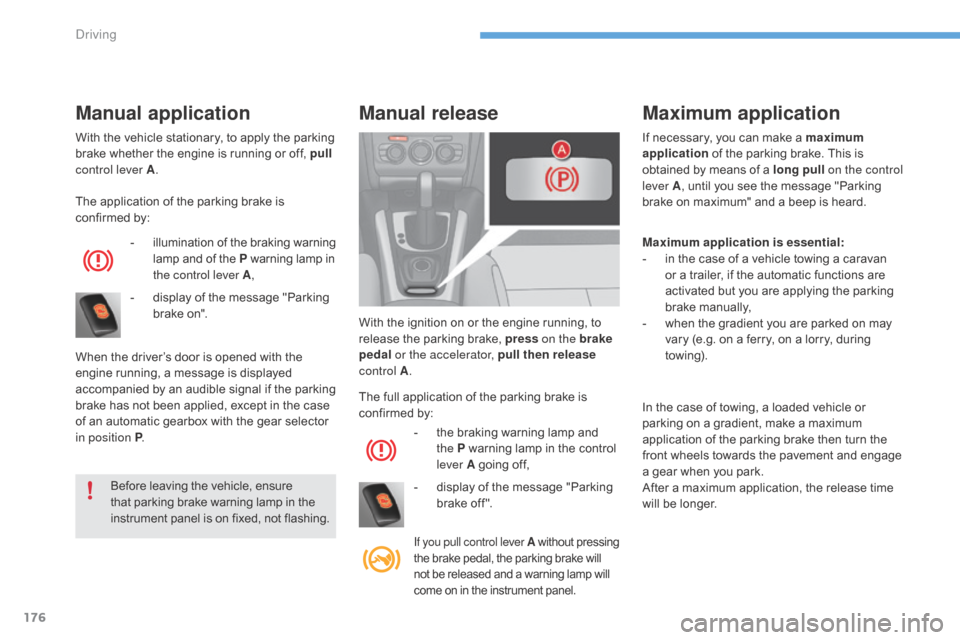
With the vehicle stationary, to apply the parking brake whether the engine is running or off, pull
control lever A .
The
application of the parking brake is
c
onfirmed by:
-
i
llumination
o
f
t
he
b
raking
w
arning
l
amp and of the P
warning lamp in
t
he control lever A ,
-
d
isplay of the message "Parking
b
rake on".
When
the driver’s door is opened with the
e
ngine running, a message is displayed
a
ccompanied by an audible signal if the parking
b
rake has not been applied, except in the case
o
f an automatic gearbox with the gear selector
i
n position P .
Before
leaving the vehicle, ensure
t
hat parking brake warning lamp in the
i
nstrument panel is on fixed, not flashing.
Manual applicationManual release
The full application of the parking brake is c
onfirmed by:
-
t
he braking warning lamp and
t
he P warning lamp in the control
l
ever A going off,
-
d
isplay of the message "Parking
b
rake off ".
If you pull control lever A without pressing t
he brake pedal, the parking brake will n
ot be released and a warning lamp will
c
ome on in the instrument panel.
With the ignition on or the engine running, to release the parking brake, press on the brake
pedal or the accelerator, pull then release
control A . If
necessary, you can make a maximum
application
of the parking brake. This is
o
btained
by m
eans
o
f
a long
pull
on the control
lever A , until you see the message "Parking
b
rake on maximum" and a beep is heard.
In the case of towing, a loaded vehicle or
p
arking on a gradient, make a maximum
a
pplication of the parking brake then turn the
f
ront wheels towards the pavement and engage
a
gear when you park.
After
a maximum application, the release time
w
ill be longer.
Maximum application
Maximum application is essential:
- i n the case of a vehicle towing a caravan
o
r a trailer, if the automatic functions are
a
ctivated but you are applying the parking
b
rake
m
anually,
-
w
hen the gradient you are parked on may
v
ary (e.g. on a ferry, on a lorry, during
tow
ing).
Driving
Page 179 of 396
177
C4-2_en_Chap06_conduite_ed02-2015
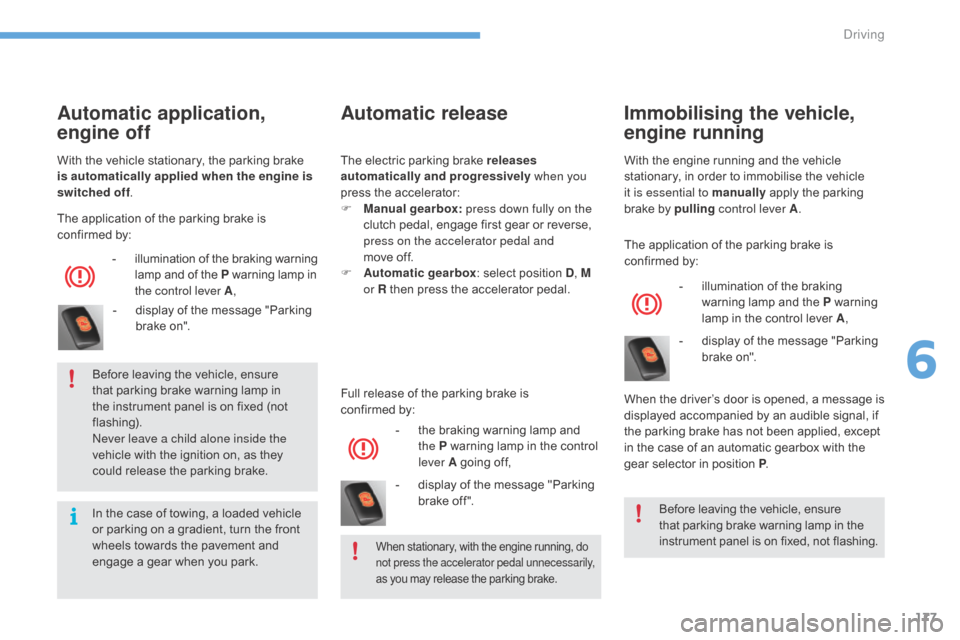
Automatic release
Full release of the parking brake is confirmed by:
-
t
he braking warning lamp and
t
he P warning lamp in the control
l
ever A going off,
-
d
isplay of the message "Parking
b
rake off ".
Automatic application,
engine off
- illumination of t he b raking w arning l
amp and of the P warning lamp in t
he control lever A ,
-
d
isplay of the message "Parking
b
rake on".
The
application of the parking brake is
c
onfirmed by:
With
the
vehicle stationary, the parking brake
i
s automatically applied when the engine is
switched off .
Before leaving the vehicle, ensure
t
hat parking brake warning lamp in
t
he
instrument panel is on fixed (not
f
lashing).
Never leave a child alone inside the
vehicle
with the ignition on, as they
c
ould release the parking brake.
When stationary, with the engine running, do not press the accelerator pedal unnecessarily,
as
you may release the parking brake.
In the case of towing, a loaded vehicle or parking on a gradient, turn the front
w
heels towards the pavement and
e
ngage a gear when you park.The
electric parking brake releases
automatically and progressively when you
press the accelerator:
F
M
anual gearbox:
press down fully on the
clutch pedal, engage first gear or reverse,
p
ress on the accelerator pedal and
move off.
F
A
utomatic gearbox
: select position D
, M
or R then press the accelerator pedal.
Immobilising the vehicle,
engine running
- illumination
of the braking w
arning lamp and the P warning
l
amp in the control lever A,
-
d
isplay of the message "Parking
b
rake on".
When
the
driver’s door is opened, a message is
d
isplayed
accompanied by an audible signal, if
t
he
parking brake has not been applied, except
i
n
the
case of an automatic gearbox with the
g
ear
selector in position P.
The
application of the parking brake is
c
onfirmed by:
With
the
engine running and the vehicle
s
tationary, in order to immobilise the vehicle
i
t is essential to manually
apply the parking
b
rake
by
pulling
control lever A .
Before leaving the vehicle, ensure
t
hat parking brake warning lamp in the
i
nstrument panel is on fixed, not flashing.
6
Driving