engine Citroen C4 2016 2.G Manual PDF
[x] Cancel search | Manufacturer: CITROEN, Model Year: 2016, Model line: C4, Model: Citroen C4 2016 2.GPages: 396, PDF Size: 10.22 MB
Page 212 of 396
210
C4-2_en_Chap07_infos-pratiques_ed02-2015
Fuel used for petrol
engines
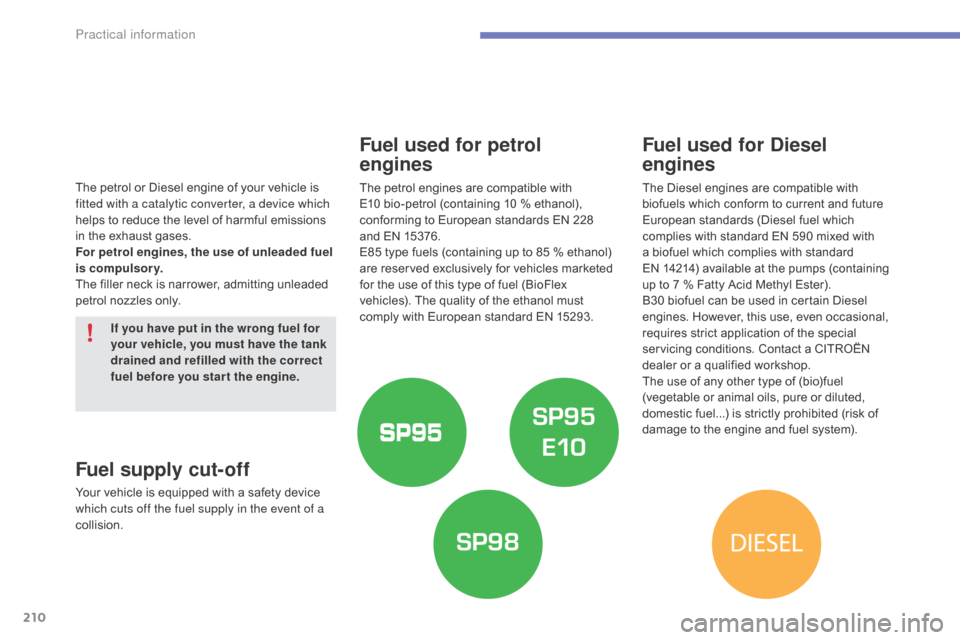
The petrol engines are compatible with E
10 bio-petrol (containing 10 % ethanol),
c
onforming to European standards EN 228
and
EN 15376.
E85
type fuels (containing up to 85 % ethanol)
a
re reserved exclusively for vehicles marketed
f
or the use of this type of fuel (BioFlex
v
ehicles). The quality of the ethanol must
c
omply with European standard EN 15293.
Fuel used for Diesel
engines
The Diesel engines are compatible with biofuels which conform to current and future
E
uropean standards (Diesel fuel which
c
omplies with standard EN 590 mixed with
a
biofuel which complies with standard
E
N 14214) available at the pumps (containing
u
p to 7 % Fatty Acid Methyl Ester).
B30
biofuel can be used in certain Diesel
e
ngines. However, this use, even occasional,
r
equires strict application of the special
s
ervicing conditions. Contact a CITROËN
d
ealer or a qualified workshop.
The
use of any other type of (bio)fuel
(
vegetable or animal oils, pure or diluted,
d
omestic fuel...) is strictly prohibited (risk of
d
amage to the engine and fuel system).
The
petrol
or
Diesel
engine
of
your
vehicle
is
f
itted with a catalytic converter, a device which
helps
to
reduce
the
level
of
harmful
emissions
i
n
the
exhaust
gases.
For petrol engines, the use of unleaded fuel
is compulsory.
The
filler
neck
is
narrower,
admitting
unleaded
p
etrol
nozzles
only.
Fuel supply cut-off
Your vehicle is equipped with a safety device w hich cuts off the fuel supply in the event of a
collision. If you have put in the wrong fuel for
your vehicle, you must have the tank
drained and refilled with the correct
fuel before you star t the engine.
Practical information
Page 213 of 396
211
C4-2_en_Chap07_infos-pratiques_ed02-2015
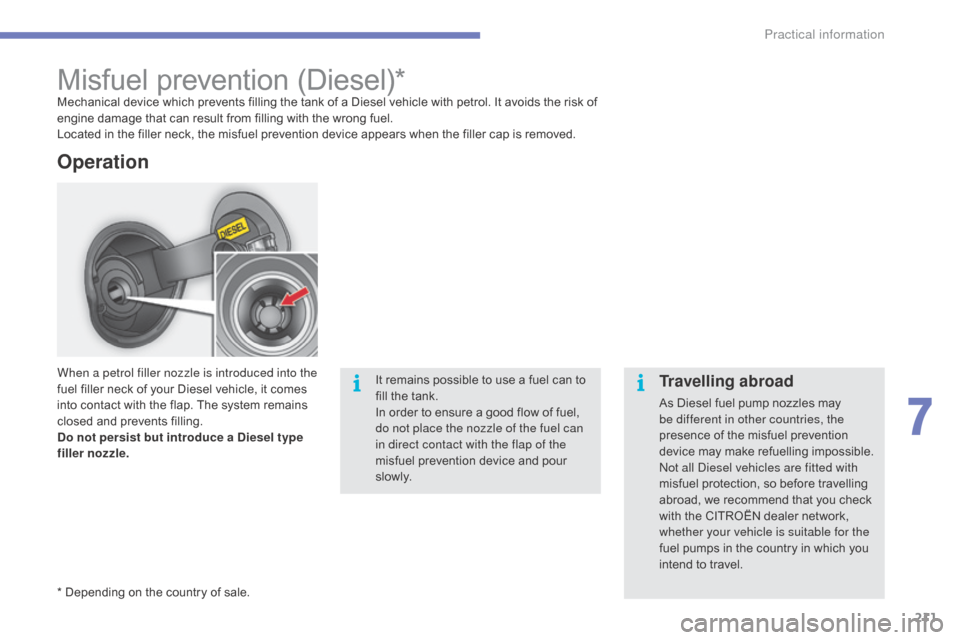
Misfuel prevention (Diesel)*Mechanical device which prevents filling the tank of a Diesel vehicle with petrol. It avoids the risk of engine damage that can result from filling with the wrong fuel.
Located
in the filler neck, the misfuel prevention device appears when the filler cap is removed.
When a petrol filler nozzle is introduced into the
fuel
filler neck of your Diesel vehicle, it comes
i
nto contact with the flap. The system remains
c
losed and prevents filling.
Do not persist but introduce a Diesel type
filler nozzle.
*
Depending on the country of sale.It
remains possible to use a fuel can to
f
ill the tank.
In
order to ensure a good flow of fuel,
d
o not place the nozzle of the fuel can
in direct contact with the flap of the
misfuel
prevention device and pour
s
l ow l y.
Travelling abroad
As Diesel fuel pump nozzles may be different in other countries, the
presence
of the misfuel prevention
d
evice may make refuelling impossible.
Not all Diesel vehicles are fitted with
misfuel
protection, so before travelling
a
broad, we recommend that you check
w
ith the CITROËN dealer network,
w
hether your vehicle is suitable for the
fuel
pumps in the country in which you
i
ntend to travel.
Operation
7
Practical information
Page 221 of 396
219
C4-2_en_Chap07_infos-pratiques_ed02-2015
Load reduction modeE nergy ec onomy m ode
Switching to economy mode
Once this period has elapsed, a message a
ppears in the screen indicating that the
v
ehicle has switched to economy mode and the
a
ctive functions are put on standby.
Exiting economy mode
These functions are reactivated automatically the next time the vehicle is driven.
F
I
n order to resume the use of these
f
unctions immediately, start the engine and
l
et it run for a few minutes.
The
time available to you will then be double
t
he period for which the engine is left running.
H
owever, this period will always be between
five
and thirty minutes.
System
which
manages
the
use
of
certain
f
unctions
according
to
the
level
of
charge
r
emaining
in
the
battery.
When
the
vehicle
is
being
driven,
the
load
r
eduction
function
temporarily
deactivates
c
ertain
functions,
such
as
the
air
conditioning,
t
he
heated
rear
screen...
The deactivated functions are reactivated
automatically
as
soon
as
conditions
permit. System
which
manages
the
period
of
use
of
certain
functions to conserve a sufficient level of
c
harge
in
the
battery.
After
the
engine
has
stopped,
you
can
still
use
functions such as the audio equipment, windscreen
w
ipers,
dipped
beam
headlamps, courtesy
lamps,
etc. for a maximum combined period of
t
hirty minutes.
A flat battery prevents the engine from
s
tarting.
For
more information on the 12 V
b
attery, refer to the corresponding
s
ection.
This
period
may
be
greatly
reduced
if
t
he
battery
is
not
fully
charged.
If
the
telephone
is
being
used
at
the
s
ame
time
with
the
touch
screen
tablet,
i
t
will
be
interrupted
after
10
minutes.
7
Practical information
Page 225 of 396
223
C4-2_en_Chap07_infos-pratiques_ed02-2015
Bonnet
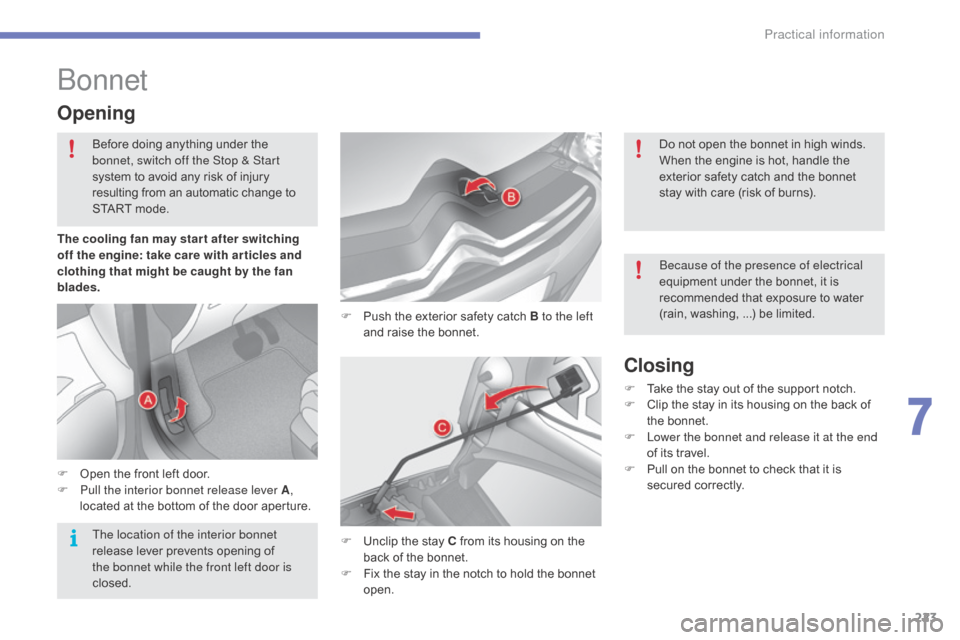
F Push the exterior safety catch B to the left
and raise the bonnet.
Opening
F Open the front left door.
F P ull the interior bonnet release lever A,
located
at the bottom of the door aperture.
F
U
nclip the stay C from its housing on the
b
ack of the bonnet.
F
F
ix the stay in the notch to hold the bonnet
ope
n.
Closing
F Take the stay out of the support notch.
F C lip the stay in its housing on the back of
t
he bonnet.
F
L
ower the bonnet and release it at the end
of
its travel.
F
P
ull on the bonnet to check that it is
s
ecured
c
orrectly.
The cooling fan may star t after switching
off the engine: take care with ar ticles and
clothing that might be caught by the fan
blades.
Before
doing
anything
under
the
b
onnet, switch off the Stop & Start
system
to
avoid
any
risk
of
injury
r
esulting
from
an
automatic
c
hange
t
o
S
TART
mode.
Do not open the bonnet in high winds.
When the engine is hot, handle the
e
xterior safety catch and the bonnet
s
tay with care (risk of burns).
Because of the presence of electrical
equipment under the bonnet, it is
r
ecommended that exposure to water
(
rain,
w
ashing, ...) be limited.
The location of the interior bonnet
release
lever
prevents
opening
of
t
he bonnet while the front left door is
closed.
7
Practical information
Page 226 of 396
224
C4-2_en_Chap07_infos-pratiques_ed02-2015
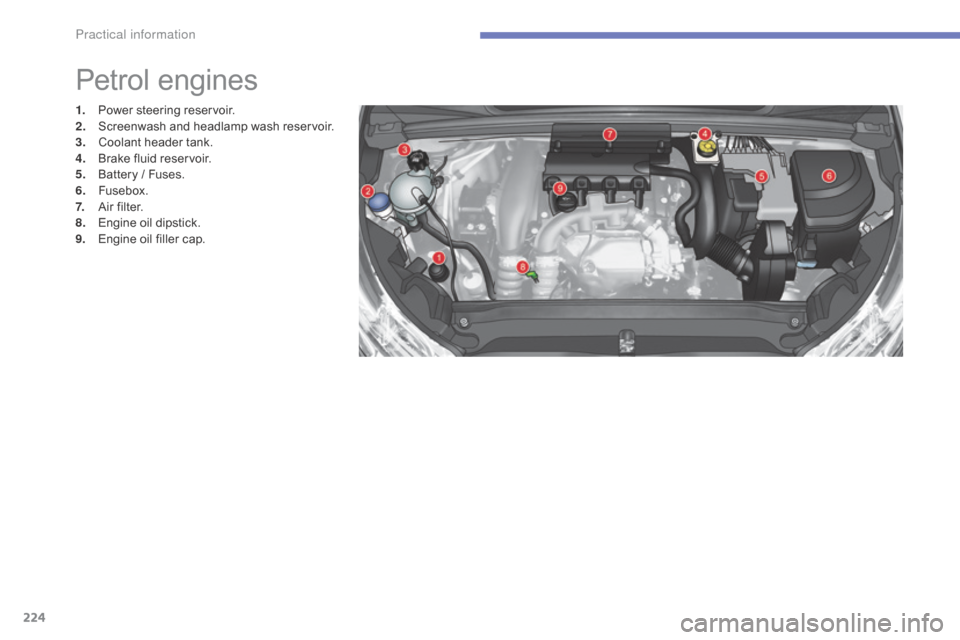
Petrol engines
1. Power steering r eservoir.
2. S creenwash and headlamp wash reservoir.
3.
C
oolant header tank.
4.
B
rake fluid reservoir.
5.
B
attery / Fuses.
6.
F
usebox.
7.
A
ir filter.
8.
E
ngine oil dipstick.
9.
E
ngine oil filler cap.
Practical information
Page 227 of 396
225
C4-2_en_Chap07_infos-pratiques_ed02-2015
* According to engine.
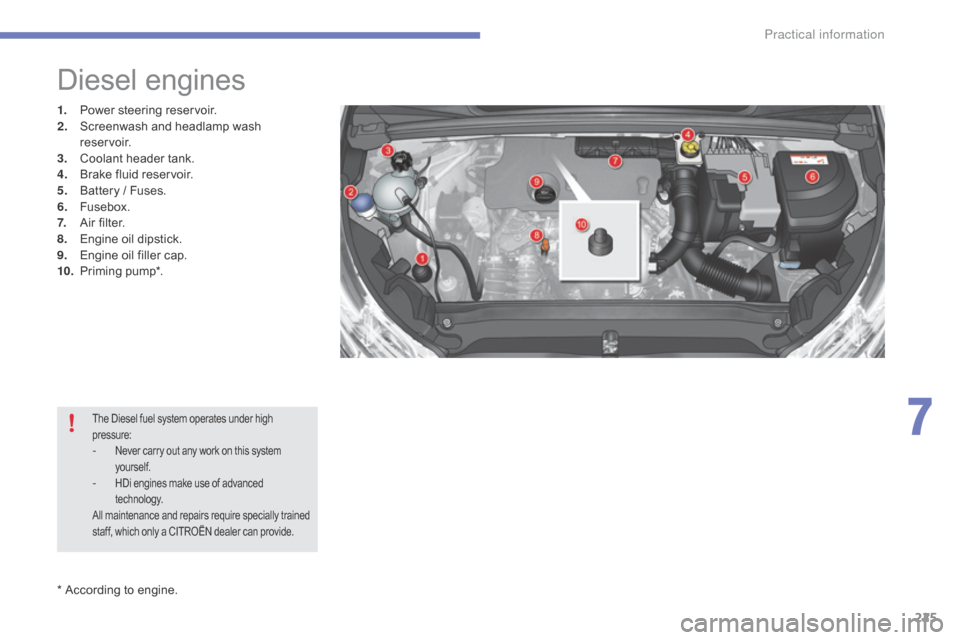
Diesel engines
1. Power steering r eservoir.
2. S creenwash and headlamp wash
reservoir.
3.
C
oolant header tank.
4.
B
rake fluid reservoir.
5.
B
attery / Fuses.
6.
F
usebox.
7.
A
ir filter.
8.
E
ngine oil dipstick.
9.
E
ngine oil filler cap.
10.
P
riming
pu
mp*.
The Diesel fuel system operates under high pressure:
- Never carry out any work on this system y
ourself.
- HDi engines make use of advanced t
echnology.
All
maintenance and repairs require specially trained
s
taff, which only a CITROËN dealer can provide.
7
Practical information
Page 228 of 396
226
C4-2_en_Chap07_infos-pratiques_ed02-2015
Checking levels
The check is carried out either when the ignition is switched on using the
o
il level indicator in the instrument
p
anel for vehicles so equipped, or
u
sing the dipstick.
Engine oil level
Checking using
the dipstick
Check all of these levels regularly, in line with the manufacturer's service schedule. Top them up if necessary, unless other wise indicated.
I f a level drops significantly, have the corresponding system checked by a CITROËN dealer or a qualified workshop.
It
is normal to top up the oil level between
t
wo services (or oil changes). CITROËN
r
ecommends that you check the level, and top
u
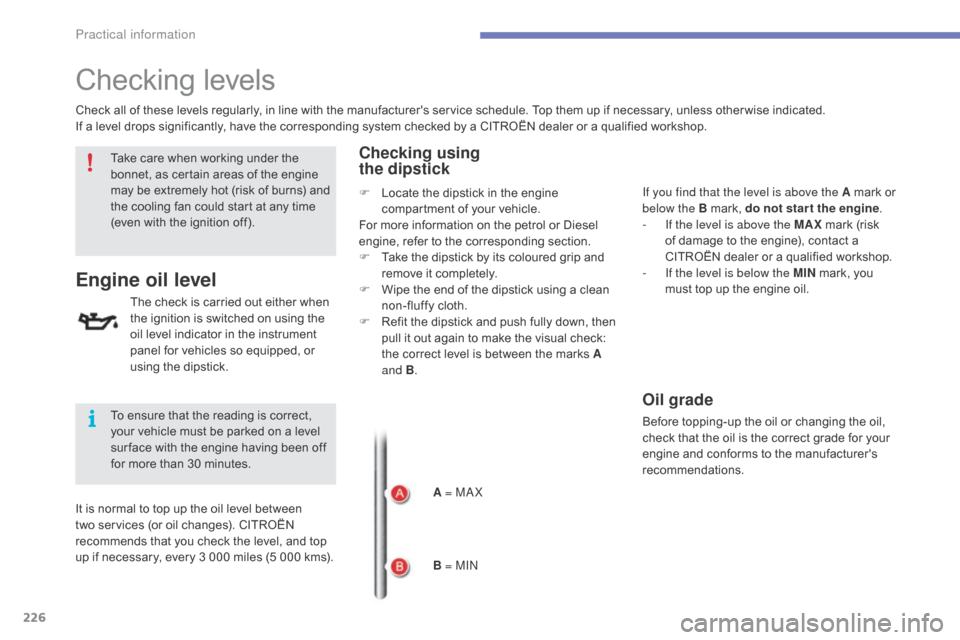
p if necessary, every 3 000 miles (5 000 kms).A = MA X
B = MIN If you find that the level is above the A
mark or
belo
w the B mark, do not star t the engine.
-
I
f the level is above the MAX
mark (risk
o
f damage to the engine), contact a
C
ITROËN dealer or a qualified workshop.
-
I
f the level is below the MIN
mark, you
m
ust top up the engine oil.
Oil grade
Before topping-up the oil or changing the oil, check that the oil is the correct grade for your
e
ngine and conforms to the manufacturer's
r
ecommendations.
Take
care
when
working
under
the
b
onnet,
as
certain
areas
of
the
engine
m
ay
be
extremely
hot
(risk
of
burns)
and
t
he
cooling
fan
could
start
at
any
time
(
even
with
the
ignition
off).
To
ensure
that
the
reading
is
correct,
y
our
vehicle
must
be
parked
on
a
level
s
ur face
with
the
engine
having
been
off
f
or
more
than
30
minutes. F
L
ocate
the
dipstick
in
the
engine
c
ompartment
of
your
vehicle.
For
more
information
on
the
petrol
or
Diesel
e
ngine,
refer
to
the
corresponding
section.
F
T
ake
the
dipstick
by
its
coloured
grip
and
r
emove
it
completely.
F
W
ipe
the
end
of
the
dipstick
using
a
clean
n
on-fluffy
cloth.
F
R
efit
the
dipstick
and
push
fully
down,
then
p
ull
it
out
again
to
make
the
visual
check:
t
he
correct
level
is
between
the
marks
A
and B .
Practical information
Page 229 of 396
227
C4-2_en_Chap07_infos-pratiques_ed02-2015
Topping-up the engine oil level
F Locate the oil filler cap in the engine c
ompartment of your vehicle.
For
more information on the petrol or Diesel
e
ngine, refer to the corresponding section.
F
U
nscrew the oil filler cap to reveal the filler
a
perture.
F
A
dd oil in small quantities, avoiding any
s
pills on engine components (risk of fire).
F
W
ait a few minutes before checking the
l
evel again using the dipstick.
F
A
dd more oil if necessary.
F
A
fter checking the level, carefully refit the
o
il filler cap and the dipstick in its tube.
After
topping-up the oil, the check when
s
witching on the ignition with the oil level
i
ndicator in the instrument panel is not valid
d
uring the 30 minutes after topping up.
Engine oil change
Refer to the manufacturer's service schedule for details of the interval for this operation.
In
order to maintain the reliability of the engine
a
nd emission control system, never use
a
dditives in the engine oil.
Brake fluid level
Changing the fluid
Refer to the manufacturer's service schedule for details of the interval for this operation.
Fluid specification
The brake fluid must conform to the manufacturer's r ecommendations.
The
brake fluid level should be close
t
o the "MA X" mark. If it is not, check
t
he brake pad wear.
Power steering
fluid level
The power steering fluid level should b
e close to the "MA X" mark. With
t
he engine cold, unscrew the cap to
c
heck the level.
7
Practical information
Page 230 of 396
228
C4-2_en_Chap07_infos-pratiques_ed02-2015
Screenwash / headlamp
wash fluid level
Specification of the fluid
To ensure optimum cleaning and to avoid freezing, the fluid should never be topped up or r
eplaced by plain water.
In wintry conditions, the use of a fluid
with
an ethyl alcohol or methanol base is
re
commended.
To
check
the
level
or
top
up
the
f
luid
on
vehicle
fitted
with
headlamp
w
ashers,
immobilise
the
vehicle
and
s
witch
of
the
engine.
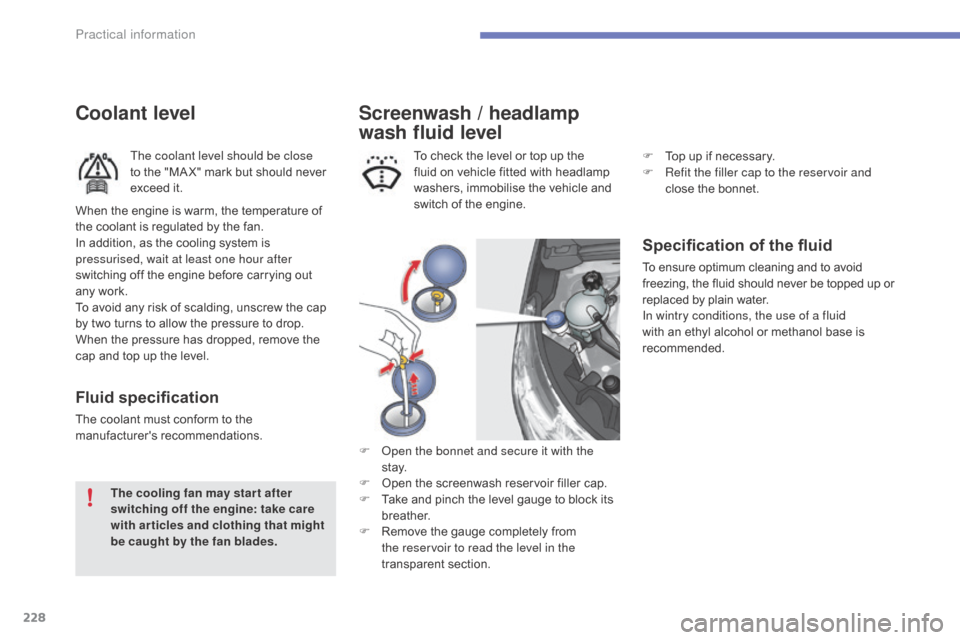
F
O
pen the bonnet and secure it with the
st ay.
F
O
pen
the
screenwash
reservoir
filler
cap.
F
T
ake
and
pinch
the
level
gauge
to
block
its
b
reather.
F
R
emove
the
gauge
completely
from
t
he reservoir to read the level in the
transparent
s
ection.
Coolant level
The coolant level should be close
to the "MA X" mark but should never
e
xceed it.
Fluid specification
The coolant must conform to the manufacturer's r ecommendations.
The cooling fan may star t after
switching off the engine: take care
with articles and clothing that might
be caught by the fan blades.
When
the engine is warm, the temperature of
t
he coolant is regulated by the fan.
In addition, as the cooling system is
p
ressurised, wait at least one hour after
switching off the engine before carrying out
any work.
To avoid any risk of scalding, unscrew the cap
b
y two turns to allow the pressure to drop.
W
hen the pressure has dropped, remove the
c
ap and top up the level. F
T
op up if necessary.
F
R
efit the filler cap to the reservoir and
close the bonnet.
Practical information
Page 232 of 396
230
C4-2_en_Chap07_infos-pratiques_ed02-2015
Checks
Particle filter (Diesel)
- fixed illumination of the particle f
ilter warning lamp, accompanied
b
y an audible signal and a
m
essage that there is a risk of
b
lockage of the particle filter.
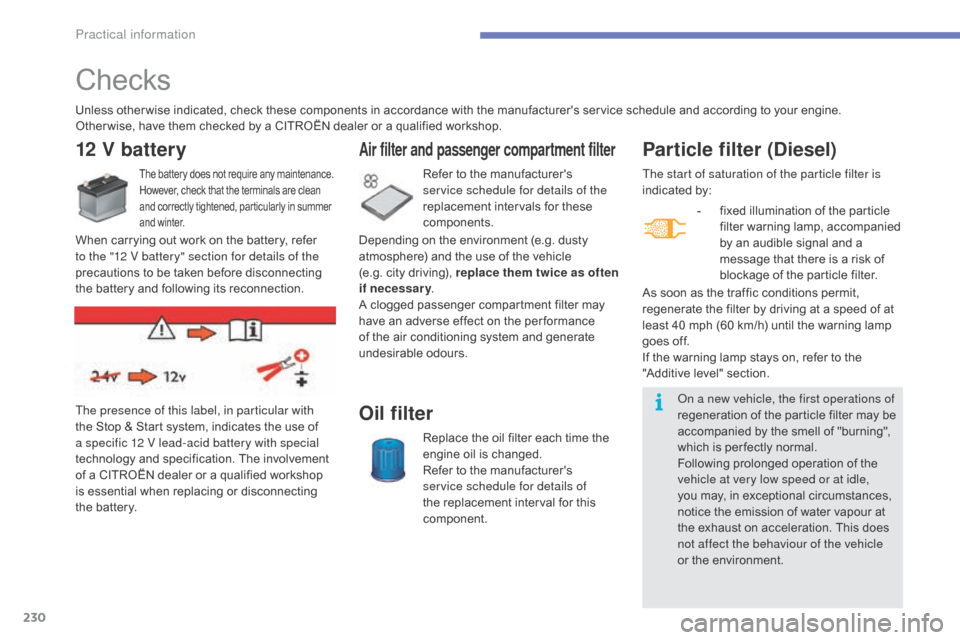
The presence of this label, in particular with
the
Stop
&
Start
system,
indicates
the
use
of
a s
pecific 12 V lead-acid battery with special
technology
and
specification.
The
involvement
o
f
a
CITROËN
dealer
or
a
qualified
workshop
i
s
essential
when
replacing
or
disconnecting
t
he
battery. As
soon
as the traffic conditions permit,
r
egenerate the filter by driving at a speed of at
l
east
40
mph (60 km/h) until the warning lamp
g
oes
off.
If
the
warning lamp stays on, refer to the
"
Additive
level" section.
Unless
other wise
indicated,
check
these
components
in
accordance
with
the
manufacturer's
service
schedule
and according to your engine.
Other wise,
have
them
checked
by
a
CITROËN
dealer
or
a
qualified
workshop.
Air filter and passenger compartment filter
Refer to the manufacturer's s
ervice schedule for details of the
replacement
intervals for these
c
omponents.
Oil filter
Replace the oil filter each time the e ngine oil is changed.
Refer
to the manufacturer's
s
ervice schedule for details of
the
replacement interval for this
c
omponent.
12 V battery
The battery does not require any maintenance.
H owever, check that the terminals are clean a
nd correctly tightened, particularly in summer
a
nd winter.
When carrying out work on the battery, refer to the "12 V battery" section for details of the
precautions
to be taken before disconnecting
t
he battery and following its reconnection.Depending
on the environment (e.g. dusty a
tmosphere) and the use of the vehicle
(e.g.
city driving), replace them twice as often
if necessary .
A
clogged passenger compartment filter may
h
ave an adverse effect on the per formance
o
f the air conditioning system and generate
u
ndesirable
o
dours.The start of saturation of the particle filter is
indicated
by:
On a new vehicle, the first operations of
regeneration of the particle filter may be
a
ccompanied by the smell of "burning",
w
hich is per fectly normal.
Following
prolonged operation of the
v
ehicle at very low speed or at idle,
you
may, in exceptional circumstances,
n
otice the emission of water vapour at
t
he exhaust on acceleration. This does
n
ot affect the behaviour of the vehicle
or
the environment.
Practical information