engine Citroen C4 2016 2.G Manual Online
[x] Cancel search | Manufacturer: CITROEN, Model Year: 2016, Model line: C4, Model: Citroen C4 2016 2.GPages: 396, PDF Size: 10.22 MB
Page 234 of 396
232
C4-2_en_Chap07_infos-pratiques_ed02-2015
AdBlue® additive and SCR system
f
or
BlueHDi Diesel engines
To assure respect for the environment and c
onformity with the new Euro 6 emissions
s
tandard, without adversely affecting the
p
er formance or fuel consumption of Diesel
e
ngines, CITROËN has taken the decision to
e
quip its vehicles with an effective system that
a
ssociates SCR (Selective Catalytic Reduction)
w
ith a particle filter (FAP) for the treatment of
e
xhaust gases.
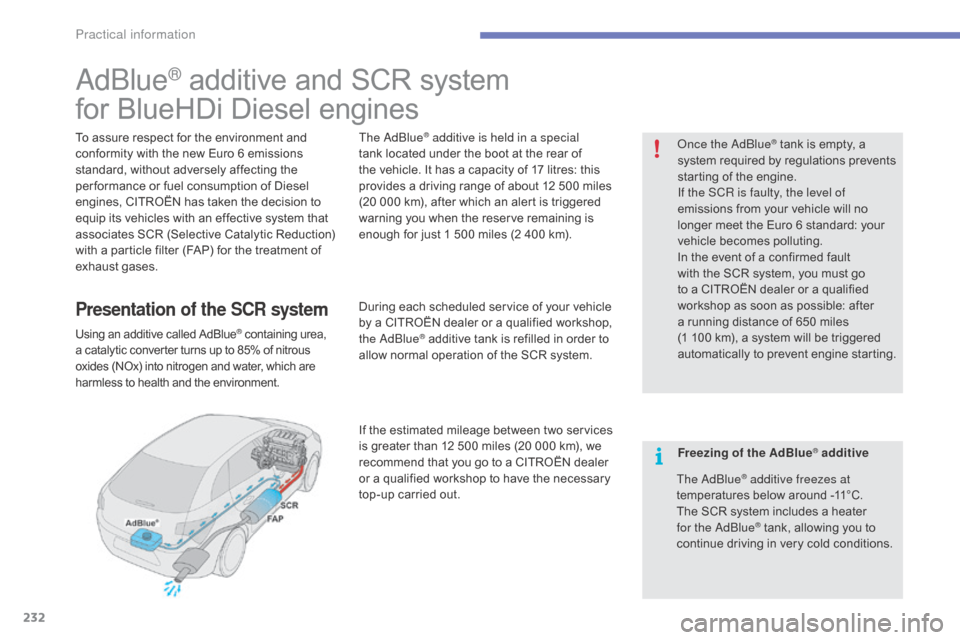
Presentation of the SCR system
Using an additive called AdBlue® containing urea, a
catalytic
converter
turns
up
to
85% of nitrous o
xides
(NOx)
into
nitrogen
and
water, which are
h
armless
to
health
and
the
environment.
The AdBlue® additive is held in a special
tank
located
under the boot at the rear of
t
he
vehicle.
It has a capacity of 17 litres: this
p
rovides
a
driving range of about 12 500 miles
(
20
000
km),
after which an alert is triggered
w
arning
you
when the reserve remaining is
e
nough
for
just 1 500 miles (2 400 km).
During
each
scheduled service of your vehicle
b
y
a
CITROËN dealer or a qualified workshop,
t
he AdBlue
® additive tank is refilled in order to a
llow
normal operation of the SCR system.
If
the
estimated mileage between two services
i
s
greater
than 12 500 miles (20 000 km), we
r
ecommend
that you go to a CITROËN dealer
o
r
a
qualified workshop to have the necessary
t
op-up
carried out. Once the AdBlue
® tank is empty, a s
ystem
required
by regulations prevents
s
tarting
of
the
engine.
If the SCR is faulty, the level of
emissions
from
your vehicle will no
l
onger
meet
the
Euro 6 standard: your
v
ehicle
becomes
polluting.
In
the
event
of
a
confirmed fault
w
ith
the
SCR
system, you must go
t
o
a
CITROËN
dealer or a qualified
w
orkshop
as
soon as possible: after
a
running
distance of 650 miles
(
1 100
km),
a
system will be triggered
a
utomatically
to
prevent engine starting.
Freezing of the AdBlue
® additive
The AdBlue
® additive freezes at
temperatures below around -11°C.
The
SCR
system includes a heater
f
or the AdBlue
® tank, allowing you to c
ontinue
driving in very cold conditions.
Practical information
Page 237 of 396
235
C4-2_en_Chap07_infos-pratiques_ed02-2015
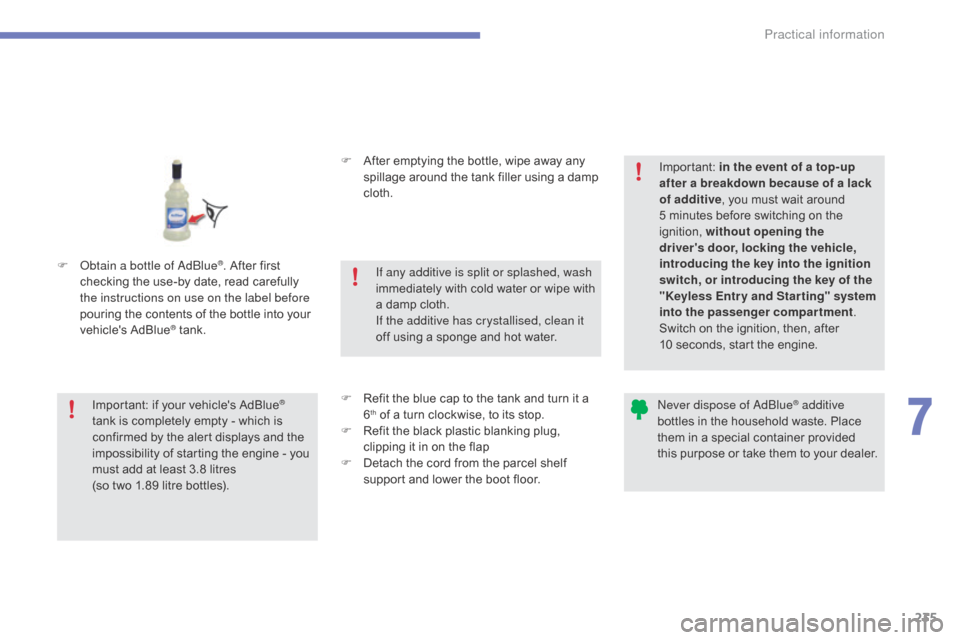
F Obtain a bottle of AdBlue®. After first c
hecking
the
use-by
date,
read carefully
t
he instructions on use on the label before
pouring
the
contents
of
the bottle into your
v
ehicle's
Ad
Blue
® tank. F
A
fter emptying the bottle, wipe away any
s
pillage around the tank filler using a damp
c
loth.
F
R
efit the blue cap to the tank and turn it a
6th of a turn clockwise, to its stop.
F
R
efit the black plastic blanking plug,
c
lipping it in on the flap
F
D
etach the cord from the parcel shelf
s
upport and lower the boot floor.
Important:
if
your
vehicle's
AdBlue®
tank
is
completely
empty
-
which
is
c
onfirmed
by
the
alert
displays
and
the
i
mpossibility
of
starting
the
engine
- you
m
ust
add
at
least
3.8
litres
(so
two
1.89 litre
bottles). If any additive is split or splashed, wash
immediately
w
ith
c
old
w
ater
o
r
w
ipe
w
ith
a
damp cloth.
If the additive has crystallised, clean it
off using a sponge and hot water.Important:
i
n the event of a top-up
after a breakdown because of a lack
of additive , you must wait around
5 minutes before switching on the
ig
nition,
w
ithout opening the
driver's door, locking the vehicle,
introducing the key into the ignition
switch, or introducing the key of the
"Keyless Entr y and Star ting" system
into the passenger compartment .
Switch on the ignition, then, after
10 seconds, start the engine.
Never dispose of AdBlue® additive
bottles
in
the
household
waste. Place
t
hem
in
a
special
container provided
t
his
p
urpose
o
r
t
ake
t
hem
t
o
y
our
d
ealer.
7
Practical information
Page 240 of 396
238
C4-2_en_Chap08_en-cas-de-panne_ed02-2015
Running out of fuel (Diesel)
Other HDi engines
(except BlueHDi version)
On
vehicles
fitted
with
Diesel
engines,
the
fuel
s
ystem
must
be
primed
if
you
run
out
of
fuel.
For all versions other than BlueHDi, refer to the
corresponding
engine
compartment
view.
For
more
information
on
the
Diesel
m
isfuel
prevention
device,
refer
to
the
c
orresponding
s
ection.
BlueHDi engines
If the engine does not start first time, d on't keep trying but start the procedure
a
gain from the beginning. F
A
dd at least five litres of Diesel fuel to the
tank.
F
O
pen the bonnet.
F
I
f necessary, unclip the styling cover for
a
ccess to the priming pump.
F
S
queeze and release the priming pump
r
epeatedly until resistance is felt (there
m
ay be resistance at the first press).
F
O
perate the starter to start the engine
(
if the engine does not start at the first
a
ttempt, wait around 15 seconds before t
rying ag ain).
F I f the engine does not start after a few
a
ttempts, operate the priming pump again
t
hen start the engine.
F
R
efit the styling cover and clip it in place.
F
C
lose the bonnet.
F
F
ill the fuel tank with at least five litres of
D
iesel.
F
S
witch on the ignition (without starting the
e
ngine).
F
W
ait around 6 seconds and switch off the
ig
nition.
F
R
epeat the operation 10 times.
F
O
perate the starter to run the engine.
In the event of a breakdown
Page 242 of 396
240
C4-2_en_Chap08_en-cas-de-panne_ed02-2015
Repair procedure
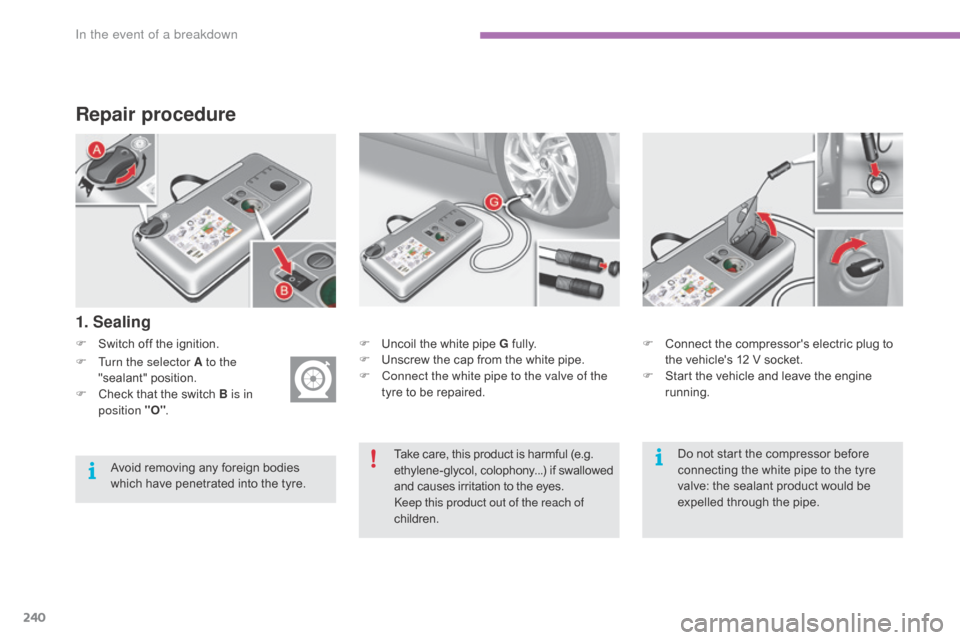
F Switch off the ignition.
1. Sealing
F Uncoil the white pipe G f ully.
F U nscrew the cap from the white pipe.
F
C
onnect the white pipe to the valve of the
tyre
to be repaired. F
C onnect the compressor's electric plug to t
he vehicle's 12 V socket.
F
S
tart the vehicle and leave the engine
r
unning.
F
T
urn the selector A to the
"sealant"
p
osition.
F
C
heck
that
the
switch
B is in
position "O" .
Take
care, this product is harmful (e.g.
e
thylene-glycol, colophony...) if swallowed
a
nd causes irritation to the eyes.
Keep this product out of the reach of
children.
Avoid
removing
any
foreign
bodies
w
hich
have
penetrated
into
the
tyre. Do
not start the compressor before
c
onnecting the white pipe to the tyre
v
alve: the sealant product would be
e
xpelled through the pipe.
In the event of a breakdown
Page 245 of 396
243
C4-2_en_Chap08_en-cas-de-panne_ed02-2015
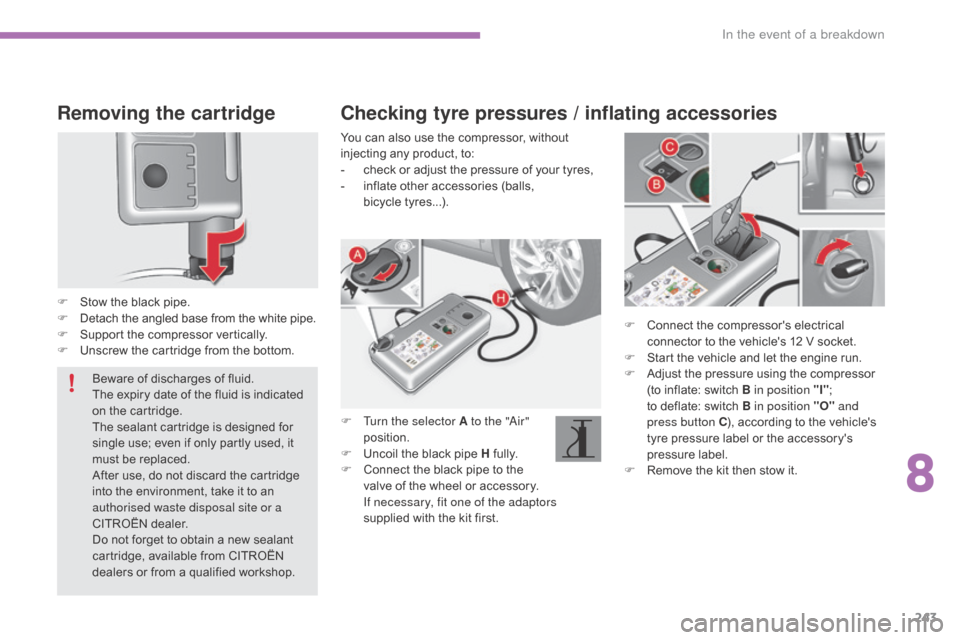
Removing the cartridge
F Stow the black pipe.
F D etach the angled base from the white pipe.
F
S
upport the compressor vertically.
F
U
nscrew the cartridge from the bottom. F
C
onnect the compressor's electrical
c
onnector to the vehicle's 12 V socket.
F
S
tart the vehicle and let the engine run.
F
A
djust the pressure using the compressor
(
to inflate: switch B in position "I";
t
o deflate: switch B in position "O" and
press button C ),
according to the vehicle's
t
yre pressure label or the accessory's
p
ressure label.
F
R
emove the kit then stow it.
Checking tyre pressures / inflating accessories
You can also use the compressor, without injecting any product, to:
-
c
heck or adjust the pressure of your tyres,
-
i
nflate other accessories (balls,
b
icycle tyres...).
F
T
urn the selector A to the "Air"
position.
F
U
ncoil the black pipe H
f
ully.
F
C
onnect the black pipe to the
v
alve of the wheel or accessory.
I
f necessary, fit one of the adaptors
supplied
with the kit first.
Beware
of
discharges
of
fluid.
The
expiry
date
of
the
fluid
is
indicated
o
n
the
cartridge.
The
sealant
cartridge
is
designed
for
s
ingle
use;
even
if
only
partly
used,
it
m
ust
be
replaced.
After
use,
do
not
discard
the
cartridge
i
nto
the
environment,
take
it
to
an
a
uthorised waste disposal site or a
CITROËN
dealer.
Do
not
forget
to
obtain
a
new
sealant
c
artridge,
available
from
CITROËN
d
ealers
or
from
a
qualified
workshop.
8
In the event of a breakdown
Page 254 of 396
252
C4-2_en_Chap08_en-cas-de-panne_ed02-2015
F Remove the air deflector by unclipping e
ach of its three attachment points.
F
U
nclip the bonnet release cable at its
two
fixings.
F
M
ove the cable down.
After
changing the failed bulb, remember to
p
ut everything back in place (cable and air
d
eflector).
Depending
on the engine and only on the left
h
and side, you must first carry out the following
o
perations for access to the protective covers
on the bulbs.
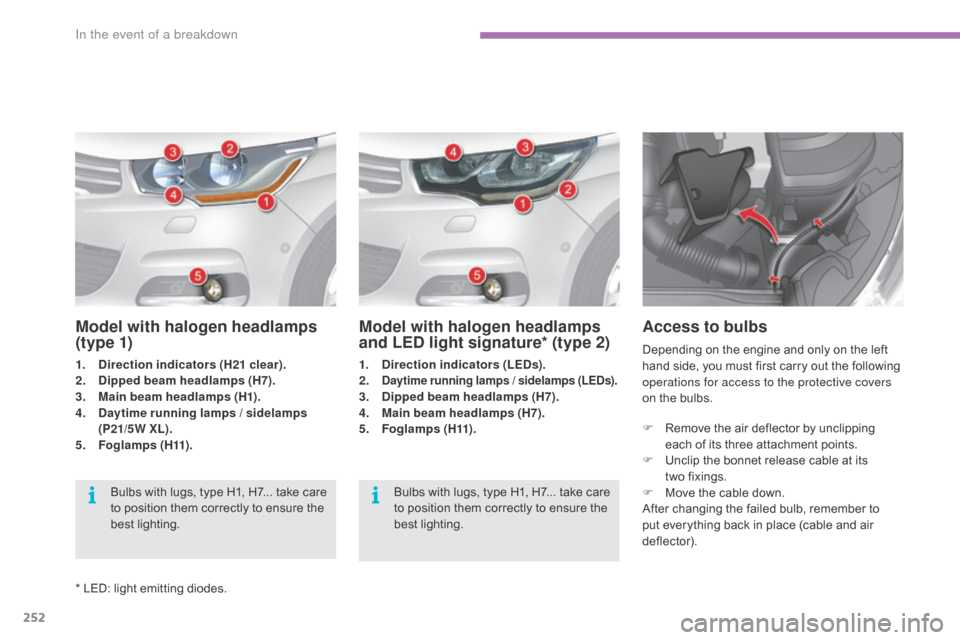
Access to bulbs
Model with halogen headlamps
and LED light signature* (type 2)
1. Direction indicators (LEDs).
2. Daytime running lamps / sidelamps (LEDs).3. Dipped beam headlamps (H7).
4. M
ain beam headlamps (H7).
5.
F
o g l a m p s ( H11) .
Bulbs
with lugs, type H1, H7... take care
t
o position them correctly to ensure the
b
est
l
ighting.
Model with halogen headlamps
(t y p e 1)
1. Direction indicators (H21 clear).
2. Dipped beam headlamps (H7).
3.
M
ain beam headlamps (H1).
4.
D
aytime running lamps / sidelamps
(P21/5W XL).
5.
F
o g l a m p s ( H11) .Bulbs
with lugs, type H1, H7... take care
t
o position them correctly to ensure the
b
est
l
ighting.
*
LED: light emitting diodes.
In the event of a breakdown
Page 266 of 396
264
C4-2_en_Chap08_en-cas-de-panne_ed02-2015
Fuse N°Rating Functions
F19 30 AWindscreen
wipers slow / fast speed.
F20 15 AFront
and rear screenwash pump.
F21 20 AHeadlamp
wash pump.
F22 15 AHorn.
F23 15 ARight-hand
main beam headlamp.
F24 15 ALeft-hand
main beam headlamp.
F27 5 ALeft-hand
d
ipped
h
eadlamp.
F28 5 ARight-hand
d
ipped
h
eadlamp.
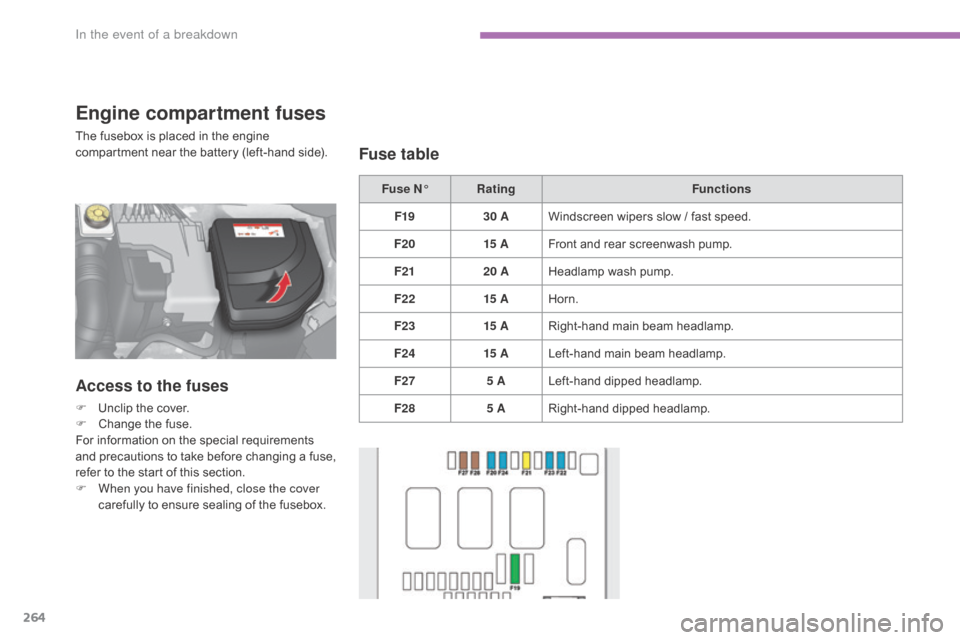
Engine compartment fuses
The fusebox is placed in the engine compartment near the battery (left-hand side).
Access to the fuses
F Unclip the cover.
F C hange the fuse.
For
information on the special requirements
a
nd
p
recautions
t
o
t
ake
b
efore
c
hanging
a
f
use,
r
efer to the start of this section.
F
W
hen you have finished, close the cover
carefully
to ensure sealing of the fusebox.
Fuse table
In the event of a breakdown
Page 267 of 396
265
C4-2_en_Chap08_en-cas-de-panne_ed02-2015
12 V battery
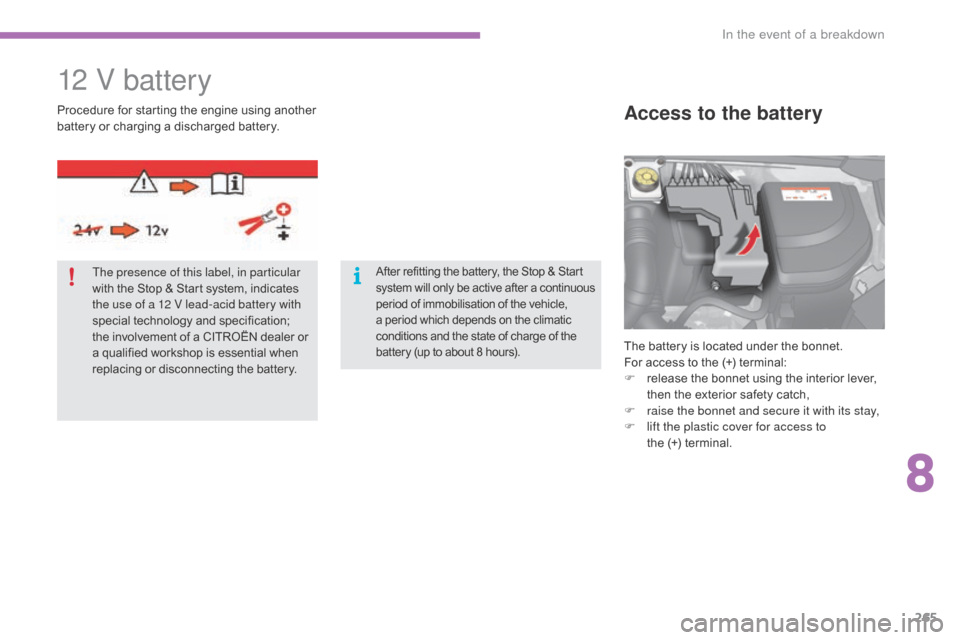
The battery is located under the bonnet.
For access to the (+) terminal:
F
r
elease the bonnet using the interior lever,
t
hen the exterior safety catch,
F
r
aise the bonnet and secure it with its stay,
F
l
ift the plastic cover for access to
the (+)
terminal.
Access to the batteryProcedure for starting the engine u sing another b
attery or charging a discharged battery.
The presence of this label, in particular
with
the Stop & Start system, indicates
t
he use of a 12 V lead-acid battery with
special
t
echnology
a
nd
s
pecification;
t
he involvement of a CITROËN dealer or
a
qualified workshop is essential when
r
eplacing or disconnecting the battery.
After refitting the battery, the Stop & Start system w ill o nly b e a ctive a fter a c ontinuous p
eriod of immobilisation of the vehicle,
a
period which depends on the climatic
c
onditions and the state of charge of the
b
attery (up to about 8 hours).
8
In the event of a breakdown
Page 268 of 396
266
C4-2_en_Chap08_en-cas-de-panne_ed02-2015
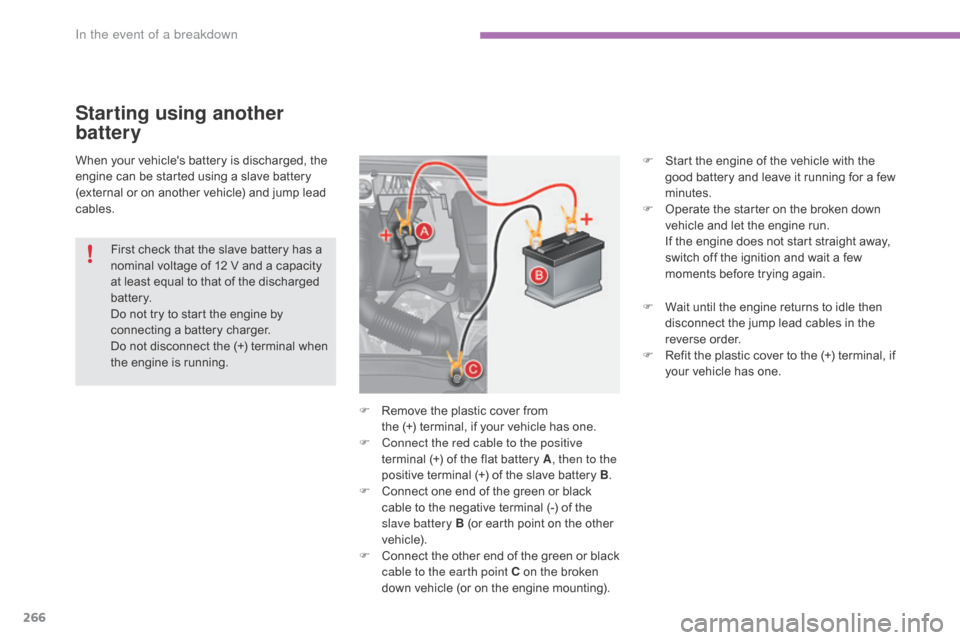
When your vehicle's battery is discharged, the engine can be started using a slave battery
(
external or on another vehicle) and jump lead
c
ables.
Starting using another
battery
First check that the slave battery has a n ominal voltage of 12 V and a capacity
a
t least equal to that of the discharged
b
attery.
Do
not try to start the engine by
c
onnecting a battery charger.
Do
not disconnect the (+) terminal when
t
he engine is running. F
S
tart the engine of the vehicle with the
g
ood battery and leave it running for a few
m
inutes.
F
O
perate the starter on the broken down
v
ehicle and let the engine run. I
f the engine does not start straight away, s
witch off the ignition and wait a few
m
oments before trying again.
F
R
emove the plastic cover from
the
(+) terminal, if your vehicle has one.
F
C
onnect the red cable to the positive
terminal
(+) of the flat battery A, then to the
positive
terminal (+) of the slave battery B.
F
C
onnect one end of the green or black
c
able to the negative terminal (-) of the
s
lave battery B (or earth point on the other
v
ehicle).
F
C
onnect
t
he
o
ther
e
nd
o
f
t
he
g
reen
o
r
b
lack
c
able to the earth point C on the broken
d
own vehicle (or on the engine mounting).F
W
ait until the engine returns to idle then
d
isconnect the jump lead cables in the
r
everse
o
rder.
F
R
efit the plastic cover to the (+) terminal, if
y
our vehicle has one.
In the event of a breakdown
Page 270 of 396
268
C4-2_en_Chap08_en-cas-de-panne_ed02-2015
Protect your eyes and face before
handling the battery.
All
operations on the battery must be
c
arried out in a well ventilated area and
away
from naked flames and sources
o
f sparks, so as to avoid the risk of
e
xplosion or fire.
Do
not try to charge a frozen battery;
t
he battery must first be thawed out to
a
void the risk of explosion. If the battery
h
as been frozen, before charging have
i
t checked by a CITROËN dealer or a
q
ualified workshop who will check that
t
he internal components have not been
d
amaged and the casing is not cracked,
w
hich could cause a leak of toxic and
c
orrosive acid.
Do not reverse the polarity and use only
a
12 V charger.
Do
not disconnect the terminals while
t
he engine is running.
Do
not charge the batteries without
d
isconnecting the terminals first.
Wash
your hands after wards. Do not push the vehicle to start the
engine
if your vehicle has an automatic
g
earbox.
Some
functions
are
not
available
if
the
b
attery
is
not
sufficiently
charged.
It is advisable to disconnect the battery if
the
vehicle
is
to
be
left
unused
for
more
t
han
one
month.
The batteries contain harmful substances s uch as sulphuric acid and lead. They m
ust be disposed of in accordance
w
ith regulations and must not, in any
c
ircumstances, be discarded with household
w
aste.
Take
used remote control batteries and
v
ehicle batteries to a special collection point.
In the event of a breakdown