ignition Citroen C4 2016 2.G Manual PDF
[x] Cancel search | Manufacturer: CITROEN, Model Year: 2016, Model line: C4, Model: Citroen C4 2016 2.GPages: 396, PDF Size: 10.22 MB
Page 200 of 396
198
C4-2_en_Chap06_conduite_ed02-2015
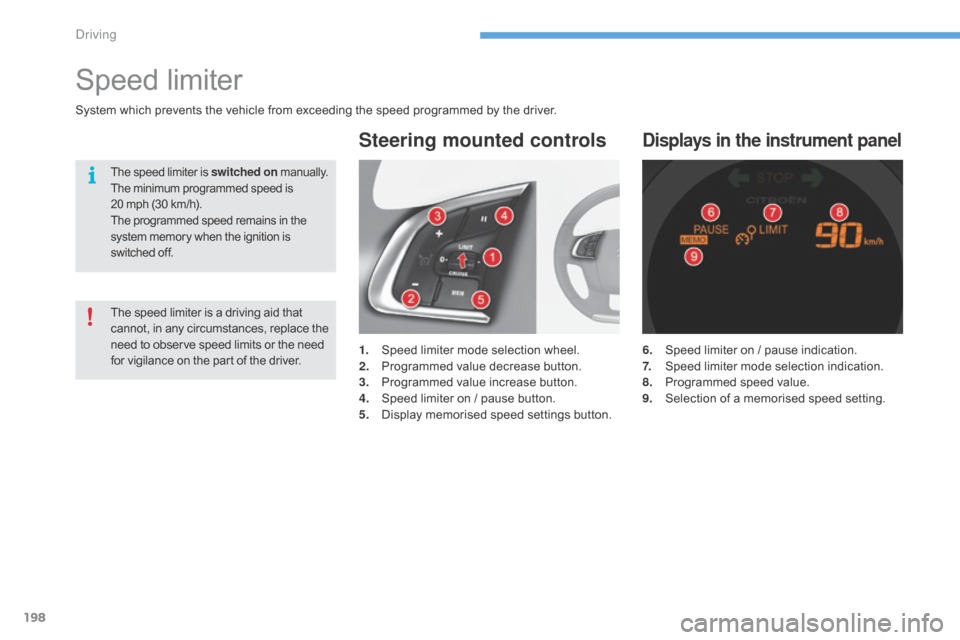
6. Speed limiter on / pause indication.
7. S peed limiter mode selection indication.
8.
P
rogrammed speed value.
9.
S
election of a memorised speed setting.
Displays in the instrument panel
Speed limiter
1. Speed limiter mode selection wheel.
2. P rogrammed value decrease button.
3.
P
rogrammed value increase button.
4.
S
peed limiter on / pause button.
5.
D
isplay memorised speed settings button.
Steering mounted controls
System which prevents the vehicle from exceeding the speed programmed by the driver.
The speed limiter is switched on manually.
The minimum programmed speed is 2
0 mph (30 km/h).
The
programmed speed remains in the
s
ystem memory when the ignition is
s
witched off.
The speed limiter is a driving aid that cannot, in any circumstances, replace the n
eed to observe speed limits or the need
f
or vigilance on the part of the driver.
Driving
Page 203 of 396

201
C4-2_en_Chap06_conduite_ed02-2015
Cruise control
1. Cruise control mode selection wheel.
2. B utton for setting the current speed of the
v
ehicle as the cruise setting or lowering the
c
ruise
se
tting.
3.
B
utton for setting the current speed of the
v
ehicle as the cruise setting or raising the
c
ruise
se
tting.
4.
C
ruise control pause / resume button.
5.
D
isplay memorised speed settings button.
Steering mounted controls
6. Cruise control pause / resume indication.
7. C ruise control mode selected indication.
8.
C
ruise speed setting.
9.
S
electing a memorised cruise speed.
Displays in the instrument panel
The operation of the cruise control can be
interrupted (pause):
-
b
y pressing control 4 or by pressing the
b
rake or clutch pedal,
-
a
utomatically, if operation of the dynamic
s
tability control system is triggered.
Switching
off the ignition cancels any
p
rogrammed speed setting.
The cruise control is switched on
manually.
It requires a minimum vehicle speed of
2
5 mph (40 km/h) as well as:
-
w
ith a manual gearbox, the
e
ngagement of fourth gear or
h
igher,
-
w
ith an automatic gearbox, the gear
s
elector at position D or second
gear or higher in manual mode.
System which automatically maintains the cruising speed of the vehicle at a setting programmed by
t
he driver, without any action on the accelerator pedal.
The cruise control system is a driving aid
t
hat cannot, in any circumstances, replace
t
he need to observe speed limits, nor the
n
eed for vigilance on the part of the driver.As
a safety measure, you are advised
t
o keep your feet near the pedals at all
ti
mes.
6
Driving
Page 211 of 396
209
C4-2_en_Chap07_infos-pratiques_ed02-2015
Fuel
Capacity of the tank: approximately 60 litres.When the low fuel level in the
tank
is reached, this warning lamp
c
omes on in the instrument panel,
a
ccompanied by an audible warning
a
nd the display of an alert message.
W
hen it first comes on, around
6
litres of fuel remain in the tank.
Low fuel level
Additions of fuel must be of at least 5 litres to be registered by the fuel gauge.
Opening
the filler cap may result in an inrush of
a
ir. This vacuum is entirely normal and results
f
rom the sealing of the fuel system.
F
P
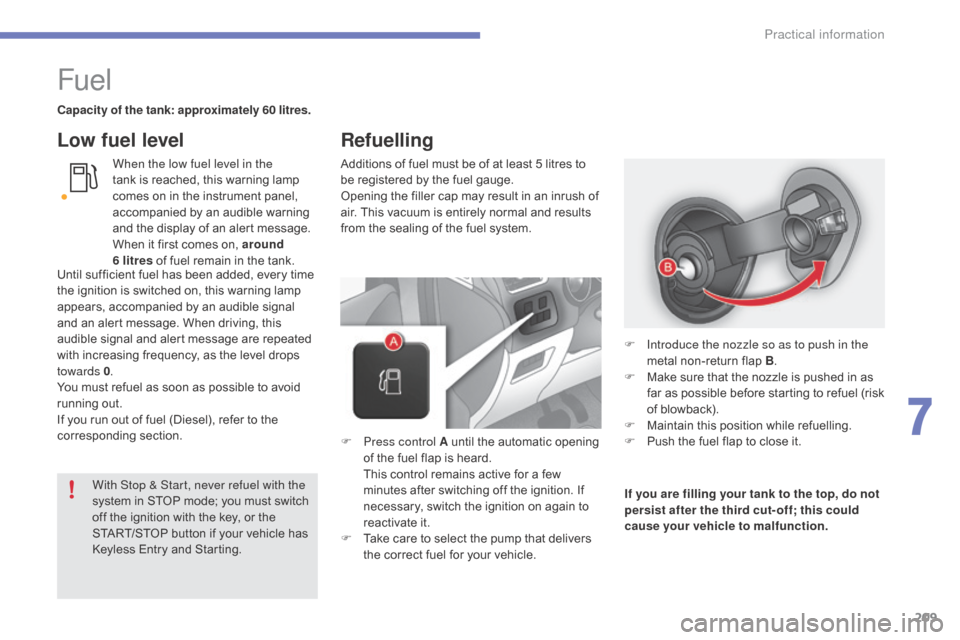
ress control A until the automatic opening
o
f the fuel flap is heard.
T
his control remains active for a few
m
inutes after switching off the ignition. If
n
ecessary, switch the ignition on again to
r
eactivate it.
F
T
ake care to select the pump that delivers
t
he correct fuel for your vehicle.If you are filling your tank to the top, do not
persist after the third cut- off; this could
cause your vehicle to malfunction.
F
I
ntroduce the nozzle so as to push in the
metal
non-return flap B.
F
M
ake sure that the nozzle is pushed in as
f
ar as possible before starting to refuel (risk
o
f blowback).
F
M
aintain this position while refuelling.
F
P
ush the fuel flap to close it.
With Stop & Start, never refuel with the
system
in
STOP
mode;
you
must
switch
o
ff
the
ignition
with
the
key,
or
the
S
TART/STOP
button
if
your
vehicle
has
K
eyless
Entry
and
Starting.
Until
sufficient
fuel
has
been
added,
every
time
t
he
ignition
is
switched
on,
this
warning
lamp
a
ppears,
accompanied
by
an
audible
signal
a
nd
an
alert
message.
When
driving,
this
a
udible
signal
and
alert
message
are
repeated
w
ith
increasing
frequency,
as
the
level
drops
tow
ards 0 .
You
must
refuel
as
soon
as
possible
to
avoid
r
unning
out.
If
you
run
out
of
fuel
(Diesel),
refer
to
the
c
orresponding
s
ection.
Refuelling
7
Practical information
Page 222 of 396
220
C4-2_en_Chap07_infos-pratiques_ed02-2015
Audio pre-equipment
Fitting an audio unit
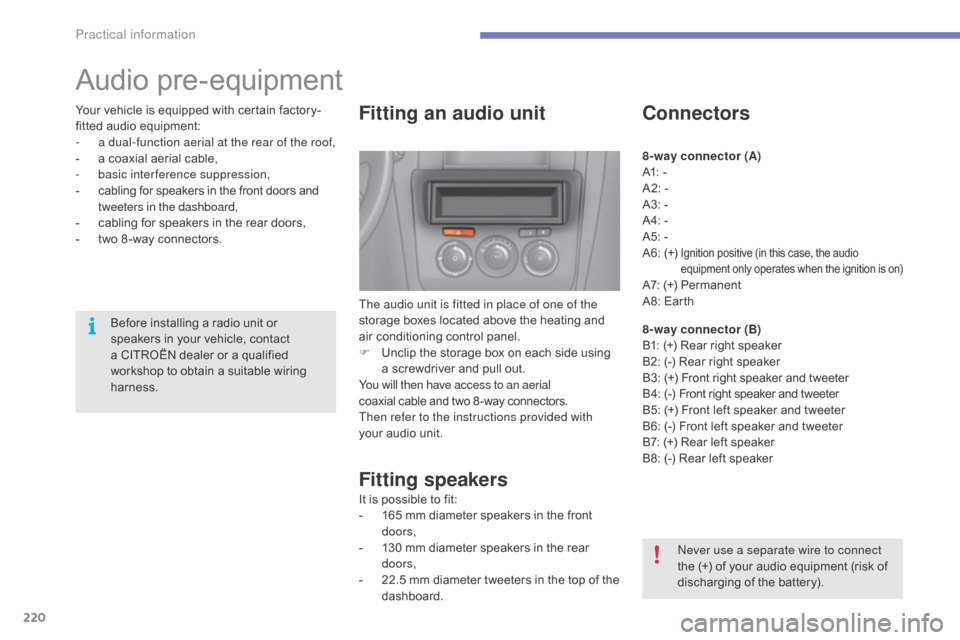
The audio unit is fitted in place of one of the
storage boxes located above the heating and
a
ir conditioning control panel.
F
U
nclip the storage box on each side using
a
screwdriver and pull out.
You will then have access to an aerial
coaxial
cable and two 8 -way connectors.
Then refer to the instructions provided with
your
audio unit.
Fitting speakers
It is possible to fit:
- 1 65 mm diameter speakers in the front
d
oors,
-
1
30 mm diameter speakers in the rear
d
oors,
-
2
2.5 mm diameter tweeters in the top of the
das
hboard.
Connectors
8-way connector (A)
A1: -
A2:
-
A3:
-
A4:
-
A5:
-
A6:
(+)
Ignition positive (in this case, the audio equipment only operates when the ignition is on)
A7: (+) Permanent
A 8: Earth
8-way connector (B)
B1:
(+) Rear right speaker
B2:
(-) Rear right speaker
B3:
(
+)
F
ront right speaker and tweeter
B 4:
(
-)
F
ront right speaker and tweeter
B5:
(+) Front left speaker and tweeter
B6:
(-) Front left speaker and tweeter
B7:
(+) Rear left speaker
B8:
(-) Rear left speaker
Never use a separate wire to connect
the
(+) of your audio equipment (risk of
d
ischarging of the battery).
Before
installing
a
radio
unit
or
s
peakers
in
your
vehicle,
contact
a
CITROËN
dealer
or
a
qualified
w
orkshop
to
obtain
a
suitable
wiring
har
ness.
Your
vehicle
is
equipped
with
certain
factory-
fitted
audio
equipment:
-
a d
ual-function aerial at the rear of the roof,
-
a
coaxial
aerial
cable,
-
b
asic interference suppression,
-
c
abling
for
speakers
in
the
front
doors
and
t
weeters in the dashboard,
-
c
abling
for
speakers
in
the
rear
doors,
-
t
wo
8 -way
connectors.
Practical information
Page 223 of 396
221
C4-2_en_Chap07_infos-pratiques_ed02-2015
Changing a wiper blade
Before removing a front
wiper blade
F Within one minute after switching off t
he ignition, operate the wiper stalk to
p
osition the wiper blades vertically on the
windscreen.
Removing
F Raise the corresponding wiper arm.
F U nclip the wiper blade and remove it.
Fitting
F Put the corresponding new wiper blade in p
lace and clip it.
F
F
old down the wiper arm carefully.
After fitting a front wiper
blade
F Switch on the ignition.
F O perate the wiper stalk again to park the
w
iper blades.
7
Practical information
Page 228 of 396
226
C4-2_en_Chap07_infos-pratiques_ed02-2015
Checking levels
The check is carried out either when the ignition is switched on using the
o
il level indicator in the instrument
p
anel for vehicles so equipped, or
u
sing the dipstick.
Engine oil level
Checking using
the dipstick
Check all of these levels regularly, in line with the manufacturer's service schedule. Top them up if necessary, unless other wise indicated.
I f a level drops significantly, have the corresponding system checked by a CITROËN dealer or a qualified workshop.
It
is normal to top up the oil level between
t
wo services (or oil changes). CITROËN
r
ecommends that you check the level, and top
u
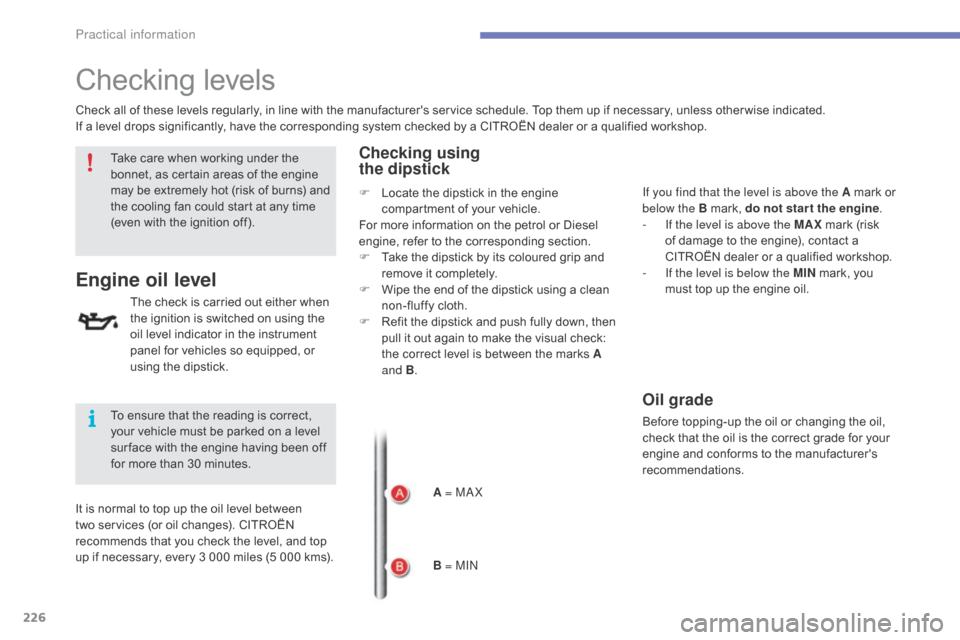
p if necessary, every 3 000 miles (5 000 kms).A = MA X
B = MIN If you find that the level is above the A
mark or
belo
w the B mark, do not star t the engine.
-
I
f the level is above the MAX
mark (risk
o
f damage to the engine), contact a
C
ITROËN dealer or a qualified workshop.
-
I
f the level is below the MIN
mark, you
m
ust top up the engine oil.
Oil grade
Before topping-up the oil or changing the oil, check that the oil is the correct grade for your
e
ngine and conforms to the manufacturer's
r
ecommendations.
Take
care
when
working
under
the
b
onnet,
as
certain
areas
of
the
engine
m
ay
be
extremely
hot
(risk
of
burns)
and
t
he
cooling
fan
could
start
at
any
time
(
even
with
the
ignition
off).
To
ensure
that
the
reading
is
correct,
y
our
vehicle
must
be
parked
on
a
level
s
ur face
with
the
engine
having
been
off
f
or
more
than
30
minutes. F
L
ocate
the
dipstick
in
the
engine
c
ompartment
of
your
vehicle.
For
more
information
on
the
petrol
or
Diesel
e
ngine,
refer
to
the
corresponding
section.
F
T
ake
the
dipstick
by
its
coloured
grip
and
r
emove
it
completely.
F
W
ipe
the
end
of
the
dipstick
using
a
clean
n
on-fluffy
cloth.
F
R
efit
the
dipstick
and
push
fully
down,
then
p
ull
it
out
again
to
make
the
visual
check:
t
he
correct
level
is
between
the
marks
A
and B .
Practical information
Page 229 of 396
227
C4-2_en_Chap07_infos-pratiques_ed02-2015
Topping-up the engine oil level
F Locate the oil filler cap in the engine c
ompartment of your vehicle.
For
more information on the petrol or Diesel
e
ngine, refer to the corresponding section.
F
U
nscrew the oil filler cap to reveal the filler
a
perture.
F
A
dd oil in small quantities, avoiding any
s
pills on engine components (risk of fire).
F
W
ait a few minutes before checking the
l
evel again using the dipstick.
F
A
dd more oil if necessary.
F
A
fter checking the level, carefully refit the
o
il filler cap and the dipstick in its tube.
After
topping-up the oil, the check when
s
witching on the ignition with the oil level
i
ndicator in the instrument panel is not valid
d
uring the 30 minutes after topping up.
Engine oil change
Refer to the manufacturer's service schedule for details of the interval for this operation.
In
order to maintain the reliability of the engine
a
nd emission control system, never use
a
dditives in the engine oil.
Brake fluid level
Changing the fluid
Refer to the manufacturer's service schedule for details of the interval for this operation.
Fluid specification
The brake fluid must conform to the manufacturer's r ecommendations.
The
brake fluid level should be close
t
o the "MA X" mark. If it is not, check
t
he brake pad wear.
Power steering
fluid level
The power steering fluid level should b
e close to the "MA X" mark. With
t
he engine cold, unscrew the cap to
c
heck the level.
7
Practical information
Page 236 of 396
234
C4-2_en_Chap07_infos-pratiques_ed02-2015
Recommendations on storageProcedure
F Switch off the ignition and remove the k
ey, or if your vehicle has one, press the
S
TART/STOP button to switch off the
e
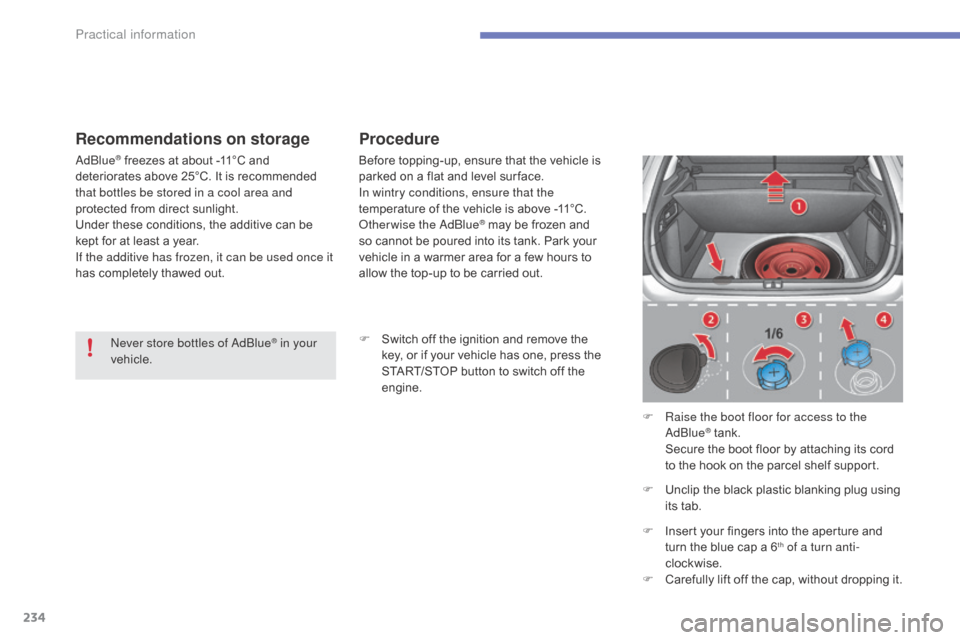
ngine. F
R
aise the boot floor for access to the
AdBlue
® tank. S
ecure
the boot floor by attaching its cord
t
o
the
hook on the parcel shelf support.
F
U
nclip
the black plastic blanking plug using
i
ts
tab.
F
I
nsert
your fingers into the aperture and
t
urn
the
blue cap a 6
th of a turn anti-
clockwise.
F
C
arefully
lift
off
the
cap, without dropping it.
Never store bottles of AdBlue
® in your
vehicle. Before
topping-up, ensure that the vehicle is
p
arked on a flat and level sur face.
In wintry conditions, ensure that the
temperature of the vehicle is above -11°C.
O
therwise the AdBlue
® may be frozen and s
o
cannot
be
poured
into its tank. Park your
v
ehicle
in
a
warmer
area for a few hours to
a
llow
the
top-up
to
be
carried out.
AdBlue
® freezes at about -11°C and d
eteriorates above 25°C. It is recommended
t
hat bottles be stored in a cool area and
protected
from direct sunlight.
Under
these conditions, the additive can be
k
ept
for
at least a year.
If the additive has frozen, it can be used once it
has
completely thawed out.
Practical information
Page 237 of 396
235
C4-2_en_Chap07_infos-pratiques_ed02-2015
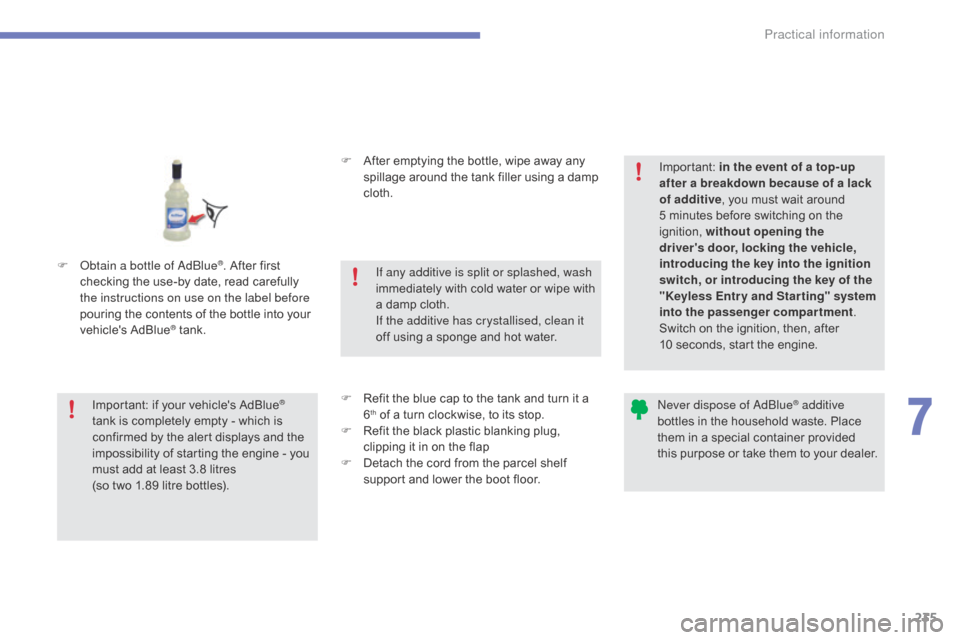
F Obtain a bottle of AdBlue®. After first c
hecking
the
use-by
date,
read carefully
t
he instructions on use on the label before
pouring
the
contents
of
the bottle into your
v
ehicle's
Ad
Blue
® tank. F
A
fter emptying the bottle, wipe away any
s
pillage around the tank filler using a damp
c
loth.
F
R
efit the blue cap to the tank and turn it a
6th of a turn clockwise, to its stop.
F
R
efit the black plastic blanking plug,
c
lipping it in on the flap
F
D
etach the cord from the parcel shelf
s
upport and lower the boot floor.
Important:
if
your
vehicle's
AdBlue®
tank
is
completely
empty
-
which
is
c
onfirmed
by
the
alert
displays
and
the
i
mpossibility
of
starting
the
engine
- you
m
ust
add
at
least
3.8
litres
(so
two
1.89 litre
bottles). If any additive is split or splashed, wash
immediately
w
ith
c
old
w
ater
o
r
w
ipe
w
ith
a
damp cloth.
If the additive has crystallised, clean it
off using a sponge and hot water.Important:
i
n the event of a top-up
after a breakdown because of a lack
of additive , you must wait around
5 minutes before switching on the
ig
nition,
w
ithout opening the
driver's door, locking the vehicle,
introducing the key into the ignition
switch, or introducing the key of the
"Keyless Entr y and Star ting" system
into the passenger compartment .
Switch on the ignition, then, after
10 seconds, start the engine.
Never dispose of AdBlue® additive
bottles
in
the
household
waste. Place
t
hem
in
a
special
container provided
t
his
p
urpose
o
r
t
ake
t
hem
t
o
y
our
d
ealer.
7
Practical information
Page 240 of 396
238
C4-2_en_Chap08_en-cas-de-panne_ed02-2015
Running out of fuel (Diesel)
Other HDi engines
(except BlueHDi version)
On
vehicles
fitted
with
Diesel
engines,
the
fuel
s
ystem
must
be
primed
if
you
run
out
of
fuel.
For all versions other than BlueHDi, refer to the
corresponding
engine
compartment
view.
For
more
information
on
the
Diesel
m
isfuel
prevention
device,
refer
to
the
c
orresponding
s
ection.
BlueHDi engines
If the engine does not start first time, d on't keep trying but start the procedure
a
gain from the beginning. F
A
dd at least five litres of Diesel fuel to the
tank.
F
O
pen the bonnet.
F
I
f necessary, unclip the styling cover for
a
ccess to the priming pump.
F
S
queeze and release the priming pump
r
epeatedly until resistance is felt (there
m
ay be resistance at the first press).
F
O
perate the starter to start the engine
(
if the engine does not start at the first
a
ttempt, wait around 15 seconds before t
rying ag ain).
F I f the engine does not start after a few
a
ttempts, operate the priming pump again
t
hen start the engine.
F
R
efit the styling cover and clip it in place.
F
C
lose the bonnet.
F
F
ill the fuel tank with at least five litres of
D
iesel.
F
S
witch on the ignition (without starting the
e
ngine).
F
W
ait around 6 seconds and switch off the
ig
nition.
F
R
epeat the operation 10 times.
F
O
perate the starter to run the engine.
In the event of a breakdown