Wi dow CITROEN C4 2018 Owner's Guide
[x] Cancel search | Manufacturer: CITROEN, Model Year: 2018, Model line: C4, Model: CITROEN C4 2018Pages: 317, PDF Size: 9.31 MB
Page 119 of 317
117
C4-cactus_en_Chap05_securite_ed01-2016
Child seats
Recommendations
Installing a booster
cushion
The chest part of the seat belt must be positioned on the child's shoulder without
t
ouching the neck.
Ensure that the lap part of the seat belt
passes
correctly over the child's thighs.
CITROËN
recommends the use of a booster
s
eat which has a back, fitted with a seat belt
g
uide at shoulder level.
As
a safety precaution, do not leave:
-
o
ne or more children alone and
u
nsupervised in a vehicle,
-
a
child or an animal in a vehicle which
i
s exposed to the sun, with the windows
c
losed,
-
t
he keys within reach of children inside
t
he vehicle.
To
prevent accidental opening of the doors,
u
se the child lock.
Take
care not to open the rear windows by
m
ore than one third.
To
protect young children from the rays of
t
he sun, fit side blinds on the rear windows.
Children at the front
For optimum installation o f t he fo rward f acing c
hild seat, ensure that the back of the child
s
eat is as close as possible to the backrest
o
f the vehicle's seat, or in contact if possible.
The
head restraint must be removed before
i
nstalling a child seat with a backrest on the
p
assenger
sea
t.
Ensure that the head restraint is stowed or
attached securely so that it is not thrown
around the vehicle in the event of sharp
braking.
Refit the head restraint as soon as the child
seat
is removed.
The
legislation on carrying a child on the
f
ront passenger seat is specific to each
c
ountry. Refer to the legislation in force in
t
he country in which you are driving.
Deactivate
the passenger's front airbag
w
hen a rear ward facing child seat is installed
o
n the front passenger seat. Other wise, the
c
hild would risk being seriously injured or
k
illed if the airbag were deployed.
The incorrect installation of a child seat in a
vehicle
compromises
the
child's
protection
in
t
he
event
of
an
accident.
Check
that
there
is
no
seat
belt
or
seat
belt
b
uckle
under
the
child
seat
as
this
could
de
stabilise
i
t.
Remember
to
fasten
the
seat
belts
or
the
c
hild seat harnesses keeping the slack in
relation
to
the
child's
body
to a minimum ,
even
for
short
journeys.
For
the
installation
of
a
child
seat
using
a
s
eat belt, ensure that this is well tensioned
on
the
child
seat
and
that
it
is
holding
the
c
hild
seat
firmly
against
the
seat
of
your
v
ehicle.
If
your
front
passenger
seat
is
a
djustable,
move
it
for ward
if
necessary.
At the rear seats, always leave sufficient
space
between
the
front
seat
and:
-
a
rear ward
facing
child
seat,
-
t
he feet of a child seated in a for ward
facing
child
seat.
For
this,
move
the
front
seat
for ward
and
if
n
ecessary
straighten
its
backrest.
5
Safety
Page 123 of 317

121
C4-cactus_en_Chap06_conduite_ed01-2016
Starting
The parking brake must be applied.
F
W
ith
a manual gearbox, place the gear
l
ever in neutral then depress the clutch
pedal
f
ully.
F
W
ith
an electronic gearbox, place the
c
ontrol at N then press the brake pedal
f
i r m l y.
F
I
nsert
the key into the ignition switch; the
s
ystem recognises the code.
F
U
nlock the steering column by simultaneously
t
urning the steering and the key.
In
certain cases, you may have to apply
m
ore force to the steering (wheels on
f
ull
lock, for example).
F
W
ith
a petrol engine, operate the starter
m
otor
by turning the key to position 3
without
pressing the accelerator pedal,
u
ntil
the engine starts. Once the engine is
r
unning, release the key.
Starting-switching off the engine
It has 3 positions:
- position 1 (Stop):
insert and removing
the
key,
-
position 2 (Ignition on) :
steering column
u
nlocked, ignition on, Diesel preheating,
e
ngine
r
unning,
-
position 3 (Starting) .
Ignition switch
Switching off the engine leads to a loss o
f braking assistance.
Ignition on position (2)
It allows the use of the vehicle's electric equipment or portable devices to be charged.
Once
the state of charge of the battery drops
t
o the reserve level, the system switches to
e
nergy economy mode: the power supply is
c
ut off automatically to preserve the remaining
b
attery charge.
Avoid
attaching heavy objects to the
k
ey, which would weigh down on its
b
lade in the ignition switch and could
c
ause a malfunction.
It
could adversely affect the deployment
o
f the front airbag.
6
Driving
Page 127 of 317

125
C4-cactus_en_Chap06_conduite_ed01-2016
5-speed manual gearbox
Engaging reverse
gear
F Press the clutch pedal fully down.
F P ush the gear lever fully to the right then
ba
ckwards.
Only
engage reverse gear when the
v
ehicle is stationary with the engine at idle.
As a safety precaution and to facilitate
starting
of the engine:
-
a
lways select neutral,
-
p
ress the clutch pedal.
6
Driving
Page 129 of 317

127
C4-cactus_en_Chap06_conduite_ed01-2016
ETG electronic gearbox
N Neutral: with your foot on the brake, press t
his control to put the gearbox into neutral
a
nd for starting the engine.
D
D
rive: press this control to engage for ward
d
rive with automatic operation of the gears.
R
R
everse: with your foot on the brake, press
t
his control to engage reverse.
Control panel
F Operate the paddle to the right of the steering wheel to
ch
ange
up.
Steering mounted controls
The steering mounted paddles do not a
llow neutral to be selected, or reverse
gear
to be engaged or disengaged.
Five
or
six-speed
electronically
controlled
gearbox
which
offers the comfort of automatic control of the gears, without any action by the driver.
You
can
temporarily
take
control
of
gear
changes
at
any
time, using the steering mounted control paddles.
F
O
perate the paddle to the left
of the steering wheel to change
down .
Display in the instrument panel
F Place your foot on the brake
when this warning lamp flashes.
N
Neutral
D and 1 2 3 4 5 / 6
D
rive (for ward drive) and
the
g
ear
enga
ged.
R
Reverse
6
Driving
Page 131 of 317

129
C4-cactus_en_Chap06_conduite_ed01-2016
Never select neutral (position N) when
moving.
Forward drive
F Press control D . T
he indicator lamp in the control comes on.
D
and the gear engaged appear in
t
he instrument panel.
The
gearbox then operates in auto-adaptive
m
ode, without any action on the part of the
d
river. It continuously selects the most suitable
g
ear taking account of:
-
o
ptimisation of fuel consumption,
-
d
riving style,
-
r
oad conditions,
-
v
ehicle load.
For
optimum acceleration, when
ov
ertaking another vehicle for example,
p
ress the accelerator pedal fully down,
beyond
the point of resistance.
Temporary control of gear
changing
You can temporarily take over control of gear changes using the steering mounted "+" and
"-"
control
paddles: if the engine speed allows, the
g
ear change is carried out.
This function allows you to anticipate certain
situations
s
uch
a
s
ov
ertaking
a
nother
v
ehicle
o
r
a
pproaching a bend.
After
a few moments without any action on the
p
addles, the gearbox resumes control of gear
c
hanging
a
utomatically. To
engage reverse, the vehicle must be
i
mmobilised with your foot on the brake.
F
P
ress control R
.
T
he indicator lamp in the control comes on.
Reverse
There is an audible signal on enga
gement o f r everse.
If
reverse gear is requested when moving,
t
he
N
warning lamp flashes and the gearbox
g
oes
into neutral automatically.
To
engage reverse, stop the vehicle then, with
y
our
foot on the brake pedal, press control N,
then R .
Do
not
press
the
brake
and
accelerator
p
edals
at
the
same
time:
this
could
c
ause
very
rapid
wear
of
the
clutch.
6
Driving
Page 165 of 317
163
C4-cactus_en_Chap07_info-pratiques_ed01-2016
Changing a wiper blade
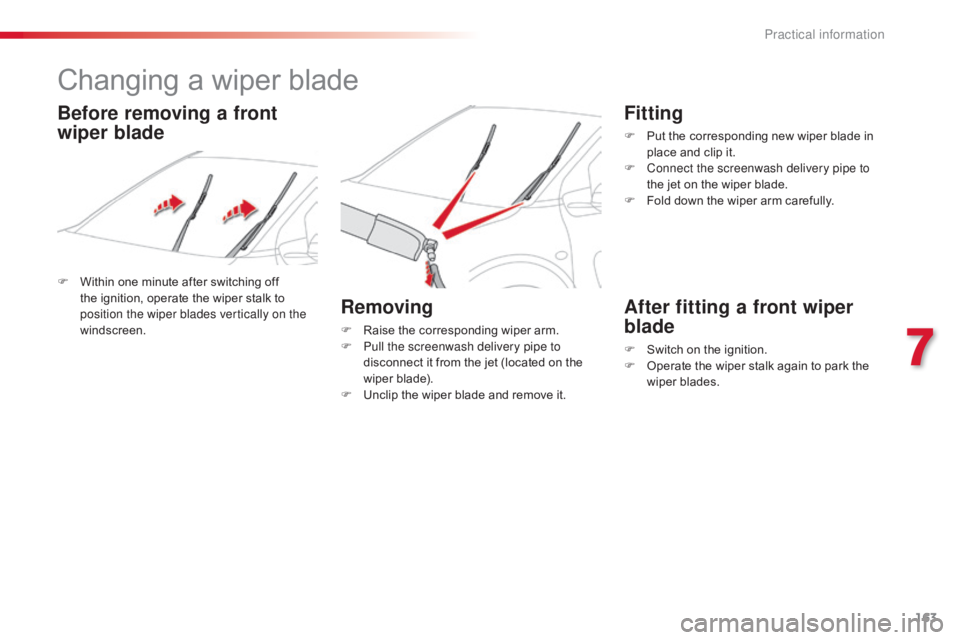
F Within one minute after switching off t
he ignition, operate the wiper stalk to
p
osition the wiper blades vertically on the
windscreen.
Removing
F Raise the corresponding wiper arm.
F P ull the screenwash delivery pipe to
disconnect
it from the jet (located on the
w
iper blade).
F
U
nclip the wiper blade and remove it.
Fitting
F Put the corresponding new wiper blade in p
lace and clip it.
F
C
onnect the screenwash delivery pipe to
the
jet on the wiper blade.
F
F
old down the wiper arm carefully.
After fitting a front wiper
blade
F Switch on the ignition.
F O perate the wiper stalk again to park the
w
iper blades.
Before removing a front
wiper blade
7
Practical information
Page 172 of 317
170
C4-cactus_en_Chap07_info-pratiques_ed01-2016
Checking levels
Take care when working under the bonnet, as certain areas of the engine
m
ay be extremely hot (risk of burns)
a
nd the cooling fan could start at any
t
ime (even with the ignition off).
Engine oil level
The check is carried out either when the ignition is switched on using the
o
il level indicator in the instrument
p
anel for vehicles so equipped, or
u
sing the dipstick.
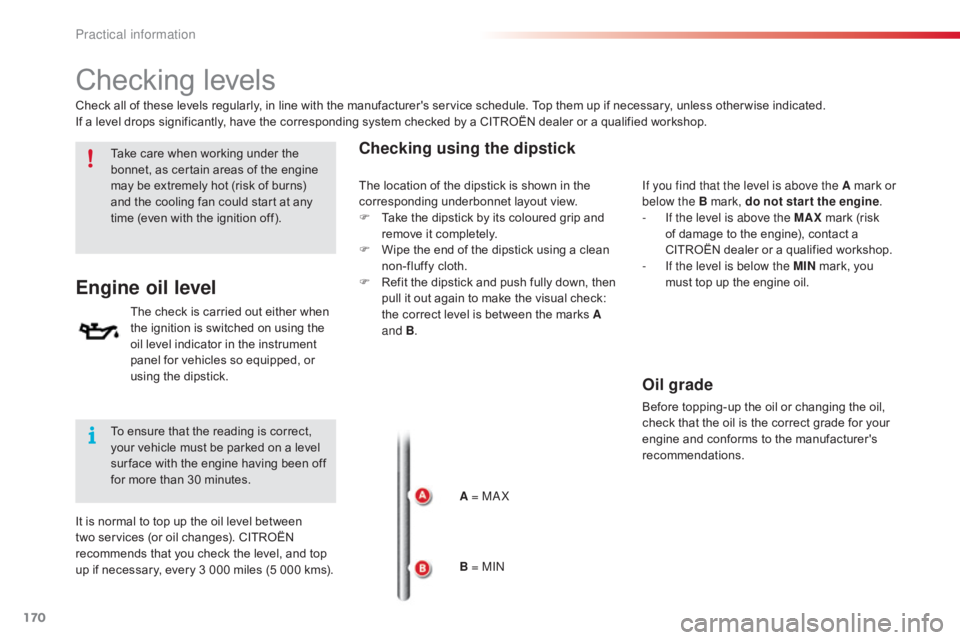
Checking using the dipstick
Check all of these levels regularly, in line with the manufacturer's service schedule. Top them up if necessary, unless other wise indicated.
I f a level drops significantly, have the corresponding system checked by a CITROËN dealer or a qualified workshop.
If you find that the level is above the A
mark or
belo
w the B mark, do not star t the engine.
-
I
f the level is above the MAX
mark (risk
o
f damage to the engine), contact a
C
ITROËN dealer or a qualified workshop.
-
I
f the level is below the MIN
mark, you
m
ust top up the engine oil.
A = MA X
B = MIN
To
ensure that the reading is correct,
y
our vehicle must be parked on a level
s
ur face with the engine having been off
f
or more than 30 minutes.
It
is normal to top up the oil level between
t
wo services (or oil changes). CITROËN
r
ecommends that you check the level, and top
u
p if necessary, every 3 000 miles (5 000 kms).The
location of the dipstick is shown in the
c
orresponding underbonnet layout view.
F
T
ake the dipstick by its coloured grip and
r
emove it completely.
F
W
ipe the end of the dipstick using a clean
n
on-fluffy cloth.
F
R
efit the dipstick and push fully down, then
p
ull it out again to make the visual check:
t
he correct level is between the marks A
and B .
Oil grade
Before topping-up the oil or changing the oil, c
heck that the oil is the correct grade for your
e
ngine and conforms to the manufacturer's
r
ecommendations.
Practical information
Page 179 of 317
177
C4-cactus_en_Chap07_info-pratiques_ed01-2016
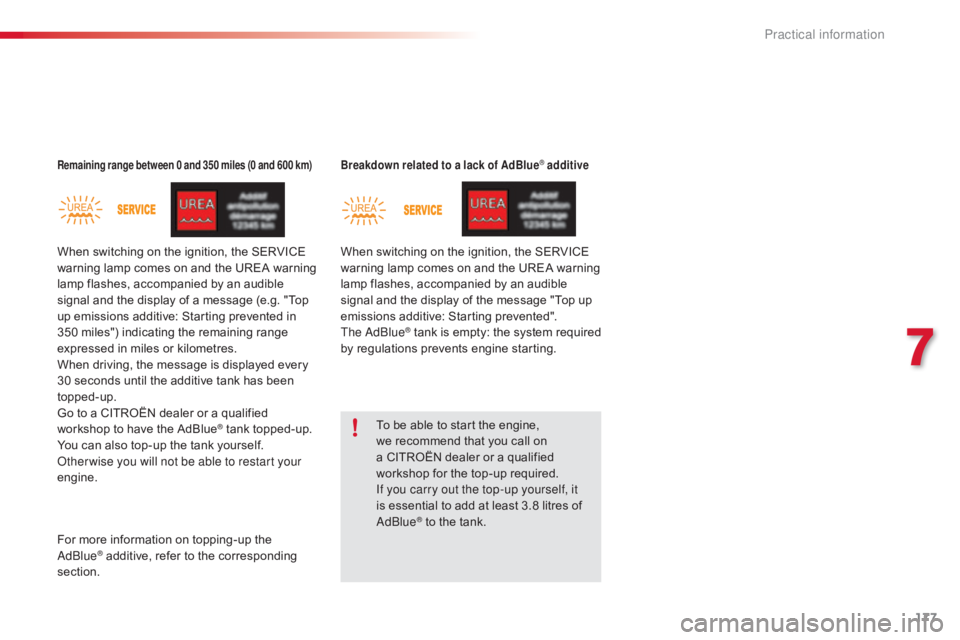
Remaining range between 0 and 350 miles (0 and 600 km)Breakdown related to a lack of AdBlue® additive
To be able to start the engine, we recommend that you call on
a
CITROËN dealer or a qualified
w
orkshop for the top-up required.
If you carry out the top-up yourself, it
is
essential to add at least 3.8 litres of
Ad
Blue
® to the tank.
W
hen
switching
on
the
ignition,
the
SERVICE
w
arning
lamp
comes
on
and
the
UREA
warning
l
amp
flashes,
accompanied
by
an
audible
s
ignal
and
the
display
of
a
message
(e.g.
"Top
u
p
emissions
additive:
Starting
prevented
in
3
50
miles")
indicating
the
remaining
range
e
xpressed
in
miles
or
kilometres.
When
driving,
the
message
is
displayed
every
3
0
seconds
until
the
additive
tank
has
been
t
opped-up.
Go
to
a
CITROËN
dealer
or
a
qualified
w
orkshop
to
have
the
AdBlue
® tank topped-up.
Y
ou
can
also
top-up
the
tank
yourself.
Other wise you will not be able to restart your
engine. When
switching on the ignition, the SERVICE
w
arning lamp comes on and the UREA warning
l
amp flashes, accompanied by an audible
s
ignal and the display of the message "Top up
e
missions additive: Starting prevented".
The AdBlue
® tank is empty: t he s ystem r equired b
y
regulations prevents engine starting.
For
more
information
on
topping-up
the
Ad
Blue
® additive, refer to the corresponding s
ection.
7
Practical information
Page 183 of 317
181
C4-cactus_en_Chap07_info-pratiques_ed01-2016
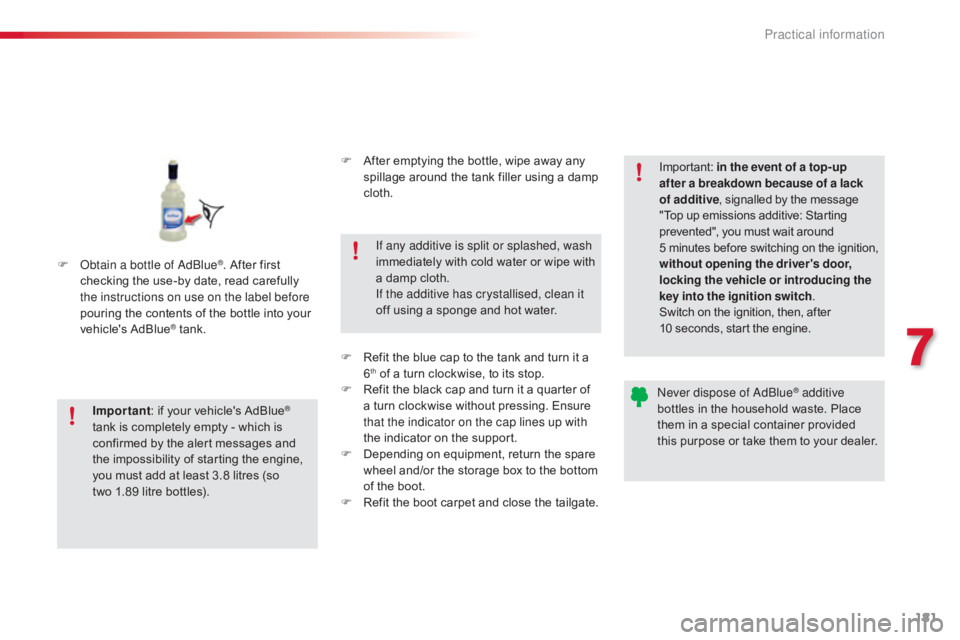
F Obtain a bottle of AdBlue®. After first c
hecking
the
use-by
date,
read carefully
t
he instructions on use on the label before
pouring
the
contents
of
the bottle into your
v
ehicle's
Ad
Blue
® tank.
I
mportant :
if
your vehicle's AdBlue
®
tank
is
completely
empty
-
which
is
c
onfirmed
by
the
alert
messages
and
t
he
impossibility
of
starting
the
engine,
y
ou
must
add
at
least
3.8
litres
(so
t
wo 1.89
litre
bottles). If any additive is split or splashed, wash
immediately
w
ith
c
old
w
ater
o
r
w
ipe
w
ith
a
damp cloth.
If the additive has crystallised, clean it
off using a sponge and hot water.Important:
i
n the event of a top-up
after a breakdown because of a lack
of additive , signalled by the message
"
Top up emissions additive: Starting
p
revented", you must wait around
5
minutes
before
switching
on
the
ignition,
w
ithout opening the driver's door,
locking the vehicle or introducing the
key into the ignition switch .
Switch on the ignition, then, after
1
0 seconds, start the engine.
Never dispose of AdBlue
® additive
bottles
in
the
household
waste. Place
t
hem
in
a
special
container provided
t
his
p
urpose
o
r
t
ake
t
hem
t
o
y
our
d
ealer.
F
A
fter
emptying
the
bottle,
wipe
away
any
s
pillage
around
the
tank
filler
using
a
damp
c
loth.
F
R
efit
the
blue
cap
to
the
tank
and
turn
it
a
6th of a turn clockwise, to its stop.
F
R
efit the black cap and turn it a quarter of
a
turn clockwise without pressing. Ensure
t
hat the indicator on the cap lines up with
the
indicator on the support.
F
D
epending on equipment, return the spare
w
heel and/or the storage box to the bottom
o
f
the boot.
F
R
efit the boot carpet and close the tailgate.
7
Practical information
Page 186 of 317
184
C4-cactus_en_Chap08_En-cas-de-panne_ed01-2016
Warning triangle (storage)
Before leaving your vehicle to set up a
nd install the triangle, switch on the
h
azard warning lamps and put on your
h
igh visibility vest.
Refer
to the manufacturer's instructions
o
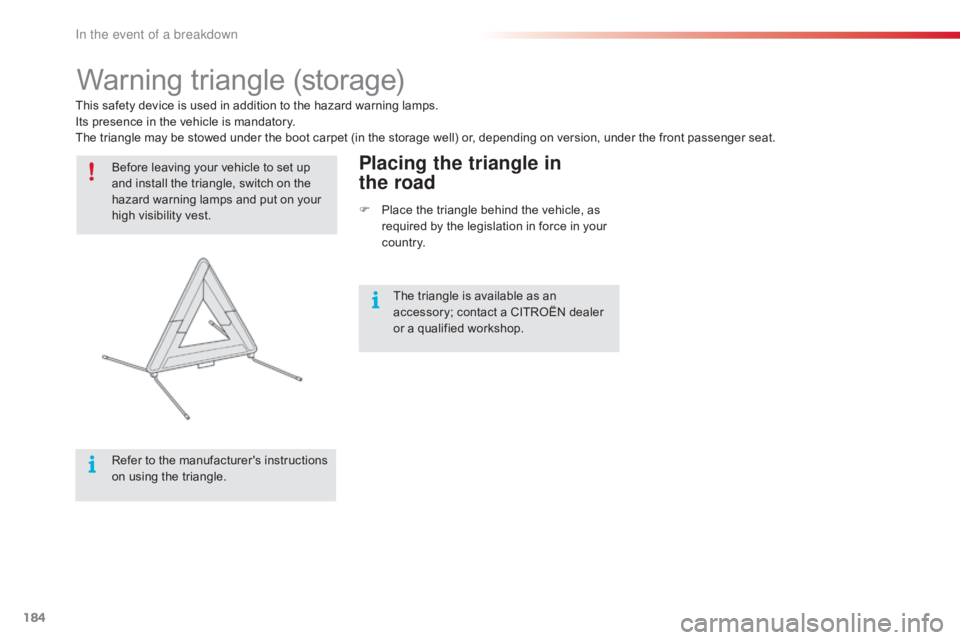
n using the triangle.Placing the triangle in
the road
F Place the triangle behind the vehicle, as r
equired by the legislation in force in your
c
o unt r y.
This
safety
device
is
used
in
addition
to
the
hazard
warning lamps.
Its
presence
in
the
vehicle
is
mandatory.
The
triangle
may
be
stowed
under
the
boot
carpet
(in the storage well) or, depending on version, under the front passenger seat.
The triangle is available as an
a
ccessory; contact a CITROËN dealer
o
r a qualified workshop.
In the event of a breakdown