Wi dow CITROEN C4 2018 Repair Manual
[x] Cancel search | Manufacturer: CITROEN, Model Year: 2018, Model line: C4, Model: CITROEN C4 2018Pages: 317, PDF Size: 9.31 MB
Page 207 of 317
205
C4-cactus_en_Chap08_En-cas-de-panne_ed01-2016
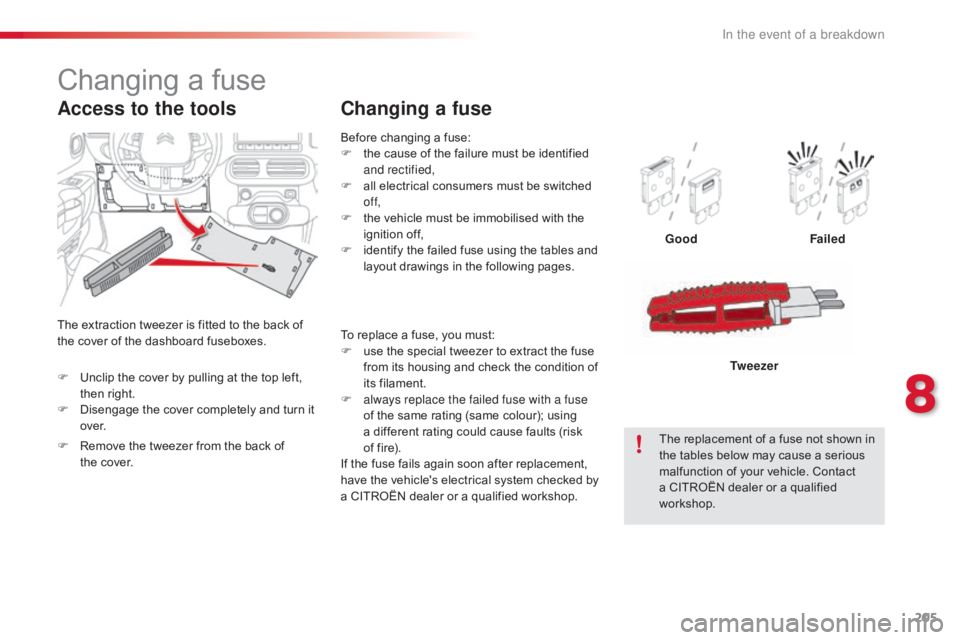
Before changing a fuse:
F t he cause of the failure must be identified
a
nd rectified,
F
a
ll electrical consumers must be switched
o
f f,
F
t
he vehicle must be immobilised with the
ig
nition
o
ff,
F
i
dentify the failed fuse using the tables and
l
ayout drawings in the following pages.
Changing a fuse
GoodFailed
The replacement of a fuse not shown in
t
he tables below may cause a serious
m
alfunction of your vehicle. Contact
a
CITROËN dealer or a qualified
w
orkshop. Tw e e z e r
Changing a fuse
The extraction tweezer is fitted to the back of t
he cover of the dashboard fuseboxes.
Access to the tools
To replace a fuse, you must:
F u se the special tweezer to extract the fuse
f
rom its housing and check the condition of
it
s
f
ilament.
F
a
lways replace the failed fuse with a fuse
of
the same rating (same colour); using
a
different rating could cause faults (risk
o
f fire).
If
the fuse fails again soon after replacement,
h
ave the vehicle's electrical system checked by
a
CITROËN dealer or a qualified workshop.
F
U
nclip
the
cover
by
pulling
at
the
top
left,
t
hen
right.
F
D
isengage
the
cover
completely
and
turn
it
o
ve r.
F
R
emove
the
tweezer
from
the
back
of
t
he cover.
8
In the event of a breakdown
Page 208 of 317
206
C4-cactus_en_Chap08_En-cas-de-panne_ed01-2016
CITROËN will not accept responsibility
for the cost incurred in repairing your
v
ehicle or for rectifying malfunctions
r
esulting from the installation of
a
ccessories not supplied and not
recommended
by CITROËN and
n
ot installed in accordance with its
instructions, in particular when the
combined
consumption of all of the
a
dditional equipment connected
e
xceeds
1
0
mil
liamperes.
Installing electrical
accessories
Your vehicle's electrical system is designed to operate with standard or
o
ptional
e
quipment.
Before
installing other electrical
e
quipment or accessories on your
v
ehicle, contact a CITROËN dealer or a
qualified
w
orkshop.
In the event of a breakdown
Page 209 of 317
207
C4-cactus_en_Chap08_En-cas-de-panne_ed01-2016
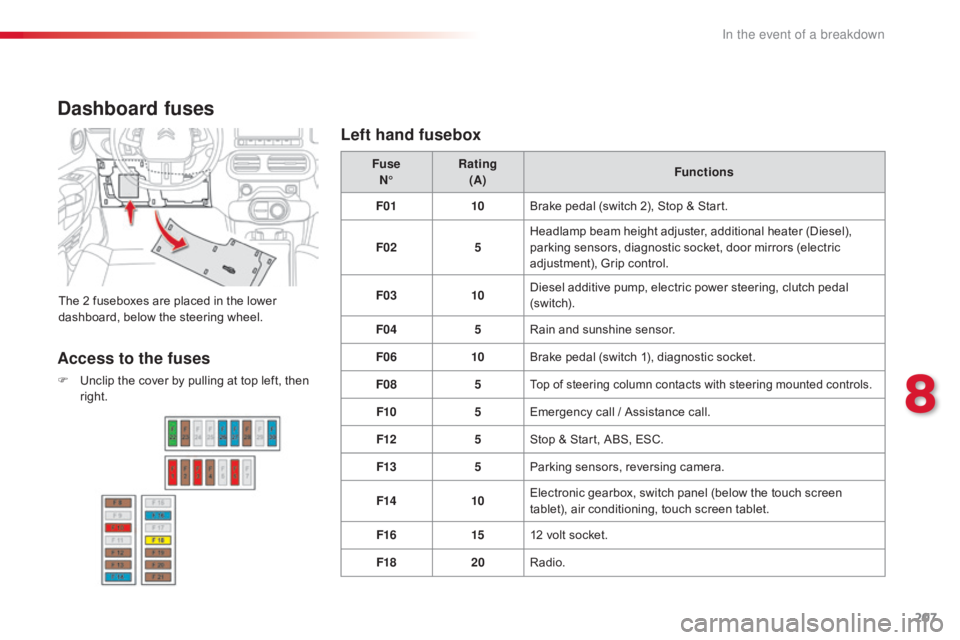
Dashboard fuses
The 2 fuseboxes are placed in the lower dashboard, below the steering wheel.Fuse
N° Rating
(A) Functions
F01 10Brake pedal (switch 2), Stop & Start.
F02 5Headlamp beam height adjuster, additional heater (Diesel),
p
arking sensors, diagnostic socket, door mirrors (electric
a
djustment), Grip control.
F03 10Diesel additive pump, electric power steering, clutch pedal (
sw i tc h).
F04 5Rain
and sunshine sensor.
F06 10Brake
pedal (switch 1), diagnostic socket.
F08 5
Top of steering column contacts with steering mounted controls.
F105Emergency call / Assistance call.
F12 5Stop
& Start, ABS, ESC.
F13 5Parking
sensors, reversing camera.
F14 10Electronic
gearbox, switch panel (below the touch screen
t
ablet), air conditioning, touch screen tablet.
F16 1512
volt socket.
F18 20Radio.
Access to the fuses
F Unclip the cover by pulling at top left, then r
ight.
Left hand fusebox
8
In the event of a breakdown
Page 210 of 317
208
C4-cactus_en_Chap08_En-cas-de-panne_ed01-2016
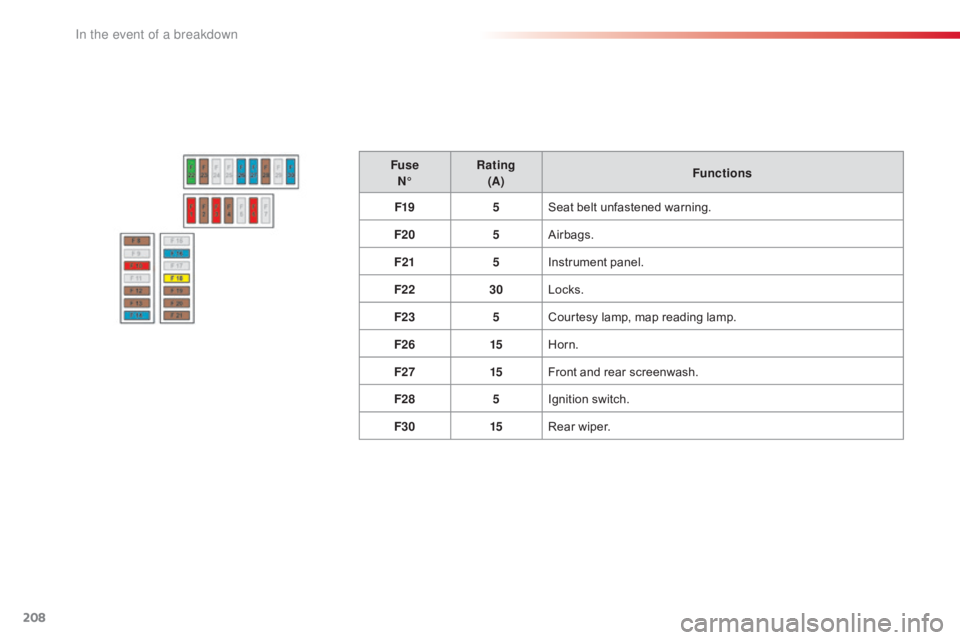
FuseN° Rating
(A) Functions
F19 5Seat
belt unfastened warning.
F20 5Airbags.
F21 5Instrument
panel.
F22 30Locks.
F23 5Courtesy
lamp, map reading lamp.
F26 15Horn.
F27 15Front
and rear screenwash.
F28 5Ignition
s
witch.
F30 15Rear
wiper.
In the event of a breakdown
Page 211 of 317
209
C4-cactus_en_Chap08_En-cas-de-panne_ed01-2016
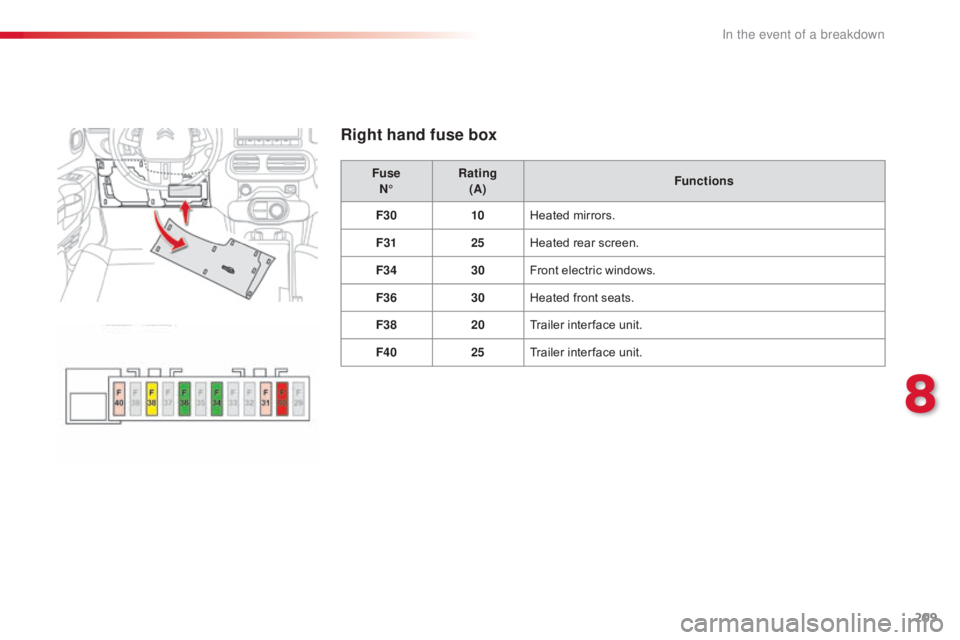
Right hand fuse box
FuseN° Rating
(A) Functions
F30 10Heated
mirrors.
F31 25Heated
rear screen.
F34 30Front
electric windows.
F36 30Heated
front seats.
F38 20Trailer
inter face unit.
F40 25Trailer
inter face unit.
8
In the event of a breakdown
Page 212 of 317
210
C4-cactus_en_Chap08_En-cas-de-panne_ed01-2016
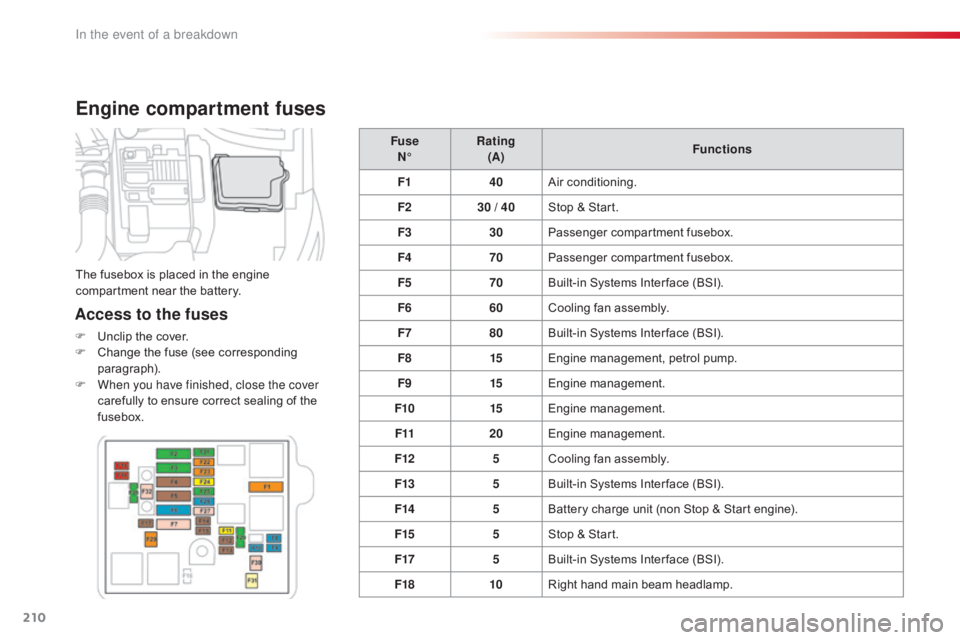
Engine compartment fuses
Access to the fuses
F Unclip the cover.
F C hange the fuse (see corresponding
par
agraph).
F
W
hen you have finished, close the cover
carefully
to ensure correct sealing of the
f
usebox. Fuse
N° Rating
(A) Functions
F1 40Air
c
onditioning.
F2 30 / 40Stop & Start.
F3 30Passenger
c
ompartment
f
usebox.
F4 70Passenger
c
ompartment
f
usebox.
F5 70Built-in Systems Inter face (BSI).
F6 60Cooling fan assembly.
F7 80Built-in Systems Inter face (BSI).
F8 15Engine
management, petrol pump.
F9 15Engine
m
anagement.
F10 15Engine
m
anagement.
F11 20Engine
m
anagement.
F12 5Cooling
fan assembly.
F13 5Built-in
Systems Inter face (BSI).
F14 5Battery
charge unit (non Stop & Start engine).
F15 5Stop
& Start.
F17 5Built-in
Systems Inter face (BSI).
F18 10Right
hand main beam headlamp.
The
fusebox is placed in the engine
c
ompartment near the battery.
In the event of a breakdown
Page 213 of 317
211
C4-cactus_en_Chap08_En-cas-de-panne_ed01-2016
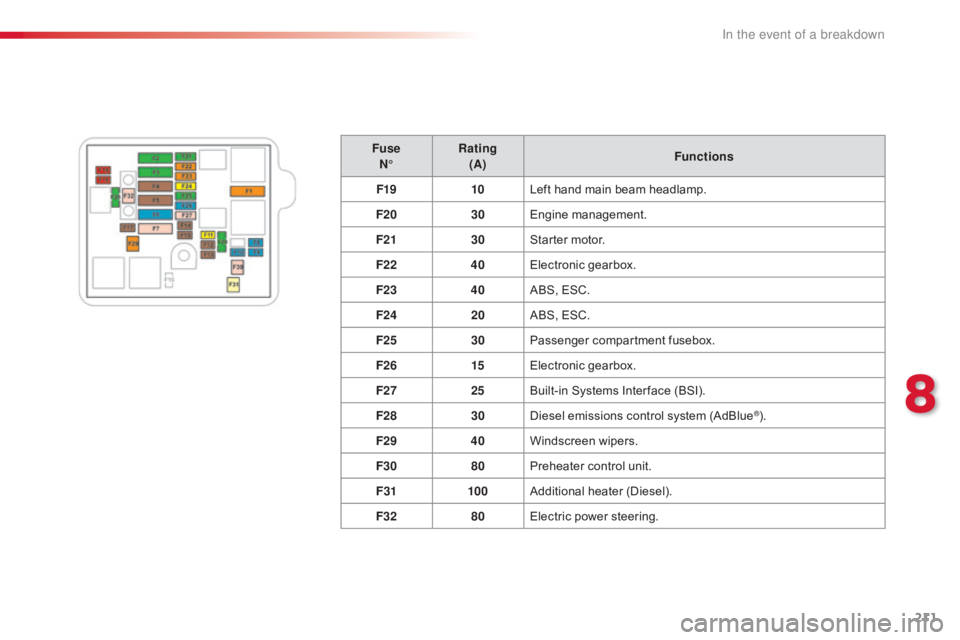
FuseN° Rating
(A) Functions
F19 10Left
hand main beam headlamp.
F20 30Engine
m
anagement.
F21 30Starter
motor.
F22 40Electronic
g
earbox.
F23 40ABS,
ESC.
F24 20ABS,
ESC.
F25 30Passenger
c
ompartment
f
usebox.
F26 15Electronic
g
earbox.
F27 25Built-in
Systems Inter face (BSI).
F28 30Diesel
emissions control system (AdBlue
®).
F29 40Windscreen
w
ipers.
F30 80Preheater
control
unit.
F31 100Additional
hea
ter
(
Diesel).
F32 80Electric
power
steering.
8
In the event of a breakdown
Page 214 of 317
212
C4-cactus_en_Chap08_En-cas-de-panne_ed01-2016
12 V battery
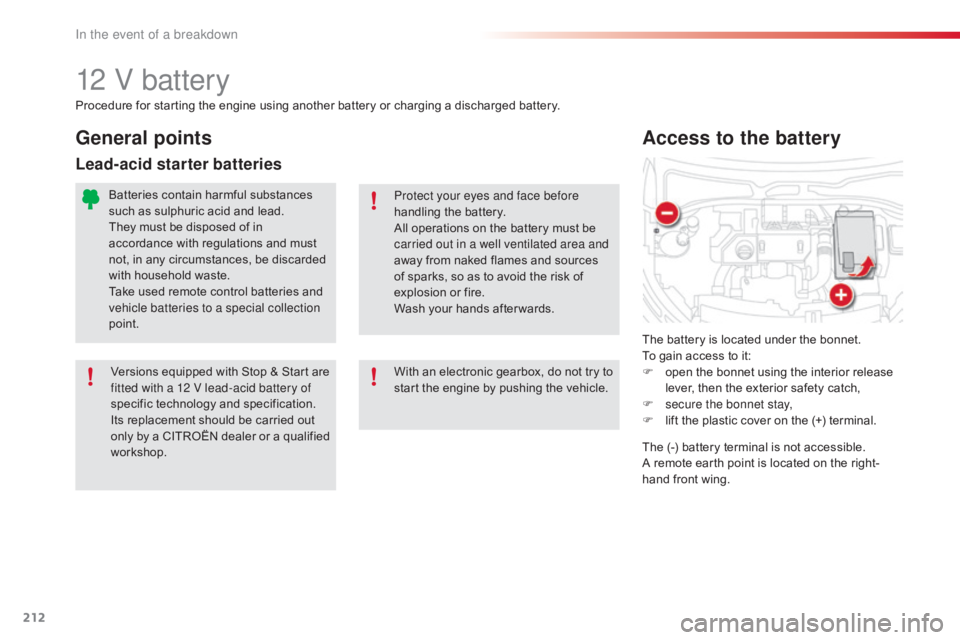
The battery is located under the bonnet.
T o gain access to it:
F
o
pen the bonnet using the interior release
l
ever, then the exterior safety catch,
F
s
ecure the bonnet stay,
F
l
ift the plastic cover on the (+) terminal.
Access to the battery
Procedure for starting the engine using another battery or charging a discharged battery.
P rotect your eyes and face before
handling
the battery.
All
operations on the battery must be
c
arried out in a well ventilated area and
away
from naked flames and sources
o
f sparks, so as to avoid the risk of
e
xplosion or fire.
Wash
your hands after wards.
Versions
equipped with Stop & Start are
f
itted with a 12 V lead-acid battery of
specific
t
echnology
a
nd
s
pecification.
Its
replacement should be carried out
o
nly
by
a
CITROËN
dealer
or
a
qualified
w
orkshop.
General points
Lead-acid starter batteries
Batteries contain harmful substances such as sulphuric acid and lead.
They
must be disposed of in
a
ccordance with regulations and must
n
ot, in any circumstances, be discarded
w
ith household waste.
Take
used remote control batteries and
v
ehicle batteries to a special collection
point.
With
an electronic gearbox, do not try to
s
tart the engine by pushing the vehicle.The
(-) battery terminal is not accessible.
A
remote earth point is located on the right-
hand
front wing.
In the event of a breakdown
Page 215 of 317
213
C4-cactus_en_Chap08_En-cas-de-panne_ed01-2016
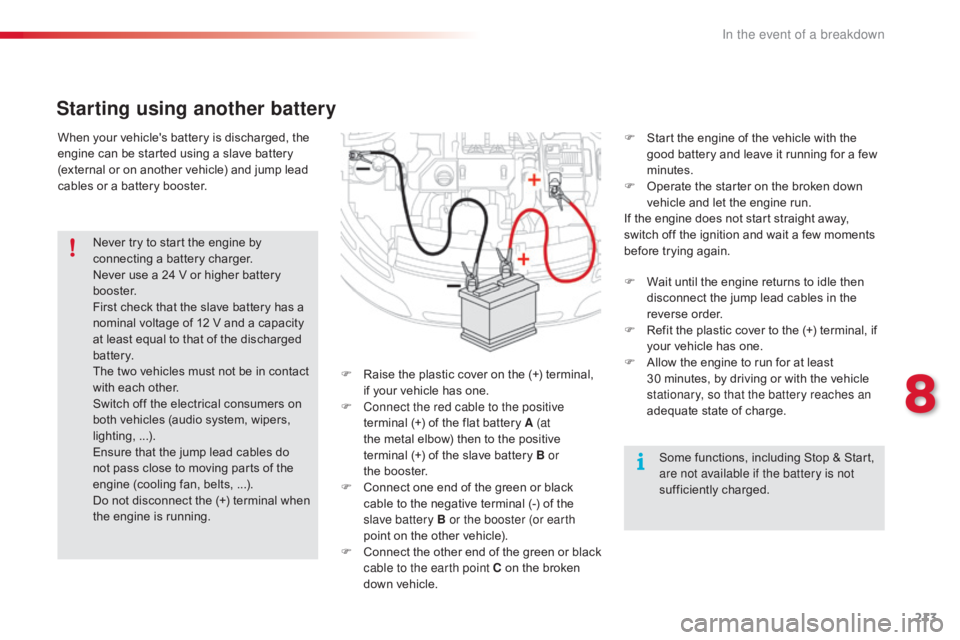
When your vehicle's battery is discharged, the engine can be started using a slave battery
(
external or on another vehicle) and jump lead
c
ables or a battery booster.
Starting using another battery
F Raise the plastic cover on the (+) terminal, i
f your vehicle has one.
F
C
onnect the red cable to the positive
terminal
(+) of the flat battery A (at
the
metal elbow) then to the positive
t
erminal (+) of the slave battery B or
the booster.
F
C
onnect one end of the green or black
c
able to the negative terminal (-) of the
s
lave battery B or the booster (or earth
point
on the other vehicle).
F
C
onnect
t
he
o
ther
e
nd
o
f
t
he
g
reen
o
r
b
lack
c
able to the earth point C on the broken
d
own vehicle. F
S
tart the engine of the vehicle with the
g
ood battery and leave it running for a few
m
inutes.
F
O
perate the starter on the broken down
v
ehicle and let the engine run.
If the engine does not start straight away,
s
witch off the ignition and wait a few moments
b
efore trying again.
Never
try
to
start
the
engine
by
c
onnecting
a
battery
charger.
Never
use
a
24
V
or
higher
battery
b
o o s t e r.
First
check
that
the
slave
battery
has
a
n
ominal
voltage
of
12
V
and
a
capacity
a
t
least
equal
to
that
of
the
discharged
b
attery.
The
two
vehicles
must
not
be
in
contact
w
ith
each
other.
Switch
off
the
electrical
consumers
on
b
oth
vehicles
(audio
system,
wipers,
l
ighting, ...).
Ensure
that
the
jump
lead
cables
do
n
ot
pass
close
to
moving
parts
of
the
e
ngine
(cooling
fan,
belts, ...).
Do
not
disconnect
the
(+)
terminal
when
t
he
engine
is
running. F
W
ait until the engine returns to idle then
d
isconnect the jump lead cables in the
r
everse
o
rder.
F
R
efit the plastic cover to the (+) terminal, if
y
our vehicle has one.
F A llow the engine to run for at least 3
0 minutes, by driving or with the vehicle
s
tationary, so that the battery reaches an
adequate
state of charge.
Some
functions, including Stop & Start,
a
re not available if the battery is not
sufficiently
c
harged.
8
In the event of a breakdown
Page 216 of 317
214
C4-cactus_en_Chap08_En-cas-de-panne_ed01-2016
Charging the battery using
a battery charger
For optimum service life of the battery, it is essential to maintain an adequate state of
c
harge.
In
some circumstances it may be necessary to
c
harge the battery:
-
i
f you use your vehicle essentially for short
journeys,
-
i
f the vehicle is to be taken off the road for
s
everal weeks.
Contact
a CITROËN dealer or a qualified
w
orkshop. It is not necessary to disconnect the
battery.
Never
try to charge a frozen battery.
If the battery has been frozen, have
it
checked by a CITROËN dealer or a
q
ualified workshop, who will check that
t
he internal components have not been
d
amaged and the casing is not cracked,
w
hich could cause a leak of toxic and
c
orrosive acid.
If
you envisage charging your vehicle's
b
attery yourself, use only a charger
c
ompatible with lead-acid batteries of a
n
ominal voltage of 12 V.
If this label is present, it is essential
to
use only a 12 V charger, to avoid
c
ausing irreversible damage to the
e
lectrical components related to the
S
top & Start system. Follow the instructions for use provided
by
the manufacturer of the charger.
Never
reverse polarities.
F
S
witch off the ignition.
F
S
witch off all electrical consumers (audio
s
ystem, lighting, wipers, ...).
F
S
witch off the charger B before connecting
t
he cables to the battery, so as to avoid any
dangerous
spar
ks.
F
E
nsure that the charger cables are in good
c
ondition.
F
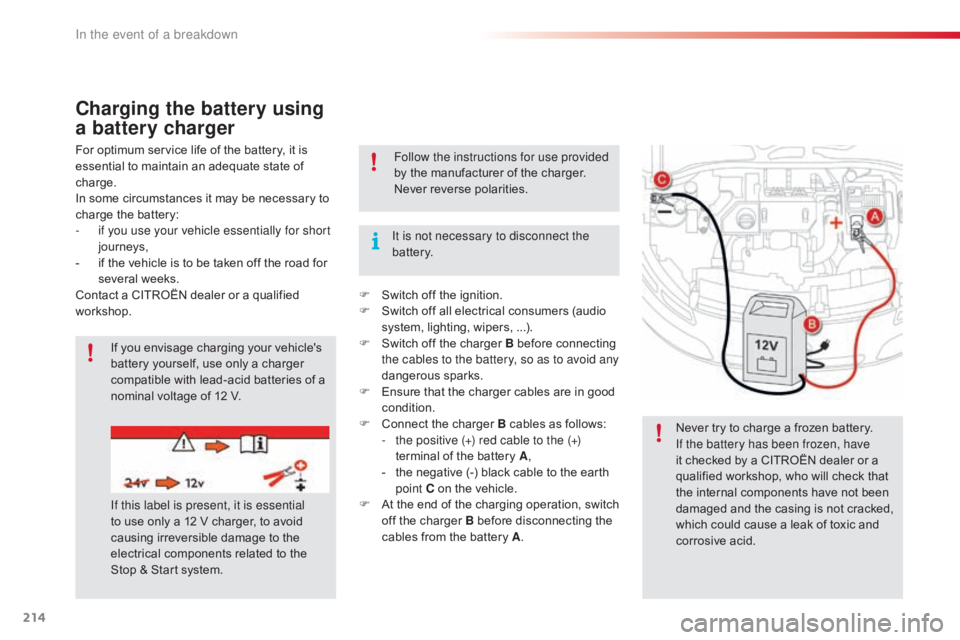
C
onnect the charger B cables as follows:
-
t
he positive (+) red cable to the (+)
terminal
of the battery A,
-
t
he negative (-) black cable to the earth
p
oint C on the vehicle.
F
A
t the end of the charging operation, switch
o
ff the charger B before disconnecting the
c
ables from the battery A.
In the event of a breakdown