light CITROEN C4 DAG 2013 Service Manual
[x] Cancel search | Manufacturer: CITROEN, Model Year: 2013, Model line: C4 DAG, Model: CITROEN C4 DAG 2013Pages: 340, PDF Size: 28.95 MB
Page 115 of 340
6
FITTINGS
113
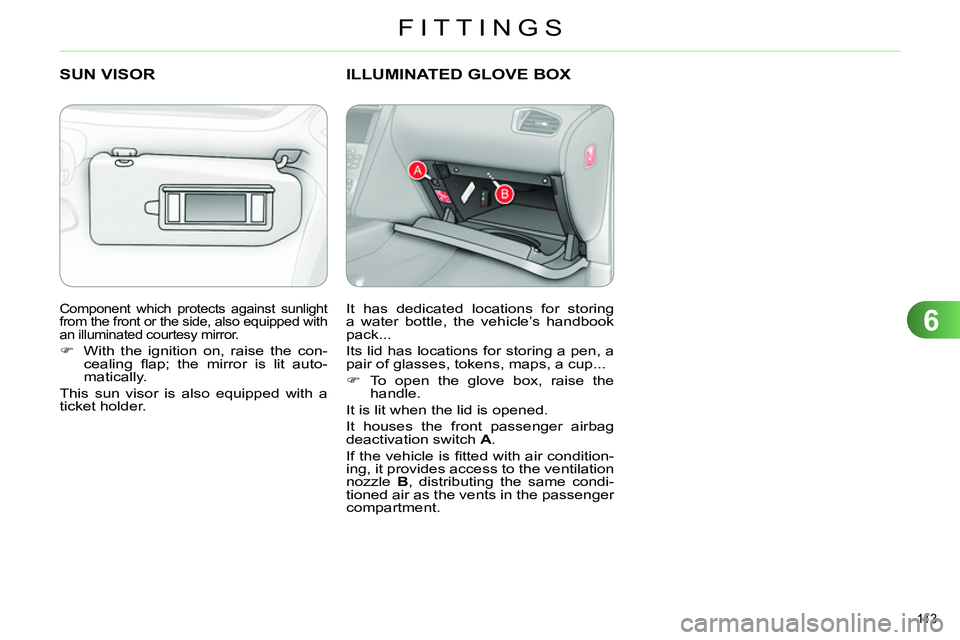
Component which protects against sunlight
from the front or the side, also equipped with
an illuminated courtesy mirror.
With the ignition on, raise the con-
cealing fl ap; the mirror is lit auto-
matically.
This sun visor is also equipped with a
ticket holder.
SUN VISOR
ILLUMINATED GLOVE BOX
It has dedicated locations for storing
a water bottle, the vehicle’s handbook
pack...
Its lid has locations for storing a pen, a
pair of glasses, tokens, maps, a cup...
To open the glove box, raise the
handle.
It is lit when the lid is opened.
It houses the front passenger airbag
deactivation switch A
.
If the vehicle is fi tted with air condition-
ing, it provides access to the ventilation
nozzle B
, distributing the same condi-
tioned air as the vents in the passenger
compartment.
Page 118 of 340
6
FITTINGS
116
LARGE MULTIFUNCTIONAL
STORAGE UNIT
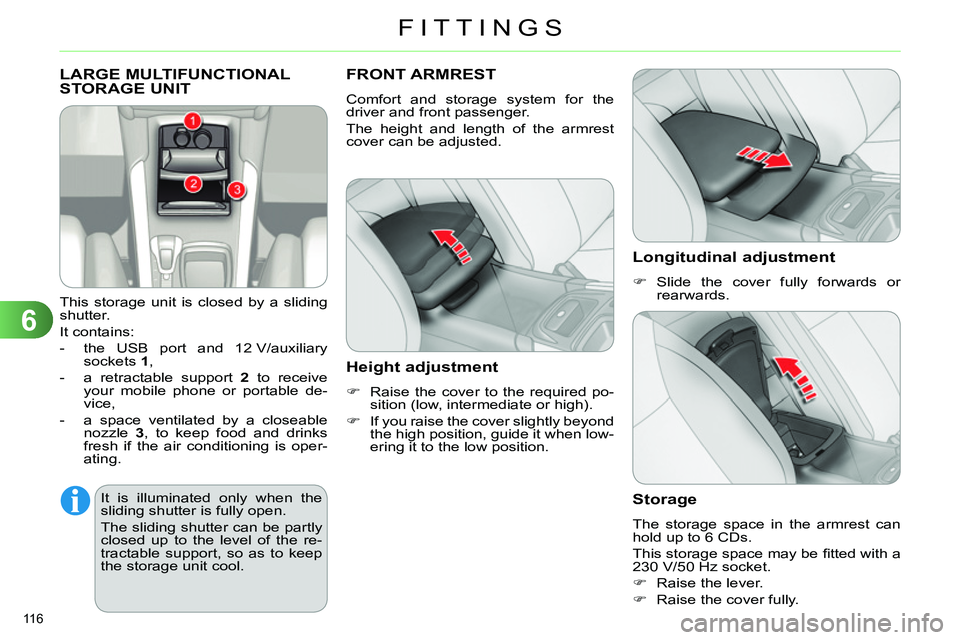
This storage unit is closed by a sliding
shutter.
It contains:
- the USB port and 12 V/auxiliary
sockets 1
,
- a retractable support 2
to receive
your mobile phone or portable de-
vice,
- a space ventilated by a closeable
nozzle 3
, to keep food and drinks
fresh if the air conditioning is oper-
ating.
FRONT ARMREST
Comfort and storage system for the
driver and front passenger.
The height and length of the armrest
cover can be adjusted.
Height adjustment
Raise the cover to the required po-
sition (low, intermediate or high).
If you raise the cover slightly beyond
the high position, guide it when low-
ering it to the low position.
Longitudinal adjustment
Slide the cover fully forwards or
rearwards.
Storage
The storage space in the armrest can
hold up to 6 CDs.
This storage space may be fi tted with a
230 V/50 Hz socket.
Raise the lever.
Raise the cover fully.
It is illuminated only when the
sliding shutter is fully open.
The sliding shutter can be partly
closed up to the level of the re-
tractable support, so as to keep
the storage unit cool.
Page 124 of 340
6
FITTINGS
122
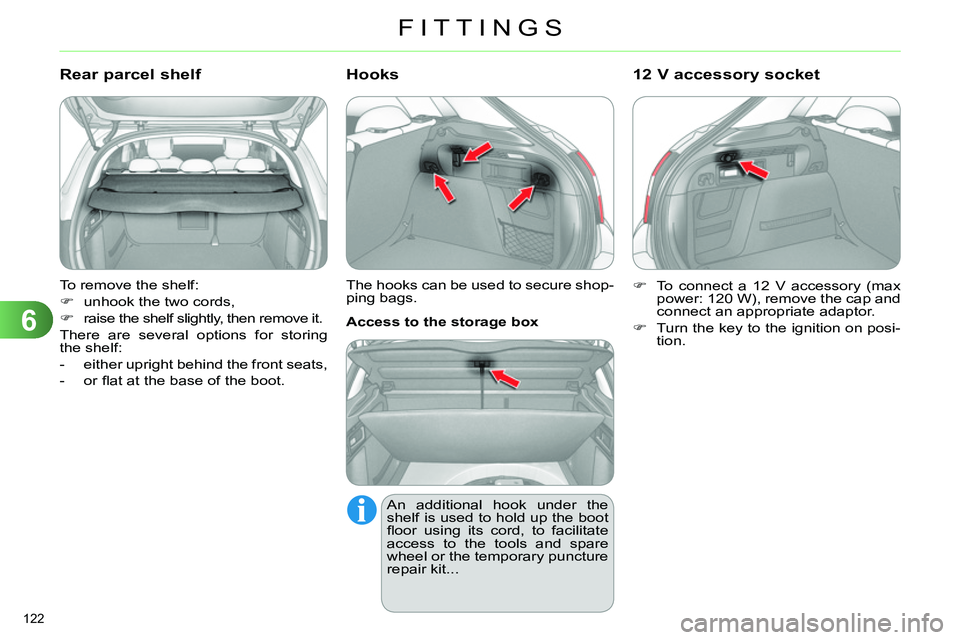
To remove the shelf:
unhook the two cords,
raise the shelf slightly, then remove it.
There are several options for storing
the shelf:
- either upright behind the front seats,
- or fl at at the base of the boot.
Rear parcel shelf
The hooks can be used to secure shop-
ping bags.
Hooks
An additional hook under the
shelf is used to hold up the boot
fl oor using its cord, to facilitate
access to the tools and spare
wheel or the temporary puncture
repair kit...
Access to the storage box
To connect a 12 V accessory (max
power: 120 W), remove the cap and
connect an appropriate adaptor.
Turn the key to the ignition on posi-
tion.
12 V accessory socket
Page 125 of 340
6
FITTINGS
123
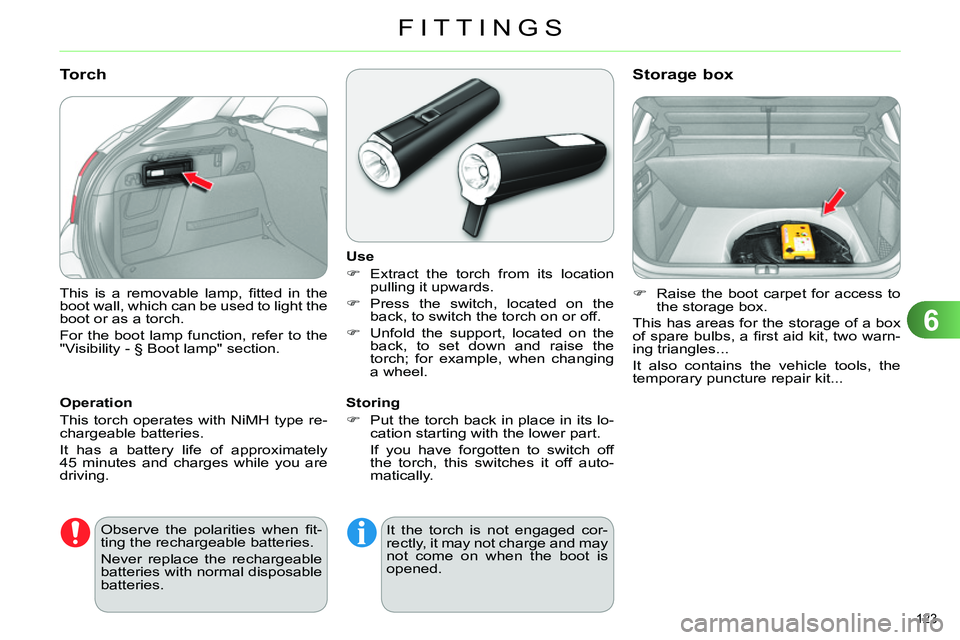
This is a removable lamp, fi tted in the
boot wall, which can be used to light the
boot or as a torch.
For the boot lamp function, refer to the
"Visibility - § Boot lamp" section.
Torch
Operation
This torch operates with NiMH type re-
chargeable batteries.
It has a battery life of approximately
45 minutes and charges while you are
driving.
Use
Extract the torch from its location
pulling it upwards.
Press the switch, located on the
back, to switch the torch on or off.
Unfold the support, located on the
back, to set down and raise the
torch; for example, when changing
a wheel.
Storing
Put the torch back in place in its lo-
cation starting with the lower part.
If you have forgotten to switch off
the torch, this switches it off auto-
matically.
Raise the boot carpet for access to
the storage box.
This has areas for the storage of a box
of spare bulbs, a fi rst aid kit, two warn-
ing triangles...
It also contains the vehicle tools, the
temporary puncture repair kit...
Storage box
Observe the polarities when fi t-
ting the rechargeable batteries.
Never replace the rechargeable
batteries with normal disposable
batteries. It the torch is not engaged cor-
rectly, it may not charge and may
not come on when the boot is
opened.
Page 141 of 340
8
SAFETY
139
DIRECTION INDICATORS
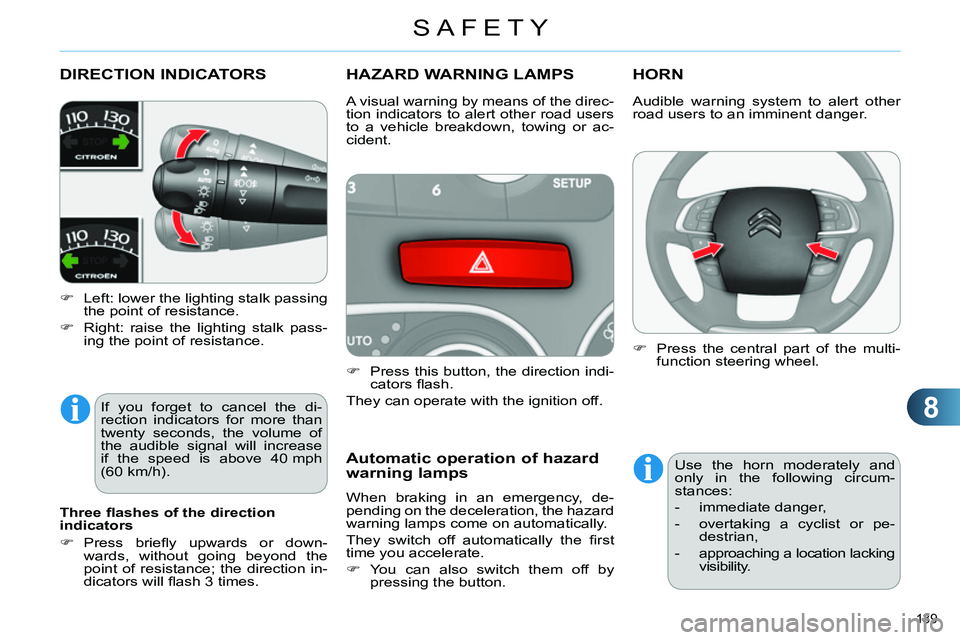
Left: lower the lighting stalk passing
the point of resistance.
Right: raise the lighting stalk pass-
ing the point of resistance.
HAZARD WARNING LAMPS
Press this button, the direction indi-
cators fl ash.
They can operate with the ignition off.
Automatic operation of hazard
warning lamps
When braking in an emergency, de-
pending on the deceleration, the hazard
warning lamps come on automatically.
They switch off automatically the fi rst
time you accelerate.
You can also switch them off by
pressing the button.
HORN
A visual warning by means of the direc-
tion indicators to alert other road users
to a vehicle breakdown, towing or ac-
cident.
Three fl ashes of the direction
indicators
Press briefl y upwards or down-
wards, without going beyond the
point of resistance; the direction in-
dicators will fl ash 3 times.
If you forget to cancel the di-
rection indicators for more than
twenty seconds, the volume of
the audible signal will increase
if the speed is above 40 mph
(60 km/h). Audible warning system to alert other
road users to an imminent danger.
Press the central part of the multi-
function steering wheel.
Use the horn moderately and
only in the following circum-
stances:
- immediate danger,
- overtaking a cyclist or pe-
destrian,
- approaching a location lacking
visibility.
Page 142 of 340
8
SAFETY
140
BRAKING ASSISTANCE
SYSTEMS
Group of supplementary systems which
help you to obtain optimum braking in
complete safety in emergency situa-
tions:
- anti-lock braking system (ABS),
- electronic brake force distribution
(EBFD),
- emergency braking assistance (EBA).
When braking in an emergency,
press very fi rmly without releas-
ing the pressure.
When replacing wheels (tyres
and rims), ensure that they con-
form to the manufacturer's rec-
ommendations.
When braking in an emergency,
press fi rmly without releasing
the pressure.
Anti-lock braking system
and electronic brake force
distribution
Linked systems which improve the sta-
bility and manoeuvrability of your vehi-
cle when braking, in particular on poor
or slippery surfaces.
Activation
The anti-lock braking system comes
into operation automatically when there
is a risk of wheel lock.
Normal operation of the ABS may make
itself felt by slight vibration of the brake
pedal.
Operating fault
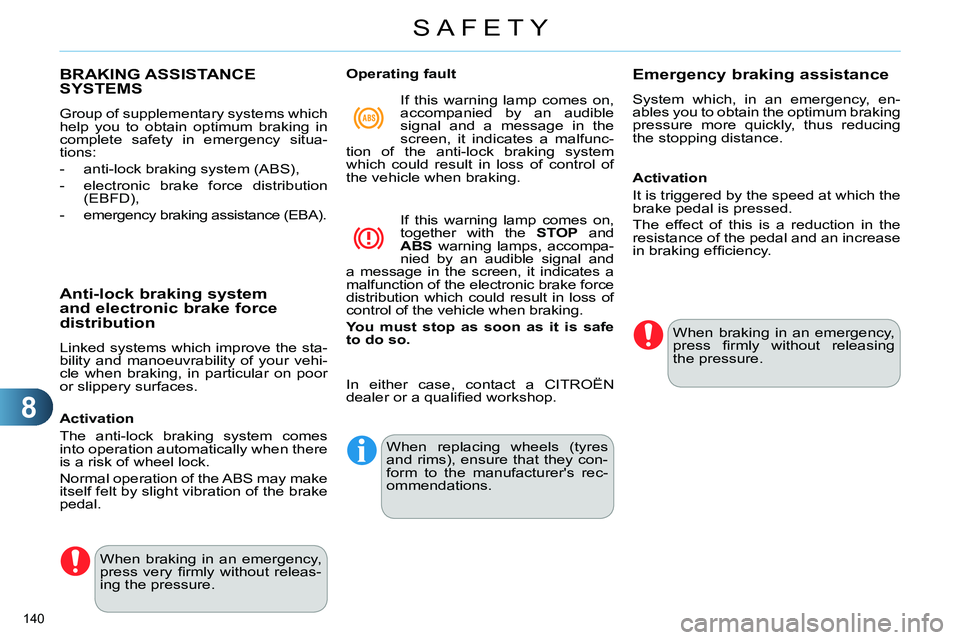
If this warning lamp comes on,
accompanied by an audible
signal and a message in the
screen, it indicates a malfunc-
tion of the anti-lock braking system
which could result in loss of control of
the vehicle when braking.
If this warning lamp comes on,
together with the STOP
and
ABS
warning lamps, accompa-
nied by an audible signal and
a message in the screen, it indicates a
malfunction of the electronic brake force
distribution which could result in loss of
control of the vehicle when braking.
You must stop as soon as it is safe
to do so.
Emergency braking assistance
System which, in an emergency, en-
ables you to obtain the optimum braking
pressure more quickly, thus reducing
the stopping distance.
Activation
It is triggered by the speed at which the
brake pedal is pressed.
The effect of this is a reduction in the
resistance of the pedal and an increase
in braking effi ciency.
In either case, contact a CITROËN
dealer or a qualifi ed workshop.
Page 147 of 340
8
SAFETY
145
The driver must ensure that passen-
gers use the seat belts correctly and
that they are all restrained securely
before setting off.
Wherever you are seated in the ve-
hicle, always fasten your seat belt,
even for short journeys.
Do not interchange the seat belt
buckles as they will not fulfi l their role
fully.
The seat belts are fi tted with an inertia
reel permitting automatic adjustment
of the length of the strap to your size.
The seat belt is stowed automatically
when not in use.
Before and after use, ensure that the
seat belt is reeled in correctly.
The lower part of the strap must be
positioned as low as possible on the
pelvis.
The upper part must be positioned in
the hollow of the shoulder.
The inertia reels are fi tted with an au-
tomatic locking device which comes
into operation in the event of a col-
lision, emergency braking or if the
vehicle rolls over. You can release
the device by pulling fi rmly on the
strap and releasing it so that it reels
in slightly. In order to be effective, a seat belt
must:
- be tightened as close to the body
as possible,
- be pulled in front of you with a
smooth movement, checking that
it does not twist,
-
be used to restrain only one person,
- not bear any trace of cuts or fraying,
- not be converted or modifi ed to
avoid affecting its performance.
In accordance with current safety
regulations, for all repairs on your ve-
hicle, go to a qualifi ed workshop with
the skills and equipment needed,
which a CITROËN dealer is able to
provide.
Have your seat belts checked regu-
larly by a CITROËN dealer or a
qualifi ed workshop, particularly if the
straps show signs of damage.
Clean the seat belt straps with soapy
water or a textile cleaning product,
sold by CITROËN dealers.
After folding or moving a seat or rear
bench seat, ensure that the seat belt
is positioned and reeled in correctly.
Recommendations for children
Use a suitable child seat if the pas-
senger is less than 12 years old or
shorter than one and a half metres.
Never use the same seat belt to se-
cure more than one person.
Never allow a child to travel on your
lap.
In the event of an impact
Depending on the nature and se-
riousness of the impact
, the pre-
tensioning device may be deployed
before and independently of the
airbags. Deployment of the preten-
sioners is accompanied by a slight
discharge of harmless smoke and
a noise, due to the activation of the
pyrotechnic cartridge incorporated in
the system.
In all cases, the airbag warning lamp
comes on.
Following an impact, have the seat
belts system checked, and if neces-
sary replaced, by a CITROËN dealer
or a qualifi ed workshop.
Page 148 of 340
8
SAFETY
146
AIRBAGS
System designed to maximise the safe-
ty of the occupants (with the exception
of the rear centre passenger) in the
event of violent collisions. The airbags
supplement the action of the force-limit-
ing seat belts (with the exception of the
centre rear passenger).
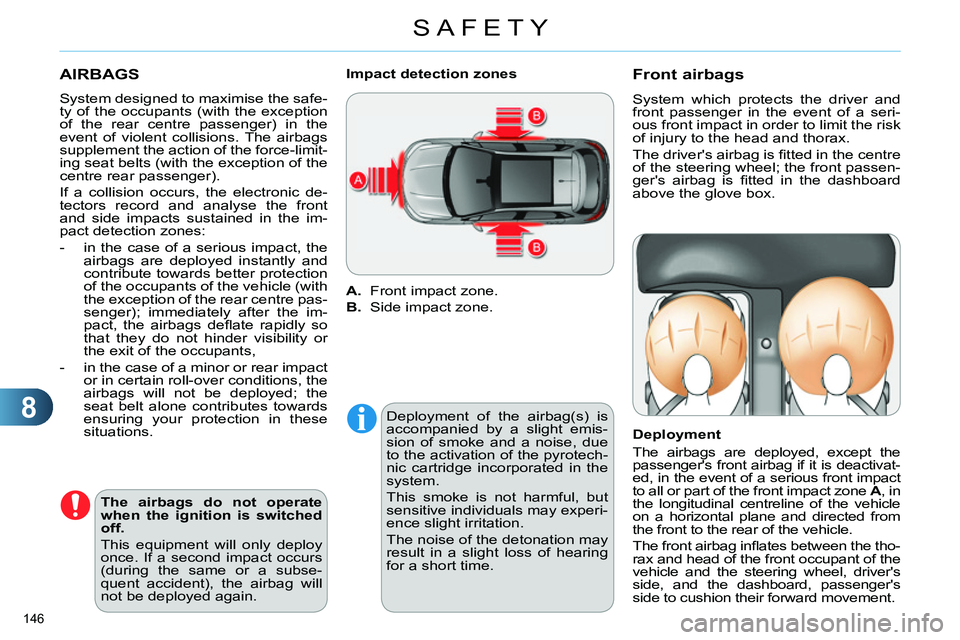
If a collision occurs, the electronic de-
tectors record and analyse the front
and side impacts sustained in the im-
pact detection zones:
- in the case of a serious impact, the
airbags are deployed instantly and
contribute towards better protection
of the occupants of the vehicle (with
the exception of the rear centre pas-
senger); immediately after the im-
pact, the airbags defl ate rapidly so
that they do not hinder visibility or
the exit of the occupants,
- in the case of a minor or rear impact
or in certain roll-over conditions, the
airbags will not be deployed; the
seat belt alone contributes towards
ensuring your protection in these
situations.
The airbags do not operate
when the ignition is switched
off.
This equipment will only deploy
once. If a second impact occurs
(during the same or a subse-
quent accident), the airbag will
not be deployed again.
A.
Front impact zone.
B.
Side impact zone.
Impact detection zones
Deployment of the airbag(s) is
accompanied by a slight emis-
sion of smoke and a noise, due
to the activation of the pyrotech-
nic cartridge incorporated in the
system.
This smoke is not harmful, but
sensitive individuals may experi-
ence slight irritation.
The noise of the detonation may
result in a slight loss of hearing
for a short time.
Front airbags
System which protects the driver and
front passenger in the event of a seri-
ous front impact in order to limit the risk
of injury to the head and thorax.
The driver's airbag is fi tted in the centre
of the steering wheel; the front passen-
ger's airbag is fi tted in the dashboard
above the glove box.
Deployment
The airbags are deployed, except the
passenger's front airbag if it is deactivat-
ed, in the event of a serious front impact
to all or part of the front impact zone A
, in
the longitudinal centreline of the vehicle
on a horizontal plane and directed from
the front to the rear of the vehicle.
The front airbag infl ates between the tho-
rax and head of the front occupant of the
vehicle and the steering wheel, driver's
side, and the dashboard, passenger's
side to cushion their forward movement.
Page 165 of 340
9
DRIVING
163
Manual operation
Select position M
for sequential
changing of the six gears.
Push the lever towards the +
sign to
change up a gear.
Pull the lever towards the -
sign to
change down a gear.
It is only possible to change from one
gear to another if the vehicle speed and
engine speed permit; otherwise, the
gearbox will operate temporarily in au-
tomatic mode.
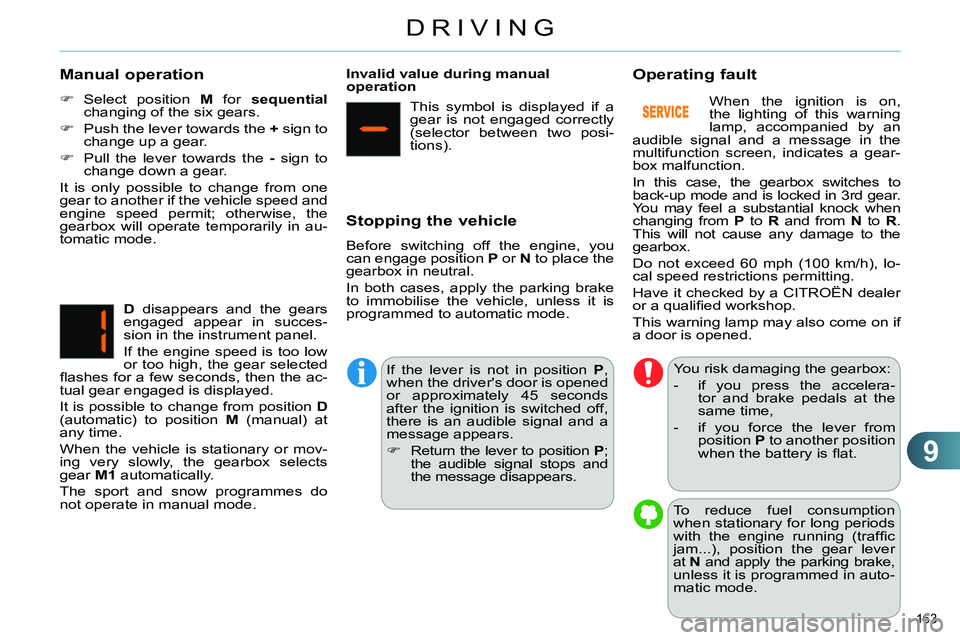
D
disappears and the gears
engaged appear in succes-
sion in the instrument panel.
If the engine speed is too low
or too high, the gear selected
fl ashes for a few seconds, then the ac-
tual gear engaged is displayed.
It is possible to change from position D
(automatic) to position M
(manual) at
any time.
When the vehicle is stationary or mov-
ing very slowly, the gearbox selects
gear M1
automatically.
The sport and snow programmes do
not operate in manual mode.
Invalid value during manual
operation
This symbol is displayed if a
gear is not engaged correctly
(selector between two posi-
tions).
Stopping the vehicle
Before switching off the engine, you
can engage position P
or N
to place the
gearbox in neutral.
In both cases, apply the parking brake
to immobilise the vehicle, unless it is
programmed to automatic mode.
If the lever is not in position P
,
when the driver's door is opened
or approximately 45 seconds
after the ignition is switched off,
there is an audible signal and a
message appears.
Return the lever to position P
;
the audible signal stops and
the message disappears.
You risk damaging the gearbox:
- if you press the accelera-
tor and brake pedals at the
same time,
- if you force the lever from
position P
to another position
when the battery is fl at. When the ignition is on,
the lighting of this warning
lamp, accompanied by an
audible signal and a message in the
multifunction screen, indicates a gear-
box malfunction.
In this case, the gearbox switches to
back-up mode and is locked in 3rd gear.
You may feel a substantial knock when
changing from P
to R
and from N
to R
.
This will not cause any damage to the
gearbox.
Do not exceed 60 mph (100 km/h), lo-
cal speed restrictions permitting.
Have it checked by a CITROËN dealer
or a qualifi ed workshop.
This warning lamp may also come on if
a door is opened.
Operating fault
To reduce fuel consumption
when stationary for long periods
with the engine running (traffi c
jam...), position the gear lever
at N
and apply the parking brake,
unless it is programmed in auto-
matic mode.
Page 170 of 340
9
DRIVING
168
STOP & START
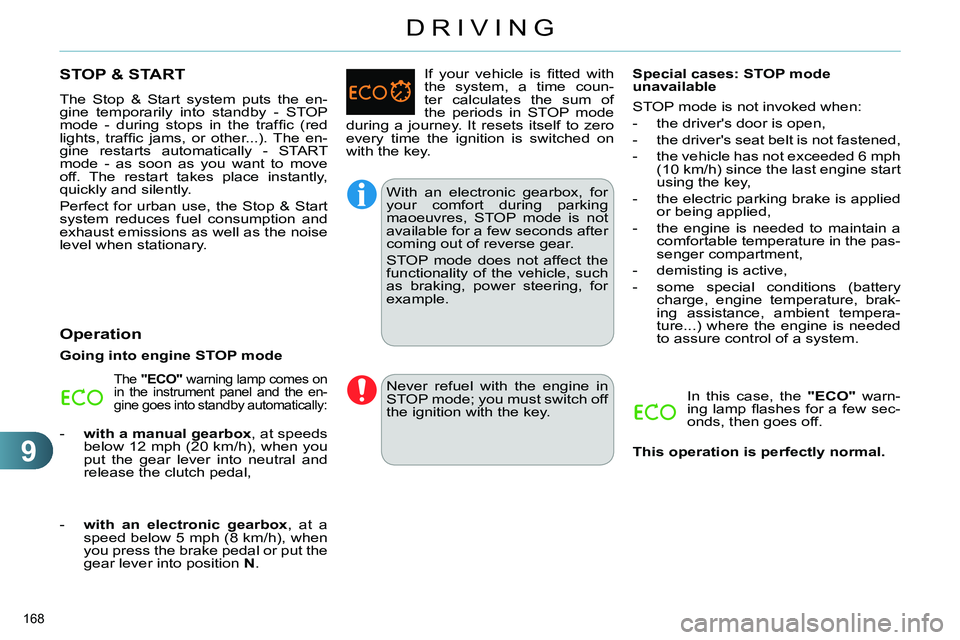
The Stop & Start system puts the en-
gine temporarily into standby - STOP
mode - during stops in the traffi c (red
lights, traffi c jams, or other...). The en-
gine restarts automatically - START
mode - as soon as you want to move
off. The restart takes place instantly,
quickly and silently.
Perfect for urban use, the Stop & Start
system reduces fuel consumption and
exhaust emissions as well as the noise
level when stationary.
Operation
Going into engine STOP mode
The "ECO"
warning lamp comes on
in the instrument panel and the en-
gine goes into standby automatically:
- with a manual gearbox
, at speeds
below 12 mph (20 km/h), when you
put the gear lever into neutral and
release the clutch pedal, If your vehicle is fi tted with
the system, a time coun-
ter calculates the sum of
the periods in STOP mode
d uring a journey. It resets itself to zero
every time the ignition is switched on
with the key.
- with an electronic gearbox
, at a
speed below 5 mph (8 km/h), when
you press the brake pedal or put the
gear lever into position N
. With an electronic gearbox, for
your comfort during parking
maoeuvres, STOP mode is not
available for a few seconds after
coming out of reverse gear.
STOP mode does not affect the
functionality of the vehicle, such
as braking, power steering, for
example.
Special cases: STOP mode
unavailable
STOP mode is not invoked when:
- the driver's door is open,
- the driver's seat belt is not fastened,
- the vehicle has not exceeded 6 mph
(10 km/h) since the last engine start
using the key,
- the electric parking brake is applied
or being applied,
- the engine is needed to maintain a
comfortable temperature in the pas-
senger compartment,
- demisting is active,
- some special conditions (battery
charge, engine temperature, brak-
ing assistance, ambient tempera-
ture...) where the engine is needed
to assure control of a system.
In this case, the "ECO"
warn-
ing lamp fl ashes for a few sec-
onds, then goes off. Never refuel with the engine in
STOP mode; you must switch off
the ignition with the key.
This operation is perfectly normal.