light CITROEN C4 DAG 2013 Workshop Manual
[x] Cancel search | Manufacturer: CITROEN, Model Year: 2013, Model line: C4 DAG, Model: CITROEN C4 DAG 2013Pages: 340, PDF Size: 28.95 MB
Page 175 of 340
9
DRIVING
173
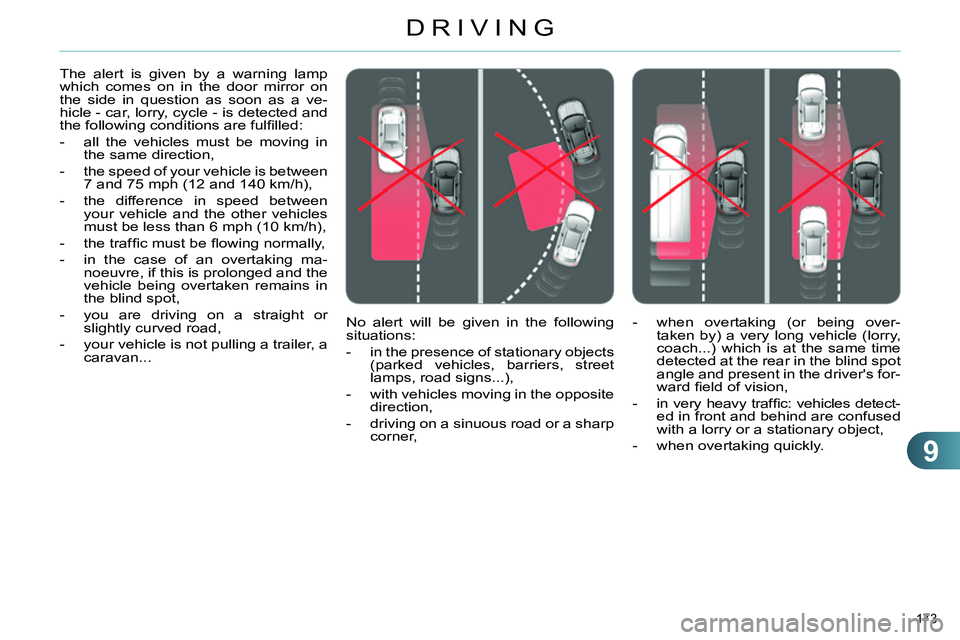
No alert will be given in the following
situations:
- in the presence of stationary objects
(parked vehicles, barriers, street
lamps, road signs...),
- with vehicles moving in the opposite
direction,
- driving on a sinuous road or a sharp
corner, The alert is given by a warning lamp
which comes on in the door mirror on
the side in question as soon as a ve-
hicle - car, lorry, cycle - is detected and
the following conditions are fulfi lled:
- all the vehicles must be moving in
the same direction,
- the speed of your vehicle is between
7 and 75 mph (12 and 140 km/h),
- the difference in speed between
your vehicle and the other vehicles
must be less than 6 mph (10 km/h),
- the traffi c must be fl owing normally,
- in the case of an overtaking ma-
noeuvre, if this is prolonged and the
vehicle being overtaken remains in
the blind spot,
- you are driving on a straight or
slightly curved road,
- your vehicle is not pulling a trailer, a
caravan...
- when overtaking (or being over-
taken by) a very long vehicle (lorry,
coach...) which is at the same time
detected at the rear in the blind spot
angle and present in the driver's for-
ward fi eld of vision,
- in very heavy traffi c: vehicles detect-
ed in front and behind are confused
with a lorry or a stationary object,
- when overtaking quickly.
Page 194 of 340
10
CHECKS
192
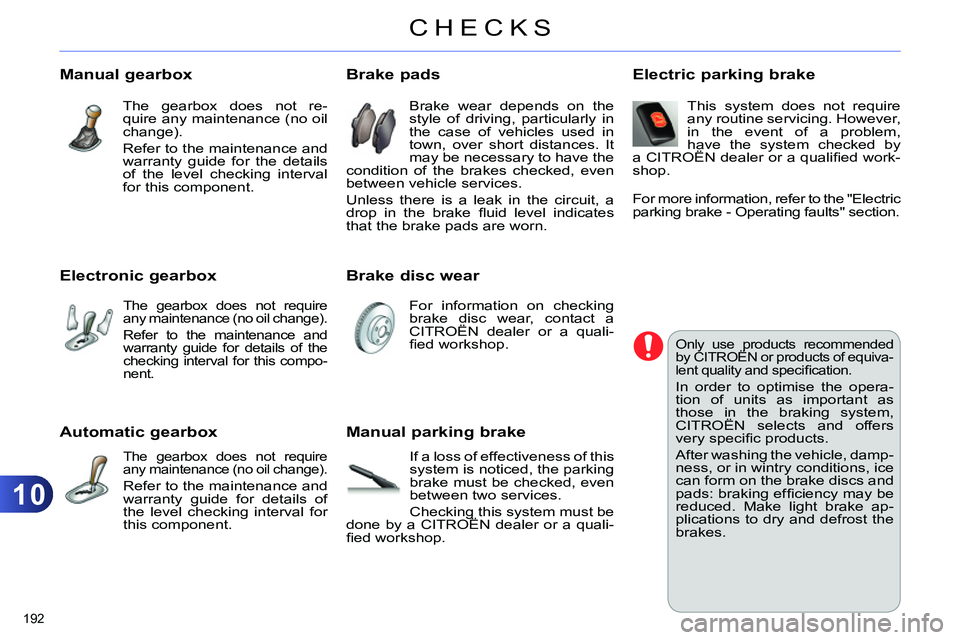
Automatic gearbox
The gearbox does not require
any maintenance (no oil change).
Refer to the maintenance and
warranty guide for details of
the level checking interval for
this component.
Electric parking brake
This system does not require
any routine servicing. However,
in the event of a problem,
have the system checked by
a CITROËN dealer or a qualifi ed work-
shop.
Manual parking brake
Only use products recommended
by CITROËN or products of equiva-
lent quality and specifi cation.
In order to optimise the opera-
tion of units as important as
those in the braking system,
CITROËN selects and offers
very specifi c products.
After washing the vehicle, damp-
ness, or in wintry conditions, ice
can form on the brake discs and
pads: braking effi ciency may be
reduced. Make light brake ap-
plications to dry and defrost the
brakes.
If a loss of effectiveness of this
system is noticed, the parking
brake must be checked, even
between two services.
Checking this system must be
done by a CITROËN dealer or a quali-
fi ed workshop.
Brake pads
Brake wear depends on the
style of driving, particularly in
the case of vehicles used in
town, over short distances. It
may be necessary to have the
condition of the brakes checked, even
between vehicle services.
Unless there is a leak in the circuit, a
drop in the brake fl uid level indicates
that the brake pads are worn.
Brake disc wear
For information on checking
brake disc wear, contact a
CITROËN dealer or a quali-
fi ed workshop.
For more information, refer to the "Electric
parking brake - Operating faults" section.
Manual gearbox
The gearbox does not re-
quire any maintenance (no oil
change).
Refer to the maintenance and
warranty guide for the details
of the level checking interval
for this component.
Electronic gearbox
The gearbox does not require
any maintenance (no oil change).
Refer to the maintenance and
warranty guide for details of the
checking interval for this compo-
nent.
Page 205 of 340
11
PRACTICAL INFORMATION
203
CHANGING A BULB
The headlamps are fi tted with
polycarbonate glass with a pro-
tective coating:
do not clean them using a
dry or abrasive cloth, nor
with a detergent or solvent
product,
use a sponge and soapy wa-
ter or a pH neutral product,
when using a high pressure
washer on persistent marks,
do not keep the lance direct-
ed towards the lamps or their
edges for too long, so as not
to damage their protective
coating and seals.
Changing a bulb should only be
done after the headlamp has
been switched off for a few min-
utes (risk of serious burns).
Do not touch the bulb directly
with your fi ngers, use a lint-
free cloth.
It is imperative to use only anti-
ultraviolet (UV) type bulbs to
avoid damaging the headlamp.
Always replace a failed bulb with
a new bulb with the same type
and specifi cation.
Risk of electrocution
Xenon bulbs (D1S-35W) must
be replaced by a CITROËN
dealer or a qualifi ed workshop.
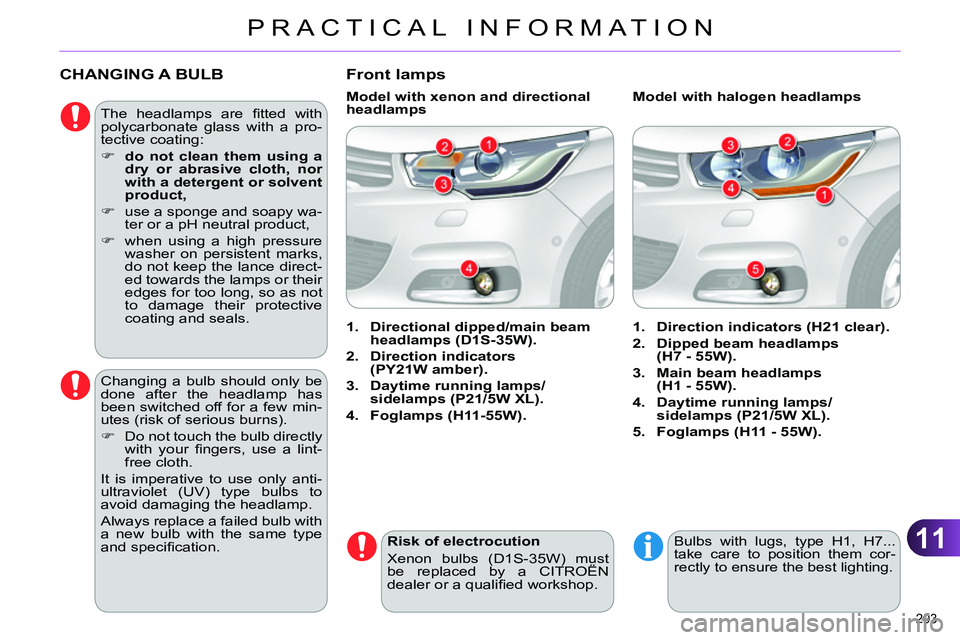
Front lamps
1.
Direction indicators (H21 clear).
2.
Dipped beam headlamps
(H7 - 55W).
3.
Main beam headlamps
(H1 - 55W).
4.
Daytime running lamps/
sidelamps (P21/5W XL).
5.
Foglamps (H11 - 55W).
1.
Directional dipped/main beam
headlamps (D1S-35W).
2.
Direction indicators
(PY21W amber).
3.
Daytime running lamps/
sidelamps (P21/5W XL).
4.
Foglamps (H11-55W).
Model with halogen headlamps
Model with xenon and directional
headlamps
Bulbs with lugs, type H1, H7...
take care to position them cor-
rectly to ensure the best lighting.
Page 212 of 340
11
PRACTICAL INFORMATION
210
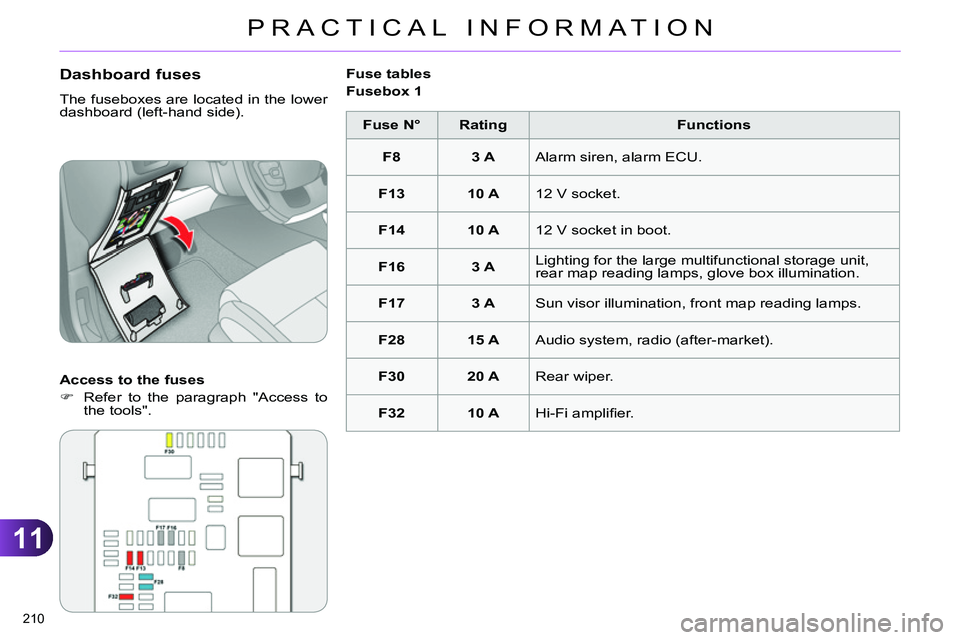
Dashboard fuses
The fuseboxes are located in the lower
dashboard (left-hand side).
Access to the fuses
Refer to the paragraph "Access to
the tools".
Fuse tables
Fusebox 1
Fuse N°
Rating
Functions
F8
3 A
Alarm siren, alarm ECU.
F13
10 A
12 V socket.
F14
10 A
12 V socket in boot.
F16
3 A
Lighting for the large multifunctional storage unit,
rear map reading lamps, glove box illumination.
F17
3 A
Sun visor illumination, front map reading lamps.
F28
15 A
Audio system, radio (after-market).
F30
20 A
Rear wiper.
F32
10 A
Hi-Fi amplifi er.
Page 222 of 340
11
PRACTICAL INFORMATION
220
TOWING A TRAILER
We recommend the use of genu-
ine CITROËN towbars and their
harnesses that have been tested
and approved from the design
stage of your vehicle, and that
the fi tting of the towbar is en-
trusted to a CITROËN dealer or
a qualifi ed workshop.
If the towbar is not fi tted by a
CITROËN dealer, it is impera-
tive that it is fi tted in accordance
with the vehicle manufacturer's
instructions.
The rear parking sensors will
be deactivated automatically if
a genuine CITROËN towbar is
used.
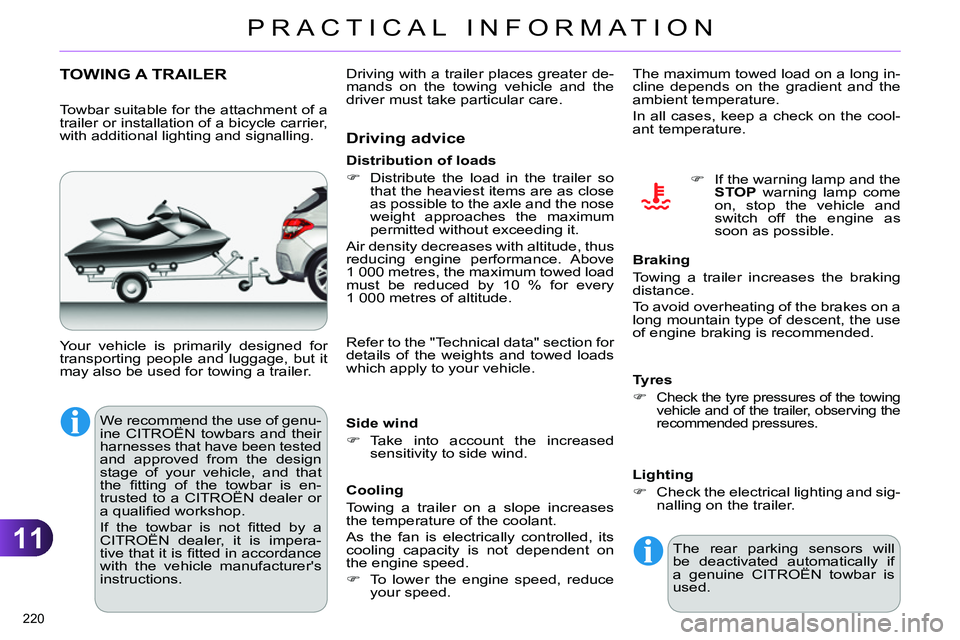
Towbar suitable for the attachment of a
trailer or installation of a bicycle carrier,
with additional lighting and signalling.
Your vehicle is primarily designed for
transporting people and luggage, but it
may also be used for towing a trailer.
Driving with a trailer places greater de-
mands on the towing vehicle and the
driver must take particular care.
Driving advice
Distribution of loads
Distribute the load in the trailer so
that the heaviest items are as close
as possible to the axle and the nose
weight approaches the maximum
permitted without exceeding it.
Air density decreases with altitude, thus
reducing engine performance. Above
1 000 metres, the maximum towed load
must be reduced by 10 % for every
1 000 metres of altitude.
Side wind
Take into account the increased
sensitivity to side wind.
Cooling
Towing a trailer on a slope increases
the temperature of the coolant.
As the fan is electrically controlled, its
cooling capacity is not dependent on
the engine speed.
To lower the engine speed, reduce
your speed. The maximum towed load on a long in-
cline depends on the gradient and the
ambient temperature.
In all cases, keep a check on the cool-
ant temperature.
If the warning lamp and the
STOP
warning lamp come
on, stop the vehicle and
switch off the engine as
soon as possible.
Braking
Towing a trailer increases the braking
distance.
To avoid overheating of the brakes on a
long mountain type of descent, the use
of engine braking is recommended.
Tyres
Check the tyre pressures of the towing
vehicle and of the trailer, observing the
recommended pressures.
Lighting
Check the electrical lighting and sig-
nalling on the trailer.
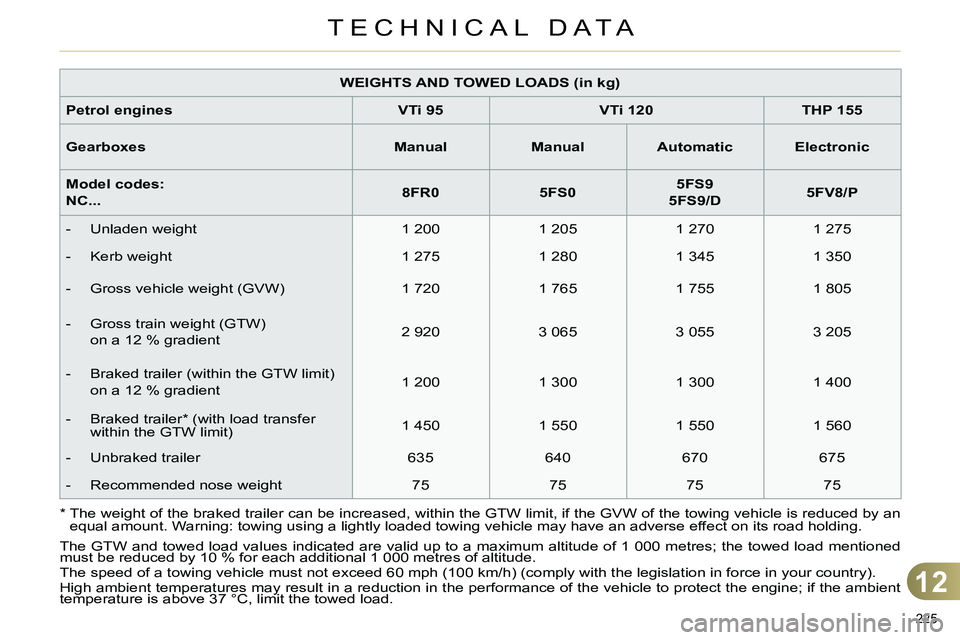
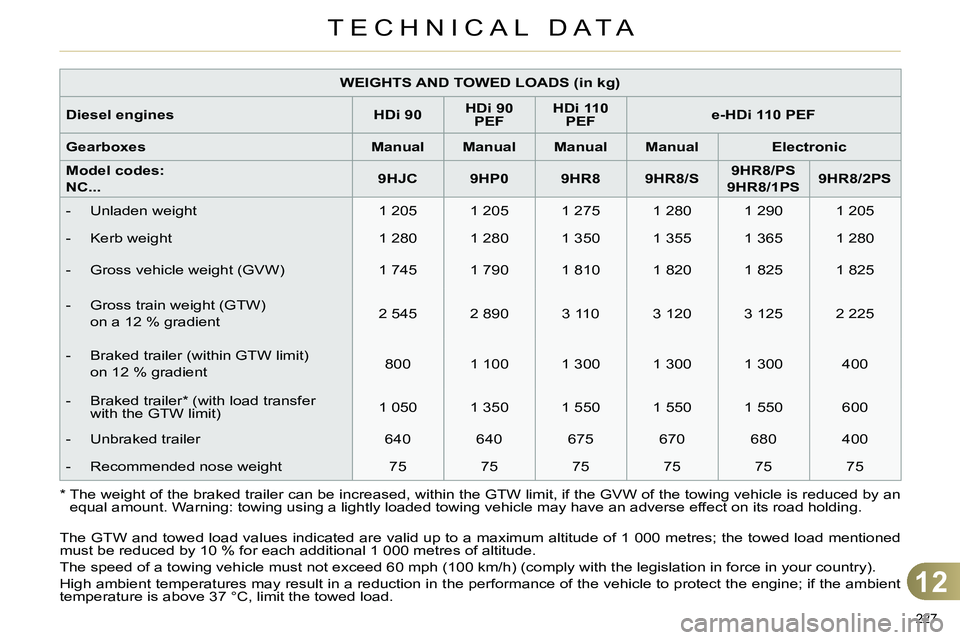
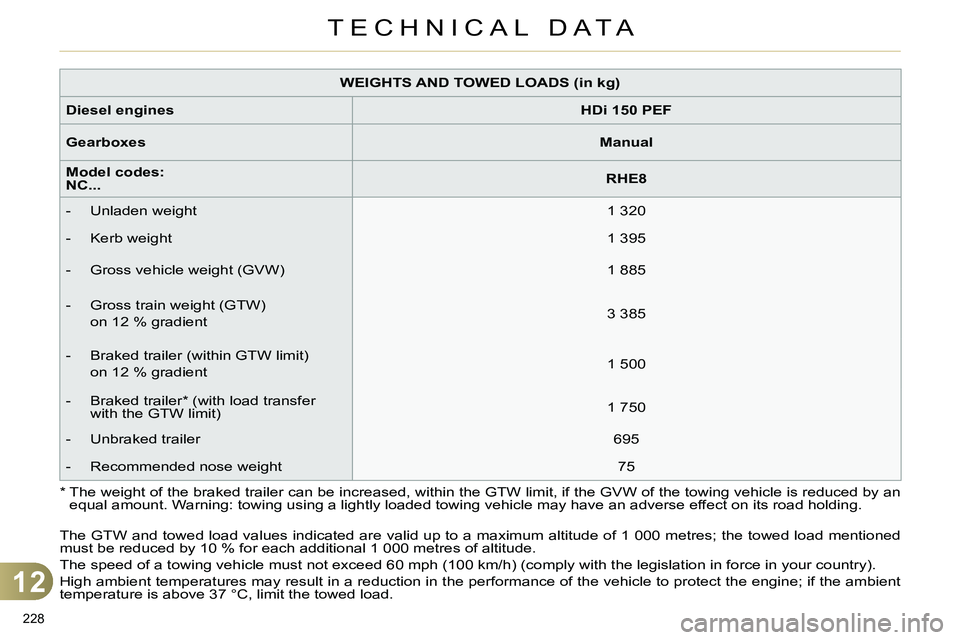
Refer to the "Technical data" section for
details of the weights and towed loads
which apply to your vehicle.
Page 227 of 340
12
TECHNICAL DATA
225
*
The weight of the braked trailer can be increased, within the GTW limit, if the GVW of the towing vehicle is reduced by an
equal amount. Warning: towing using a lightly loaded towing vehicle may have an adverse effect on its road holding.
The GTW and towed load values indicated are valid up to a maximum altitude of 1 000 metres; the towed load mentioned
must be reduced by 10 % for each additional 1 000 metres of altitude.
The speed of a towing vehicle must not exceed 60 mph (100 km/h) (comply with the legislation in force in your country).
High ambient temperatures may result in a reduction in the performance of the vehicle to protect the engine; if the ambient
temperature is above 37 °C, limit the towed load.
WEIGHTS AND TOWED LOADS (in kg)
Petrol engines
VTi 95
VTi 120
THP 155
Gearboxes
Manual
Manual
Automatic
Electronic
Model codes:
NC...
8FR0
5FS0
5FS9
5FS9/D
5FV8/P
- Unladen weight
1 200
1 205
1 270
1 275
- Kerb weight
1 275
1 280
1 345
1 350
- Gross vehicle weight (GVW)
1 720
1 765
1 755
1 805
- Gross train weight (GTW)
on a 12 % gradient
2 920
3 065
3 055
3 205
- Braked trailer (within the GTW limit)
on a 12 % gradient
1 200
1 300
1 300
1 400
- Braked trailer * (with load transfer
within the GTW limit)
1 450
1 550
1 550
1 560
- Unbraked trailer
635
640
670
675
- Recommended nose weight
75
75
75
75
Page 229 of 340
12
TECHNICAL DATA
227
*
The weight of the braked trailer can be increased, within the GTW limit, if the GVW of the towing vehicle is reduced by an
equal amount. Warning: towing using a lightly loaded towing vehicle may have an adverse effect on its road holding.
The GTW and towed load values indicated are valid up to a maximum altitude of 1 000 metres; the towed load mentioned
must be reduced by 10 % for each additional 1 000 metres of altitude.
The speed of a towing vehicle must not exceed 60 mph (100 km/h) (comply with the legislation in force in your country).
High ambient temperatures may result in a reduction in the performance of the vehicle to protect the engine; if the ambient
temperature is above 37 °C, limit the towed load.
WEIGHTS AND TOWED LOADS (in kg)
Diesel engines
HDi 90
HDi 90
PEF
HDi 110
PEF
e-HDi 110 PEF
Gearboxes
Manual
Manual
Manual
Manual
Electronic
Model codes:
NC...
9HJC
9HP0
9HR8
9HR8/S
9HR8/P
S
9HR8/1PS
9HR8/2PS
- Unladen weight
1 205
1 205
1 275
1 280
1 290
1 205
- Kerb weight
1 280
1 280
1 350
1 355
1 365
1 280
- Gross vehicle weight (GVW)
1 745
1 790
1 810
1 820
1 825
1 825
- Gross train weight (GTW)
on a 12 % gradient
2 545
2 890
3 110
3 120
3 125
2 225
- Braked trailer (within GTW limit)
on 12 % gradient
800
1 100
1 300
1 300
1 300
400
- Braked trailer * (with load transfer
with the GTW limit)
1 050
1 350
1 550
1 550
1 550
600
- Unbraked trailer
640
640
675
670
680
400
- Recommended nose weight
75
75
75
75
75
75
Page 230 of 340
12
TECHNICAL DATA
228
WEIGHTS AND TOWED LOADS (in kg)
Diesel engines
HDi 150 PEF
Gearboxes
Manual
Model codes:
NC...
RHE8
- Unladen weight
1 320
- Kerb weight
1 395
- Gross vehicle weight (GVW)
1 885
- Gross train weight (GTW)
on 12 % gradient
3 385
- Braked trailer (within GTW limit)
on 12 % gradient
1 500
- Braked trailer * (with load transfer
with the GTW limit)
1 750
- Unbraked trailer
695
- Recommended nose weight
75
*
The weight of the braked trailer can be increased, within the GTW limit, if the GVW of the towing vehicle is reduced by an
equal amount. Warning: towing using a lightly loaded towing vehicle may have an adverse effect on its road holding.
The GTW and towed load values indicated are valid up to a maximum altitude of 1 000 metres; the towed load mentioned
must be reduced by 10 % for each additional 1 000 metres of altitude.
The speed of a towing vehicle must not exceed 60 mph (100 km/h) (comply with the legislation in force in your country).
High ambient temperatures may result in a reduction in the performance of the vehicle to protect the engine; if the ambient
temperature is above 37 °C, limit the towed load.
Page 243 of 340
04
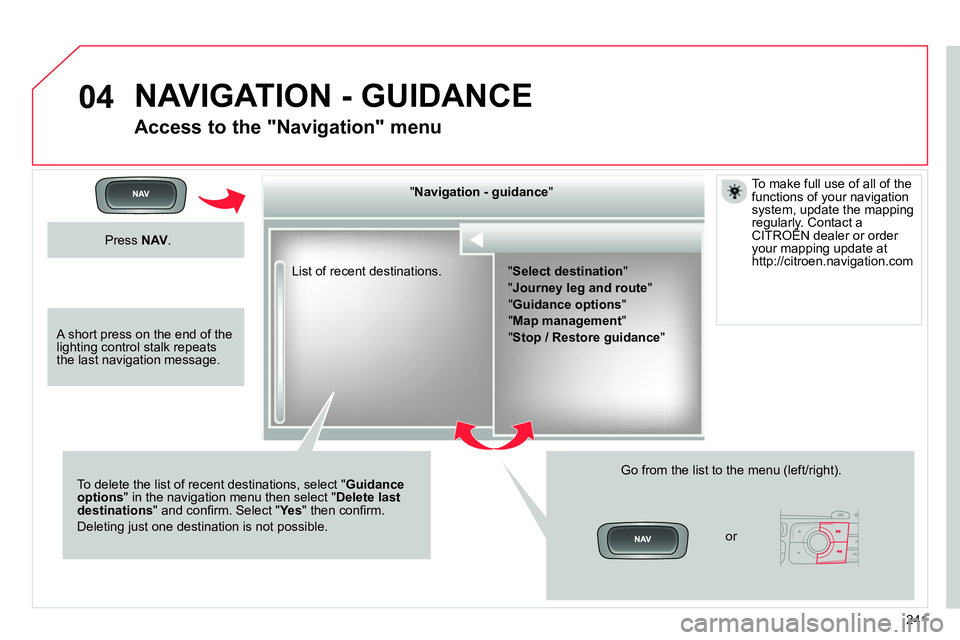
241 List of recent destinations.
" Navigation - guidance
"
To delete the list of recent destinations, select " Guidance
options
" in the navigation menu then select " Delete last
destinations
" and confi rm. Select " Ye s
" then confi rm.
Deleting just one destination is not possible.
Go from the list to the menu (left/right).
" Select destination
"
" Journey leg and route
"
" Guidance options
"
" Map management
"
" Stop / Restore guidance
"
NAVIGATION - GUIDANCE
Access to the "Navigation" menu
Press NAV
.
or
To make full use of all of the
functions of your navigation
system, update the mapping
regularly. Contact a
CITROËN dealer or order
your mapping update at
http://citroen.navigation.com
A short press on the end of the
lighting control stalk repeats
the last navigation message.
Page 325 of 340
323
VISUAL SEARCH
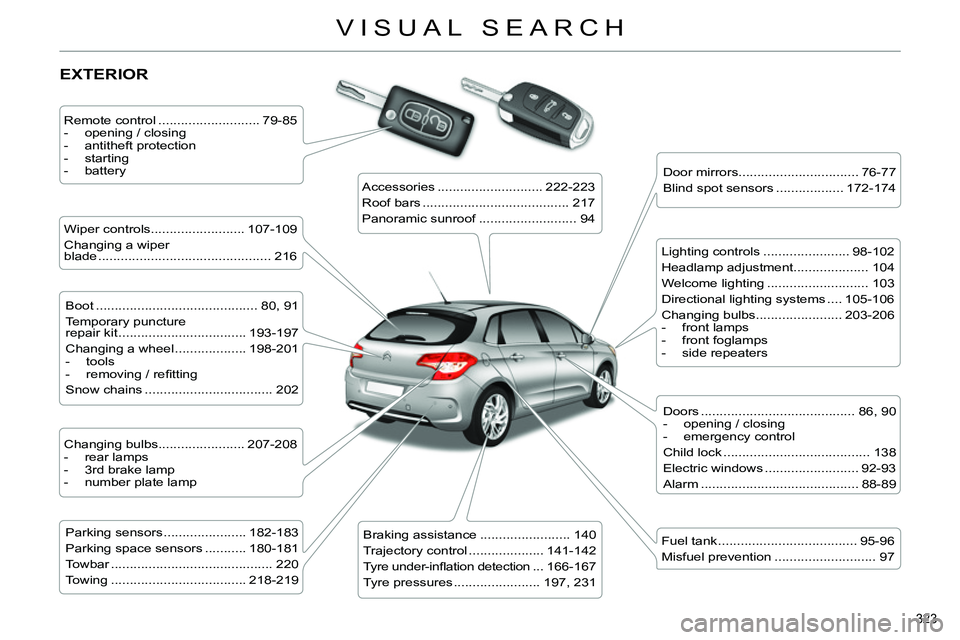
EXTERIOR
Remote control ........................... 79-85
- opening / closing
- antitheft protection
- starting
- battery
Wiper controls......................... 107-109
Changing a wiper
blade .............................................. 216
Door mirrors ................................ 76-77
Blind spot sensors .................. 172-174
Boot ........................................... 80, 91
Temporary puncture
repair kit .................................. 193-197
Changing a wheel ................... 198-201
- tools
- removing / refi tting
Snow chains .................................. 202
Changing bulbs....................... 207-208
- rear lamps
- 3rd brake lamp
- number plate lamp
Parking sensors ...................... 182-183
Parking space sensors ........... 180-181
Towbar ........................................... 220
Towing .................................... 218-219
Accessories ............................ 222-223
Roof bars ....................................... 217
Panoramic sunroof .......................... 94
Braking assistance ........................ 140
Trajectory control .................... 141-142
Tyre under-infl ation detection ...166-167
Tyre pressures ....................... 197, 231
Lighting controls ....................... 98-102
Headlamp adjustment.................... 104
Welcome lighting ........................... 103
Directional lighting systems .... 105-106
Changing bulbs....................... 203-206
- front lamps
- front foglamps
- side repeaters
Doors ......................................... 86, 90
- opening / closing
- emergency control
Child lock ....................................... 138
Electric windows ......................... 92-93
Alarm .......................................... 88-89
Fuel tank ..................................... 95-96
Misfuel prevention ........................... 97