check engine Citroen C4 DAG 2014.5 2.G Owner's Guide
[x] Cancel search | Manufacturer: CITROEN, Model Year: 2014.5, Model line: C4 DAG, Model: Citroen C4 DAG 2014.5 2.GPages: 340, PDF Size: 12.89 MB
Page 185 of 340
1010
183
C4-2_en_Chap10_verification_ed01-2014
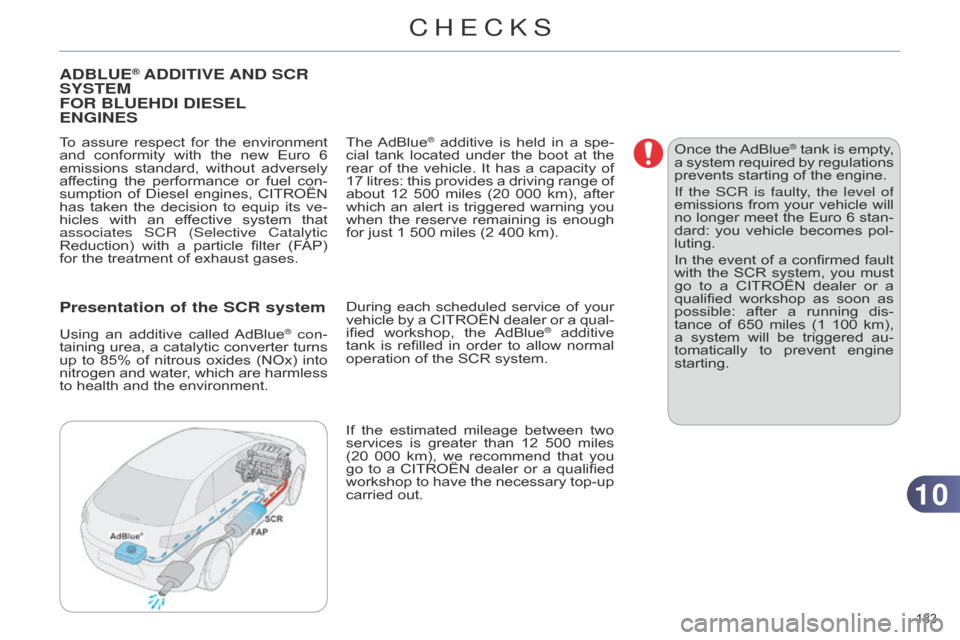
ADBLUE® ADDITIVE AND SCR SYSTEM
FOR
B
LUE HD I D IESEL
ENGINES
To assure respect for the environment and
conformity with the new Euro 6
emissions
standard,
without
adversely
af
fecting
the
performance
or
fuel
con
-
sumption
of
Diesel
engines,
CITROËN
has
taken
the
decision
to
equip
its
ve
-
hicles
with
an
ef
fective
system
that
associates SCR (Selective Catalytic
Reduction)
with
a
particle
filter
(F
AP)
for
the treatment of exhaust gases.
Presentation of the SCR system
Using an additive called AdBlue® con-
taining
urea,
a
catalytic
converter
turns
up
to
85%
of
nitrous
oxides
(NOx)
into
nitrogen
and
water
,
which
are
harmless
to
health
and
the
environment. The
AdBlue® additive
is held in a spe -
cial
tank
located under the boot at the
rear
of
the
vehicle.
It
has
a
capacity
of
17
litres:
this
provides
a
driving
range
of
about
12
500
miles
(20
000
km),
after
which
an
alert
is
triggered
warning
you
when
the
reserve
remaining
is
enough
for
just
1
500 miles (2 400 km).
During
each
scheduled
service
of
your
vehicle
by
a
CITROËN
dealer
or
a
qual
-
ified
workshop,
the
AdBlue® additive tank
is
refilled
in
order
to
allow normal
operation
of
the
SCR
system.
If
the
estimated
mileage
between
two
services
is
greater
than
12
500
miles
(20
000
km),
we
recommend
that
you
go
to
a
CITROËN
dealer
or
a
qualified
workshop
to
have
the
necessary
top-up
carried
out. Once
the
AdBlue® tank is
empty , a
system
required
by regulations
prevents
starting
of the engine.
If the SCR
is faulty, the level of
emissions
from
your
vehicle
will
no
longer
meet
the
Euro
6
stan
-
dard:
you
vehicle
becomes
pol
-
luting.
In
the
event
of
a
confirmed
fault
with
the
SCR
system,
you
must
go
to
a
CITROËN
dealer
or
a
qualified
workshop
as
soon
as
possible:
after
a
running
dis
-
tance
of
650
miles
(1
100
km),
a
system
will
be
triggered
au
-
tomatically
to
prevent
engine
starting.
CHECKS
Page 186 of 340
1010
184
C4-2_en_Chap10_verification_ed01-2014
Range indicators
When switching on the ignition, an indi -
cator gives an estimate of the distance
that
can
be
travelled
with
your
vehicle
before
engine
starting
is
automatically
prevented,
once
the
vehicle
starts
us
-
ing
the
reserve
of
AdBlue® or after a
fault
is
detected
with
the
SCR system.
In
the
event
of
simultaneous
system
fault
and
low
AdBlue® level, the short-
est
range
is
the
one
displayed. In the event of the risk of non-starting related to a lack of AdBlue
®
The engine
start prevention system required by regulations is activated automatically
once the AdBlue® tank is empty.
Range greater than 1 500 miles
(2
400 km)
When
the
ignition
is
switched
on,
no
information
on
range
is
displayed
auto
-
matically
in
the
instrument
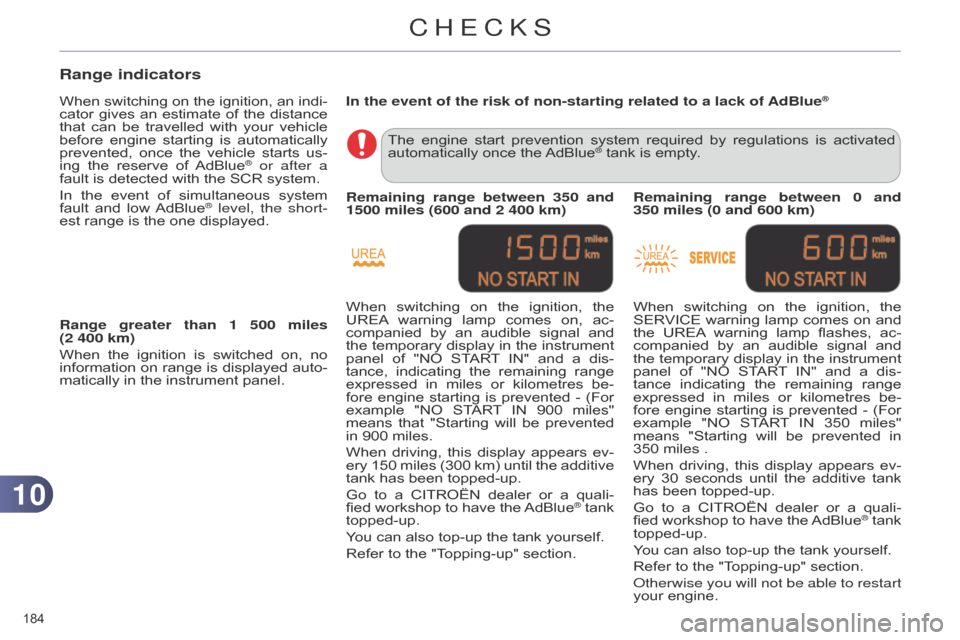
panel. Remaining range between 350 and
1500 miles (600 and 2 400 km)
When
switching
on
the
ignition,
the
UREA warning
lamp
comes
on,
ac
-
companied
by
an
audible
signal
and
the
temporary
display
in
the
instrument
panel
of
"NO
ST
ART
IN"
and
a
dis
-
tance,
indicating
the
remaining
range
expressed
in
miles
or
kilometres
be
-
fore
engine
starting
is
prevented
-
(For
example
"NO
ST
ART
IN
900
miles"
means
that
"Starting
will
be
prevented
in
900
miles.
When
driving,
this
display
appears
ev
-
ery
150
miles
(300
km)
until
the
additive
tank
has
been
topped-up.
Go
to
a
CITROËN
dealer
or
a
quali
-
fied
workshop
to
have
the
AdBlue® tank topped-up.
Y
ou
can
also
top-up
the
tank
yourself.
Refer
to
the
"Topping-up"
section. Remaining range between 0 and
350
miles (0 and 600 km)
When
switching
on
the
ignition,
the
SER
VICE
warning
lamp
comes
on
and
the
UREA warning
lamp
flashes,
ac
-
companied
by
an
audible
signal
and
the
temporary
display
in
the
instrument
panel
of
"NO
ST
ART
IN"
and
a
dis
-
tance
indicating
the
remaining
range
expressed
in
miles
or
kilometres
be
-
fore
engine
starting
is
prevented
-
(For
example
"NO
ST
ART
IN
350
miles"
means
"Starting
will
be
prevented
in
350
miles .
When
driving,
this
display
appears
ev
-
ery
30
seconds
until
the
additive
tank
has
been topped-up.
Go to a CITROËN dealer or a quali -
fied workshop to have the AdBlue® tank topped-up.
Y
ou
can
also
top-up
the
tank
yourself.
Refer
to
the
"Topping-up"
section.
o
therwise you will not be able to restart
your
engine.
CHECKS
Page 187 of 340
1010
185
C4-2_en_Chap10_verification_ed01-2014
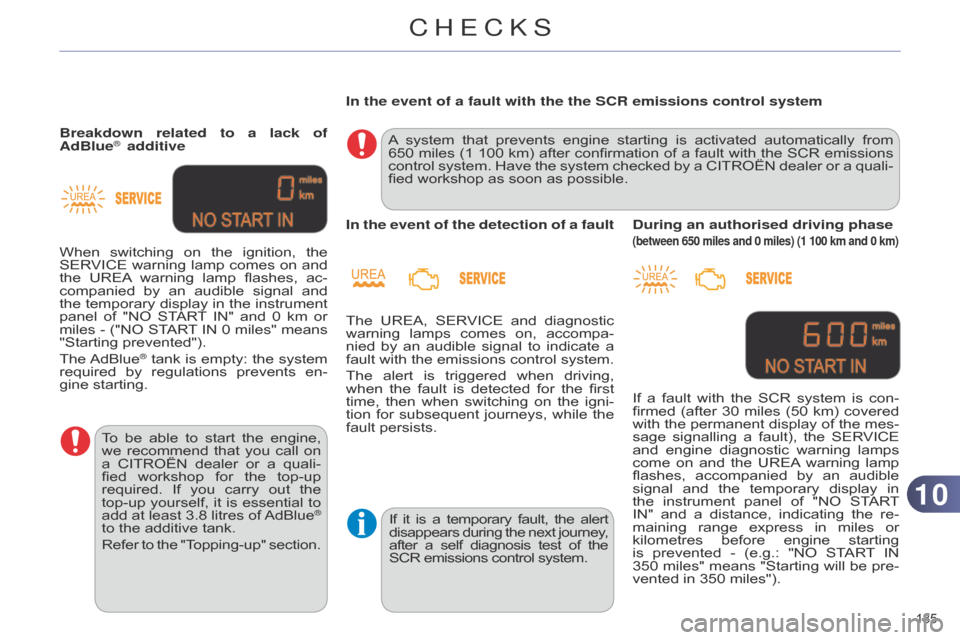
Breakdown related to a lack of
AdBlue® additive
To
be
able
to
start
the
engine,
we
recommend
that
you
call
on
a
CITROËN
dealer
or
a
quali
-
fied
workshop
for
the
top-up
required.
If
you
carry
out
the
top-up
yourself,
it
is
essential
to
add
at
least
3.8
litres
of
AdBlue®
to
the
additive
tank.
Refer
to
the
"T
opping-up"
section.
When
switching
on
the
ignition,
the
SER
VICE
warning
lamp
comes
on
and
the
UREA warning
lamp
flashes,
ac
-
companied
by
an
audible
signal
and
the
temporary
display
in
the
instrument
panel
of
"NO
ST
ART
IN"
and
0
km
or
miles
-
("NO
ST
ART
IN
0
miles"
means
"Starting
prevented").
The
AdBlue® tank
is empty: the system required
by
regulations prevents en -
gine
starting. In the event of a fault with the the SCR emissions control system
A
system
that
prevents
engine
starting
is
activated
automatically
from
650
miles
(1
100
km)
after
confirmation
of
a
fault
with
the
SCR
emissions
control
system.
Have
the
system
checked
by
a
CITROËN
dealer
or
a
quali
-
fied workshop as soon as possible.
In the event of the detection of a fault
The
UREA,
SER
VICE
and
diagnostic
warning
lamps
comes
on,
accompa
-
nied by an audible signal to indicate a fault
with the emissions control system.
The
alert
is
triggered
when
driving,
when
the
fault
is
detected
for
the
first
time,
then
when
switching
on
the
igni
-
tion
for
subsequent
journeys,
while
the
fault
persists.
If
it
is
a
temporary
fault,
the
alert disappears
during
the
next
journey
,
after
a
self
diagnosis
test
of
the SCR
emissions control system.During an authorised driving phase
(between 650 miles and 0 miles) (1 100 km and 0 km)
If a
fault with the SCR system is con -
firmed (after 30 miles (50 km) covered
with
the
permanent
display
of
the
mes
-
sage
signallin
g
a
fault),
the
SER
VICE
and
engine
diagnostic
warning
lamps
come
on
and
the
UREA warning
lamp
flashes,
accompanied
by
an
audible
signal
and
the
temporary
display
in
the
instrument
panel
of
"NO
ST
ART
IN"
and
a
distance,
indicating
the
re
-
maining
range
express
in
miles
or
kilometres
before
engine
starting
is
prevented
-
(e.g.:
"NO
ST
ART
IN
350
miles"
means
"Starting
will
be
pre
-
vented
in 350 miles").
CHECKS
Page 188 of 340
1010
186
C4-2_en_Chap10_verification_ed01-2014
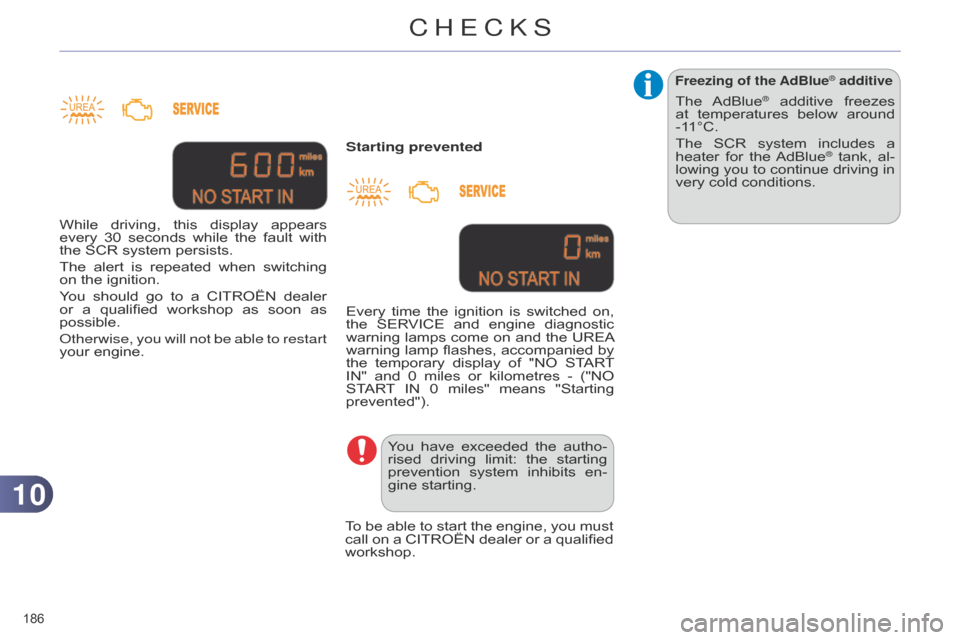
Starting preventedYou
have
exceeded
the
autho
-
rised
driving
limit:
the
starting
prevention
system
inhibits
en
-
gine
starting.
Every
time
the
ignition
is
switched
on,
the
SER
VICE
and
engine
diagnostic
warning
lamps
come
on
and
the
UREA warning
lamp
flashes,
accompanied
by
the
temporary
display
of
"NO
ST
ART
IN"
and
0
miles
or
kilometres
-
("NO
ST
ART
IN
0
miles"
means
"Starting
prevented").
T
o
be
able
to
start
the
engine,
you
must
call
on
a
CITROËN
dealer
or
a
qualified
workshop.
Freezing of the AdBlue® additive
The AdBlue® additive freezes at
temperatures below around
-1
1°C.
The
SCR
system
includes
a
heater
for
the
AdBlue® tank, al-
lowing
you
to
continue
driving in
very
cold
conditions.
While
driving,
this
display
appears
every
30
seconds
while
the
fault
with
the
SCR
system
persists.
The
alert
is
repeated
when
switching
on
the
ignition.
You
should
go
to
a
CITROËN
dealer
or
a
qualified
workshop
as
soon
as
possible.
o
therwise, you will not be able to
restart
your
engine.
CHECKS
Page 191 of 340
1010
189
C4-2_en_Chap10_verification_ed01-2014
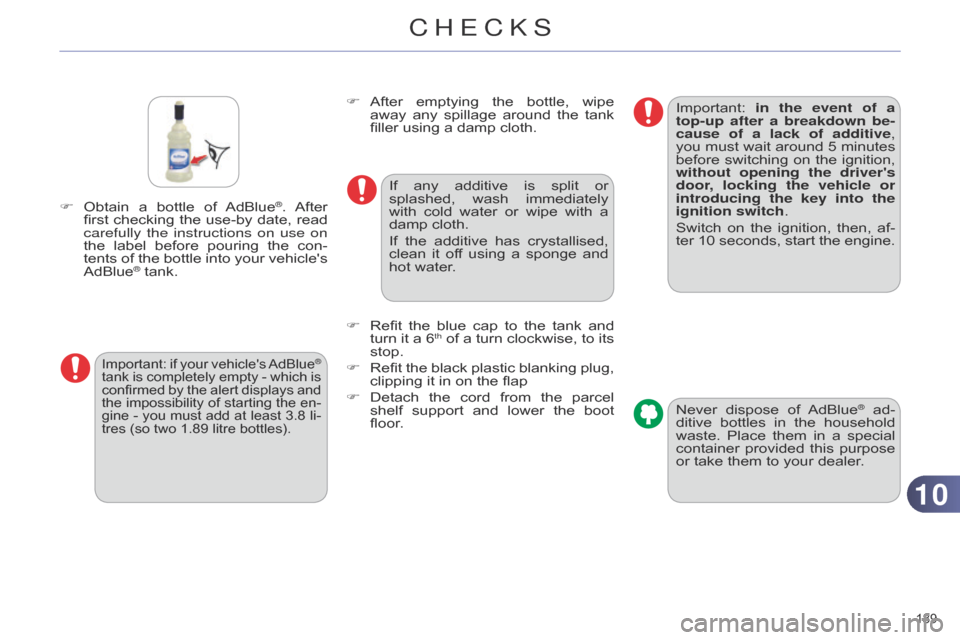
F Obtain a bottle of AdBlue®. After first
checking
the
use-by
date, read
carefully
the instructions on use on
the
label
before
pouring
the
con
-
tents
of
the
bottle
into
your
vehicle's
AdBlue® tank.
Important: if your vehicle's AdBlue®
tank
is
completely
empty
-
which
is
confirmed
by
the
alert
displays
and
the
impossibility
of
starting
the
en
-
gine
-
you
must
add
at
least
3.8
li-
tres
(so
two
1.89
litre
bottles).
F After emptying the bottle, wipe away
any spilla ge around the tank
filler
using a damp cloth.
If
any
additive
is
split
or
splashed,
wash
immediately
with
cold
water
or
wipe
with
a
damp
cloth.
If
the
additive
has
crystallised,
clean
it
of
f
using
a
sponge
and
hot
water.
F
Refit
the
blue
cap
to
the
tank
and
turn
it
a
6th of a turn clockwise, to its stop.
F
Refit
the
black
plastic
blanking
plug,
clipping
it
in on the flap
F
Detach
the
cord
from
the
parcel
shelf
support
and
lower
the
boot
floor
. Never
dispose
of
AdBlue® ad-
ditive
bottles
in
the
household
waste.
Place
them
in
a
special
container
provided
this
purpose
or
take
them
to
your
dealer.
Important:
in the event of a
top-up
after a breakdown be-
cause of a lack of additive,
you
must
wait
around
5
minutes
before
switching
on
the
ignition,
without
opening the driver's
door, locking the vehicle or
introducing the key into the
ignition switch.
Switch
on
the
ignition,
then,
af
-
ter
10
seconds,
start
the
engine.
CHECKS
Page 196 of 340
1111
194
C4-2_en_Chap11_info-pratique_ed01-2014
Removing the cartridge
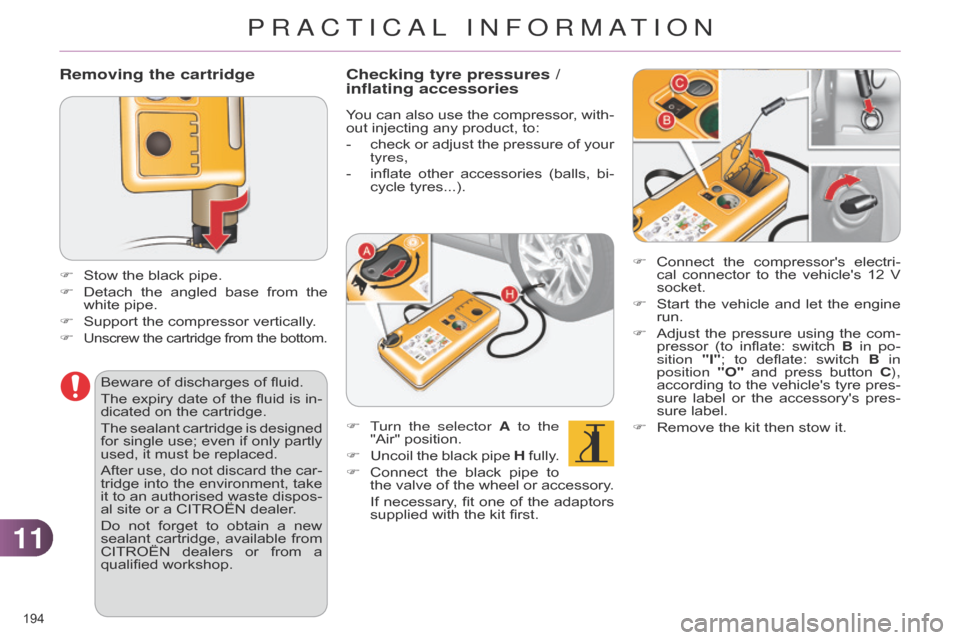
F Stow the black pipe.
F
Detach
the
angled
base
from
the
white
pipe.
F
Support
the compressor vertically.
F
Unscrew the cartridge from the bottom.
F Connect the compressor's electri -
cal connector to the vehicle's 12 V
socket.
F
Start
the
vehicle
and
let
the
engine
run.
F
Adjust
the
pressure
using
the
com
-
pressor
(to
inflate:
switch
B
in po-
sition "I";
to
deflate:
switch
B
in
position "O"
and
press
button
C
),
according
to
the
vehicle's
tyre
pres
-
sure
label
or
the
accessory's
pres
-
sure
label.
F
Remove
the kit then stow it.
Beware
of
discharges
of
fluid.
The
expiry
date
of
the
fluid
is
in
-
dicated
on
the
cartridge.
The
sealant
cartridge
is
designed
for
single
use;
even
if
only
partly
used,
it
must
be
replaced.
After
use,
do
not
discard
the
car
-
tridge
into
the
environment,
take
it
to
an
authorised
waste
dispos
-
al
site
or
a
CITROËN
dealer.
Do
not
forget
to
obtain
a
new
sealant
cartridge,
available
from
CITROËN
dealers
or
from
a
qualified
workshop.
Checking tyre pressures /
inflating accessories
You can also use the compressor , with -
out injecting any product, to:
-
check
or
adjust
the
pressure
of
your
tyres,
-
inflate
other
accessories
(balls,
bi
-
cycle
tyres...).
F
T
urn the selector A to the
"Air"
position.
F
Uncoil
the
black
pipe
H
fully
.
F
Connect
the
black
pipe
to
the
valve
of
the
wheel
or
accessory
.
If
necessary
,
fit
one
of
the
adaptors
supplied
with the kit first.
PRACTICAL INFORMATION
Page 214 of 340
1111
212
C4-2_en_Chap11_info-pratique_ed01-2014
When your vehicle's battery is dis -
charged, the engine can be started
using
a
slave
battery
(external
or
on
another
vehicle) and jump lead cables.
Starting using another battery
12 V
BATTERY
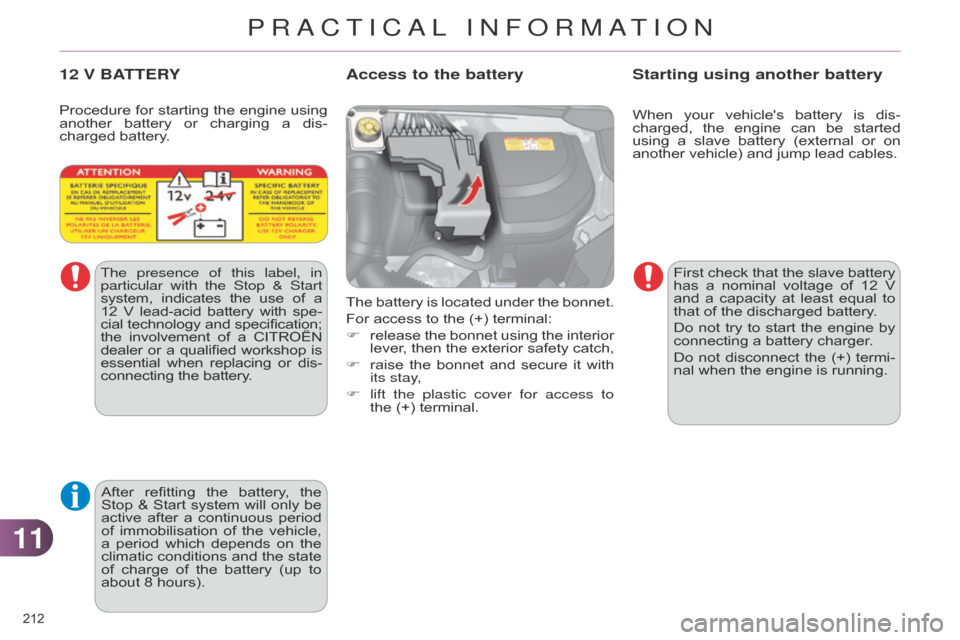
The battery is located under the bonnet.
For access to the (+) terminal:
F
release
the
bonnet
using
the
interior
lever
,
then
the
exterior
safety
catch,
F
raise
the
bonnet
and
secure
it
with
its stay
,
F
lift the plastic cover for access to
the (+)
terminal.
Access to the battery
The presence of this label, in
particular with the Stop & Start
system,
indicates
the
use
of
a 12
V
lead-acid
battery
with
spe
-
cial
technology
and
specification; the
involvement
of
a
CITROËN dealer
or
a
qualified
workshop
is essential
when
replacing
or
dis
-
connecting
the battery.
Procedure
for
starting
the
engine
using
another
battery
or
charging
a
dis
-
charged battery.
After
refitting
the
battery
,
the
Stop
&
Start
system
will
only
be
active
after
a
continuous
period
of
immobilisation
of
the
vehicle,
a
period
which
depends
on
the
climatic
conditions
and
the
state
of
charge
of
the
battery
(up
to
about
8 hours). First
check that the slave battery has
a nominal voltage of 12 V
and
a
capacity
at
least
equal
to
that
of the discharged battery.
Do
not
try
to
start
the
engine
by
connecting
a battery charger.
Do
not
disconnect
the
(+)
termi
-
nal
when the engine is running.
PRACTICAL INFORMATION
Page 216 of 340
1111
214
C4-2_en_Chap11_info-pratique_ed01-2014
Charging the battery using
a battery chargerIt is advisable to disconnect the battery if the vehicle is to be left
unused
for more than one month.
The
batteries
contain
harmful
substances
such as sulphuric
acid
and
lead.
They
must
be
disposed
of
in
accordance
with
regulations
and
must
not,
in
any
circumstances,
be
discarded
with
household
waste.
Take
used
remote
control
bat
-
teries
and
vehicle
batteries
to
a
special
collection
point.
F
Disconnect the battery from the vehicle.
F Follow the instructions for use pro -
vided by the manufacturer of the
charger
.
F
Connect
the
battery
starting
with
the
negative
terminal (-).
F
Check
that
the
terminals
and
con
-
nectors
are
clean.
If
they
are
covered with
sulphate
(whitish
or
greenish
deposit),
remove
them
and
clean
them. Protect
your
eyes
and
face
be
-
fore handling the battery.
a
ll operations on the battery
must be carried out in a well ventilated
area and away from naked
flames and sources of
sparks,
so
as
to
avoid
the
risk
of
explosion
or fire.
Do
not
try
to
charge
a
frozen
battery;
the
battery
must
first
be
thawed
out
to
avoid
the
risk
of
explosion.
If
the
battery
has
been
frozen,
before
charging
have
it
checked
by
a
CITROËN
dealer
or
a
qualified
workshop
who
will
check
that
the
inter
-
nal
components
have
not
been
damaged
and
the
casing
is
not
cracked,
which
could
cause
a
leak
of toxic and corrosive acid.
Do
not
reverse
the
polarity
and
use
only a 12 V charger.
Do
not
disconnect
the
terminals
while
the engine is running.
Do
not
charge
the
batteries
with
-
out
disconnecting
the
terminals
first.
W
ash your hands afterwards.
Reinitialisation after
reconnection
after any reconnection of the battery,
switch on the ignition and wait at least
one
minute
before
starting,
to
allow
time
for
the initialisation of the
electronic
systems.
By
referring
to
the
corresponding
sec
-
tions,
you
should
set
or
initialise
the
fol
-
lowing
systems yourself:
-
one-touch
electric windows,
-
time
and date,
-
audio
and
navigation
system
set
-
tings.
Check
that
no
alert
message
or
warning
lamp
comes
on
after
switching
on
the
ignition.
However
,
if
minor
problems
persist
after
carrying
out
these
operations,
contact
a
CITROËN
dealer
or
a
quali
-
fied
workshop. Some
functions
are
not
available
if
the
battery
is
not
sufficiently
charged.
d
o not push the vehicle to start
the
engine
if
you
have
an
elec
-
tronic
or automatic gearbox.
With Stop & Start, the battery
does
not
have
to
be
disconnect
-
ed
for charging.
PRACTICAL INFORMATION
Page 221 of 340
1111
219
C4-2_en_Chap11_info-pratique_ed01-2014
TOWING A TRAILER
We recommend the use of genu -
ine CITROËN towbars and their
harnesses
that
have
been
tested
and
approved
from
the
design
stage
of
your
vehicle,
and
that
the
fitting
of
the
towbar
is
en
-
trusted
to
a
CITROËN
dealer
or
a
qualified workshop.
If
the
towbar
is
not
fitted
by
a
CITROËN
dealer
,
it
must
still
be
fitted
in
accordance
with
the
vehicle
manufacturer's
instruc
-
tions.
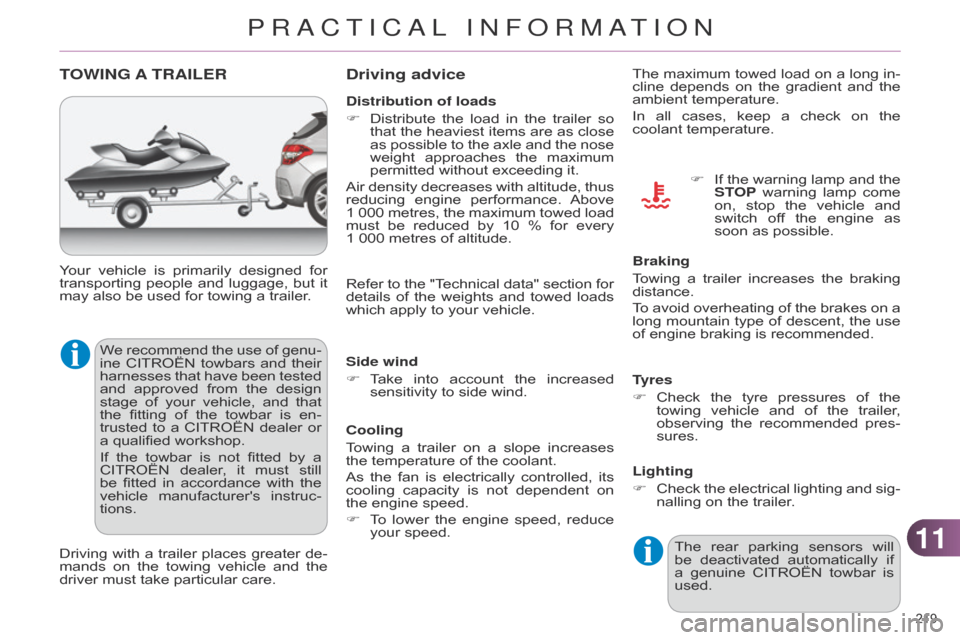
Your
vehicle
is
primarily
designed
for
transporting
people
and
luggage,
but
it
may
also be used for towing a trailer.
Driving
with
a
trailer
places
greater
de
-
mands
on
the
towing
vehicle
and
the
driver
must take particular care.
Driving advice
Distribution of loads
F
Distribute
the
load
in
the
trailer
so
that
the
heaviest
items
are
as
close
as
possible
to
the
axle
and
the
nose
weight
approaches
the
maximum
permitted
without exceeding it.
Air
density
decreases
with
altitude,
thus
reducing
engine
performance.
Above
1
000
metres,
the
maximum
towed
load
must
be
reduced
by
10
%
for
every
1 000
metres of altitude.
Side wind
F
T
ake
into
account
the
increased
sensitivity
to side wind.
Cooling
Towing
a
trailer
on
a
slope
increases
the
temperature of the coolant.
As
the
fan
is
electrically
controlled,
its
cooling
capacity
is
not
dependent
on
the
engine speed.
F
T
o
lower
the
engine
speed,
reduce
your
speed. The
maximum
towed
load
on
a
long
in
-
cline depends on the gradient and the ambient
temperature.
In all cases, keep a check on the
coolant
temperature.
F
If
the
warning
lamp
and
the
ST
OP
warning
lamp
come
on,
stop
the
vehicle
and
switch
of
f
the
engine
as
soon
as possible.
Braking
Towing
a
trailer
increases
the
braking
distance.
T
o
avoid
overheating
of
the
brakes
on
a
long
mountain
type
of
descent,
the
use
of
engine braking is recommended.
Tyres
F
Check
the
tyre
pressures
of
the
towing
vehicle
and
of
the
trailer
,
observing
the
recommended
pres
-
sures.
Lighting
F
Check
the
electrical
lighting
and
sig
-
nalling
on the trailer.
Refer
to
the
"T
echnical
data"
section
for
details
of
the
weights
and
towed
loads
which
apply to your vehicle.
The
rear
parking
sensors
will
be
deactivated
automatically
if
a
genuine
CITROËN
towbar
is
used.
PRACTICAL INFORMATION
Page 329 of 340
327
C4-2_en_Chap14_index-alpha_ed01-2014
ABS and EBFD
systems .................................. 123a
ccessories
............................... 221
Accessory
socket, 12V
......... 97,
98,
101,
105
AdBlue
® ..................................... 183
Additive, AdBlue .......... 23, 183, 186
Adjusting
headlamps
................... 87
Adjusting
head
restraints
................................... 59
Adjusting
seat belt
height
.............................. 126,
127
Adjusting
the steering
wheel
........................................ 65
Advice
on
driving
..................................... 133
Airbags
................................ 22,
129
Airbags,
curtain.................. 131, 132
Airbags,
front
..................... 129,
132
Airbags,
lateral................... 131, 132
Air
conditioning
............................ 10
Air
conditioning,
automatic
...................... 48,
49, 52
Air
conditioning,
manual
................................. 48-50
Air
filter
...................................... 181
Air
flow
......................................... 10a
ir vents....................................... 47
Alarm
........................................... 74
Anti-lock
braking
system
(ABS)
.......................... 123
Anti-pinch..................................... 78
Anti-theft
.................................... 134
Armrest,
front
....................... 99,
100
Armrest,
rear
.............................. 103a
ssistance call
.......................... 125,
235,
236Audible
warning
......................... 122
Audio
streaming
( b luetooth)
.............. 278,
308, 310
Audio system
................. 35,
37, 293
Automatic illumination
of headlamps ...................... 82, 85
Automatic operation
of
hazard warning lamps
........ 122
Automatic
rain sensitive
windscreen
wipers
.............. 90,
91
Auxiliary
socket.................. 279, 307
Auxiliary
sockets
.......................... 97
A
Backup
starting
.......................... 212b
attery
........................ 181,
212-214
Battery,
charging
........................ 214
Battery
, remote
control
.................................. 69-71
Black
panel
.................................. 33
Blind
spot
sensors
................................... 158b
lue H d i
............................ 174,
183
b
luetooth (hands-free)
.................... 260,
309
b
luetooth (telephone)
............................. 260b
onnet
....................................... 175b
onnet stay................................ 175
b
oot
............................................. 77
Boot
lamp
............................ 94,
106
Brake
discs
................................ 182
Brake
lamps............................... 206
Brake
pads
................................ 182
Brakes
....................................... 182
Braking
assistance
system
.................................... 123
B
C
Capacity
, fuel tank
..................... 171
C
d
............................................. 302
CD
MP3
............................. 303,
304
Central locking
....................... 68,
72
Centre console ............................ 98
Changing a bulb ................ 202, 206
Changing a fuse ........................ 208
Changing
a wheel
...................... 195
Changing
a wiper blade
....... 92,
215
Changing
the date
........... 35,
37, 42
Changing
the remote
control battery
..................... 69,
70
Changing
the time
..... 32,
35, 37, 42
Checking
levels
.................. 178-180
Checking
the engine
oil level...................................... 29
Checking
tyre pressures
(using
the kit)
.......................... 190
Checks.............................. 176,
177,
181,
182
Child
lock
................................... 121
Children
...................... 1
15, 118, 119
Child
seats
....................... 108,
109,
113-115,
120
Child
seats, conventional............11 4
C
ITR o Ë n Localised
a
ssistance Call
....................... 236
C
ITR o Ë n Localised
Emergency
Call
...................... 236
Clock
............................................ 32
Closing
the boot..................... 68, 77
Closing
the doors................... 68, 76
Cold
climate screen
................... 216
Colour screen
.............................. 41
Connectors,
audio
....... 97,
305, 307
Coolant level
.............................. 179
Courtesy
lamps...................... 86, 93
aLPHabETICaL IndEx