ignition Citroen C4 PICASSO 2015 2.G Service Manual
[x] Cancel search | Manufacturer: CITROEN, Model Year: 2015, Model line: C4 PICASSO, Model: Citroen C4 PICASSO 2015 2.GPages: 420, PDF Size: 10.72 MB
Page 195 of 420
193
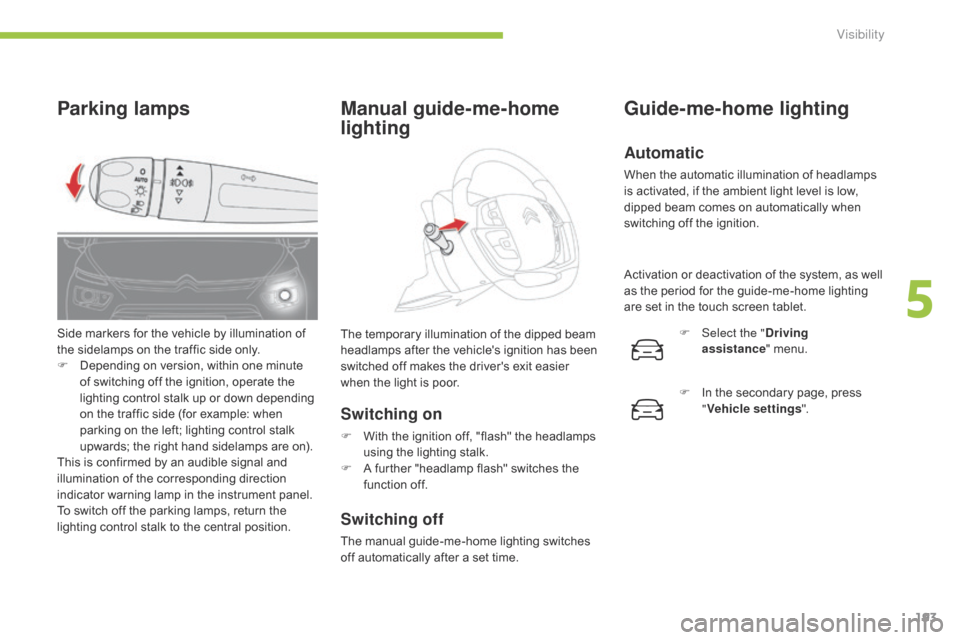
Parking lampsManual guide-me-home
lighting
Switching on
F With the ignition off, "flash" the headlamps u
sing the lighting stalk.
F
A
further "headlamp flash" switches the
f
unction off.
Switching off
The manual guide-me-home lighting switches off automatically after a set time.
The
temporary illumination of the dipped beam
h
eadlamps after the vehicle's ignition has been
s
witched off makes the driver's exit easier
w
hen the light is poor.
Side
markers
for
the
vehicle
by
illumination
of
t
he
sidelamps
on
the
traffic
side
only.
F
D
epending
on
version,
within
one
minute
o
f
switching
off
the
ignition,
operate
the
l
ighting
control
stalk
up
or
down
depending
o
n
the
traffic
side
(for
example:
when
p
arking
on
the
left;
lighting
control
stalk
u
pwards;
the
right
hand
sidelamps
are
on).
This
is
confirmed
by
an
audible
signal
and
i
llumination
of
the
corresponding
direction
i
ndicator
warning
lamp
in
the
instrument
panel.
To
switch
off
the
parking
lamps,
return
the
l
ighting
control
stalk
to
the
central
position.
Guide-me-home lighting
Automatic
When the automatic illumination of headlamps i
s activated, if the ambient light level is low,
d
ipped beam comes on automatically when
s
witching off the ignition.
Activation
or deactivation of the system, as well
a
s the period for the guide-me-home lighting
a
re set in the touch screen tablet.
F
I
n the secondary page, press
"V
ehicle settings".
F
Sel
ect the "Driving
assistance " menu.
5
Visibility
Page 199 of 420

197
To make your approach to the vehicle easier, these illuminate:
-
t
he zones facing the driver’s and
p
assenger’s
do
ors,
-
t
he zones for ward of the door mirrors and
r
ear ward of the front doors.
Door mirror spotlamps
Switching on
The spotlamps come on automatically:- when you unlock the vehicle,- when you remove the electronic key from the reader,- when you open a door,- when you use the remote control to locate the v
ehicle.
Switching off
They go off automatically after 30 seconds.
Exterior welcome lighting
Switching on
F Press the open padlock on the r
emote control or one of the front
d
oor handles with Keyless Entry
an
d
S
tarting.
T
he dipped beam headlamps
a
nd the sidelamps come on; your
v
ehicle is also unlocked.
Programming
Daytime running lamps
(LEDs)
They come on automatically when the engine is started, when the lighting control stalk is in
p
osition " 0" or " AUTO ".
In
some weather conditions (e.g. low
t
emperature or humidity), the presence
o
f misting on the internal sur face of the
g
lass of the headlamps and rear lamps
i
s normal; it disappears after the lamps
h
ave been on for a few minutes. The
remote switching on of the lighting makes
y
our approach to the vehicle easier in poor
light. It is activated when the lighting control
i
s in the "
AUTO" position and the level of light
d
etected by the sunshine sensor is low.
Switching off
The activation, deactivation and choice of w
elcome lighting duration are done in the
"D
riving assistance "
menu then "Vehicle
settings ".
The
exterior welcome lighting switches off
a
utomatically after a set time, when the ignition
i
s switched on or on locking the vehicle.
5
Visibility
Page 207 of 420
205
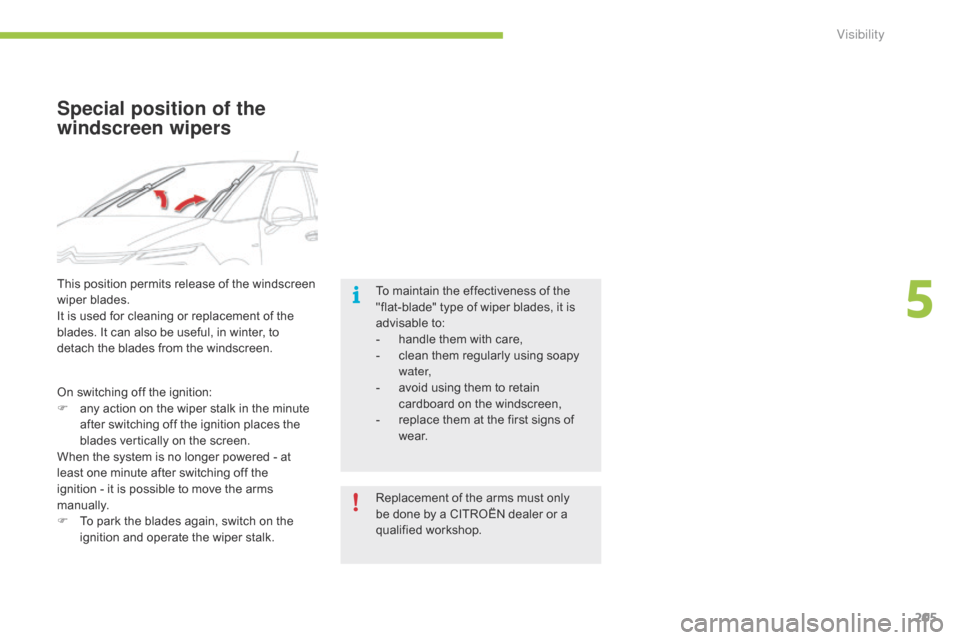
Special position of the
windscreen wipers
To maintain the effectiveness of the "flat-blade" type of wiper blades, it is
a
dvisable
t
o:
-
h
andle them with care,
-
c
lean them regularly using soapy
w
ater,
-
a
void using them to retain
c
ardboard on the windscreen,
-
r
eplace them at the first signs of
w
e a r.
This
position
permits
release
of
the
windscreen
w
iper
blades.
It
is
used
for
cleaning
or
replacement
of
the
b
lades.
It
can
also
be
useful,
in
winter,
to
d
etach
the
blades
from
the
windscreen.
On
switching
off
the
ignition:
F
a
ny
action
on
the
wiper
stalk
in
the
minute
a
fter
switching
off
the
ignition
places
the
b
lades
vertically
on
the
screen.
When
the
system
is
no
longer
powered
-
at
l
east
one
minute
after
switching
off
the
i
gnition -
it
is
possible
to
move
the
arms
m
anually.
F
T
o
park
the
blades
again,
switch
on
the
i
gnition
and
operate
the
wiper
stalk. Replacement
of the arms must only
b
e done by a CITROËN dealer or a
q
ualified
w
orkshop.
5
Visibility
Page 208 of 420

206
Courtesy lamps
1. Front courtesy lamp
2. F ront map reading lamps
3.
R
ear courtesy lamp
4.
R
ear map reading lamps
Front - rear courtesy lamps
F With the ignition on, press the c
orresponding s witch.
Front - rear map reading
lamps
With the "permanent lighting" mode, the lighting time varies according to the circumstances:
- with the ignition off, approximately t
en minutes,
- in energy economy mode, approximately t
hirty seconds,
- with the engine running, unlimited.
In this position, the courtesy lamp c
omes on gradually:
Permanently
off.
Permanent
l
ighting.
-
w
hen
the vehicle is unlocked,
-
w
hen
the electronic key is removed from
t
he
r
eader,
-
w
hen
opening a door,
-
w
hen
the remote control locking button is
u
sed,
in order to locate your vehicle.
It
switches off gradually:
-
w
hen
the vehicle is locked,
-
w
hen
the ignition is switched on,
-
3
0
seconds after the last door is closed.Take
care to avoid leaving anything in
c
ontact with the courtesy lamps.
Depending
o
n
v
ersion, you can
also switch the
courtesy
lamp on or
o
ff by pressing this
b
utton.
Visibility
Page 211 of 420

209
Direction indicators
F Left: lower the lighting stalk passing the p
oint of resistance.
F
R
ight: raise the lighting stalk passing the
p
oint of resistance.
Three flashes of the direction
indicators
F Press briefly upwards or downwards, w
ithout going beyond the point of
r
esistance; the direction indicators will
f
lash 3 times.
Hazard warning lam ps
Visual warning by means of the direction i
ndicators to alert other road users to a vehicle
b
reakdown, towing or accident.
F
Press this button, the direction indicators flash.They can operate with the ignition off.
Automatic operation of
hazard warning lamps
When braking in an emergency, depending on the deceleration, the hazard warning lamps
c
ome on automatically.
They
switch off automatically the first time you
a
ccelerate.
F
Y
ou can also switch them off by pressing
t
he button.
Horn
F Press the central part of the steering w
heel.
6
Safety
Page 215 of 420
213
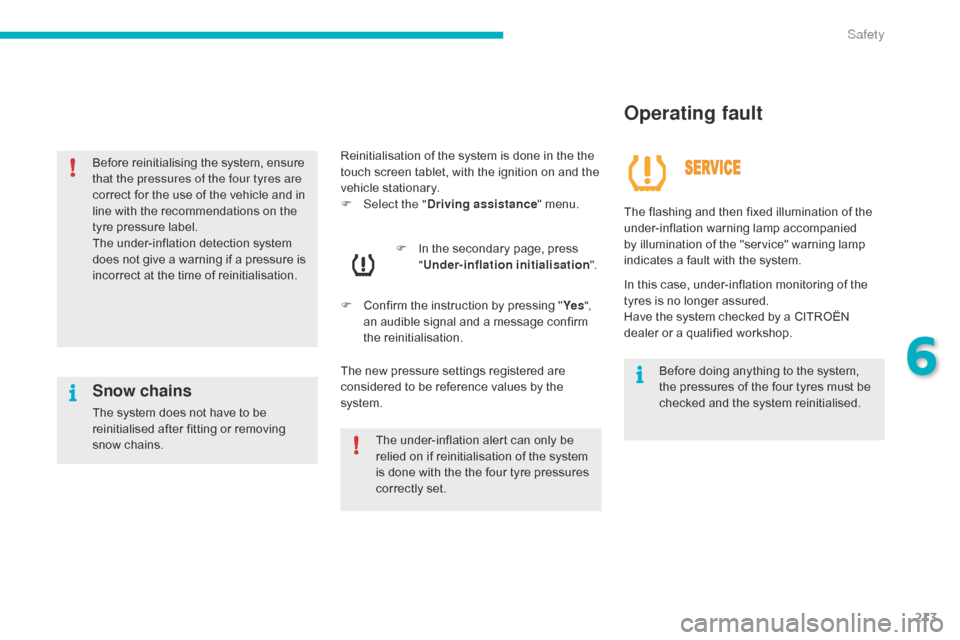
Reinitialisation of the system is done in the the touch screen tablet, with the ignition on and the
v
ehicle stationary.
F
Sel
ect the " Driving assistance "
menu.
F
I
n the secondary page, press
"U
nder-inflation initialisation ".
F
C
onfirm the instruction by pressing "Ye s ",
an
audible signal and a message confirm
th
e
r
einitialisation.
The
new pressure settings registered are
c
onsidered to be reference values by the
s
ystem.
Operating fault
The flashing and then fixed illumination of the u nder-inflation w arning lam p a ccompanied b
y illumination of the "service" warning lamp
i
ndicates a fault with the system.
In
this case, under-inflation monitoring of the
t
yres is no longer assured.
Have
the system checked by a CITROËN
d
ealer or a qualified workshop.
Before
doing anything to the system,
t
he pressures of the four tyres must be
c
hecked and the system reinitialised.
The
under-inflation
alert
can
only
be
r
elied
on
if
reinitialisation
of
the
system
i
s
done
with
the
the
four
tyre
pressures
c
orrectly
set.
Snow chains
The system does not have to be r einitialised after fitting or removing
sn
ow
c
hains.
Before
reinitialising the system, ensure
t
hat the pressures of the four tyres are
correct for the use of the vehicle and in
l
ine with the recommendations on the
t
yre pressure label.
The under-inflation detection system
d
oes not give a warning if a pressure is
i
ncorrect at the time of reinitialisation.
6
Safety
Page 219 of 420
217
After an impact, have these systems checked by a CITROËN dealer or a
q
ualified
w
orkshop.
Operating fault
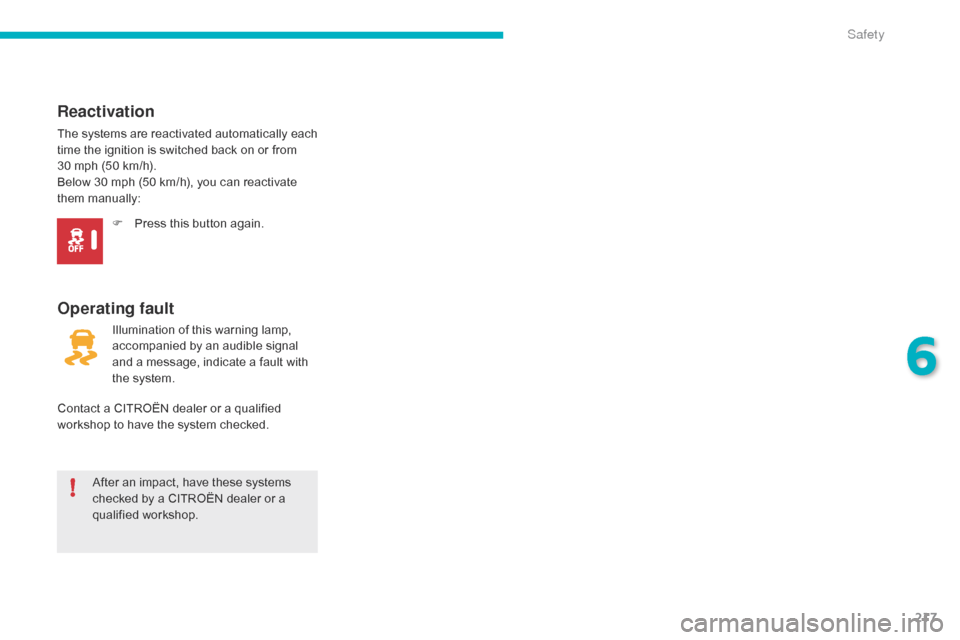
Reactivation
The systems
a re r eactivated a utomatically e ach t
ime the ignition is switched back on or from
3
0 mph (50 km/h).
Below
30 mph (50 km/h), you can reactivate
t
hem
m
anually:F
P
ress this button again.
Illumination
of this warning lamp,
a
ccompanied by an audible signal
a
nd a message, indicate a fault with
t
he system.
Contact
a CITROËN dealer or a qualified
w
orkshop to have the system checked.
6
Safety
Page 220 of 420
218
Seat belts
Front seat belts
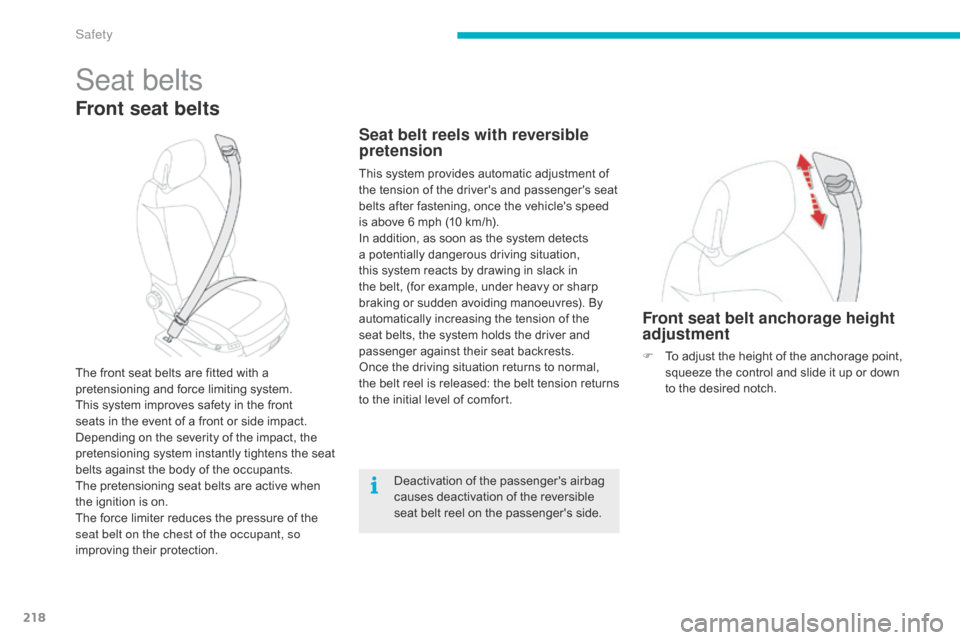
The front seat belts are fitted with a pretensioning and force limiting system.
This
system improves safety in the front
s
eats in the event of a front or side impact.
D
epending on the severity of the impact, the
p
retensioning system instantly tightens the seat
b
elts against the body of the occupants.
The
pretensioning seat belts are active when
t
he ignition is on.
The
force limiter reduces the pressure of the
s
eat belt on the chest of the occupant, so
improving
their protection.
Seat belt reels with reversible
pretension
This system provides automatic adjustment of the tension of the driver's and passenger's seat
b
elts after fastening, once the vehicle's speed
i
s above 6 mph (10 km/h).
In
addition, as soon as the system detects
a
potentially dangerous driving situation,
t
his system reacts by drawing in slack in
t
he belt, (for example, under heavy or sharp
b
raking or sudden avoiding manoeuvres). By
a
utomatically increasing the tension of the
s
eat belts, the system holds the driver and
p
assenger
a
gainst
t
heir
sea
t
b
ackrests.
Once
the driving situation returns to normal,
t
he belt reel is released: the belt tension returns
t
o the initial level of comfort.
Deactivation
of the passenger's airbag
c
auses deactivation of the reversible
s
eat belt reel on the passenger's side.
Front seat belt anchorage height
adjustment
F To adjust the height of the anchorage point, s
queeze the control and slide it up or down
t
o the desired notch.
Safety
Page 223 of 420
221
Seat belt not fastened
and unfastened alerts
Rear seat belts not fastened
alert
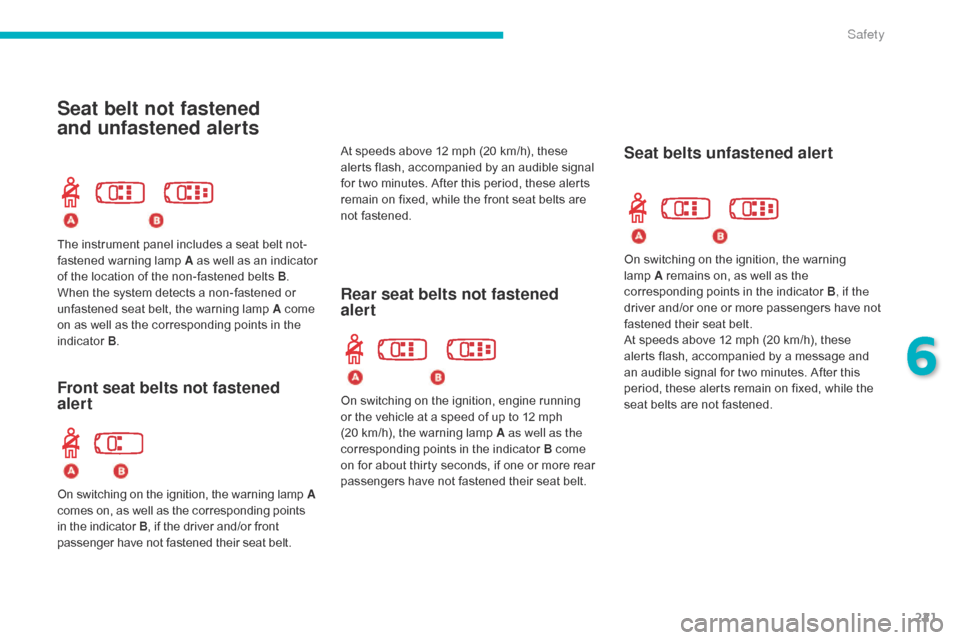
The instrument panel includes a seat belt not-
f astened w arning lam p A as well as an indicator o
f the location of the non-fastened belts B.
When
the system detects a non-fastened or
u
nfastened seat belt, the warning lamp A come
o
n as well as the corresponding points in the
i
ndicator B.
On
switching on the ignition, engine running
o
r the vehicle at a speed of up to 12 mph
(
20 km/h), the warning lamp A as well as the
corresponding
points in the indicator B come
o
n for about thirty seconds, if one or more rear
p
assengers have not fastened their seat belt.
Seat belts unfastened alert
Front seat belts not fastened
alert
On switching on the ignition, the warning lamp A
c omes on, as well as the corresponding points i
n the indicator B,
if the driver and/or front
p
assenger have not fastened their seat belt.At
speeds above 12 mph (20 km/h), these
a
lerts flash, accompanied by an audible signal
f
or two minutes. After this period, these alerts
r
emain on fixed, while the front seat belts are
n
ot fastened.
On switching on the ignition, the warning
lam
p
A
remains on, as well as the
c
orresponding points in the indicator B
, if the
driver and/or one or more passengers have not
f
astened their seat belt.
At speeds above 12 mph (20 km/h), these
a
lerts flash, accompanied by a message and
a
n audible signal for two minutes. After this
p
eriod, these alerts remain on fixed, while the
s
eat belts are not fastened.
6
Safety
Page 225 of 420
223
Airbags
System designed to contribute towards improving the safety of the occupants
(with
the exception of the rear centre
p
assenger) in the event of violent collisions.
T
he airbags supplement the action of the force-
limiting
seat belts (with the exception of the
c
entre
r
ear
p
assenger).
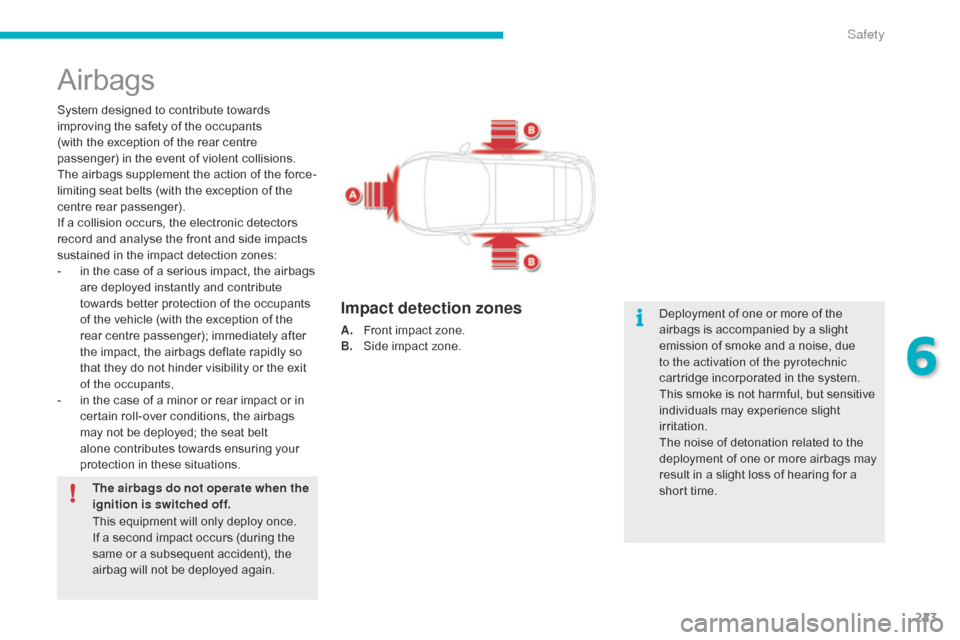
If
a collision occurs, the electronic detectors
r
ecord and analyse the front and side impacts
s
ustained in the impact detection zones:
-
i
n the case of a serious impact, the airbags
a
re deployed instantly and contribute
t
owards better protection of the occupants
o
f the vehicle (with the exception of the
r
ear centre passenger); immediately after
t
he impact, the airbags deflate rapidly so
t
hat they do not hinder visibility or the exit
o
f the occupants,
-
i
n the case of a minor or rear impact or in
c
ertain roll-over conditions, the airbags
m
ay not be deployed; the seat belt
a
lone contributes towards ensuring your
p
rotection in these situations.
The airbags do not operate when the
ignition is switched off.
This
equipment will only deploy once.
I
f a second impact occurs (during the
s
ame or a subsequent accident), the
a
irbag will not be deployed again. Deployment
of one or more of the
a
irbags is accompanied by a slight
e
mission of smoke and a noise, due
t
o the activation of the pyrotechnic
cartridge
incorporated in the system.
This
smoke is not harmful, but sensitive
i
ndividuals may experience slight
ir
ritation.
The
noise of detonation related to the
d
eployment of one or more airbags may
r
esult in a slight loss of hearing for a
s
hort time.
Impact detection zones
A. Front impact zone.
B. S ide impact zone.
6
Safety