charging Citroen C4 PICASSO 2015 2.G Owner's Manual
[x] Cancel search | Manufacturer: CITROEN, Model Year: 2015, Model line: C4 PICASSO, Model: Citroen C4 PICASSO 2015 2.GPages: 420, PDF Size: 10.72 MB
Page 38 of 420
36
Warning / indicator lampStateCause Action / Observations
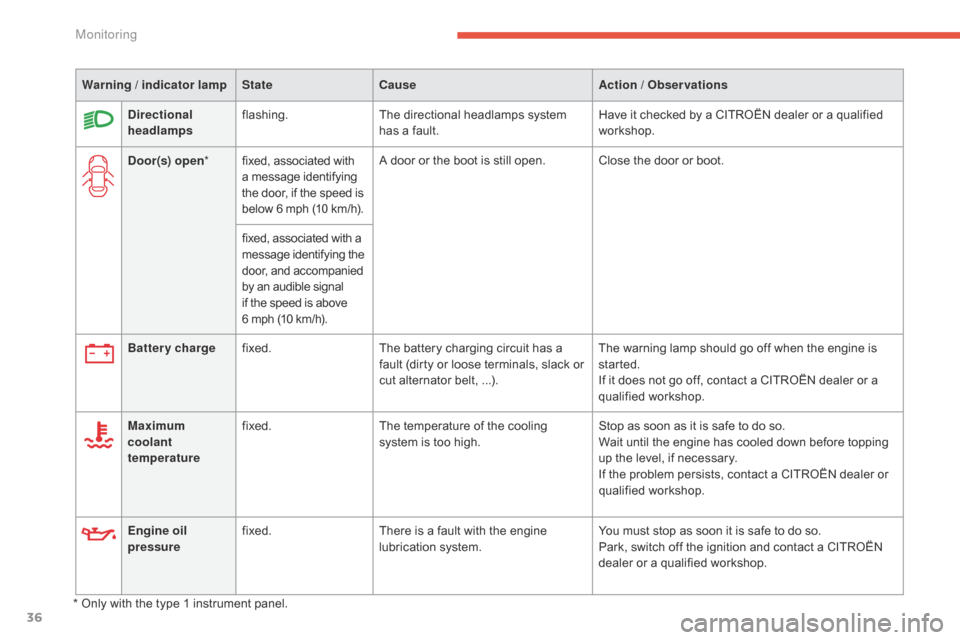
Battery charge fixed. The
battery charging circuit has a
f
ault (dirty or loose terminals, slack or
c
ut alternator belt, ...).The
warning lamp should go off when the engine is
s
tarted.
If
it does not go off, contact a CITROËN dealer or a
q
ualified
w
orkshop.
Maximum
coolant
temperature fixed.
The
temperature of the cooling
s
ystem is too high.Stop
as soon as it is safe to do so.
Wait
until the engine has cooled down before topping
u
p the level, if necessary.
If
the problem persists, contact a CITROËN dealer or
q
ualified
w
orkshop.
Directional
headlamps
flashing.
The
directional headlamps system
h
as a fault.Have
it checked by a CITROËN dealer or a qualified
w
orkshop.
Door(s) open *fixed,
associated with
a m
essage
id
entifying
t
he door, if the speed is
b
elow 6 mph (10 km/h).A
door or the boot is still open. Close the door or boot.
fixed,
associated with a
m
essage
id
entifying
th
e
d
oor, and accompanied
b
y an audible signal
i
f the speed is above
6
mph (10 km/h).
*
Only with the type 1 instrument panel.
Engine oil
pressure
fixed.
There
is a fault with the engine
l
ubrication system.You
must stop as soon it is safe to do so.
Park,
switch off the ignition and contact a CITROËN
d
ealer or a qualified workshop.
Monitoring
Page 69 of 420
67
Manual operation
When opening and closing a motorised tailgate manually, there is no assistance from gas-filled
s
truts. Resistance to opening and closing is
t
herefore entirely normal.
Reinitialising the tailgate
This operation is necessary where there is no
movement - after detection of an obstacle, after
c
onnecting or recharging the battery, ...
F
O
pen the tailgate by hand, if necessary.
F
M
anually close the tailgate fully.
If
the problem persists, contact a CITROËN
d
ealer or a qualified workshop.
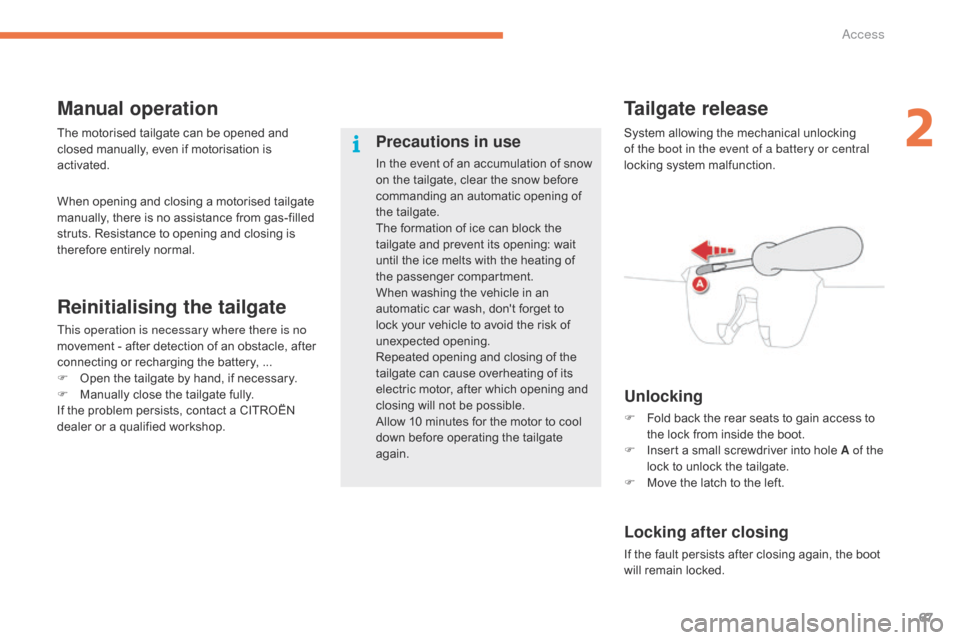
Tailgate release
Unlocking
F Fold back the rear seats to gain access to t
he lock from inside the boot.
F
I
nsert a small screwdriver into hole A of the
lock
to unlock the tailgate.
F
M
ove the latch to the left.
Locking after closing
If the fault persists after closing again, the boot will remain locked.
The
motorised
tailgate
can
be
opened
and
c
losed
manually,
even
if
motorisation
is
a
ctivated.
Precautions in use
In the event of an accumulation of snow o
n the tailgate, clear the snow before
c
ommanding an automatic opening of
t
he tailgate.
The
formation of ice can block the
t
ailgate and prevent its opening: wait
u
ntil the ice melts with the heating of
t
he
p
assenger
c
ompartment.
When
washing the vehicle in an
a
utomatic car wash, don't forget to
l
ock your vehicle to avoid the risk of
u
nexpected
ope
ning.
Repeated
opening and closing of the
t
ailgate can cause overheating of its
e
lectric motor, after which opening and
c
losing will not be possible.
Allow
10 minutes for the motor to cool
d
own before operating the tailgate
ag
ain. System
allowing the mechanical unlocking o
f the boot in the event of a battery or central
locking system malfunction.
2
Access
Page 77 of 420
75
Front seats
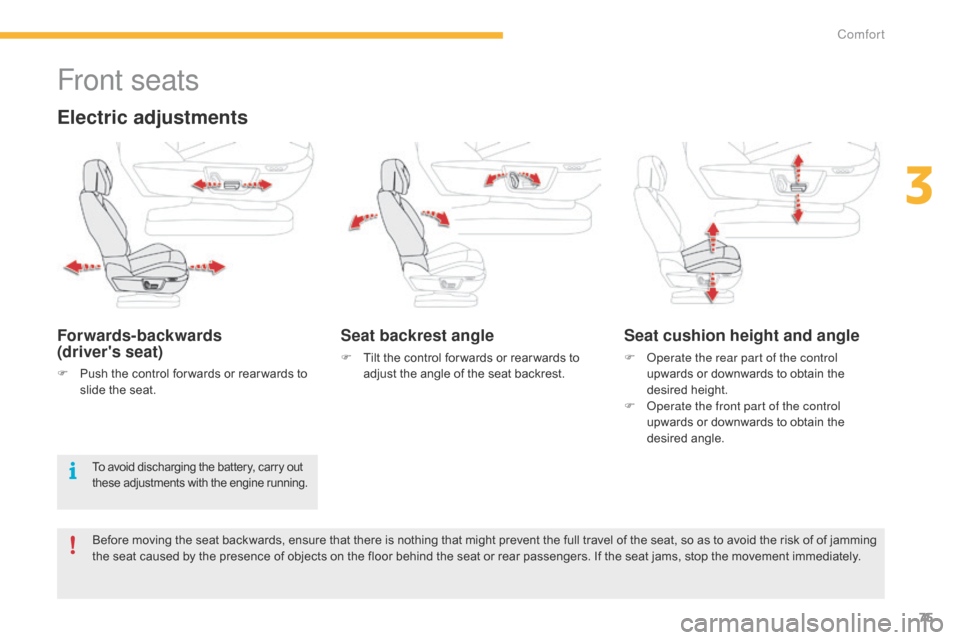
Electric adjustments
Forwards-backwards
(driver's seat)
F Push the control for wards or rear wards to s
lide the seat.
Seat backrest angle
F Tilt the control for wards or rear wards to a
djust the angle of the seat backrest.
Seat cushion height and angle
F operate the rear part of the control upwards or downwards to obtain the
de
sired
h
eight.
F
o
p
erate the front part of the control
upwards
or downwards to obtain the
de
sired
a
ngle.
To avoid discharging the battery, carry out these adjustments with the engine running.
Before moving the seat backwards, ensure that there is nothing that might prevent the full travel of the seat, so as to avoid the risk of of jamming the seat caused by the presence of objects on the floor behind the seat or rear passengers. If the seat jams, stop the movement immediately.
3
Comfort
Page 151 of 420
149
The system is reactivated automatically every time the engine is started by the
d
river.
Reactivation
Press this button again.
Operating fault
Have it checked by a CITROËN dealer or a qualified w orkshop.
In
the event of a fault in STOP mode, the vehicle
m
ay stall.
All
of the instrument panel warning lamps come on.
Depending
on version, an alert message may also
b
e displayed, asking you to place the gear selector
l
ever on position N
and put your foot on the brake
ped
al.
It
is then necessary to switch off the ignition and
s
tart the engine again using the "START/STOP"
b
utton. In
t
he
e
vent
o
f
a
f
ault
w
ith
t
he
s
ystem,
t
he symbol for the button changes
t
o alert mode and the warning lamp
f
lashes for a few moments then
c
omes on continuously.
The
system
is
active
again;
this
is
c
onfirmed
by
the
indicator
lamp
in
the
b
utton
going
off
and
illumination
of
t
his
symbol.
The
Stop & Start system makes use of
a
dvanced technology. For any work on
t
he system go to a qualified workshop
w
ith the skills and equipment required,
w
hich a CITROËN dealer is able to
pro
vide.
Before
doing anything under the
b
onnet, deactivate the Stop & Start
s
ystem to avoid any risk of injury
r
esulting from automatic operation of
S
TART mode.
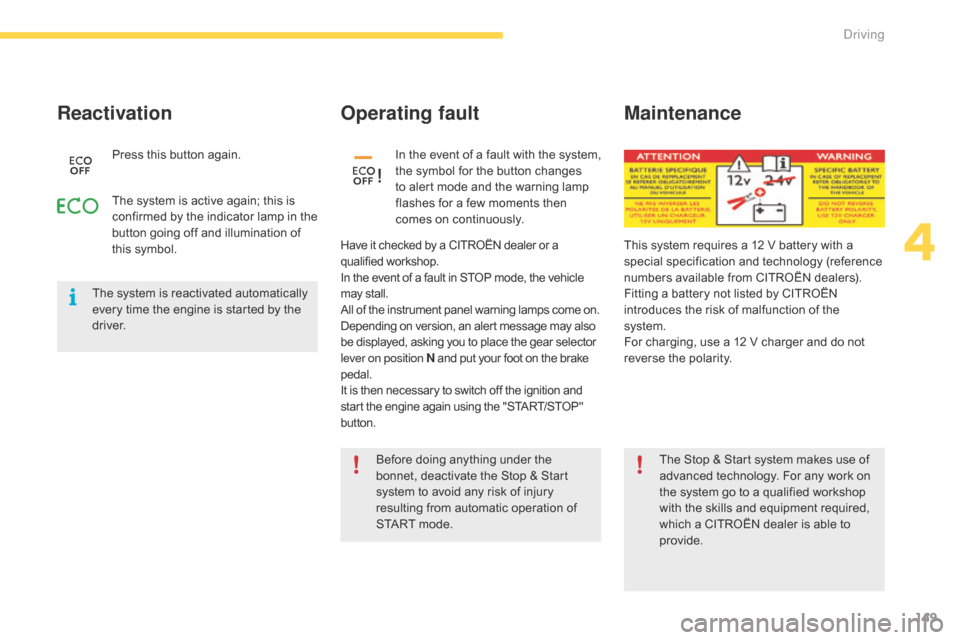
Maintenance
This system requires a 12 V battery with a special specification and technology (reference
n
umbers available from CITROËN dealers).
Fitting
a battery not listed by CITROËN
i
ntroduces the risk of malfunction of the
s
ystem.
For
charging, use a 12 V charger and do not
r
everse the polarity.
4
Driving
Page 230 of 420

228
Sit in a normal upright position.
W ear a correctly adjusted seat belt.
Do
not allow anything to come between
t
he occupants and the airbags (a child, pet,
o
bject...), do not attach or fix anything near
t
o the airbags or their trajectories when
i
nflating as this could cause injuries when
t
he airbags are deployed.
Never
modify the original definition of your
v
ehicle, particularly in the area directly
a
round the airbags.
After
an accident or if the vehicle has been
s
tolen or broken into, have the airbag
s
ystems checked.
All
work on the airbag system must be
c
arried out by a CITROËN dealer or a
q
ualified
w
orkshop.
Even
if all of the precautions mentioned
a
re observed, a risk of injury or of minor
b
urns to the head, chest or arms when an
a
irbag is deployed cannot be ruled out. The
b
ag inflates almost instantly (within a few
m
illiseconds) then deflates within the same
t
ime discharging the hot gas via openings
p
rovided for this purpose.Front airbags
Do not drive holding the steering wheel by its spokes or resting your hands on the centre
p
art of the wheel.
Passengers
must not place their feet on the
das
hboard.
Do
not smoke as deployment of the airbags
c
an cause burns or the risk of injury from a
c
igarette or pipe.
Never
remove
or
pierce
the
steering
wheel
or
h
it it violently.
Do
not fit or attach anything to the steering
w
heel or dashboard, this could cause
i
njuries with deployment of the airbags.
Guidelines to follow: Lateral airbags
Use only approved covers on the seats, compatible with the deployment the lateral
a
irbags. For information on the range of seat
c
overs suitable for your vehicle, you can
contact
a CITROËN dealer.
Refer
to the "Accessories" section.
Do
not fix or attach anything to the seat
b
acks (clothing...). This could cause injury
t
o the chest or arms if the lateral airbag is
d
eployed.
Do
not sit with the upper part of the body any
n
earer to the door than necessary.
Curtain airbags
Do not fix or attach anything to the roof. This could cause injury to the head if the curtain
a
irbag is deployed.
If
fitted on your vehicle, do not remove the
g
rab handles installed on the roof, they play
a
part in securing the curtain airbags.
Safety
Page 286 of 420
284
12 V battery
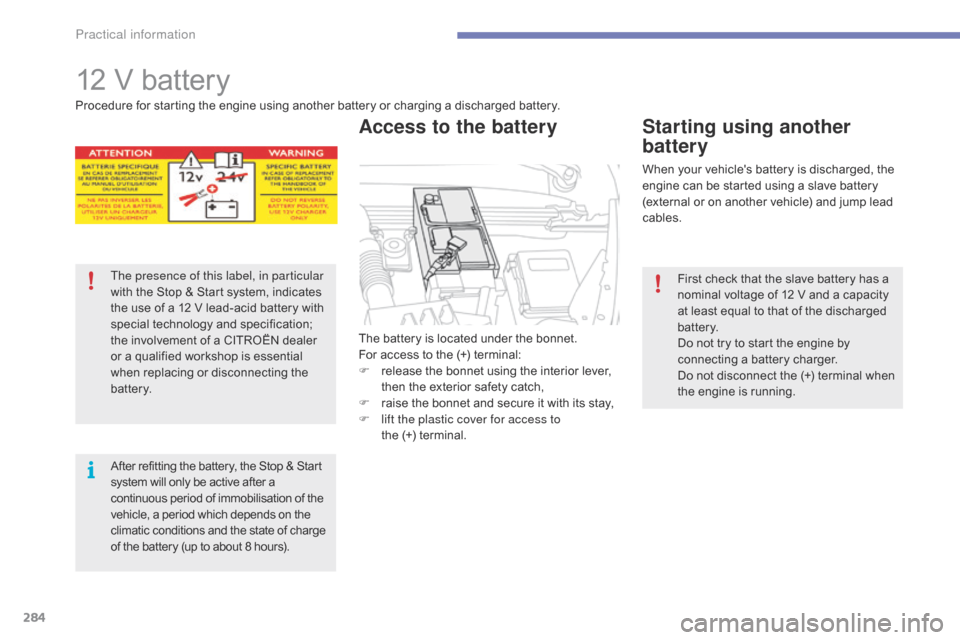
The battery is located under the bonnet.
F or access to the (+) terminal:
F
r
elease the bonnet using the interior lever,
t
hen the exterior safety catch,
F
r
aise the bonnet and secure it with its stay,
F
l
ift the plastic cover for access to
the
(+) terminal.
Access to the battery
Procedure for starting the engine using another battery or charging a discharged battery.
T he presence of this label, in particular
with
the Stop & Start system, indicates
t
he use of a 12 V lead-acid battery with
s
pecial
t
echnology
a
nd
s
pecification;
t
he involvement of a CITROËN dealer
o
r a qualified workshop is essential
w
hen replacing or disconnecting the
b
attery.
After
refitting the battery, the Stop & Start
s
ystem will only be active after a
c
ontinuous period of immobilisation of the
v
ehicle, a period which depends on the
c
limatic conditions and the state of charge
o
f the battery (up to about 8 hours). When
your vehicle's battery is discharged, the
e
ngine can be started using a slave battery
(
external or on another vehicle) and jump lead
c
ables.
Starting using another
battery
First check that the slave battery has a nominal voltage of 12 V and a capacity
a
t least equal to that of the discharged
b
attery.
Do
not try to start the engine by
c
onnecting a battery charger.
Do
not disconnect the (+) terminal when
t
he engine is running.
Practical information
Page 288 of 420
286
The batteries contain harmful substances such as sulphuric acid and lead. They m
ust be disposed of in accordance
w
ith regulations and must not, in any
c
ircumstances, be discarded with household
w
aste.
Take
used remote control batteries and
v
ehicle batteries to a special collection point.
Protect your eyes and face before handling the battery.
All
operations on the battery must be
c
arried out in a well ventilated area and
a
way from naked flames and sources
o
f sparks, so as to avoid the risk of
e
xplosion or fire.
Do
not try to charge a frozen battery;
t
he battery must first be thawed out to
a
void the risk of explosion. If the battery
h
as been frozen, before charging have
i
t checked by a CITROËN dealer or a
q
ualified workshop who will check that
t
he internal components have not been
d
amaged and the casing is not cracked,
w
hich could cause a leak of toxic and
c
orrosive acid.
Do
not reverse the polarity and use only
a
12 V charger.
Do
not disconnect the terminals while
t
he engine is running.
Do
not charge the batteries without
d
isconnecting the terminals first.
Wash
your hands after wards.
It
is
advisable
to
disconnect
the
battery
i
f
the
vehicle
is
to
be
left
unused
for
m
ore
than
one
month.
do n
ot push the vehicle to start the
engine
if you have an electronic or
a
utomatic gearbox.Charging the battery using
a battery charger
F Disconnect the battery from the vehicle.
F F ollow the instructions for use provided by
t
he manufacturer of the charger.
F
C
onnect the battery starting with the
n
egative terminal (-).
F
C
heck that the terminals and connectors
a
re clean. If they are covered with sulphate
(
whitish or greenish deposit), remove them
a
nd clean them.
With
Stop & Start, the battery does not
h
ave to be disconnected for charging.
Do
not
apply
excessive
force
on
the
t
ab
as
locking
will
not
be
possible
if
the
c
lamp
is
not
positioned
correctly;
start
t
he
procedure
again.
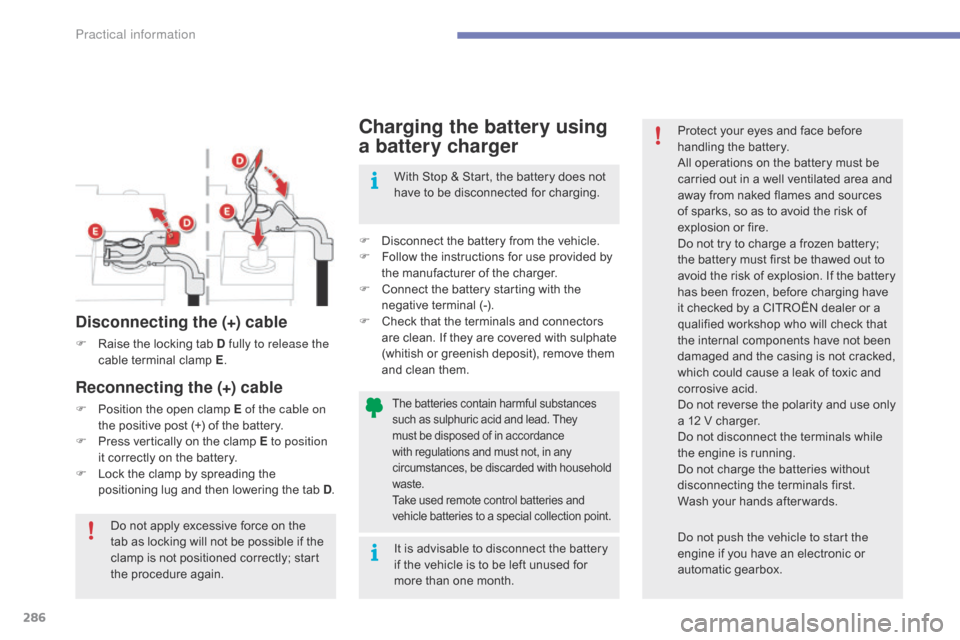
Disconnecting the (+) cable
F Raise the locking tab D fully to release the
cable t erminal c lamp E.
Reconnecting the (+) cable
F Position the open clamp E of the cable on
the positive post (+) of the battery.
F
P
ress vertically on the clamp E to position
it
correctly on the battery.
F
L
ock the clamp by spreading the
p
ositioning lug and then lowering the tab D.
Practical information
Page 400 of 420
398
QUESTIONANSWER SOLUTION
There
is a difference in
s
ound
quality between the
d
ifferent audio sources. For
optimum sound quality, the audio settings for Volume, Bass,
T
reble, Equalizer and Loudness can be adapted to the different
s
ound sources, which may result in audible differences when
c
hanging
s
ource. Check
that the audio settings for (Volume, Bass,
T
reble, Equalizer, Loudness) are adapted to the
s
ources listened to. It is advisable to set the
A
udio functions (Bass, Treble, Fr-Re balance,
L
e-Ri balance) to the middle position, select the
"
Linear", musical ambience and set the loudness
c
orrection to the "Active" position in CD mode or
t
o the "Inactive" position in radio mode.
With
the engine off, the
s
ystem
switches off after a
f
ew
minutes of use. When
the engine is switched off, the system's operating time
d
epends on the state of charge of the battery.
The
switch-off is normal: the system switches to economy mode
a
nd switches off to prevent discharging of the vehicle's battery.Start
the vehicle's engine to increase the battery
c
harge.
Audio and Telematics
Page 405 of 420
403
Oil change .....................................................308
Oil consumption ............................................ 3
08
OIl,
eng
ine
...............................
......................308
Opening
the bonnet
...................................... 3
01
Opening
the boot
..............................
.. 51, 54, 64
Opening
the doors
...............................
..... 51, 54
Opening
the panoramic sunroof blind
..........2
07
Pads,
b
rake
................................................... 3
13
Paint
colour code
.......................................... 333
P
anoramic glass sunroof
..............................2
07
Parcel shelf, rear
................................... 11
3 ,
11
6
Park
Assist
...............................
..............181-188 Radio
...............
......................................350-353
Radio,
digital
(Digital
Audio Broadcasting - DAB)
... 3
52, 353
Range,
AdBlue
...............................
...............315
R
dS ................
...............................................3 51
Reading
lamps, rear
......................................11
3
Rear
s
creen,
d
emisting
.................................10
3
Recharging
the battery
.................................28
6
Recirculation, air
.............................. 9
4, 96, 100
Reduction
of electrical load
.......................... 2
87
Regeneration
of the particle filter
.................3
12
Reinitialising
the remote control
.....................59
P
arking brake,
electric
..............................
...........
128 -13 4,
3
13
Parking sensors, front
...................................
17
7
Parking sensors, rear....................................
176
Plates,
id
entification
...................................... 333
Player, a
pple® ..............................
.................356
Player, Cd
............................... ......................354
Player, US
b
...................................1
10, 354, 356
Port, US
b
.............................................. 1
10, 354
Pressures, tyres
............................2
51, 256, 333
Priming
the
fuel
system
................
......................................... 307
Protecting
children
................ 2
22, 225, 229 -248
Puncture
................
........................................ 249
O
P
R
net ................................................................. 118
Number plate lamps ...................................... 2
76
N
Load reduction mode .................................... 287
Localised Assistance Call .............................33
4
Locating
your vehicle
...................................... 53
L
ocking from the inside
...................................61
L
ocking the doors
..............................
.............61
Low fuel level
..............................
..................304
Lumbar
...............................
.............................78
Maintenance, routine
........................................ 9
M
ap reading lamps
....................................... 20
6
Markings,
id
entification
................................. 333
M
assage function
...............................
............78
Mat
.......
......................................................... 111
Memorising
a speed
..................................... 15
4
Menu
................................... 3
44, 346, 348, 358,
3
60, 364, 372, 384, 386
Menus (Touch
screen tablet)
..................3
37, 342, 343
Mirror,
child surveillance
.................................91
M
irror, rear view
.............................................. 90
M
irrors, door......................................89, 90, 173
Misfuel prevention
...............................
..........305
Modularity,
s
eats
...............................
.............. 87
Mountings,
I
SOFIX
....................................... 24
0
M
.
alphabetical index