ignition Citroen C4 RHD 2014 2.G Service Manual
[x] Cancel search | Manufacturer: CITROEN, Model Year: 2014, Model line: C4 RHD, Model: Citroen C4 RHD 2014 2.GPages: 328
Page 112 of 328

6
FITTINGS
110
Component which protects against
sunlight from the front or the side, also
equipped with an illuminated courtesy
mirror.
With the ignition on, raise the con-
cealing fl ap; the mirror is lit auto-
matically.
This sun visor is also equipped with a
ticket holder.
SUN VISOR
ILLUMINATED GLOVE BOX
Its lid has locations for storing a pen, a
pair of glasses, tokens, maps, a cup...
To open the glove box, raise the
handle.
It is lit when the lid is opened.
It houses the front passenger airbag
deactivation switch A
.
If the vehicle is fi tted with air condition-
ing, it provides access to the ventilation
nozzle B
, distributing the same cooled
air as the vents in the passenger com-
partment.
It gives access to the dashboard fusebox
(see "Practical information - § Changing
a fuse").
Page 120 of 328
6
FITTINGS
118
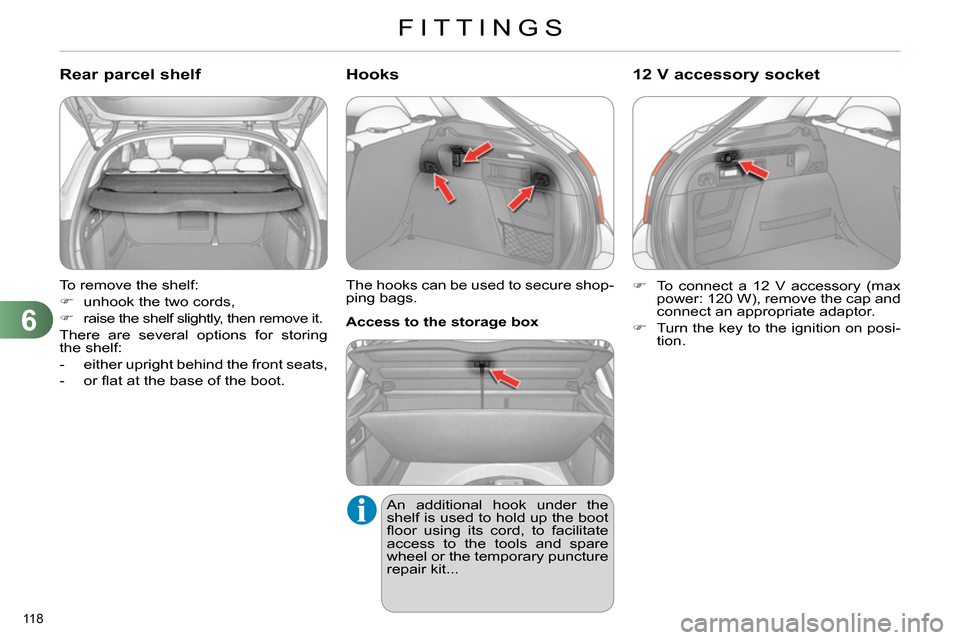
To remove the shelf:
unhook the two cords,
raise the shelf slightly, then remove it.
There are several options for storing
the shelf:
- either upright behind the front seats,
- or fl at at the base of the boot.
Rear parcel shelf
The hooks can be used to secure shop-
ping bags.
Hooks
An additional hook under the
shelf is used to hold up the boot
fl oor using its cord, to facilitate
access to the tools and spare
wheel or the temporary puncture
repair kit...
Access to the storage box
To connect a 12 V accessory (max
power: 120 W), remove the cap and
connect an appropriate adaptor.
Turn the key to the ignition on posi-
tion.
12 V accessory socket
Page 135 of 328
7
CHILD SAFETY
133
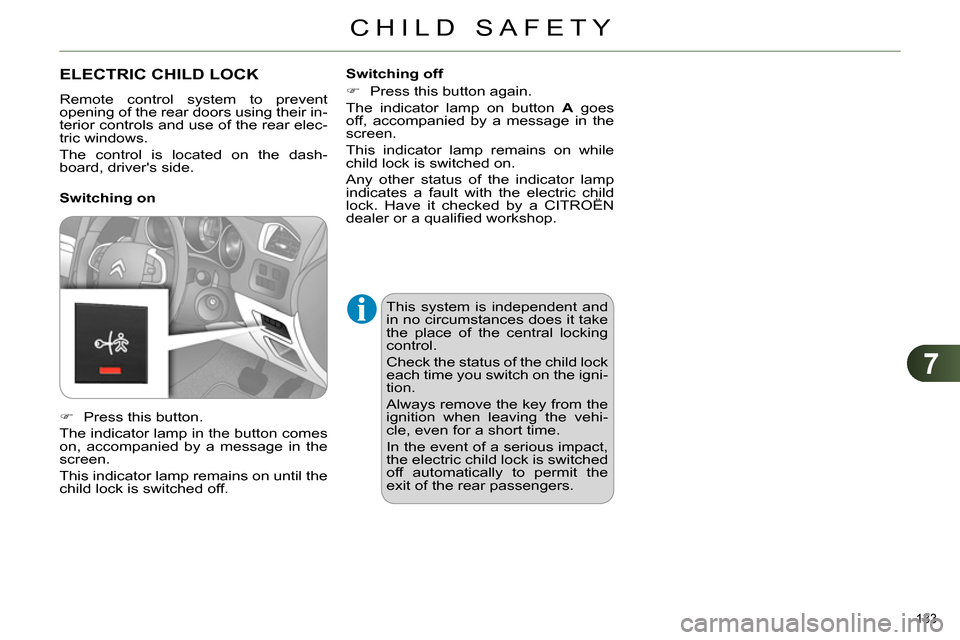
ELECTRIC CHILD LOCK
Remote control system to prevent
opening of the rear doors using their in-
terior controls and use of the rear elec-
tric windows.
The control is located on the dash-
board, driver's side.
Press this button.
The indicator lamp in the button comes
on, accompanied by a message in the
screen.
This indicator lamp remains on until the
child lock is switched off.
Switching on
Switching off
Press this button again.
The indicator lamp on button A
goes
off, accompanied by a message in the
screen.
This indicator lamp remains on while
child lock is switched on.
Any other status of the indicator lamp
indicates a fault with the electric child
lock. Have it checked by a CITROËN
dealer or a qualifi ed workshop.
This system is independent and
in no circumstances does it take
the place of the central locking
control.
Check the status of the child lock
each time you switch on the igni-
tion.
Always remove the key from the
ignition when leaving the vehi-
cle, even for a short time.
In the event of a serious impact,
the electric child lock is switched
off automatically to permit the
exit of the rear passengers.
Page 136 of 328
8
SAFETY
134
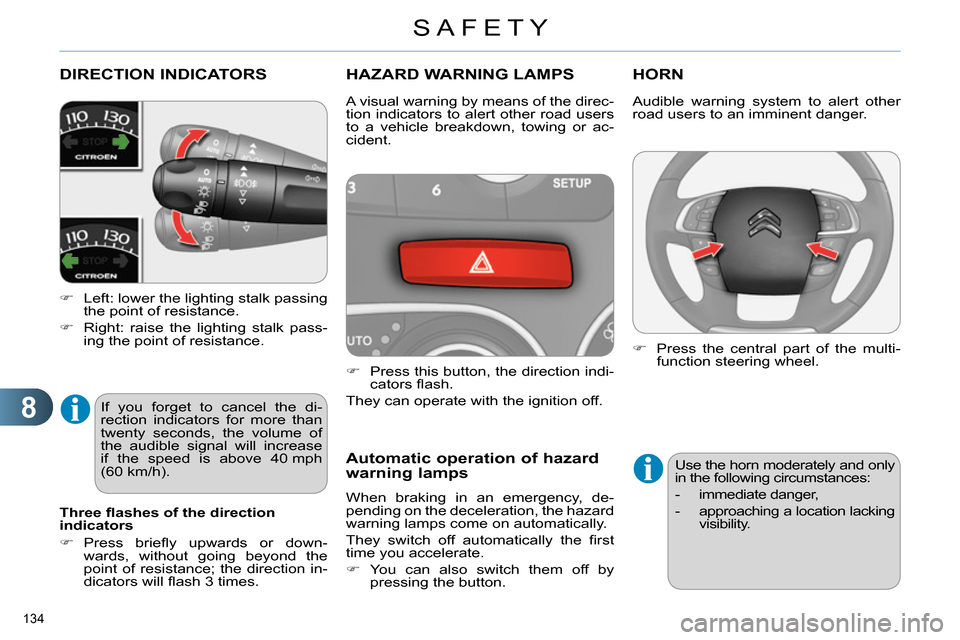
DIRECTION INDICATORS
Left: lower the lighting stalk passing
the point of resistance.
Right: raise the lighting stalk pass-
ing the point of resistance.
HAZARD WARNING LAMPS
Press this button, the direction indi-
cators fl ash.
They can operate with the ignition off.
Automatic operation of hazard
warning lamps
When braking in an emergency, de-
pending on the deceleration, the hazard
warning lamps come on automatically.
They switch off automatically the fi rst
time you accelerate.
You can also switch them off by
pressing the button.
HORN
A visual warning by means of the direc-
tion indicators to alert other road users
to a vehicle breakdown, towing or ac-
cident.
Three fl ashes of the direction
indicators
Press briefl y upwards or down-
wards, without going beyond the
point of resistance; the direction in-
dicators will fl ash 3 times.
If you forget to cancel the di-
rection indicators for more than
twenty seconds, the volume of
the audible signal will increase
if the speed is above 40 mph
(60 km/h). Audible warning system to alert other
road users to an imminent danger.
Press the central part of the multi-
function steering wheel.
Use the horn moderately and only
in the following circumstances:
- immediate danger,
- approaching a location lacking
visibility.
Page 139 of 328
8
SAFETY
137
The trajectory control systems
offer increased safety in normal
driving, but this should not en-
courage the driver to take extra
risks or drive at high speed.
The correct functioning of these
systems is assured provided
that manufacturer's recommen-
dations are observed on:
- wheels (tyres and rims),
- braking components,
- electronic components,
- assembly and repair proce-
dures.
After an impact, have these sys-
tems checked by a CITROËN
dealer or a qualifi ed workshop.
Reactivation
These systems are reactivated au-
tomatically each time the ignition is
switched back on or from 30 mph
(50 km/h).
Press the "ESP OFF"
button again
to reactivate them manually.
If this warning lamp in the instru-
ment panel and the " ESP OFF
"
indicator lamp in the button come
on, accompanied by an audible
signal and a message in the screen, this
indicates a fault with these systems.
Have it checked by a CITROËN dealer
or a qualifi ed workshop.
Operating fault
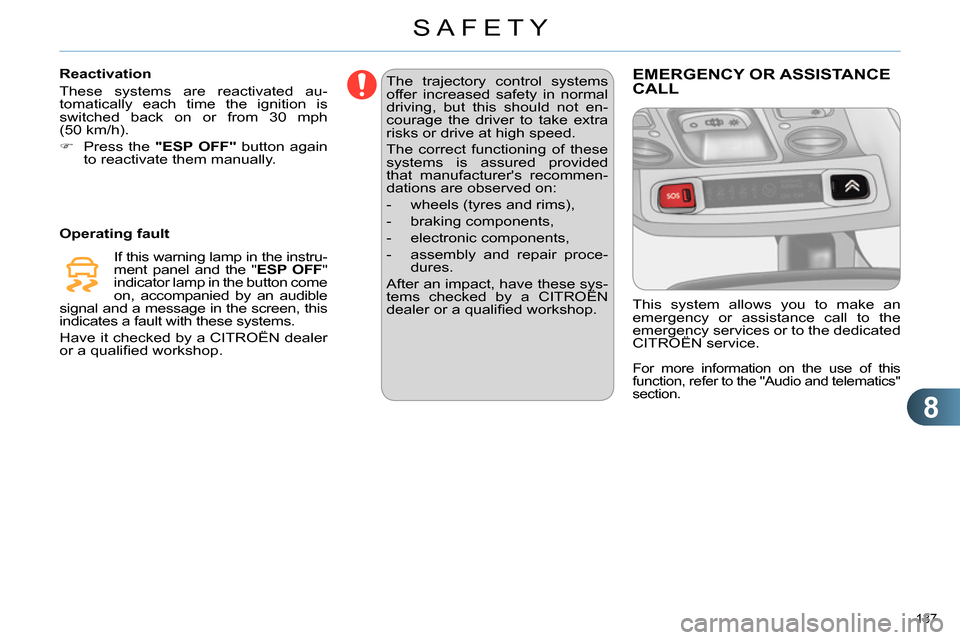
EMERGENCY OR ASSISTANCE
CALL
This system allows you to make an
emergency or assistance call to the
emergency services or to the dedicated
CITROËN service.
For more information on the use of this
function, refer to the "Audio and telematics"
section.
Page 140 of 328
8
SAFETY
138
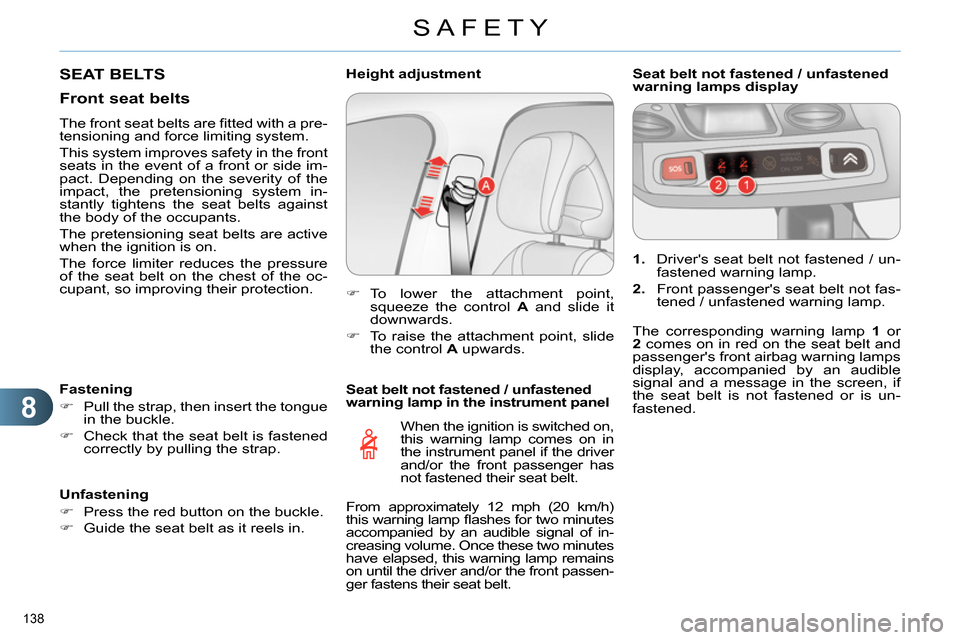
Seat belt not fastened / unfastened
warning lamp in the instrument panel
When the ignition is switched on,
this warning lamp comes on in
the instrument panel if the driver
and/or the front passenger has
not fastened their seat belt.
1.
Driver's seat belt not fastened / un-
fastened warning lamp.
2.
Front passenger's seat belt not fas-
tened / unfastened warning lamp.
Seat belt not fastened / unfastened
warning lamps display
To lower the attachment point,
squeeze the control A
and slide it
downwards.
To raise the attachment point, slide
the control A
upwards.
Height adjustment
SEAT BELTS
Front seat belts
The front seat belts are fi tted with a pre-
tensioning and force limiting system.
This system improves safety in the front
seats in the event of a front or side im-
pact. Depending on the severity of the
impact, the pretensioning system in-
stantly tightens the seat belts against
the body of the occupants.
The pretensioning seat belts are active
when the ignition is on.
The force limiter reduces the pressure
of the seat belt on the chest of the oc-
cupant, so improving their protection.
Fastening
Pull the strap, then insert the tongue
in the buckle.
Check that the seat belt is fastened
correctly by pulling the strap.
Unfastening
Press the red button on the buckle.
Guide the seat belt as it reels in.
The corresponding warning lamp 1
or
2
comes on in red on the seat belt and
passenger's front airbag warning lamps
display, accompanied by an audible
signal and a message in the screen, if
the seat belt is not fastened or is un-
fastened.
From approximately 12 mph (20 km/h)
this warning lamp fl ashes for two minutes
accompanied by an audible signal of in-
creasing volume. Once these two minutes
have elapsed, this warning lamp remains
on until the driver and/or the front passen-
ger fastens their seat belt.
Page 141 of 328

8
SAFETY
139
Rear seat belts
The rear seats are each fi tted with a
three-point seat belt, with force limiter
and, for the outer seats, an effort limiter.
Fastening
Pull the strap, then insert the tongue
in the buckle.
Check that the seat belt is fastened
correctly by pulling the strap.
Unfastening
Press the red button on the buckle.
Guide the seat belt as it reels in.
On the outer seat belts, raise the
bar to the top of the backrest to
prevent the tongue from knocking
against the side trim.
This warning lamp comes on in
the instrument panel when one
or more rear passengers unfas-
ten their seat belt.
Seat belt unfastened warning lamp
in the instrument panel
3.
Right hand rear seat belt warning
lamp.
4.
Centre rear seat belt warning lamp.
5.
Left hand rear seat belt warning lamp.
Seat belt unfastened warning lamps
display
When the ignition is switched on, with
the engine running or when the ve-
hicle is moving at less than 12 mph
(20 km/h), the corresponding warning
lamps 3
, 4
and 5
come on in red for ap-
proximately 30 seconds, if the seat belt
is not fastened.
When the vehicle is moving at more
than 12 mph (20 km/h), the correspond-
ing warning lamps 3
, 4
and 5
come on
in red, accompanied by an audible sig-
nal and a message in the screen, if a
rear passenger has unfastened their
seat belt.
From approximately 12 mph (20 km/h),
this warning lamp fl ashes for two min-
utes accompanied by an audible signal
of increasing volume. Once these two
minutes have elapsed, this warning
lamp remains on until the one or more
rear passengers fasten their seat belt.
Page 143 of 328

8
SAFETY
141
AIRBAGS
System designed to maximise the safe-
ty of the occupants (with the exception
of the rear centre passenger) in the
event of violent collisions. The airbags
supplement the action of the force-limit-
ing seat belts (with the exception of the
centre rear passenger).
If a collision occurs, the electronic de-
tectors record and analyse the front
and side impacts sustained in the im-
pact detection zones:
- in the case of a serious impact, the
airbags are deployed instantly and
contribute towards better protection
of the occupants of the vehicle (with
the exception of the rear centre pas-
senger); immediately after the im-
pact, the airbags defl ate rapidly so
that they do not hinder visibility or
the exit of the occupants,
- in the case of a minor or rear impact
or in certain roll-over conditions, the
airbags will not be deployed; the
seat belt alone contributes towards
ensuring your protection in these
situations.
The airbags do not operate when
the ignition is switched off.
This equipment will only deploy
once. If a second impact occurs
(during the same or a subse-
quent accident), the airbag will
not be deployed again.
A.
Front impact zone.
B.
Side impact zone.
Impact detection zones
Deployment of the airbag(s) is
accompanied by a slight emis-
sion of smoke and a noise, due
to the activation of the pyrotech-
nic cartridge incorporated in the
system.
This smoke is not harmful, but
sensitive individuals may experi-
ence slight irritation.
The noise of the detonation may
result in a slight loss of hearing
for a short time.
Front airbags
System which protects the driver and
front passenger in the event of a seri-
ous front impact in order to limit the risk
of injury to the head and thorax.
The driver's airbag is fi tted in the centre
of the steering wheel; the front passen-
ger's airbag is fi tted in the dashboard
above the glove box.
Deployment
The airbags are deployed, except the
passenger's front airbag if it is deactivat-
ed, in the event of a serious front impact
to all or part of the front impact zone A
, in
the longitudinal centreline of the vehicle
on a horizontal plane and directed from
the front to the rear of the vehicle.
The front airbag infl ates between the tho-
rax and head of the front occupant of the
vehicle and the steering wheel, driver's
side, and the dashboard, passenger's
side to cushion their forward movement.
Page 144 of 328

8
SAFETY
142
Deactivation
Only the passenger's front airbag can
be deactivated:
insert the key in the passenger air-
bag deactivation switch,
turn it to the "OFF"
position,
then, remove the key keeping the
switch in the new position.
According to version, this warn-
ing lamp comes on in the in-
strument panel and/or in the
seat belt and passenger's front
airbag warning lamps display when the
ignition is on and until the airbag is re-
activated. To assure the safety of your
child, the passenger's front air-
bag must be deactivated when
you install a "rear facing" child
seat on the front passenger seat.
Otherwise, the child would risk
being seriously injured or killed if
the airbag were deployed.
Reactivation
When you remove the child seat, turn
the switch to the "ON"
position to re-
activate the airbag and so assure the
safety of your front passenger in the
event of an impact.
With the ignition on, this warn-
ing lamp comes on in the seat
belt and passenger's front air-
bag warning lamps display for
approximately one minute, if the pas-
senger's front airbag is activated.
Operating fault
If this warning lamp comes on
in the instrument panel, con-
tact a CITROËN dealer or a
qualifi ed workshop to have the
system checked. The airbags may no
longer be deployed in the event of a se-
rious impact.
Page 148 of 328

9
DRIVING
146
Manual release
With the ignition on or the engine run-
ning, to release the parking brake,
press
on the brake
pedal
or the accel-
erator, pull then release
control A
.
The full application of the parking brake
is confi rmed by:
- the braking warning lamp
and the P
warning lamp in
the control lever A
going off,
- display of the message
"Parking brake off".
If you pull control lever A
with-
out pressing the brake pedal,
the parking brake will not be
released and a warning lamp
will come on in the instrument
panel.
Maximum application
If necessary, you can make a maxi-
mum application
of the parking brake.
This is obtained by means of a long
pull
on the control lever A
, until you see
the message "Parking brake on maxi-
mum" and a beep is heard.
Maximum application is essential:
- in the case of a vehicle towing a
caravan or a trailer, if the automatic
functions are activated but you are
applying the parking brake manu-
ally,
- when the gradient you are parked
on may vary (e.g. on a ferry, on a
lorry, during towing),
In the case of towing, a loaded vehicle
or parking on a gradient, make a maxi-
mum application of the parking brake
then turn the front wheels towards the
pavement and engage a gear when you
park.
After a maximum application, the re-
lease time will be longer.
Automatic application,
engine off
With the vehicle stationary, the parking
brake is automatically applied when
the engine is switched off.
- illumination of the braking warn-
ing lamp and of the P
warning
lamp in the control lever A
,
- display of the message
"Parking brake on".
Before leaving the vehicle, en-
sure that parking brake warning
lamp in the instrument panel is
on fi xed (not fl ashing).
Never leave a child alone inside
the vehicle with the ignition on,
as they could release the park-
ing brake.
In the case of towing, a loaded
vehicle or parking on a gradient,
turn the front wheels towards the
pavement and engage a gear
when you park.
The application of the parking brake is
confi rmed by: