ignition Citroen C4 RHD 2014 2.G Repair Manual
[x] Cancel search | Manufacturer: CITROEN, Model Year: 2014, Model line: C4 RHD, Model: Citroen C4 RHD 2014 2.GPages: 328
Page 172 of 328
9
DRIVING
170
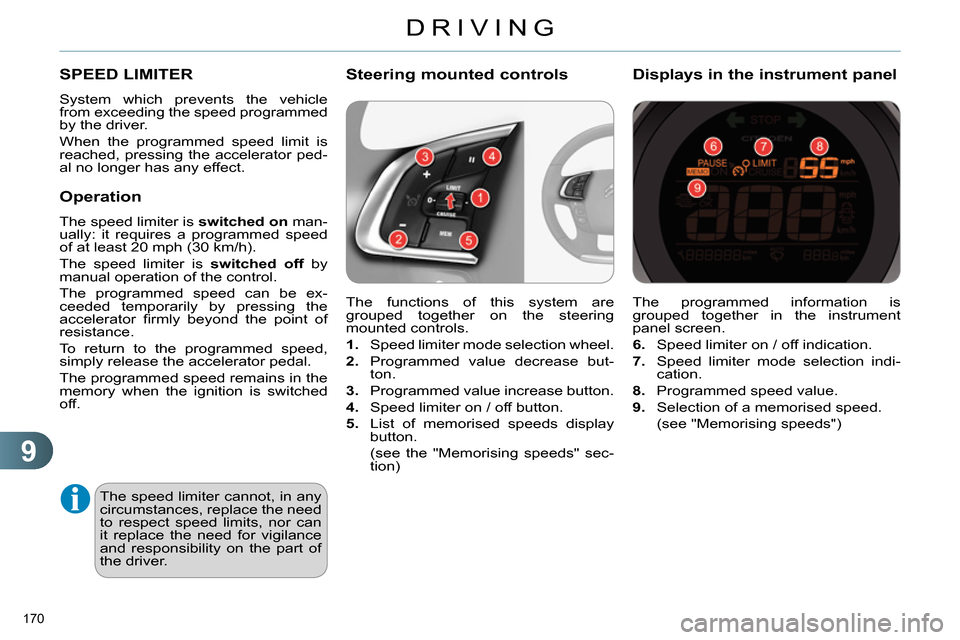
The programmed information is
grouped together in the instrument
panel screen.
6.
Speed limiter on / off indication.
7.
Speed limiter mode selection indi-
cation.
8.
Programmed speed value.
9.
Selection of a memorised speed.
(see "Memorising speeds")
Displays in the instrument panel
SPEED LIMITER
System which prevents the vehicle
from exceeding the speed programmed
by the driver.
When the programmed speed limit is
reached, pressing the accelerator ped-
al no longer has any effect.
The speed limiter cannot, in any
circumstances, replace the need
to respect speed limits, nor can
it replace the need for vigilance
and responsibility on the part of
the driver. The functions of this system are
grouped together on the steering
mounted controls.
1.
Speed limiter mode selection wheel.
2.
Programmed value decrease but-
ton.
3.
Programmed value increase button.
4.
Speed limiter on / off button.
5.
List of memorised speeds display
button.
(see the "Memorising speeds" sec-
tion)
Steering mounted controls
Operation
The speed limiter is switched on
man-
ually: it requires a programmed speed
of at least 20 mph (30 km/h).
The speed limiter is switched off
by
manual operation of the control.
The programmed speed can be ex-
ceeded temporarily by pressing the
accelerator fi rmly beyond the point of
resistance.
To return to the programmed speed,
simply release the accelerator pedal.
The programmed speed remains in the
memory when the ignition is switched
off.
Page 174 of 328
9
DRIVING
172
The cruise control system can-
not, in any circumstances, re-
place the need to respect speed
limits, nor can it replace the need
for vigilance and responsibility
on the part of the driver.
You are advised to keep your
feet near the pedals at all times.
CRUISE CONTROL
System which automatically maintains
the speed of the vehicle at the value
programmed by the driver, without any
action on the accelerator pedal.
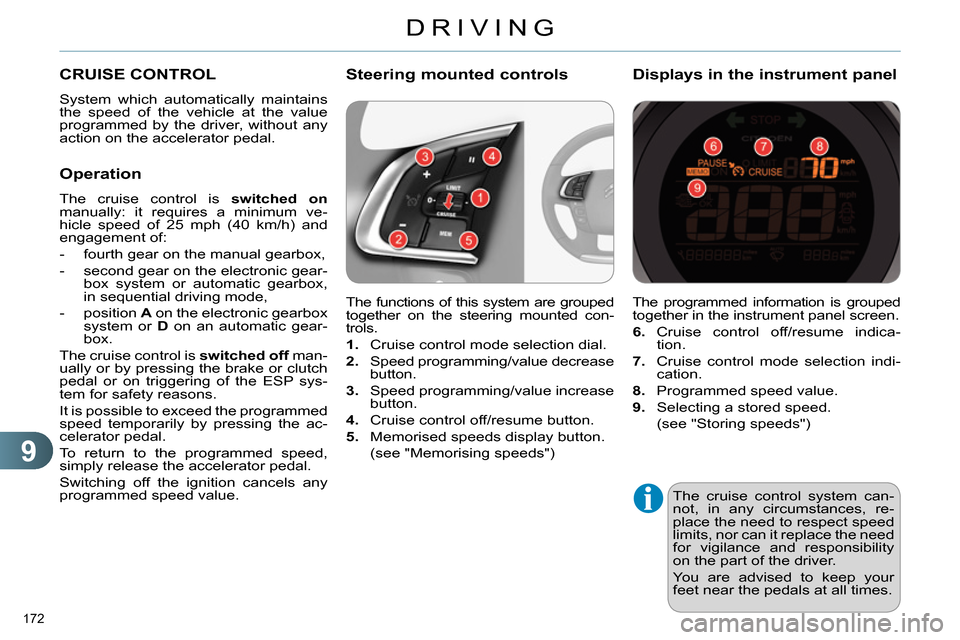
The functions of this system are grouped
together on the steering mounted con-
trols.
1.
Cruise control mode selection dial.
2.
Speed programming/value decrease
button.
3.
Speed programming/value increase
button.
4.
Cruise control off/resume button.
5.
Memorised speeds display button.
(see "Memorising speeds")
Steering mounted controls
The programmed information is grouped
together in the instrument panel screen.
6.
Cruise control off/resume indica-
tion.
7.
Cruise control mode selection indi-
cation.
8.
Programmed speed value.
9.
Selecting a stored speed.
(see "Storing speeds")
Displays in the instrument panel
Operation
The cruise control is switched on
manually: it requires a minimum ve-
hicle speed of 25 mph (40 km/h) and
engagement of:
- fourth gear on the manual gearbox,
- second gear on the electronic gear-
box system or automatic gearbox,
in sequential driving mode,
- position A
on the electronic gearbox
system or D
on an automatic gear-
box.
The cruise control is switched off
man-
ually or by pressing the brake or clutch
pedal or on triggering of the ESP sys-
tem for safety reasons.
It is possible to exceed the programmed
speed temporarily by pressing the ac-
celerator pedal.
To return to the programmed speed,
simply release the accelerator pedal.
Switching off the ignition cancels any
programmed speed value.
Page 177 of 328

9
DRIVING
175
The function displays the following types
of message:
Parking possible
Parking diffi cult
Parking not advised
The function deselects itself automati-
cally:
- when you engage reverse gear,
- when you switch off the ignition,
- if measuring is not requested,
- within fi ve minutes of selection of
the function,
- if the vehicle speed exceeds the
threshold of 45 mph (approx. 70 km/h)
for one minute.
If the lateral distance between your ve-
hicle and the parking space is too large,
the system may not be able to measure
the space.
If there is a fault, have the sys-
tem checked by a CITROËN
dealer or a qualifi ed workshop.
The system remains available after
each measurement and can therefore
measure several spaces in succession.
In poor or wintry weather, ensure that
the sensors are free of dirt, ice or snow.
The parking space sensor system de-
activates the front parking sensors
when measuring forwards.
Page 185 of 328
10
CHECKS
183
CHECKING LEVELS
Take care when working under
the bonnet, as certain areas of
the engine may be extremely hot
(risk of burns) and the cooling
fan could start at any time (even
with the ignition off).
The check is carried out either
when the ignition is switched
on using the oil level indicator
in the instrument panel, or us-
ing the dipstick.
It will only be correct if the vehicle is on
level ground and the engine has been
off for more than 30 minutes.
It is normal to top up the oil level be-
tween two services (or oil changes).
CITROËN recommends that you check
the level, and top up if necessary, every
3 000 miles (5 000 kms).
After topping up the oil, the check when
switching on the ignition with the oil
level indicator in the instrument panel
is not valid during the 30 minutes after
topping up.
Oil level
Engine oil change
Refer to the maintenance and warranty
guide for details of the interval for this
operation.
In order to maintain the reliability of the
engine and emission control system,
the use of additives in the engine oil is
prohibited.
Brake fluid level
Changing the fl uid
Refer to the maintenance and warranty
guide for details of the interval for this
operation.
Fluid specifi cation
The brake fl uid must conform to the
manufacturer's recommendations.
Power steering fluid level
The power steering fl uid level
should be close to the "MAX"
mark. With the engine cold, un-
screw the cap to check the level.
Coolant level
The coolant level should be
close to the "MAX" mark but
should never exceed it.
When the engine is warm, the
temperature of the coolant is regulated
by the fan.
In addition, as the cooling system is
pressurised, wait at least one hour after
switching off the engine before carrying
out any work.
To avoid any risk of scalding, unscrew
the cap by two turns to allow the pres-
sure to drop. When the pressure has
dropped, remove the cap and top up
the level.
Fluid specifi cation
The coolant must conform to the manu-
facturer's recommendations.
Check all of these levels regularly, in
line with the maintenance and warranty
guide. Top them up if necessary, unless
otherwise indicated.
If a level drops signifi cantly, have the
corresponding system checked by a
CITROËN dealer or a qualifi ed work-
shop.
Oil specifi cation
The oil must be the correct grade for
your engine and conform to the manu-
facturer's recommendations.
The cooling fan may start after
switching off the engine: take
care with articles and clothing
that might become caught by the
fan blades.
The brake fl uid level should be
close to the "MAX" mark. If it is
not, check the brake pad wear.
Page 190 of 328
11
PRACTICAL INFORMATION
188
Repair procedure
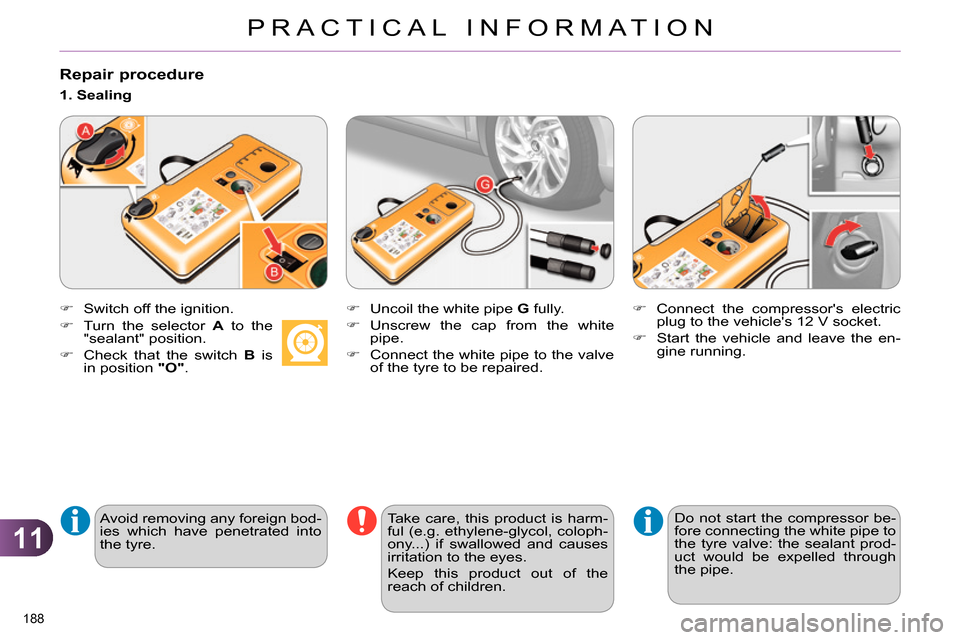
Switch off the ignition.
Avoid removing any foreign bod-
ies which have penetrated into
the tyre.
1. Sealing
Uncoil the white pipe G
fully.
Unscrew the cap from the white
pipe.
Connect the white pipe to the valve
of the tyre to be repaired.
Connect the compressor's electric
plug to the vehicle's 12 V socket.
Start the vehicle and leave the en-
gine running.
Do not start the compressor be-
fore connecting the white pipe to
the tyre valve: the sealant prod-
uct would be expelled through
the pipe.
Take care, this product is harm-
ful (e.g. ethylene-glycol, coloph-
ony...) if swallowed and causes
irritation to the eyes.
Keep this product out of the
reach of children.
Turn the selector A
to the
"sealant" position.
Check that the switch B
is
in position "O"
.
Page 205 of 328

11
PRACTICAL INFORMATION
203
CHANGING A FUSE
Access to the tools
The extraction tweezer is fi tted to the
back of the dashboard fusebox cover.
To gain access to them:
open the glove box lid,
unclip the carrier fi tted to the fuse-
box cover by pulling on the right,
Changing a fuse
Before changing a fuse,
the cause of the failure must be
identifi ed and rectifi ed,
all electrical consumers must be
switched off,
the vehicle must be immobilised
with the ignition off,
Identify the failed fuse using the al-
location tables and illustrations on
the following pages.
Good
Failed
To replace a fuse, you must:
use the special tweezer to extract
the fuse from its housing and check
the condition of its fi lament.
always replace the failed fuse with
a fuse of the same rating (same col-
our); use of a different rating may
cause malfunctions (risk of fi re).
If the fuse fails again soon after re-
placement, have the electrical system
checked by a CITROËN dealer or a
qualifi ed workshop.
Installing electrical
accessories
Your vehicle's electrical sys-
tem is designed to operate with
standard or optional equipment.
Before installing other electrical
equipment or accessories on
your vehicle, contact a CITROËN
dealer or a qualifi ed workshop.
CITROËN will not accept responsi-
bility for the cost incurred in repairing
your vehicle or for rectifying malfunc-
tions resulting from the installation of
accessories not supplied and not
recommended by CITROËN and
not installed in accordance with its
instructions, in particular when the
combined consumption of all of the
additional equipment connected ex-
ceeds 10 milliamperes.
The replacement of a fuse not
mentioned in the following ta-
bles may cause a serious mal-
function of your vehicle. Contact
a CITROËN dealer or a qualifi ed
workshop.
Tweezer
remove the tweezer,
open the fusebox cover by pulling at
top right, then left,
fold down the fusebox cover com-
pletely.
Page 210 of 328
11
PRACTICAL INFORMATION
208
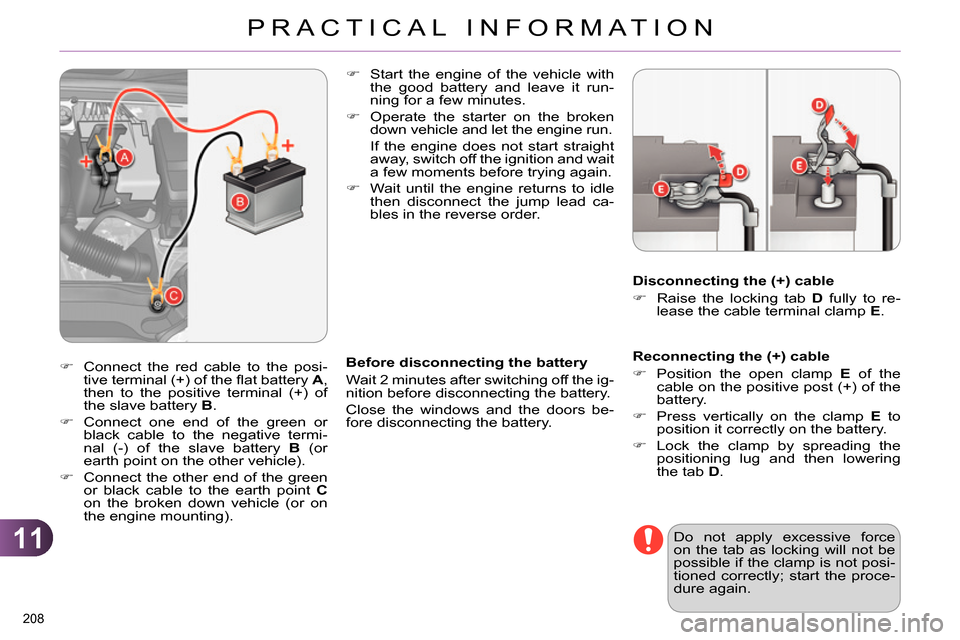
Reconnecting the (+) cable
Position the open clamp E
of the
cable on the positive post (+) of the
battery.
Press vertically on the clamp E
to
position it correctly on the battery.
Lock the clamp by spreading the
positioning lug and then lowering
the tab D
.
Start the engine of the vehicle with
the good battery and leave it run-
ning for a few minutes.
Operate the starter on the broken
down vehicle and let the engine run
.
If the engine does not start straight
away, switch off the ignition and wait
a few moments before trying again.
Wait until the engine returns to idle
then disconnect the jump lead ca-
bles in the reverse order.
Before disconnecting the battery
Wait 2 minutes after switching off the ig-
nition before disconnecting the battery.
Close the windows and the doors be-
fore disconnecting the battery.
Disconnecting the (+) cable
Raise the locking tab D
fully to re-
lease the cable terminal clamp E
.
Do not apply excessive force
on the tab as locking will not be
possible if the clamp is not posi-
tioned correctly; start the proce-
dure again.
Connect the red cable to the posi-
tive terminal (+) of the fl at battery A
,
then to the positive terminal (+) of
the slave battery B
.
Connect one end of the green or
black cable to the negative termi-
nal (-) of the slave battery B
(or
earth point on the other vehicle).
Connect the other end of the green
or black cable to the earth point C
on the broken down vehicle (or on
the engine mounting).
Page 211 of 328
11
PRACTICAL INFORMATION
209
Charging the battery using a
battery charger
It is advisable to disconnect the
battery if the vehicle is to be left
unused for more than one month.
The batteries contain harmful
substances such as sulphuric
acid and lead. They must be
disposed of in accordance with
regulations and must not, in any
circumstances, be discarded
with household waste.
Take used remote control bat-
teries and vehicle batteries to a
special collection point.
Disconnect the battery from the vehicle.
Follow the instructions for use pro-
vided by the manufacturer of the
charger.
Connect the battery starting with the
negative terminal (-).
Check that the terminals and con-
nectors are clean. If they are covered
with sulphate (whitish or greenish
deposit), remove them and clean
them.
Protect your eyes and face be-
fore handling the battery.
All operations on the battery
must be carried out in a well
ventilated area and away from
naked fl ames and sources of
sparks, so as to avoid the risk of
explosion or fi re.
Do not try to charge a frozen
battery; the battery must fi rst
be thawed out to avoid the risk
of explosion. If the battery has
been frozen, before charging
have it checked by a CITROËN
dealer or a qualifi ed workshop
who will check that the inter-
nal components have not been
damaged and the casing is not
cracked, which could cause a
leak of toxic and corrosive acid.
Do not reverse the polarity and
use only a 12 V charger.
Do not disconnect the terminals
while the engine is running.
Do not charge the batteries with-
out disconnecting the terminals
fi rst.
Wash your hands afterwards.
Reinitialisation after
reconnection
After any reconnection of the battery,
switch on the ignition and wait at least
one minute before starting, to allow
time for the initialisation of the electron-
ic systems.
By referring to the corresponding sec-
tions, you should set or initialise the fol-
lowing systems yourself:
- one-touch electric windows,
- time and date,
- audio and navigation system set-
tings.
Check that no alert message or warn-
ing lamp comes on after switching on
the ignition.
However, if minor problems persist af-
ter carrying out these operations, con-
tact a CITROËN dealer or a qualifi ed
workshop.
Some functions are not available
if the battery is not suffi ciently
charged.
Do not push the vehicle to start
the engine if you have an elec-
tronic or automatic gearbox.
With Stop & Start, the battery
does not have to be disconnect-
ed for charging.
Page 212 of 328
11
PRACTICAL INFORMATION
210
LOAD REDUCTION MODE
System which manages the use of cer-
tain functions according to the level of
charge remaining in the battery.
When the vehicle is being driven, the
load reduction function temporarily de-
activates certain functions, such as the
air conditioning, the heated rear screen...
The deactivated functions are reactivat-
ed automatically as soon as conditions
permit.
ENERGY ECONOMY MODE
System which manages the period of
use of certain functions to conserve a
suffi cient level of charge in the battery.
After the engine has stopped, you can
still use functions such as the audio
equipment, windscreen wipers, dipped
beam headlamps, courtesy lamps, etc.
for a maximum combined period of thirty
minutes.
Switching to economy mode
Once this period has elapsed, a message
appears in the screen indicating that the
vehicle has switched to economy mode
and the active functions are put on standby.
If the telephone is being used at
the same time on the navigation
system, it will be interrupted after
10 minutes.
A fl at battery prevents the en-
gine from starting (refer to the
corresponding paragraph).
Exiting economy mode
These functions are reactivated auto-
matically the next time the vehicle is
driven.
In order to resume the use of these
functions immediately, start the engine
and let it run for a few minutes.
The time available to you will then be
double the period for which the engine
is left running. However, this period will
always be between fi ve and thirty minutes.
This period may be greatly re-
duced if the battery is not fully
charged.
CHANGING A WIPER BLADE
Before removing a front wiper
blade
Within one minute after switching
off the ignition, operate the wiper
stalk to position the wiper blades
vertically on the windscreen.
Removing
Raise the corresponding wiper arm.
Unclip the wiper blade and remove it.
Fitting
Put the corresponding new wiper
blade in place and clip it.
Fold down the wiper arm carefully.
After fitting a front wiper blade
Switch on the ignition.
Operate the wiper stalk again to
park the wiper blades.
Page 215 of 328
11
PRACTICAL INFORMATION
213
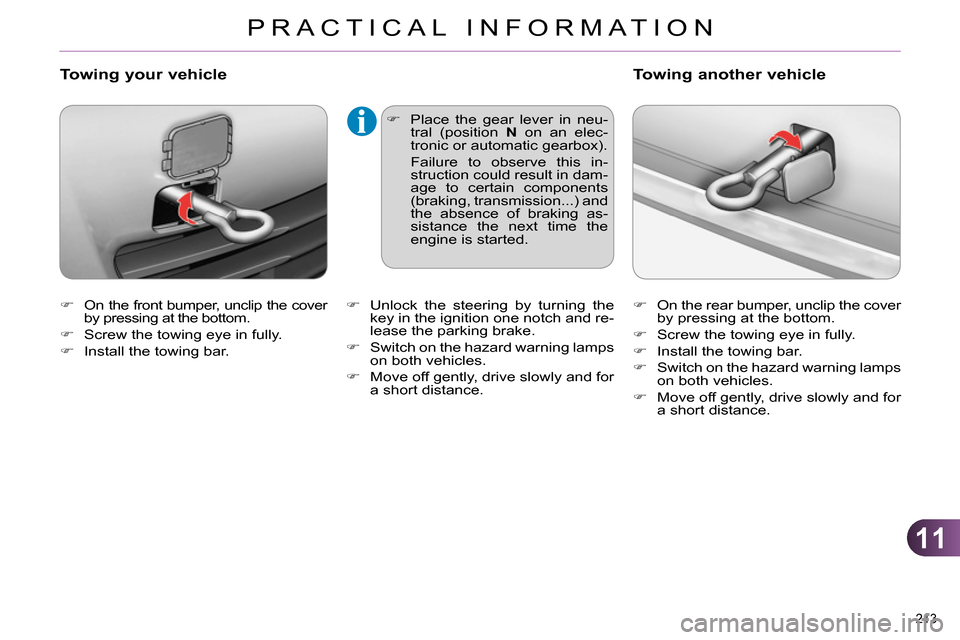
On the front bumper, unclip the cover
by pressing at the bottom.
Screw the towing eye in fully.
Install the towing bar.
Towing your vehicle
Place the gear lever in neu-
tral (position N
on an elec-
tronic or automatic gearbox).
Failure to observe this in-
struction could result in dam-
age to certain components
(braking, transmission...) and
the absence of braking as-
sistance the next time the
engine is started.
On the rear bumper, unclip the cover
by pressing at the bottom.
Screw the towing eye in fully.
Install the towing bar.
Switch on the hazard warning lamps
on both vehicles.
Move off gently, drive slowly and for
a short distance.
Towing another vehicle
Unlock the steering by turning the
key in the ignition one notch and re-
lease the parking brake.
Switch on the hazard warning lamps
on both vehicles.
Move off gently, drive slowly and for
a short distance.