wheel Citroen C5 2014.5 (RD/TD) / 2.G Owner's Guide
[x] Cancel search | Manufacturer: CITROEN, Model Year: 2014.5, Model line: C5, Model: Citroen C5 2014.5 (RD/TD) / 2.GPages: 344, PDF Size: 12.9 MB
Page 70 of 344

68
We recommend use of the automatic regulation
of the air conditioning.
It permits automatic and optimised control
of all of the following functions: air flow,
temperature in the passenger compartment
and air distribution, by means of various
sensors (ambient temperature, sunshine).
This eliminates any need for you to change
your settings other than the temperature value
displayed.
F Take care not to cover the sunshine sensor A .
If you select the automatic mode
(by pressing the "AUTO" control) and leave
all of the vents open, optimum comfort will be
maintained and humidity and condensation will
be removed regardless of the exterior climatic
conditions.
The temperature in the passenger compartment
can only be lower than the ambient temperature
if the air conditioning is on.
In order to be effective, the air conditioning must
be used with the windows closed. If the vehicle
has been parked in the sun for a long period and
the interior temperature is very high, first ventilate
the passenger compartment with the windows
open for a few minutes, then close the windows.
Heating, ventilation and air conditioning recommendations
To keep the air conditioning system in
good working order it is essential that it is
operated at least once a month.
The air conditioning uses engine power
during its operation. As a result, the fuel
consumption of the vehicle increases.
In certain cases of particularly arduous use
(e.g. towing the maximum load on a steep
gradient in high temperatures), switching off
the air conditioning saves engine power and
improves the towing capacity.
Air inlet
Check that the exterior grille for the air inlet,
at the bottom of the windscreen, is clean and
free of dead leaves, snow, etc.
When washing the vehicle using a high
pressure nozzle, avoid spraying at the air
inlet. Maximum comfort is obtained by means of
a good distribution of air in the passenger
compartment, both in the front and in the rear.
To obtain a uniform distribution of air, take
care not to block the exterior air intake grille
located at the base of the windscreen, the
vents, the air outlets under the front seats and
the air extractor located behind the flaps in
the boot.
The front and rear vents are fitted with
thumbwheels to adjust the air flow and
direction. We recommend that you leave all of
the vents open.
Dust filter / Odour filter
(active carbon)
There is a filter for excluding odours and
dust.
This filter must be changed in line with the
vehicle's servicing schedule. (Refer to the
maintenance and warranty guide).
Air conditioning
Air circulation
Ease of use and comfort
Page 93 of 344

91
Boot fittings (Saloon)
1. Boot floor (spare wheel storage).2. B oot lamp.
3. L ocation for 6 CD changer.
Luggage securing rings
F Use the 4 securing rings on the boot floor to secure your luggage.
For safety reasons in the event of sharp
braking, you are advised to place heavy objects
as far for ward in the boot as possible.
3
Ease of use and comfort
Page 98 of 344
96
A few driving recommendations
Driving on flooded roads
We strongly advise against driving on flooded
roads, as this could cause serious damage
to the engine or gearbox, as well as to the
electrical systems of your vehicle. Observe the driving regulations at all times and
remain vigilant whatever the traffic conditions.
Pay close attention to the traffic and keep your
hands on the wheel so that you are ready to
react at any time to any eventuality.
On a long journey, a break every two hours is
strongly recommended.
In difficult weather, drive smoothly, anticipate
the need to brake and increase the distance
from other vehicles.
Important!
Never drive with the parking brake
applied - Risk of overheating and
damage to the braking system!
Do not park or run the engine when
stationary in areas where inflammable
substances and materials (dry grass,
dead leaves...) might come into contact
with the hot exhaust system - Risk of
fire!
Never leave a vehicle unsupervised
with the engine running. If you have
to leave your vehicle with the engine
running, apply the parking brake
and put the gearbox into neutral or
position
N or P, depending on the type
of gearbox.
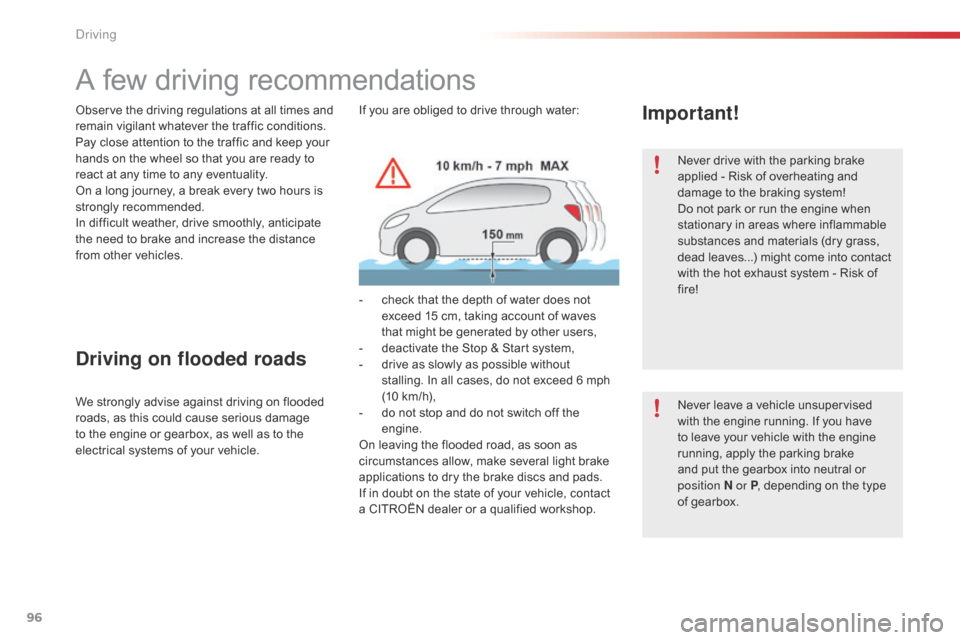
If you are obliged to drive through water:
-
c
heck that the depth of water does not
exceed 15 cm, taking account of waves
that might be generated by other users,
-
d
eactivate the Stop & Start system,
-
d
rive as slowly as possible without
stalling. In all cases, do not exceed 6 mph
(10
km/h),
-
d
o not stop and do not switch off the
engine.
On leaving the flooded road, as soon as
circumstances allow, make several light brake
applications to dry the brake discs and pads.
If in doubt on the state of your vehicle, contact
a CITROËN dealer or a qualified workshop.
Driving
Page 100 of 344
98
Starting the engine
Wait until this warning lamp goes off in the
instrument panel then operate the starter
motor by turning the key to position 3
without pressing the accelerator pedal,
until the engine starts. Once the engine is
running, release the key.
With the parking brake applied and the gearbox
in neutral or position N or P:
F
d
epress the clutch pedal fully (manual
gearbox),
or
F
p
ress the brake pedal firmly (electronic or
automatic gearbox),
F
i
nsert the key into the ignition switch; the
system recognises the code,
F
u
nlock the steering column by simultaneously
turning the steering and the key.
F
W
ith a petrol engine, operate the starter
motor by turning the key to position 3
without pressing the accelerator pedal,
until the engine starts. Once the engine is
running, release the key. Never leave the engine running in
an enclosed area without adequate
ventilation: internal combustion
engines emit toxic exhaust gases,
such as carbon monoxide. Danger of
intoxication and death.
In very severe wintry conditions
(temperatures below -23°C), to ensure
the correct operation and durability of
the mechanical components of your
vehicle, engine and gearbox, it is
necessary to leave the engine running
for 4 minutes before moving off.
In wintry conditions, the warning lamp
can stay on for a longer period. When
the engine is hot, the warning lamp
does not come on.
In certain cases, you may have to apply
more force to the steering (wheels on
full lock, for example). F
W ith a Diesel engine, turn the key to
position 2 , ignition on, to operate the
engine pre-heating system.
If the engine does not start straight
away, switch off the ignition. Wait a
few moments before operating the
starter motor again. If the engine does
not start after several attempts, do not
keep trying: you risk damaging the
starter motor or the engine. Contact
a CITROËN dealer or a qualified
workshop. In temperate conditions, do not leave
the engine at idle to warm up but move
off straight away and drive at moderate
speed.
Driving
Page 101 of 344
99
Do not flick the accelerator at the
moment of switching off the ignition.
This could cause serious damage to the
turbocharger(s).
Vehicles equipped with a
turbocharger
Never stop the engine without having allowed it
to run for a few seconds at idle, this being the
time required for the turbocharger to return to a
normal speed.Energy economy mode
After switching off the engine (position 1- Stop),
for a maximum of 30 minutes you can still use
functions such as the audio and telematic
system, the wipers, dipped beam headlamps,
courtesy lamps, ...
Switching off the engine
F Stop the vehicle.
F W ith the engine running at idle, turn the key
to position 1 .
F
R
emove the key from the ignition switch.
F
T
o lock the steering column, turn the
steering until it locks.
When you leave the vehicle, keep the
key with you and lock the vehicle. To facilitate unlocking of the steering
column, it is recommended that the
wheels be returned to the straight ahead
position before switching off the engine.
Never switch off the ignition before the
vehicle is at a complete stop. With the
engine off, the braking and steering
assistance systems are also cut off: risk
of loss of control of the vehicle. For more information, refer to the
"Practical information" section, under
"Energy economy mode".
F
C
heck that the parking brake is correctly
applied, particularly on sloping ground.
Key left in the "Ignition on"
position
On opening the driver's door, an alert
message is displayed, accompanied
by an audible signal, to remind you that
the key is still in the ignition switch at
position 1 (Stop) .
If the key has been left in the ignition
switch at position 2 (Ignition on) ,
the ignition will be switched off
automatically after one hour.
To switch the ignition back on, turn the
key to position 1 (Stop) , then back to
position 2 (Ignition on) .
4
Driving
Page 102 of 344
100
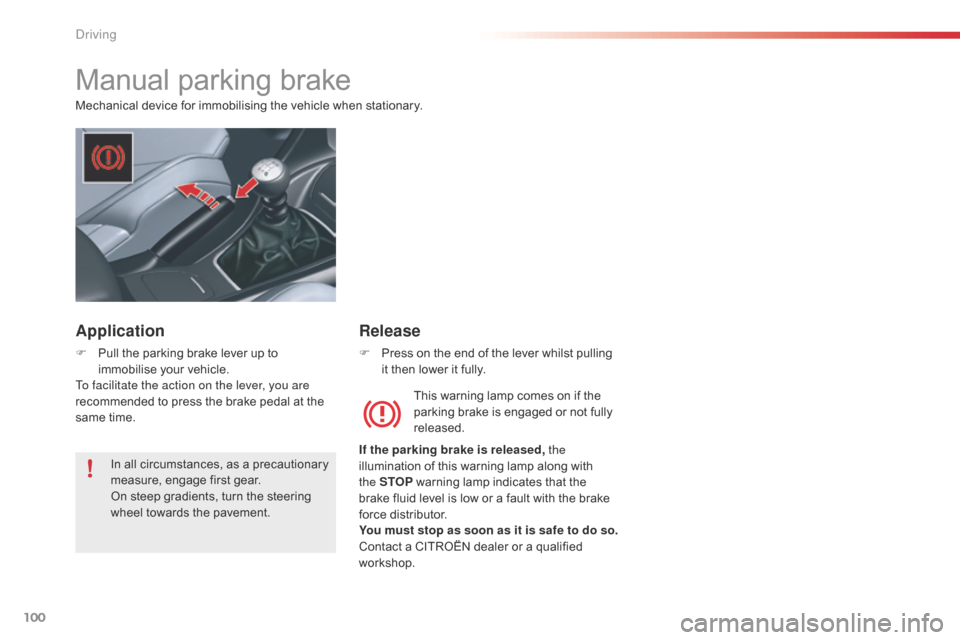
Manual parking brake
Mechanical device for immobilising the vehicle when stationary.This warning lamp comes on if the
parking brake is engaged or not fully
released.
If the parking brake is released, the
illumination of this warning lamp along with
the
STOP warning lamp indicates that the
brake fluid level is low or a fault with the brake
force distributor.
You must stop as soon as it is safe to do so.
Contact a CITROËN dealer or a qualified
workshop.
Application
F Pull the parking brake lever up to immobilise your vehicle.
To facilitate the action on the lever, you are
recommended to press the brake pedal at the
same time.
Release
F Press on the end of the lever whilst pulling it then lower it fully.
In all circumstances, as a precautionary
measure, engage first gear.
On steep gradients, turn the steering
wheel towards the pavement.
Driving
Page 106 of 344

104
Maximum application
If necessary, you can make a maximum
application of the parking brake. It is obtained
by means of a long pull on control lever A,
until you see the message "Max application of
the parking brake" and a beep is heard.
Maximum application is essential:
-
i
n the case of a vehicle towing a caravan
or a trailer, if the automatic functions are
activated but you are applying the parking
brake manually,
-
w
hen the effective gradient you are parked
on is variable (e.g. on a ferry, in a lorry,
during towing).
-
i
n the case of towing, a loaded vehicle or
parking on a gradient, turn the front wheels
towards the pavement and engage a gear
when you park.
-
a
fter a maximum application, the release
time will be longer.
Particular situations
In certain situations (starting the engine...), the
parking brake can automatically alter its level of
application. This is normal operation.
To advance your vehicle a few centimetres
without starting the engine, but with the ignition
on, press on the brake pedal and release the
parking brake by pushing then releasing
control lever A .
The full release of the parking brake is
confirmed by the warning lamp P in the control
lever and the warning lamp in the instrument
panel going off and the display of a message
"Parking brake off " in the instrument panel
screen.
To ensure correct operation of the parking
brake and therefore your safety, the number of
successive application/release operations is
limited to eight.
If this number is exceeded, you are warned
by the message "Parking brake faulty" and a
warning lamp flashes. In the event of a battery failure, it will
not be possible to operate the electric
parking brake.
As a safety measure if the parking
brake is not applied, immobilise the
vehicle by engaging a gear or by
placing a chock against one of the
wheels.
Contact a CITROËN dealer or a
qualified workshop.
Driving
Page 113 of 344

111
6-speed electronic gearbox system
F automatic mode: gear lever in position A,
F m anual mode: gear lever in position M ,
F
S
PORT mode: gear lever in position A and
a press on button 1 .
Six-speed electronic gearbox system which
offers a choice between the comfort of fully
automatic operation or the pleasure of manual
gear changing.
There are two driving modes:
-
a
utomatic
operation for electronic control
of the gears by the gearbox,
-
m
anual
operation for sequential gear
changing by the driver.
In automated mode, it remains possible to
change gear manually by using the steering
mounted control paddles, when overtaking, for
example.
a
SPORT
programme is available in automated
mode, providing a more dynamic driving style.
Mode selection
+. Change up paddle to the right of the steering
wheel.
F
P
ress the back of the "+" steering mounted
paddle to change up a gear.
-.
C
hange down paddle to the left of the
steering wheel.
F
P
ress the back of the "-" steering mounted
paddle to change down a gear.
Steering mounted control paddles
The steering mounted paddles cannot
be used to select neutral or to engage
or disengage reverse gear.
4
Driving
Page 119 of 344

117
Moving off
F To start the engine, the gear lever must be in position P or N .
F
O
perate the starter.
F
W
hen the engine is running, place the gear
lever on R , D or M as required.
F
C
heck, in the instrument panel, the position
engaged.
F
R
elease the brake pedal and accelerate.
F
T
o avoid a possible difference between the
position of the gear lever and the actual
position of the gearbox, always exit from
position P with the ignition on and brake
pedal applied.
Otherwise, when the ignition is on or the engine
is running:
F
r
eposition the gear lever in position P ,
F
p
ut your foot on the brake pedal and then
select the gear you want.
Park
This position of the gear lever is used
to prevent the vehicle from moving
when you are stationary.
Reverse gear
Only engage this position when the
vehicle is stationary. To prevent
snatching, do not accelerate too soon
after selection.
Neutral
never select position N if the vehicle
is moving.
F
T
o select position P
, move the gear lever
back to the highest position (towards R ),
then push it for wards and then to the left.
F
T
o exit position P
, move the gear lever to
the right and then to the position you want.
F
O
nly engage this position when the vehicle
is completely stationary. In this position,
the front wheels are locked. Make sure that
the gear lever is correctly positioned.
ne
ver select positions P or R if the
vehicle is not stationary.
If, while the vehicle is moving,
position
N is engaged inadvertently,
allow the engine to idle before engaging
position D or M .
4
Driving
Page 126 of 344
124
Tyre under-inflation detection
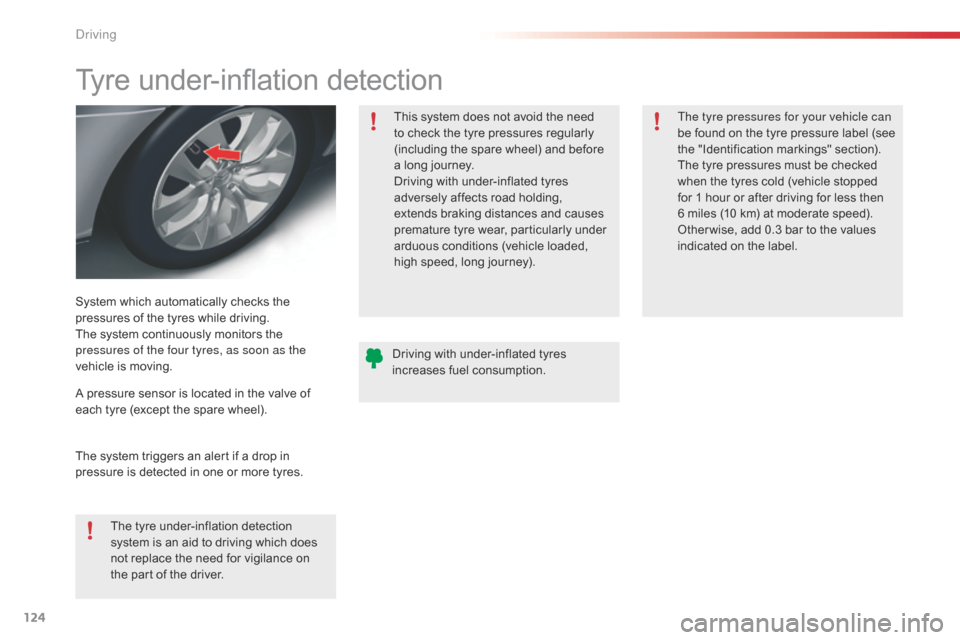
System which automatically checks the
pressures of the tyres while driving.
The system continuously monitors the
pressures of the four tyres, as soon as the
vehicle is moving.The tyre under-inflation detection
system is an aid to driving which does
not replace the need for vigilance on
the part of the driver. This system does not avoid the need
to check the tyre pressures regularly
(including the spare wheel) and before
a long journey.
Driving with under-inflated tyres
adversely affects road holding,
extends braking distances and causes
premature tyre wear, particularly under
arduous conditions (vehicle loaded,
high speed, long journey).
The tyre pressures for your vehicle can
be found on the tyre pressure label (see
the "Identification markings" section).
The tyre pressures must be checked
when the tyres cold (vehicle stopped
for 1 hour or after driving for less then
6 miles (10 km) at moderate speed).
Other wise, add 0.3 bar to the values
indicated on the label.
Driving with under-inflated tyres
increases fuel consumption.
A pressure sensor is located in the valve of
each tyre (except the spare wheel).
The system triggers an alert if a drop in
pressure is detected in one or more tyres.
driving