wheel Citroen C5 2014.5 (RD/TD) / 2.G Service Manual
[x] Cancel search | Manufacturer: CITROEN, Model Year: 2014.5, Model line: C5, Model: Citroen C5 2014.5 (RD/TD) / 2.GPages: 344, PDF Size: 12.9 MB
Page 161 of 344

159
DSC/ASR
The DSC and ASR systems offer increased
safety in normal driving, but they should not
encourage the driver to take extra risks or
drive at high speed.
It is in conditions of reduced grip (rain,
snow, ice) that the risk of loss of grip
increases. It is therefore important for your
safety to keep the DSC and ASR systems
activated in all conditions, and particularly
in difficult conditions.
The correct operation of these systems
depends on observation of the
manufacturer's recommendations regarding
as much the wheels (tyres and rims),
braking and electronic components as the
assembly and repair procedures used by
CITROËN dealers.To benefit in full from the effectiveness
of the DSC and ASR systems in wintry
conditions, the vehicle must be fitted with
four snow tyres, allowing the the vehicle to
retain neutral behaviour on the road.
After an impact, have these systems
checked by a CITROËN dealer or a
qualified workshop.
6
Safety
Page 166 of 344
164
Front airbags
Deployment
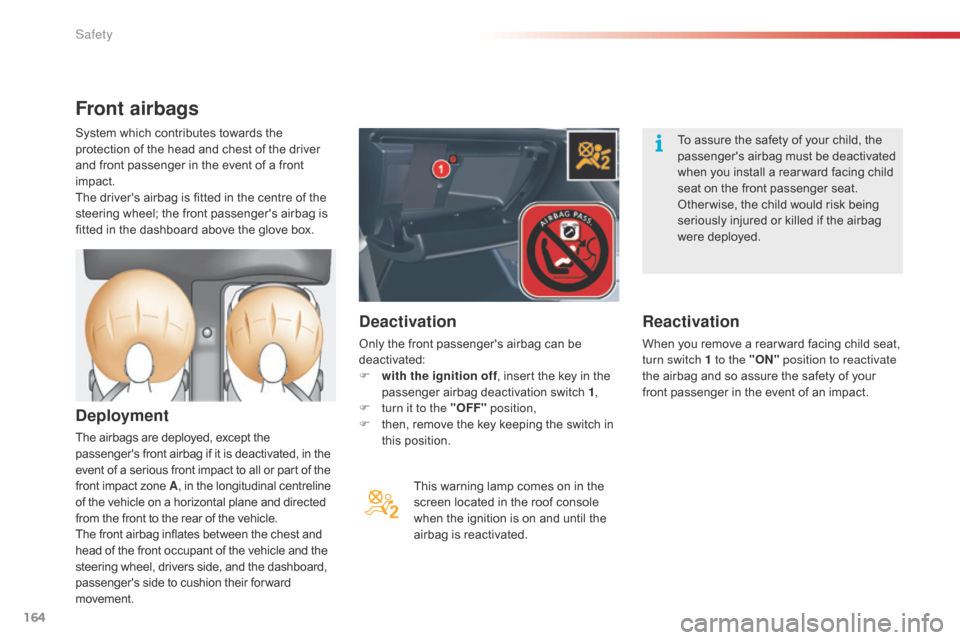
The airbags are deployed, except the
passenger's front airbag if it is deactivated, in the
event of a serious front impact to all or part of the
front impact zone A, in the longitudinal centreline
of the vehicle on a horizontal plane and directed
from the front to the rear of the vehicle.
The front airbag inflates between the chest and
head of the front occupant of the vehicle and the
steering wheel, drivers side, and the dashboard,
passenger's side to cushion their for ward
movement. This warning lamp comes on in the
screen located in the roof console
when the ignition is on and until the
airbag is reactivated.
Deactivation
Only the front passenger's airbag can be
deactivated:
F
w
ith the ignition off , insert the key in the
passenger airbag deactivation switch 1 ,
F
t
urn it to the "OFF" position,
F
t
hen, remove the key keeping the switch in
this position. To assure the safety of your child, the
passenger's airbag must be deactivated
when you install a rear ward facing child
seat on the front passenger seat.
Other wise, the child would risk being
seriously injured or killed if the airbag
were deployed.
Reactivation
When you remove a rear ward facing child seat,
turn switch 1 to the "ON"
position to reactivate
the airbag and so assure the safety of your
front passenger in the event of an impact.
System which contributes towards the
protection of the head and chest of the driver
and front passenger in the event of a front
impact.
The driver's airbag is fitted in the centre of the
steering wheel; the front passenger's airbag is
fitted in the dashboard above the glove box.
Safety
Page 169 of 344
167
For the airbags to be fully
effective, observe the following
safety rules:
Sit in a normal upright position.
Wear a correctly adjusted seat belt.
Do not leave anything between the
occupants and the airbags (a child, pet,
object...). This could hamper the operation of
the airbags or injure the occupants.
After an accident or if the vehicle has been
stolen or broken into, have the airbag
systems checked.
All work on the airbag system must be
carried out by a CITROËN dealer or a
qualified workshop.
Even if all of the precautions mentioned
are observed, a risk of injury or of minor
burns to the head, chest or arms when an
airbag is deployed cannot be ruled out. The
bag inflates almost instantly (within a few
milliseconds) then deflates within the same
time discharging the hot gas via openings
provided for this purpose.
Front airbags
Do not drive holding the steering wheel by its spokes or resting your hands on the centre part
of the wheel.
Passengers must not place their feet on the dashboard.
Do not smoke as deployment of the airbags can cause burns or the risk of injury from a
cigarette or pipe.
Never remove or pierce the steering wheel or hit it violently.
Do not fit or attach anything to the steering wheel or dashboard, this could cause injuries with
deployment of the airbags.
Lateral airbags
Use only approved covers on the seats, compatible with the deployment the lateral airbags.
For information on the range of seat covers suitable for your vehicle, you can contact a
CITROËN dealer.
Refer to the "Accessories" section.
Do not fix or attach anything to the seat backs (clothing...). This could cause injury to the chest
or arms if the lateral airbag is deployed.
Do not sit with the upper part of the body any nearer to the door than necessary.
Curtain airbags
Do not fix or attach anything to the roof. This could cause injury to the head if the curtain
airbag is deployed.
If fitted on your vehicle, do not remove the grab handles installed on the roof, they play a part
in securing the curtain airbags.
6
Safety
Page 191 of 344

189
Using the kit
F Switch off the ignition.
F A ffix the speed limitation sticker to the
vehicle's steering wheel to remind you that
a wheel is in temporary use. F
C heck that the switch A is in position "0"
.
F C onnect the pipe of the cartridge 1 to the
valve of the tyre to be repaired. F
C onnect the compressor's electric plug to
the vehicle's 12 V socket.
F
S
tart the vehicle and leave the engine
running.
8
Practical information
Page 192 of 344

190
F Remove the compressor and unclip and store the cartridge in a sealed bag to avoid
staining your vehicle with traces of fluid.
F
D
rive immediately for approximately
two
miles (three kilometres), at reduced
speed (between 15 and 35 mph [20 and
60
km/h]), to plug the puncture.
F
S
top to check the repair and the pressure. F
C onnect the compressor pipe directly to
the valve of the repaired wheel.
F
S
witch on the compressor by moving
the switch A to position
"1" until the tyre
pressure reaches 2.0 bars.
If this pressure has not been reached
after approximately five to ten minutes,
the tyre cannot be repaired; contact a
CITROËN dealer to have your vehicle
repaired.
Practical information
Page 193 of 344

191
F Connect the compressor's electric plug to the vehicle's 12 V socket again.
F
S
tart the vehicle again and leave the
engine running. F
A djust the pressure using the compressor
(to inflate: switch A in position "1";
to
deflate: switch A in position "0" and
press button B ), in accordance with the
vehicle's tyre pressure label (located on
the door aperture on the left-hand side),
then remember to check that the leak has
been plugged correctly (no further loss of
pressure after several miles [kilometres]).
F
R
emove the compressor, then store the
whole kit.
F
D
rive at reduced speed (50 mph
[80
km/h] max) limiting the distance
travelled to approximately 120 miles
(200
km).
F
V
isit a CITROËN dealer or a qualified
workshop as soon as possible to have the
tyre repaired or replaced by a technician. Take care as sealant cartridge contains
ethylene-glycol. This product is harmful
if swallowed and causes irritation to the
eyes. Keep it out of reach of children.
The expiry date of the sealant is
indicated on the base of the cartridge.
The cartridge is designed for a single
use; even if only partly used, it must be
replaced.
After use, do not discard the cartridge
into the environment, take it to a
CITROËN dealer or an authorised
waste disposal site.
Do not forget to obtain a new cartridge,
available from CITROËN dealers or a
qualified workshop.
If the vehicle is fitted with tyre under-
inflation detection, the tyre under-
inflation warning lamp will remain on
after the wheel has been repaired until
the system is reinitialised by a CITROËN
dealer or a qualified workshop.
8
Practical information
Page 194 of 344

192
Changing a wheel
Access to the tools
The tools are to be found in a protective holder
inside the spare wheel.
F
P
ull back the retaining strap for access.List of tools
all of these tools are specific to your vehicle
and may vary according to equipment. Do not
use them for any other purpose. 1. W
heelbrace.
U
sed for removing the wheel trim and the
wheel fixing bolts.
2.
J
ack with integral handle.
U
sed to raise the vehicle.
3.
B
olt head finisher tool.
U
sed to remove the wheel bolt protectors
(finishers) on wheel bolts with alloy wheels.
4.
T
owing eye.
S
ee the "Towing the vehicle" section.
5.
Wh
eel chock*
* Depending on country of sale.
Practical information
Page 195 of 344

193
Access to the spare wheel
To remove the spare wheel
F Saloon: raise the boot floor and fold in two.
F T ourer: raise the boot floor and hook it
using the retractable handle. Secure the
hook to the top part of the boot.
F
d
e
tach the strap then push the wheel
for wards so as to be able to lift it.
To reposition the spare wheel
F Position the spare wheel flat in the boot, then pull it towards you.
F
N
ext place the toolbox inside the wheel,
then secure the assembly with the strap.
F
R
elease the boot floor to return it to its
initial position. The tyre pressures are indicated on the
label located on the driver's side centre
door pillar. Tyre pressures are given for
different vehicle loading conditions.
8
Practical information
Page 196 of 344

194
Removing a wheel
F Park the vehicle on stable, firm ground that is not slippery. apply the parking brake.
F
I
f your vehicle is equipped with
"Hydractive
III+" suspension, with the
engine running at idle, adjust the ground
clearance to its maximum height.
F
S
witch off the ignition and engage first gear
(position R for an electronic gearbox; P for
an automatic gearbox).
F
I
f your vehicle is fitted with "Hydractive III+"
suspension, position the chock, whichever
direction the gradient may be in, in front of
the front wheel diametrically opposite to
the one to be replaced.
List of operations
F Remove the protector from each bolt using tool 3 .
F
F
it the security bolt socket to the
wheelbrace to slacken the security bolt
(depending on equipment).
F
S
lacken the other bolts using just the
wheelbrace 1 .
Before positioning the jack:
F
A
lways adjust the vehicle’s ground
clearance to the "maximum height"
position and retain this adjustment
for as long as the jack is under the
vehicle (do not use the hydraulic
adjustments),
F
E
nsure that any passengers have
left the vehicle and are in a safe
place.
Never get underneath the vehicle if it is
supported only by the jack.
The jack and all of the tools are specific
to your vehicle. Do not use them for any
other applications.
Have the original wheel repaired and
refitted as soon as possible.
Practical information
Page 197 of 344

195
F Position the foot of the jack 2 on the ground, ensuring that it is directly below the
front A or rear B jacking point provided on
the underbody, closest to the wheel to be
changed. Ensure that the jack is stable. If the
ground is slippery or loose, the jack
may slip or drop - Risk of injury!
Ensure that the jack is positioned only
at one of the jacking points under the
vehicle, making sure that the vehicle's
contact sur face is centred on the head
of the jack. Other wise there is a risk of
damage to the vehicle and/or of the jack
dropping - Risk of injury!
F E xtend the jack 2 until its head comes into
contact with the jacking point A or B used;
the contact sur face A or B
on the vehicle
must engage with the central part of the
head of the jack.
F
Ra
ise the vehicle until there is sufficient
space between the wheel and the ground
to easily fit the spare (non punctured) spare
wheel.
F
R
emove the bolts and stow them in a clean
place.
F
R
emove the wheel.
8
Practical information