warning Citroen C8 2013 1.G Owner's Guide
[x] Cancel search | Manufacturer: CITROEN, Model Year: 2013, Model line: C8, Model: Citroen C8 2013 1.GPages: 234, PDF Size: 8.86 MB
Page 93 of 234
SAFETY
91
Seat belts
4
FRONT AND REAR SIDE
SEAT BELTS
The front seats and the rear side seats
of row 2 are fi tted with pre-tensioners
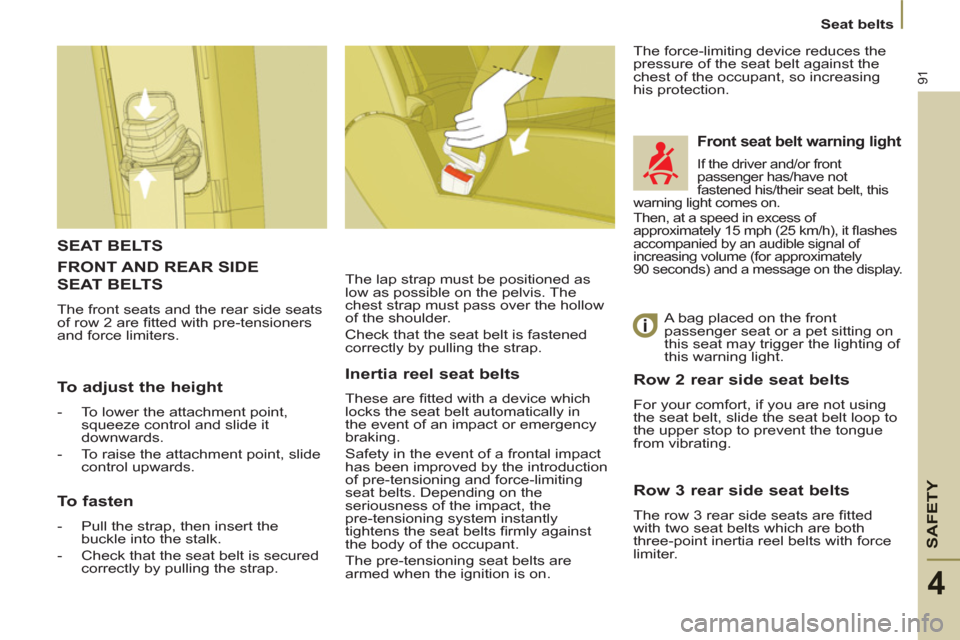
and force limiters. The lap strap must be positioned as
low as possible on the pelvis. The
chest strap must pass over the hollow
of the shoulder.
Check that the seat belt is fastened
correctly by pulling the strap. The force-limiting device reduces the
pressure of the seat belt against the
chest of the occupant, so increasing
his protection.
A bag placed on the front
passenger seat or a pet sitting on
this seat may trigger the lighting of
this warning light.
SEAT BELTS
Front seat belt warning light
If the driver and/or front
passenger has/have not
fastened his/their seat belt, this
warning light comes on.
Then, at a speed in excess of
approximately 15 mph (25 km/h), it fl ashes
accompanied by an audible signal of
increasing volume (for approximately
90 seconds) and a message on the display.
Row 2 rear side seat belts
For your comfort, if you are not using
the seat belt, slide the seat belt loop to
the upper stop to prevent the tongue
from vibrating.
To adjust the height
-
To lower the attachment point,
squeeze control and slide it
downwards.
- To raise the attachment point, slide
control upwards.
To fasten
-
Pull the strap, then insert the
buckle into the stalk.
- Check that the seat belt is secured
correctly by pulling the strap.
Inertia reel seat belts
These are fi tted with a device which
locks the seat belt automatically in
the event of an impact or emergency
braking.
Safety in the event of a frontal impact
has been improved by the introduction
of pre-tensioning and force-limiting
seat belts. Depending on the
seriousness of the impact, the
pre-tensioning system instantly
tightens the seat belts fi rmly against
the body of the occupant.
The pre-tensioning seat belts are
armed when the ignition is on.
Row 3 rear side seat belts
The row 3 rear side seats are fi tted
with two seat belts which are both
three-point inertia reel belts with force
limiter.
Page 94 of 234
92
Seat belts
Depending on the nature and
seriousness of any impact, the
pretensioning device may be triggered
before and independently of infl ation
of the airbags. It instantly tightens
the seat belts against the body of the
occupants.
Triggering of the pretensioners is
accompanied by a slight discharge
of harmless smoke and a noise, due
to the activation of the pyrotechnic
cartridge incorporated in the system.
The force limiter reduces the pressure
of the seat belt against the body of the
occupants.
The pretensioning seat belts are active
when the ignition is switched on.
The inertia reels are fi tted with a device
which automatically locks the strap in
the event of a collision or emergency
braking or if the vehicle rolls over.
You can unfasten the seat belt by
pressing the red button on the buckle.
Guide the seat belt after unfastening. The upper part of the seat belt should
be positioned in the hollow of the
shoulder.
The lap part should be placed as low
as possible on the pelvis.
Do not invert the seat belt buckles as
they will not fulfi l their role completely.
If the seats are fi tted with armrests, the
lap part of the seat belt should always
pass under the armrest.
Check that the seat belt is fastened
correctly by pulling the strap fi rmly.
Good practice
The driver must ensure that
passengers use the seat belts correctly
and that they are all strapped in
securely before moving off.
Wherever you are seated in the
vehicle, always fasten your seat belt,
even for short journeys.
The seat belts are fi tted with an inertia
reel which automatically adjusts the
length of the strap to your size.
Do not use accessories (clothes pegs,
clips, safety pins, etc.) which permit a
clearance with the seat belt straps.
Ensure that the seat belt is rolled up
correctly after use.
After folding or moving a seat or a rear
bench seat, ensure that the seat belt is
rolled up correctly and that the buckle
is ready to accommodate the tongue. To install the seat belt, move the
tongue into position to insert it into the
buckle.
Row 2 and 3 rear centre seat
belts
The row 2 rear centre seat and the
rear bench seat centre seat have an
integrated three-point inertia reel seat
belt.
The airbag warning light comes on
if the pretensioners are triggered.
Consult a CITROËN dealer.
In order to be effective, a seat belt
must:
- restrain one person only,
- must not be twisted, check by
pulling in front of you with an even
movement,
- be tightened as close to the body
as possible.
Recommendations for children:
- use a suitable child seat if the
passenger is less than 12 years old
or shorter than one metre fi fty,
- never allow a child to travel on
your lap, even with the seat belt
fastened.
For further information regarding child
seats, refer to the "Children on board"
section of chapter 4.
In accordance with current safety
regulations, your CITROËN dealer
guarantees all work or any checks,
from testing to maintenance, on your
seat belt equipment.
Have the seat belts checked regularly
(even after a minor impact) by a
CITROËN dealer: they must not show
any signs of wear, cutting or fraying
and they must not be transformed or
modifi ed.
Clean the seat belt straps with soapy
water or a textile cleaning product, sold
by CITROËN dealers.
Page 97 of 234
SAFETY
95
Airbags
4
Side airbags
If fi tted on your vehicle, this is a system
which protects the driver and front
passenger in the event of a serious
side impact in order to limit the risk of
injury to the chest.
Each side airbag is incorporated in the
front seat back frame, on the door side. The curtain airbag infl ates between the
front or rear occupant of the vehicle
and the windows.
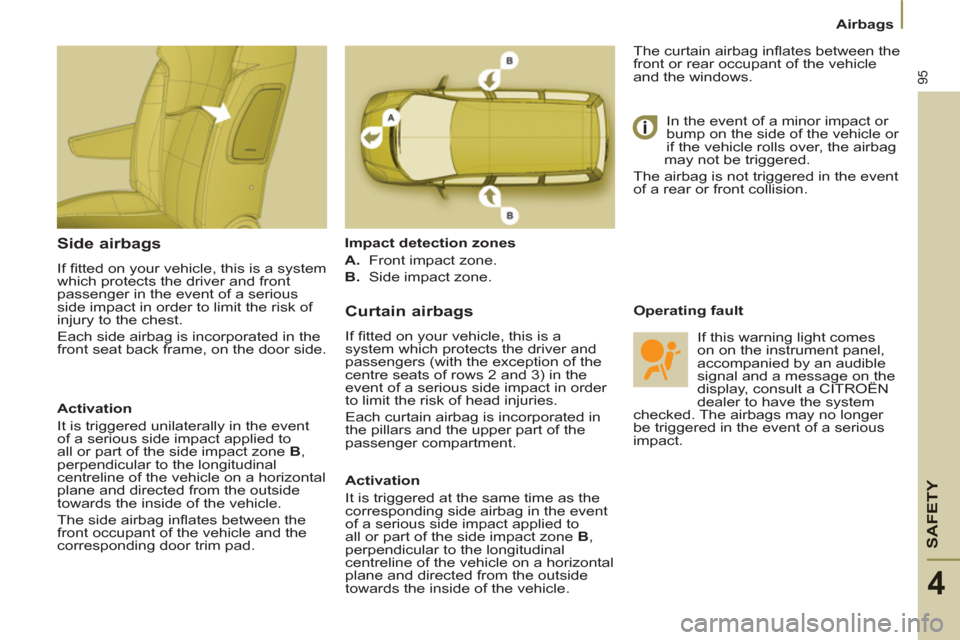
Impact detection zones
A.
Front impact zone.
B.
Side impact zone.
In the event of a minor impact or
bump on the side of the vehicle or
if the vehicle rolls over, the airbag
may not be triggered.
The airbag is not triggered in the event
of a rear or front collision.
Operating fault
Curtain airbags
If fi tted on your vehicle, this is a
system which protects the driver and
passengers (with the exception of the
centre seats of rows 2 and 3) in the
event of a serious side impact in order
to limit the risk of head injuries.
Each curtain airbag is incorporated in
the pillars and the upper part of the
passenger compartment.
Activation
It is triggered unilaterally in the event
of a serious side impact applied to
all or part of the side impact zone B
,
perpendicular to the longitudinal
centreline of the vehicle on a horizontal
plane and directed from the outside
towards the inside of the vehicle.
The side airbag infl ates between the
front occupant of the vehicle and the
corresponding door trim pad.
Activation
It is triggered at the same time as the
corresponding side airbag in the event
of a serious side impact applied to
all or part of the side impact zone B
,
perpendicular to the longitudinal
centreline of the vehicle on a horizontal
plane and directed from the outside
towards the inside of the vehicle.
If this warning light comes
on on the instrument panel,
accompanied by an audible
signal and a message on the
display, consult a CITROËN
dealer to have the system
checked. The airbags may no longer
be triggered in the event of a serious
impact.
Page 98 of 234
96
Airbags
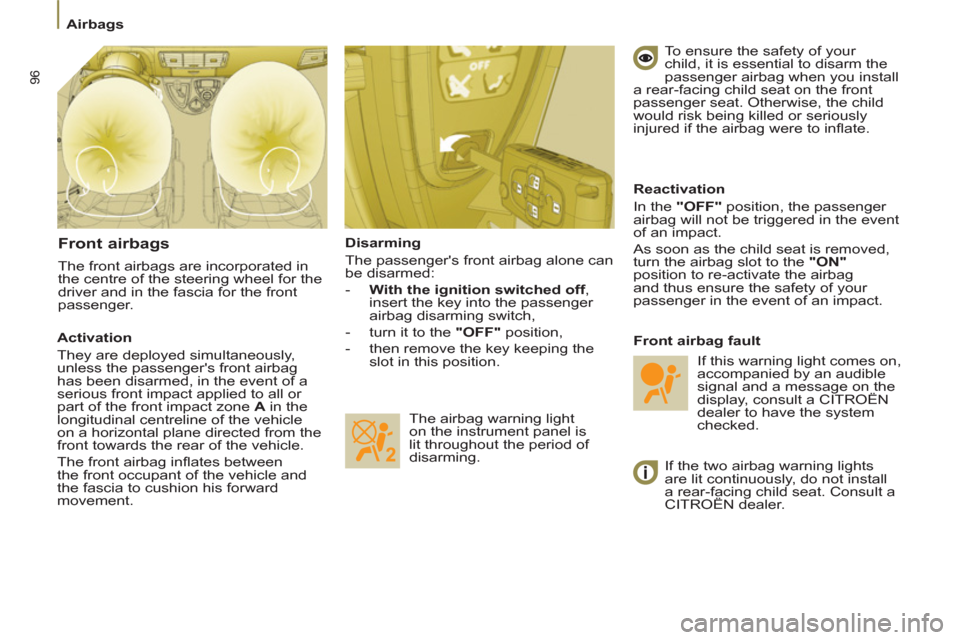
Disarming
The passenger's front airbag alone can
be disarmed:
- With
the
ignition
switched
off
,
insert the key into the passenger
airbag disarming switch,
turn it to the "OFF"
position,
-
then remove the key keeping the
slot in this position.
Front airbags
The front airbags are incorporated in
the centre of the steering wheel for the
driver and in the fascia for the front
passenger.
Front airbag fault
Reactivation
In the "OFF"
position, the passenger
airbag will not be triggered in the event
of an impact.
As soon as the child seat is removed,
turn the airbag slot to the "ON"
position to re-activate the airbag
and thus ensure the safety of your
passenger in the event of an impact. To ensure the safety of your
child, it is essential to disarm the
passenger airbag when you install
a rear-facing child seat on the front
passenger seat. Otherwise, the child
would risk being killed or seriously
injured if the airbag were to infl ate.
The airbag warning light
on the instrument panel is
lit throughout the period of
disarming.
If the two airbag warning lights
are lit continuously, do not install
a rear-facing child seat. Consult a
CITROËN dealer.
Activation
They are deployed simultaneously,
unless the passenger's front airbag
has been disarmed, in the event of a
serious front impact applied to all or
part of the front impact zone A
in the
longitudinal centreline of the vehicle
on a horizontal plane directed from the
front towards the rear of the vehicle.
The front airbag infl ates between
the front occupant of the vehicle and
the fascia to cushion his forward
movement. If this warning light comes on,
accompanied by an audible
signal and a message on the
display, consult a CITROËN
dealer to have the system
checked.
Page 106 of 234
104
Towing a trailer
On the contrary, use a high gear to
lower the engine speed and reduce
your speed.
In all cases, pay attention to the
coolant temperature.
Brakes:
towing increases the braking
distance. Drive at a moderate speed,
change down early and brake
gradually.
Automatic adjustment
For vehicles with Xenon bulbs, and if
the change in load makes it necessary,
this system automatically corrects the
height of the beam after approximately
2 minutes. The driver is then assured
of having optimum lighting and not
causing a nuisance to other road
users.
In certain cases of particularly
arduous use (towing the
maximum load up a steep slope
in high temperatures), the engine
automatically limits its power. In this
case, cutting off the air conditioning
allows the engine power to be
recovered, and therefore the towing
speed to be signifi cantly increased
(approximately 12 mph [20 km/h]
more). Sequential control of the
gearbox may also become unavailable.
Lighting
Bicycle carrier
Refer to the "Identifi cation
features" section of chapter 8. Refer to the "Steering wheel
controls" section of chapter 3.
When using a trailer connection,
you must add a fuse. Refer to
the "Changing a fuse" section of
chapter 7.
If the coolant temperature warning light
comes on, stop the vehicle and switch
off the engine as soon as possible.
Tyres:
check the tyre pressures of
the towing vehicle and of the trailer,
observing the recommended pressure.
Side wind:
sensitivity to side wind is
increased. Drive smoothly and at a
moderate speed.
Towbar
We recommend the use of original
CITROËN towbars, which have been
tested for endurance from the design
stage of your vehicle.
Towing equipment must be fi tted in
accordance with the manufacturer's
instructions, with particular attention to
the towing capacities of your vehicle,
the load towed, the nose weight and
the electrical connection. As this fi tting
should be carried out by a professional,
we recommend that you entrust the
fi tting of this equipment to a CITROËN
dealer.
In accordance with the general
instructions referred to above, we draw
your attention to the risk connected
with fi tting a towbar or other electrical
accessory which is not recommended
by the CITROËN network. Fitting such
equipment could result in a failure
of your vehicle's electronic system.
Please contact a CITROËN dealer fi rst
for further information.
Manual adjustment
Adjust your headlamps so as not to
dazzle other road users. Check the
electrical signalling of the trailer.
If you fi t a bicycle carrier on
the tailgate, deactivate the
rear wiper from the display's
confi guration menu.
Page 109 of 234
107
Other accessories
ACCESSORIES
5
OTHER ACCESSORIES
These accessories and parts, after
being tested and approved for
reliability and safety, are all adapted
to your vehicle. A wide choice of
recommended accessories and original
parts is offered by CITROËN. To avoid any jamming under the
pedals:
- ensure that the mat and its fi xings
are positioned correctly,
- never place one mat on top of
another.
Compatible portable equipment
For the hands-free kit audio
equipment, the fi tting of an RCA
auxiliary socket is offered specifi cally
by the Network.
The audio cable for connection to
the auxiliary socket (RCA yellow-red
located in the glove box) is also offered
by the network.
Following connection of the cable and
selection of the AUX mode, via the
source button, your portable equipment
is ready to operate.
Set the portable equipment to half
volume to avoid saturating the audio
system sound. Then use the audio
system volume button.
Audio systems, telephone, hands-free
kit, speakers, CD changer, navigation
system, DVD player, ...
Alloy wheels, trims, aluminium interior
trim kit, mud fl aps, ...
Seat covers compatible with side
airbags, mats, boot tray, sunroof,
luggage net, door defl ectors, cool box
secured on the slides, clip armrest,
load carrying roof bars, roof box, snow
chains, ski carrier, tailgate bicycle
carrier, interior bicycle carrier, booster
seats and child seats, Isofi x seats, side
sun blinds and rear blind, ...
Trailer towbar which must be fi tted by a
CITROËN dealer.
The fi tting of electrical equipment
or accessories which are not
recommended by CITROËN may
result in a failure of your vehicle's
electronic system.
Please note this specifi c warning. You
are advised to contact a representative
of the Marque to be shown the range
of recommended equipment or
accessories.
Screenwash, interior and exterior
maintenance and cleaning products,
replacement bulbs, ...
Depending on the country in which
the vehicle is sold, it is compulsory to
have a safety jacket, warning triangle
and replacement bulbs available in the
vehicle.
A further range is also available,
structured around comfort, leisure and
maintenance:
Anti-theft alarm, window engraving,
fi rst aid kit, high visibility vest, rear
parking sensors, warning triangle, ...
When using a tailgate bicycle
carrier, deactivate the rear
wiper from the display
confi guration menu.
Before installing a radio communication
transmitter with aerial, contact a
CITROËN dealer who will inform you
of the specifi cations of the transmitters
which can be fi tted, in accordance with
the Motor Vehicle Electromagnetic
Compatibility Directive (2004/104/EC).
Page 111 of 234
109
Fuel
6
LOW FUEL LEVEL
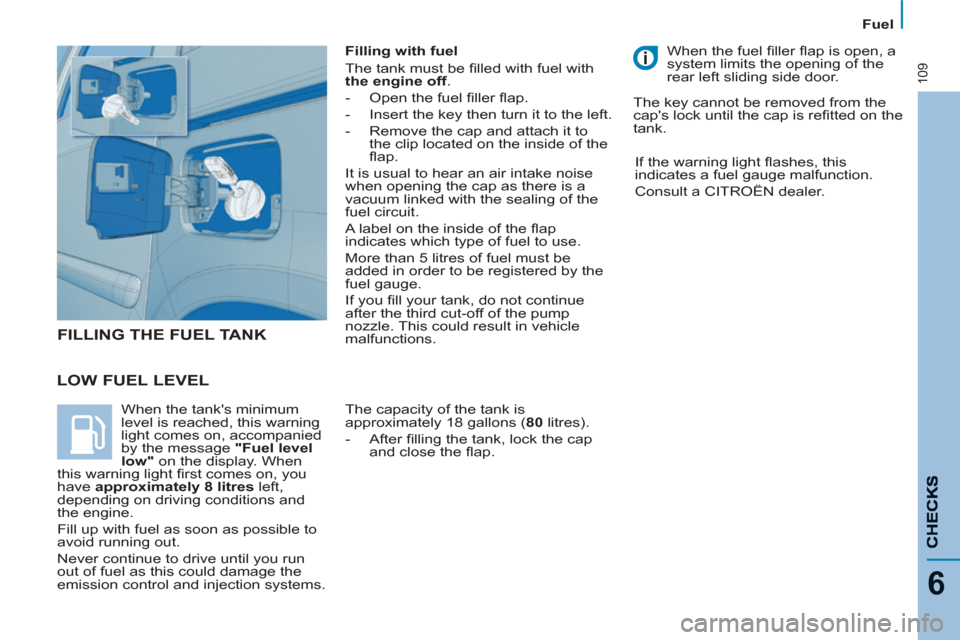
Filling with fuel
The tank must be fi lled with fuel with
the engine off
.
- Open the fuel fi ller fl ap.
- Insert the key then turn it to the left.
- Remove the cap and attach it to
the clip located on the inside of the
fl ap.
It is usual to hear an air intake noise
when opening the cap as there is a
vacuum linked with the sealing of the
fuel circuit.
A label on the inside of the fl ap
indicates which type of fuel to use.
More than 5 litres of fuel must be
added in order to be registered by the
fuel gauge.
If you fi ll your tank, do not continue
after the third cut-off of the pump
nozzle. This could result in vehicle
malfunctions.
FILLING THE FUEL TANK
If the warning light fl ashes, this
indicates a fuel gauge malfunction.
Consult a CITROËN dealer.
When the tank's minimum
level is reached, this warning
light comes on, accompanied
by the message "Fuel level
low"
on the display. When
this warning light fi rst comes on, you
have approximately 8 litres
left,
depending on driving conditions and
the engine.
Fill up with fuel as soon as possible to
avoid running out.
Never continue to drive until you run
out of fuel as this could damage the
emission control and injection systems.
The capacity of the tank is
approximately 18 gallons ( 80
litres).
- After fi lling the tank, lock the cap
and close the fl ap.
When the fuel fi ller fl ap is open, a
system limits the opening of the
rear left sliding side door.
The key cannot be removed from the
cap's lock until the cap is refi tted on the
tank.
Page 112 of 234
DIESEL
11 0
Fuel
FUEL CIRCUIT DISARMED
In a serious collision, a mechanism
automatically prevents fuel from
reaching the engine.
The fl ashing of this warning
light is accompanied by a
message on the display.
DIESEL REPRIMING
PUMP
If you should run out of fuel, it is
necessary to re-prime the circuit:
- fi ll the fuel tank with at least fi ve
litres of diesel,
- squeeze and release the manual
re-priming pump, under the bonnet
under the protective cover, until fuel
appears in the transparent pipe,
- operate the starter until the engine
starts. Check that there is no odour or
leakage of fuel outside the vehicle and
re-establish the fuel supply:
- switch off the ignition
(STOP position).
- remove the key.
- put the key back in the ignition.
- switch on the ignition and start.
Quality of the fuel used for
Diesel engines
The Diesel engines are perfectly
compatible with biofuels which conform
to current and future European
standards (Diesel fuel which complies
with standard EN 590 mixed with a
biofuel which complies with standard
EN 14214) available at the pumps
(containing up to 7 % Fatty Acid Methyl
Ester).
The B30 biofuel can be used in certain
Diesel engines; however, this use
is subject to strict application of the
special servicing conditions. Consult a
CITROËN dealer.
The use of any other type of (bio)fuel
(vegetable or animal oils, pure or
diluted, domestic fuel...) is strictly
prohibited (risk of damage to the
engine and fuel system).
Page 113 of 234
111
CHECK
S
6
Opening the bonnet
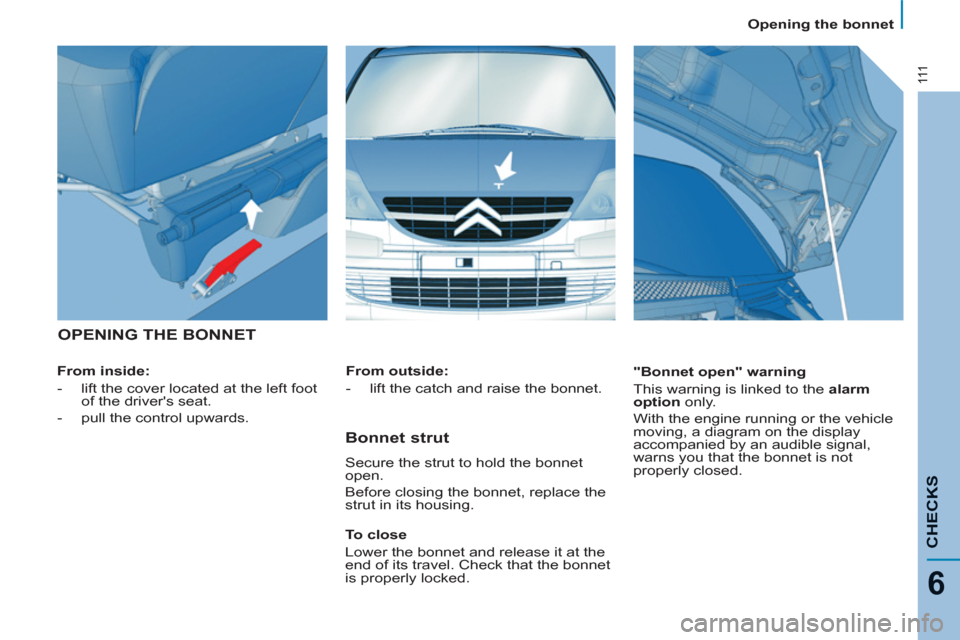
OPENING THE BONNET
From inside:
-
lift the cover located at the left foot
of the driver's seat.
-
pull the control upwards.
"Bonnet open" warning
This warning is linked to the alarm
option
only.
With the engine running or the vehicle
moving, a diagram on the display
accompanied by an audible signal,
warns you that the bonnet is not
properly closed.
From outside:
- lift the catch and raise the bonnet.
Bonnet strut
Secure the strut to hold the bonnet
open.
Before closing the bonnet, replace the
strut in its housing.
To close
Lower the bonnet and release it at the
end of its travel. Check that the bonnet
is properly locked.
Page 115 of 234
11 3
Levels
CHECK
S
6
These regular maintenance
operations will keep your vehicle
in good running order. Consult the
instructions at CITROËN dealerships
or in the servicing booklet enclosed in
the handbook pack. To maintain the reliability of engines
and emission control systems, the use
of additives in engine oil is prohibited.
Oil change
It is imperative that this is carried out at
the intervals specifi ed and the viscosity
grade of the oil selected must fulfi l the
requirements in accordance with the
manufacturer's servicing schedule.
Consult the instructions at CITROËN
dealerships.
Remove the dipstick before fi lling.
Check the level after fi lling (never
exceed the max mark).
Screw the cap back onto the sump
before closing the bonnet.
LEVELS
If you have to remove/refi t the
engine style cover, handle it with
care to avoid damaging the fi xing
clips.
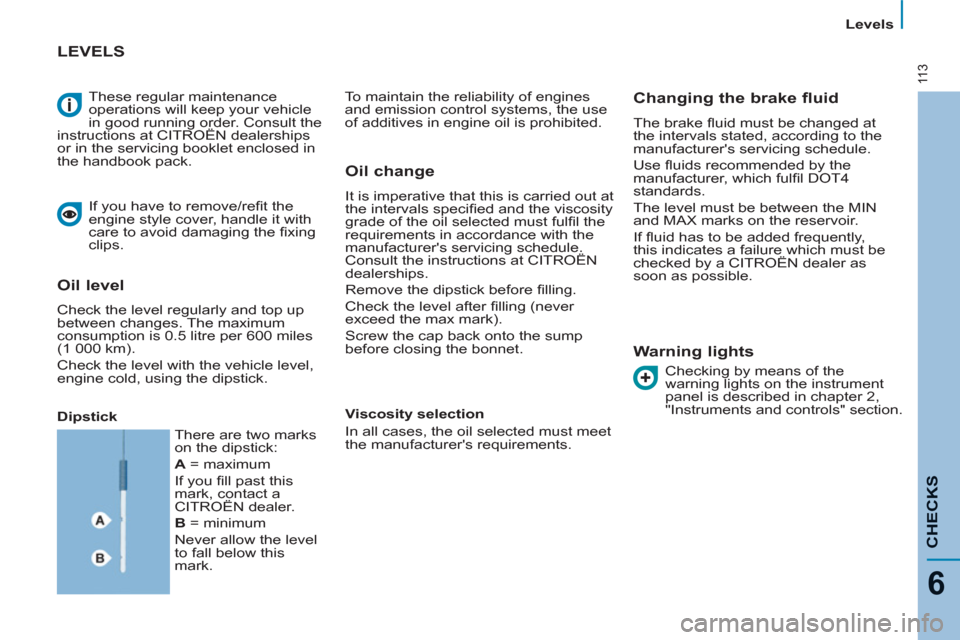
Dipstick
Warning lights
Oil level
Check the level regularly and top up
between changes. The maximum
consumption is 0.5 litre per 600 miles
(1 000 km).
Check the level with the vehicle level,
engine cold, using the dipstick.
Viscosity selection
In all cases, the oil selected must meet
the manufacturer's requirements.
Checking by means of the
warning lights on the instrument
panel is described in chapter 2,
"Instruments and controls" section.
Changing the brake fluid
The brake fl uid must be changed at
the intervals stated, according to the
manufacturer's servicing schedule.
Use fl uids recommended by the
manufacturer, which fulfi l DOT4
standards.
The level must be between the MIN
and MAX marks on the reservoir.
If fl uid has to be added frequently,
this indicates a failure which must be
checked by a CITROËN dealer as
soon as possible.
There are two marks
on the dipstick:
A
= maximum
If you fi ll past this
mark, contact a
CITROËN dealer.
B
= minimum
Never allow the level
to fall below this
mark.