port CITROEN DS4 2023 Owners Manual
[x] Cancel search | Manufacturer: CITROEN, Model Year: 2023, Model line: DS4, Model: CITROEN DS4 2023Pages: 296, PDF Size: 9.91 MB
Page 9 of 296
7
Eco-driving
Eco-driving is a range of everyday practices
that allow the motorist to optimise their fuel
consumption and CO
2 emissions.
Optimise the use of your gearbox
With a manual gearbox, move off gently
and change up without waiting. During
acceleration, change up early.
With an automatic gearbox, give preference
to automatic mode and avoid pressing the
accelerator pedal heavily or suddenly.
The gear efficiency indicator invites you to
engage the most suitable gear: as soon as the
indication is displayed in the instrument panel,
follow it straight away.
For vehicles fitted with an automatic gearbox,
this indicator appears only in manual mode.
Drive smoothly
Maintain a safe distance between vehicles,
use engine braking rather than the
brake pedal, and press the accelerator
progressively. These practices contribute
towards a reduction in fuel consumption and
CO
2 emissions and also help reduce the
background traffic noise.
If your vehicle has cruise control, make use of
the system at speeds above 25 mph (40 km/h)
when the traffic is flowing well.
Control the use of your electrical
equipment
Before moving off, if the passenger
compartment is too warm, ventilate it by
opening the windows and air vents before
using the air conditioning.
Above around 30 mph (50 km/h), close the
windows and leave the air vents open.
Consider using equipment that can help
keep the temperature in the passenger
compartment down (sunroof blind and window
blinds...).
Unless it has automatic regulation, switch off
the air conditioning as soon as the desired
temperature has been reached. Switch off the headlamps and front foglamps
when the ambient light level does not require
their use.
Avoid running the engine before moving off,
particularly in winter; your vehicle will warm up
much faster while driving. Switch off the demisting and defrosting
controls, if these are not automatically
managed.
Switch off the heated seat as soon as possible.
As a passenger, if you avoid connecting your
multimedia devices (film, music, video game
etc.), you will contribute towards limiting the
consumption of electrical energy, and so of
fuel.
Disconnect your portable devices before
leaving the vehicle.
Eco-driving
Page 60 of 296

58
The monitoring system is active: the indicator
lamp in the button flashes once per second
and the direction indicators come on for about
2 seconds.
Following a vehicle locking request, the
perimeter monitoring is activated after 5
seconds and the interior volumetric and anti-tilt
monitoring after 45 seconds.
If an opening (door, boot...) is not fully closed,
the vehicle will not be locked but the exterior
perimeter monitoring will be activated after
45 seconds, at the same time as the interior
volumetric and anti-tilt monitoring.
Deactivation
F Press the unlocking button on the remote control.
or
F
U
nlock the vehicle with the "Keyless Entry
and Starting" system.
The monitoring system is deactivated: the
indicator lamp in the button goes off and the
direction indicators flash for about 2 seconds. If the vehicle locks itself again
automatically (which occurs 30 seconds
after unlocking, if a door or the boot is
not opened), the monitoring system is not
reactivated automatically. To reactivate it,
the vehicle must be unlocked and locked
again, using the remote control or the
"Keyless Entry and Starting" system.
Locking the vehicle with
exterior perimeter monitoring
only
Deactivate the interior volumetric and anti-tilt
monitoring to avoid unwanted triggering of the
alarm in certain cases such as:
-
l
eaving a pet in the vehicle,
-
l
eaving a window partially open,
-
w
ashing your vehicle,
-
c
hanging a wheel,
-
h
aving your vehicle towed,
-
t
ransportation by sea.
Deactivating the interior volumetric
and anti-tilt monitoring
F Switch off the ignition and within ten seconds, press the button until the indicator
lamp is on continuously.
F
G
et out of the vehicle.
F
I
mmediately lock the vehicle using the
remote control or the Keyless Entry and
Starting system.
The exterior perimeter monitoring alone is
activated: the indicator lamp in the button
flashes once per second.
To be effective, this deactivation must
be carried out each time the ignition is
switched off.
02
Access
Page 68 of 296
66
Seat backrest angle
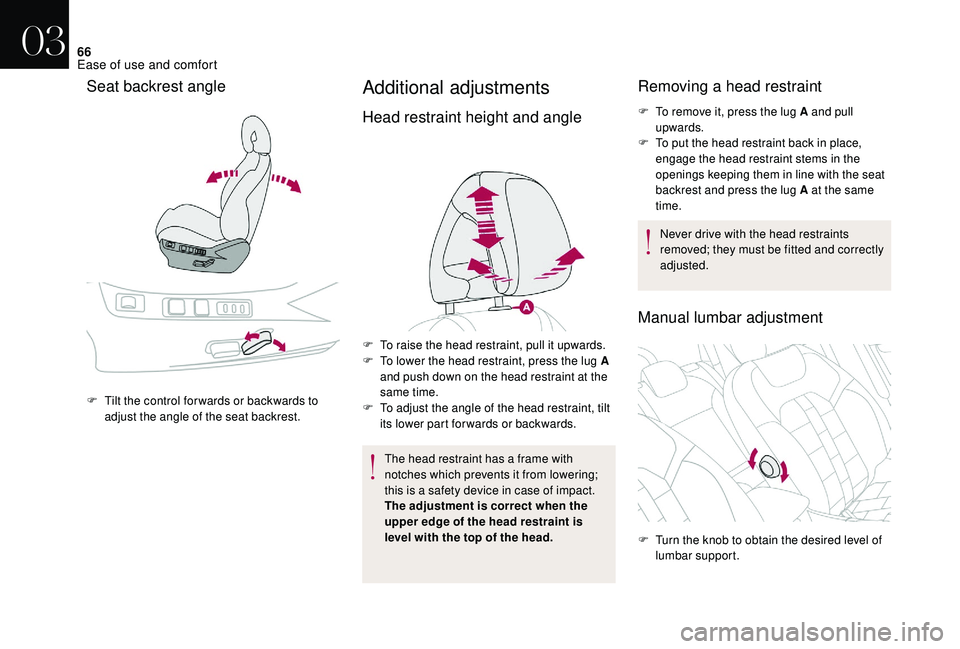
F Tilt the control for wards or backwards to adjust the angle of the seat backrest.
Additional adjustments
Head restraint height and angle
F To raise the head restraint, pull it upwards.
F T o lower the head restraint, press the lug A
and push down on the head restraint at the
same time.
F
T
o adjust the angle of the head restraint, tilt
its lower part forwards or backwards.
The head restraint has a frame with
notches which prevents it from lowering;
this is a safety device in case of impact.
The adjustment is correct when the
upper edge of the head restraint is
level with the top of the head.
Removing a head restraint
F To remove it, press the lug A and pull upwards.
F
T
o put the head restraint back in place,
engage the head restraint stems in the
openings keeping them in line with the seat
backrest and press the lug A at the same
time.
Never drive with the head restraints
removed; they must be fitted and correctly
adjusted.
Manual lumbar adjustment
F Turn the knob to obtain the desired level of lumbar support.
03
Ease of use and comfort
Page 69 of 296
67
Massage function
Electric lumbar adjustment
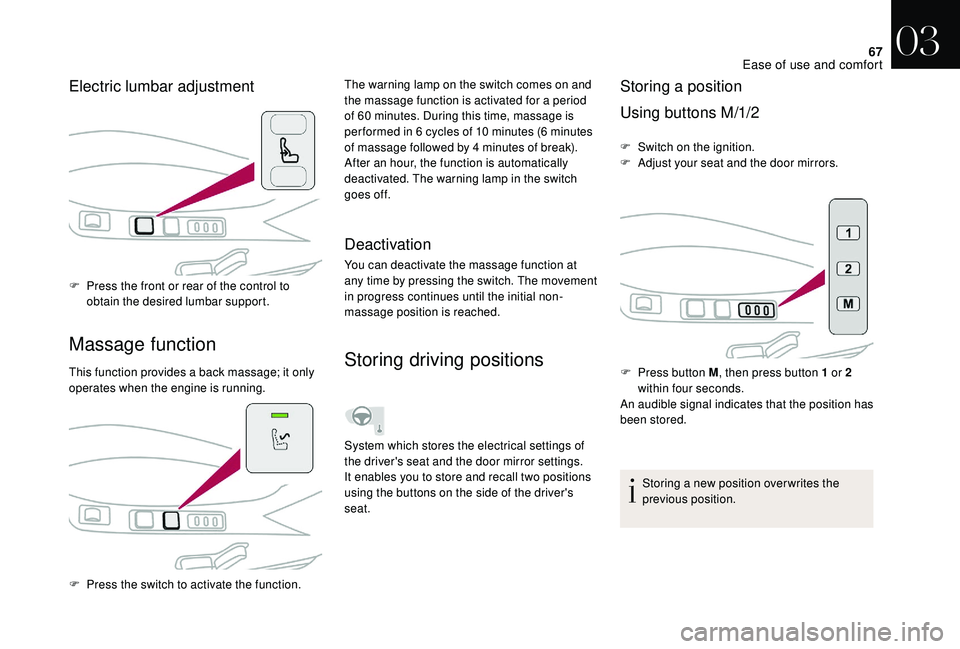
F Press the front or rear of the control to obtain the desired lumbar support.
This function provides a back massage; it only
operates when the engine is running. The warning lamp on the switch comes on and
the massage function is activated for a period
of 60 minutes. During this time, massage is
per formed in 6 cycles of 10 minutes (6 minutes
of massage followed by 4 minutes of break).
After an hour, the function is automatically
deactivated. The warning lamp in the switch
goes off.
F
P
ress the switch to activate the function.
Deactivation
You can deactivate the massage function at
any time by pressing the switch. The movement
in progress continues until the initial non-
massage position is reached.
Storing driving positions
System which stores the electrical settings of
the driver's seat and the door mirror settings.
It enables you to store and recall two positions
using the buttons on the side of the driver's
seat.
Storing a position
Using buttons M/1/2
F Switch on the ignition.
F A djust your seat and the door mirrors.
Storing a new position over writes the
previous position.
F
P
ress button M , then press button 1 or 2
within four seconds.
An audible signal indicates that the position has
been stored.
03
Ease of use and comfort
Page 84 of 296
82
To avoid any risk of jamming of the pedals:
- o nly use mats which are suited to the
fixings already present in the vehicle;
these fixings must be used,
-
n
ever place one mat on top of another.
The use of unapproved mats may inter fere
with access to the pedals and hinder the
operation of the cruise control/speed
limiter.
The approved mats have two fixings
located below the seat.
Cigar lighter/12 V accessory
s o c ket (s)
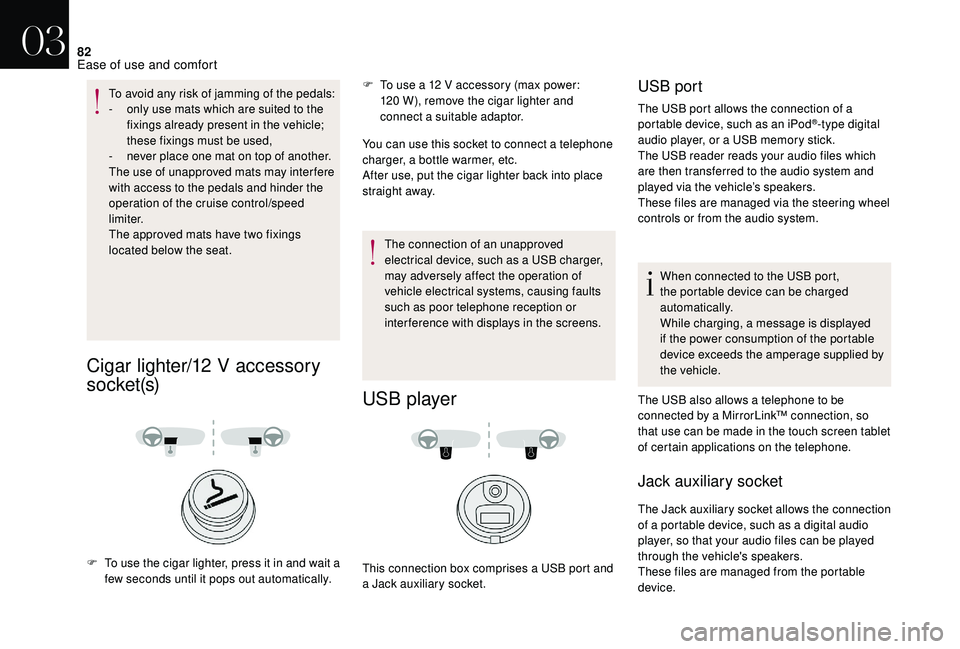
F To use a 12 V accessory (max power: 120 W), remove the cigar lighter and
connect a suitable adaptor.
You can use this socket to connect a telephone
charger, a bottle warmer, etc.
After use, put the cigar lighter
back into place
straight away.
F
T
o use the cigar lighter, press it in and wait a
few seconds until it pops out automatically. The connection of an unapproved
electrical device, such as a USB charger,
may adversely affect the operation of
vehicle electrical systems, causing faults
such as poor telephone reception or
interference with displays in the screens.
USB player
This connection box comprises a USB port and
a Jack auxiliary socket.
USB port
The USB port allows the connection of a
portable device, such as an iPod®-type digital
audio player, or a USB memory stick.
The USB reader reads your audio files which
are then transferred to the audio system and
played via the vehicle’s speakers.
These files are managed via the steering wheel
controls or from the audio system.
When connected to the USB port,
the portable device can be charged
automatically.
While charging, a message is displayed
if the power consumption of the portable
device exceeds the amperage supplied by
the vehicle.
The USB also allows a telephone to be
connected by a MirrorLink™ connection, so
that use can be made in the touch screen tablet
of certain applications on the telephone.
Jack auxiliary socket
The Jack auxiliary socket allows the connection
of a portable device, such as a digital audio
player, so that your audio files can be played
through the vehicle's speakers.
These files are managed from the portable
device.
03
Ease of use and comfort
Page 90 of 296

88
Rear fittings
12 V accessory socket
F To connect a 12 V accessory (max. power: 120 W), lift the cover and connect a suitable
adaptor.
Rear armrest
Comfort system for rear passengers. F
L
ower the rear armrest for a more
comfortable position.
This also gives access to the ski flap.
Ski flap
Mechanism for storing and transporting long
objects.
Opening
F Lower the rear armrest.
F P ull the flap handle downwards.
F
L
ower the flap.
F
L
oad the objects from inside the boot.
Boot fittings
Rear shelf
To remove the shelf:
F r elease the two cords,
F
g
ently lift the shelf, then remove it.
There are several ways of storing it:
-
ei
ther upright behind the front seats,
-
o
r flat on the bottom of the boot.
03
Ease of use and comfort
Page 91 of 296
89
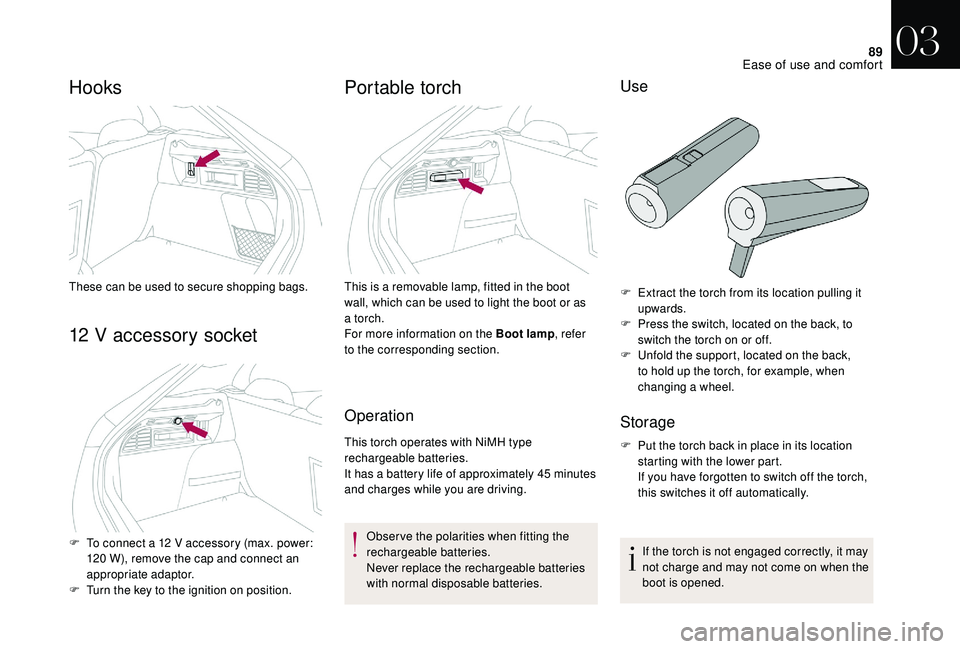
Hooks
These can be used to secure shopping bags.
12 V accessory socket
F To connect a 12 V accessory (max. power: 120 W), remove the cap and connect an
appropriate adaptor.
F
T
urn the key to the ignition on position.
Portable torch
Operation
This torch operates with NiMH type
rechargeable batteries.
It has a battery life of approximately 45 minutes
and charges while you are driving.
Observe the polarities when fitting the
rechargeable batteries.
Never replace the rechargeable batteries
with normal disposable batteries.
This is a removable lamp, fitted in the boot
wall, which can be used to light the boot or as
a torch.
For more information on the Boot lamp
, refer
to the corresponding section.
Use
F Extract the torch from its location pulling it upwards.
F
P
ress the switch, located on the back, to
switch the torch on or off.
F
U
nfold the support, located on the back,
to hold up the torch, for example, when
changing a wheel.
Storage
F Put the torch back in place in its location starting with the lower part.
If you have forgotten to switch off the torch,
this switches it off automatically.
If the torch is not engaged correctly, it may
not charge and may not come on when the
boot is opened.
03
Ease of use and comfort
Page 101 of 296

99
Without AUTO wiping
With AUTO wiping
Front wipers
To select wiping speed: raise or lower the lever
to the desired position.Fast wiping (heavy rain).
Normal wiping (moderate rain). Intermittent wiping (proportional to
the speed of the vehicle).
Of f.
Single wipe (press downwards or
pull the stalk briefly towards you,
then release).
or Automatic wiping (press down,
then release).
Single wipe (pull the stalk briefly
towards you).
Automatic windscreen wipers
The windscreen wipers operate automatically
once rainfall is detected (sensor behind the
rear view mirror), adapting their speed to the
intensity of the rainfall without any action on the
part of the driver.
Switching on
F Briefly push the control stalk downwards.
The request is confirmed by a wiping cycle,
accompanied by illumination of this warning
lamp in the instrument panel and/or display of
an activation message.
Switching off
Briefly push the stalk downwards
again.
The request is confirmed by this warning lamp
going off in the instrument panel and/or display
of a deactivation message.
The automatic windscreen wipers must
be reactivated each time the ignition has
been off for more than one minute.
04
Lighting and visibility
Page 112 of 296
11 0
ASR/DSC
These systems offer increased safety
in normal driving, but they should not
encourage the driver to take extra risks or
drive at high speed.
It is in conditions of reduced grip (rain,
snow, ice) that the risk of loss of grip
increases. It is therefore important for your
safety to keep these systems activated in
all conditions, and particularly in difficult
conditions.
The correct operation of these systems
depends on observation of the
manufacturer's recommendations, not
only about the wheels (tyres and rims),
braking and electronic components but
also the assembly and repair procedures
used in the dealer network.
To benefit in full from the effectiveness
of these systems in wintry conditions,
the vehicle must be fitted with four snow
tyres, allowing the vehicle to retain neutral
behaviour on the road.Seat belts
Front seat belts
The front seat belts are fitted with a
pretensioning and force limiting system.
This system improves safety in the front
seats in the event of a front or side impact.
Depending on the severity of the impact, the
pretensioning system instantly tightens the seat
belts against the body of the occupants.
The pretensioning seat belts are active when
the ignition is on.
The force limiter reduces the pressure of
the seat belt on the passenger’s chest, thus
improving their protection.
Fastening
F Pull the strap then insert the tongue in the buckle.
F
C
heck that the seat belt is fastened
correctly by pulling the strap.
Unfastening
F Press the red button on the buckle.
F G uide the seat belt as it reels in.
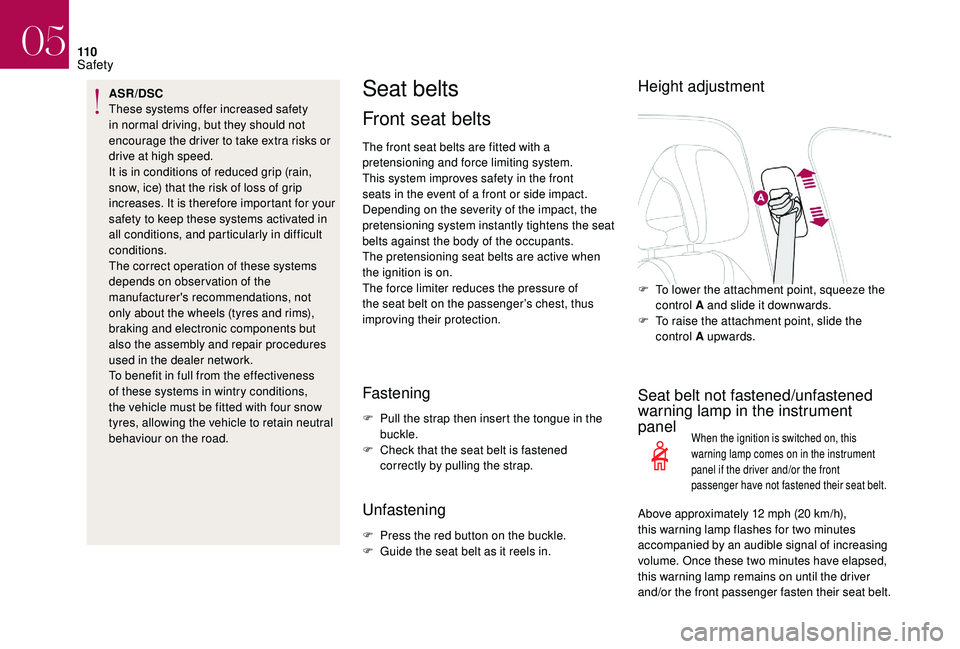
Height adjustment
F To lower the attachment point, squeeze the control A and slide it downwards.
F
T
o raise the attachment point, slide the
control A upwards.
Seat belt not fastened/unfastened
warning lamp in the instrument
panel
When the ignition is switched on, this
warning lamp comes on in the instrument
panel if the driver and/or the front
passenger have not fastened their seat belt.
Above approximately 12 mph (20 km/h),
this warning lamp flashes for two minutes
accompanied by an audible signal of increasing
volume. Once these two minutes have elapsed,
this warning lamp remains on until the driver
and/or the front passenger fasten their seat belt.
05
Safety
Page 118 of 296

11 6
General points relating to
child seats
The regulations on carrying children are
specific to each country. Refer to the
legislation in force in your country.
For maximum safety, please obser ve the
following recommendations:
-
i
n accordance with European regulations,
all children under the age of 12 or less
than one and a half metres tall must
travel in approved child seats suited to
their weight , on seats fitted with a seat belt
or ISOFIX mountings,
-
s
tatistically, the safest seats in your
vehicle for carr ying children are the rear
seats,
-
a c
hild weighing less than 9 kg must
travel in the rear ward facing position
both in the front and in the rear. It is recommended
that children travel on
the rear seats of your vehicle:
-
re
arward facing
up to the age of 3,
- fo rward facing
over the age of 3.
Child seat at the rear
"Rearward facing"
When a "rear ward facing" child seat is installed
on a rear passenger seat , move the vehicle's
front seat for ward and straighten the backrest
so that the rear ward facing child seat does not
touch the vehicle's front seat.
"Forward facing"
When a "for ward facing" child seat is installed
on a rear passenger seat , move the vehicle's
front seat for ward and straighten the backrest
so that the legs of the child in the for ward
facing child seat do not touch the vehicle's front
seat.
Ensure that the seat belt is correctly
tensioned.
For child seats with a support leg, ensure
that this is in firm contact with the floor. If
necessary, adjust the passenger seat.
05
Safety