port CITROEN DS4 2023 User Guide
[x] Cancel search | Manufacturer: CITROEN, Model Year: 2023, Model line: DS4, Model: CITROEN DS4 2023Pages: 296, PDF Size: 9.91 MB
Page 119 of 296
11 7
Centre rear seat
A child seat with a support leg must never be
installed on the centre rear passenger seat.
The incorrect installation of a child seat in
a vehicle compromises the protection of
the child in the event of an accident.
Child seat at the front
(Refer to the legislation in force in your country
before installing your child on this seat.)
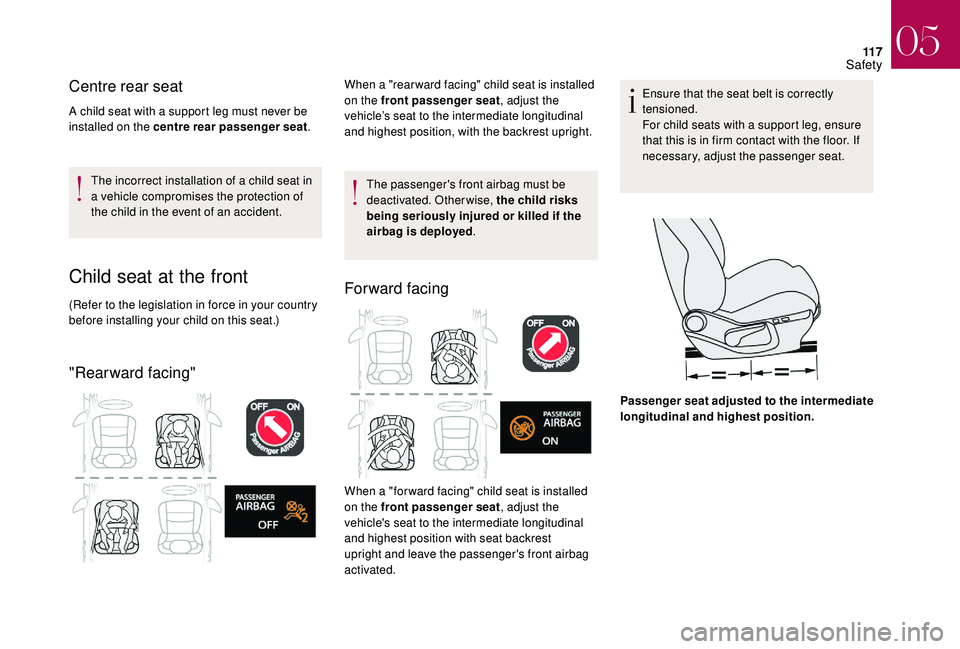
"Rearward facing"
When a "rear ward facing" child seat is installed
on the front passenger seat , adjust the
vehicle’s seat to the intermediate longitudinal
and highest position, with the backrest upright.
The passenger's front airbag must be
deactivated. Otherwise, the child risks
being seriously injured or killed if the
airbag is deployed .
Forward facing
When a "for ward facing" child seat is installed
on the front passenger seat , adjust the
vehicle's seat to the intermediate longitudinal
and highest position with seat backrest
upright and leave the passenger's front airbag
activated. Ensure that the seat belt is correctly
tensioned.
For child seats with a support leg, ensure
that this is in firm contact with the floor. If
necessary, adjust the passenger seat.
Passenger seat adjusted to the intermediate
longitudinal and highest position.
05
Safety
Page 127 of 296

125
- a ring B, behind the seat and identified by
a marking, referred to as the TOP TETHER
for fixing the upper strap.
This ISOFIX mounting system provides fast,
reliable and safe fitting of the child seat in your
vehicle.
The ISOFIX child seats are fitted with two
latches which are secured on the two rings A .
Some seats also have an upper strap , known
as the Top Tether, which is attached to ring B .
To secure the child seat to the TOP TETHER :
-
r
emove and stow the head restraint before
installing the child seat on the seat (refit it
once the child seat has been removed),
-
r
aise the carpet cover to expose the TOP
TETHER,
-
p
ass the upper strap of the child seat behind
the seat backrest, between the apertures
for the head restraint rods, When fitting an ISOFIX child seat to the
left-hand rear seat, before fitting the
seat, first move the centre rear seat belt
towards the middle of the vehicle, so
as to avoid the seat inter fering with the
operation of the seat belt.
The incorrect installation of a child seat in
a vehicle compromises the protection of
the child in the event of an accident.
Strictly obser ve the fitting instructions
provided with the child seat.
For information on the possibilities for
installing ISOFIX child seats in your
vehicle, refer to the summary table.
Also consult the installation notes of the
child seat’s manufacturer to find out how
to install and remove the seat.
-
f
ix the hook of the upper strap to the ring B
,
-
t
ighten the upper strap.
"RÖMER Baby- Safe Plus and its ISOFIX
base"
(size category: E )
Group 0+: from bir th to 13 kg
Installed rearward-facing using an ISOFIX base which is attached to rings A .
The base has a height adjustable support leg that rests on the vehicle's floor.
This child seat can also be secured with a
seat belt. In this case, only the shell is used and attached to the vehicle seat using the three-point seat belt.
Recommended ISOFIX child
seats
05
Safety
Page 128 of 296

126
Baby P2C Mini and its ISOFIX base(size categories: C, D, E )
Group 0+: from bir th to 13 kg
Installed rearward-facing using an ISOFIX base which is attached to rings A .
The base has a height adjustable support leg that rests on the vehicle's floor.
This child seat can also be secured with the seat belt.
In this case only the seat shell is used and is attached to the vehicle's seat by the three-point seat belt. RÖMER Duo Plus ISOFIX
(size category: B1 )
Group 1: 9 –18 kg
Installed only in the forward-facing position. Attached to the rings A and the ring B ,
referred to as the TOP TETHER, using an upper strap.
Three seat body angles: sitting, reclining, lying.
This child seat can also be used on seats not equipped with ISOFIX mountings. In
this case, it must be secured to the vehicle's seat by the three-point seat belt. Adjust the
position of the vehicle's front seat so that the child's feet are not touching the backrest. Baby P2C Midi and its ISOFIX base
(size categories: D, C, A, B, B1 )
Group 1: 9 –18 kg
Installed rearward-facing using an ISOFIX base which is attached to rings A .
The base has a height adjustable support leg that rests on the vehicle's floor.
This child seat can also be used for ward facing.
This child seat cannot be secured with a seat
belt.
We recommend that you use the seat in the rear ward facing position up to the age of 3
years.
05
Safety
Page 129 of 296

127
Summary table of locations for ISOFIX child seats
In line with European regulations, this table indicates the options for installing ISOFIX child seats on seats in the vehicle fitted with ISOFIX mountings.
In the case of universal and semi-universal ISOFIX child seats, the ISOFIX size category, determined by a letter from A to G, is indicated on the child
seat next to the ISOFIX logo.
Weight of the child/indicative age
Under 10 kg (group 0)
Up to about 6
monthsUnder 10 kg
(group 0)
Under 13 kg (group 0+)
Up to about 1 year From 9 to 18 kg (group 1)
From about 1 to 3 years
Type of ISOFIX child seat Cot* rearward facing rearward facing forward facing
ISOFIX size categor y F G C D E C D A B B1
Universal and semi-universal ISOFIX child seats which can be installed on the outer rear seats IL- SU
** IL- SU IL- SU IUF
IL- SU
I UF: seat suitable for the installation of
an Isofix U niversal seat, " For ward
facing", secured using the top tether.
IL- SU:
seat suitable for the installation of an
I sofix S emi-Universal seat which is either:
-
"
rear ward facing" fitted with an upper
strap or a support leg,
-
f
or ward facing fitted with a support
leg,
-
a
n infant car seat fitted with an upper
strap or a support leg.
For advice on securing of the upper strap, refer
to the "ISOFIX mountings" section.
Remove and stow the head restraint
before installing a child seat with backrest
on a passenger seat. Refit the head
restraint once the child seat has been
removed. *
I
nfant car seats and "car cots" cannot be
installed in the front passenger seat.
**
T
he ISOFIX cot, secured to the lower rings
of an ISOFIX seat, occupies all of the space
on the rear bench seat.
05
Safety
Page 134 of 296
132
Driving recommendations
Observe the driving regulations and remain
vigilant whatever the traffic conditions.
Pay close attention to the traffic and keep your
hands on the wheel so that you are ready to
react at any time to any eventuality.
As a safety measure, the driver should only
carry out any operations that require close
attention when the vehicle is stationary.
On a long journey, a break every two hours is
strongly recommended.
In bad weather, drive smoothly, anticipate the
need to brake and increase the distance from
other vehicles.Never leave the engine running in
an enclosed area without adequate
ventilation: internal combustion engines
emit toxic exhaust gases, such as carbon
monoxide. There is a risk of poisoning and
death!
In very severe wintry conditions
(temperatures below -23°C), to guarantee
correct operation and the longevity of
the mechanical elements of your vehicle,
engine and gearbox, the engine must be
left running for 4 minutes before driving.
Important!
Never drive with the parking brake applied
– Risk of overheating and damage to the
braking system!
Do not park and do not run the engine,
the vehicle is stationary, in areas where
substances and combustible materials
(dry grass, leaves ...) can come into
contact with the hot exhaust system – Risk
of fire!
Never leave a vehicle unsuper vised with
the engine running. If you have to leave
your vehicle with the engine running, apply
the parking brake and put the gearbox into
neutral or position N or P , depending on
the type of gearbox.
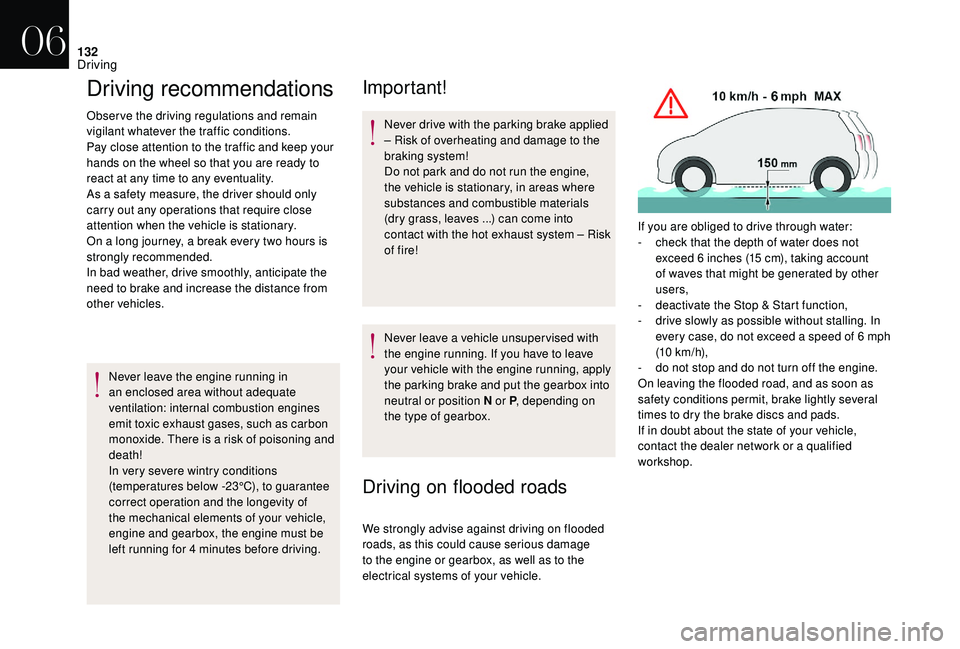
Driving on flooded roads
We strongly advise against driving on flooded
roads, as this could cause serious damage
to the engine or gearbox, as well as to the
electrical systems of your vehicle. If you are obliged to drive through water:
-
c
heck that the depth of water does not
exceed 6 inches (15 cm), taking account
of waves that might be generated by other
users,
-
d
eactivate the Stop & Start function,
-
d
rive slowly as possible without stalling. In
every case, do not exceed a speed of 6 mph
(10 km/h),
-
d
o not stop and do not turn off the engine.
On leaving the flooded road, and as soon as
safety conditions permit, brake lightly several
times to dry the brake discs and pads.
If in doubt about the state of your vehicle,
contact the dealer network or a qualified
workshop.
06
Driving
Page 136 of 296

134
Anti-theft protection
Electronic immobiliser
The keys contain an electronic chip which has
a specific code. When the ignition is switched
on, this code must be recognised to allow the
engine to be started.
This electronic engine immobiliser locks the
engine management system a few minutes
after the ignition is switched off and prevents
starting of the engine by anyone who does not
have the key.In the event of a fault, you are
informed by illumination of this
warning lamp, an audible signal
and/or the display of a message,
depending on version.
Starting/Switching off the
engine with the key
Ignition switch
It has 3 positions:
- position 1 (Stop): inserting and removing
the key, steering column locked,
-
position 2 (Ignition on) : steering column
unlocked, ignition on, Diesel preheating,
engine running,
-
position 3 (Starting) .
Ignition on position
It allows the use of the vehicle's electric
equipment or portable devices to be charged.
Once the state of charge of the battery drops
to the reser ve level, the system switches to
energy economy mode: the power supply is
cut off automatically to preser ve the remaining
battery charge. Avoid attaching heavy objects to the key
or the remote control, which would weigh
down on its blade in the ignition switch
and could cause a malfunction.
Switching off the engine leads to a loss of
braking assistance.
Starting the engine
With the parking brake applied and the gearbox
in neutral or position N
or P:
F
d
epress the clutch pedal fully (manual
gearbox),
or
F
p
ress the brake pedal firmly (automatic
gearbox),
F
i
nsert the key into the ignition switch; the
system recognises the code,
F
u
nlock the steering column by simultaneously
turning the steering wheel and the key.
In certain cases, you may have to apply
more force to the steering (wheels on full
lock, for example).
F
W
ith a petrol engine, operate the starter
motor by turning the key to position 3
without pressing the accelerator pedal,
until the engine starts. Once the engine is
running, release the key.
In this case, your vehicle will not start; contact
the dealer network as soon as possible.
06
Driving
Page 145 of 296

143
Automatic gearbox
Six speed automatic gearbox which offers a
choice between the comfort of fully automatic
operation, enhanced by sport and snow
programmes, and the pleasure of manual gear
changing.
Two driving modes are offered:
-
a
utomatic operation for electronic
management of the gears by the gearbox,
with a spor t programme for a more dynamic
style of driving and a snow programme to
improve driving when traction is poor,
-
man
ual operation for sequential changing
of the gears by the driver.
Gear selector module
1. Gear selector.
2. "T " (snow) button.
3. "S " (spor t) button.
4. Gear selector positions diagram.
Gear selector positions
P. Park.
-
I mmobilisation of the vehicle,
parking brake on or off.
-
S
tarting the engine.
R. Reverse.
-
R
eversing manoeuvres, vehicle
stationary, engine at idle.
N. Neutral.
-
I
mmobilisation of the vehicle,
parking brake on.
-
S
tarting the engine.
D. Automatic operation.
M.+/- Manual operation with sequential
changing of the six gears.
F
P
ush for wards to change up through the
gears.
or
F
P
ull backwards to change down through the
gears.
Displays on the instrument panel
When you move the selector in the grille to
select a position, the corresponding indicator is
displayed in the instrument panel.
P Park
R Reverse
N Neutral
D Drive (automatic driving)
S Sport programme
T Snow
programme
1 to 6 Gear engaged during manual operation
- Invalid value during manual operation
06
Driving
Page 146 of 296

144
Moving off
F With your foot on the brake, select position P or N .
F
S
tart the engine.
If this procedure is not followed, an audible
signal is heard, accompanied by a message in
the instrument panel screen.
F
W
ith the engine running, press the brake
pedal.
F
Sel
ect position R , D or M.
If you do not press the brake pedal
when trying to move the gear selector
out of position P , this warning lamp or
this symbol appears in the instrument
panel accompanied by the flashing
of the P symbol, the display of a
message and an audible signal.
F Check that the display in the instrument panel agrees with the position engaged.
F
G
radually release the brake pedal.
If the parking brake is released manually, the
vehicle moves off immediately.
If the parking brake is applied and automatic
mode is activated, accelerate progressively. If the parking brake does not release
automatically, check that the front doors
are fully closed.
If position N is selected inadvertently while
driving, allow the engine to return to idle,
then select position D to accelerate.
When the engine is running at idle, with
the brakes released, if position R
, D or
M is selected, the vehicle moves even
without the accelerator being pressed.
Never leave children unsuper vised in the
vehicle when the engine is running.
When carrying out maintenance with the
engine running, apply the parking brake
and select position P .
Automatic operation
the profile of the road and the load in the
vehicle.
For maximum acceleration without touching
the selector, press the accelerator fully down
(kick-down). The gearbox changes down
automatically or holds the gear selected until
the maximum engine speed is reached.
On braking, the gearbox changes down
automatically to provide effective engine
braking.
If you release the accelerator sharply, the
gearbox will not shift to a higher gear for safety
reasons.
Never select position N while the vehicle
is moving.
Never select position P or R unless the
vehicle is completely stationary.
Sport and snow programmes
These two special programmes supplement the
automatic operation in very specific conditions
of use.
F
Sel
ect position D to change the six gears
automatically .
The gearbox then operates in auto-adaptive
mode, without any inter vention on the part
of the driver. It continuously selects the most
suitable gear according to the style of driving,
06
Driving
Page 147 of 296

145
Sport programme "S"
F Press the "S" button after starting the
engine.
The gearbox automatically favours a dynamic
style of driving.
S appears on the instrument panel.
Snow programme " T"
F With the engine running, press the " T"
button.
The gearbox adapts to driving on slippery
roads.
This programme improves starting and
handling when traction is poor.
T appears in the instrument panel.
Return to auto-adaptive mode
F At any time, press the selected button again to leave the special programme engaged
and return to auto-adaptive mode.
Manual operation
F Select the M position for sequential
changing of the six gears.
F
P
ush the selector towards the " +" sign to
change up a gear.
F
P
ull the selector towards the " -" sign to
change down a gear.
It is only possible to change from one gear to
another if the vehicle speed and engine speed
permit; otherwise, the gearbox will operate
temporarily in automatic mode.
D disappears, and the gears
engaged appear in succession on
the instrument panel.
If the engine is under-revving or over-revving,
the gear selected flashes for a few seconds,
then the actual gear engaged is displayed.
When the vehicle is stationary or moving very
slowly, the gearbox automatically selects gear 1 .
It is not necessary to release the accelerator
when changing gear.
It is possible to change from position D
(automatic) to position M (manual) at any time.
The sport and snow programmes are inactive
in manual operation.
Invalid value during manual
operation
This symbol is displayed if a gear
is not engaged correctly (selector
between two positions).
Stopping the vehicle
Before switching off the engine, put the selector
in position P or N to place the gearbox in
neutral.
In both cases, apply the parking brake to
immobilise the vehicle, unless it is programmed
to automatic mode.
If the selector is not in position P , when the
driver's door is opened or approximately
45 seconds after the ignition is switched
off, an audible signal sounds and a
message appears.
F
R
eturn the gear selector to position
P ; the audible signal stops and the
message disappears.
06
Driving
Page 172 of 296

170
Very cold climate screen
(Depending on the country of sale.)
Removable protective screen which prevents
the accumulation of snow at the radiator
cooling fan.
Fitting
F Position the very cold climate screen to the front of the lower section of the front
b u m p e r.
F
P
ress around its edge to engage its fixing
clips one by one.
Removing
F Use a screwdriver as a lever to release each fixing clip.
The very cold climate screen must be
removed when:
-
t
he exterior temperature exceeds
10°C,
-
w
hen towing,
-
a
t speeds above 75 mph (120 km/h).
To w b a r
Your vehicle is primarily designed for
transporting people and luggage, but it may
also be used for towing a trailer.We recommend the use of genuine
DS AUTOMOBILES towbars and their
harnesses that have been tested and
approved from the design stage of your
vehicle, and that the fitting of the towbar
is entrusted to a dealer or a qualified
workshop.
If the towbar is not fitted by a dealer, it
must still be fitted in accordance with the
vehicle manufacturer's instructions. Driving with a trailer places greater
demands on the towing vehicle and the
driver must take particular care.
For more information on Driving advice
,
particularly when towing, refer to the
corresponding section.
Obser ve the maximum authorised towable
weight, indicated on your vehicle's
registration certificate, the manufacturer's
label as well as in the Technical data
section of this guide.
Complying with the maximum
authorised nose weight (towball)
also includes the use of accessories
(bicycle carriers, tow boxes, etc.).
The maximum authorised nose weight
does not depend on the type of device
installed, fixed or removable, with or
without a tool.
07
Practical information