lock CITROEN E-MEHARI 2017 Handbook (in English)
[x] Cancel search | Manufacturer: CITROEN, Model Year: 2017, Model line: E-MEHARI, Model: CITROEN E-MEHARI 2017Pages: 81, PDF Size: 2.46 MB
Page 36 of 81

34
e-mehari_en_Chap02_conduite_ed02-2016
Your E-MEHARI is a silent electric
vehicle.
Your E-MEHARI produces no noise
from its electric motor.
For any manoeuvre: take particular
care in checking your surroundings,
particularly for pedestrians, cyclists and
other road users.
Moving off
To move off in your E-MEHARI, you should:
1. Unlock your E-MEHARI using your personal
RFID key ring.
2.
In
sert the key in the starting switch then turn
it to the MAR position. The welcome screen
appears.
3.
Wh
en you are invited to do it, turn the key to
the AV V position, holding it until your hear
an audible signal (beep). Release the key,
the switch automatically returns to the MAR
position. The following image appears in the
instrument panel screen: 4. Pr
ess the brake pedal.
5. Pl ace the drive selector at position "D"
(for ward drive) or "R" (reverse).
6.
Re
lease the manual parking brake.Switching off the vehicle
To park your E-MEHARI, you should:
1. Place the vehicle in a secure area suitable
for parking.
2.
Immo
bilise the vehicle.
3.
Pl
ace the drive selector at position
"
N".
4.
Ap
ply the manual parking brake.
5.
Sw
itch off and remove the key from the
starting switch.
Driving
Page 37 of 81

35
e-mehari_en_Chap02_conduite_ed02-2016
Instruments and indicators on your E-MEHARI
Instrument panel
(1) The instrument panel.
Warning and indicator
lamps
(1) Battery fault.
(2) Motor fault.
(3) Charge indicator.
If warning lamp (1) or (2)
i
s on, you must
stop your E-MEHARI as soon as it is
safe to do so.
Symbols
Main beam
Sidelamps
Rear foglamp
Left-hand direction indicator
Right-hand direction indicator
Braking fault
Alert message
ESP
Defrosting
Heating
Motor power limited
Battery fault
Battery power limited Door locking
Air
c
onditioning
ABS Power steering problem
Seat belt not fastened
Door open (vehicle stationary)
Door open (vehicle moving)
Boot open (vehicle stationary)
Boot open (vehicle moving)
Maintenance
2
Driving
Page 38 of 81

36
e-mehari_en_Chap02_conduite_ed02-2016
Distance recorders
(1) Total distance covered (in km).
(2) Di stance covered since the last reset
(in
k
m).
Speedometer, temperature
indicator and clock
(1) Clock.
(2 ) Ri sk of ice indicator.
(3)
Ambi
ent temperature indicator.
(4)
Curr
ent speed.
Consumption, charge,
state of charge indicators
(1) Image of power demand.
(2 ) Im age of energy recovery.
(3) LMP
® battery state of charge indicator.
(4) Pe
rcentage charge remaining.
Driving
Page 41 of 81

39
e-mehari_en_Chap02_conduite_ed02-2016
ABS – ESP
These systems are additional aids when
driving in critical situations, allowing the
behaviour of the vehicle to be adapted
to the driver's wishes.
However these systems intervene
taking the place of the driver.
They cannot extend the vehicle's limits
and should not encourage you to drive
f a s t e r.
They cannot, in any circumstances,
replace the need for vigilance, or
the responsibility of the driver when
manoeuvring the vehicle (the driver
must always be alive to sudden events
that could occur while driving).Precautions
In an emergency, it is recommended that you
apply the brakes firmly and continuously.
It is not necessary to successively apply and
release the brakes (pumping the pedal).
The ABS will modulate the brake effort
applied.
ABS (anti-lock braking
system)
The ABS avoids locking the wheels under
heavy braking, so optimising the stopping
distance and allowing control of the vehicle to
be retained.
In these conditions, avoiding manoeuvres while
braking are possible.
In addition, this system optimises the stopping
distance on sur faces offering poor grip (wet
roads…).
ABS (warning lamp)
It comes on when the vehicle is switched on
and then goes off shortly after wards.
If it comes on when driving, it signals a fault in
the anti-lock braking system.
The braking system then operates as on
a vehicle not fitted with ABS. Contact a
CITROËN
a
uthorised
r
epairer
o
r
a q
ualified
pr
ofessional without delay.
ESP
This system helps retain control of the vehicle
in "critical" driving situations (avoiding an
obstacle, loss of grip in a corner…).
Principle of operation
A steering wheel sensor provides information
on the trajectory wanted by the driver.
Other sensors around the vehicle measure the
actual trajectory.
The system compares the driver's wishes with
the actual trajectory of the vehicle, correcting
the latter if necessary by acting on certain
brakes and/or the engine power.
ESP (warning lamp)
It comes on when the vehicle is switched on
and then goes off shortly after wards.
The ESP warning lamp flashes in regulation
mode, when its is called on to maintain grip.
If it comes on when driving, it signals a fault
in the ESP: contact a CITROËN authorised
repairer
o
r
a q
ualified
p
rofessional
w
ithout
d e
l ay.
Operation of the system can be felt by vibration
in the brake pedal.
The ABS does not improve the "physical"
per formance possible, which depends on the
grip between the tyres and the road.
It follows that the normal safe driving practices
must be observed (distance between
vehicles…).
2
Driving
Page 52 of 81
50
e-mehari_en_Chap03_confort_ed02-2016
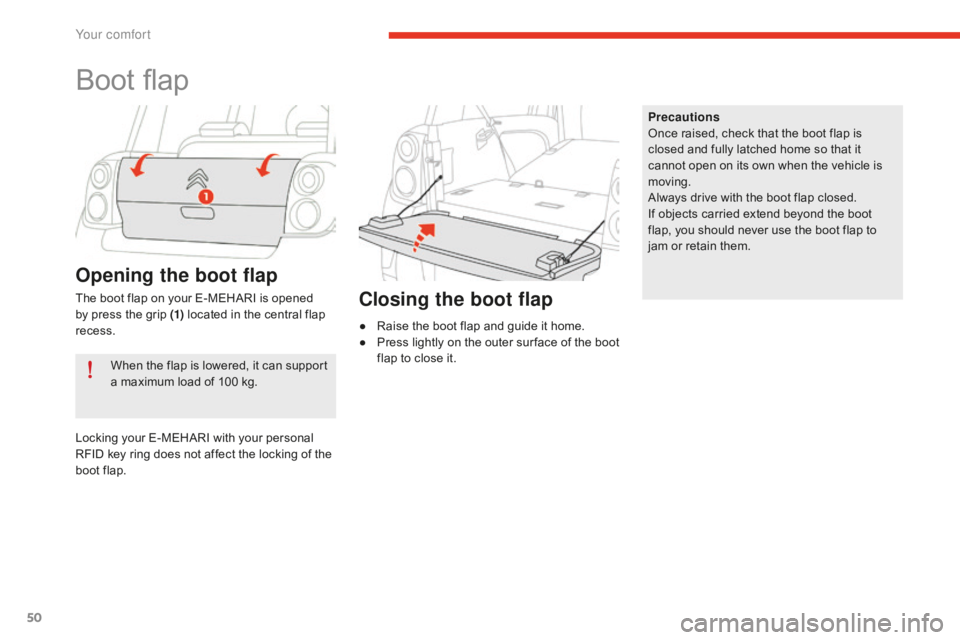
Boot flap
When the flap is lowered, it can support
a maximum load of 100 kg. Precautions
Once raised, check that the boot flap is
closed and fully latched home so that it
cannot open on its own when the vehicle is
moving.
Always drive with the boot flap closed.
If objects carried extend beyond the boot
flap, you should never use the boot flap to
jam or retain them.
Opening the boot flap
The boot flap on your E-MEHARI is opened
by press the grip (1)
located in the central flap
recess.
Locking your E-MEHARI with your personal
RFID key ring does not affect the locking of the
boot flap.Closing the boot flap
● Raise the boot flap and guide it home.
● P ress l ightly o n t he o uter s ur face o f t he b oot fl
ap to close it.
Your comfort
Page 60 of 81

58
e-mehari_en_Chap05_conseils-pratiques_ed02-2016
Temporary puncture repair kit
Access to the repair kit
You E-MEHARI's puncture repair kit (1) is
located under the boot floor hatch.
The boot floor hatch is opened with the grip (2)
(only if your E-MEHARI is only unlocked using
your personal RFID key ring). Never remove from a tyre the foreign
body that has caused the puncture.
The sealant product held in the
compressor is toxic and is an irritant.
Never ingest it, never spray it onto the
body, face or eyes.
In the event of ingestion, call the
emergency services (fire, ambulance...)
or go to Accident & Emergency
services.
If it enters the eyes, wash with abundant
clean water and consult a doctor
without delay.
If the symptoms persist, consult a
specialist.
Keep the sealant product out of the
reach of children.
Using the puncture repair kit
Refer to the instructions provided with the
compressor.
Do not simply throw the old cartridge
away
a
fter
u
se;
t
ake
i
t
t
o
y
our
C
ITROËN
au
thorised repairer or to a waste
recovery organisation that specialises
in this type of product.
Once the tyre has been repaired, go
to a CITROËN authorised repairer or
a
q
ualified
p
rofessional
a
s
s
oon
a
s
po
ssible.
If you are unable to obtain the desired
pressure after a few minutes of
operation of the compressor, this
means that the tyre cannot be repaired.
Contact CITRÖEN ASSISTANCE who
will send a roadside recovery agent.
Practical advice
Page 64 of 81

62
e-mehari_en_Chap05_conseils-pratiques_ed02-2016
Going into hibernation
mode
Maximum hibernation period
according to the state of charge
of the battery
100%: 4 months
75% - 99%: 3 months
50% - 74%: 2 months
25% - 49%: 1 monthDo not put your E-MEHARI into
hibernation with a battery state of
charge of less than 25%.
Unlock your vehicle and disconnect the
charging plug.
Turn the ignition key to the first position, the
screen then displays:
Position the hibernation key in the switch
located below the drive selector, turn it to
the right and hold it in this position for a few
seconds.
The screen then displays: entry into hibernation
mode is confirmed.
Remove the hibernation key and the starter key.
The screen goes off after 30
s
econds.
Do not lock the vehicle.
Hibernation mode
Hibernation mode allows the consumption of
energy from the battery to be reduced to a
minimum.
In this way you can park your E-MEHARI,
not connected and with no consumption of
electrical energy, for several weeks or even
several months.
Coming out of hibernation mode takes 4
h
ours
and is followed by the charging time (a
maximum of between 8
a
nd 13
h
ours).
Practical advice
Page 65 of 81

63
e-mehari_en_Chap05_conseils-pratiques_ed02-2016
Coming out of hibernation mode
Do not connect the vehicle before step
5 and carry out each step in order.
1.
Po
sition the hibernation key in the switch.
Turn it to the left. 2. Ch
eck the message displayed: the screen
asks you to turn the key.
3.
Tu
rn the ignition key to the first position. The
vehicle wakes up.
4.
Sw
itch off and remove the ignition key. The
screen display is then as shown, 5.
Pl
ug in the charging cable.
Check for the rapid flashing of the green LED,
confirming that the battery is charging.
Leave your vehicle on charge for the period
displayed so that it is 100% operational. Never disconnect the charging cable
while the green LED is flashing rapidly
(a minimum of 4
h
ours).
You have to be in possession of the
charging cable and be able to connect
your vehicle to a power supply to
be able to wake the vehicle from
hibernation.
Wait a few seconds. The hazard warning lamps
flash several times and the boot locks and
unlocks.
5
Practical advice
Page 73 of 81

71
e-mehari_en_Chap07_inde-alpha_ed02-2016
ABS - ESP ......................................................39
Ac cess, charging socket .................................. 8
A
ir conditioning
...............................
...............45
Antitheft / immobiliser
...................................... 9
A
ssistance call
...............................
..................9
Care of interior trim
........................................ 57
C
are of the bodywork..................................... 57
Changing a bulb
............................................. 59
C
haractristics (motor)
.................................... 66
Char
ger, on-board .......................................... 66
Check of operation
......................................... 35
C
hild safety
.............................................. 15
, 16
Clock
...............
............................................... 35
Closing the doors
...............................
........8, 10
Conditioning, air
............................................. 45
C
oolant, engine
...............................
...............54
Courtesy lamp
...............................
.................46Electrical cut-off in an accident
.....................
26
E
ngine characteristics
...................................66
F
ault, electric
...............................
.....................7
Flap, charging
..............................
....................8
Flashing indicators
................................... 2
0, 22
Foglamp, rear
................................................. 20
Fu
ses
................
..............................................59
A
B
C
E
D
Battery ........................................................4, 69
Bonnet ............... ............................................. 53
Boot flap
...............
.......................................... 50
Boot floor hatch
.............................................. 10
B
rake fluid
...................................................... 54
B
raking
........................................................... 70
B
ulbs
.............................................................. 59
F
Hazard warning lamps ...................................23
H eadlamps, dipped beam .............................. 20
H
eadlamps, main beam
................................. 20
He
ad restraints .......................................... 11, 4 8
Heating
................
............................................ 41
High voltage
............................................... 4
, 26
Horn ................................................................ 24
Identification, vehicle
..................................... 65
In
dicators: consumption - charging - load
.... 35
In
dicators: speed - time - temperature
.......... 36
I
nflating tyres
..............................
.............56, 68
Instrument panel
............................................ 35
I
nstruments and controls
............................... 17
In
terior fittings
................................................ 47
I
sofix
..............................................................
.16
H
I
Dashboard ...................................................... 35
Da ytime running lamps .................................. 20
D
emisting the windscreen
............................. 44
D
esign
.............................................................
.4
Dimensions
..............................
......................68
Direction indicators
.................................. 2
0, 22
Doors
.......................................................... 8
, 10
Driving
...............................
.............................40
Drive selector
...............................
..................38
Key ring, personal RFID
.................................. 8
K
.
Alphabetical index
Page 74 of 81
72
e-mehari_en_Chap07_inde-alpha_ed02-2016
Lamps, indicator ............................................35
Levels ............................... ..............................54
Lighting : adjustment
...................................... 2
2
Lighting, interior
............................................. 46
P
arking brake
................................................. 37
Pe
dals, control
................................................ 11
P
erformance
..............................
....................69
Port, USB
....................................................... 47
Po
wer steering
............................................... 18
P
recautions related to road
traffic accidents
.......................................... 4,
6
Pressures, tyres
....................................... 5
6, 68
Maintenance
..............................
....................53
Mirrors
............................................................ 19
Mob
ility, electric
............................................... 4Ra
dio ............... ...............................................64
Range ................
.............................................69
Recharging the battery
......................... 8, 2
7, 67
Recorder, total distance
................................. 36
R
emote control (door locking)
.......................10
R
oof, fabric
.....................................................51
M
L
P
R
Safety, high voltage ...................................4, 2 6
Screenwash .............................. .....................25
Screenwash fluid
........................................... 55
Se
at belts
....................................................... 14
Sea
t, rear bench
..............................
.........11, 4 8
Seats, front (adjustment)
............................... 12
Sel
ector, drive
................................................ 38
S
idelamps
...................................................... 20
S
ocket, 12V
.................................................... 47
S
peakers
........................................................ 64
S
tarting switching off the vehicle
................... 33
S
teering wheel
...............................
................18
Sun visor
........................................................ 47
S
uspension
.................................................... 70
S
witch, starting
.............................................. 33
S
ymbols
..............................
...........................35
S
Ty r e s ................................................... 5 6, 58, 68
T
Ventilation - air conditioning ..........................45
U nderbonnet
...............................
...................
53
Unlocking
................................................... 8
, 10
V
U
Washing ...............
.......................................... 57
Weights ............... ........................................... 68
Wheel, spare
.................................................. 58
W
indows, front
...............................
................52
Windows, rear
................................................ 49
W
inter preparation
...............................
..........62
Wipers
............................................................ 25
W
Alphabetical index