change CITROEN JUMPY 2015 User Guide
[x] Cancel search | Manufacturer: CITROEN, Model Year: 2015, Model line: JUMPY, Model: CITROEN JUMPY 2015Pages: 252, PDF Size: 12.15 MB
Page 48 of 252

46
Steering mounted controls Dipped beam/main beam change
Pull the stalk fully towards you. Automatic illumination of headlamps
if your vehicle is fitted with a
sunshine sensor. Lighting off
Dipped beam (green)
Main beam (blue)
DIRECTION INDICATORS
(flashing indicators)
STEERING MOUNTED CONTROLS
Checking by means of the indicator
lamps in the instrument panel is
described in the "Instruments and
controls" section of chapter 2. Sidelamps
Lighting-on audible warning
When the ignition is switched off, when the
driver's door is opened, there is an audible
warning if you have left the vehicle's lighting on.
Left : downwards passing
the point of resistance.
Right : upwards passing
the point of resistance.
LIGHTING CONTROL
Front and rear lamps
Selection is by turning ring
A .
Page 55 of 252

53
Steering mounted controls
EASE OF USE
and
COMFORT
3
Switching the function off
- Place the dial in position 0 or switch off
the ignition to switch everything off.
Good practice
When changing the programmed reference
speed by means of a maintained press,
pay attention as the speed can increase or
decrease rapidly.
Do not use the cruise control on slippery
roads or in heavy traffic.
In the event of a steep slope, the cruise
control cannot prevent the vehicle from
exceeding the programmed speed.
In any event, the cruise control cannot
replace the need to observe the speed limits,
nor can it replace the need for vigilance and
responsibility on the part of the driver.
It is advisable to leave your feet near the
pedals.
To avoid any jamming under the pedals:
- ensure that the mat and its fixings on the floor are positioned correctly,
- never place one mat on top of another.
Cancelling the programmed
reference speed
When the vehicle becomes stationary, after
switching off the ignition, the system no
longer memorises a speed. Using the accelerator:
- exceed the memorised speed until the speed required is reached,
- press the Set + or Set - button.
To memorise a speed lower than the
previous one:
- press the Set - button.
A brief press decreases the speed
by 1 mph (km/h).
A maintained press decreases the speed in
steps of 5 mph (km/h).
Operating fault
The programmed speed is cleared then
replaced by three dashes. Contact a
CITROËN dealer or a qualified workshop to
have the system checked.
FIXED SPEED LIMITER
If your vehicle is fitted with this function,
the speed of your vehicle can be limited to
a fixed speed of approximately 56, 60, 70
or 80 mph (90, 100, 110 or 130 km/h). The
fixed maximum speed cannot be changed.
The fixed speed limiter is not a function
of the cruise control type. It cannot be
activated or deactivated by the driver while
driving.
Page 62 of 252

60
Ventilation Driver or passenger side comfort value
The value indicated on the display
corresponds to a level of comfort and
not a temperature in degrees Celsius or
Fahrenheit.
Automatic operation Do not cover the sunshine sensor,
located on the windscreen behind
the mirror, it is used for regulation of the
air conditioning.
AUTO comfort programme
This is the normal air conditioning system
operating mode.
Press this button, the
AUTO symbol is
displayed.
Depending on the comfort value selected,
the system controls the distribution,
the fl ow and the intake of air to guarantee comfort
and a suffi cient circulation of air in the passenger
compartment. No further action on your part is required.
When the engine is cold, to prevent an
excessive diffusion of cold air, the ventilation
will reach its optimum level gradually.
For your comfort, the settings are stored
when the ignition is switched off and
are reinstated the next time the vehicle
is started, if the temperature in the
passenger compartment has not changed
significantly; otherwise, operation resumes
in automatic mode. Turn this control to the left or to
the right to decrease or increase
the value. A setting around the
value 21 provides optimum
comfort. However, depending on your
requirements, a setting between 18 and 24
is usual.
Page 83 of 252

81
Rear suspension
EASE OF USE
and
COMFORT
3
Deactivation of manual height correction Good practice
When stationary and with the ignition key
removed, excessive use of the system
consumes battery power. Long term parking
Avoid parking for a long duration on ground
which could present a potential obstacle as
your vehicle could lower.
Following a long period out of use, the
height of the platform may change due to the
automatic height correction on unlocking or
on opening one of your vehicle's doors.
With the vehicle stationary:
- press and hold,
- release the control.
Return to manual height correction
According to the configuration, a beep may
be heard during these operations. You must deactivate the manual height
correction in the following situations:
- when working underneath the vehicle,
- when changing a wheel,
- when the vehicle is being transported by lorry, train, ferry, boat, ... Warning lamp
Driving with the height of the rear platform:
- too low, risks damaging the technical
components underneath the vehicle,
- too high, risks unstable driving.
With the vehicle stationary:
- press and hold,
- release the control. Refer to the "Instruments and controls"
section of chapter 2.
If you start and the warning lamp flashes, to
switch it off:
- correct the position of the manual
control which is still at the lower or
upper limit,
- or drive slowly at above 6 mph (10 km/h), until height correction returns to automatic
mode.
Return to manual correction is confirmed by
the LED which goes off. Deactivation is confirmed by the LED which
is on. It remains on for approximately
30 seconds.
Page 85 of 252

83
Mirrors and windows
EASE OF USE
and
COMFORT
3
Manual rear view mirror
The rear view mirror has two positions:
- day (normal),
- night (anti-dazzle).
To change from one to the other, push or
pull the lever on the lower edge of the mirror.
Page 88 of 252

86
Parking sensors
Engage reverse gear
An audible signal confirms the activation of
the system by engaging reverse gear.
The proximity information is indicated by an
audible signal which becomes more rapid as
the vehicle approaches the obstacle. When
the distance between the rear of the vehicle
and the obstacle is less than approximately
thirty centimetres, the audible signal
becomes continuous.
Stop the assistance
Change to neutral.
REAR PARKING SENSORS
The audible and/or visual rear parking
sensor system consists of four proximity
sensors, installed in the rear bumper. The
sensors detect any obstacle which enters
the field: person, vehicle, tree, fence, behind
the vehicle during the manoeuvre.
Certain objects detected at the beginning of
the manoeuvre will no longer be detected
at the end of the manoeuvre due to the
blind spots between and below the sensors.
Examples: stake, roadworks cone or
pavement post.
Activation / Deactivation
You can activate or deactivate the
system by pressing this button.
The activation or deactivation of
the system is stored when the
vehicle stops.
Malfunction
In the event of a malfunction, when reverse
gear is engaged the LED in the button
comes on, accompanied by an audible
signal and a message in the screen. Contact
a CITROËN dealer or a qualified workshop.
Good practice
In bad weather or in winter, ensure that the
sensors are not covered with mud, ice or
snow.
The system will be deactivated automatically
if a trailer is being towed or if a bicycle
carrier is fitted (vehicle fitted with a
towbar or bicycle carrier recommended by
CITROËN).
The parking assistance cannot, in any
circumstances, take the place of the
vigilance and responsibility of the driver.
Display in the screen
You are advised to deactivate the system if
your vehicle is fitted with a rear ladder or if
you are transporting a load which exceeds
the length of the vehicle.
Page 108 of 252
106
Towing a trailer
You should therefore use a high gear to
lower the engine speed and reduce your
speed.
In all cases, pay attention to the coolant
temperature. Tyres
Check the tyre pressures of the towing
vehicle (see the "Identification markings"
section of chapter 8) and of the trailer,
observing the recommended pressures.
Towbar
We recommend the use of genuine
CITROËN towbars and their harnesses,
which have been tested and approved from
the design stage of your vehicle, and that
you entrust the fitting of this equipment to a
CITROËN dealer.
If this equipment is not fitted by a CITROËN
dealer, it is imperative that it is fitted using
the electrical pre-equipment installed at the
rear of the vehicle and in accordance with
the manufacturer's instructions.
In accordance with the general instructions
a reminder of which has been given above,
we draw your attention to the risk associated
with fitting a towbar or electrical accessory
not recommended by CITROËN. Fitting such
equipment could result in the failure of your
vehicle's electronic system. Please obtain
information from the Manufacturer before
fitting this type of equipment.
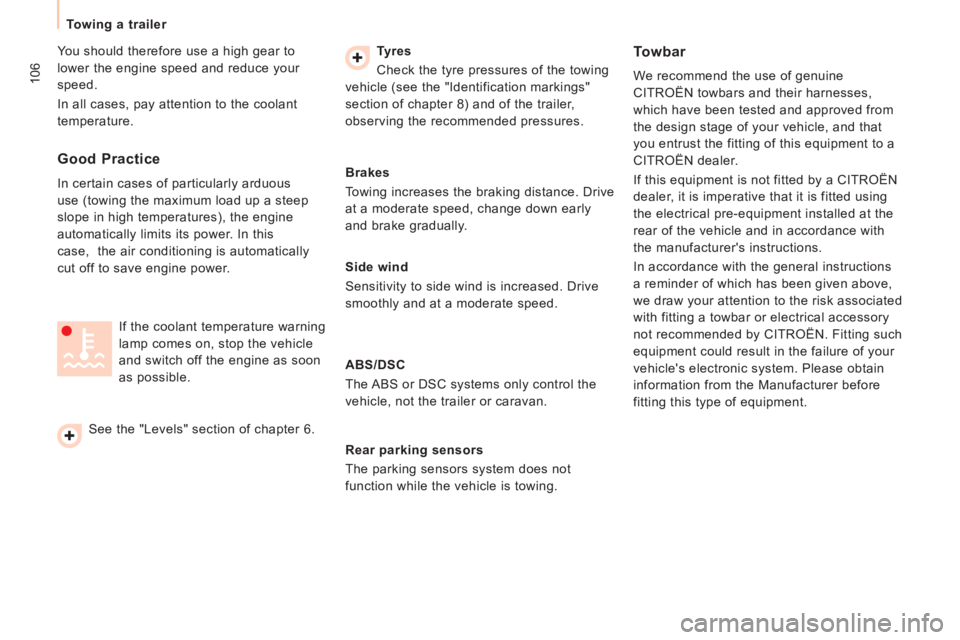
See the "Levels" section of chapter 6.
Good Practice
In certain cases of particularly arduous
use (towing the maximum load up a steep
slope in high temperatures), the engine
automatically limits its power. In this
case, the air conditioning is automatically
cut off to save engine power.
If the coolant temperature warning
lamp comes on, stop the vehicle
and switch off the engine as soon
as possible. Brakes
Towing increases the braking distance. Drive
at a moderate speed, change down early
and brake gradually.
Side wind
Sensitivity to side wind is increased. Drive
smoothly and at a moderate speed.
ABS/DSC
The ABS or DSC systems only control the
vehicle, not the trailer or caravan.
Rear parking sensors
The parking sensors system does not
function while the vehicle is towing.
Page 110 of 252

108
Equipment The fitting of electrical equipment
or accessories which are not
recommended by CITROËN may result
in the failure of your vehicle's electronic
system. Please note this specific warning.
You are advised to contact a representative
of the Marque to be shown the range of
recommended equipment and accessories.
Depending on the country in which the
vehicle is sold or operated, it is compulsory
to have a high visibility safety vest, warning
triangle and replacement bulbs available in
the vehicle.
Installation of radiocommunication
transmitters
Before installing accessory
radiocommunication transmitters with an
external aerial on your vehicle, you are
advised to contact a representative of the
CITROËN marque.
The CITROËN dealer network can inform
you of the specifications (frequency
band, maximum output power, aerial
position, specific installation conditions)
of the transmitters which can be fitted,
in accordance with the Motor Vehicle
Electromagnetic Compatibility Directive
(2004/104/CE). Front mud flaps, rear mud flaps, ...
Range of trade
equipment
Parts and Services technical information
publishes an accessory catalogue offering
various equipment and fittings, such as:
Screenwash, replacement fuses, wiper
blades, interior and exterior cleaning
and maintenance products, replacement
bulbs, ...
Roof bars for short, medium and long
wheelbase (load retainers for all models).
Towbar, towbar harness: trailer towbar which must be fi tted by the network.
Sill plate, loading roller, sill. Sill plate,
loading roller, sill.
Roof bars for the various heights, roof bars,
ladder.
Separation partitions and grilles, smooth,
non-slip wooden protective floor.
Protective grilles, multimedia.
Another range is also available, structured
around comfort, leisure and maintenance:
Anti-theft alarm, window engraving, first aid
kit, high visibility safety vest, rear parking
sensors, warning triangle, ...
Front seat covers compatible with airbags,
bench, rubber mats, carpet mats, snow
chains. To prevent the mat from becoming caught
under the pedals:
- ensure that the mat and its fi xings are
positioned correctly,
- never fi t one mat on top of another.
Audio equipment, hands-free kit, speakers,
CD changer, navigation, ...
Regardless of the audio and telematic
equipment offered on the market, the
technical constraints linked with the fi tting of
equipment of these families of products mean
that the special features of the equipment and
its compatibility with the capacities of the your
vehicle's standard equipment must be taken
into account. Please contact a dealer for
information before fi tting such equipment.
Page 114 of 252
11 2
Levels
LEVELS
To maintain the reliability of engines and
emission control systems, the use of
additives in engine oil is prohibited. Changing the brake fluid
The brake fluid must be changed at
the intervals stated, according to the
manufacturer's servicing schedule.
Use fluids recommended by the
manufacturer, which fulfil DOT4 standards.
The level must be between the MIN and
MAX marks on the reservoir.
If fluid has to be added frequently, this
indicates a fault which must be checked by a
CITROËN dealer or a qualified workshop as
soon as possible.
Warning lamps
These regular maintenance operations
will keep your vehicle in good running
order. Consult a CITROËN dealer or the
servicing and warranty booklet enclosed in
the handbook pack.
If you have to remove / refit the engine
style cover, handle it with care to avoid
damaging the fixing clips.
Oil level
Check the level regularly and top up
between changes.
Check the level with the vehicle level,
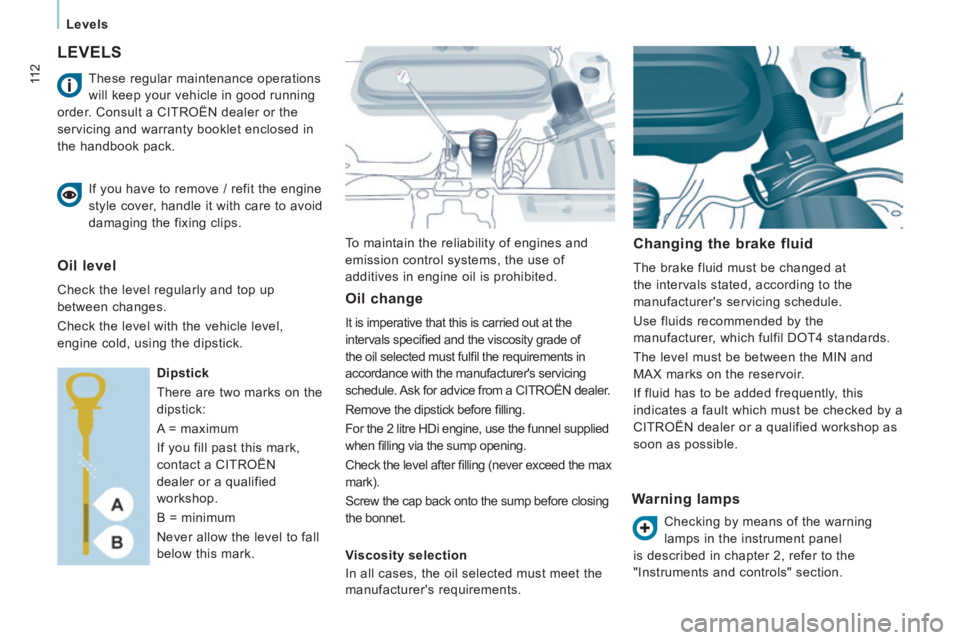
engine cold, using the dipstick. Dipstick
There are two marks on the
dipstick:
A = maximum
If you fill past this mark,
contact a CITROËN
dealer or a qualified
workshop.
B = minimum
Never allow the level to fall
below this mark. Oil change
It is imperative that this is carried out at the
intervals specifi ed and the viscosity grade of
the oil selected must fulfi l the requirements in
accordance with the manufacturer's servicing
schedule. Ask for advice from a CITROËN dealer.
Remove the dipstick before fi lling.
For the 2 litre HDi engine, use the funnel supplied
when fi lling via the sump opening.
Check the level after fi lling (never exceed the max
mark).
Screw the cap back onto the sump before closing
the bonnet.
Viscosity selection
In all cases, the oil selected must meet the
manufacturer's requirements. Checking by means of the warning
lamps in the instrument panel
is described in chapter 2, refer to the
"Instruments and controls" section.
Page 116 of 252

11 4
Checks
CHECKS
Battery
At the start of winter, have your battery
checked by a CITROËN dealer or a qualified
workshop.
Brake pads
Brake pad wear depends on the style of
driving, in particular for vehicles which are
used in town, over short distances. It may
be necessary to check the thickness of the
pads, even between services.
Unless there is a leak in the system, a drop
in the brake fluid level indicates that the
brake pads are worn.
Brake disc / drum wear
For any information on checking the brake
disc / drum wear, contact a CITROËN dealer
or a qualified workshop.
Parking brake
Where the parking brake travel is too great
or there is a reduction in the performance
of the system, the parking brake should be
adjusted, even between services.
Have the system checked by a CITROËN
dealer or a qualified workshop.
Oil filter
Change the filter regularly, in accordance
with the servicing schedule.
Carbon filter and passenger
compartment filter
The carbon fi lter permits continuous and effective
fi ltering of dust.
If the passenger compartment fi lter becomes
clogged, this may reduce the performance of the
air conditioning system and generate unpleasant
odours.
We recommend the use of a combined passenger
compartment fi lter. By means of its second special
active fi lter, it contributes to the purifi cation of the
air breathed by the occupants and the cleanness
of the passenger compartment (reduction of
allergic symptoms, unpleasant odours and greasy
deposits).
Refer to the servicing and warranty booklet to fi nd
out the replacement interval for these components.
Depending on the environment (dusty
atmosphere...) and the use of the vehicle (urban
driving...), change them twice as often if necessary.
Particle emission filter (Diesel)
This filter actively contributes
to the preservation of air quality
by trapping unburnt polluting
particles. It is controlled
completely and automatically by the engine
management system.
This warning lamp comes on if there is a risk
of blockage of the filter.
This alert signals the start of saturation of
the particle emissions filter (exceptionally
prolonged driving in urban conditions:
reduced speed, traffic jams…).
If this alert persists, contact a CITROËN
dealer or a qualified workshop.
On acceleration after the vehicle has been
running for a prolonged period at very low
speed or at idle, you may, in exceptional
circumstances, notice the emission of water
vapour at the exhaust. This water vapour
does not have any adverse effect on vehicle
handling or the environment.
To regenerate the filter, it is recommended
that as soon as driving conditions permit,
you drive at a speed of at least 36 mph
(60 km/h) for at least 5 minutes (until the
warning lamp goes off and/or the message
disappears).
Refer to "Under the bonnet" in section 6.