change CITROEN JUMPY 2015 Owners Manual
[x] Cancel search | Manufacturer: CITROEN, Model Year: 2015, Model line: JUMPY, Model: CITROEN JUMPY 2015Pages: 252, PDF Size: 12.15 MB
Page 20 of 252

18ECO-DRIVING
Eco-driving is a range of everyday practices that allow the motorist to \
optimise their fuel
consumption and CO
2 emissions.
Optimise the use of your
gearbox
With a manual gearbox, move off gently
and change up without waiting. During
acceleration change up early.
With an automatic or electronic gearbox,
give preference to automatic mode and
avoid pressing the accelerator pedal
heavily or suddenly.
Control the use of your
electrical equipment
Before moving off, if the passenger
compartment is too warm, ventilate it by
opening the windows and air vents before
using the air conditioning.
Above 30 mph (50 km/h), close the windows
and leave the air vents open. Switch off the headlamps and front
foglamps when the level of light does not
require their use.
Avoid running the engine before moving
off, particularly in winter; your vehicle will
warm up much faster while driving.
Drive smoothly
Maintain a safe distance between vehicles,
use engine braking rather than the
brake pedal, and press the accelerator
progressively. These practices contribute
towards a reduction in fuel consumption and
CO
2 emissions and also helps reduce the
background traffic noise.
If your vehicle has cruise control, make use
of the system at speeds above 25 mph
(40 km/h) when the traffic is flowing well.
As a passenger, if you avoid connecting
your multimedia devices (film, music,
video game...), you will contribute towards
limiting the consumption of electrical
energy, and so of fuel.
Disconnect your portable devices before
leaving the vehicle. Remember to make use of equipment
that can help keep the temperature in the
passenger compartment down (sunroof
and window blinds...).
Switch off the air conditioning, unless it
has automatic regulation, as soon as the
desired temperature is attained.
Switch off the demisting and defrosting
controls, if not automatic.
Switch off the heated seat as soon as
possible.
The gear efficiency indicator invites
you engage the most suitable gear: as
soon as the indication is displayed in the
instrument panel, follow it straight away.
For vehicles fitted with an electronic or
automatic gearbox, this indicator appears
only in manual mode.
Page 21 of 252

19
FAMILIARISATION
1
Limit the causes of
excess consumption
Spread loads throughout the vehicle;
place the heaviest items in the bottom of
the boot, as close as possible to the rear
seats.
Limit the loads carried in the vehicle and
reduce wind resistance (roof bars, roof
rack, bicycle carrier, trailer...). Use a roof
box in preference.
Remove roof bars and roof racks after
use.
At the end of winter, remove snow tyres
and refit your summer tyres.
Observe the recommendations
on maintenance
Check the tyre pressures regularly, when
cold, referring to the label in the door
aperture, driver's side.
Carry out this check in particular:
- before a long journey,
- at each change of season,
- after a long period out of use.
Don't forget the spare wheel and the tyres
on any trailer or caravan.
Have your vehicle serviced regularly
(engine oil, oil filter, air filter, passenger
compartment filter...) and observe the
schedule of operations recommended in the
maintenance and warranty guide. When refuelling, do not continue after the
third cut-off of the nozzle to avoid any
overflow.
At the wheel of your new vehicle, it is only
after the fi rst 1 800 miles (3 000 kilometres)
that you will see the fuel consumption settle
down to a consistent average.
Page 22 of 252

20
Accessthis selectivity of opening between the cab
and the load space; contact a CITROËN
dealer.
REMOTE CONTROL
This is confirmed by fixed lighting of the
direction indicators for approximately
two seconds.
ACCESS
Unlocking the cab
Press this button once to unlock
your vehicle's cab.
The direction indicators flash
twice.
Press this button a second time
to unlock the side door(s) and the rear
doors.
This selective door locking function is
active when the vehicle is delivered. At your
request, the dealer network can deactivate
Unlocking the load
space
Press this button to unlock all of
the rear doors.
This separation of the locking
of the cab and load space is an
operating security feature. It enables you
to prevent access to the part of the vehicle
from which you are absent.
Central locking
Press this button to lock your
vehicle, cab and rear doors.
The direction indicators flash
once.
If one of the front doors is open or is not
closed correctly, the central locking will not
work.
Deadlocking
If your vehicle is fitted with deadlocking,
a second press on the closed padlock on
the remote control within five seconds after
locking changes the locking to deadlocking. Deadlocking renders the exterior and interior
door opening handles inoperative: do not
leave anyone inside the vehicle when it is
deadlocked.
If deadlocking is activated from inside the
vehicle, it will change to normal locking
when the vehicle is started.
Folding / unfolding the key
Press this button to release the
key from its housing.
To fold the key, press the
chromed button then fold the key
into the housing. If you do not press the
button, the mechanism may be damaged.
Good practice
Take care not to allow the remote control to
come into contact with grease, dust, rain or
a damp environment.
A heavy object attached to the key (key
ring, ...) weighing on the shaft of the key in
the switch, may cause a malfunction.
Page 23 of 252

21
Access
READY TO GO
2
KEY
This locks and unlocks the doors on the
vehicle, opens and closes the fuel filler cap,
as well as starting and stopping the engine.
REMOTE CONTROL
ELECTRONIC IMMOBILISER
All of the keys contain an electronic
immobiliser device.
This device locks the engine supply system.
It is activated automatically when the key is
removed from the ignition.
After the ignition is switched on, a dialogue
is established between the key and the
electronic immobiliser system.
The metal part of the key must be unfolded
correctly for correct dialogue to take place.
Reinitialising the remote control
Following changing of the remote control battery
or disconnection of the vehicle battery, the remote
control may have to be reinitialised.
Wait at least one minute before using the remote
control.
Insert the key in the ignition switch with the buttons
(padlocks) of the remote control facing you. Switch on the ignition.
Press the locking padlock for at least
five seconds within the next ten seconds.
Switch off the ignition.
Wait at least one minute before using the
remote control.
The remote control is now working again.
There is a risk of damage if the replacement
battery is not the correct type.
Use only identical batteries or batteries of an
equivalent type to those recommended by
CITROËN dealers.
Do not discard the remote control batteries,
they contain metals which are harmful to the
environment.
Deposit them at a CITROËN dealership, or
at an authorised collection point.
Changing the battery
Battery ref.: CR1620 / 3 volts.
The "battery flat" information is given by an
audible signal, accompanied by a message
in the screen.
To replace the battery, unclip the casing
using a coin at the ring.
If the remote control does not work after the
battery has been changed, reinitialise the
remote control. If you lose your keys
Visit a CITROËN dealer with the
vehicle's V5 registration document and your
identification document.
A CITROËN dealer will be able to retrieve
the key code and the transponder code so
that a replacement key can be ordered.
Page 24 of 252
22
Access
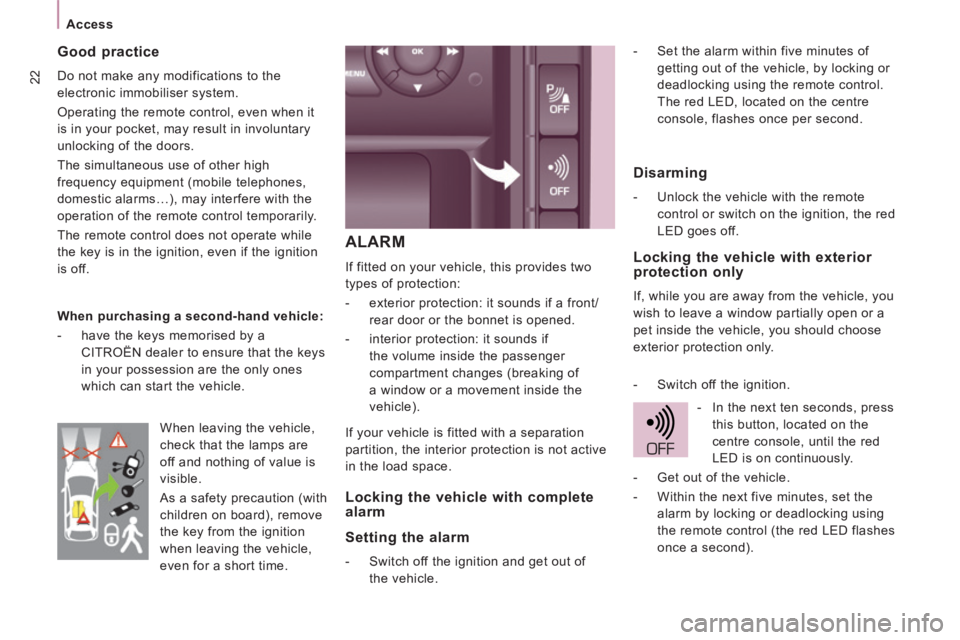
ALARM
If fitted on your vehicle, this provides two
types of protection:
- exterior protection: it sounds if a front/rear door or the bonnet is opened.
- interior protection: it sounds if the volume inside the passenger
compartment changes (breaking of
a window or a movement inside the
vehicle).
Good practice
Do not make any modifications to the
electronic immobiliser system.
Operating the remote control, even when it
is in your pocket, may result in involuntary
unlocking of the doors.
The simultaneous use of other high
frequency equipment (mobile telephones,
domestic alarms…), may interfere with the
operation of the remote control temporarily.
The remote control does not operate while
the key is in the ignition, even if the ignition
is off.
If your vehicle is fitted with a separation
partition, the interior protection is not active
in the load space.
Locking the vehicle with complete
alarm
Setting the alarm
- Switch off the ignition and get out of the vehicle.
When purchasing a second-hand vehicle:
- have the keys memorised by a CITROËN dealer to ensure that the keys
in your possession are the only ones
which can start the vehicle. - Set the alarm within five minutes of
getting out of the vehicle, by locking or
deadlocking using the remote control.
The red LED, located on the centre
console, flashes once per second.
Disarming
- Unlock the vehicle with the remote control or switch on the ignition, the red
LED goes off.
Locking the vehicle with exterior
protection only
If, while you are away from the vehicle, you
wish to leave a window partially open or a
pet inside the vehicle, you should choose
exterior protection only.
- Switch off the ignition.
- In the next ten seconds, press this button, located on the
centre console, until the red
LED is on continuously.
- Get out of the vehicle.
- Within the next five minutes, set the alarm by locking or deadlocking using
the remote control (the red LED flashes
once a second).
When leaving the vehicle,
check that the lamps are
off and nothing of value is
visible.
As a safety precaution (with
children on board), remove
the key from the ignition
when leaving the vehicle,
even for a short time.
Page 32 of 252

30
Instruments and controls
Warning lamp is indicates Solution-action
Coolant
temperature
and level
on with needle
in the red zone.
abnormal increase in
temperature. Park, switch off the ignition then allow to cool. Visually
check the level.
flashing. drop in coolant level. Chapter 6, "Levels" section. Contact a CITROËN dealer
or a qualified workshop.
Service on temporarily.
minor faults or warnings. Consult the warnings log in the display or on the screen.
See chapter 9, "Trip computer" section then "Warnings
log".
Depending on the seriousness of the fault, contact a
CITROËN dealer or a qualified workshop.
remains on.
major faults.
Row 1 seat belt
not fastened
lit then flashing.
the driver or a front passenger
has not fastened his seat belt. Pull the strap then insert the tongue in the buckle.
accompanied
by an audible
signal then
remains on. the vehicle is moving with the
driver or front passenger seat
belt not fastened. Check that the seat belt is fastened by pulling the strap.
Chapter 4, "Seat belts" section.
The driver must ensure that all passengers have
fastened their seat belt and use it correctly.
Under-inflation
detection
on.
a deflated or punctured tyre. Park and switch off the ignition. Change or repair
the wheel.
on,
accompanied
by the service
warning lamp. a faulty sensor.
Have it checked by a CITROËN dealer or a qualified
workshop.
Page 35 of 252
33
Instruments and controls
READY TO GO
2
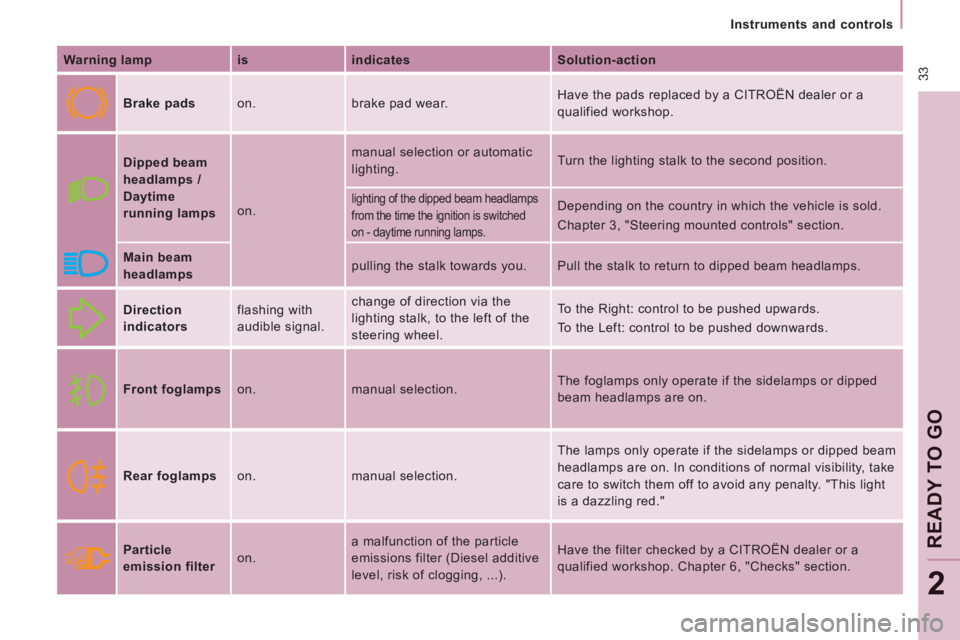
Warning lamp is indicates Solution-action
Brake pads on. brake pad wear. Have the pads replaced by a CITROËN dealer or a
qualified workshop.
Dipped beam
headlamps /
Daytime
running lamps
on. manual selection or automatic
lighting.
Turn the lighting stalk to the second position.
lighting of the dipped beam headlamps
from the time the ignition is switched
on - daytime running lamps. Depending on the country in which the vehicle is sold.
Chapter 3, "Steering mounted controls" section.
Main beam
headlamps pulling the stalk towards you.
Pull the stalk to return to dipped beam headlamps.
Direction
indicators
flashing with
audible signal. change of direction via the
lighting stalk, to the left of the
steering wheel. To the Right: control to be pushed upwards.
To the Left: control to be pushed downwards.
Front foglamps on. manual selection. The foglamps only operate if the sidelamps or dipped
beam headlamps are on.
Rear foglamps on. manual selection. The lamps only operate if the sidelamps or dipped beam
headlamps are on. In conditions of normal visibility, take
care to switch them off to avoid any penalty. "This light
is a dazzling red."
Particle
emission filter
on. a malfunction of the particle
emissions filter (Diesel additive
level, risk of clogging, ...). Have the filter checked by a CITROËN dealer or a
qualified workshop. Chapter 6, "Checks" section.
Page 44 of 252

42
Gearboxes and steering wheel
Moving off
With the engine running, to move off from
position P .
For immediate maximum acceleration
without touching the gear lever,
depress the accelerator pedal to the extent
of its travel, passing the point of resistance
(kickdown). The gearbox will automatically
change down or maintain the gear selected
until maximum engine speed is reached.
On a descent, the gearbox will automatically
change down in order to provide efficient
engine braking and good pickup.
If you take your foot off the accelerator
suddenly, the gearbox will not change to a
higher gear for reasons of safety.
When stationary with the gear lever in
position D (drive), a vibration limiting device
is activated by pressing the brake pedal.
- gradually release the
pressure on the brake pedal;
the vehicle then moves off.
- Press the brake pedal to
come out of position P ,
- select position R or D ,
- gradually release the pressure on the brake pedal;
the vehicle then moves off.
You can also move off from position N .
- With your foot on the brake, release
the parking brake,
- select position R , D or M ,
- Select position D . The gearbox always selects the most
suitable gear taking account of the following:
- the style of driving,
- the road profile,
- the vehicle load.
The gearbox is then operating in auto-
adaptive mode, without any action on your
part.
Reverse gear
- Select position R
, with the
vehicle stationary and the
engine at idle.
Stopping the vehicle, starting the
engine
- Select position P to
immobilise the vehicle or
to start the engine , with the
parking brake on or off.
If the battery is flat and the gear lever
is in position P , it will be impossible to
change to another position.
- You can also select position N
to park or to start the
engine , with the parking
brake on.
If position N is engaged inadvertently
while driving, allow the engine to return
to idle before engaging position D to restore
drive.
Page 45 of 252

43
READY TO GO
2
Gearboxes and steering wheel
Manual mode
Manual sequential gear changing.
- Select gear lever position M ,
- push the gear lever towards the + sign to change up, from 1 through to 6,
- conversely, push the gear lever towards the - sign to change down.
You can change from position D
(automatic mode) to position M
(manual mode) at any time.
In manual mode, it is only possible to
change from one gear to another if the
vehicle speed and engine speed permit.
If they do not, the vehicle will operate
temporarily in automatic mode.
When the vehicle is stationary or moving
very slowly, the gearbox automatically
selects first gear.
Good practice
Never select position N when the vehicle is
moving.
Never select positions P or R unless the
vehicle is stationary.
Never change between positions to optimise
braking on a slippery surface.
There is a risk of damage to the gearbox:
- if you press the accelerator and brake pedals at the same time,
- if you force the gear lever from position P to another position in the
event of a battery failure.
When the engine is at idle, brakes not
applied, if position R , D or M is selected the
vehicle moves even without the accelerator
being pressed.
For this reason, do not leave children
unsupervised inside the vehicle, with the
engine running .
Operating fault
Any operating fault is indicated by an
audible signal, accompanied by the
message "Automatic gear fault" in the
screen.
In this situation the gearbox operates in
downgrade mode (locked in 3rd gear). You
may feel a substantial knock when changing
from P to R and from N to R (this will not
cause any damage to the gearbox).
Do not exceed 60 mph (100 km/h), keeping
within the limit of local speed restrictions.
Contact a CITROËN dealer or a qualified
workshop as soon as possible.
When traversing a flooded road or a
ford, drive at walking pace.
Page 46 of 252

44
Gearboxes and steering wheel
GEAR EFFICIENCY INDICATOR
This system allows fuel consumption to be
reduced by suggesting when to change up. The information appears in the
instrument panel in the form of an
arrow.
The system adapts its gear change
recommendations according to the driving
conditions (slope, load, ...) and demands
from the driver (for power, acceleration,
braking, ...).
Operation
Depending on the driving conditions and the
equipment of your vehicle, the system may
recommend skipping one or more gears.
You can follow this indication without going
through the intermediate gears.
The gear engagement recommendations
should not be considered to be compulsory.
This because the configuration of the
road, the traffic density and safety remain
determining factors when choosing the
best gear. Therefore, the driver remains
responsible for deciding whether or not to
follow the advice given by the system.
This system cannot be deactivated.
The system never recommends
engaging first gear or reverse, or
changing down.
STEERING WHEEL HEIGHT AND REACH ADJUSTMENT
When the vehicle is stationary, release the
steering wheel adjustment mechanism by
lowering the lever.
Adjust the steering wheel for height and
reach, then lock the adjustment mechanism
by pushing the lever fully upwards.
With an automatic gearbox, the system is
only active in manual mode.