brake DACIA DUSTER 2010 1.G Owner's Manual
[x] Cancel search | Manufacturer: DACIA, Model Year: 2010, Model line: DUSTER, Model: DACIA DUSTER 2010 1.GPages: 200, PDF Size: 7.12 MB
Page 141 of 200
changing a wheel.................................. (up to the end of the DU)
practical advice ..................................... (up to the end of the DU)
jack ....................................................... (up to the end of the DU)
puncture ................................................ (up to the end of the DU)
lifting the vehicle changing a wheel ............................ (up to the end of the DU)
5.9
ENG_UD20699_3
Changement de roue (H79 - Dacia)
ENG_NU_898-5_H79_Dacia_5
Changing a wheel
CHANGING A WHEEL (1/2)
Switch on the hazard warn-
ing lights.
Park the vehicle away from
traffic on firm, flat, non-slip -
pery ground (if necessary, place a
solid support under the jack base).
Apply the handbrake and engage a
gear (first or reverse gear).
Ask the passengers to leave the ve-
hicle and to keep away from traffic.
If you have a puncture, re -
place the wheel as soon as
possible.
A tyre which has been punc-
tured should always be inspected
(and repaired, where possible) by a
specialist.
Vehicles equipped with a jack
and wheelbrace
If necessary, remove the wheel trim,
refer to the information on “Wheel trims
- Wheels” in this Section. Undo the
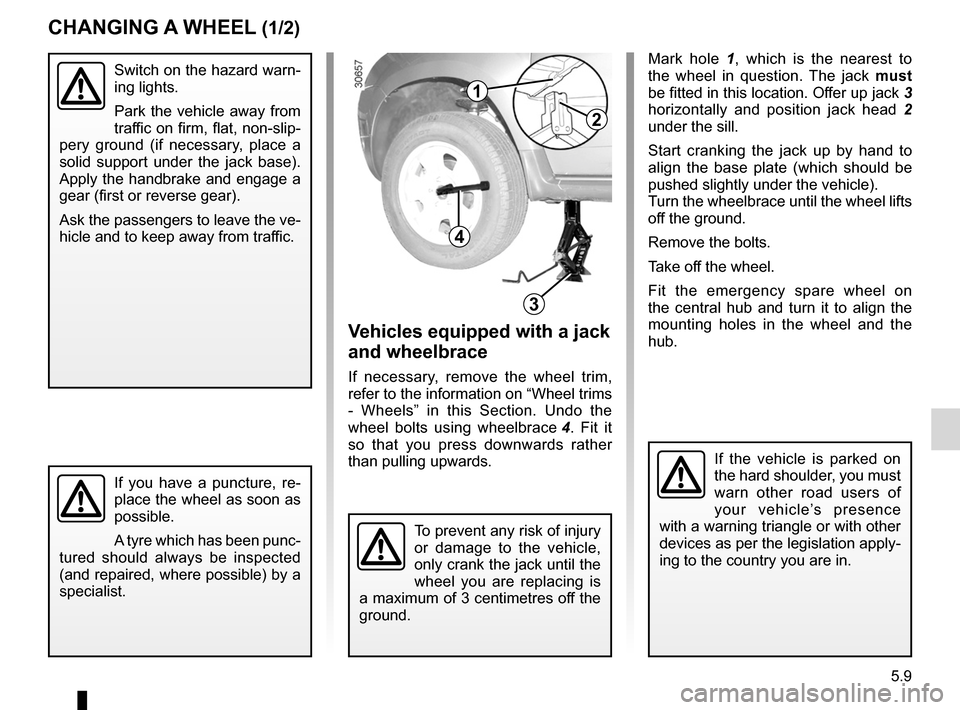
wheel bolts using wheelbrace 4 . Fit it
so that you press downwards rather
than pulling upwards. Mark hole
1 , which is the nearest to
the wheel in question. The jack must
be fitted in this location. Offer up jack 3
horizontally and position jack head 2
under the sill.
Start cranking the jack up by hand to
align the base plate (which should be
pushed slightly under the vehicle).
Turn the wheelbrace until the wheel lifts
off the ground.
Remove the bolts.
Take off the wheel.
Fit the emergency spare wheel on
the central hub and turn it to align the
mounting holes in the wheel and the
hub.
To prevent any risk of injury
or damage to the vehicle,
only crank the jack until the
wheel you are replacing is
a maximum of 3 centimetres off the
ground.
If the vehicle is parked on
the hard shoulder, you must
warn other road users of
your vehicle’s presence
with a warning triangle or with other
devices as per the legislation apply-
ing to the country you are in.
1
2
3
4
Page 150 of 200
bulbschanging ......................................... (up to the end of the DU)
changing a bulb .................................... (up to the end of the DU)
practical advice ..................................... (up to the end of the DU)
lighting: exterior ............................................ (up to the end of the DU)
lights: reversing lights ................................................. (current page)
lights: brake lights ...................................................... (current page)
bulbs changing ......................................... (up to the end of the DU)
5.18
ENG_UD20583_3
Feux arrière : remplacement des lampes (H79 - Dacia)
ENG_NU_898-5_H79_Dacia_5
Jaune NoirNoir texte
Rear lights
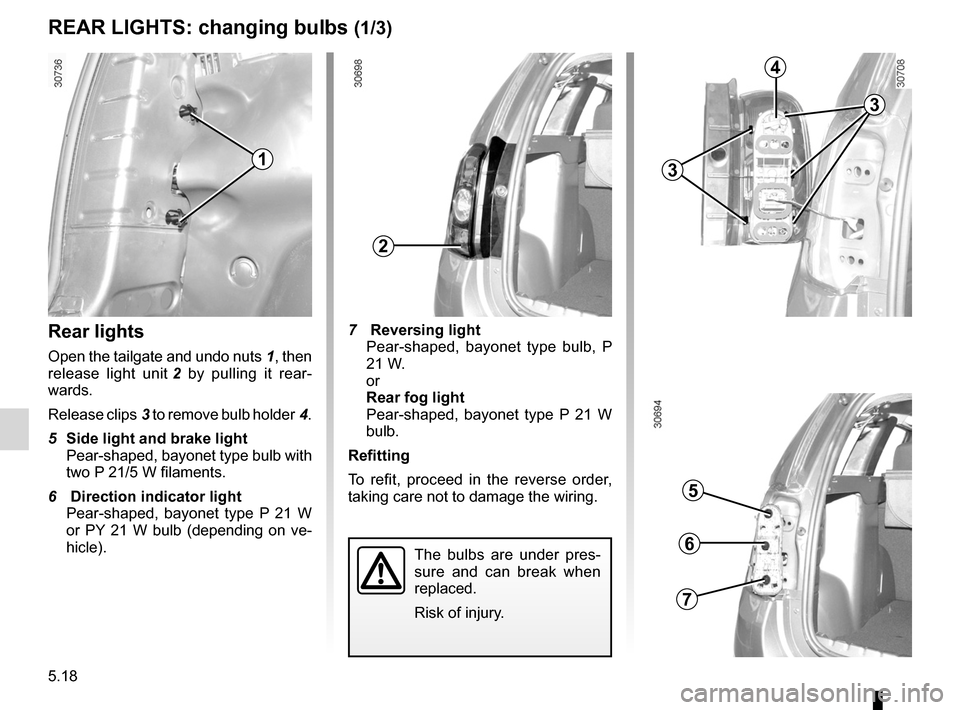
7 Reversing light
Pear-shaped, bayonet type bulb, P
21 W.
or
Rear fog light
Pear-shaped, bayonet type P 21 W
bulb.
Refitting
To refit, proceed in the reverse order,
taking care not to damage the wiring.
REAR LIGHTS: changing bulbs (1/3)
Rear lights
Open the tailgate and undo nuts 1, then
release light unit 2 by pulling it rear -
wards.
Release clips 3 to remove bulb holder 4.
5 Side light and brake light
Pear-shaped, bayonet type bulb with
two P 21/5 W filaments.
6 Direction indicator light
Pear-shaped, bayonet type P 21 W
or PY 21 W bulb (depending on ve-
hicle).
The bulbs are under pres -
sure and can break when
replaced.
Risk of injury.
1
2
3
3
4
5
6
7
Page 151 of 200
lights:reversing lights ................................................. (current page)
lights: brake lights ...................................................... (current page)
JauneNoirNoir texte
5.19
ENG_UD20583_3
Feux arrière : remplacement des lampes (H79 - Dacia)
ENG_NU_898-5_H79_Dacia_5
REAR LIGHTS: changing bulbs (2/3)
The bulbs are under pres-
sure and can break when
replaced.
Risk of injury.
High-level brake light
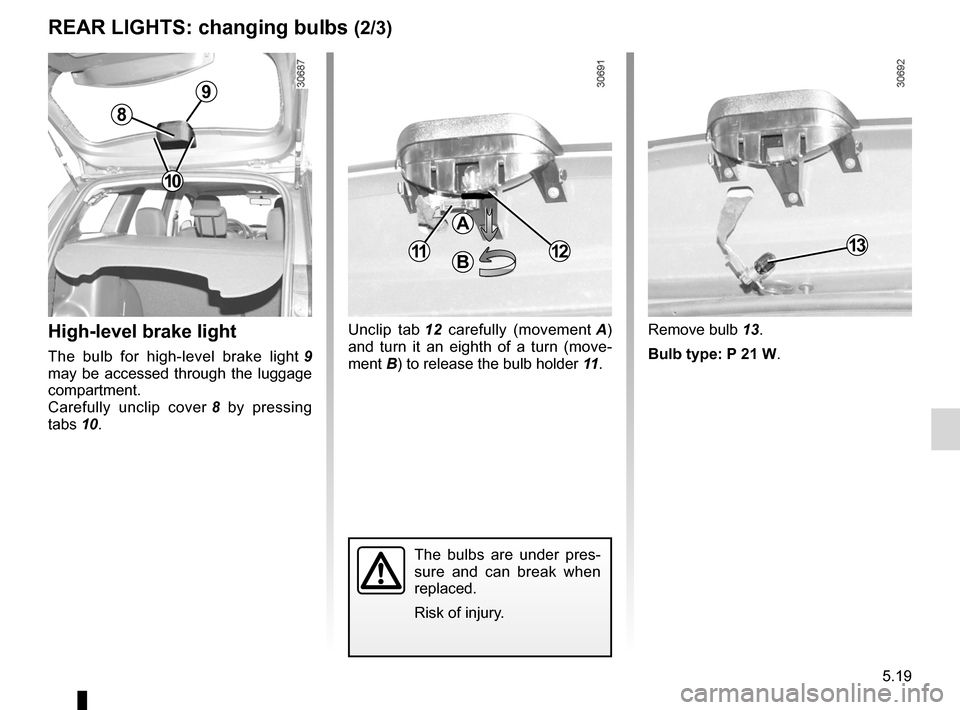
The bulb for high-level brake light 9
may be accessed through the luggage
compartment.
Carefully unclip cover 8 by pressing
tabs 10. Remove bulb
13.
Bulb type: P 21 W.
Unclip tab
12 carefully (movement A )
and turn it an eighth of a turn (move -
ment B) to release the bulb holder 11.
10
8
9
11
A
B1213
Page 158 of 200
5.26
ENG_UD22381_3
Fusibles (H79 - Dacia)
ENG_NU_898-5_H79_Dacia_5
Jaune NoirNoir texte
FUSES (2/3)
Symbol Allocation
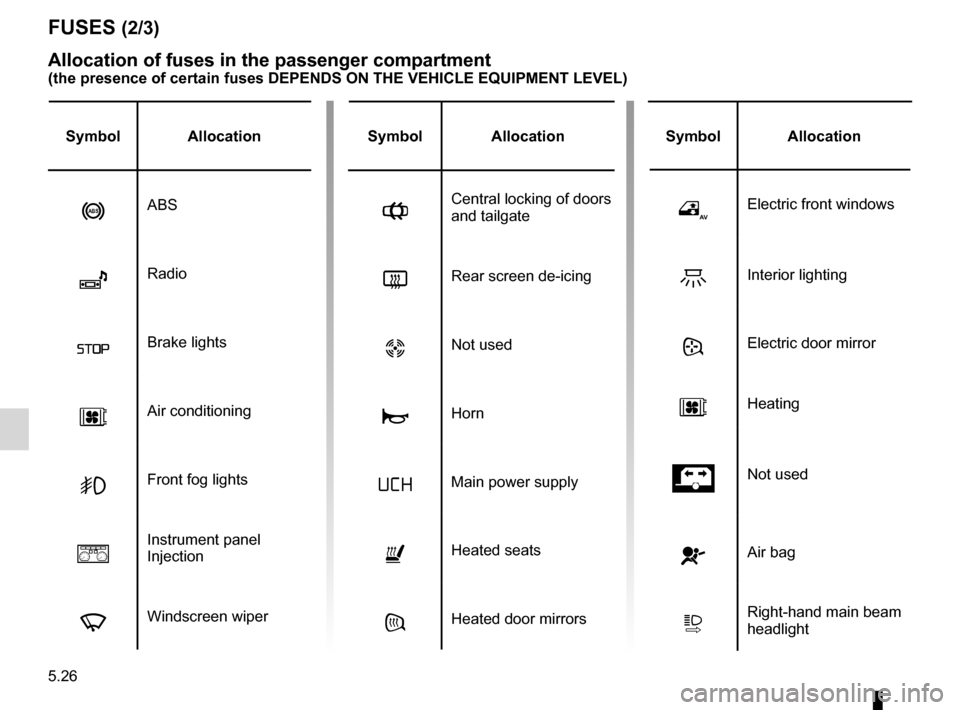
ḽElectric front windows
ZInterior lighting
eElectric door mirror
àHeating
àNot used
ÅAir bag
PRight-hand main beam
headlight
Allocation of fuses in the passenger compartment(the presence of certain fuses DEPENDS ON THE VEHICLE EQUIPMENT LEVEL)\
SymbolAllocation
nABS
îRadio
ßBrake lights
àAir conditioning
GFront fog lights
aInstrument panel
Injection
fWindscreen wiper
Symbol Allocation
]Central locking of doors
and tailgate
CRear screen de-icing
ÙNot used
ÌHorn
ôMain power supply
ñHeated seats
sHeated door mirrors
Page 164 of 200
towing hitch........................................... (up to the end of the DU)
practical advice ..................................... (up to the end of the DU)
towing breakdown ...................................... (up to the end of the DU)
5.32
ENG_UD22437_4
Remorquage : dépannage (H79 - Dacia)
ENG_NU_898-5_H79_Dacia_5
Jaune NoirNoir texte
Towing: troubleshooting
TOWING: breakdown (1/3)
Towing procedure
The steering wheel must be un -
locked and the ignition key must be
in position M (ignition on) to pro -
vide stop lights and hazard warning
lights on the towed vehicle. At night
the vehicle must have its lights on.
Unhitch the trailer, etc., if one is being
towed.
You must observe the towing regu -
lations which apply in the country in
which you are driving: do not exceed
the towing weight for your vehicle.
Contact an approved Dealer.
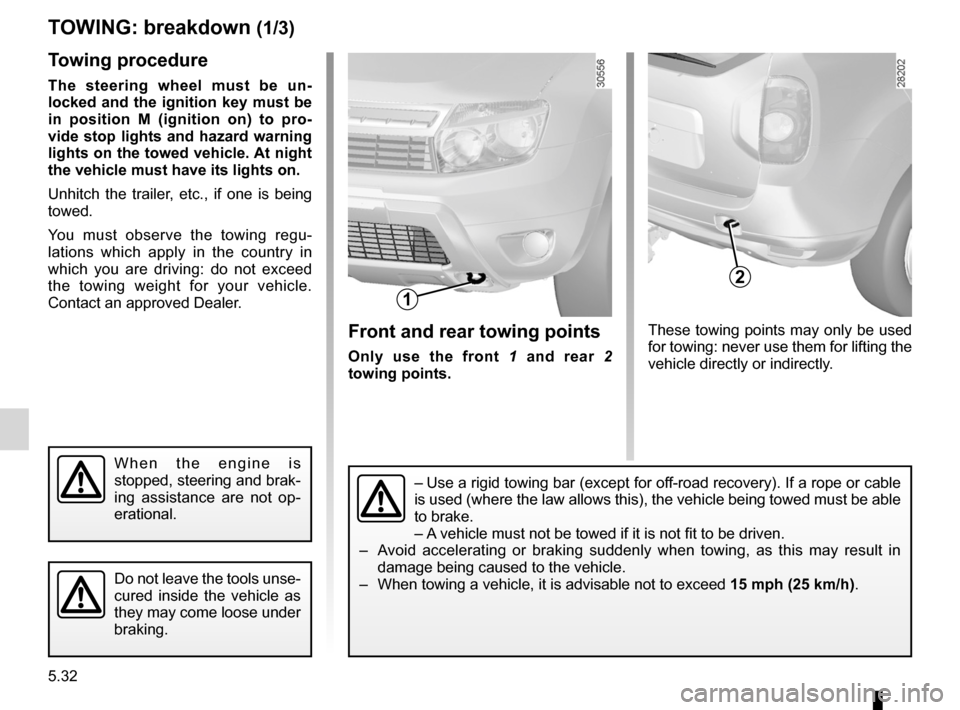
Front and rear towing points
Only use the front 1 and rear 2
towing points.
W h e n t h e e n g i n e i s
stopped, steering and brak-
ing assistance are not op -
erational.
Do not leave the tools unse-
cured inside the vehicle as
they may come loose under
braking.
– Use a rigid towing bar (except for off-road recovery). If a rope or cable
is used (where the law allows this), the vehicle being towed must be able
to brake.
– A vehicle must not be towed if it is not fit to be driven.
– Avoid accelerating or braking suddenly when towing, as this may result in
damage being caused to the vehicle.
– When towing a vehicle, it is advisable not to exceed 15 mph (25 km/h).
These towing points may only be used
for towing: never use them for lifting the
vehicle directly or indirectly.
1
2
Page 166 of 200
5.34
ENG_UD22437_4
Remorquage : dépannage (H79 - Dacia)
ENG_NU_898-5_H79_Dacia_5
TOWING: breakdown (3/3)
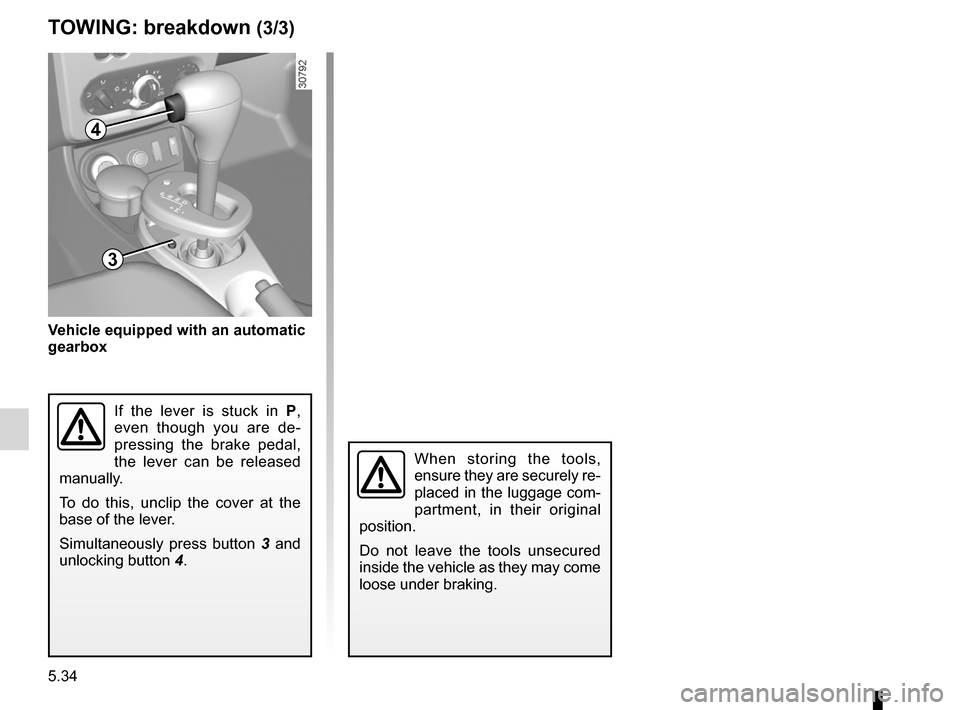
If the lever is stuck in P,
even though you are de -
pressing the brake pedal,
the lever can be released
manually.
To do this, unclip the cover at the
base of the lever.
Simultaneously press button 3 and
unlocking button 4.
When storing the tools,
ensure they are securely re-
placed in the luggage com-
partment, in their original
position.
Do not leave the tools unsecured
inside the vehicle as they may come
loose under braking.
3
4
Vehicle equipped with an automatic
gearbox
Page 167 of 200
practical advice ..................................... (up to the end of the DU)
towing towing equipment ............................ (up to the end of the DU)
5.35
ENG_UD20704_2
Remorquage : attelage (H79 - Dacia)
ENG_NU_898-5_H79_Dacia_5
Towing: equipment
TOWING: towing equipment
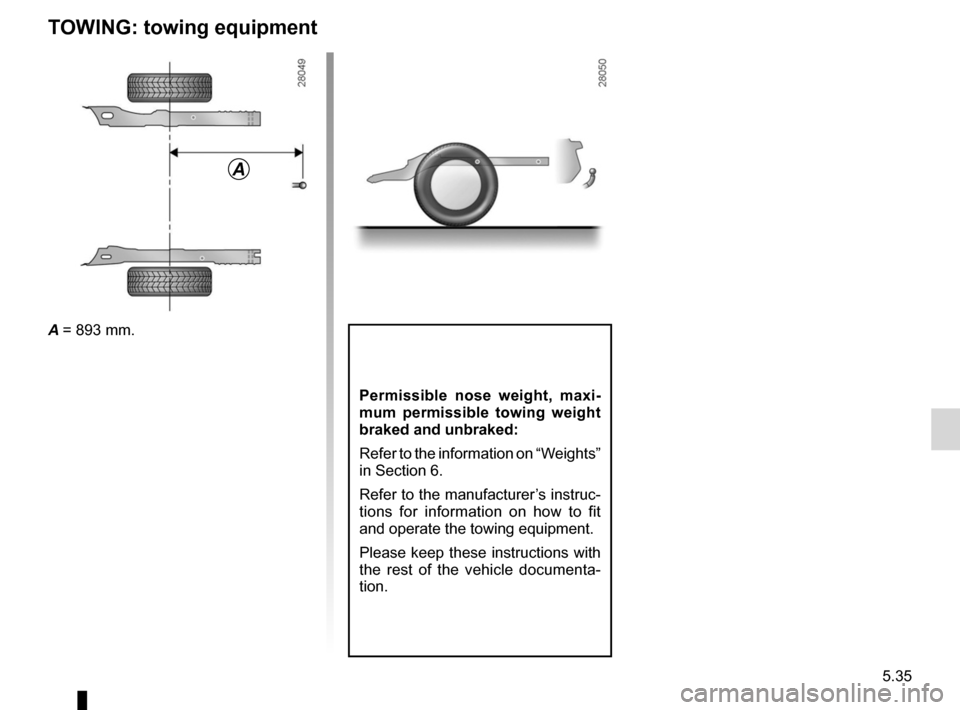
A
Permissible nose weight, maxi -
mum permissible towing weight
braked and unbraked:
Refer to the information on “Weights”
in Section 6.
Refer to the manufacturer’s instruc-
tions for information on how to fit
and operate the towing equipment.
Please keep these instructions with
the rest of the vehicle documenta -
tion.
A = 893 mm.
Page 170 of 200
5.38
ENG_UD14153_1
Accessoires (H79 - Dacia)
ENG_NU_898-5_H79_Dacia_5
Accessories
ACCESSORIES
Use of transmission/
receiving devices
(telephones, CB
equipment etc.).
Telephones and CB equipment with
integrated aerials may cause inter -
ference to the original electronic
systems fitted to the vehicle: it is ad-
visable only to use equipment with
an external aerial.
Furthermore, we remind you of
the need to comply with the legis-
lation in force concerning the use
of such equipment.
Electrical and electronic
accessories
– C o n n e c t a c c e s s o r i e s
with a maximum power of
120 Watts only.
Fire hazard.
– No work may be carried out on
the vehicle’s electrical or radio
circuits, except by approved
dealers: an incorrectly connected
system may result in damage
being caused to the electrical
equipment and/or the compo -
nents connected to it;
– if the vehicle is fitted with any
aftermarket electrical equip -
ment, make sure that the unit
is correctly protected by a fuse.
Establish the rating and position
of this fuse.
Before fitting an electrical or
electronic device (particu -
larly for transmitters/receiv-
ers: frequency bandwidth,
power level, position of the aerial
etc.), ensure that it is compatible
with your vehicle.
Contact an approved dealer for this
information.
Fitting after-market
accessories
If you wish to install acces-
sories on the vehicle: con -
sult an approved dealer.
Also, to ensure the correct opera -
tion of your vehicle, and to avoid
any risk to your safety, we recom -
mend that you use only specific ac-
cessories, designed for your vehi -
cle, which are the only accessories
for which the manufacturer will pro-
vide a warranty.
If you are using an anti-theft
device, only attach it to the
brake pedal.
Page 182 of 200
technical specifications ......................... (up to the end of the DU)
weight ................................................... (up to the end of the DU)
towing ................................................... (up to the end of the DU)
towing a caravan ................................................... (current page)
towing weights ....................................................... (current page)
weights .................................................................. (current page)
6.6
ENG_UD22464_3
Masses/Charges remorquables (H79 - Dacia)
ENG_NU_898-5_H79_Dacia_6
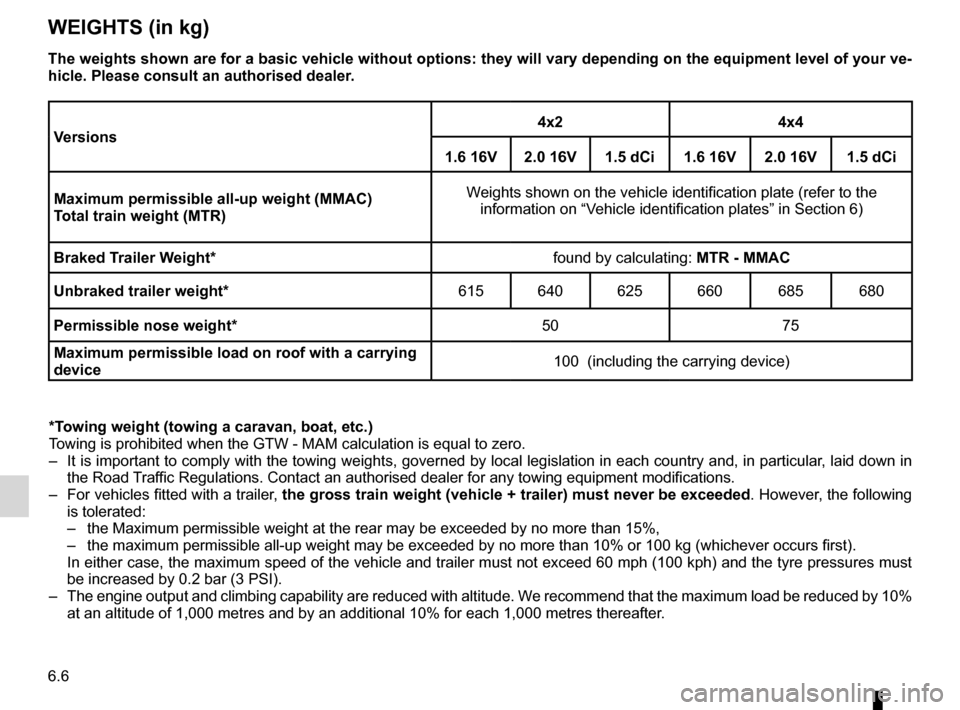
Weights/Towing weights
WEIGHTS (in kg)
Versions 4x2
4x4
1.6 16V 2.0 16V 1.5 dCi1.6 16V 2.0 16V 1.5 dCi
Maximum permissible all-up weight (MMAC)
Total train weight (MTR) Weights shown on the vehicle identification plate (refer to the
information on “Vehicle identification plates” in Section 6)
Braked Trailer Weight* found by calculating: MTR - MMAC
Unbraked trailer weight* 615640625 660 685680
Permissible nose weight* 5075
Maximum permissible load on roof with a carrying
device 100 (including the carrying device)
*Towing weight (towing a caravan, boat, etc.)
Towing is prohibited when the GTW - MAM calculation is equal to zero.
– It is important to comply with the towing weights, governed by local legislation in each country and, in particular, laid down in
the Road Traffic Regulations. Contact an authorised dealer for any towing equipment m\
odifications.
– For vehicles fitted with a trailer, the gross train weight (vehicle + trailer) must never be exceeded . However, the following
is tolerated:
– the Maximum permissible weight at the rear may be exceeded by no more than 15%,
– the maximum permissible all-up weight may be exceeded by no more than 10% or 100 kg (whichever occu\
rs first).
In either case, the maximum speed of the vehicle and trailer must not exceed 60 mph (100 kph) and the tyre pressures must
be increased by 0.2 bar (3 PSI).
– The engine output and climbing capability are reduced with altitude. We recommend that the maximum load be reduced by 10%
at an altitude of 1,000 metres and by an additional 10% for each 1,000 m\
etres thereafter.
The weights shown are for a basic vehicle without options: they will vary depending on the equipment level of your ve-
hicle. Please consult an authorised dealer.
Page 195 of 200
7.1
FRA_UD25066_7
Index (H79 - Dacia)
ENG_NU_898-5_H79_Dacia_7
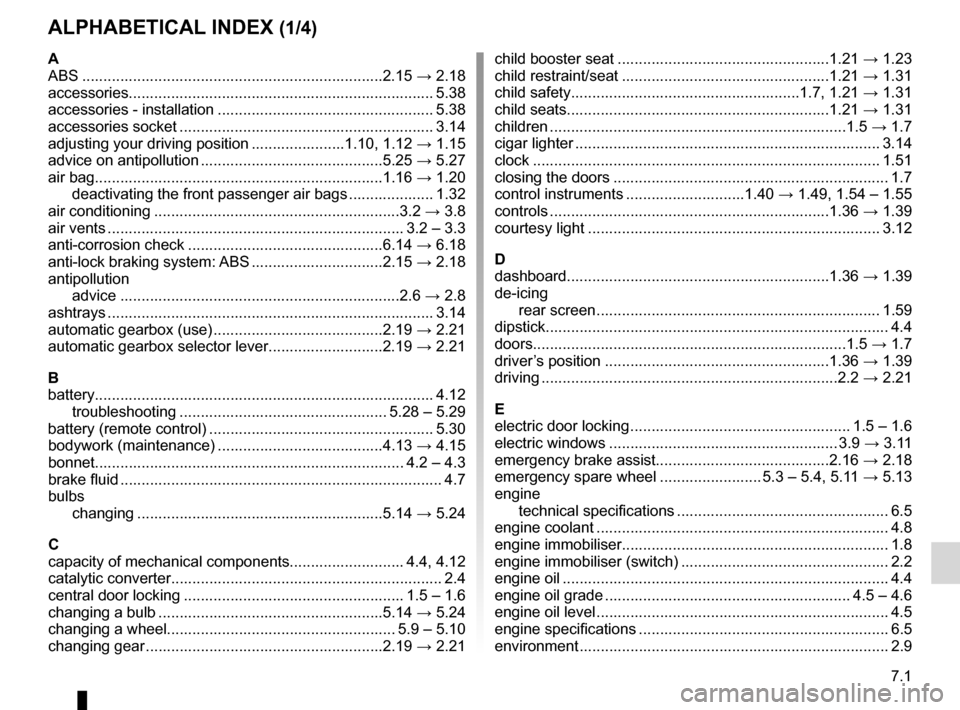
AlphAbeticAl index (1/4)
A
ABS ....................................................................... 2.15 → 2.18
accessories........................................................................\
5.38
accessories - installation ................................................... 5.38
accessories socket ............................................................ 3.14
adjusting your driving position ...................... 1.10, 1.12 → 1.15
advice on antipollution ........................................... 5.25 → 5.27
air bag .................................................................... 1.16 → 1.20
deactivating the front passenger air bags .................... 1.32
air conditioning .......................................................... 3.2 → 3.8
air vents ...................................................................... 3.2 – 3.3
anti-corrosion check .............................................. 6.14 → 6.18
anti-lock braking system: ABS ...............................2.15 → 2.18
antipollution advice .................................................................. 2.6 → 2.8
ashtrays ........................................................................\
..... 3.14
automatic gearbox (use) ........................................ 2.19 → 2.21
automatic gearbox selector lever ...........................2.19 → 2.21
b
battery ........................................................................\
........ 4.12
troubleshooting ................................................. 5.28 – 5.29
battery (remote control) ..................................................... 5.30
bodywork (maintenance) ....................................... 4.13 → 4.15
bonnet ........................................................................\
. 4.2 – 4.3
brake fluid ........................................................................\
.... 4.7
bulbs changing .......................................................... 5.14 → 5.24
c
capacity of mechanical components ...........................4.4, 4.12
catalytic converter ................................................................ 2.4
central door locking .................................................... 1.5 – 1.6
changing a bulb ..................................................... 5.14 → 5.24
changing a wheel ...................................................... 5.9 – 5.10
changing gear ........................................................ 2.19 → 2.21child booster seat
.................................................. 1.21 → 1.23
child restraint/seat ................................................. 1.21 → 1.31
child safety ...................................................... 1.7, 1.21 → 1.31
child seats .............................................................. 1.21 → 1.31
children ...................................................................... 1.5 → 1.7
cigar lighter ........................................................................\
3.14
clock ........................................................................\
.......... 1.51
closing the doors ................................................................. 1.7
control instruments ............................ 1.40 → 1.49, 1.54 – 1.55
controls .................................................................. 1.36 → 1.39
courtesy light ..................................................................... 3.12
d
dashboard .............................................................. 1.36 → 1.39
de-icing rear screen ................................................................... 1.59
dipstick........................................................................\
......... 4.4
doors ........................................................................\
.. 1.5 → 1.7
driver’s position ..................................................... 1.36 → 1.39
driving ...................................................................... 2.2 → 2.21
e
electric door locking .................................................... 1.5 – 1.6
electric windows ...................................................... 3.9 → 3.11
emergency brake assist ......................................... 2.16 → 2.18
emergency spare wheel ........................ 5.3 – 5.4, 5.11 → 5.13
engine technical specifications .................................................. 6.5
engine coolant ..................................................................... 4.8
engine immobiliser............................................................... 1.8
engine immobiliser (switch) ................................................. 2.2
engine oil ........................................................................\
..... 4.4
engine oil grade .......................................................... 4.5 – 4.6
engine oil level ..................................................................... 4.5
engine specifications ........................................................... 6.5
environment ........................................................................\
. 2.9