ignition DACIA SANDERO 2013 2.G Owner's Manual
[x] Cancel search | Manufacturer: DACIA, Model Year: 2013, Model line: SANDERO, Model: DACIA SANDERO 2013 2.GPages: 146, PDF Size: 6.4 MB
Page 61 of 146
driving ...................................................(up to the end of the DU)starting ..................................................(up to the end of the DU)starting the engine ................................(up to the end of the DU)
2.3
ENG_UD5482_1Mise en route / Arrêt du moteur (U90 - Dacia)ENG_NU_817-2_NU_Dacia_2
Stopping the engine
With the engine idling, turn the key back to “Stop” position St.
ÉDiesel injection
Turn the ignition key to ignition “On” po- sition M, and hold this position until the preheating warning light goes out.
Turn the key to starter position D with- out depressing the accelerator pedal.
Release the key as soon as the engine starts.
Starting the engine
Special feature on vehicles equipped with an engine immobiliser system
In very cold conditions (temperatures below –20°C): so that it is easier to start the engine, switch on the ignition for several seconds before starting the engine.
Make sure the engine immobiliser is not activated. Refer to the information on the “Engine immobiliser” in Section 1.
Petrol injection
Engine warm or cold
– Turn the key to the start position
without depressing the accelera- tor.
– Release the key as soon as the
engine starts.
Mise en route / Arrêt du moteur
STARTING/STOPPING THE ENGINE
Never leave your vehicle with the keys inside when leaving a child (or \
animal) in the car, even for a short period.
The reason for this is that the child may endanger himself or others by starting the engine, activating equipment such
as the window winders for example, or locking the doors.
Risk of serious injury.
Never switch off the ignition before the vehicle has stopped completely. Once the engine has stopped, the brake servo, power assisted steering and passive safety equipment such as air bags wi\
ll no longer operate.
The steering is locked when the key is removed.
Page 62 of 146
driving ...................................................(up to the end of the DU)catalytic converter.................................(up to the end of the DU)catalytic converter.................................(up to the end of the DU)special features of petrol vehicles ........(up to the end of the DU)
2.4
ENG_UD5483_1Particularités des versions essence (U90 - Dacia)ENG_NU_817-2_NU_Dacia_2
Particularités des versions essence
SPECIAL FEATURES OF PETROL VERSIONS
The following operating conditions:
– driving for long periods when the low
fuel level warning light is lit up,
– using leaded petrol,
– using oil or fuel additives which are
not approved by the manufacturer.
Or operating faults such as:
– faulty ignition, running out of fuel or
spark plug disconnected resulting in engine misfiring and hesitation when driving,
– loss of power,
may cause the catalytic converter to overheat, reducing its efficiency which may irreparably damage it and cause heat damage to the vehicle.
If you notice any of the above operat- ing faults, have the necessary repairs carried out as soon as possible by your approved dealer.
These faults may be avoided by regularly taking your vehicle to your approved dealer at the intervals specified in your Maintenance Service Booklet.
Starting problems
To avoid damaging the catalytic con- verter, do not keep trying to start the engine (using the start button, or by pushing or towing the vehicle) without having identified and corrected the starting fault.
If the fault cannot be identified, do not continue to try and start the engine, but contact an approved dealer.
Do not park the vehicle or
run the engine in locations where combustible sub- stances or materials such as grass or leaves can come into contact with a hot exhaust system.
Page 64 of 146
antipollutionadvice .............................................(up to the end of the DU)fueladvice on fuel economy ..................(up to the end of the DU)driving ...................................................(up to the end of the DU)fuel economy ........................................(up to the end of the DU)
2.6
ENG_UD5485_1Conseils antipollution, économies de carburant, conduite (U90 - Daci\
a)ENG_NU_817-2_NU_Dacia_2
JauneNoirNoir texte
Conseils antipollution, économies de carburant
The manufacturer is acively striving to reduce pollutant exhaust gas emissions and to save energy.
By virtue of its design, moderate fuel consumption and initial settings, your vehicle conforms to current antipollu- tion regulations. Technical design, how- ever, cannot achieve all. The fuel con- sumption of your vehicle and the level of pollutant exhaust gas emissions are very much within your control. Make sure that your vehicle is maintained correctly, and is driven carefully.
Maintenance
It should be noted that failure to respect antipollution regulations may lead to legal action being taken against the vehicle owner. In addition, replacing engine, fuel supply system and exhaust components with parts other than those originally recommended by the manu- facturer may alter your vehicle so that it no longer complies with antipollution regulations.
Have your vehicle checked and ad- justed by your approved dealer in ac- cordance with the instructions in your Maintenance Service Booklet.
Your approved dealer has all the equipment necessary for ensuring that your vehicle is maintained to its original standard.
Engine adjustments
– ignition: this does not require ad- justment.
– spark plugs: for optimum fuel econ- omy, efficiency and performance the specifications laid down by our Design Department must be strictly applied.
If the spark plugs have to be changed, use the make, type and gap specified for your vehicle’s engine. Contact an approved Dealer as soon as possi- ble.
–
idle speed: this does not require ad- justment.
–
air filter, diesel filter: a choked el- ement hinders performance. It must be replaced.
ADVICE ON ANTIPOLLUTION, FUEL ECONOMY AND DRIVING
Page 80 of 146
electric windows ...................................(up to the end of the DU)
3.10
ENG_UD5583_1Lève-vitres / pare soleil - poignée de maintien (B90 - Dacia)ENG_NU_817-2_NU_Dacia_3
JauneNoirNoir texte
Lève-vitres
ELECTRIC WINDOWS
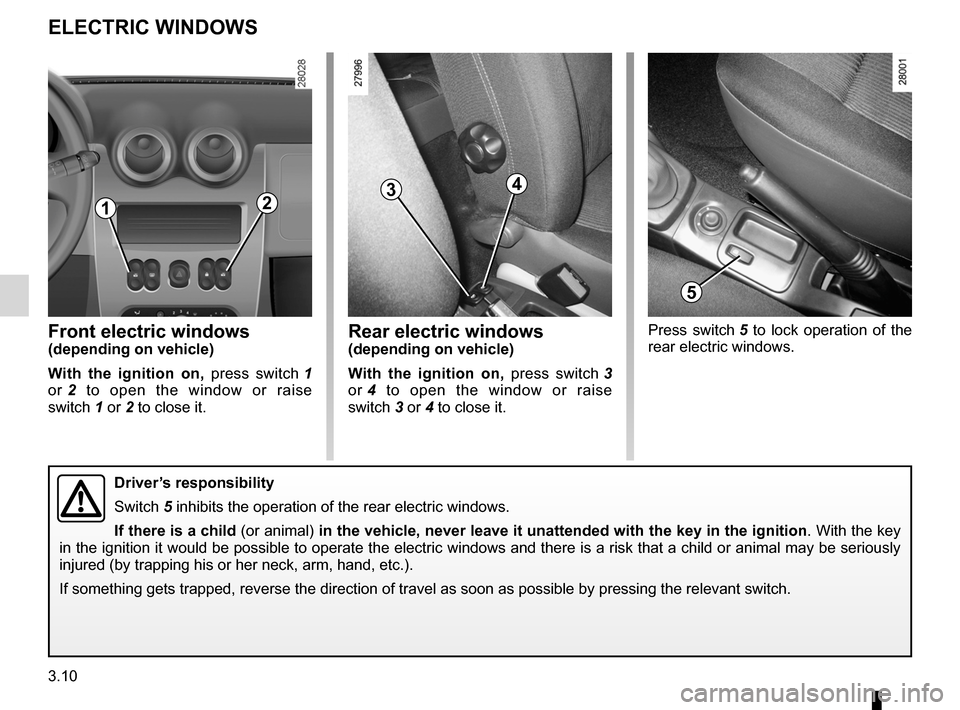
Front electric windows(depending on vehicle)
With the ignition on, press switch 1
or 2 to open the window or raise
switch 1 or 2 to close it.
Rear electric windows(depending on vehicle)
With the ignition on, press switch 3
or 4 to open the window or raise
switch 3 or 4 to close it. Press switch
5 to lock operation of the rear electric windows.
1234
5
Driver’s responsibility
Switch
5 inhibits the operation of the rear electric windows.
If there is a child (or animal) in the vehicle, never leave it unattended with the key in the ignition. With the key in the ignition it would be possible to operate the electric windows and there is a risk that a child or animal may be seriously injured (by trapping his or her neck, arm, hand, etc.).
If something gets trapped, reverse the direction of travel as soon as po\
ssible by pressing the relevant switch.
Page 82 of 146
cigar lighter ...........................................(up to the end of the DU)ashtrays ................................................(up to the end of the DU)
3.12
ENG_UD5584_1Cendriers - Allume-cigares (B90 - Dacia)ENG_NU_817-2_NU_Dacia_3
Cendriers - Allume-cigares
ASHTRAYS/CIGAR LIGHTER
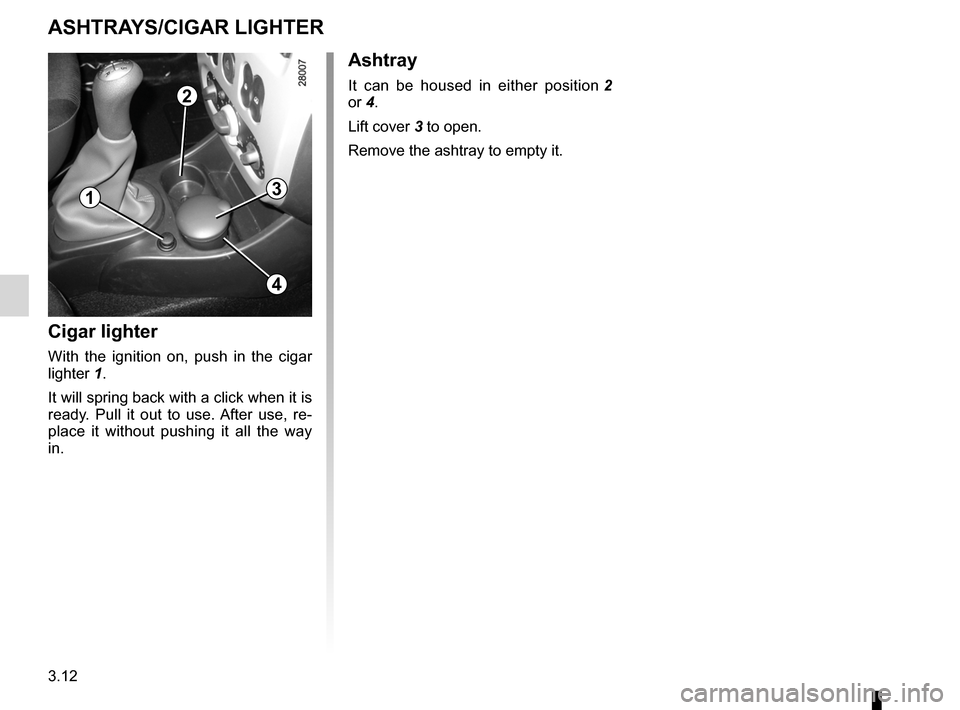
Cigar lighter
With the ignition on, push in the cigar
lighter 1.
It will spring back with a click when it is ready. Pull it out to use. After use, re- place it without pushing it all the way in.
Ashtray
It can be housed in either position 2
or 4.
Lift cover
3 to open.
Remove the ashtray to empty it.
13
4
2
Page 86 of 146
tailgate ...................................................................(current page)transporting objectsin the luggage compartment ............................(current page)
3.16
ENG_UD5587_1Coffre à bagage / transport d’objets dans le coffre (B90 - Dacia)ENG_NU_817-2_NU_Dacia_3
Coffre à bagages - Transport d’objets dans le coffre
LUGGAGE COMPARTMENT - TRANSPORTING OBJECTS IN THE LUGGAGE COMPARTMENT
Tailgate
Manual control
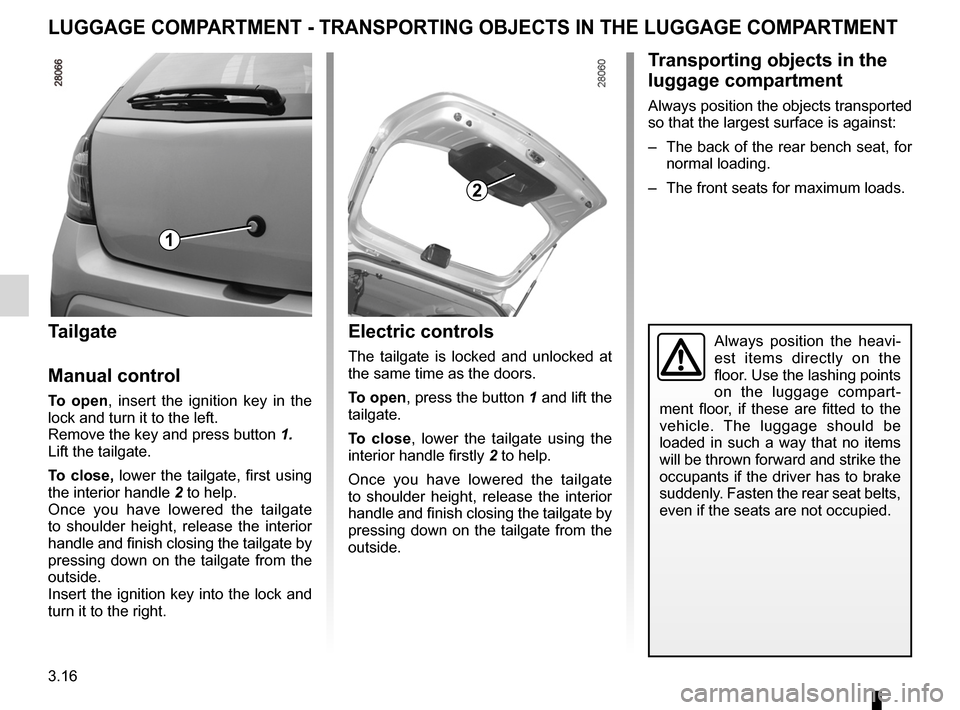
To open, insert the ignition key in the lock and turn it to the left.
Remove the key and press button 1.Lift the tailgate.
To close, lower the tailgate, first using
the interior handle 2 to help.Once you have lowered the tailgate to shoulder height, release the interior handle and finish closing the tailgate by pressing down on the tailgate from the outside.Insert the ignition key into the lock and turn it to the right.
Always position the heavi- est items directly on the floor. Use the lashing points on the luggage compart- ment floor, if these are fitted to the vehicle. The luggage should be loaded in such a way that no items will be thrown forward and strike the occupants if the driver has to brake suddenly. Fasten the rear seat belts, even if the seats are not occupied.
Transporting objects in the
luggage compartment
Always position the objects transported so that the largest surface is against:
– The back of the rear bench seat, for
normal loading.
– The front seats for maximum loads.
Electric controls
The tailgate is locked and unlocked at the same time as the doors.
To open , press the button 1 and lift the tailgate.
To close, lower the tailgate using the
interior handle firstly 2 to help.
Once you have lowered the tailgate to shoulder height, release the interior handle and finish closing the tailgate by pressing down on the tailgate from the outside.
1
2
Page 121 of 146
JauneNoirNoir texte
5.21
ENG_UD5609_1Batterie : dépannage (B90 - Dacia)ENG_NU_817-2_NU_Dacia_5
BATTERY: troubleshooting (continued)
2
3
1
2
3
4
A
B
Connecting a battery charger
The battery charger must be com- patible with a battery with nominal voltage of 12 volts.
Switch the engine off and then discon- nect both battery leads starting with the negative terminal.
Do not disconnect the battery when the engine is running. Follow the instruc- tions given by the manufacturer of the battery charger you are using.
Starting the vehicle using the
battery from another vehicle
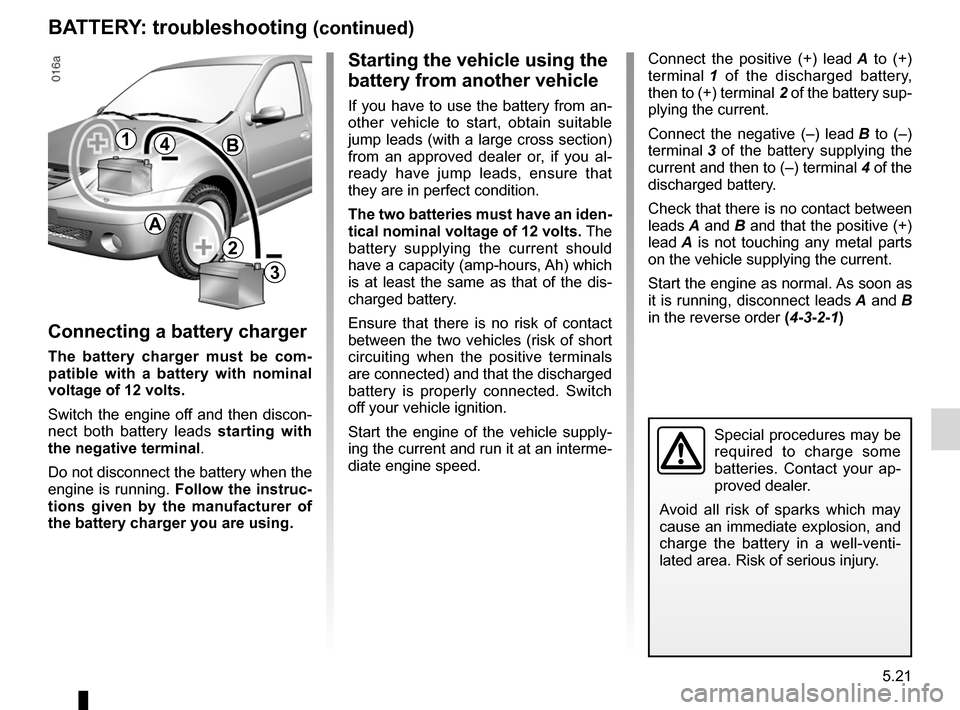
If you have to use the battery from an- other vehicle to start, obtain suitable jump leads (with a large cross section) from an approved dealer or, if you al- ready have jump leads, ensure that they are in perfect condition.
The two batteries must have an iden- tical nominal voltage of 12 volts. The battery supplying the current should have a capacity (amp-hours, Ah) which is at least the same as that of the dis- charged battery.
Ensure that there is no risk of contact between the two vehicles (risk of short circuiting when the positive terminals are connected) and that the discharged battery is properly connected. Switch off your vehicle ignition.
Start the engine of the vehicle supply- ing the current and run it at an interme- diate engine speed.Connect the positive (+) lead
A to (+)
terminal 1 of the discharged battery,
then to (+) terminal 2 of the battery sup- plying the current.
Connect the negative (–) lead
B to (–)
terminal 3 of the battery supplying the
current and then to (–) terminal 4 of the discharged battery.
Check that there is no contact between
leads A and B and that the positive (+)
lead A is not touching any metal parts on the vehicle supplying the current.
Start the engine as normal. As soon as
it is running, disconnect leads A and B in the reverse order (4-3-2-1)
Special procedures may be required to charge some batteries. Contact your ap- proved dealer.
Avoid all risk of sparks which may cause an immediate explosion, and charge the battery in a well-venti- lated area. Risk of serious injury.
Page 125 of 146
towing hitch...........................................(up to the end of the DU)practical advice .....................................(up to the end of the DU)towingbreakdown ......................................(up to the end of the DU)
5.25
ENG_UD5611_1Remorquage : dépannage (B90 - Dacia)ENG_NU_817-2_NU_Dacia_5
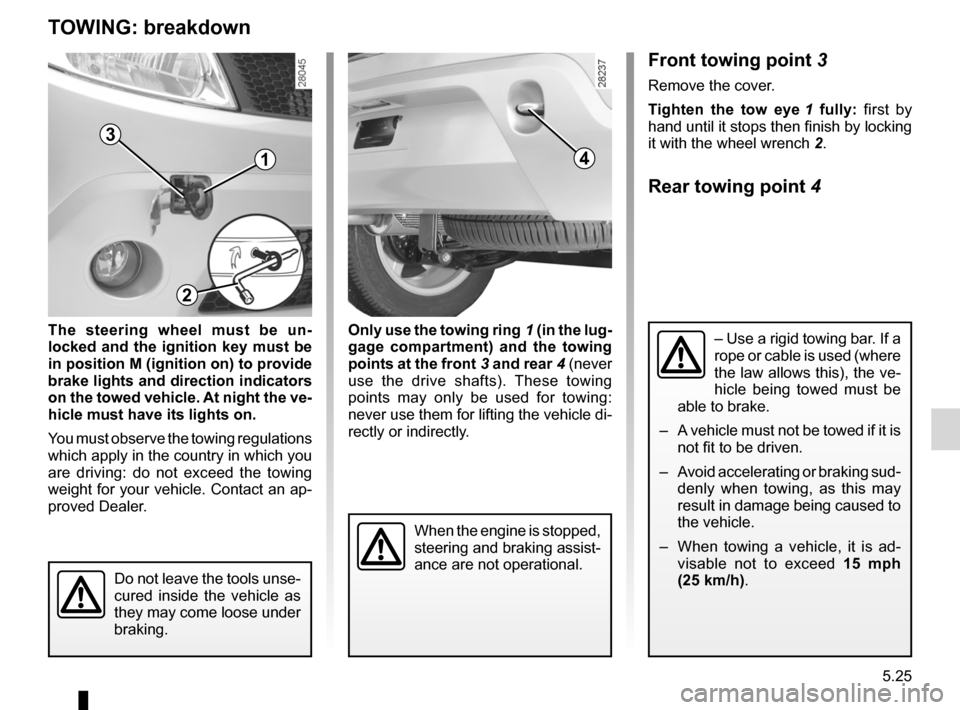
Front towing point 3
Remove the cover.
Tighten the tow eye 1 fully: first by hand until it stops then finish by locking
it with the wheel wrench 2.
Rear towing point 4
Remorquage : dépannage
TOWING: breakdown
The steering wheel must be un- locked and the ignition key must be in position M (ignition on) to provide brake lights and direction indicators on the towed vehicle. At night the ve- hicle must have its lights on.
You must observe the towing regulations which apply in the country in which you are driving: do not exceed the towing
weight for your vehicle. Contact an ap- proved Dealer.
Only use the towing ring 1 (in the lug- gage compartment) and the towing points at the front 3 and rear 4 (never use the drive shafts). These towing points may only be used for towing: never use them for lifting the vehicle di- rectly or indirectly.
When the engine is stopped, steering and braking assist- ance are not operational.Do not leave the tools unse- cured inside the vehicle as they may come loose under braking.
41
3
2
– Use a rigid towing bar. If a rope or cable is used (where the law allows this), the ve- hicle being towed must be able to brake.
– A vehicle must not be towed if it is
not fit to be driven.
– Avoid accelerating or braking sud
- denly when towing, as this may result in damage being caused to the vehicle.
– When towing a vehicle, it is ad
- visable not to exceed 15 mph
(25 km/h).
Page 130 of 146
operating faults .....................................(up to the end of the DU)practical advice .....................................(up to the end of the DU)faultsoperating faults ...............................(up to the end of the DU)
5.30
ENG_UD5616_1Anomalies de fonctionnement (B90 - Dacia)ENG_NU_817-2_NU_Dacia_5
JauneNoirNoir texte
Anomalies de fonctionnement
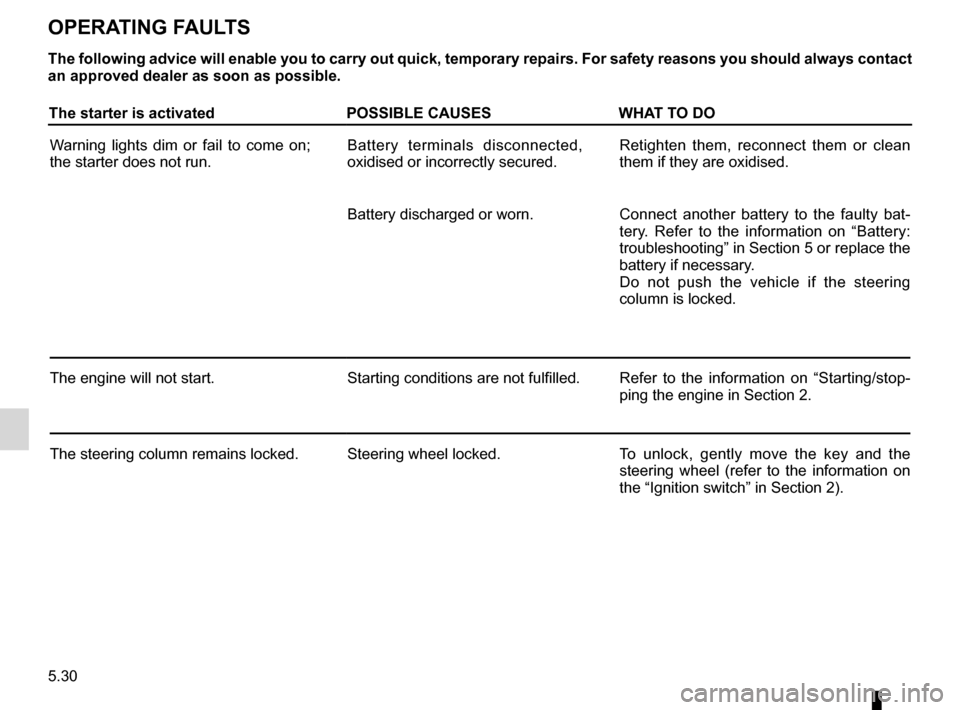
OPERATING FAULTS
The following advice will enable you to carry out quick, temporary repairs. For safety reasons you should always contact an approved dealer as soon as possible.
The starter is activatedPOSSIBLE CAUSESWHAT TO DO
Warning lights dim or fail to come on; the starter does not run.Battery terminals disconnected, oxidised or incorrectly secured.Retighten them, reconnect them or clean them if they are oxidised.
Battery discharged or worn.Connect another battery to the faulty bat- tery. Refer to the information on “Battery: troubleshooting” in Section 5 or replace the battery if necessary.Do not push the vehicle if the steering column is locked.
The engine will not start.Starting conditions are not fulfilled.Refer to the information on “Starting/stop- ping the engine in Section 2.
The steering column remains locked.Steering wheel locked.To unlock, gently move the key and the steering wheel (refer to the information on the “Ignition switch” in Section 2).
Page 131 of 146
JauneNoirNoir texte
5.31
ENG_UD5616_1Anomalies de fonctionnement (B90 - Dacia)ENG_NU_817-2_NU_Dacia_5
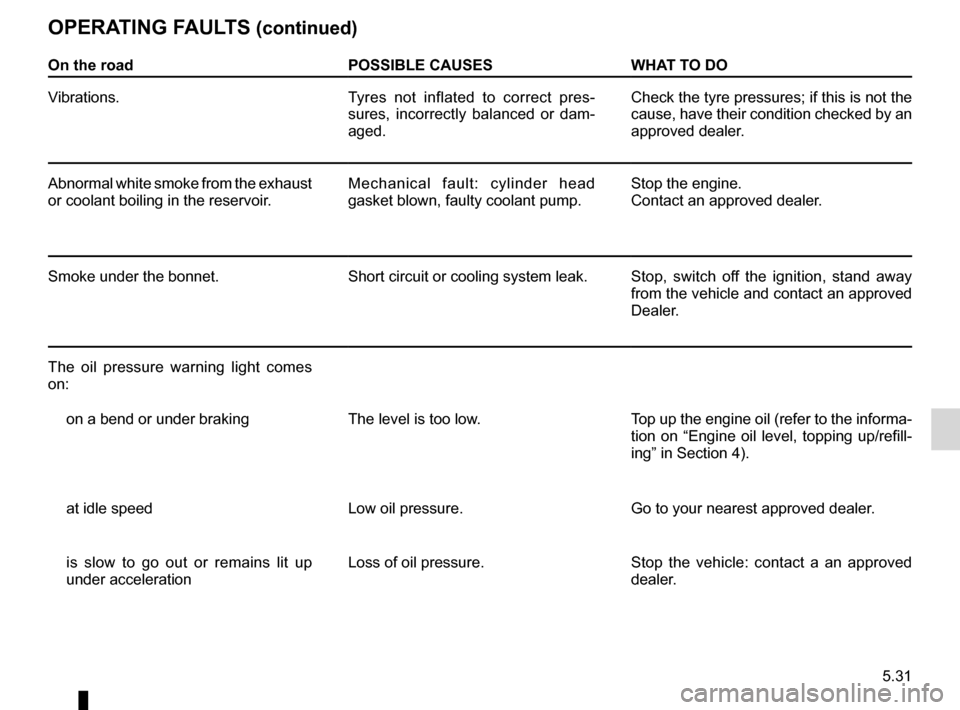
OPERATING FAULTS (continued)
On the roadPOSSIBLE CAUSESWHAT TO DO
Vibrations.Tyres not inflated to correct pres- sures, incorrectly balanced or dam- aged.
Check the tyre pressures; if this is not the cause, have their condition checked by an approved dealer.
Abnormal white smoke from the exhaust or coolant boiling in the reservoir.Mechanical fault: cylinder head gasket blown, faulty coolant pump.Stop the engine.Contact an approved dealer.
Smoke under the bonnet.Short circuit or cooling system leak.Stop, switch off the ignition, stand away from the vehicle and contact an approved Dealer.
The oil pressure warning light comes on:
on a bend or under brakingThe level is too low.Top up the engine oil (refer to the informa- tion on “Engine oil level, topping up/refill- ing” in Section 4).
at idle speedLow oil pressure.Go to your nearest approved dealer.
is slow to go out or remains lit up under accelerationLoss of oil pressure.Stop the vehicle: contact a an approved dealer.